Australia’s Clean Energy Finance Corporation in demand by many projects
The CEFC was established as part of the Federal Government’s carbon pricing package and will have a total of $10 billion in funds to allocate over a five year period to renewable energy investments, as well as energy efficiency and low emissions projects.
It must, however, deliver a return on its investment, more than the equivalent of the government bond rate. More than that, it must also fight for survival if a Coalition government is elected in September.
CEO Oliver Yates said the CEFC – which officially “opened its doors” in early April after absorbing Low Carbon Australia and expanding its team – was involved in “active discussions” with more than 50 project proponents who were seeking CEFC funding of around $2 billion, and which had total project costs of more than $4.5 billion.
He said the CEFC had have received further proposals from more than 100 additional project proponents seeking CEFC finance of more than $3 billion and with total project costs of over $6 billion. He said the CEFC had “already committed” to concluding some transitions and that list was growing. ”There are many aspects of any transaction that need to be concluded before a deal is ‘done’,” he said……
He said the CEFC would be taking a “commercial approach” to investment and would be self-sufficient. Its mandate no longer assumed it would be making losses of 7.5 per cent on each investment, and it would not cost “anything like” the $350-450 million per year that the Coalition says it can save by dumping the institution.
“The whole concept of the CEFC was to provide stability and independent market-based decision making for financing development of the clean energy sector,” Yates said.
“The difference between the CEFC and a traditional financial institution is that we don’t seek maximum profits. The CEFC expects to earn a positive, risk-adjusted return for taxpayers from its portfolio of investments higher than the government’s costs of funds and the benchmark rate and is intended to operate as a self-sustaining operation within a few years.
“Our potential to make higher profits helps to secure public policy benefits and reduce the cost of moving to a lower carbon economy. The big difference is that the CEFC has the ability to offer concessional finance where we consider there are real public policy benefits for a transaction to occur.”
Yates also said that repeated Coalition threats to not honour the contracts entered into by the CEFC had raised the threat of sovereign risk, and were not something that any government should be contemplating.
“Imagine a world where every infrastructure project in the country will need to consider an environment that contracts could be ripped up by incoming governments that don’t like the project,” he said. “It is not a world we want in Australia.” http://reneweconomy.com.au/2013/cefc-receives-proposals-for-more-than-10bl-in-projects-23772
Australian Greens’ practical plan for an Energy Savings Agency
 Politics of solar: Milne, Hunt and the CEFC, REneweconomy, By Giles Parkinson 24 May 2013 The politics around solar, and the renewable energy target, and enabling bodies such as the Clean Energy Finance Corporation continue to get murkier as the election approaches. Attendees at the Solar 2013 conference in Melbourne got a taste of it on Friday as various politicians swaggered into the conference. Investment certainty is craved, and promised. But it remains elusive.
Greens leader Christine Milne delivered the only new initiative, saying she wants to establish a new federal government agency – the Energy Savings Agency – that she says will lower electricity bills, save energy and reduce emissions.
She says the Energy Savings Agency will have three priorities – focusing on reducing demand in peak periods, striking a minimum and compulsory “fair price” for electricity generated by consumers and exported to the grid, and designing a national energy efficiency scheme, something that Labor has talked about but failed to deliver.
 Milne proposes providing $400 million over 5 years in incentives to reduce demand, which she says could deliver $1 billion in energy savings. The national EE scheme would look to combine and expand the three state-based schemes currently in operation.
She said the agency will make Australia’s energy system fairer, cheaper and cleaner. “The Federal and State Governments have failed to prevent unnecessary spending on new electricity poles and wires,” Senator Milne said. “Make no mistake, several state governments want to maximise profit from their electricity assets. Selling less electricity is not in their interest which is why reform of the energy market is too slow and why intervention is vital.”
“We need an independent agency to provide information, analysis, advocacy and financial support to help remove the barriers to cheaper and cleaner energy options.”
Senator Milne said the proposal has been costed by the Parliamentary Budget Office and will cost $405 million to run each year.
The case of over-investment in the grid was one taken up by Oliver Yates, the CEO of the Clean Energy Finance Corporation, which has $10 billion in funds to invest – for a commercial return – in emerging renewable technologies, and which is likely to be a major catalyst of big solar and other significant renewable projects.
Yates said that the $40 billion spent on the grid in recent years had provided a “miserable” outcome for consumers. A study to be released soon by the CEFC will conclude that a minimal amount had been spent on demand management – despite numerous studies saying that these could have saved billions of dollar in investment, and thousands of dollars to individual households.
“Rather than writing off expenditure … there is a real risk that these costs will get pushed onto retail and commercial customers that produce electricity,” Yates said. This would be bad for the solar industry. http://reneweconomy.com.au/2013/politics-of-solar-milne-hunt-and-the-cefc-22212
Commercial scale solar systems now becoming competitive in Australia
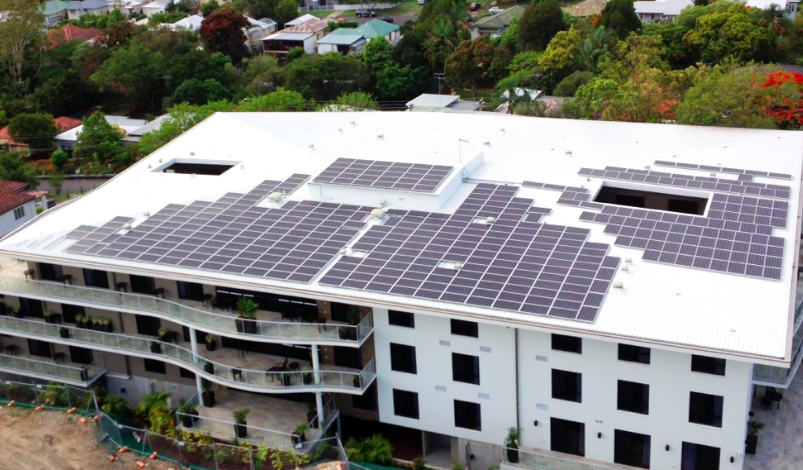
Conergy tips Australia solar market to grow 20% a year to 2015 REneweconomy, By Giles Parkinson on 23 May 2013 German solar giant Conergy is predicting 20 per cent annual growth in the Australian solar market between now and 2015 as commercial-scale solar systems become competitive with the local electricity market. Conergy said the levellised cost of energy (LCOE) for solar PV systems in Australia had fallen to just under 13c/kWh, which is less than half of the average retail price in the country. It says commercial scale plants, such as the recent 100kW system it commissioned at the Casa dAmore nursing home [seen below] in South Brisbane, were now cost effective with no subsidies.
Below – Brisbane’s solar powered nursing home. The installation was made by SEQ Energy Pty Ltd: http://www.seqenergy.com.au The generation of this plant is 160 MWH/year, not 392 and the panels used are Conergy Power Plus 255M.
 “The excellent climatic conditions and the achievement of grid parity … are now opening up new opportunities for the Australian market,” said David McCallum, managing director of Conergy Australia in a statement. He said the market, which is expected to fall by 25 per cent in 2013 toa round 750MW, from its 2012 peak of around 1,000MW, should grow 20 per cent a year in coming years. “Thanks to solar power becoming competitive, the Australian market will move away from being a purely investment driven market and become part of the genuine energy market, where the main criteria are electricity availability and the price per kilowatt hour. “Bearing these criteria in mind, plants no longer need to be as large as possible but instead tailored precisely to the customers and their load profile in order to optimise production and consumption behaviour.
Grid parity has reached Australia. “Thanks to solar power becoming competitive, the Australian market will move away from being a purely investment driven market and become part of the genuine energy market, where the main criteria are electricity availability and the price per kilowatt hour. “Bearing these criteria in mind, plants no longer need to be as large as possible but instead tailored precisely to the customers and their load profile in order to optimise production and consumption behaviour. Grid parity has reached Australia. Conergy said the output of the 100kW system at Casa d’Amore was being consumed entirely on site, and accounting for one third of its total electricity needs. It will deliver $16,000 in savings from the annual electricity bills each year. http://reneweconomy.com.au/2013/conergy-tips-australia-solar-market-to-grow-20-a-year-to-2015-2015
Value of coal generators is falling as demand falls, renewables rise
Shift from base-load slashes value of state coal generators REneweconomy By Giles Parkinson 23 May 2013 It seems certain that the NSW and Queensland governments will have to take significant write-downs on the value of the fleet of coal-fired power generators, and the assets may not be able to be sold because of the radical reshaping of the Australian electricity market.
The NSW government is seeking buyers for its coal-fired generators, and a price of $3 billion, and the Queensland government is mulling over recommendations that they should do the same. Any sale of those assets would likely be held in 2015/16.
But are they worth anything? Industry insiders say there are unlikely to be any buyers at the price the governments are expecting- because black coal-fired generation is becoming increasingly sidelined by the unanticipated fall in demand, the impact of renewables such as rooftop solar and wind farms, and the effects of the carbon price. Many of the black coal-fired generators are operating at barely more than half their capacity, as the concept of baseload generation gradually recedes….. http://reneweconomy.com.au/2013/shift-from-base-load-slashes-value-of-state-coal-generators-92669
Community solar energy gathering pace in Australia
 Community solar may be next big thing in Australia renewables REneweconomy. By Giles Parkinson 22 May 2013 The momentum for a big push into community solar projects appears to be gathering pace, with several different organisations planning public launches in the next month, and suggestions that several dozen projects could be built on NSW rooftops in coming years.
Among plans revealed this week are the launch of a community solar network Farming the Sun in the northern Rivers region, to be followed soon by similar groups in New England and the Riverina. This is the work of community energy advocate Embark and Starfish Enterprises, which has identified 7 different projects of at least 80kW that could be commissioned in the next 18 months.
A Newcastle community group has also emerged with a plan to launch a “crowd-funding model – similar to that used successfully by Mosaic in the US – to develop projects in its region. Meanwhile, a new organisation known as the Community Power Agency was launched on Wednesday to help the development of community energy projects.
The announcements come as news circulates that the NSW government’s Office of Environment and Heritage has approved funding for up to 9 groups to either conduct feasibility studies into their business models, or provide funds for the groundwork for particular projects.
Community ownership of renewable projects has yet to take off in Australia, even if in countries like Germany it accounts for around half of renewables investments.
Australia has two community-owned wind farms – the Hepburn Wind project near Daylesford in Victoria and in Denmark, near Albany in WA- but community owned solar projects are tipped to be a compelling proposition because of plunging cost of solar and their ability to compete with retail prices rather than wholesale prices.
Farming the Sun Project director Adam Blakester, of Starfish Enterprises, said the business model for the community projects his consortium is proposing is similar to that of the 400kW community solar project announced late last year for the Lend Lease development in Sydney’s Darling Harbour….. http://reneweconomy.com.au/2013/community-groups-look-to-crowd-funding-rooftop-solar-86008
Australian businesses rapidly taking up solar energy
 Commercial Solar Electricity ‘Cheaper Than Buying From The Grid’ http://www.energymatters.com.au/index.php?main_page=news_article&article_id=3754 22 May 13
According to an article on The Australian, the economics of solar have improved so much in recent years, commercial solar is being installed without major subsidies.
Quoting figures from AGL, The Australian states the number of commercial scale solar installations has jumped from 550 in the first four months in 2012 to 1,460 in the same period this year. Continue reading
Photovoltaic colar cell printing – just like printing on a T shirt – an Australian first!
“We’re using the same techniques that you would use if you were screen printing an image on to a T-Shirt,” he says.
 VIDEO Printing Australia’s Largest Solar Cells http://cleantechnica.com/2013/05/19/printing-australias-largest-solar-cells/#I2hPrL1dDL6WTXwD.99 20 May 13, Scientists have produced the largest flexible, plastic solar cells in Australia – 10 times the size of what they were previously able to – thanks to a new solar cell printer that has been installed at CSIRO. The printer has allowed researchers from the Victorian Organic Solar Cell Consortium (VICOSC) – a collaboration between CSIRO, The University of Melbourne, Monash University and industry partners – to print organic photovoltaic cells the size of an A3 sheet of paper.
According to CSIRO materials scientist Dr Scott Watkins, printing cells on such a large scale opens up a huge range of possibilities for pilot applications.
“There are so many things we can do with cells this size,” he says. “We can set them into advertising signage, powering lights and other interactive elements. We can even embed them into laptop cases to provide backup power for the machine inside.”….. Continue reading
Australian Renewable Energy Agency (ARENA) funds Victoria’s revolutionary solar cell printing technology
The Victorian Organic Solar Cell Consortium is a collaborative effort between CSIRO, The University of Melbourne, Monash University, BlueScope Steel, Robert Bosch SEA, Innovia Films and Innovia Security and is supported by the Victorian State Government and the federally funded Australian Renewable Energy Agency (ARENA).
 VIDEO Next Generation Solar Cell Printer In Australia http://www.energymatters.com.au/index.php?main_page=news_article&article_id=3747 20 May 13 A new solar cell printer installed at CSIRO in Clayton, Victoria is now cranking out A3-sized flexible solar cells.
The $200,000 printer is the next stage in the evolution of solar cell printing in Australia. In just three years, researchers from the Victorian Organic Solar Cell Consortium (VICOSC) have progressed from making cells the size of a fingernail to cells that are now 30cm wide.
Using semiconducting inks, the cells are printed on thin flexible plastic or steel at a rate of up to ten metres per minute or one large cell every two seconds. Current studies have shown stable outdoor performance beyond six months and the consortium anticipates lifetimes of several years will be achievable soon. Current module power output from printed devices is 10-50W per square metre; but over 80W has been achieved on small lab-scale devices.
The technology doesn’t have to be a competitor when it comes to traditional silicon based solar panels. Thin film solar can be used to enhance the efficiency of standard solar panels as the different types of cells capture light from different parts of the solar spectrum.
The researchers have a grand vision for their printed solar cell technology.
“Eventually we see these being laminated to windows that line skyscrapers,” says VICOSC project coordinator and University of Melbourne researcher Dr David Jones. “By printing directly to materials like steel, we’ll also be able to embed cells onto roofing materials.”
A screen printing line is also being installed at nearby Monash University and combined will see Clayton Manufacturing and Materials Precinct one of the largest organic solar cell printing facilities on the planet.
The Victorian Organic Solar Cell Consortium is a collaborative effort between CSIRO, The University of Melbourne, Monash University, BlueScope Steel, Robert Bosch SEA, Innovia Films and Innovia Security and is supported by the Victorian State Government and the federally funded Australian Renewable Energy Agency (ARENA).
Australia’s power utilities blaming home solar, conveniently forgetting subsidy for air-conditioning
 Utilities want higher charges to shade business model from solar, REneweconomy, By Giles Parkinson 20 May 2013The electricity supply industry has resumed and intensified its efforts to change the tariff system for rooftop solar households, in a bid to protect revenues that are falling and their business models that are eroding because more customers are producing their own electricity.
A new discussion paper was released this weekend, “exclusively” to News Ltd newspapers which enthusiastically took up the chance to demonise the cost of renewables once again.
The upshot of the paper is that households with rooftop solar are “avoiding” network costs, and these in turn are being passed on to other users, which the electricity supply industry says are mostly less wealthy households.
The ESAA estimated the current total of “avoided” costs at $340 million, or around $30 per household.
To put this into context, this sum is – according to the ESAA’s own data – just one eleventh of the cross-subsidy paid by households with no air conditioning.….. Does the ESAA suggest that air conditioning households should be hit with higher fixed tariffs to pay for network extensions? No, of course not, because the increased use of air conditioners adds to the revenue pool of the electricity industry, and they want to get a return on their grid investment.
The use of solar, however, detracts from the incumbents because rooftop solar households draw less electricity from the grid – leading to the now well documented “death spiral.”
The ESAA wants to arrest this spiral by lifting fixed charges or introducing tariffs for solar households to maintain the revenue pool and protect its business model. This has already begun in several states, and to make itself look like an innocent bystander, the industry has brought the violins to play a song of woe on behalf of the least well off. But this is not about protecting less wealthy households, it is about protecting the business model of the utilities.
What seems inevitable however is that the industry will one day soon need to change its business model of face the same decline as fixed priced telephony or printed photos. They are fast approaching their Kodak moment……
Solar is causing problems for traditional utilities because it is taking revenue away from the day-time peaks. Extending rooftop solar’s reach into the early evening, and combining it with smart technology, would remove the evening peak as well – and with even more revenue from the incumbent generators, network providers and retailers. But it would certainly reduce costs for customers……. http://reneweconomy.com.au/2013/utilities-want-higher-charges-to-shade-business-model-from-solar-92600?utm_source=RE+Daily+Newsletter&utm_campaign=fc04820a93-Daily_update5_19_2013&utm_medium=email&utm_term=0_46a1943223-fc04820a93-15813513
Australian Renewable Energy Agency relatively unscathed in Budget Cuts

Federal budget 2013: Renewable energy agency spared funding axe http://www.startupsmart.com.au/financing-a-business/federal-budget-2013-renewable-energy-agency-spared-funding-axe.html , 14 May 2013 | By Oliver Milman The federal government will extend the funding for its flagship clean tech initiative, the Australian Renewable Energy Agency, confounding fears from green start-ups that the program was to be slashed to the bone.
Media reports in the lead-up to the budget suggested ARENA was set for funding cuts after the government flagged a reduction in the carbon price and the deferment of a tax cut linked to the scheme.
In the budget papers, the government has indeed deferred the tax cut until the carbon price is estimated to be above $25.40, which is projected for 2018-19.
However, ARENA has emerged relatively unscathed, with Treasurer Wayne Swan and Climate Change Minister Greg Combet announcing that its funding will be extended by two years to 2021-22, with funding “remaining above $3 billion for the life of the program”. Continue reading
A Big Lobbying Force for Small Solar Power – SOLAR CITIZENS launched today
 Solar Citizens Officially Launches Today http://www.energymatters.com.au/index.php?main_page=news_article&article_id=3736 by Energy Matters, 14 May 13 Solar Citizens aims to bring together existing and future solar owners in Australia and to help see solar installed on every suitable rooftop in the nation. The project is an offshoot of 100% Renewable; a non-partisan organisation established to help move Australia towards a renewable energy future.
 While the solar revolution is well under way and millions of systems have been installed in Australia; there are some dark clouds on the horizon. “But despite the many reasons to go solar, some big energy companies don’t want to see Australians take back control of their own energy needs. They want to make connecting to solar harder, not easier,” says part of a statement on the Solar Citizens web site.
According to Solar Citizens, Australians have invested $8 billion so far in small scale solar power systems.
Calculations performed by national solar provider Energy Matters estimate that collectively, the 1 million plus solar panel arrays in the nation will generate around $913 million worth of electricity (retail value) over the next 12 months – making these households a threat to Big Energy in Australia.
Solar Citizens says it will strive to protect the rights of solar households, lobbying to ensure they are treated with respect and paid a fair price for the power they contribute to the mains grid. With potentially nearly 2 million households as participants including solar hot water system owners; the group could become a powerful voice.
Solar Citizens’ first two campaigns focus on looming issues in Tasmania and Queensland. The Queensland campaign highlights concerns regarding a proposal from the Queensland Competition Authority to move solar power owners on to a different electricity billing system that could see increased charges for solar households.
The campaign for Tasmania is in relation to the privatising Aurora’s electricity retailer arm, to occur in January 2014. There are fears that as a result, solar feed-in tariffs could be slashed. Both campaigns involve petitions that will be presented to relevant authorities.
“Solar Citizens” will tackle Queensland’s anti solar recommendations
Sun power advocacy lights up http://www.theage.com.au/business/carbon-economy/sun-power-advocacy-lights-up-20130512-2jg4w.html May 13, 2013 Peter Hannam
The million-plus Australian residents with solar panels on their roofs will be less likely to be treated poorly by power companies and politicians following the creation of a new advocacy group, its backers say.
The group, Solar Citizens, expects to muster tens of thousands of members in a bid to defend the rights of the million-plus homes with panels on their roofs. “People are feeling vulnerable having invested thousands of dollars in solar panels,” Greg Evans, manager of Solar Citizens, said. “We think there is a pushback going on.”
In recent months, corporate chiefs including Origin Energy’s managing director Grant King have blamed efforts to promote solar and wind energy for driving up electricity costs. If solar PV owners retain access to the grid but source little power from it, costs will be higher for everybody else, Mr King said in March.
Mr Evans, though, said about 2.5 million Australians live in home with solar PV or solar hot water systems, or both. He predicted many of these households, ranging from outer suburbs to the bush, had sunk $8 billion into PV alone and would be prepared to protect the value of that investment.
Among the group’s first actions would be to campaign against the introduction of recommendations from Queensland’s Competition Authority that would force solar owners to pay more to connect to the grid.
“They’re suggesting solar users should pay time of use tariffs when consuming electricity from the grid and it’s not clear other consumers will be obliged to do that,” Mr Evans said.
“If they’re going to do that fairly (in Queensland), they’re going to have to do that for everyone who gets an air-conditioner,” Craig Memery, energy policy advocate at the Alternative Technology Association, said. “Those who don’t have air-conditioners very heavily cross-subsidise those who do.” Mr Memery said it was very important that conditions PV owners signed up for are preserved. With their numbers swelling at the rate of thousands across the country, their clout is only likely to grow.
“It’s at the point where politicians will have to listen to what this group has to say.”
“Solar Citizens” – Australia’s solar homeowners fight back against fossil fuel lobby
Little wonder then, that solar consumers and rooftop solar providers are starting to organise themselves to protect the interests of individual consumers, and the industry as a whole.
In Australia, a new solar campaign initative known as “Solar Citizens” is being launched this week to ensure the interests of solar owners are protected from changes to laws and policies by power companies and governments.
Rooftop solar owners vs utilities – the battle beginshttp://reneweconomy.com.au/2013/rooftop-solar-owners-vs-utilities-the-battle-begins-63919 By Giles Parkinson 13 May 2013 You don’t have to go too far into a document prepared by the US-based Edison Electric Institute (EEI) to realise what is at stake for centralised utilities from the threat of rooftop solar.
The EEI, a trade group that represents most investor owned utilities in the US, said solar PV and battery storage were two technologies (along with fuel cells and storage from electric vehicles) that could “directly threaten the centralised utility model” that has prevailed for a century or more.
How worried should they be? A lot, said the EEI. The ability of rooftop solar, battery storage and energy efficiency programs to reduce demand from the grid would likely translate into lower prices for wholesale power and reduced profits. Worse still, customers were just as likely to “leave the system entirely” if a more cost-competitive alternative is available.
“While tariff restructuring can be used to mitigate lost revenues, the longer-term threat of fully exiting from the grid (or customers solely using the electric grid for backup purposes) raises the potential for irreparable damages to revenues and growth prospects.”
In the US, utilities are now seeking to protect their business models by pushing hard against net metering and seeking to influence the pace and manner of deployment of other technologies and new energy market concept that don’t fit the decades old model.
In Australia, much the same has been happening. RenewEconomy reported on the concerns of utilities in this article last month. Feed-in-tariffs have been wound back, as they were supposed to have been as technology costs fell, but now the pendulum is swinging the other way, and utilities – with the apparent complicity of state-based pricing regulators – are now trying to extract as much revenue from solar customers as they can.
It is a dangerous game. Leading electricity executives and market analysts suggest the rollout of rooftop solar is inevitable and “unstoppable” – unless, of course, by regulation and changing tariffs. Continue reading
Australian Energy Market Operator’s report shows that 100% renewable energy for Australia is achievable
 Decarbonising Australia , May 7th, 2013 John Quiggin I’ve been meaning to post about the Australian Energy Market Operator’s report on the feasibility of a 100 per cent renewable electricity supply system for Australia . In the meantime, Brian Bahnisch at LP has done a detailed summary, so I’ll refer you there and make a few points of my own.
First, this study should kill off, once and for all, claims made here and in many other places (notably, at Brave New Climate) that the intermittency of renewable electricity is an insuperable problem.[1] The AEMO is the body that manages the electricity market on a minute-to-minute basis, so it has the expertise to assess this claim, unlike the many amateurs who have tried their hands. And, since it might have to do the job, it has no reason to understate the difficulties of a renewables-based system.
Second, the estimate cost of $111 to $133 per megawatt-hour represents an increase of $60-80/MwH on current wholesale prices, or 6-8c/Kwh on retail prices. That’s much less than the increase we’ve seen thanks to the mishandling of electricity market reform. If we wound back those costs, we could actually end up with both 100 per cent renewables and cheaper electricity.
Third, although the study envisages a role for electric vehicles, it doesn’t present a full-scale program for decarbonization. But once you have a scalable, fully renewable electricity supply, everything else is comparatively easy.
Finally, if we take Tony Abbott at his word in wanting direct action to deal with climate change, this report provides him with a blueprint. If we want to, we can eliminate the great majority of domestic CO2 emissions simply by mandating renewable technology and electric vehicles. The cost would be substantial in dollar terms ($250 billion for the electricity component). But, over a couple of decades, it would be a barely detectable deduction from growth in national income…… http://johnquiggin.com/2013/05/07/decarbonising-australia/
Busting the anecdotal “evidence” of the Waubra anti wind energy campaign
Anti-wind groups and others hostile to renewable technology wish to deem anecdotal evidence inscrutable – consequently, they must accept all claims of health effects, no matter how improbable. If those professing this fallacy were bound by a scientific framework, this attitude would be indefensible.
Wind farm sickness: anecdotes versus evidence KETAN JOSHI ABC 7 MAY 2013 Anedotes are concerning, but should not be immune to scrutiny. A family’s experience of illness they attribute to a local wind farm is concerning, but is no substitute for medical research and hard evidence. “……
“I know this lady and her husband, as I’ve said, I’ve known them the majority of my life, and, this woman looks twenty years older than her husband now……This woman is absolutely tormented by the things, and she’s got two of them, near her. There’s only two turbines.”
 – Australia DLP Senator John Madigan, Booroowa District Landscape Guardians Meeting, May 2012
Fear spreads better with a dash of human tears. As you visualise a weeping mother, her voice wavering as she speaks, the impact is instantaneous and potent. Millions of years of natural selection breathe life into the visceral salience of human suffering. Our ancestors, dwelling on the savannah, knew that the cost of ignoring a potential threat could be very, very high………..
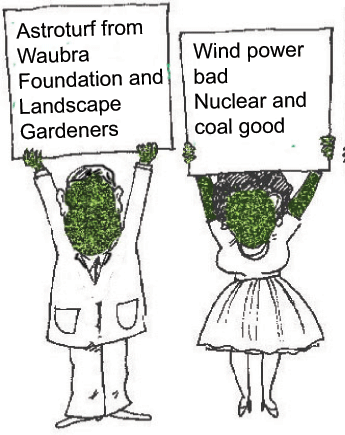 Anti-wind lobby groups (such as the Waubra Foundation, headed by ex-GP Sarah Laurie) travel to communities facing wind farm developments, and present direct testimony from individuals attributing a range of symptoms to the presence of wind turbines. Anecdotal evidence is their key instrument in spreading fear of wind energy.
This is stated explicitly by Peter Quinn, a South Australian barrister who regularly represents anti-wind lobby groups:
“That experience is in itself, evidence. If you dragged in thirty people from Waubra, twenty from Waterloo and put them in a court room, to talk about the loss and the suffering, it will support a claim to obtain an injunction against any wind farm being proposed”
The implication is quite clear – anecdotal reports and emotional recitations are powerful tools in the fight against wind farm developments. Consequently, a large number of claimed health impacts, attributed to wind turbines, exist in the public domain.
Chapman began compiling these symptoms in early 2012. His list grew rapidly – it currently numbers 216, and features a bewildering array of symptoms, involving adults, children, cattle, sheep, chicken, dogs, peacocks, cats, pigs, earthworms, crabs, goats, crickets and horses (pdf).
These symptoms are collectively referred to as “Wind Turbine Syndrome” (WTS), originally coined by Nina Pierpont (a paediatrician married to an anti-wind activist). It has become the fundamental claim of groups working to stifle the development of renewables in Australia.
The ‘disease’ is not recognised by any medical authority in the world. It is purportedly caused by infrasonic (less than 20 Hz) noise from wind turbines. The South Australian Environmental Protection Agency recently measured levels of infrasound near wind farms(pdf), and compared them to rural and urban environments. Wind farms had some of the lowest recorded levels in their study. Some of the highest levels of infrasound were recorded inside the EPA’s office in Adelaide.
Importantly, research conducted by Professor Simon Chapman of Sydney University seems to show that complaints of ill-health seem to cluster around wind farms that have been subject to the presence of anti-wind lobbyists. Continue reading
1 This month

of the week – Australians for War Powers Reform (AWPR)
To see nuclear-related stories in greater depth and intensity
 Antinuclear