“Solar Citizens” – Australia’s solar homeowners fight back against fossil fuel lobby
 Little wonder then, that solar consumers and rooftop solar providers are starting to organise themselves to protect the interests of individual consumers, and the industry as a whole.
In Australia, a new solar campaign initative known as “Solar Citizens” is being launched this week to ensure the interests of solar owners are protected from changes to laws and policies by power companies and governments.
Rooftop solar owners vs utilities – the battle beginshttp://reneweconomy.com.au/2013/rooftop-solar-owners-vs-utilities-the-battle-begins-63919 By Giles Parkinson 13 May 2013 You don’t have to go too far into a document prepared by the US-based Edison Electric Institute (EEI) to realise what is at stake for centralised utilities from the threat of rooftop solar.
The EEI, a trade group that represents most investor owned utilities in the US, said solar PV and battery storage were two technologies (along with fuel cells and storage from electric vehicles) that could “directly threaten the centralised utility model” that has prevailed for a century or more.
How worried should they be? A lot, said the EEI. The ability of rooftop solar, battery storage and energy efficiency programs to reduce demand from the grid would likely translate into lower prices for wholesale power and reduced profits. Worse still, customers were just as likely to “leave the system entirely” if a more cost-competitive alternative is available.
“While tariff restructuring can be used to mitigate lost revenues, the longer-term threat of fully exiting from the grid (or customers solely using the electric grid for backup purposes) raises the potential for irreparable damages to revenues and growth prospects.”
In the US, utilities are now seeking to protect their business models by pushing hard against net metering and seeking to influence the pace and manner of deployment of other technologies and new energy market concept that don’t fit the decades old model.
In Australia, much the same has been happening. RenewEconomy reported on the concerns of utilities in this article last month. Feed-in-tariffs have been wound back, as they were supposed to have been as technology costs fell, but now the pendulum is swinging the other way, and utilities – with the apparent complicity of state-based pricing regulators – are now trying to extract as much revenue from solar customers as they can.
It is a dangerous game. Leading electricity executives and market analysts suggest the rollout of rooftop solar is inevitable and “unstoppable” – unless, of course, by regulation and changing tariffs. Continue reading
Australian Energy Market Operator’s report shows that 100% renewable energy for Australia is achievable
 Decarbonising Australia , May 7th, 2013 John Quiggin I’ve been meaning to post about the Australian Energy Market Operator’s report on the feasibility of a 100 per cent renewable electricity supply system for Australia . In the meantime, Brian Bahnisch at LP has done a detailed summary, so I’ll refer you there and make a few points of my own.
First, this study should kill off, once and for all, claims made here and in many other places (notably, at Brave New Climate) that the intermittency of renewable electricity is an insuperable problem.[1] The AEMO is the body that manages the electricity market on a minute-to-minute basis, so it has the expertise to assess this claim, unlike the many amateurs who have tried their hands. And, since it might have to do the job, it has no reason to understate the difficulties of a renewables-based system.
Second, the estimate cost of $111 to $133 per megawatt-hour represents an increase of $60-80/MwH on current wholesale prices, or 6-8c/Kwh on retail prices. That’s much less than the increase we’ve seen thanks to the mishandling of electricity market reform. If we wound back those costs, we could actually end up with both 100 per cent renewables and cheaper electricity.
Third, although the study envisages a role for electric vehicles, it doesn’t present a full-scale program for decarbonization. But once you have a scalable, fully renewable electricity supply, everything else is comparatively easy.
Finally, if we take Tony Abbott at his word in wanting direct action to deal with climate change, this report provides him with a blueprint. If we want to, we can eliminate the great majority of domestic CO2 emissions simply by mandating renewable technology and electric vehicles. The cost would be substantial in dollar terms ($250 billion for the electricity component). But, over a couple of decades, it would be a barely detectable deduction from growth in national income…… http://johnquiggin.com/2013/05/07/decarbonising-australia/
Busting the anecdotal “evidence” of the Waubra anti wind energy campaign
Anti-wind groups and others hostile to renewable technology wish to deem anecdotal evidence inscrutable – consequently, they must accept all claims of health effects, no matter how improbable. If those professing this fallacy were bound by a scientific framework, this attitude would be indefensible.
Wind farm sickness: anecdotes versus evidence KETAN JOSHI ABC 7 MAY 2013 Anedotes are concerning, but should not be immune to scrutiny. A family’s experience of illness they attribute to a local wind farm is concerning, but is no substitute for medical research and hard evidence. “……
“I know this lady and her husband, as I’ve said, I’ve known them the majority of my life, and, this woman looks twenty years older than her husband now……This woman is absolutely tormented by the things, and she’s got two of them, near her. There’s only two turbines.”
 – Australia DLP Senator John Madigan, Booroowa District Landscape Guardians Meeting, May 2012
Fear spreads better with a dash of human tears. As you visualise a weeping mother, her voice wavering as she speaks, the impact is instantaneous and potent. Millions of years of natural selection breathe life into the visceral salience of human suffering. Our ancestors, dwelling on the savannah, knew that the cost of ignoring a potential threat could be very, very high………..
 Anti-wind lobby groups (such as the Waubra Foundation, headed by ex-GP Sarah Laurie) travel to communities facing wind farm developments, and present direct testimony from individuals attributing a range of symptoms to the presence of wind turbines. Anecdotal evidence is their key instrument in spreading fear of wind energy.
This is stated explicitly by Peter Quinn, a South Australian barrister who regularly represents anti-wind lobby groups:
“That experience is in itself, evidence. If you dragged in thirty people from Waubra, twenty from Waterloo and put them in a court room, to talk about the loss and the suffering, it will support a claim to obtain an injunction against any wind farm being proposed”
The implication is quite clear – anecdotal reports and emotional recitations are powerful tools in the fight against wind farm developments. Consequently, a large number of claimed health impacts, attributed to wind turbines, exist in the public domain.
Chapman began compiling these symptoms in early 2012. His list grew rapidly – it currently numbers 216, and features a bewildering array of symptoms, involving adults, children, cattle, sheep, chicken, dogs, peacocks, cats, pigs, earthworms, crabs, goats, crickets and horses (pdf).
These symptoms are collectively referred to as “Wind Turbine Syndrome” (WTS), originally coined by Nina Pierpont (a paediatrician married to an anti-wind activist). It has become the fundamental claim of groups working to stifle the development of renewables in Australia.
The ‘disease’ is not recognised by any medical authority in the world. It is purportedly caused by infrasonic (less than 20 Hz) noise from wind turbines. The South Australian Environmental Protection Agency recently measured levels of infrasound near wind farms(pdf), and compared them to rural and urban environments. Wind farms had some of the lowest recorded levels in their study. Some of the highest levels of infrasound were recorded inside the EPA’s office in Adelaide.
Importantly, research conducted by Professor Simon Chapman of Sydney University seems to show that complaints of ill-health seem to cluster around wind farms that have been subject to the presence of anti-wind lobbyists. Continue reading
Billion-dollar global private equity fund investing in wind power in Australia
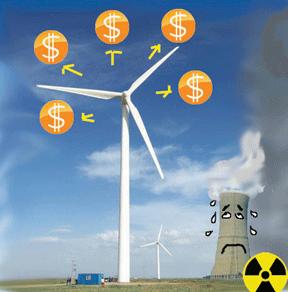 Global fund backs cheap Australian wind as local firms head abroad http://reneweconomy.com.au/2013/global-fund-backs-cheap-australian-wind-as-local-firms-head-abroad-99984 By Sophie Vorrath on 8 May 2013 At a time when Australian wind energy companies are turning their focus to overseas marketsin the search for growth opportunities, a billion-dollar global private equity fund has announced an investment of $75 million in wind power in Australia.
Denham Capital Management, a $7.3 billion US-based fund focused on mining and energy, announced on Tuesday that it had invested $75 million in a 1GW portfolio of Australian wind power projects currently under development. Part of the deal, which remains subject to procedural closing conditions, will see Denham join existing project sponsors Enersis Australia, National Power and Kato Capital to create a separate entity called OneWind Australia.
Denham’s arrival on the scene is hoped to accelerate the development of these projects, with an initial focus on the late-stage development and financing of several of them, including Glen Innes, a 100MW wind farm in NSW; Lincoln Gap, a 250MW project in South Australia; and Cattle Hill, a 240MW development in Tasmania. Continue reading
University of New South Wales makes solar cell efficiency breakthrough
 Solar Cell Efficiency Breakthrough At UNSW http://www.energymatters.com.au/index.php?main_page=news_article&article_id=3721 6 May 13 Those clever folks at the University of New South Wales have done it again – this time with a solar breakthrough that wasn’t expected for another decade. Continue reading
Energy efficiency and renewable energy the solutions to Australia’s rising gas prices
there is a solution to all this – a combination of energy efficiency and renewable energy.
The significant rise in gas prices is starting to impact householders who rely on it for heating and cooking, as well as manufacturers and other major energy users who are already struggling due to the high Aussie dollar. It’s also making the power sector think seriously about the affordability of using gas to generate electricity.
The average gas bill in NSW is set to go up by just under 9 per cent next year. And it is likely to keep moving higher, according to the report released by the Independent Pricing and Regulatory Tribunal (IPART). Couple that with a prediction that gas prices could triple on Australia’s east coast within the next 10 years, as gas companies sell increasing volumes overseas, and you’ve got an expensive scenario for Australian businesses and households already battling with their energy bills. Continue reading
Politicians against renewable energy are losing in USA, but perhaps not in Australia?
 In Australia, a similar battle is about to be waged. The difference here is that renewable energy targets are a federal policy mechanism, but the four mainland conservative state governments (Queensland, NSW, Victoria and Western Australia) are lined up firmly against them, and the new energy minister in WA, Mike Nahan, has upped the ante – possibly in anticipation of the Coalition winning the federal poll in September.
Are renewables doomed to failure in Australia?, REneweconomy By Giles Parkinson 3 May 2013 Across the United States right now, a pitched battle is being fought over the future of renewable energy targets in the 29 states that have them. Already, 16 of these states are considering legislation – templated by a fossil fuel-sponsored lobby group, the American Legislative Exchange Council – to repeal or dilute the ambition of renewable standards.
So far, the campaign – boosted by Tea Party radicals in the Republican movement – has not been successful. In the past week, North Carolina rejected the idea after leading utilities such as Duke Energy, and big data centre operators such as Apple and Google expressed their support for wind and solar projects.
In Colorado, the ALEC bill met a similar fate, with the state deciding instead to lift its clean energy standard for rural electric cooperatives to 25 per cent by 2020 — a 15 percentage point jump from the current 10 per cent.
Still, the fate of other state-based RPS schemes remains in the balance. ALEC task force director Todd Wynn recently told Bloomberg that 2013 will be the most active year yet in efforts to repeal renewable energy standards. “Natural gas is a clean fuel, and regulators and policy makers are seeing how it’s much more affordable than renewable energy.” Continue reading
Clean Technology Investment Program funds Bendigo solar system
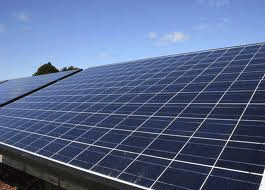 Australian Vaccine Manufacturer Going Solar http://www.energymatters.com.au/index.php?main_page=news_article&article_id=3720, 3 May 13 Veterinary vaccine manufacturer, MSD Animal Health, has been awarded funding under the Clean Technology Investment Program to install a 250kW solar panel system at its manufacturing facility in Bendigo East, Victoria.
The solar array will slash carbon emissions intensity from the facility by 22 per cent and result in savings of around $44,000 on electricity bills each year. The government’s contribution of $335,660 will be matched by the company. Continue reading
CSIRO ‘s UltraBattery could be a key component of Australia’s Smart Grid
How UltraBattery could help our grid http://ecogeneration.com.au/news/how_ultrabattery_could_help_our_grid/081278/ MELANIE RYAN May/June 2013 Low-cost, durable and fast with a long life-cycle – and it ‘smooths’ intermittent electricity from renewable sources. The CSIRO-developed UltraBattery could be the key component of an Australian smart grid of the future.
Dr Lan Lam, the primary inventor of CSIRO’s UltraBattery, retired in February 2013 after he and his team turned battery technology into a storage unit that simultaneously brings down the cost of hybrid electric vehicles and makes it easier to integrate more renewable energy into a grid.
Dr Lam leaves quite a legacy behind him: this year, the first UltraBattery will be released in the automotive market, powering hybrid electric vehicles in Japan, the United States, South America, Europe and Asia. In October 2013, the battery is also due to be installed at Tasmania’s King Island Renewable Energy Integration Project, becoming the largest clean energy storage system in Australia.
The UltraBattery combines a traditional lead acid battery and a super capacitor into one; normally they are separate components.
“It sounds simple, but we have now created a new technology that is 70 per cent cheaper than current batteries used in hybrid electric cars, and they can also be made in existing manufacturing facilities,” Dr Lam explains. UltraBattery technology has now been successfully installed in a large-scale solar power plant in New Mexico, United States; its storage capacity allows for intermittent renewable energy to be smoothly supplied to an electricity grid.
The CSIRO says that in comparison to alternate renewable energy battery options, the UltraBattery is more low-cost, durable, has faster discharge/charge rates, and has a life-cycle that is two to three times longer than a regular lead acid battery. When intermittent electricity from renewables is fed into the grid through UltraBattery’s smoothing process, power quality and stability are improved. UltraBattery can also store energy for use during peak demand times, assisting the grid to balance supply and demand and avoid local stress.
CSIRO UltraBattery team member Dr Peter Coppin says that a number of large-scale demonstration projects both completed and in-planning have shown the battery’s applications in power system support and smoothing. These projects include wind smoothing at Hampton Wind Farm in New South Wales and grid support at the PJM in Pennsylvania, United States.
“These real-world, at-scale applications are very important, as they clearly demonstrate the commercial viability of the UltraBattery,” Dr Coppin notes. “It’s exciting, as the interest in the UltraBattery projects is building rapidly, as managing intermittency from renewable sources becomes more of an issue for grid integration.”
CSIRO’s energy storage team says that it will continue Dr Lam’s legacy by researching and developing the UltraBattery, aiming to make it lighter and more efficient. CSIRO is considering next-generation development with new materials and higher-energy-density technologies, such as lithium.
Australia’s million-plus solar households have collectively become a massive power station
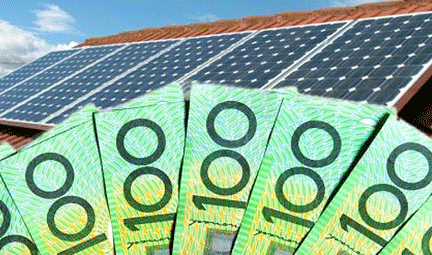 Solar Slashing Wholesale Electricity Costs In Australia http://www.energymatters.com.au/index.php?main_page=news_article&article_id=3714 29 April 13, That solar is reducing the cost of wholesale electricity is not new news in itself – but now a figure has been put on the savings. Solar PV ranks highly in the Merit Order of electricity generation in some peak conditions; being cheaper than coal and gas.
At times when wholesale electricity costs from ‘traditional’ sources can eclipse $10,000 per megawatt-hour; surplus solar electricity is being exported to the mains grid for as little as $80 per megawatt hour.
Centre of Policy Development’s sustainable economy research director Laura Eadie says Australia’s rooftop solar power systems are saving between $300 million and $670 million each year in wholesale electricity costs; which could be reducing household power bills if electricity retailers pass the savings on to consumers. According to an article on NewsMail, Ms Eadie’s report also states solar households were more energy-aware; which not only reduces their own electricity costs, but also helps to further lighten the load on the mains grid network.
Australia’s million-plus solar households have collectively become a massive power station; with total capacity of 2,461,696 kW of solar panels on the nation’s rooftops as at early this month. According to figures from solar provider Energy Matters, Australia’s small-scale solar power systems could generate over $900 million worth of electricity over the next 12 months; based on an average 25c/kWh retail electricity cost.
While solar has been demonised in the past courtesy of myths perpetuated from certain corners, it’s becoming increasingly clear the scapegoating has been misdirected and solar’s net effect on Australia’s electricity infrastructure is a boon; not a blight.
Assuming satisfactory conditions and policies; residential and commercial-scalesolar energy will continue its ascent in Australia and help to not only slash the power bills of millions more, but also play a greater role in reducing the nation’s carbon emissions and support thousands of Australian families through employment in the sector.
Australia’s Clean Energy Finance Corporation can write contracts before July
 CEFC may write financing contracts before July, REneweconomy By Giles Parkinson 26 April 2013 The newly created Clean Energy Finance Corporation is likely to enter contracts for financing deals even before July 1, when the first of its $10 billion in funding becomes available, according to CEO Oliver Yates.
In an interview with RenewEconomy, Yates said the CEFC was capable of entering contracts in coming months, even if the $2 billion that can be spent by the organization in 2013/14 is not available until July 1.
The CEFC has become a subject of controversy because of the Coalition’s pledge to disband it, among other clean energy and climate change institutions, should it be elected in September, and because of the Coalition’s demand that it not make any investments pending the result of the election.
The CEFC became fully operational at the start of this month, and now boasts 50 staff, including those incorporated from Low Carbon Australia (LCA). As we reported on Wednesday, the government has released its final investment mandate, which defines its targeted returns and manner of operations.
Yates said the work of the LCA, particularly in the areas of energy efficiency, would continue, and would likely be upscaled. This would allow larger clients such as municipalities, hospitals and universities to get financing assistance for these sorts of projects.
“These organizations have got budget cycles, so they find it hard to fund such investments up front,” Yates said. ”We can help with that.”
Yates also identified solar leasing as an area of interest for the CEFC. Solar leasing, which allows home-owners and commercial companies to install solar PV on their rooftops for no deposit, removing the problems of upfront capital cost, has taken off in the US, where it accounts for around three-quarters of new installations. The financing is now well supported by mainstream banks such as Goldman Sachs and US Bancorp.
In Australia, however, solar leasing is relatively new and has struggled to gain finance from banks at interesting rates because they have no experience of the technology or the financing, and have so far resorted mostly to the private wealth market.
Yates said it was typical of the sort of investments where the CEFC could play some sort of trail-blazing role that would encourage the commercial market to follow…….http://reneweconomy.com.au/2013/cefc-may-write-financing-contracts-before-july-28670
Tony Shepherd’s attack on Renewable Energy Target does not make sense, for Business Council of Australia
by using the BCA’s own criteria, the RET is sensible energy policy.
The RET has been a very effective piece of legislation enjoying bipartisan support for good reason. South Australia now sources over 25 per cent of its electricity from renewable energy sources resulting in lower emissions, substantial regional investments and jobs, and perhaps most importantly, lower wholesale electricity prices in that state.
We need policy settings to remain predictable and thereby provide investor confidence. Investment in large-scale renewable energy generation in Australia will deliver economic prosperity to regional Australia and more broadly improve Australia’s competitiveness.
Waging war on sensible energy policy : http://www.businessspectator.com.au/article/2013/4/22/renewable-energy/waging-war-sensible-energy-policy#ixzz2RWoPG4SL Miles George22 April 13, In an address to the National Press Club on Thursday, Business Council of Australia president Tony Shepherd AO asserted without any basis in fact that Australia needed “to wind up the Renewable Energy Target”.
Mr Shepherd said that the BCA was “consulting widely and broadly” and welcomed the “contest of ideas”, and yet clearly the BCA did not refer to the findings of the recent independent Climate Change Authority review of the Renewable Energy Target.
Following broad and wide consultation and a very strong contest of ideas, modelling undertaken on behalf of the CCA found that:
— The cost of the RET is an immaterial component of retail electricity bills before taking into account the benefits it brings in reducing wholesale electricity prices.
— Reducing the large-scale RET would result in higher wholesale and retail electricity prices. Continue reading
South Australia may cut its a Solar Feed In Tariff
South Australia Solar Feed In Tariff Threatened, by Energy Matters, 23 April 13, Households and businesses in South Australia considering going solar may want to do so soon. The Essential Services Commission of South Australia (ESCoSA) has proposed that from 1 July 2014, the amount paid to South Australian owners of solar panel systems for surplus electricity exported to the mains grid should be slashed from 25.8 cents down to 9.8 cents.
Under current arrangements and according to information from solar systems provider Energy Matters, a 5kW solar panel system installed in Adelaide can provide a financial benefit exceeding $2,000 a year.
The CEC says ESCoSA has “used the narrowest definition of a feed-in tariff, based on the financial benefit that a solar PV owner provides to his or her electricity retailer.”….
ESCoSA has invited public submissions to its draft determination and a copy of CEC’s submission can be viewed here (PDF). http://www.energymatters.com.au/index.php?main_page=news_article&article_id=3703
Solar panels a winner for millions of Australian homes
 In the words of Mahatma Gandhi; “First they ignore you, then they laugh at you, then they fight you, then you win,” – and the ultimate winners are the 1 million solar households across the nation who are not only striking a blow in the carbon emissions battle, but also slashing their power bills while helping support the thousands of Australians employed in the local renewable energy sector and their families.
Australian Home Solar Generating $2 Million+ In Electricity Daily http://www.energymatters.com.au/index.php?main_page=news_article&article_id=3692 17 April 13, It’s little wonder Australia’s electricity sector is becoming increasingly cagey about the home solar revolution – rooftop systems in the nation will generate many hundreds of millions of dollars worth of electricity at retail value over the next 12 months says Energy Matters.
According to figures Energy Matters sourced from the Clean Energy Regulator, 1,000,643 small solar power systems were installed in Australia as at April 5; with a collective total capacity of 2,461,696 kW.
Most of these systems would have been installed in the last few years and on average, each system works out to be around 2.4kW.
Given an average over a year of 4.5 sun hours a day, each of these systems would produce in the region of 10kWh of electricity daily.
This translates to an estimated 10,006,430 kWh a day generated by all small Australian solar power systems. Over a year, the figure would be 3,652,346,950 kWh.
Based on an average 25c/kWh retail electricity cost (day rates); these home solar power systems could generate as much as $913,086,737 worth of electricity over the next 12 months. Continue reading
Southern hemisphere’s biggest wind farm opened in Victoria
 Australia’s biggest wind farm – the vital statisticshttp://reneweconomy.com.au/2013/australias-biggest-wind-farm-the-vital-statistics-35976 By Giles Parkinson 12 April 2013 Macarthur wind farm – the largest in Australia and the southern hemisphere – was officially opened in south western Victoria on Friday by the local member and state premier Denis Napthine. The 420MW wind farm, built at a cost of $1 billion by AGL Energy and New Zealand company Meridian, is the biggest single investment in renewable energy in the country since the Snowy Mountain hydro project was completed in the 1970s, the companies say. Continue reading
1 This month



Help Aunty Sue Protect Her Land and Sacred Sites From Destructive Rocket Testing.
.

Australians deserve the truth
about
AUKUS – https://aukuspublicinquiry.com/

PETITION – To: Prime Minister Anthony Albanese and the Australian Labor Government

of the week – Australians for War Powers Reform (AWPR)
To see nuclear-related stories in greater depth and intensity

