Solar power success is putting the brakes on gas-fired electricity in South Australia
 Solar Helps Delay South Australian Peaking Power Plant http://www.energymatters.com.au/index.php?main_page=news_article&article_id=3489by Energy Matters, 27 Nov 12 Construction of a gas-fired power station at Tepko near Mannum in South Australia has been put on the backburner again; thanks in part to the state’s solar households. Continue reading
Broken Hill’s exciting future as Australia’s first renewable energy town

Most rural communities are dying – this is a town that has the potential to move forward.

ALTERNATE WMA VERSION | MP3 DOWNLOAD
Broken Hill a frontrunner in renewable energy adoption ABC Radio AM Margaret Paul reported this story on Tuesday, November 27, 2012 …
DARRIEA TURLEY: There is a possibility that Broken Hill could be the first town that would live on renewable energy, that would be sustained by renewable energy. No other town has done that.
MARGARET PAUL: Broken Hill’s acting Mayor is Darriea Turley.
She’s excited that Broken Hill is set to become home to two major renewable energy projects.
The first, a photovoltaic solar farm, is set to produce 125,000 megawatt hours of electricity every year – enough to power 17,000 homes.
The second is a wind farm to be developed at nearby Silverton that could power as many as 43,000 homes. Continue reading
Australian Renewable Energy Agency announces a regional program
the Australian Renewable Energy Agency has decided to have another go, announcing it will run a ‘Regional Australia’s Renewables program’.
Because these remote electricity demand loads are relatively small, you don’t have to install much renewable energy capacity, nor spend much money, before renewables become a very large proportion of total generation.
A bold pursuit of renewable-powered mining http://www.businessspectator.com.au/bs.nsf/Article/mining-renewables-ARENA-power-resources-electricit-pd20121127-2F257?opendocument&src=rss Tristan Edis, 27 Nov 2012 For those of you with reasonable memories, you’ll know the Australian government ran a program for around a decade called the Remote Renewable Power Generation Program or RRPGP. The idea behind the program was that remote off-grid regions or regions with only small grids tended to rely on very expensive diesel fuel for their power needs, and so renewable energy is closer to being a cost-effective option. To illustrate, the cost per megawatt-hour for diesel generation is close to $250 to $400, a price that solar with battery storage can match and even beat.
Climate Change Commission says solar and wind could power Australia
 Solar and wind the cheapest sources of energy and could power Australia, the Climate Commission says THE AUSTRALIAN BY: NATIONAL EDUCATION WRITER JESSICA MARSZALEK From: News Limited Network November 26, 2012 SOLAR and wind could become the cheapest sources of energy and almost exclusively power the country in coming decades as carbon prices climb, the Climate Commission says.
A report, to be released today by chief commissioner Professor Tim Flannery, notes the vast potential from sunlight and wind and “solar PV and wind could be the cheapest forms of power in Australia for retail users by 2030, if not earlier, as carbon prices rise”.
Prof Flannery said improvements had driven down the cost of renewable energy so much that Australia’s uptake had increased more than a decade faster than earlier imagined.
He said people might find it hard to believe communities could one day be powered almost entirely by renewable energy, but people would never have believed they would one day carry around little computers in their pockets.
“It’s like anything, computers or mobile phones, they started off expensive and over time the cost just declines and we’ve seen that with wind and now with solar,” he said.
Whyalla making wind turbines – it’s not wiped off the map by carbon tax
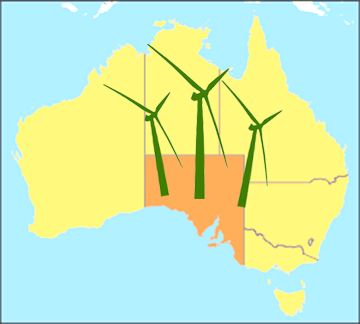 Wind Turbine Towers To Be Manufactured In South Australia, http://www.energymatters.com.au/index.php?main_page=news_article&article_id=3485 by Energy Matters 26 Nov 12, 20 wind turbine towers for South Australia’s Snowtown II wind farm will be constructed in Whyalla.
Siemens Ltd is working with E&A Contractors, who are planning to build a wind tower manufacturing facility in the town using equipment and personnel from former wind tower manufacturers RPG; which was recently placed into Voluntary Administration.
According to a press release from Minister Greg Combet’s office, over 80 per cent of wind turbine towers used in Australia so far have been sourced from Australian suppliers.
“As part of this great project we have actively collaborated with Australian suppliers to supply the towers locally,” said Siemens Ltd’s Vice President David Pryke. “E & A have demonstrated strong business acumen and a commitment to re-establishing the wind tower business for South Australia by acquiring the key assets and people of RPG.”
Minister Combet’s office used the opportunity to again criticise previous comments by Opposition Leader Tony Abbott who suggested Whyalla would be “wiped off the map” as a result of Australia’s carbon tax.
Construction of Snowtown Stage II started late last month and consists of a 90 turbine expansion of the existing Snowtown wind farm, which will add 270 megawatts capacity.
Snowtown II is expected to be capable of generating enough electricity to supply around 180,000 South Australian homes when it is operational by the end of 2014.
Stage 1 of Snowtown Wind Farm was completed in 2008 and generates enough power to supply nearly 70,000 households.
Owned by TrustPower, Snowtown wind farm is situated on the Barunga and Hummocks ranges west of Snowtown, around 150 kilometres north of Adelaide. The turbines use Siemens’ Direct Drive technology, which eliminates the gearbox, and longer blades.
Home efficiency is having a major impact
Five things we learned this week …., REneweconomy, By Giles Parkinson 23 November 2012“…. It’s not just renewables the incumbents have to contend with, it’s also falling demand. And it seems much of it is to do with consumer choice. A press release from Mark Dreyfus, parliamentary secretary for Climate Change and Energy Efficiency this week highlighted just how far we have reduced our consumption, even as we bulk up on household appliances.
An eight star (yes, 8) TV in the small to medium range now costs $21 to run, one sixth the running cost of a 3-star TV, and one-twentieth the cost of a 1-star TV. Even in the large category, a 7-star TV costs just $69 a year to run, compared with a 2 star TV currently which costs $250 a year to operate. Samsung got a gong for the 8-star, LG for the 7-star.
Dreyfus says 10-star TVs are now coming into the market, causing the government to upgrade its star rating scheme to remove the bottom three rungs. These and more efficient fridges and laptops are expected to save households and businesses $5.2 billion dollars in 2020 alone. The biggest consumer in the household in terms of kilowatts consumed is often the clothes dryer. That’s where solar comes in as a really useful energy source – just hang them outside.
And don’t miss Sophie Vorrath’s The week in green numbers …. http://reneweconomy.com.au/2012/five-things-we-learned-this-week-42434
Victoria’s very large wind farm will be operational in early 2013
 AGL readies biggest wind farm in southern hemisphere November 23, 2012 – AGL Energy, Australia’s largest operator of renewable energy projects, expects its $1 billion Macarthur wind farm to be operating fully in February as the country seeks to reduce it reliance on coal. “It’s on time, on budget and, in fact, may well be completed a little ahead of schedule,” Managing Director Michael Fraser said.
Sydney-based AGL and partner Meridian Energy are starting the 420-megawatt Macarthur project in Victoria, the largest wind farm in the Southern Hemisphere, as Australia moves toward its goal of getting 20 per cent of its power from renewable energy by 2020.
The company expected Macarthur to be completed by the end of March 2013, Fraser said……
With natural gas prices on the east coast of Australia projected set to double and the government’s price on carbon emissions discouraging fossil fuels, the cost of gas-fired power stations may converge with that of wind farms, he said.
Australia in July started charging about 300 of its largest polluters a fixed price of $23 a ton for their carbon emissions. It plans a market-based system beginning in 2015.
http://www.smh.com.au/business/carbon-economy/agl-readies-biggest-wind-farm-in-southern-hemisphere-20121123-29ubz.html#ixzz2D4V3rlIp
New Tesla electric car – agreement with Origin to use renewable energy

The diagram at left – highly inaccurate – as the new Tesla Model S is a five door sedan
Origin in deal with Tesla to help bring Model S to Australia http://reneweconomy.com.au/2012/origin-in-deal-with-tesla-to-help-bring-model-s-to-australia-68764 By Sophie Vorrath 21 November 2012
Tesla is set to launch the Model S five door sedan – the company’s first full-sized sedan, with a range of 480km – in Australia from mid 2013 after a fairly successful roll-out in the US since June; capped off this month by winning 2013 Motor Trend Car of the Year in a unanimous vote from the panel of judges. Reservations for the Model S currently exceed 13,000 worldwide.
In a similar deal to that which was brokered between Better Place and Holden for Volt customers, Tesla owners in Australia will have access to Origin’s accredited GreenPower, a variety of fully-installed charging equipment and services, and electricity management systems and advice.
Tesla’s Australia & New Zealand manager, Jay McCormack, said the agreement with Origin would provide Model S owners with the opportunity to use energy generated from renewable resources – although possibly not from wind energy, if Origin’s recent comments about Australia’s attitude to wind farms are to be taken seriously – and reduce the transport sectors’ dependence on oil – “a goal both of our companies share,” McCormack said.
Origin and Energy Australia – ignorant critics of wind energy community acceptance
But for Origin and Energy Australia to assert that there isn’t a social license to operate for wind farms in this country is preposterous given their small part in actually developing wind projects
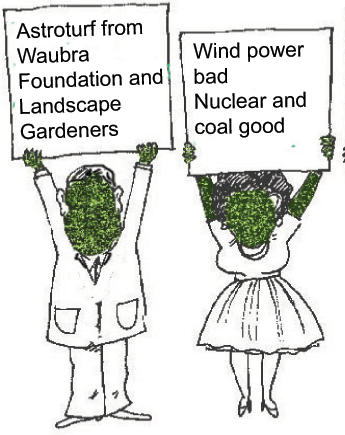 What would Origin and EnergyAustralia know about wind?, Climate Spectator, 21 Nov 2012, Tristan Edis
Origin Energy and EnergyAustralia (formerly TRUenergy) were on the front page of The Australian newspaper yesterday claiming the renewable energy target couldn’t be met because of community opposition to wind farms.
According to Origin Energy, wind farms are causing greater angst in the community than coal seam gas. And Energy Australia felt the around 300 MW of wind installed each year was “already testing the limits of community acceptance.” EnergyAustraia’s CEO Richard McIndoe was cited by the newspaper as claiming that the social licence wasn’t there to ramp up construction of wind farms.
This sounded rather interesting because I regularly talk to people heavily engaged in developing wind farms. These people attend community meetings, talk with local landowners, and deal with planning approval hearings – and this is very different to what they’ve told me. Every one of them of course has a horror story to tell about some particularly challenging people they’ve had to deal with in getting planning approvals. Often these people live several kilometres from the nearest turbine, or even outside of the local community, such as just about everyone involved in the Landscape Guardians and the Waubra Foundation.
But they generally find that if you take the effort to consult extensively within the community, you can get a large proportion of the community on-board. So it poses the question – do Origin and EnergyAustralia actually know what they’re talking about?… Continue reading
Energy storage systems to revolutionise renewable energy
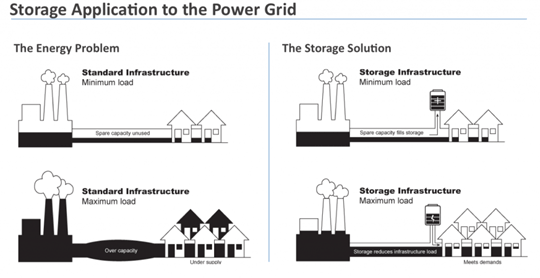
 Energy storage systems signal arrival of ‘baseload’ renewables REneweconomy, By Giles Parkinson 21 November 2012 It has been widely thought that the arrival of cost-competitive rooftop solar PV systems would be the biggest game changer in the electricity market. But it may be that the emergence of affordable energy storage systems will have an even more profound impact.
There are predictions that the energy storage market is going to boom. One survey suggested that $30 billion will be spent on energy storage in the next decade in Australia alone. In the US, where $1 trillion is expected to be spent on electricity network infrastructure in the next 10 years, at least one fifth of that – or $200 billion – will be spent on energy storage.
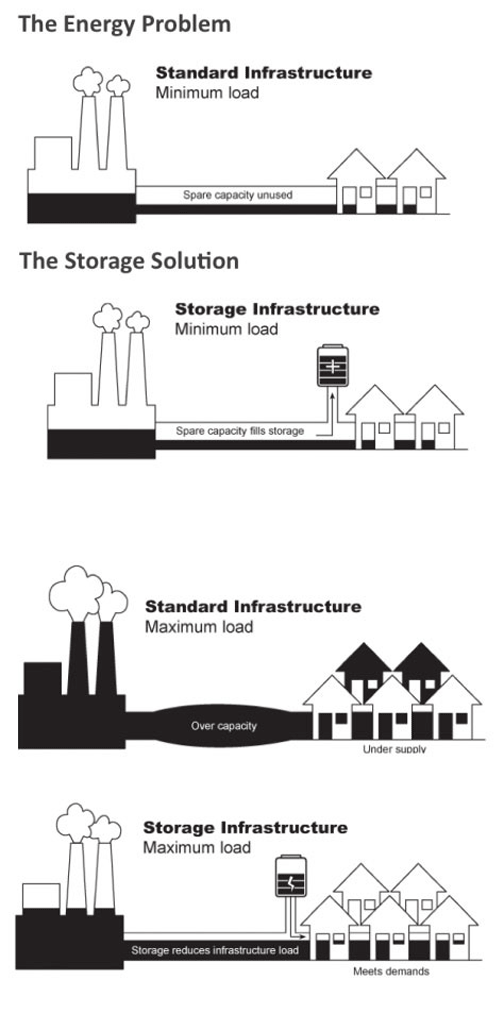
The big question is who is going to benefit most from that investment – the customer, or the utility that delivers or sells the electricity. Or maybe even both. Most people are still trying to figure that out. Continue reading
China’s Energy White Paper contrasts with Australia’s vision of “dig it up, ship it out”
The contrast with China’s Energy White Paper could not be starker. China clearly views its energy security as the most fundamental feature of its future prosperity. It is building renewable energy industries as fast as is economically and technologically possible, as its major ‘nation building’ 21st century project. All government departments are focused on achieving the energy goals.
So here we have a tale of two visions of the future of a country. In Australia, according to the Energy White Paper, we still have a vision of ourselves as a country that digs stuff up and ships it out, or burns it.
 A tale of two energy visions: China and Australia, The Conversation, John Mathews, 22
  November 2012, Over the past few weeks China and Australia have both released white papers on energy. The two documents could not be more different.
Australia’s white paper is largely about our continued obsession with becoming an alternative “Saudi Arabia” of gas. It has a view we should take over as the world’s largest exporter of gas before the year 2020.
The White Paper has extensive sections on building up the gas and petroleum sectors, as well as coal for export, and allowing market forces to work in the national markets for liquid fuels. In all this, the White Paper has a single paragraph on the country’s disastrous increasing dependence on petroleum products imports…… Its almost exclusive focus on export prospects for oil and gas (and to some extent coal) is achieved at the cost of any serious consideration of the building of the only long-term sources of energy security, which are renewables. Continue reading
Only 5.6% of Australians prefer fossil fuel energy, meanwhile, wind energy growing
Almost three-quarters of the 1000 Australians polled prefer to have their energy supplied by renewable sources, and just 5.6 per cent for fossil fuels – almost the reverse of the country’s actual energy mix………
Tilting towards wind energy, SMH, November 21, 2012, Peter Hannam AUSTRALIANS overwhelmingly want more renewable energy over the next five years and half of them want the brands they regularly buy to declare the source of the energy that went into making them.
That’s two of the findings in a study across 20 countries commissioned by Vestas Wind Systems, the world’s biggest maker of wind turbines, and Bloomberg New Energy Finance. Continue reading
Get informed on solar energy panels
 Surviving The Solar Panel Installation Stampede http://www.energymatters.com.au/index.php?main_page=news_article&article_id=3478 by Energy Matters , 21 Nov 12, Households in a hurry to have a solar panel system installed before the looming subsidy cut deadline still need to exercise caution and understand what it is they are buying – and who they are buying it from.
It’s an unfortunate situation that in any rush on solar, there will be victims of unethical providers. While these are certainly a minority in the industry, they do cause a lot of damage that also tarnishes the many reputable players.
When consumers have time to make a decision, they will tend to choose wisely; but with announcements such as the early end to the Solar Credits multiplier; the pressure is on to select a system and a solar panel installer – and mistakes can be made.
Energy Matters’ free Solar Power Consumer Guide is designed to help consumers select the right solar power system and avoid potential pitfalls. The online version primarily examines the tricks and traps and the more detailed 23 page download version covers the following topics: Continue reading
So far, Australian government catering to big utilities, to damage rooftop solar industry
Rooftop solar PV poses a greater threat to the business models of the utilities because it gets behind the meter. This means that, unlike the boom in air conditioners in recent years, rooftop solar PV reduces demand on the network rather than adds to it. The business models of all generators, distributors and retailers have long been based around the unwavering assumption of growing demand. They are simply not able to deal with with the absence of growth – and for this reason, rooftop solar PV is likely to have an even greater impact on their business models than more wind farms
 Is Australia’s solar industry being blindsided by utilities?, REneweconomy, By Giles Parkinson 19 November 2012 Beware of people bearing gifts, the old saying goes. And beware of politicians bearing promises of a reduction in electricity bills.
The Federal Government last Friday announced the early closure of its Solar Credits scheme which offered a multiplier in the number of renewable energy certificate issued for the output of a rooftop solar PV systems.
It justified this on the basis that it would save Australian electricity consumers between $80 and $100 million in 2013. But this amounts to be just $10 a year, or 20c per household a week, in an average bill of more than $2,000. If the government were really serious about reducing the impact on electricity bills from the scheme, there were numerous other options.
It could, for instance, be pushing for a change in the rules that allow utilities to pass on a fixed $40 price for each certificate, rather than the much lower market price. (Only the ACT pricing regulator has reduced the pass-through cost, although NSW’s IPART is considering it). Such a move would save perhaps one quarter of the estimated $1.2 billion cost of the scheme this year. Even that amounts to less than 2 per cent of electricity bills – and is forecast to decline to around 0.8 per cent in coming years.
So what is the government up to? The decision announced by Climate Change Minister Greg Combet on Friday took the solar industry by surprise. It’s not so much the financial impact of the decision that worries the industry – it will reduce the savings of a 1.5kW system by around $700, but this was going to happen in July anyway. As Nigel Morris pointed out in his blog, the biggest impact is to effectively cancel Christmas for solar installers, because they will be too busy trying to cope with the last minute rush.
What really worries the solar industry is the form guide of the decision, its timing– coming in the middle of a review of the Renewable Energy Target by the Climate Change Authority – and its arbitrary nature. Continue reading
Victoria needs renewable energy planning (let’s kick Baillieu out)
Hot planning issue as solar left in shade, The Age November 18, 2012 Jason Dowling HOME owners are calling for solar panels to be protected with new planning rules and compensation should a neighbour build up and block sunlight to rooftops.
Victorian residents spending thousands of dollars installing solar power systems to offset escalating electricity prices now have no protection for their investment. There have been more than 142,000 roof-top solar systems installed in Victoria since 2000 – one in 15 Victorian homes now has solar panels.
The shading of solar panels as Melbourne’s housing density increases is becoming a hot planning issue.
Planning and building regulations protect north-facing windows and shading of back yards but do not specifically address the shading of solar panels…..
Stephen Ingrouille, owner of solar company Going Solar, said shading was occurring more frequently and could have a big impact on solar panels.
”The one thing they [solar panels] do need is direct sunlight and so they just have to be in full sun. And any shading, even shading over a portion of one corner of one cell can actually knock out a whole bank of cells – that’s the issue,” he said.
He said protection for solar panels through building and planning rules was needed.
http://www.theage.com.au/victoria/hot-planning-issue-as-solar-left-in-shade-20121117-29j1g.html#ixzz2ChetfaFZ
1 This month

of the week – Australians for War Powers Reform (AWPR)
To see nuclear-related stories in greater depth and intensity
 Antinuclear