Fossil fuel industries losing revenue with the success of the Renewable Energy Target.

 Putting wind up generators BY: GILES PARKINSON The Australian September 28, 2012 BERNIE Fraser built up an enviable record of responsible economic reform as head of Treasury, governor of the Reserve Bank, and as chairman of two prominent superannuation funds. …
He is a shrewd analyst with a special interest in consumer equity. He is not likely to be easily fooled by the subtleties of the campaign against renewables when the Climate Change Authority, which he heads, sits down to its first major task working through the submissions to its review of the Renewable Energy Target.
First, Fraser will want to cut through the numbers, and in doing so may well wonder if there has ever been such a concerted campaign by big business to act in what they describe as the “public interest”, and to lobby so aggressively for a change in key public policy that they say will save householders 14c a day
….. the real number that concerns the incumbents [fossil fuel energy generators] is not the purported saving to consumers, it is the loss of revenue from the fall in wholesale energy prices.
It is not 1c or 14c a day, or $840 over 18 years, it is $2.7bn a year. That is the potential loss of revenue for the incumbent coal and gas-fired generators if the RET continues as a fixed target of 41,000GWh. Continue reading
Family First Party tries to stop wind energy for homes
 Push to close turbine loophole before 10m-high structures are erected
http://www.adelaidenow.com.au/news/south-australia/push-to-close-turbine-loophole-before-10m-high-structures-are-erected/story-e6frea83-1226482927714 Emma Altschwager The Advertiser September 27, HOUSEHOLDERS can cash in on wind power by erecting turbines up to 10m high in their backyard that could transform suburban skylines.
But the window of opportunity could be slammed shut by Family First, which wants to change development regulations and allow neighbours to have a say in the erection of any wind turbines in their street. Continue reading
South Australia’s history of small and effective wind turbines
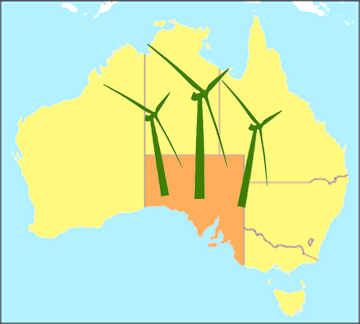 KJBeinke of ADELAIDE September 27, 2012 I grew up in rural SA and we generated all of our own power as there
was no grid available. When it did become available in the late 1960’s it was cost prohibitive to pay for the poles and transformer to the farm house. The wind power was used to charge a bank of batteries and we used them in lieu of 240 volts.
Now days batteries are much cheaper, more efficient and inverters are more efficient and cheaper. For those who don’t understand, you can become self sufficient on solar and wind power with battery back up to store un-used energy. It
has nothing to do with base load and that argument is irrelevant.
The problem with some of the wind-turbines is they can be noisy. Bird strikes are almost non-existent as in my 17 years relying on wind power, never once did I see a dead bird at the base of the tower. – comment at http://www.adelaidenow.com.au/news/south-australia/wattle-park-mans-development-application-shows-10m-high-wind-turbines-are-allowed-in-adelaides-suburbs/story-e6frea83-1226481983640
Small home wind turbines allowable in South Australia, without Council consent
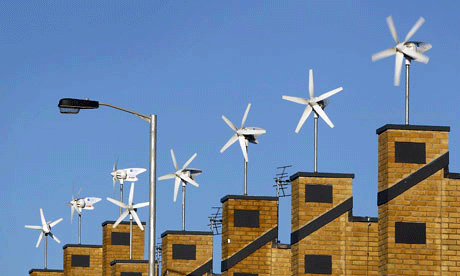 Wattle Park man’s development application shows 10m-high wind turbines are allowed in Adelaide’s suburbs
(picture shows home wind turbines in England – so it’s not really a new idea) http://www.adelaidenow.com.au/news/south-australia/wattle-park-mans-development-application-shows-10m-high-wind-turbines-are-allowed-in-adelaides-suburbs/story-e6frea83-1226481983640
A WATTLE Park man’s bid to build a 6m-high wind turbine in his
backyard has revealed a loophole that could transform suburban skylines. Continue reading
Australia: $11 billion for energy infrastructure that is rarely used
$11B Spent On Electricity Infrastructure Used Only 4 Days A Year http://www.energymatters.com.au/index.php?main_page=news_article&article_id=3400 by Energy Matters, 27 Sept 12, A survey carried out by consumer group Choice shows electricity price rises are one of the biggest concerns of Australian households.
Massive power rises have occurred throughout Australia in recent years, but in New South Wales the hikes have hit particularly hard. “Since 2007, the average NSW household’s electricity bill has more than doubled to around $2,200, and the main driver of that – over $650 a year – is the multi-billion dollar price tag of electricity poles and wires,” says Choice head of campaigns, Matt Levey.
Choice states $11 billion has been spent on energy infrastructure that is only used four days out of every year. Continue reading
The murky story of how anti-wind energy bullies hijacked a town’s name
The New South Wales and South Australian governments are currently reviewing guidelines for wind farms. Neither government is likely to ignore a recent poll that 77 per cent of Australians support wind farms.
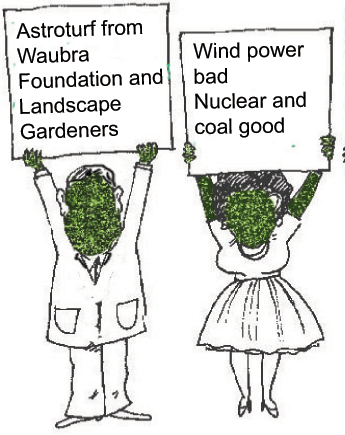
Waubra Fights The Anti-Wind Bullies. New Matilda , 26 Sept 12, By Sandi Keane The town of Waubra has had its name hijacked by anti-wind astroturfers. Locals say they’re happy with wind-farming – and it’s not making them sick. So who are the scare campaigners? Sandi Keane reports
It’s spring in the quiet sheep-farming hamlet of Waubra, an hour’s drive northwest of Ballarat in Victoria. With the shearing done and the crops in, local farmers have turned to a bit of springtime mending. Not fences, but the town’s image. After three years saddled with the negative legacy of the “foundation” that stole their name, local farmer, Karen Molloy, says the community is fighting back with a bumper festival.
Back in 2009, Waubra hit the news when powerful forces linked to mining interests, and Australia’s climate sceptic factory, the Institute of Public Affairs, used what was then the largest wind farm in the southern hemisphere as an easy target for their anti-wind scare campaign. The establishment of the Waubra Foundation followed.
“For three years, we’ve lived here quite happily. We love the wind towers and love Waubra. But it is so much more than wind so we’ve dropped the word “Wind” from the Waubra Community Festival”, Molloy said.
The festival, which takes place on Saturday 6 October, will showcase the positives of renewable energy as well as the fresh produce grown in its red volcanic soil. There’ll be a “Waubra Gift” running race, free rides, entertainment for the whole family, a free bus from Ballarat and a tour of the wind farm. Continue reading
Solar energy going backwards in Queensland, with its anti-renewable energy government
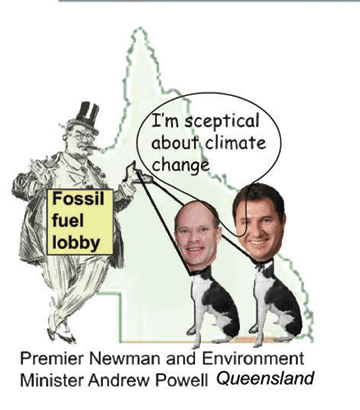 Queensland a leader in solar? Not on Campbell Newman’s watch By Charis Palmer 27 September 2012 The Conversation Around the clock solar power could be a reality for Australians in the foreseeable future, but experts say a hostile state government stands in the way of Queensland becoming the solar power leader suggested by the Climate Commission.
The latest instalment from the Climate Commission on the impacts and opportunities of climate change is “wilfully blind to reality”, with no mention of the massive coal and coal seam gas industries in Queensland, said Chris McGrath, senior lecturer in environmental regulation at the University of Queensland. The report says Queensland’s solar resources are among the best in the world, and the state should take more advantage of the opportunity.
But in the absence of positive deployment policies from the state government, it will take some time to see large solar power stations serving retail customers, said Mark Diesendorf, deputy director of the Institute of Environmental Studies at University of New South Wales. The Climate Commission’s report cites the Kogan Creek Solar Boost Project, which will provide a solar thermal addition to the neighbouring coal-fired power station, expected to be the largest solar integration project in the world.
But in July, Queensland Premier Campbell Newman withdrew $75 million in funding from the proposed stand-alone 250 megawatt Solar Dawn project near Chinchilla.
Dr Diesendorf said concentrated solar thermal could be vital to solar power generation in the longer term. “It’s not very expensive to store the heat on concentrated solar thermal and therefore have 24 hour solar power.”
But with several coal-fired power stations running at less than capacity in Queensland, organisations investing in new solar infrastructure will find it difficult to compete, Dr McGrath said. He added that the government’s focus remained on coal and coal seam gas, with renewables seen as a small component only.
“They’re talking about Queensland as a leader for solar, but Queensland’s going backwards in terms of participating in any funding for addressing climate change, and unwinding programs.” Dr McGrath said the picture painted by the Climate Commission in its report is the same one that’s been painted for ten years with no action taken.
He said a blunter approach was needed from the Commission and agreed that while it may not be an advocacy group, it was up to scientists to point out the consequences of policy choices. “It’s not advocating if you say the 5 per cent by 2020 goal will lead to three degrees warming and we won’t have a Great Barrier Reef at this point. That’s just joining the dots for people to see.”
Solar power in Australia being taken up by the less well off
 ‘Solar Is For The Rich’ Myth Well And Truly Busted http://www.energymatters.com.au/index.php?main_page=news_article&article_id=3392 by Energy Matters, 24 Sept 12 The anti-solar brigade is running out of ammunition after yet another popular myth – that rich city dwellers represent the majority of solar installs – has again been shown to be completely and utterly false.
In a submission prepared by the Rec Agents Association (RAA) to the Climate Change Authority in relation to Australia’s Renewable Energy Target review, an analysis of postcode locations of solar electric and solar hot water system installations found most systems (53%) were installed in regional and rural communities with only 43% installed in the major capital cities.
Solar power uptake amounted to 13% in the major capital cities of Australia and 21% outside of the major capital cities.
Furthermore, the suburbs with the highest income levels did not correspond to those with highest penetration – in fact, the opposite was more likely.
“A broad range of communities have accessed solar under the RET scheme and the above figures explode the myth that the RET is supporting metropolitan middle class welfare and is evidence of the RET’s equitable effectiveness,” states the submission.
Echoing sentiments expressed by others, RAA also believes the RET review should be extended from 2 to a minimum of 4 years as the current 2 year review increases investment uncertainty for the renewable energy industry.
RAA’s response to the Climate Change Authority’s Statutory Renewable Energy Target Review can be viewed here (PDF).
The REC Agents Association (RAA) was established in late 2011 and represents agents registered with the Clean Energy Regulator (CER) that createsRenewable Energy Certificates (RECs) and other environmental certificates.
Australia: Renewable Energy Market Research Report
 Renewable Energy in Australia Industry Market Research Report Now Updated by IBISWorld http://www.redorbit.com/news/science/1112699124/renewable-energy-in-australia-industry-market-research-report-now-updated/ September 22, 2012 Melbourne, Australia (PRWEB) September 23, 2012
The energy world faces unprecedented uncertainty. Increased awareness surrounding the impact of climate change and dependence on fossil fuels has prompted policy makers and scientists to rethink their strategies. The Renewable Energy industry has been both a benefactor and victim of these changing tides, as increased investment and support has been offset by delayed implementation and political populism.
The Federal Government’s mandatory Renewable Energy Target (RET), which aims to have 20% of the country’s electricity generated from renewable sources by 2020, is a good indicator of its commitment to a clean energy future. However, the economics of coal-fuelled electricity considerably outweigh that of renewables. The introduction of the carbon tax on 1 July 2012 will see the industry benefit from significant assistance in the form of grants and concessions, but still remains at the mercy of its infancy and expensive cost structure. According to IBISWorld industry analyst, Naren Sivasailam, “in the five years leading up to 2012-13, industry revenue is estimated to grow at an annualised 5.6% to total $5.24 billion”. Revenue in 2012-13 is expected to post an increase of 35.2% from the previous year.
Hydropower continues to be the largest source of renewable energy, but has been affected by poor rainfall and drought conditions. “Wind and solar power have exhibited dramatic growth over the decade, but their contribution to overall output remains small”, adds Sivasailam. The Renewable Energy industry has a medium level of market concentration, although there are significant segmental differences. For example, the hydropower segment is highly concentrated, with the two major players, while the wind power segment is more fragmented, with a number of players operating wind farms with medium capacities. The major players in the industry are Snowy Hydro Limited and Hydro-Electric Corporation.
The future prospects of the Renewable Energy industry are inextricably tied to the level of government support and the willingness of end users to wear higher costs. Initiatives such as interest free Green Loans and the Renewable Energy Development Fund aid investment in technology that will eventually make clean energy affordable. However, support from consumers and industry is equally important in setting a precedent for change. The next five years will be critical in determining whether Australia’s abundant natural resources can indeed be harnessed and set a world example for a decarbonised future.
For more information, visit IBISWorld’s Renewable Energy report in Australia industry page.
Call for Victorian government to allow small scale community wind farms
 Call to ease regulations for small wind farms http://www.abc.net.au/news/2012-09-20/call-to-ease-regulations-for-small-wind-farms/4271052 Sep 20, 2012 The Hepburn council will lobby the Victorian Government to exempt community-based wind farms from strict regulations. A planning amendment introduced by the State Government last year prohibits new wind farms in certain areas and within two kilometres of houses.
The council adopted a motion at this week’s meeting to express its ongoing support for renewable energy developments.
Mayor Sebastian Klein says small wind farms should not be treated the same as large-scale wind farms. “It basically asks for the State Government to make different considerations for community owned wind farms than I guess large-scale, corporate wind farms,” he said.
“So I guess small-scale community owned wind farms that provide back to the community have a community dividend and also have a much smaller footprint and a much smaller impact on the landscape and on people’s amenity.”
Canberra’s drive for 100% renewable energy by 2020
Canberra Shooting For 90% Renewable Energy By 2020 http://www.energymatters.com.au/index.php?main_page=news_article&article_id=3387 by Energy Matters, 19 Sept 12 The ACT Government has set a goal of 90% of the Territory’s electricity being sourced from renewables by 2020.
The Government has also set the most ambitious greenhouse gas reduction targets in Australia, committing to a goal of zero net emissions by 2060 and a 40% reduction in greenhouse gas emissions from 1990 levels by 2020.
An updated paper detailing the plans, Weathering the Change – ACT Climate Change Strategy 2007 – 2025, details 18 actions to be undertaken. Among them is an increased focus on renewables; including wind and solar power.
The plan states a major barrier to deployment of renewables in the ACT currently is a lack of publicly accessible information on the ability of the Territory’s electricity distribution network to cope with additional generation capacity. One the first steps needed in order for Canberra to attain its lofty goal is for the government to develop detailed mapping of these resources.
Making a significant contribution to the target will be the recently announced 20MW Royalla FV Solar Farm, a facility that will consist of approximately 83,000solar panels; and other similar projects are expected to be constructed between now and 2020.
Should Canberra reach its goal, the impact on carbon emissions will see a reduction of 1,471,000 tonnes of carbon equivalent in 2020. Canberra already has a healthy show of solar in the form of home solar panel systems, with uptake being supported by a feed in tariff incentive. Owners of systems are paid the same rate as their electricity supply tariff for surplus power exported to the mains grid.
According to Energy Matters, a 4kW system installed in Canberra can generate electricity bill savings exceeding $1,000 a year.
The updated Weathering the Change – ACT Climate Change Strategy 2007 – 2025 paper can be viewed here (PDF).
Advance in renewable energy storage patented at Murdoch University
A water-based sodium battery is an affordable and safe option to store power from renewable generation.
This new concept – patented at Murdoch University – replaces lithium with a sodium component in the device’s makeup, resulting in a more environmentally friendly system. The battery offers a four-fold energy increase
A step forward for renewable energy storage? http://www.climatespectator.com.au/commentary/step-forward-renewable-energy-storage, 19 Sep 2012 Manickam Minakshi-Sundaram and Danielle Meyrick The Conversation Energy storage will be critically important as we work towards sustainable living. Developing cost-effective ways to store large amounts of electricity from wind turbines and solar farms will be essential in turning from fossil fuels to renewables as our primary source of energy.
As these technologies develop and our reliance on them grows, there will be an increasing need for rechargeable energy storage capability. Continue reading
Australia’s Renewable Energy Target: dubious, unreliable, advice from ACIL Tasman
TRUenergy RET confessions, CLIMATE SPECTATOR Tristan Edis , 17 Sep 2012 Earlier this month, TRUenergy used modelling work by ACIL Tasman to spearhead an effort to have the Renewable Energy Target watered down.
This analysis suggested that the cost of the RET would be an eye popping $53.3 billion (strangely expressed in nominal dollars when just about everyone normally adjusts for inflation).
Yet why would anyone take analysis from economic consultancy and energy modellers ACIL Tasman seriously?
Let’s consider its track record.
– In a 2010 report for the Department of Climate Change it forecast that cumulative installed capacity for solar PV would reach 1348MW by 2029-2030. We actually reached that amount around the end of 2011.
– In a 2008 report for the oil and gas companies Chevron, ConocoPhillips, Exxon Mobil and Woodside Petroleum, ACIL tried to suggest that the carbon pricing scheme would put at risk LNG project development in the country. Since that report was issued, over $150 billion has been committed to construction of LNG investments including by Chevron, ConocoPhillips and Exxon Mobil.
– In modelling for the ESAA, ACIL Tasman predicted that just about all Latrobe Valley coal generators would shut by 2020 as a result of the emissions trading scheme. Perhaps that should have happened if we were genuinely worried about climate change, but now the government can’t even pay these guys to shutdown……
let’s face it, sometimes it’s hard to know where the polluters end and ACIL Tasman starts.
This is an organisation that used to share the same office as the chief umbrella lobby group for large emitters of greenhouse gases – the Australian Industry Greenhouse Network (aka the Greenhouse Mafia according to ABC’s 4 Corners). In addition, the AIGN’s last two chief executives were also consultants at ACIL Tasman, one of them being a director at the firm.
What I think tops it all off was a story told to me by Ric Brazzale, head of Green Energy Markets. Back when Mark O’Neill was the head of the Australian Coal Association, he was unable to make it to a government-industry stakeholder meeting on climate change policy. Not to worry, an ACIL Tasman staff member attended in his place to represent the coal industry.
http://www.businessspectator.com.au/bs.nsf/Article/renewable-energy-target-australia-climate-change-t-pd20120917-Y82HH?OpenDocument&emcontent_spectators&src=rot
Importance of keeping Australia’s Renewable Energy Target unchanged
Australia’s Renewable Energy Target – Stability Crucial http://www.energymatters.com.au/index.php?main_page=news_article&article_id=3381 by Energy Matters, 14 Sept 12, Flip flops isn’t just an American term for a popular form of Aussie footwear; it also describes our country’s approach to renewable energy at times – and to our detriment.
The Federal Government’s Climate Change Authority is currently undertaking a review of Australia’s Renewable Energy Target, currently set at 20 per cent of Australia’s energy to be gained from renewable sources by 2020. The Clean Energy Council has called for the Federal Government to ensure the Renewable Energy Target remains unchanged, stating that it was crucial to promoting investment, driving job creation and continuing to push down costs for consumers. “The Renewable Energy Target is the single most important policy measure for the entire Australian renewables sector,” said Clean Energy Council Chief Executive David Green.
“Any changes to the Renewable Energy Target will shatter this stability and remove investor confidence in clean energy, negating the industry’s ability to support Australia’s shift to clean energy sources and to reduce energy costs for consumers in the long-term. The fact a review is even being held is already contributing to uncertainty in the market.”
The CEC believes alterations to policy could damage returns on investments already made and consequently, Australia’s reputation with regard to energy infrastructure investment.
The organisation states the Renewable Energy Target has generated around $18.5 billion of investment and thousands of jobs, seen 1.7 million home solar power and solar hot water systems installed and resulted in the equivalent of more than 2.1 million households being powered by large scale renewables to date.
“To date, it has also been the single largest carbon abatement scheme in Australia and without it Australia would not have achieved its emissions reductions target under the Kyoto Protocol,” says Mr. Green.
Left untouched, current policies would see a further $30 billion in investment and a total reduction of 380 million tonnes in carbon emissions over the life of the scheme.
“The cost of the Renewable Energy Target contributes just 7 per cent to the average Australian electricity bill, and this is forecast to drop to just 4 per cent by 2020 – with even greater potential savings as we all become smarter about how we use our energy.”
Submissions in response to an initial issues paper released by the Climate Change Authority are due today. The Clean Energy Council’s submission can be viewed here .
Queensland leads in war against solar energy
War against solar: pricing regulator favours gross tariffs, REneweconomy, By Giles Parkinson on 14 September 2012 The Queensland pricing regulator says it favours the introduction of a gross feed in tariff in the state, in a move that the solar industry say would be devastating for the rooftop solar PV market…..
They argue it effectively reduces competition in the industry, and potentially removes one of the key solutions to the overloading of grids. Numerous independent studies have underlined the important role that solar PV could help in meeting peak demand, but this is rarely acknowledged by the utilities, who are more concerned about protecting revenues by growing their assets. The move comes just months after the Queensland Government slashed its net feed in tariff. Queensland had been the fastest growing state for solar PV, accounting for 40 per cent of national installations by some count.
The introduction of gross tariffs would also likely kill off the emerging commercial-scale solar PV market in Australia. Commercial scale solar is considered one of the most effective options for reducing peak demand because the output from the rooftop or ground mounted panels corresponds with usage by commercial users.
However, Australian solar companies have also expressed fears that the suspension of grants under the Federal government’s $800 million Clean Technology Investment Program for manufacturing groups could threaten many projects, just as the industry was getting started.
The head of one NSW company, who requested anonymity, said he had 15 proposals on the drawing board, ranging in size from 30kW systems to up to 1MW for customers including manufacturers, processors, retailers, and vineyards.
He said if the funding was withdrawn, only a couple of smaller projects were likely to go ahead. That’s because larger commercial customers had the buying power to negotiate lower electricity prices – of around 16c-18c/kWh (instead of 30ckW/h or more) from the utilities which were effectively cross subsidized by other users. RenewEconomy highlighted the other issues surrounding commercial solar in this piece earlier this week, Why new solar tariffs coud drive a man to diesel”….
The situation in Australis is not unique. In the US, for instance, the solar industry is facing similar issues, as highlighted in this piece on Greentech Media this week – where they flagged a potential installation of 75GW of solar PV in the country by the end of the decade – 15 times its current capacity – and massive resistance from utilities.
In Australia, the utilities have become concerned because of recent forecasts that suggest up to 18GW of solar PV could be installed in the country over the next few decades. Some private forecasts suggest that could happen within a decade.
As David Crane, the head of leading US energy generator NRG, said earlier this year, solar PV represents the biggest threat to the conventional energy industry in half a century. In the Greentech Media piece, the solar companies said utilities in the US were so powerful they acted as “a fourth arm of government” and won’t give up easily. Professor Ross Garnaut has commented on the extent of regulatory capture in the Australian industry, hence the ability to “gold plate” networks and extract huge compensation packages for the carbon price. http://reneweconomy.com.au/2012/war-against-solar-pricing-regulator-favours-gross-tariffs-23984
1 This month
15 April – Zoom –Nuclear Power is Not the Solution
Apr 15, 2026 01:00 AM in Canberra, Melbourne, Sydney

Join the International Physicians for the Prevention of Nuclear War (IPPNW) on Tuesday, April 14th for a timely webinar exploring the risks associated with nuclear power and challenging the myth that it offers a simple, safe, carbon-free solution to the climate crisis

of the week – Australians for War Powers Reform (AWPR)
To see nuclear-related stories in greater depth and intensity
 Antinuclear