Australia’s energy trends: we could be 100% renewable sooner than you think
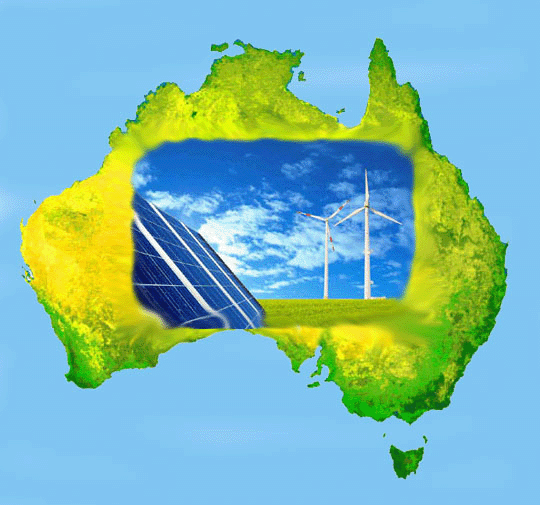 Australia could hit 100% renewables sooner than most people think, Guardian,
Not since the invention of the steam engine have we seen the pace of change occurring in energy systems around the world. In Australia our electricity system is changing rapidly, from new technologies and business models to changes in policy and perhaps even regulation. As the year begins, here are five energy trends you should expect to see in 2019.
1. More action towards 100% renewable energy
Last year was a boom year for renewables. Despite rhetoric from some political quarters talking up coal and talking down renewable energy, we installed more solar panels and wind turbines than ever before. There are at least 40 large-scale wind and solar projects in construction in Australia, totalling over 6000MWs of new generation capacity. This means renewables will continue on a steep growth curve as analysis by the Melbourne University Climate and Energy College shows.
This rapid growth in renewables and soon battery storage is at least in part driven by a corresponding reduction in cost. Bloomberg New Energy Finance analysis reveals a compound annual reduction in cost of battery storage of 21% over eight years. Facts such as these are the engine driving us towards 100% renewables at a pace much faster than most pundits think.
At a political level California has just legislated a move to 100% renewables, while at home South Australia, Tasmania and the ACT are on track to be net 100% renewables in the next few years. With everyone from tech billionaires to school students demanding 100% renewables, pressure for a more rapid shift to renewables is likely to continue to build.
In the corporate sector, global initiative The RE100 has arrived in Australia. This initiative which encourages companies to commit to 100% renewables has seen global companies headquartered outside of Australia such as Carlton United Breweries and Ikea lead the way. In late 2018 Commonwealth Bank became the first Australian company to join, signing a large power purchase agreement in the process.
2. Solar for renters and other locked-out energy users……..For a long time these households have been in the too-hard basket for policymakers and industry alike. However, there are signs that in 2019 this could be changing. The Victorian and South Australian governments have announced policies to support 50,000 rental properties to access solar, and for South Australia, batteries also. In NSW the government is trialling a program of solar for 15,000 low-income energy rebate customers. These are small steps, but if scaled could start to change the current trend towards solar energy haves and have-nots.
3. Community energy going gangbusters
Communities are also taking matters into their own hands, developing innovative community-owned clean energy projects and implementing plans to move to 100% renewables. Despite a lack of interest from mainstream energy players and little policy support, Australia’s community energy sector has grown to more than 105 groups and 174 operating projects. Most famously the communities of Yackandandah and Daylesford……
4. A battle between good and bad hydrogen
Hydrogen fuel is not a new idea, yet in 2019 hydrogen is likely to make significant strides towards becoming a major part of our global energy ecosystem……..
5. Clean energy elections
No 2019 trend article is complete without mentioning the upcoming elections. According to researcher Rebecca Huntly climate change is a top issue with the electorate and as such both the NSW and federal elections are going to have a focus on climate and energy policy whether politicians like it or not…….https://www.theguardian.com/commentisfree/2019/jan/14/australia-could-hit-100-renewables-much-sooner-than-most-people-think
The problem of hazardous waste from discarded old solar panels
 I have long been worried that environmentalists are seen to be enthusiastic about renewable energy, seeing it as the panacea for the world’s climate woes. Solar power is a great technology for replacing polluting fossil fuel power, but it’s only a part of what needs to be done – in the urgently needed transition from our wasteful CONSUMER SOCIETY to a CONSERVER SOCIETY. It must not become a contributor to the waste disaster.
 Australia’s enthusiastic embrace of rooftop solar has brought clear environmental and economic benefits, but critics say governments have dragged their feet in addressing the looming waste crisis.
As of December more than 2 million Australian households had rooftop solar installed. The uptake continues to grow due to the technology’s falling cost and rising electricity bills.
Photovoltaic panels last about 30 years, and those installed at the turn of the millennium are nearing the end of their lives. Many have already been retired due to faults or damage during transport and installation.
The nation’s environment ministers in April last year agreed to fast-track the development of new product stewardship schemes for photovoltaic solar panels and associated batteries. Such schemes make producers and retailers take responsibility for an item across its life cycle.
However, Total Environment Centre director Jeff Angel, a former federal government adviser on product stewardship, said action was long overdue and the delay reveals a “fundamental weakness” in Australia’s waste policies.
“We’ve had a solar panel industry for years which is an important environmental initiative, and it should have been incumbent on government to act in concert with the growth of the industry so we have an environmentally responsible end-of-life strategy,” he said.
Mr Angel said photovoltaic panels contain hazardous substances and “when we are sending hundreds of thousands of e-waste items to landfill we are also creating a pollution problem”.
“It’s a systemic problem that [applies to] a whole range of products”, he said, saying schemes were badly needed for paint, batteries, floor coverings, commercial furniture and many types of electronic waste.
Photovoltaic panels are predominantly made from glass, polymer and aluminium, but may also contain potentially hazardous materials such as lead, copper and zinc.
 Australian Council of Recycling chief executive Peter Schmigel attributed delays in product stewardship schemes to both “bureaucratic malaise” and unfounded concern about cost.
The national television and computer recycling scheme, which since 2011 has required manufacturers and importers to participate in industry-funded collection and recycling, showed that regulatory measures can work, he said.
“Recovery rates have been out of sight since the beginning of the scheme, nobody has said anything at all about there being an inbuilt recycling cost. It generates jobs, it generates environmental outcomes and yet for some reason we have policymakers who are hesitant about [establishing similar schemes] for solar PVs and batteries,” he said.
Victoria will ban electronic waste in landfill from July 2019, including all parts of a photovoltaic system, mirroring schemes imposed in Europe.
Sustainability Victoria is also leading a project examining end-of-life management options for photovoltaic systems, which may progress to a national program. The issue is particularly pertinent in Victoria where a new $1.3 billion program is expected to install solar power on 700,000 homes.
Sustainability Victoria resource recovery director Matt Genever said there was strong support from industry, government and consumers for a national approach to photovoltaic product stewardship. Final options are due to be presented to environment ministers in mid-2019.
He rejected suggestions that plans were progressing too slowly.
“The analysis we’ve done in Victoria … shows that it’s in 2025 that we see a real ramp up in the waste being generated out of photovoltaic panels. I certainly don’t think we’ve missed the boat,” he said.
A report by the International Energy Agency and the International Renewable Energy Agency in 2016 found that recoverable materials from photovoltaic panel waste had a potential value of nearly $US15 billion by 2050.
Reclaim PV director Clive Fleming, whose business is believed to be the only dedicated photovoltaic recycler in Australia, said it recycles 90 per cent of materials in a panel. The company has been lobbying for state bans on solar panels entering landfill.
The NSW Environment Protection Authority said it has commissioned research to better understand how e-waste, including solar panels, was managed. The panels can be dumped in NSW landfill, however given their life span they were “not a common item in the waste stream”, it said.
The Queensland government is developing an end-of-life scheme for batteries used in solar systems and other appliances.
Mr Genever hoped the review would result in a broader range of products being subject to stewardship programs and take steps to ensure voluntary schemes were effective.
Both the Smart Energy Council and the Clean Energy Council, which represent solar industry operators, said a well-designed product stewardship scheme was important and should be developed through cooperation between industry, governments and recyclers.
Despite Tony Abbott, renewable energy investment has been promoted by Labor and the crossbench
Senate crossbench gave renewables $23bn boost by thwarting Abbott’s plan https://www.theguardian.com/environment/2019/jan/06/senate-crossbench-gave-renewables-23bn-boost-by-thwarting-abbotts-plan, Paul Karp@Paul_Karp Sun 6 Jan 2019
Decisions by Labor and crossbench to save clean energy agencies encouraged investment, report says The Senate’s decisions to stop Tony Abbott abolishing clean energy agencies helped create renewable energy projects worth $23.4bn, a new report says.
 The Australia Institute says decisions taken by Labor and the crossbench between 2013 and 2015 to
 save the Clean Energy Finance Corporation and Australian Renewable Energy Agency (Arena) have now secured $7.8bn in public funding and investment for clean energy.
Together with the renewable energy target – which was retained but reduced to 33,000GWh by 2020 – these measures will cut greenhouse gases by 334m tonnes over their lifetime, compared with 192m tonnes through the Coalition’s emissions reduction fund.
The Australia Institute released the Saved by the Bench report alongside polling that showed Australians supported the Senate’s role as a check on government power but were split on whether it blocked government legislation too often. Continue reading
The electric-car revolution is here, but is that a good thing for the environment?
https://www.abc.net.au/news/science/2018-12-08/electric-cars-revolution-environment/10589270 By environment reporter Nick Kilvert for Life Matters
The electric-car revolution is well and truly upon us.
There were more than a million bought worldwide last year.
In Australia, 2017 sales were up more than 4,000 per cent compared to 2011.
By 2035, it’s estimated that there’ll be over 11 million electric cars bought every year worldwide, and more than half of those will be bought in China.
But they take more energy to produce than petrol and diesel cars and often they’re charged from a dirty electricity grid.
And producing enough batteries and magnets to power them is going to place a huge demand on rare-earth metals — the mining of which has a bad environmental track record.
So is the electric-car revolution actually going to do us more harm than good?
What if I charge my electric car with coal?
Transport is Australia’s third biggest source of greenhouse gas emissions, accounting for 19 per cent of our total emissions last year.
That includes planes, shipping, and trucks, but around half of that comes from our petrol and diesel-powered cars.
The beauty of an electric car is that once it’s charged, there are no emissions being pumped out of the exhaust pipe and into the atmosphere.
And if you can charge your car from a renewable source, like solar during the day, you’re effectively driving an emissions-free car.
Most Australians though, if they want to charge their car overnight, will be plugging into the grid.
The average running emissions budget of a petrol-powered car sold in 2016 was 182 grams of CO2 per kilometre (g CO2/km).
Charging an electric car on Australia’s cleanest grid — Tasmania — has an emissions cost of just 27g CO2/km, or around one-seventh the emissions of petrol. In South Australia, that goes up to 95g CO2/km — still around half that of petrol.
In fact, in every state except Victoria, you’re producing less emission by driving an electric car charged from the grid, than by driving a combustion-powered car.
If we’ve got a chance of meeting our modest 2030 Paris target of 26-28 per cent emissions reduction on 2005 levels, greening our grid could have the two-fold benefit of greening our transport.
n 2019, researchers at the University of Queensland (UQ) are looking at rolling out vehicle-to-grid technology at a couple of demonstration sites.
The technology is already in limited use in Japan, Europe and the United States, and an electric vehicle model will be released in Australia next year with vehicle-to-grid charging capability.
Vehicle-to-grid capacity effectively means that an electric car and its battery can be plugged into a house to provide power when other sources, like solar, aren’t available, according to Jake Whitehead from UQ.
“In the first instance, that could be for powering the building, supplementing the solar and the built-in battery storage,” Dr Whitehead said.
An average three-person home in south-east Queensland uses just over 15 kilowatt hours (kWh) of electricity daily.
This means an electric car battery can easily supply the energy needs of a house overnight, and the driving needs of its occupants during the day, as long as there’s at least an hour of downtime to top up at a supercharging station.
According to Dr Whitehead’s calculations, electric car batteries have the potential to supply all our household energy storage in the future.
“If you look at the light vehicle fleet in Australia — just over 14 million cars and light commercial vehicles — if all of those were to be transitioned to be electric … you would have enough potential energy storage across that fleet to power the entire country across every sector for an entire day,” he said.
“If you could charge and discharge every day, that would essentially mean the entire fleet could run the country all year. So there’s all this potential there, but we’re a long way off 14 million EVs [electric vehicles].”………..
What’s better than an electric car?
Side by side, electric cars are a better environmental option than internal combustion vehicles.
Oil drilling and refining does, after all, come with its own equivalent set of environmental and geopolitical baggage.
But with China and India’s growing middle classes, it’s estimated that more than 500 million electric cars will have been produced worldwide by 2040, putting a massive strain on raw materials. Even if mining adheres to the strictest environmental parameters, deforestation from mining operations is inevitable and at odds with a sustainable future.
Better than both fuel and electric car options is no car at all, according to Martin Brueckner from Murdoch University.
While Dr Brueckner sees a role for electric transport in the future, he argues that we need a fundamental overhaul of how see transport.
“We’ve basically adopted wholeheartedly a US model of city development — an inner city and sprawling suburbia,” he said.
“As the density increases we’re now looking at clogged city arteries … it’s impossible basically, having large cities functioning using that old way of thinking.”
Instead, he’s advocating for better infrastructure, where cities are designed around public transport rather than cars.
According to the ABS, Australian cars travelled an average of 37 kilometres each day in 2016 — a couple of hours at most.
Replacing individually owned cars with car-share models could also cut down on the number of cars, according to Dr Brueckner.
“[Electric cars] don’t change congestion issues, it doesn’t change pedestrian-unfriendly cities and all the problems that are associated with that,” he said.
“We need whole new mobility concepts. In all likelihood it would also be electrified, but not necessarily individual car-based.”
https://www.abc.net.au/news/science/2018-12-08/electric-cars-revolution-environment/10589270
Plans for Australia to become a renewable energy exporting superpower
|
Making Australia a renewable energy exporting superpower The Conversation Senior lecturer, Monash University, Researcher, The Energy Transition Hub, University of Melbourne, Strategic Advisory Panel Member
December 5, 2018 Politicians around Australia are proposing ambitious plans to export renewable energy from Australia, using high-voltage power lines laid under the oceans.But will this work? Our research is investigating the economic and environmental case for Australia to become an Asian energy superpower.
Our recent study, which will be presented on December 11 at the UN Climate Change Conference, models electricity generation and demand – as well as the cost of augmenting and extending transmission infrastructure. We found a transmission network connecting Australia to Indonesia could help both nations achieve 100% renewable electricity by 2050. This is in line with a UN push for more global power connections. Exporting clean power from countries with strong infrastructure to burgeoning global populations may be key to reaching the Paris Agreement climate targets………… Australia’s northwest desert region has some of the world’s best solar and wind resources. An underwater high-voltage Direct Current (HVDC) link connecting Indonesia’s Java-Bali power grid to the Australian National Electricity Market grid through the Northern Territory would help both nations to achieve a 100% renewable power system by 2050. An interconnector would change the Java-Bali decarbonisation pathway dramatically. In this scenario, power generation in Java-Bali is greatly reduced due to imports; energy wasted from local wind and solar PV becomes negligible. A large amount of electricity is imported into Java-Bali from Australia, especially in the evening after the sun has set and the PV in Java-Bali stops generating. We could also take the opportunity to connect the Northern Territory to the rest of Australia’s energy market through an above-ground transmission line. Any wind and solar energy not used by Indonesia could then be fed to the national grid. Australia could then meet the bulk of its energy needs through wind power, since strategic placement of wind farms would minimise variability in generation. Our models also favoured coupling wide-scale solar power with pumped hydro facilities. Pumped hydro can store solar power during the day and send it into the grid during the evening, and thus stabilise the entire operation. Despite the high cost of building this infrastructure, our research found a 100% renewable Australasia power system could reduce wholesale electricity costs by more than 16%. Our estimates may be on the conservative side, as we assumed a constant cost for the HVDC technology but it’s likely to become cheaper in the coming decades. The model finds that the optimal configuration of the international connector from NT to Indonesia is a staggering capacity of 43.8GW with construction starting from 2030. The optimal regional transmission from NT to the east coast would have a capacity of 5.5GW. Incentives moving forward Australia is one of the most vulnerable developed countries in terms of risk from climate change. It is in our interest to promote a strong global response. Australia has inherent advantages in terms of our abundant renewable resources and geographical location in the Asia Pacific. (Of course, there are political complications to overcome.) Future research will expand the geographical scope of the current study by considering more domestic and international interconnection options to assess the economic viability of a larger Australasian super grid. The recent suggestion for electrification of Papua New Guinea and meeting the energy demands of Pacific island nations are two examples. Comparison with hydrogen exports, which might involve conversion of renewable energy into hydrogen or ammonia to allow export by ship, will also be studied. Our ultimate goal is to build a coalition of nation builders to make Australia a renewable energy exporting superpower. https://theconversation.com/making-australia-a-renewable-energy-exporting-superpower-107285 The authors are presenting their research at COP24 in partnership with GEIDCO, IEA, UN Climate Change and UN DESA. |
|
South Australia now supplying electricity to Victoria, as wind power surges
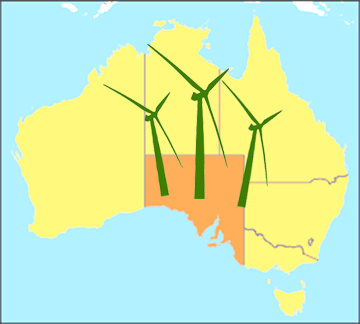 Victoria now relying on SA for power as wind production rises and coal plants close, Adelaide Now Daniel Wills, State Political Editor, The Advertiser December 3, 2018 Green-powered South Australia is now sending Victoria more electricity than it takes back as wind production surges, leading energy experts to warn that more storage is the key to keeping the local grid stable. Victoria now relying on SA for power as wind production rises and coal plants close, Adelaide Now Daniel Wills, State Political Editor, The Advertiser December 3, 2018 Green-powered South Australia is now sending Victoria more electricity than it takes back as wind production surges, leading energy experts to warn that more storage is the key to keeping the local grid stable.
|
|
|
Renewables to be providing 80 per cent of electricity market by 2030
|
Renewables heading for 80 per cent of electricity market by 2030, putting pressure on future funding: report, ABC News By business reporter Stephen Letts Key points:
|
|
Australia’s transition to clean energy gets a boost with Victorian Labor’s whopping victory
 Labor’s smashing win in Victoria a huge tonic for Australia’s clean energy transition, REneweconomy, 26 November 2018 The relief from Victoria’s stunning election result this weekend was palpable. Not just to those in the renewable energy and energy storage industries, but to anyone interested and concerned about the clean energy transition, tackling climate change, and with an eye to Australia’s economic and environmental future.
Labor to adopt Malcolm Turnbull’s National Energy Guarantee (NEG), and promote renewable energy – bigtime
 Bill Shorten to adopt Malcolm Turnbull’s energy policy, pledges to throw billions at renewables, ABC 21 Nov 18 By political editor Andrew Probyn and political reporter Melissa Clarke Australian households will be offered federal rebates to install solar storage batteries under a federal Labor energy policy that will also direct billions of taxpayer dollars at solar, wind and hydro projects.
Key points:
- Labor to adopt Malcolm Turnbull’s National Energy Guarantee (NEG)
- Rebates for households and businesses to install batteries if Labor wins election
- Pledge of $10 billion for Clean Energy Finance Corporation
With climate and energy expected to be subjects of fierce battle ahead of the election next year, Opposition Leader Bill Shorten will unveil Labor’s long-awaited policy today.
The ABC understands Mr Shorten will formally adopt former prime minister Malcolm Turnbull’s ill-fated National Energy Guarantee (NEG) as Labor policy.
Though Mr Shorten is likely to frame ALP adoption of the NEG as an attempt to find common ground with the Coalition on energy and climate change, it will also serve to give Labor political cover against Coalition attack.
The NEG, which was enthusiastically backed by then-energy minister and current Treasurer Josh Frydenberg, was twice supported by the Liberal party room but was dropped in August after some Coalition conservatives continued agitating against the policy.
“We remain committed to a bipartisan solution, if that is possible,” Shadow Energy Minister Mark Butler told AM.
“But we’re not going to wait for this Government.
“We’re willing to work with them, but we’re not willing to wait for them.”
Mr Shorten will recommit a Labor Government to a 45 per cent emissions reduction target by 2030, based on 2005 levels.
He will promise massive spending on renewable energy projects, with the Clean Energy Finance Corporation (CEFC) to have its funding topped up to $10 billion………..https://www.abc.net.au/news/2018-11-21/labor-energy-policy-ahead-of-election/10519018
Lack of network planning threatens Australia’s renewable electricity future, expert warns
ABC North Qld , By Tom Major 22 Nov 18 Australia’s boom in renewable energy faces an impasse unless more is done to develop infrastructure to complement wind, solar and pumped hydro storage systems, an expert has warned.
The expanding footprint of renewables represents a radical change from traditional large-scale, centralised generation, necessitating more national planning for sending power where it is needed.
Australian National University’s Energy Change Institute director Kenneth Baldwin said the remote locations of present and future renewable facilities meant Australia’s 20th century power grid required reform.
“This is a seismic shift in the way electricity is generated and distributed,” he said.
“In the future it will look much more like the internet of energy, in the same way that the internet developed into multiple nodes and many different interconnecting pathways.
“All these features of the future energy landscape are located in areas that are not necessarily where the demand is, so you have to arrange the electricity network to access the best resources and the best storage.”
Big potential unrealised
Air conditioning – if supplied by fossil fuels – increases global warming
 This article highlights Sir Richard Branson (a nuclear power proponent) and correctly reminds us of the carbon footprint if air-conditioning, if fuelled by fossil power. Important to Australia, and also to India. Why didn’t Ft mention this?
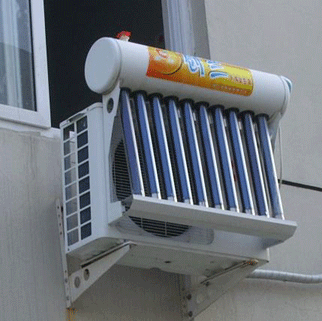 BUT – the logical alternative is renewable energy – either by use of a total
  renewable energy electrical system, or just a solar air-conditioner.
FT 12th Oct 2018 Air Conditioning A competition to find a breakthrough in air-conditioning technology has been launched with the backing of Sir Richard Branson and the Indian government, in an effort to avert the climate impact of the huge expected growth in the use of cooling systems.
The prize is intended to encourage inventors to find new ideas for indoor cooling that can be economically competitive against current technologies, while reducing energy consumption and the use of refrigerants such as hydrofluorocarbons that contribute to global warming.
There are about 1.2bn air-conditioning units installed worldwide today, and that number is forecast to rise to 4.5bn by 2050 as incomes rise and living standards improve in hot countries in Asia, Africa and Latin America.
If today’s technology is used for those units, they would by themselves emit enough greenhouse gases to raise global temperatures by 0.5C, according to Rocky Mountain Institute, an energy think-tank. The International Energy Agency has also sounded the alarm over air-conditioning, describing it as one of the most critical blind spots in international energy policy.
https://www.ft.com/content/1e056bde-e5ef-11e8-8a85-04b8afea6ea3
Victorian Labor dials up its renewable energy target to 50 per cent by 2030
 By Benjamin Preiss, Adam Carey & Noel Towell, Canberra Times, 8 November
 2018 Half of Victoria’s energy could come from renewable sources such as wind, solar and hydro power within 12 years, if the Andrews government is re-elected.
The Age can reveal that Labor will promise to raise Victoria’s renewable energy target from 40 per cent to 50 per cent by 2030 if it wins this month’s election.
The move would enhance Labor’s green credentials and cement the state’s transition away from coal as its primary power source.
Victoria has already legislated renewable energy targets of 25 per cent by 2020 and 40 per cent by 2025, although the Coalition has promised to scrap the targets if it wins the November 24 election. ………https://www.canberratimes.com.au/politics/victoria/labor-dials-up-its-renewable-energy-target-to-50-per-cent-by-2030-20181107-p50emw.html
Mike Cannon-Brookes, Atlassian billionaire, calls on Government to reinstate carbon price
 ABC News 7.30 By Nadia Daly 7 Nov 18, Atlassian co-founder Mike Cannon-Brookes has called for Australia to reinstate the controversial carbon price, as he pushes to influence government policy with his new green energy campaign.
Mr Cannon-Brookes said the “movement”, dubbed Fair Dinkum Power, would put forward policy suggestions around renewable energy ahead of the upcoming election, with the aim to move Australia to “200 per cent renewable energy”.
“I think it will clearly be the number one or number two issue in the election,” he told 7.30.
“Australia could be a renewable energy super power. “We could be exporting massive amounts of power, we could have huge numbers of jobs here in this space.
“We’ve just got to have vision and insight to go after that.”…….https://www.abc.net.au/news/2018-11-07/mike-cannon-brookes-calls-government-to-reinstate-carbon-price/10474702
New South Wales government is preparing for a surge in renewable energy
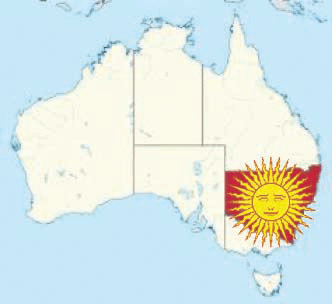 We want to do everything we can’: NSW readies for renewables surge, Brisbane Times, By Peter Hannam, 5 November 2018 New solar and wind farms being planned for NSW have twice the capacity of the state’s coal-fired power stations, prompting the state government to set aside $55 million to help smooth their introduction.As of October 29, NSW had 20,000 megawatts of generation capacity either approved or seeking planning approval, worth more than $27 billion in investment, according to government data.
Proposed solar plants accounted for 11,200MW, dwarfing wind farms with 5100MW, and the Snowy 2.0 pumped hydro of about 2000MW. Just 100MW involved coal, with the planned upgrade of AGL’s Bayswater power station.
Along with the new plants, some eight large-scale battery projects – all with solar farms – with more than 400MW-hours of capacity are also in the planning pipeline as the industry gears up for the bulge in variable energy sources.
The market, though, is going to need some near-term help to smooth the exit of most of the state’s existing power plants – particularly the 10,160MW of coal-fired power stations, said Amy Kean, director of the Energy Infrastructure and Emerging Technologies unit at the Department of Planning
To that end, the government last week revealed the first details of its $55 million Emerging Energy Program aimed at supporting a portfolio of nascent technologies that will be needed as 70 per cent of the state’s generation fleet retires by 2035.
“We’re trying to drive these technologies down the cost curve so they can then complement variable wind and solar technologies,” Ms Kean said.
The surge in renewable energy comes as the federal government has largely vacated the energy policy space after the demise of the Turnbull government’s National Energy Guarantee. The states are largely being left to press on with carbon reduction and other power sector goals.
“We want to do everything we can to unlock the expertise of the private sector to accelerate projects that deliver clean, reliable and affordable energy.”
Renewable energy could emerge as a key policy issue at next March’s state election. Adam Searle, Labor’s energy spokesman said his party planned to “have quite a lot more to say about it”, and that the ALP “will do more on new energy than Coalition parties”.
Solar catches up with windThe rapid advance and competitive nature of solar photovoltaic panels, meanwhile, has caught many by surprise. …….https://www.brisbanetimes.com.au/environment/climate-change/we-want-to-do-everything-we-can-nsw-readies-for-renewables-surge-20181104-p50dw9.html
Nuclear and Coal Lobbyists be warned – Fair Dinkum Power is here!
A “bat symbol” for renewables: Cannon-Brookes launches “fair dinkum” power https://reneweconomy.com.au/a-bat-symbol-for-renewables-cannon-brookes-launches-fair-dinkum-power-56345/2 November 2018
1 This month


Help Aunty Sue Protect Her Land and Sacred Sites From Destructive Rocket Testing.
.

Australians deserve the truth
about
AUKUS – https://aukuspublicinquiry.com/

PETITION – To: Prime Minister Anthony Albanese and the Australian Labor Government

of the week – Australians for War Powers Reform (AWPR)
To see nuclear-related stories in greater depth and intensity

