Promoting renewable energy from the grassroots – The Australian Youth Climate Coalition
 Generation Y promote renewable energy http://www.parramattasun.com.au/news/local/news/general/generation-y-promote-renewable-energy/2582725.aspx BY CALLAN LAWRENCE, 07 Jun, 2012 IF climate change does pan out, with oceans rising, rivers drying and storms causing havoc, it will be Generation Y that lives it, so they are trying to stop it.
The Australian Youth Climate Coalition has small groups in Parramatta and Blacktown to help change how western Sydney is powered. Business by business, school by school, the group of youth wants to convert people to “green” power.
Granville resident and Parramatta climate coalition convener Amy Gordon, 22, said they wanted to raise money to reduce the community footprint.
“We go out in to the community and approach local businesses, whether it’s a cafe, a school or a not-for-profit organisation, and create some sort of event,” she said. “It could be a mufti day, or a band event or whatever, to try and
raise $1000 and help them switch to renewable energy. “It’s about raising an awareness in our own community . . . “it’s
really inspiring to see change from the grassroots up.”
The coalition has worked with inner-west Sydney businesses for two years but Parramatta High School was the first organisation in the region to take part. Deputy principal Paul Taylor said Ms Gordon spoke to students about the environment. “They came away very enthusiastic and empowered from the whole experience,” Mr Taylor said. Students have introduced water and energy saving measures to the school and plan a media campaign.
Australian govt helping local councils, low income earners, to get solar hot water systems
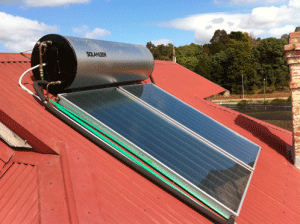 Solar funds redirected to councils, poor, Business Spectator, 6 Jun 2012 The federal government has finally announced what it plans to do with the $45 million left over after the solar hot water rebate program was wound up earlier this year.
Climate change parliamentary secretary Mark Dreyfus said on Wednesday $24 million would be spent on a new program to help local councils install solar or heat pump hot water systems in community facilities. The remaining $20.7 million would be redirected to the existing home energy saver scheme (HESS), which helps poor Australians buy more efficient white goods and air-conditioning systems……
 The Australian Greens claimed credit for forcing the government to spend the money on programs that would continue to support the solar hot water industry. “The Greens highlighted the scheme was underspent and insisted the funding allocation be maintained and not lost to general revenue,” leader Christine Milne said in a statement. “So directing this support to lower income householders and to community facilities is a great way to direct the benefits where they
are needed most.”
The Australian Council of Social Services praised Labor for pumping an extra $21 million into the HESS. “It will assist households to better understand and manage energy use,” council chief executive Cassandra Goldie said in a statement.
“New funds for investment in solar hot water systems are an excellent extension of the scheme that will allow households to take action to reduce energy costs.” Australian Manufacturing Workers Union NSW secretary Tim Ayres said the government had pledged the $45 million would be spent on locally-made products…
http://www.businessspectator.com.au/bs.nsf/Article/Solar-funds-redirected-to-councils-poor-UZBG7?OpenDocument&src=hp7
New South Wales government policies stifle wind energy development, promote coal and gas
 Concern over State Government’s wind farm guidelines, ABC News June 06, 2012 The State Opposition says the O’Farrell Government’s planning guidelines for wind farms is putting potential investment in the Hunter at risk. The guidelines include a two-kilometre exclusion zone between homes and wind turbines.
Energy spokesman Luke Foley says planning charges are set to prohibit investment in the industry. He says developers could be paying more than $1 million in planning fees compared to $15,000 in Victoria.
Mr Foley says the planning guidelines for wind energy are much stronger than for the coal and gas industry.
“If a single landholder, one landholder out of hundreds objects to a wind farm proposal the proposal then has to go through all sorts of hoops, that doesn’t apply to coal seam gas or coal or our extractive industries,” he said.
Newcastle based, wind energy consultant Richard Finlay-Jones says the planning guidelines could put local projects at risk…. http://www.abc.net.au/news/2012-06-06/concern-over-state-government27s-wind-farm-guidelines/4056328
Wind farm development stalled in Bailleiu’s Victoria
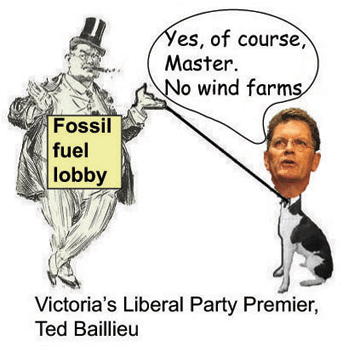 the delay in construction and state government rules giving households right-of-veto over turbines planned within two kilometres of their homes could stop the country meeting the 20 per cent target…..
Country’s largest wind turbine maker sacks 24 workers, The Age, Adam Morton, June 7, 2012 AS AUSTRALIA prepares to launch into what is billed as a clean energy future, its largest wind turbine manufacturer has sacked 24 staff because of a lack of business…
… The market for renewable energy certificates created through clean projects has been flooded with credits from rooftop solar panels.
It has suppressed the certificate price, stymieing the development of
the cheapest large-scale clean energy – wind farms.
Parliament tackled the problem in 2010 by dividing the market into
large and small-scale renewable energy schemes, but the certificate
price is yet to fully recover. Continue reading
New report on the prospects for solar thermal energy
CSP: It needs a new way of thinking about energy REneweconomy, By Giles Parkinson 6 June 2012 A new report outlining the prospects of solar thermal energy has underlined its enormous potential for Australia, saying it could provide between a third and even one half of the nation’s energy needs, but notes it may require a new of thinking about energy production and delivery. Continue reading
The true value of Concentrated Solar Power is underestimated
market mechanisms are a long way from recognising and rewarding the full value of CSP – 100 per cent renewable, zero carbon, zero waste, dispatchable power – as compared with incumbent coal, gas and diesel.
As Australia considers how to gain best advantage from the huge investment we will make in our electricity system in the coming 20 years, the evidence points to solar thermal power as having very significant value for Australia – value our markets are not currently reflecting….
Not all electrons are created equal REneweconomy, By Andrew Want on 6 June 2012 All electrons look the same, so the saying goes. It only matters that the electricity comes out of the consumer’s power point when needed. Modern economies and consumers demand reliability of electricity supply. The question modern electricity markets need to answer is, what is the most economically efficient way to meet that expectation? And that question is about value, not cost.
The new report, Realising the Potential of Concentrating Solar Power in Australia, confirms that, as much as they may all look the same, not all electrons are created equal – some are indeed more valuable than others.
Commissioned by the Australian Solar Institute (ASI) and undertaken by international renewable energy consultancy IT Power, the report is the result of an extensive 12 month collaborative review involving Australian Solar Thermal Energy Association (AUSTELA), the Clean Energy Council, the Australian Solar Energy Society, CSIRO and Boston Consulting Group.
The report confirms that assessments of the costs of concentrating solar thermal power used in Australia for many years are well and truly outdated. Continue reading
Will Tony Abbott say “yes” to the Greenhouse and Energy Minimum Standards Bill (GEMS)
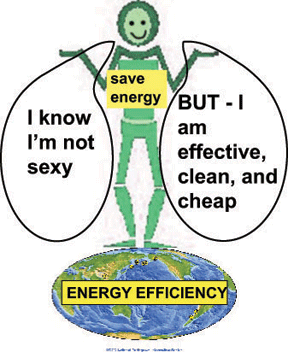 One hopes that Tony Abbott might expand his vocabulary from ‘no’ in this particular case. After all it was under the Coalition’s watch that the energy efficiency standards and labelling program started to make an impact. Minimum standards for the energy efficiency of residential and commercial buildings, refrigerators, water heaters, fluorescent tubes, air conditioners, electric motors, and transformers were put in place by the Howard government. Indeed, thanks to Malcolm Turnbull, we started a worldwide trend in phasing out conventional incandescent light globes that create 99 times more heat than light.
Abbott’s power bill ‘yes’ test, CLIMATE SPECTATOR, Tristan Edis, 5 Jun 2012 A little noticed piece of legislation was introduced into parliament last week which is likely to make a big difference to energy bills and carbon emissions – the Greenhouse and Energy Minimum Standards Bill (GEMS).
This bill aims to move the country toward a single national system for implementing and enforcing minimum standards of energy efficiency and energy rating labels, instead of the current state-based model we currently have.
What many people may not realise is that the measures which have made the greatest impact to date on reducing Australia’s energy emissions have nothing to do with renewable energy, or natural gas, or clean
coal. Instead it has been lots of little incremental improvements in the energy efficiency of mundane things like refrigerators, light bulbs, houses, office buildings, water heaters, air-conditioners, televisions, and electric motors driven by regulated minimum standards and mandatory energy rating labels. Continue reading
Australia’s politicians ignorant about the economic impact of solar photovoltaic energy
rooftop solar PV was about to play a significant role in the electricity market, so much so that rooftop solar alone could add 12,000 megawatts to 18,000MW to Australia’s electricity capacity by 2031
the economics of solar PV has changed dramatically in recent years.
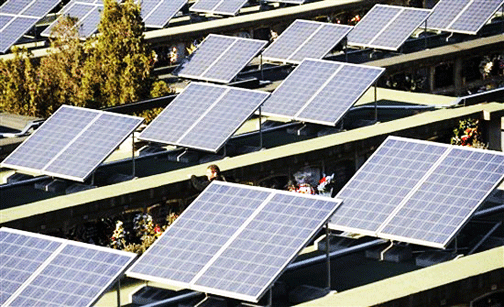
Politics must catch up with solar BY: GILES PARKINSON The Australian June 01, 2012 IT is time politicians in state and federal parliaments had a look at what’s happening in the solar photovoltaic market. There is a revolution going on in the electricity industry and no one in politics seems to have noticed.
This was made clear this week by a report from the Australian Energy Market Operator, which supervises the operation of the electricity grid in the eastern states, and which for the first time has produced a separate report analysis the impact of rooftop solar PV. It came to conclusions that would appear remarkable to those not close to the solar industry. Continue reading
Overwhelming majority of Australians support solar power
In the long run, big solar is also a big money-saver. Initial set up costs are high. But because the energy source is free, big solar will save many billions of dollars worth of coal and gas bills in coming decades.
The 100% renewables survey reported many of those polled said they supported big solar power because it would help boost employment. Unlike fossil fuels, solar power is a job-rich option.
Big solar power needs democracy to switch on, Green Left June 2, 2012, By Simon Butler If Australia were a democracy and governments had no choice but to carry out the will of the majority, we’d be well on our way to a 100% renewable power grid.
Recent polling organised by climate action groups around the country found that 94% of 12,000 people polled said they wanted big solar power stations built in Australia . And 93% of those polled said the government should invest public money to make that happen. Continue reading
Despite the anti-wind hype, South Australia’s success shows the power of renewable energy
Australian energy ministers have been so keen on geothermal, because they can most readily understand the concept of drilling for energy. You can’t dig up solar and wind power.
Not only are wind and solar playing increasingly significant roles in the power grid, but they are also helping to make wholesale electricity prices cheaper.
the progress with renewable energy in South Australia is promising and shows that with a friendly policy environment – for example, no 2km wind farm exclusion zones – great strides can be made.

Are the lights still on in South Australia? Business Spectator, Daniel Palmer , 1 Jun 2012 “……I was concerned for the state of South Australia after receiving some interesting news during the day – wind now makes up 31 per cent of the state’s power supply, with solar PV accounting for another 3.5 per cent.
According to a leading energy advisory firm (Energy Quest), wind already “appears to be the new baseload.” Not bad in spite of the campaign against wind by they-who-shall-not-be-named……. . I have been told for years that wind and solar are not capable of supplying power consistently enough to power one house, yet alone be able to supply a third of the energy needs for an entire state.
It appears to be all a Y2K-like false alarm however, with everything operating as normal…. Continue reading
South Australia’s wind power figures vindicate radical energy plan http://www.greenleft.org.au/node/51184, May 31, 2012 Beyond Zero Emissions released the statement below on May 31. Yesterday energy consultants EnergyQuest broke the news that wind power supplied 31% of South Australia’s electricity in the last quarter. Continue reading
South Australia’s baseload power from wind energy
Wind Power ‘The New Baseload’ In South Australia http://www.energymatters.com.au/index.php main_page=news_article&article_id=3231 by Energy Matters, 31 May 12 Achieving 20% renewable energy in Australia by 2020 isn’t impossible – in fact, South Australia has already blown past goal that courtesy of wind energy primarily, with a helping hand from residential solar panel installations. Continue reading
Distributed energy, small scale solar, has taken off in Australia
Solar insights – Australia big in small solar REneweconomy, By Giles Parkinson 28 May 2012 Germany may set most of the records for the amount of solar PV installed – 27GW and growing quickly – but it seems that Australia can claim a record of its own – it’s really big in small solar.
According to data drawn to our attention by Warwick Johnston of Sunwiz Consulting, Australia installed more small-scale solar than Germany in calendar 2011 – 795MW of rooftop systems of 10kW or less (the average size in Australia ranges from 1.5kW to 2.2kW) compared to 759MW in Germany…. http://reneweconomy.com.au/2012/solar-insights-australia-big-in-small-solar-65337
Queensland govt axes solar farm project
Queensland Government Bails On Solar Farm Project
http://www.energymatters.com.au/index.php?main_page=news_article&article_id=3224 by Energy Matters, 25 May 12 The Queensland Government has withdrawn funding for Cloncurry Solar arm as part of a cost cutting campaign that may see other solar elated casualties. Continue reading
Renewable energy in Australia threatening the profits of fossil fuel industries
Electricity industry is in for a big shock by: Giles Parkinson The Australian May 25, 2012 Data from the European electricity market shows how 25GW of solar PV has changed the nature of the German electricity market. The data compares how the market looked in 2008, against how it looked on a sunny day on March 12 this year.
“……..It is just a snapshot, but it is being repeated often enough that generators in Germany, Italy and elsewhere in Europe are calling for the rollout of solar to be capped to protect their earnings.
Several gas-fired plants in Germany have either been closed or marked for closure, and the largest electricity companies, E.ON and RWE, have made it clear they cannot keep these plants open, and are refusing to build new ones, without further help. So the German government has come up with a new mechanism called “capacity factors”. The details are yet to be worked out, but essentially it represents a payment to ensure that the gas-fired plants are available to balance the growing number of solar PV and offshore and onshore wind plants in the German grid, and to provide capacity as nuclear and then coal-fired power stations are removed.
It would seem inevitable that Australia will have to follow the same path. The brown coal generators are already feeling the pinch from lower wholesale prices of electricity caused by moderating demand and by the large wind capacity in South Australia. They have succeeded once in persuading the Victorian government to reduce the ambitions of its state-based renewable energy target, and are now seeking to do so again at the federal level. Already, the federal government has provided two payment mechanisms for the closure for some of the most polluting plants, and compensation to ensure that others stay open despite the impact of the carbon price (which ostensibly is designed to force their closure).
The government also has an energy security mechanism that can provide emergency financing to any generators finding themselves in trouble. Capacity payments, incentives to ensure that “peaking” generators that are flexible enough to provide energy when a coal-fired generator is offline, renewables are not functioning, or in times of peak demand, may well become part of the landscape…..
1 This month



Help Aunty Sue Protect Her Land and Sacred Sites From Destructive Rocket Testing.
.

Australians deserve the truth
about
AUKUS – https://aukuspublicinquiry.com/

PETITION – To: Prime Minister Anthony Albanese and the Australian Labor Government

of the week – Australians for War Powers Reform (AWPR)
To see nuclear-related stories in greater depth and intensity

