Clean Energy Finance available to Australian companies first
Australian companies get first shot at green energy cash, David Wroe, Brisbane Times, May 23, 2012 AUSTRALIAN companies will be guaranteed the chance to pitch for business flowing from the Gillard government’s $10 billion clean energy fund that Labor will announce today in an effort to sell the benefits of green jobs at home.
Climate Change Minister Greg Combet will announce today that the Clean Energy Finance Corporation, which will provide grants and government investment to green projects, will require candidates to show they are
giving local firms a fair go to supply parts and services……
Mr Combet, meanwhile, will introduce today legislation to set up the $10 billion corporation, to be chaired by respected businesswoman Jillian Broadbent. It will require candidates for funding to have Australian Industry Participation Plans, which are a key part of the government’s broader manufacturing strategy.
Under these plans, which are already used by the resources sector in return for tax breaks, projects have to demonstrate they have given Australian firms ”full, fair and reasonable opportunity”. A wind farm, for example, might have to show it has offered Australian firms the chance to supply the turbine towers. http://www.brisbanetimes.com.au/opinion/political-news/australian-companies-get-first-shot-at-green-energy-cash-20120522-1z39j.html#ixzz1vjfBtHvJ
Success of solar power is giving a shock to Australia’s utilities
 Fear and loathing as utilities grasp impact of solar PV, REneweconomy By Giles Parkinson 21 May 2012 Australia’s power generators and electricity network operators are viewing the rapid falls in the cost of solar PV and an anticipated surge in installation with an increasing level of concern.
The potential of solar PV to deliver cost-effective options for home and commercial consumers has been apparent to many in the industry for some time.
The report delivered by the Victorian Competition and Efficiency Commission into solar feed-in tariffs merely confirmed this, and offered it as a potential excuse for the utilities’ apparently lack of enthusiasm to ensure connections for solar PV and other forms of distributed energy.
While plunging costs are good news for consumers, who can turn to solar PV in increasing numbers with the emergence of innovative financing solutions, it is a massive headache for the incumbent generators and network operators, who are about to witness business models built up over decades being shredded by a technology that is as disruptive to the electricity industry as mobile phones were to telecoms…..
Australia has just over 1.5GW of solar PV installed on rooftops now – so there is little apparent impact on the NEM as it stands. By 2020, when the percentage of households with solar PV is expected to treble from around 7 per cent now to 19-20 per cent, the impact is significant.
By 2030 and 2035, it takes a large slice out of the generators’ earnings pie – an impact that has already been established in Germany, which has 25GW of solar PV and counting, and which we documented in our piece “Why generators are terrified of solar.”
It should be remembered that the profit projections – and the debt repayments – built into the Australian generators’ financing models depend almost entirely on the “super dividend” they receive when peak demand surges and the cost of wholesale electricity rises up to 10-fold for just a few hours of the year. A large deployment of solar PV will quite literally throw a spanner in those works…… http://reneweconomy.com.au/2012/fear-and-loathing-as-utilities-grasp-impact-of-solar-pv-15262
Australia’s Clean Energy Finance money is going to dirty gas, rather than renewables
Gas is not a new, emerging technology worthy of support. Gas power would keep Australia on a very high path of emissions compared with world averages.
It would take the building of a few initial solar thermal plants to bring its building costs down to a reasonable, commercially viable level.
But the CEFC is clearly not aiming at that result….
The conclusion is that the CEFC will probably do nothing to break the grip of the fossil fuel industry “greenhouse mafia” on Australia’s politics and energy supply.
First, because it has so much potential for supporting “clean” gas, not really clean renewable energy.

 Clean energy finance, or gas industry handouts? http://www.greenleft.org.au/node/51071, May 19, 2012 By Ben Courtice A concentrated solar thermal power plant. The CEFC will probably do nothing to break the grip of the fossil fuel industry “greenhouse mafia” on Australia’s politics and energy supply. The Clean Energy Finance Corporation (CEFC) is being set up under the Clean Energy Future legislation (the carbon price package). It will provide $10 billion to support renewable and low-emissions energy.
That’s the message that most climate-concerned people have been hearing from the Labor government and the Greens.
Unfortunately, it now seems overly optimistic. The recently completed CEFC expert review shows it may give most of its support to gas projects. Continue reading
Distributed renewable energy bringing about an energy revolution
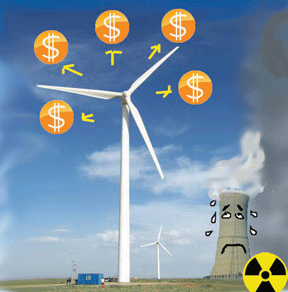 The Victorian Competition and Efficiency Commission also recognised that distributed generation also offered a cheap form of energy, and made the network more efficient.
Nuclear’s financing meltdown While the technology costs of renewable technologies are falling rapidly, the costs of new nuclear appear to going in the other direction with equal speed
Five things we learned this week, REneweconomy , By Giles Parkinson 18 May 2012 “…….Solar costs are coming down rapidly …. It seems everyone is now cottoning on to the idea that costs of solar PV have come down so rapidly that the technology is likely to revolutionise the electricity industry, at least at the retail level.
Welcome to the new world of “socket parity”, where comparisons with the price of rooftop solar and the electricity produced at coal-fired power stations becomes redundant, because consumers only care about the cost of electricity at the socket. In Australia, despite its abundant cheap coal, its overcapitalised network guarantees that the grid-based power will be more expensive.
NRG CEO David Crane said this week that solar PV is so cheap, and so compelling for residential and commercial customers, that it would likely do to the electricity grid what mobiles did to fixed line telephony,which basically means that much of the current infrastructure would be made redundant, and the industry would be dominated in the future by new, nimble players with different energy products. …..
Wind costs are falling too …. Continue reading
Adelaide schoolchidren becoming skilled in solar and wind technologies
 Students full of renewable energy Adelaide Now, Clare Peddie May 16, 2012 SCHOOL students are learning about renewable energy through Australia’s first mini wind turbine trial at West Beach. The State Government, with the West Beach Trust, is testing four different turbines for 12 months. The power output is compared to a 6kW solar system nearby, with all the data displayed online.
Yester- day the Royal Institution of Australia launched a Wind Technology Education Package, with funding from the West Beach branch of Bendigo Bank, to help students in Years 7-10 get in on the act. The package covers practical applications, optimal locations and uses of wind turbines. Students from West Beach Primary School and Henley High School were the first to use the package, conducting hands-on activities at the site of the mini wind turbine trial. Students built and tested a model wind turbine and learned what designs worked best….
http://www.adelaidenow.com.au/news/south-australia/students-full-of-renewable-energy/story-e6frea83-1226358260038
In reality, Western Australia’s Solar Feed In Tariff is an economic boon
 Western Australia’s Solar Feed In Tariff Ramifications Exaggerated http://www.energymatters.com.au/index.php?main_page=news_article&article_id=3211, 17 May 12, Professor Ray Wills of the Sustainable Energy Association of Australia (SEA) has challenged the notion that spending more on renewables is somehow a bad thing and brought the situation regarding Western Australia’s solar feed in tariff into perspective.
Professor Wills points out while the media circus has focused on the “blowout” in Western Australia’s scheme; there has been no analysis of the benefits. “Energy Minister Peter Collier rightly points out that 76,000 WA homes now have solar panels on their roofs as “a terrific outcome”,’ says Professor Wills, who says the uptake hasn’t been confined to the wealthy, but spurred on by average households in Western Australia now slashing their electricity bills.
“We are yet to calculate the savings that this program has bought – savings that will amount to fewer upgrades to poles and wires, has in the vast majority of cases delivered improved electricity quality and reliability, and will avoid the need for investment in new fossil-fuel based generation.” Continue reading
Carbon Capture and Storage- a tax-payer funded fantasy
 the collapse of CCS projects overseas and in Australia shows the technology is commercially unviable
Greenpeace rejects carbon capture funding, ABC News, By Gus Goswell May 16, 2012 Environment group Greenpeace says governments are wasting public money on carbon capture and storage (CCS) research.
Carbon capture and storage is the process through which emissions from power stations would be captured and then stored underground to reduce carbon pollution. The Victorian and federal governments have invested millions of
dollars into CCS research. Continue reading
New ARENA appointments – but will they toe Ferguson’s anti renewable energy line?
First appointments to ARENA Board, Ecogeneration, 10 May 2012 The Federal Government has announced a number of appointments to the board of the Australian Renewable Energy Agency, set to begin operation on 1 July 2012.
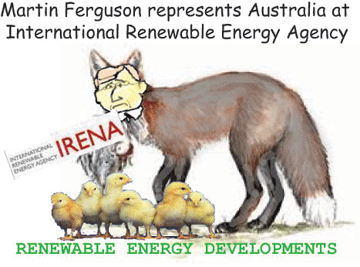
Greg Bourne has been announced as acting chair of the Australian Renewable Energy Agency (ARENA) Board, while Dr Brian Spalding and Drew Clarke have also been welcomed to the board. Mr Bourne brings to the board an extensive background in renewable energy development and project commercialisation, including as a former director of Carnegie Wave Energy and as Chief Executive of the World Wildlife Fund Australia.
Dr Spalding is a current Australian Energy Market Commissioner with more than 30 years’ experience in power system operations, and provides continuity from the board of the Australian Centre for Renewable Energy.
ARENA is a component of the Federal Government’s Clean Energy Future package, consolidating $3.2 billion in funding for renewable energy innovation….. http://ecogeneration.com.au/news/first_appointments_to_arena_board/069117/#
Member for Northern Victoria Donna Petrovich called to account on her claims against wind power
 there is an onus on Ms Petrovich to come clean on her research if she is to stand by her claim that communities right across the Macedon and McHarg Ranges and big chunks of Central Victoria are “not appreciative” of this form of green and sustainable energy.
Yes to renewables
http://yes2renewables.org/2012/05/07/where-did-the-no-go-zones-come-from/Where did the ‘No Go’ zones come from? May 7, 2012 by Cam Walker The following is a letter from last weeks Macedon Ranges Weekly. Where did the ‘No Go’ zones come from? Last year, the state government created a series of ‘No Go’ zones, which block wind energy developments across much of Victoria, including the Macedon – McHarg Ranges. The government seems to think these ranges extend almost as far north as Bendigo.
Member for Northern Victoria Donna Petrovich has said in state parliament that the No Go zones were “carefully” selected where communities “on the whole have told us that they are not appreciative of wind farms”.
Given the controversial nature of the No Go zones, and the widespread support for the Macedon and Castlemaine community wind proposals, it would be useful to understand how Ms Petrovich consulted the community
to reach her conclusion that wind power is unpopular. Continue reading
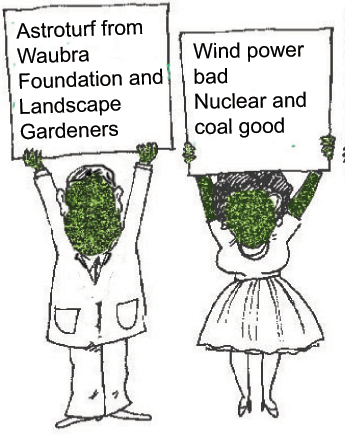
Mass media and State govt policies damaging Australia’s wind farm industry
 Economics taking the wind out of farm’s sails, Canberra Times, Graham Downie.May 7, 2012 “……. Infigen Energy, the largest wind farm owner in Australia, owns Capital Wind Farm, between Bungendore and Tarago, east of Canberra, which has 67 turbines.
The company has approval to almost double this. Only the present economics prevent the extension going ahead.
Mr Upson said about 20 new wind farms had been approved in Victoria and about six in NSW. These projects had been delayed by the ”small-scale screw up”. That had now been fixed by separating the small-scale and large-scale schemes but the glut of certificates remained.
Mr Upson said some elements of the media spread a lot of misinformation about wind energy. Certainly, turbines killed a small number of birds, but this was infinitesimal compared to the number of birds killed by power lines, motor vehicles, cats and pesticides.
He also dismissed concerns that wind farms caused illness. ”There is no independent, regulatory, scientific or medical body in the world that thinks wind turbines make people sick.”
With wind energy worldwide doubling every three years, there would be an epidemic of biblical proportions if wind turbines made people sick. ”There are wind turbines everywhere in Europe and no one is getting sick.”
Mr Upson said the wind industry worldwide had grown by more than 25 per cent each year for the past 15 years. ”I challenge you to think of another industry that has had this sustained and long-term growth.”
Wind produced less than 2 per cent of the total electricity demand in NSW and the ACT, but in South Australia, with a greater wind resource and less demand for electricity, wind produced about 25 per cent of that state’s total demand. At times, it reached about 70 per cent.
Though generation from wind turbines was variable, the Australian Energy Market Operator could now forecast wind energy throughout the grid with 98 per cent accuracy an hour ahead. This meant other generators were turned on or off as required.
Wind farms were expensive to build but were very cheap to run. So they could under bid coal and gas generators given suitable wind.
Infigen had plans to develop solar generation and would be pleased to be selected in the Solar Flagships program, he said. ”In which case we would build three large-scale solar facilities.” One would be at the Capital Wind Farm, one at Nyngan and one at Manildra. At present, generating electricity from even large-scale solar plants was about twice as expensive as from wind.
”May be by the middle of the decade it might be more competitive … to build a large-scale solar facility we need some sort of grant or subsidy.” http://www.canberratimes.com.au/act-news/economics-taking-the-wind-out-of-farms-sails-SMH 20120506-1y7bt.html#ixzz1uDQDJkG
Australia and China – a solar energy story, with more achievement to come
 China’s solar story is Australia’s solar story. It is an untold story of Australian innovation and climate change action. Everywhere I went in China, I met Aussies. So many of the leaders of China’s PV industry – indeed the global PV industry – were trained in Australia, at the University of New South Wales or the Australian National University.
Suntech is just one example of Chinese and Australian innovation, action on climate change and strategic investment in solar.
The solar partnership between Australia and China is making the economics of solar persuasive, and the introduction of a carbon price, the establishment of the Clean Energy Finance Corporation and the continuation of the Renewable Energy Target will open up investment opportunities.
Power in numbers: Tapping the Aus-China solar alliance, REneweconomy, By John Grimes on 4 May 2012 Greg Combet’s recent visit to China for the annual Australia-China Climate Change Forum was a timely reminder of the strong action China is taking to cut its carbon pollution levels and the importance of the partnership between Australia and China in reducing global greenhouse gas emissions. Nowhere is that partnership more important than in the clean energy space.
As the world’s largest greenhouse gas emitter, largest population centre and second largest economy, China is facing the extraordinarily difficult challenge of disconnecting its rapid economic growth from soaring greenhouse emissions. China is introducing a pilot emissions trading scheme in seven provinces, with a combined population of 250 million people, before introducing a national emissions trading scheme from 2015-16. China is committed to reducing its national carbon output per unit of GDP by 17 per cent by 2015, and 40-45 per cent by 2020.
China has also made a strategic investment in renewable energy, with the unstated aim of leading the world as it moves into the next industrial revolution. China is already the world’s leading manufacturer and installer of wind turbines and is the home of seven of the world’s top ten solar PV manufacturers (up from four in 2009). It won’t be long before China takes the lead as the largest installer of PV…… Continue reading
Tasmanian wind farm providing jobs, while conventional farming continues, too
 Premier Lara Giddings, who yesterday visited the site, said 200 jobs over 18 months was a welcome boost for an area hit hard by the forestry downturn.
Wind farm has plenty of puff http://www.themercury.com.au/article/2012/05/04/325101_tasmania-news.html BRUCE MOUNSTER | May 04, 2012 YOU just have to look at the trees.. Then, says Hydro Tasmania chief executive Roy Adair, it’s easy to see why the Cape Portland property on Tasmania’s far north-east tip, is considered one of the best wind farm sites in Australia. “The configuration of the trees and the way that they are heavily leaning to one side,” he said.
The 550ha beef, dairy and former woolgrowing property is home to the 56 turbine Musselroe wind farm, now under construction after an eight year gestation. Continue reading
Bega, New South Wales, getting very Smart about Solar Energy
the stored energy can also be fed back into the network at peak demand times – say, at night when people come home and cook dinner, watch television or play computer games, or use their hot water systems for things like showers and washing up
The battery banks can also be configured to be charged from the network, creating a micro-grid
Bega library’s bright future Eden Magnet, BY BEN SMYTH 03 May, 2012 The roof of the Bega library is sporting a new look this week. On Friday, a network of solar panels was installed as part of a project that will see considerable savings for the Bega Valley Shire Council and, in turn, ratepayers.
In a first for regional NSW, Essential Energy is constructing an “intelligent” solar energy system, which will showcase the benefits of community-based renewable energy solutions and effectively make the library self-sufficient in regards to its electricity consumption. According to Essential’s regional general manager south eastern, Phillip Green, who was on hand to launch the project with Member for Bega Andrew Constance, the library’s system is the third phase of the energy company’s “Intelligent Network”. Continue reading
Australia’s Renewable Energy Target driving new wind farm projects in S.A. and NSW

the first major PPA for new build wind farm for several years that has been driven by the renewable energy target
Wind energy finally taking off again in Australia, REneweconomy, By Sophie Vorrath 2 May 2012 The Australia wind energy industry looks set to end its near three-year hiatus, as Origin Energy signed its largest ever power purchase agreement, Thai group Ratchaburi Electricity Generating Holding said it would be adding 200 megawatts of wind turbine capacity in Australia (to its existing 100MW) over the next few years, and REpower Australia prepared to launch a scaled-down version of a new wind farm in NSW. Continue reading
The smart grid and renewable energy are on their way to Australia
“The current electricity system is designed for electricity to flow in one direction, but as we put more renewable energy into the system, more and more electricity will flow in the other direction
with the level of control and intelligence provided by the smart grid, electric car batteries could store power while parked helping balance supply and demand across the network.
Welcome to the smart grid, ABC 1 May 12, JOHN PICKRELL “….Welcome to the world of the smart home and its sister, the smart grid.
Already across Victoria, smart meters are being fitted that tell the grid how much power you’re using, and charge a different rate at peak and off-peak times of day. Last year in the Sydney suburb of Newington, a family of human guinea pigs lived in a smart home created by electricity provider Ausgrid and Sydney Water. This house had a HAN — or energy dashboard — and tested energy- and water-saving technologies, as well as generating its own power from solar cells and a ceramic fuel cell. In this way, the family generated most of their power, some of which they stored in batteries in both the house and their Mitsubishi i-MieV electric car. (Find out more about the smart home here and here) Continue reading
1 This month
15 April – Zoom –Nuclear Power is Not the Solution
Apr 15, 2026 01:00 AM in Canberra, Melbourne, Sydney

Join the International Physicians for the Prevention of Nuclear War (IPPNW) on Tuesday, April 14th for a timely webinar exploring the risks associated with nuclear power and challenging the myth that it offers a simple, safe, carbon-free solution to the climate crisis

of the week – Australians for War Powers Reform (AWPR)
To see nuclear-related stories in greater depth and intensity
 Antinuclear