Photovoltaic solar energy boom in Australia benefits rural and low income communities
 Love of a sunburnt country a boon for solar set http://www.smh.com.au/environment/energy-smart/love-of-a-sunburnt-country-a-boon-for-solar-set-20120406-1wgtn.html#ixzz1rNtGo1ee 7 April 12, THE humble city of Dubbo has emerged as the solar power capital of Australia, with more than a quarter of the houses in one postcode generating their own electricity from rooftop panels.
Even as subsidies are slashed, data shows the boom in photovoltaic solar panel continues.
The breakdown of solar use by postcode shows a clear bias towards regional Australia and city suburbs with lower-than-average incomes, industry body the Clean Energy Council says. ”Solar panels are fast becoming the Hills Hoist of the 21st century,” the council’s acting chief executive, Kane Thornton, said. Continue reading
REneweconomy lists Australia’s top solar energy postcodes for 5 States
 The top solar postcodes, and Australia’s solar capital, REneweconomy, By Giles Parkinson 6 April 2012
The top 10 NSW solar postcodes:
1. 2830 Dubbo and surrounds 28.0%…….
The top 10 Queensland solar postcodes
1 4551 Caloundra, Pelican Waters, Golden Beach 27.3% of houses have solar power systems……
The top 10 West Australian solar postcodes:
1. 6208 Pinjarra, Oakley, Blythewood, Ravenswood 24.7% of houses have solar power systems…..
The top 10 South Australian solar postcodes:
1. 5211 Victor Harbor, McCracken, Hindmarsh Valley 25.9% of houses have solar power systems….
The top 10 Victoria solar postcodes:
1. 3564 Echuca 13.3% of houses have solar power systems…..
http://reneweconomy.com.au/2012/the-top-solar-postcodes-and-australias-solar-capital-28344
Sydney to get low carbon electricity network – cogeneration for energy efficiency
 History made with Australia’s first low carbon energy network, Cogeneration and on site power production, Cospp.com, 05/04/2012 By Diarmaid Williams Sydney’s Lord Mayor Clover Moore has hailed the groundbreaking new district energy system, which will link Sydney in the country’s first citywide low carbon network, and says has the potential to make Sydney one of the world’s leading green cities. “Our trigeneration network will give consumers a cleaner and cost-competitive alternative to the rising price of electricity,” the Lord Mayor said.
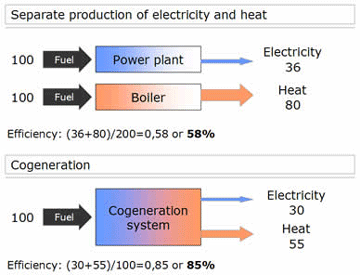
“This network could save NSW electricity consumers as much as $1.5 bn by 2030 in avoided or delayed spending on grid upgrades and new power stations. “It will help us deliver on our target to cut carbon emissions across the City of Sydney by 70 per cent by 2030 (on 2006 levels) – one of the most ambitious of any Australian government.” Continue reading
Stock analysis report shows the advantages of solar power, worldwide
In Australia, the solar industry is driven by several regulatory initiatives that support the installation of solar PV modules in both rooftop and free-field applications, including the federal government’s nationwide Renewable Energy Target, which has set a renewable energy goal for Australia of 20% by 2020. Clean Energy Finance Corporation (CEFC) and Australian Renewable Energy Agency (ARENA), both established in 2011, will begin implementation in 2012.
Alternative Energy Stock Outlook – April 2012, By: Zacks Equity Research April 03, 2012 “……A worldwide industry association for solar photovoltaic electricity market, the European Photovoltaic Industry Association (EPIA) forecasts that the power generated from solar modules in Europe could be competitive in relation to conventional forms of energy by the end of the current decade. The major solar markets under survey were Germany, Italy, France, Spain and Britain…..
A major growth area in this space is Solar Energy…… Continue reading
Queensland solar energy plan will go ahead, despite no help from government
 the nature of solar – there’s no waste, there’s no ongoing costs, there’s no emissions,
Funding cuts won’t cast shadow over Gulf solar plans ABC News, http://www.abc.net.au/news/2012-04-04/funding-cuts-wont-cast-shadow-over-gulf-solar-plans/3931956?section=qld April 04, 2012 A plan to power properties in north-west Queensland’s eastern Gulf Country with solar electricity is likely to go ahead, despite cuts to State Government clean energy funds. Continue reading
A clever solar energy tariff plan from Western Australian firm
 Horizon finds a smart way to price a solar tariff, REneweconomy, By Giles Parkinson 5 April 2012 Western Australia energy utility Horizon Power has achieved what appears beyond the capabilities of its larger peers in the eastern states, the Victorian and NSW governments and regulatory pricing authorities, and produced Australia’s first differentiated feed in tariff for rooftop solar PV.
Horizon, which services 100,000 residents and 9,000 businesses in towns and communities across the state, beyond the grid located in the south-western corner, is introducing area-specific solar feed-in tariffs which recognise a higher value for solar put back into the grid from remote locations, and a lower value for solar energy fed from near towns and alternative energy sources. Continue reading
Forget nuclear, clean coal, clean gas – renewables are ready to roll
 Clean coal and clean gas is a pipedream and typical of Australia’s irrational debate around carbon and energy – something that stems from the influence of the fossil fuel interests over government, through royalties and donations.
We are ready to roll with renewables today, no new capital should be spent locking in anymore fossil fuel burning. As we deploy our renewables they will continue to get cheaper. We’ll learn as we go and, most importantly, we’ll benefit from the learnings that are continuing to benefit the world’s most innovative successful economies.
Clean fossils of the future? How about ready renewables, REneweconomy By Matthew Wright 4 April 2012 There’s a lot of discussion and political jostling around energy options, decarbonisation, low-carbon or zero-carbon transition…..
Nuclear was not an option for Australia even prior to Fukushima. As second generation nuclear plants have a bad name and are basically off limits in any OECD country, the industry has come up with third generation plants, but these have so far proved impossible to get built. Not one is operating and the flagship plant, by the world’s biggest nuclear builder Areva, is still under construction. Its construction time has more than doubled to 10 years and its costs have more than tripled over original estimates. This plant in Finland is not expected to be finished for at least another two-to-four years, if ever.
With that in mind the nuclear proponents have leapfrogged their own suggestion of going third generation and now push fourth generation plant. Great on the drawing board, deep in a government-sponsored lab in the middle of nowhere US, and sounds great, but no one is selling one, which is telling – not GE, not Toshiba, not Westinghouse, not Areva. Just in case you didn’t get that, you can’t buy one at all, anywhere, period!… Continue reading
Rooftop solar energy to turn out to be an election winner for Gillard?
 it could also have a big impact on established energy utilities, both generators and retailers, and has the potential of changing the political rhetoric as the next federal poll is fought on cost-of-living issues, mostly retail electricity prices.
A new surge in the deployment of rooftop solar in Australia could have an impact on generators, who are already worried about the impact it is having on their profits…. AGL highlighted the potential for this to happen in Australia, which is why it is lobbying to slow down the growth in the solar industry in Queensland, the last state to have a significant feed in tariff.
The Clean Energy Future can indeed be clean, exciting (new technology), and cost a lot less than sticking with polluting fossil fuels.
 Zero-cost solar: Will this be Gillard’s election secret weapon?, REneweconomy, By Giles Parkinson 2 April 2012 Australian solar installers are racing to become the first companies to offer long-term leasing arrangements that will allow householders to install large rooftop solar installations at zero up-front cost and hedge against rising electricity prices. Continue reading
What’s stopping windy Western Australia from developing wind power?
Why isn’t WA harnessing wind power?, WA Today April 4, 2012 – Perth is an international hotspot for windsurfing and the destination of choice for the ISAF Sailing World Championships. If you thought Western Australia was a leader in wind power, think again.
New research reveals while Perth is the third windiest capital in the world, it is in the doldrums when it comes to wind power….. With an average wind speed of more than 27km/h and twelve operating wind farms lining the coast from Coral Bay to Albany, WA could be leading the nation. Continue reading
Western Australia’s Horizon Power’ s solar feed-in tariffs will especially benefit rural communities
 Solar households in towns located further from energy generation sources, or where power generation is expensive, will be offered higher prices for the electricity they export to the grid…. For households in regional and remote areas of Western Australia, under Horizon’s new feed in tariff structure the savings could be much higher.
Horizon Power To Offer Location Based Solar Feed In Tariff, Energy Matters, 3 April 12, In what appears to be a first for Australia, Western Australia’s Horizon Power will introduce area-specific solar feed-in tariffs. While owners of systems in some towns will receive a much higher rate, others will receive less.Horizon Power’s Renewable Energy Buyback Scheme rate is currently equivalent to a customer’s current electricity tariff, minus GST. Horizon’s incentive is in addition to Western Australia’s state government mandated feed in tariff rate of 8c per kilowatt hour. Continue reading
Decentralised energy – you can start with a mixture of grid power and off-grid solar
 Hybrid solar: How to kiss the grid goodbye , REneweconomy, By Jeff Bye 30 March 2012 If ever there were a need to develop off-grid power systems it would have to be now, when transmission costs are now up to around 60 per cent of non-solar power bills.
Solar systems have historically been classified into two broad camps – “grid connected” or “off-grid” systems. This distinction has arisen due to historical segments of the market that needed solar to do different things. The vast majority of systems we see around Australia’s towns and cities are grid connected and have been driven by feed-in-tariffs and consumer desires to cut electricity costs and do something positive for the environment.
Off-grid systems have historically been the preserve of regional customers seeking to avoid expensive network augmentation costs to provide power to their remote locations. Off-grid systems are usually a lot more expensive as they require battery storage, more complicated control technology and often diesel backup generators to ensure the lights will always shine. Battery technology has also been a culprit as the memory effect of old-style lead-acid batteries has meant that battery arrays are oversized to ensure the depth of discharge is not high and hence battery life is extended.
An emerging trend though is for so-called hybrid systems which take a little from column A, and a little from column B. Such systems could either be described as an off-grid system which uses the grid as the standby generator or a grid-connected system with some added battery storage. Either way, these systems don’t require expensive diesel generators since the grid provides that service, and the size of the battery arrays can be downgraded as the cost of back-up power using off-peak grid electricity is much lower than that provided by diesel generators.
The technology that is making this possible is a new generation of products capable of directing energy flows as the consumer best desires….
Increasingly the electricity grid is moving towards Grid 2.0. Eventually, the networks will cease to become simply a delivery mechanism for electrons to your home and will morph into a shared network designed to help each energy user effectively manage their surplus or deficit of electrons to meet their needs. With this will come enormous changes to the business models of the network operators as customers gradually become more and more self-sufficient and use less and less from the grid….. http://reneweconomy.com.au/2012/hybrid-solar-how-to-kiss-the-grid-goodbye-59957
Urgent need for Australia to upgrade its “cheap and dirty” grid
“Australia can’t turn its back on the global shift from dirty to clean energy, from non-renewable to renewable, and from inefficient to efficient. It can’t do this anymore than it could resist the information technology age or the rise of China – and it is not in our national interest to do so.”
Cheap and dirty grid may be our biggest liability, REneweconomy By Giles Parkinson 30 March 2012 For decades Australia has boasted of its cheap and reliable electricity grid as the most potent sign of its economic competitiveness. But two new studies highlight the folly of resting on past laurels, and how Australia’s cheap and dirty grid has left our economy exposed and poorly prepared for the inevitable change to a low-carbon economy.
One study , by the University of Queensland and the Global Change Institute, suggests that Australia’s power system is among the least resilient in the world – even compared to other resource-rich nations such as Canada and Brazil – and presents a risk for consumers and investors alike.
The second report, prepared by The Climate Institute in conjunction with US industrial giant General Electric, finds that Australia is now ranked 16th among G20 countries in terms of the ability to prosper in a low-carbon economy, and is the only country to have gone backwards since 1995,… Continue reading
Renewable energy economics – sending shockwaves through fossil fuel lobby
Broader estimates produced by the International Energy Agency and the European Commission suggest that the final outcome of moving to renewables will be cost-neutral over the long term, and may even save money, but will likely cause a rise in costs over the short term because of new technologies and infrastructure investment.
More critically, it will also send shockwaves through the energy industry as economics of fossil fuel generators is undermined
In a renewable world, baseload generation is redundant, REneweconomy, By Giles Parkinson 29 March 2012 Energy Minister Martin Ferguson revealed the tenuous nature of his understanding of solar technologies in an interview on ABC TV’s 7.30 Report on Tuesday, referring to Solar Flagships projects as “solar baseload power.”
The Solar Flagships may be many things – big is one of them and possibly what Minister Ferguson meant. Or they may not be anything at all, given their problems in financing. But without storage one thing they certainly will not be is baseload. And even with storage, would solar ever work as baseload energy?
It is a common misconception, given that the energy grids for decades have been based on the principal of providing baseload energy, supplemented by peak-load power when demand is high. The question is often put: How could solar – or any other intermittent renewable ever be considered to be a source of baseload energy?
According to the latest study produced by experts at the UNSW, it may not need to. Continue reading
Success of solar energy electricity prices is frightening power generator industries
 Why power generators are terrified of solar http://www.crikey.com.au/2012/03/27/why-generators-are-terrified-of-solar/ Crikey.com by Giles Parkinson, of RenewEconomy, 28 March 12, ”….. the merit order effect and the impact that solar is having on electricity prices in Germany; and why utilities there and elsewhere are desperate to try to rein in the growth of solar PV in Europe.
It may also explain why Australian generators are fighting so hard against the extension of feed-in tariffs in this country….. that solar PV is not just licking the cream off the profits of the fossil fuel generators — as happens in Australia with a more modest rollout of PV — it is in fact eating their entire cake….. Continue reading
Premier Campbell Newman to stop Queensland’s solar thermal energy program
 Huge solar project in limbo as Newman pulls funding SMH, March 29, 2012 The first chance to test whether solar thermal energy can provide large-scale alternative power in Australia may be in doubt under the new LNP state government. The incoming Queensland government wants to pull out of an agreement formed by its predecessor to provide $75 million towards the $1.2 billion Solar Dawn solar research and power plant at Chinchilla, west
of Toowoomba, Premier Campbell Newman said yesterday.
The Solar Dawn project is set to be one of the largest of its kind in the world….. Solar Dawn is a 250 megawatt solar thermal project using sun-heated water in tubes to produce steam-driven energy, and is backed by the federal government and was supported by former Premier Anna Bligh. It is part of the federal government’s Solar Flagship Program. A similar project at Moree, in New South Wales, has received federal funding under the same program.
The University of Queensland has developed a $60 million research project to link to Solar Dawn.
UQ’s Professor Paul Meredith, the head of the university’s renewable energy research, said he was worried the LNP’s decision would damage what he thought was a worthwhile project and one that provided almost
400 jobs. http://www.brisbanetimes.com.au/queensland/huge-solar-project-in-limbo-as-newman-pulls-funding-20120328-1vynx.html#ixzz1qXtf3XFT
1 This month
15 April – Zoom –Nuclear Power is Not the Solution
Apr 15, 2026 01:00 AM in Canberra, Melbourne, Sydney

Join the International Physicians for the Prevention of Nuclear War (IPPNW) on Tuesday, April 14th for a timely webinar exploring the risks associated with nuclear power and challenging the myth that it offers a simple, safe, carbon-free solution to the climate crisis

of the week – Australians for War Powers Reform (AWPR)
To see nuclear-related stories in greater depth and intensity
 Antinuclear