National Party M.P. John Cobb urged to support new $10 billion renewable energy fund

 Participants are calling on member for Calare John Cobb to get behind the renewable energy fund.
Groups shine light on solar energy http://www.centralwesterndaily.com.au/news/local/news/general/groups-shine-light-on-solar-energy/2490146.aspx. Central Western Daily, BY TRACEY PRISK 16 Mar, 2012 ORANGE Climate Action Now and the Environmentally Concerned Citizens of Orange joined forces on the weekend to support a national push for the formation of a $10 billion clean energy fund. Continue reading
South Australia’s wind energy experience debunks the myths of the anti wind lobby
Australia can draw on real-life experience in South Australia. And it serves to debunk a few myths: wind does not need like-for-like back-up, or anything near it. It does achieve abatement, it does displace fossil fuel generation, and it is not anywhere near as expensive as some claim.
wind accounts for more than 20 per cent of SA’s electricity consumption, making it the second largest in percentage terms in the world after Denmark, and the highest on a per capita basis.
 State’s wind farms help debunk a few myths BY: GILES PARKINSON, The Australian March 16, 2012 IS wind energy as useless as its critics say it is? Is it really so expensive and ineffective that its emissions abatement is achieved at 10 times
the cost of gas-fired generation?
That was the conclusion of a British study sponsored by the Global Warming Policy Foundation, chaired by former Conservative chancellor and noted climate sceptic Nigel Lawson. Wind power upsets a few people, not least the climate sceptics who simply can’t comprehend its utility. Continue reading
Wind farms unhealthy for Australians, but not for 1 million Danes?
our wind resource is twice as powerful as in Europe.
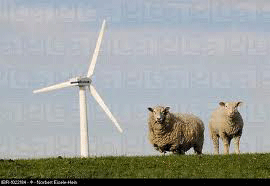 Australia’s twist in the wind, CLIMATE SPECTATOR: Matthew Wright, 13 Mar 2012 Denmark’s renewable energy achievements and its ambitious targets demonstrate a serious plan to lead the world in tackling global climate and energy security. Wind turbine technology will power half of its plan.
At the end of last year, Denmark announced that it will increase its share of wind power in the electricity supply mix from 25 per cent, its total today, to 50 per cent by 2020. The earlier plan was to do the same, but by 2025.
Denmark’s bullish drive towards wind energy comes from the public’s ongoing strong support for the industry and technology. Over one million Danes currently live within one kilometre of an operating wind farm. Many of these wind farms are being, or are scheduled to be, upgraded with newer turbines. This ongoing process of upgrades shows that support for wind energy stays strong in the local vicinity even after communities have lived with a generation of turbines that have served their useful lives.
Denmark will reach its 50 per cent wind power target through three main tracks. They’re building a generation of new onshore wind farms as well as the establishing a brand new offshore wind industry. A very important part of the plan involves the repowering of existing wind farms. Continue reading
In the interests of their fossil fuel backers, Liberal Party attacks wind energy
 Is Rowan looking after the interests of his constituents, or of the fossil fuel industry? He is correct, as I understand it, in pointing out that there are times when the generated wind power loads the SA grid to its limit, and that there will be a need for more interconnection between SA and the eastern states if wind power is to expand much further. However, the Liberal Party’s systematic attacks on sustainable energy and support for the fossil fuel industry in its campaign to stop the rise in sustainable energy shows a complete abandonment of ethical standards…
More Coalition attacks on wind power and renewables, Independent Australia, 08 Mar 2012 Liberal MP Rowan Ramsay is yet another Coalition MP keen to promote fossil fuels over renewables — especially wind. Environmentalist Dave Clarke responds to a speech Ramsay made recently attacking wind power projects in South Australia. Rowan Ramsey gave a speech in the Australian Parliament in mid-February 2012, which was biased against wind power. In this speech he made a number of claims and inferences that were questionable at best and false at worst. Continue reading
The right policy mix – Australian Renewable Energy Agency (ARENA) and the Clean Energy Finance Corporation (CEFC)
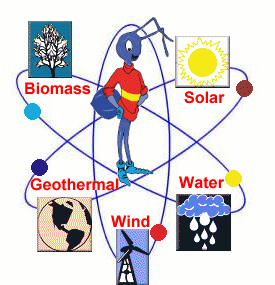 Luckily, in Australia, we are developing precisely such a [correct] policy mix. R&D support is taken care of by the Australian Renewable Energy Agency (ARENA), a price on carbon starts in mere months, and the Clean Energy Finance Corporation (CEFC) focuses on rolling out clean energy projects.
If subsidies are an economic evil, then let’s deny them across the board. Let’s wind back the billion dollar depreciation subsidies for oil and gas and wind back the billions in fuel tax exemptions for the mining industry for a start.
Right track for a clean energy future Climate Spectator, 8 Mar 2012 Simon O’Connor “…….that policy option, [supporting renewable energy combined with a price on carbon] is far and away the most cost-effective climate change mitigation strategy, delivering emissions reductions at significantly lower cost..
….. At a time when most economies are blindly groping for industries that will create jobs and open new markets, the renewable energy industry is a global superstar. Over $260 billion was invested globally in renewables last year, with more renewable energy infrastructure built than fossil fuels since 2010.
Germany is the world’s biggest market for solar power, producing about half of all solar output in 2010, and was recently responsible for lodging around a quarter of the world’s patents for renewable energy technologies. Considering the more than $40 billion invested there last year in the midst of a tumultuous eurozone economy, and the 370,000 jobs in the renewable sector, it seems odd to suggest that support for clean energy has been poorly targeted.
German growth in this sector has without doubt been primarily due to strong government support. Having nurtured the industry to the point that it is becoming genuinely commercially competitive, the German government is now slowly unwinding its support. Far from a demonstration of the failure of public support, this is a textbook example of how innovation should be considered a public good, one that should be supported then left to stand on its own two feet once mature. .. Continue reading
7,200 jobs to be lost in Australian govt’s sudden closure of solar hot water rebate
GREEN DEALS: Solar surprise, Climate Spectator, Daniel Palmer, 7 March The federal government’s decision to abandon the solar hot water rebate (Renewable Energy Bonus Scheme) on Tuesday afternoon has been a major talking point, with manufacturers critical of the lack of consultation.
An initiative of the Coalition government in 2007, the Renewable Energy Bonus Scheme offered rebates of up to $1,000 for households that installed solar hot-water systems. It was always slated to end after five years (i.e. 2012) but the exact date for its cessation was widely expected to be June 30, the end of the financial year (and basically five years from its beginning on July 17, 2007). Hence the move to end the offer for rebated as of close of business Tuesday was met with more than a hint of surprise from the industry.
The industry has said that as many as 7,200 jobs (1,200 in manufacturing and 6,000 in installation) could be at stake. It is a blow to the likes of Dux and Rheem, but Dreyfus indicated that the government would be offering no special assistance……http://www.climatespectator.com.au/commentary/green-deals-solar-surprise
A history of dishonesty – Waubra Foundation, Landscape Guardians, and the Baillieu government.
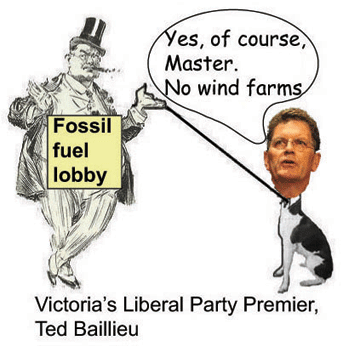 The question we, the voters, need to ask is: ‘how did such a sorry lot with such a transparent and dishonest agenda succeed in bringing the wind industry to its knees thus depriving the public of a chance to reduce our carbon emissions?’
The answer is that no government could have been so easily duped unless it was complicit.
It is clear that the scuttling of the wind industry in Victoria was a deliberate political ploy to appease the coal industry, with the Guardians’ scare campaign simply serving as window dressing to dupe the public into thinking it was all in our interest.
This is the third part of Independent Australia environment editor Sandi Keane’s trilogy on the role of deception in the public debate on global warming. The first part, Deception is our Product, looked at the role of clever PR practitioners hired by the mining oligarchs to trick the unsuspecting into sacrificing their interests for those of their clients. The second part was the handy guide: The Practical Guide to Trickery & Fakery in the Digital Age. This thirdinstalment is the actual case study of Sandi’s investigation of the Landscape Guardians and the Waubra Foundation.
CASE STUDY: The Landscape Guardians and the Waubra Foundation, Independent Australia, 6 March 12, It began early last year, when a mate who likes to argue the toss with me on enviro-issues tipped me off about the anti-wind group, the Landscape Guardians.
The first hint that these people were not the self-appointed protectors of the landscape they claimed to be was the name. No dinky di greenie group would knowingly jump into bed with the notorious UK Country Guardians, with its links to both climate skeptics and the nuclear industry. The pressure group was set up by Sir Bernard Ingham, who was a former press secretary to Margaret Thatcher, consultant to the nuclear industry and an acknowledged “black belt” in the art of spin. Continue reading
New renewable energy course in 187 Australian secondary schools
 Students help get world on renewable path, Illawarra Mercury, BY KATE MCILWAIN 05 Mar, 2012 A new course focusing on renewable energy at Corrimal High School is helping to inspire the next generation of scientists. The Science and Technology Education Leveraging Relevance, or STELR, course provides colourful, interactive equipment for Year 10 students
to experiment with different ways of generating solar and wind energy. It was developed by the Australian Academy of Technological Sciences and Engineering and is now taught at 187 schools nationally…..
http://www.illawarramercury.com.au/news/local/news/general/students-help-get-world-on-renewable-path/2476193.aspx
Australia positioned to lead in renewable energy, says global engineering investor ABB
 ABB undeterred by carbon tax controversy, BY:SARAH-JANE TASKER , The Australian , March 02, 2012 GLOBAL engineering company ABB Group will continue investing in its Australian arm despite the political upheaval. ….. ABB, one of the largest engineering companies in the world with a market value of about $38 billion, is targeting the renewable energy sector as a significant growth area. It believes Australia is in pole position because of the carbon tax.
ABB Australia country manager Axel Kuhr said the company had not given up on the renewables sector in Australia, despite the opposition’s promise to scrap the carbon tax.
Its confidence in the sector was reflected in its decision in November to buy Darwin-based Powercorp, a renewable power automation company.
“All the discussions around the carbon tax and the delay around that wasn’t helpful but we believe global warming is happening and that countries are really looking at doing something about it,” Mr Kuhr said. “This is a sector where we see further growth in the future years.”
ABB describes itself as a global leader in power and automation technology that enables utilities and industrial users to improve their performance while reducing their environmental impact.
“Our equipment is geared to help our customers save energy, so for us (the carbon tax) should generate new business as it helps companies look to make carbon tax savings,” Mr Kuhr said.
He said wind and solar power would take off in the long term, and prices would fall…… http://www.theaustralian.com.au/business/mining-energy/abb-undeterred-by-carbon-tax-controversy/story-e6frg9df-1226286684365
Australia’s big utility industries holding back renewable energy development
frustration from having its wind farm development options restricted by the dominance of the big three energy utilities.
the secretary of the Department of Energy, Drew Clarke, conceded that the market power of the three big retailers and their impact on the deployment of large scale renewables was an issue that was being monitored.
Big three utilities hindering renewable energy, BY:GILES PARKINSON, :The Australian , March 02, 2012 AFTER spending more than three years waiting for Australia’s dominant energy utilities to sign contracts to build new wind farms, the country’s largest renewable energy developers have decided to take matters into their own hands and write the contracts themselves.
The announcement by Pacific Hydro last week that it would establish its own energy retailer by July 1 was driven primarily by its immediate need to find an off-take agreement for the power to be generated by the 150MW Moree Solar Farm.
Without it, the consortium in which PacHydro is involved had little chance of retaining the tender for the Solar Flagships project. But the decision to push into retailing has been brewing for some time and could provide some interesting dynamics as Australia embarks on a $20 billion-plus spend to meet the country’s 20 per cent renewable energy target by 2020. Continue reading
Tasmania’s unique opportunity as leader in renewable energy
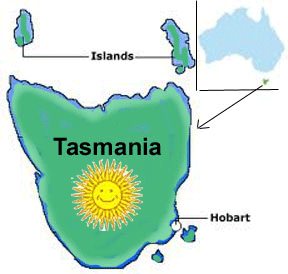 Opportunities for Tasmania in the impacts of climate change, 1 March 2012 The Tasmanian Energy Forum was opened in Hobart today with an address from Minister for Climate Change and energy efficiency, Cassy O’Connor, outlining the opportunities that co-exist with the impacts of climate change.
“Tasmania has an opportunity like no other state in Australia to become a leader in renewable technology,” she said. “Through our early investment into renewable energy technology, Tasmania is perfectly positioned to become a green battery for mainland Australia and an economic powerhouse in a carbon constrained world.
“We have the Climate Futures work from the Antarctic Climate & Ecosystems CRC that tells us how rainfall patterns will change, what to expect in the way of extreme events like flooding and bushfire, and which parts of our state will suffer more severe frost, and longer dry spells.
“The change in rain patterns will affect flows into our hydro dams, investment in renewable energy production must happen now if we are to maintain our competitive advantage. “We have amazing opportunities in:
Renewable energy with excellent wind resources, and potential in solar, tidal and geothermal
Energy efficiency across industry, business and the community with big in roads into energy efficiency upgrades in public housing, and
Innovative and sustainable agriculture, and a sustainable forestry industry
“The time is now to act upon advice from the Tasmanian Renewable Energy Industry Development Board, to secure our clean, green, energy future.” http://www.media.tas.gov.au/release.php?id=34357
Ted Baillieu is costing Victoria’s economy, with wind energy losses
Another wind farm falls to Vic laws, Yes! to Renewables February 27, 2012 by Ben Courtice, Synergy Wind’s wind farm that was proposed for Devon North, near Yarram in South Gippsland, has had an extension of its planning approval rejected by the Wellington Shire Council. This is the first wind farm to fall due to the requirement to renew or extend planning approvals under the new laws, and unfortunately there may be more to come quite soon.
We will track these setbacks as they occur, and will soon update our assessment of just how much the 2011 anti-wind policy is costing Victoria in jobs and investment dollars….. http://yes2renewables.org/2012/02/27/another-wind-farm-falls-to-vic-laws/
Solar energy a good financial deal for Australian homes
Double quick time for solar returns, The Border Mail, 22 Feb 12, Solar power systems are offering a return on investment in half the time it took a decade ago, according to an industry leader. Eco-Kinetics general manager South Australia, Mark Hofner, said solar power investments today would pay for themselves in about five years.
“A return on investment a decade ago would have taken 10 years,” Mr Hofner said. “Today it is around half the time; even a little 1.5 kilowatt system is under three-and-a-half years for a return. Solar is a good deal.” Continue reading
Renewable energy helped Australia to lower greenhouse gas emissions
Mixed Greens: Clean power cut carbon in 2011, RENeweconomy, By Sophie Vorrath 21 February 2012 Australia has cut its total carbon emissions for the second year running, according to new figures released by the federal government yesterday, an achievement – coming at a time of economic growth – that is being largely attributed to the electricity sector and, more specifically, the introduction of more clean, renewable energy into the power mix
. Clean Energy Council acting CEO Kane Thornton said the analysis from the Australian National Greenhouse Accounts shows that overall greenhouse emissions dropped about 1 per cent in the year to September 2011, while electricity emissions dropped 3.2 per cent during this period……. http://reneweconomy.com.au/2012/mixed-greens-clean-power-cut-carbon-in-2011-2011
Australia’s has inadequate renewable energy policy , in opposing solar feed-in tariffs
 The Australian laws – dubbed the ”clean energy future package” by the government….The package also includes a
$10 billion Clean Energy Finance Corporation to invest in and underwrite the development of fledgling technologies.
But the government opposes feed-in tariffs and is reducing a national solar incentive scheme. State solar feed-in tariffs have been wound back
German experience: clean energy requires subsidies, The Age, Adam Morton February 18, 2012 AN ARCHITECT of Germany’s rapid growth in clean energy – it has nearly half the world’s rooftop solar power – has warned that Australia’s climate policies will not alone drive a switch to greenhouse-gas-free electricity.
Germany reached its 2020 target of generating a fifth of its electricity from renewable sources nine years ahead of schedule, largely through feed-in tariffs that guarantee new power forms an inflated rate for the power they use to make them competitive.
It installed 3 gigawatts of solar photovoltaic panels in December alone – roughly enough for 1.5 million homes. Australia has less than half this in total. Continue reading
1 This month



Help Aunty Sue Protect Her Land and Sacred Sites From Destructive Rocket Testing.
.

Australians deserve the truth
about
AUKUS – https://aukuspublicinquiry.com/

PETITION – To: Prime Minister Anthony Albanese and the Australian Labor Government

of the week – Australians for War Powers Reform (AWPR)
To see nuclear-related stories in greater depth and intensity

