 REneweconomy Giles Parkinson, 22 October 2018 The rapidly emerging large scale solar sector achieved a significant milestone on Sunday, October 21, when their combined output in the National Electricity Market broke through the 1GW barrier for what is believed to be the first time.According to this graph below [on original] sent to us by Mike Hudson, using data he sourced from the Australian Energy Market Operator, the 1GW level was first breached in mid morning, and continued until almost 3pm in the afternoon.
October 21, 2018
Posted by Christina Macpherson |
AUSTRALIA - NATIONAL, solar |
2 Comments
Victoria’s largest solar farm goes ahead after “solving” connection  dilemma, REneweconomy, Giles Parkinson, 16 October 2018 The 200MW Kiamal solar farm in Victoria – the largest in the state to date – will be officially launched on Wednesday and begin construction this month after developer Total Eren says it has resolved connection issues that had already delayed the $300 million project.The Kiamal solar farm is located near the town of Ouyen – not far from Mildura in the state’s north west. But as RenewEconomy revealed in May, it is located in what could be described as the “rhombus of death”, a part of the network that doesn’t have the “system strength” to accommodate all the wind and solar projects planned for the area. dilemma, REneweconomy, Giles Parkinson, 16 October 2018 The 200MW Kiamal solar farm in Victoria – the largest in the state to date – will be officially launched on Wednesday and begin construction this month after developer Total Eren says it has resolved connection issues that had already delayed the $300 million project.The Kiamal solar farm is located near the town of Ouyen – not far from Mildura in the state’s north west. But as RenewEconomy revealed in May, it is located in what could be described as the “rhombus of death”, a part of the network that doesn’t have the “system strength” to accommodate all the wind and solar projects planned for the area.
|
October 16, 2018
Posted by Christina Macpherson |
solar, Victoria |
Leave a comment
 Climate right for solar plan: Reynolds, HOBART residents and businesses would be able to install solar energy systems with no upfront costs under an initiative proposed by mayoral candidate Anna Reynolds. HELEN KEMPTON, news.com.au Sunday Tasmanian OCTOBER 14, 2018
HOBART residents and businesses would be able to install solar energy systems with no upfront costs under an initiative proposed by mayoral candidate Anna Reynolds.
Ald Reynolds says the city should strive to double solar installations over the next five years.
Hobart is a poor performer compared with other Tasmanian local government areas with Sustainable Living Tasmania figures placing it 16th in terms of solar installations per capita.
“Council has taken action to install solar panels on its own buildings but there is so much more we can do,” Ald Reynolds said.
“I will advocate for a solar saver program to help Hobart residents, businesses and organisations install solar panels.
“Council will pay the upfront cost for the system and you, or your landlord, pay it off over 10 years, interest free.
“The savings made on energy bills will more than outweigh the payments to council, leaving you better off.”
The independent candidate’s push is backed by the chief strategist of climate advocacy group 350 Australia……..https://www.news.com.au/national/tasmania/climate-right-for-solar-plan-reynolds/news-story/1aa9c5761666dbbb411a35f424b0c8a0
October 15, 2018
Posted by Christina Macpherson |
solar, Tasmania |
Leave a comment
news.com.au , 10 Oct 18, IT WAS Australia’s big hope for cutting your electricity bills and ending the climate wars but today it’s been confirmed that’s not going to happen. EVERYONE has been crying out for the major parties to agree on an energy policy for Australia but it’s becoming clear this is probably not going to happen.
At an energy forum being held in Sydney today, new Federal Energy Minister Angus Taylor dismissed suggestions a bipartisan agreement was the way forward and pointed to the huge difference in the policies of the major parties.
“I don’t know how we’re going to get bipartisanship given we have a 26 per cent emissions reduction target … and the other side has 45 per cent,” Mr Taylor told the AFR Energy Forum 2018.
Australia’s energy policy is in tatters after the National Energy Guarantee was abandoned by the Coalition after Malcolm Turnbull lost the prime ministership.
Now even Labor’s shadow minister for climate change and energy Mark Butler has acknowledged defeat. Speaking after Mr Taylor, he said the idea of developing a bipartisan “market mechanism” to address climate and energy policy would not happen.
“We need to recognise that the solution we’ve been banking on now for a number of years … has been snatched away,” he told the forum.
“They (the Coalition) have walked away from the table because they’ve said they can’t countenance any agreement with Labor over climate and energy policy.”
Mr Butler noted the two parties got close in 2016 with the emissions intensity scheme, then again in 2017 with the clean energy target and most recently with the NEG this year, but each time the policies were taken off the table largely due to revolt within the Coalition party room led by Tony Abbott, despite the policies having broad support among state and territory governments as well as the business community.
“Now we confront a position … where investors are left with no rules to guide their investment decisions once the renewable energy target starts to taper off in coming months.”
As Australia heads towards its next federal election — likely to be held next year — Mr Butler noted there were warnings electricity prices would rise if the NEG was not passed and the futures market was already predicting hikes next year.
But he acknowledged there was no quick fix and said getting the unit price of electricity would be difficult. He said Labor would focus on policies to reduce consumption as a way of lowering bills. It has already announced plans to help businesses with tax write-offs for capital upgrades and software to make them more energy efficient.
He said Australia’s energy efficiency and productivity was already lower than average compared to some other OECD countries and China, which haven’t enjoyed low prices in the past like Australia has.
“The pathway for really substantial reductions to energy bills for business and households, I think, lie more in an aggressive approach to energy efficiency and productivity,” Mr Butler said.
When it comes to the Coalition’s approach, Mr Taylor said Prime Minister Scott Morrison had given him one KPI (Key Performance Indicator) and that was to lower power prices while keeping the lights on………
https://www.news.com.au/finance/business/australias-energy-solution-has-been-snatched-away/news-story/2fe7777c47e785a94bcc621e6a62ede4
October 11, 2018
Posted by Christina Macpherson |
AUSTRALIA - NATIONAL, energy |
Leave a comment
https://www.sbs.com.au/news/renewable-subsidies-phased-out-by-2030 Labor leader Bill Shorten says coal will be part of Australia’s energy mix for the foreseeable future, but wants renewable energy to be more accessible.
Opposition Leader Bill Shorten says a lack of policy is preventing Australia from becoming a renewable energy superpower, but admits coal will be part of the mix for the foreseeable future.
“What we need to do is create investment certainty, write out what the rules are so we can get more renewable energy,” he told reporters in Melbourne on Wednesday.
Renewable energy “is getting cheaper and I want to make it more accessible to small business and consumers.”
October 11, 2018
Posted by Christina Macpherson |
AUSTRALIA - NATIONAL, energy, politics |
Leave a comment
Electric cars would save lives and cut costs, but Australians ‘risk being left behind’, SMH, By Nicole Hasham
6 October 2018 Deaths from air pollution would be prevented and the Morrison government would meet its pledge to make electricity more reliable and affordable if more Australians drove electric cars, but a lack of political will is holding back the benefits.That is the widespread view expressed to a Senate probe into electric vehicles in Australia. Electric car maker Tesla, headed by controversial entrepreneur Elon Musk, is among those who assert that “government leadership” is the main barrier to increasing electric vehicle uptake in Australia, while the government’s own infrastructure adviser warned that Australians “risk being left behind” in the global transition.
Australia trails the world in the adoption of electric vehicles. Just 2284 were sold last year – 0.2 per cent of total vehicle sales. This is largely attributed to a lack of vehicle choice, fears about limited driving range and higher upfront costs than traditional cars.
In contrast, electric vehicles make up about 20 per cent of new sales in Norway, and are expected to reach 30 per cent of sales in China by 2030.
The Senate inquiry, chaired by independent South Australian senator Tim Storer, is investigating the benefits and opportunities of electric vehicles in Australia.
It is broadly acknowledged that electric vehicles improve air quality, help address climate change, boost public health and are cheaper to run than conventional vehicles.
……The Morrison government said these two outcomes – making electricity more reliable and affordable – would be its “unrelenting” focus following the demise of the National Energy Guarantee. However the government provided only limited support for electric-vehicle adoption.
Tesla told the inquiry that thousands of Australians had placed deposits for its model 3 sedan and research showed 50 per cent of Australians would consider an electric vehicle for their next purchase.
But it said governments must help ensure Australians could access charging infrastructure and a wide range of vehicle models, and reduce financial and logistical hurdles.
“The main barrier to increasing electric vehicle uptake in Australia is not consumer appetite; rather it is clear government leadership,” Tesla wrote.
Tesla said the Morrison government should set an ambitious target for electric vehicle uptake to send a clear message to manufacturers and consumers that Australia was ready for the transition.
The NRMA, ClimateWorks and the Electric Vehicle Council also called on governments to act to encourage the uptake of electric vehicles in various ways, such as implementing vehicle emissions standards, supporting the establishment of charging infrastructure and setting targets for government fleets. ……
October 8, 2018
Posted by Christina Macpherson |
AUSTRALIA - NATIONAL, energy, politics |
Leave a comment
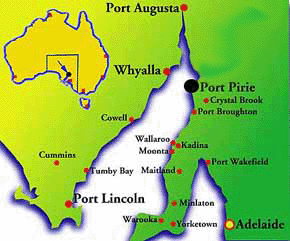 ‘Renewables capital of Australia’? Port Augusta shows off its green energy credentials, ABC
By Stephen Long, 5 Oct 18 “………
Renewables boom boosts Port Augusta
Thirteen renewable energy projects are underway or under consideration — from wind farms and pumped hydro-electric power to solar with storage that can shift electricity made when the sun’s shining to meet peak demand in the evening.
“The one great resource we have here in Port Augusta and the upper Spencer Gulf is this wonderful natural resource called the sun,” Mr Johnson said.
“It’s no different to having a massive uranium deposit, a massive gold deposit, a massive copper deposit.”
In a country drenched in sun, this natural resource is particularly abundant in the arid landscape around Port Augusta, and there are also plenty of flat expanses on which to build the facilities needed to exploit it.
Framed by the Flinders Ranges, stage one of the Bungala solar farm stretches over 300 hectares of land owned by the Bungala Aboriginal Corporation about 10 kilometres north-east of town.
Bungala uses a solar photovoltaic technology, with panels mounted on a tilting axis that can follow the sun’s path from east to west, maximising output and efficiency.
“It’s not only the largest solar project in Australia,” Mr Johnson said. “It’s also the largest in the southern hemisphere. And it’s only half complete.”
When stage two is complete, the entire project will cover more than 800 hectares — an expanse nearly as big as the Melbourne CBD — and generate up to 570 gigawatt hours of electricity a year, enough to power about 82,000 households, according to its owners, Italian multinational Enel Green Power and the Dutch Infrastructure Fund.
“Note that the Northern Power Station, when it was operating, was only producing between 500 and 540 megawatts,” Mr Johnson said.
“Obviously, it was operating 24-7, while the solar plant will only operate when the sun is shining, but when you start to incorporate battery storage and solar thermal, you then build in the energy security.”
Solar that releases energy even when the sun doesn’t shine
The Aurora project about 30 kilometres north-west of Port Augusta addresses the criticism often levelled at renewable energy — that when the sun doesn’t shine, and the wind doesn’t blow, the power doesn’t flow.
Construction is due to start soon on the concentrated solar thermal power station. It will able to store a massive 1,100 megawatt-hours of electricity, according to the project proponent, SolarReserve.
When it is built, an impressive sight will greet observers: a tower full of molten salt standing about 250 metres high, surrounded by more than 10,000 heliostats — movable mirrors, the size of billboards, algorithmically programmed to track the sun.
Those thousands of mirrors will reflect and concentrate sunlight, beaming it onto a receiver straddling the top of the tower.
During the day, molten salt will flow through the receiver and be heated to temperatures as high as 566 degrees Celsius, then stored in tanks overnight.
The energy will be dispatchable as electricity when needed — after dark in the evening peaks, or in the morning, hours after it was generated. It will be enough energy to power 90,000 homes, according to SolarReserve, which wants to build six of these plants in South Australia.
Crescent Dunes in the Nevada desert uses an identical technology.
There is one key difference: the price of the power.
“Pricing has come down dramatically, as it has throughout the renewable energy industry,” Kevin Smith, the chief executive of SolarReserve, said.
Crescent Dunes, the first plant of its kind, began operating in 2014.
Construction was aided by a concessional loan of $US737 million ($1,040 million) from the US Department of Energy. Despite that subsidy, it was contracted to supply electricity to Nevada at $190 a megawatt hour. Not cheap.
The Aurora project is receiving a much smaller concessional loan from the Australian Government — about $110 million — but will supply energy at a fraction of the price.
SolarReserve is cagey about the precise figure (the contractual conditions are complex) but Mr Smith agreed with reports that put the cost at about $78 a megawatt hour.
At current exchange rates, that is well under half the price of electricity from its inaugural plant in the US — and far cheaper than new coal-fired power.
“In terms of cents per kilowatt hour, we can supply electricity 30 to 40 per cent cheaper than new-build coal,” Mr Smith maintained.
A town blanketed in ash
Coal used to be Port Augusta’s lifeblood………
“We have incredible geography. We have everything we need to become the renewables capital of the world.”
An exaggeration? Maybe, but it’s not far off the mark.
The arid-zone landscape of the upper Spencer Gulf has solar resources ideally suited for concentrating solar thermal power, wind in abundance at speeds well suited for turbines, and a coastal location that opens the possibility of pumped hydro energy using seawater.
What you won’t find are fields of fruit and vegetables — but where there’s a will, there’s a way.
That white beacon of light on the edge of town? It’s a solar thermal power plant that runs a massive greenhouse that grows truss tomatoes.
Sundrop Farm is using the solar thermal electricity to desalinate water, create electricity to power the operation, and pump heat through 60 kilometres of pipe around the vines.
It’s a testament to human ingenuity, like much of what’s happening in the renewal of Port Augusta. http://www.abc.net.au/news/2018-10-05/port-augusta-becomes-australian-renewable-energy-hub/10338812
October 6, 2018
Posted by Christina Macpherson |
energy, South Australia |
Leave a comment
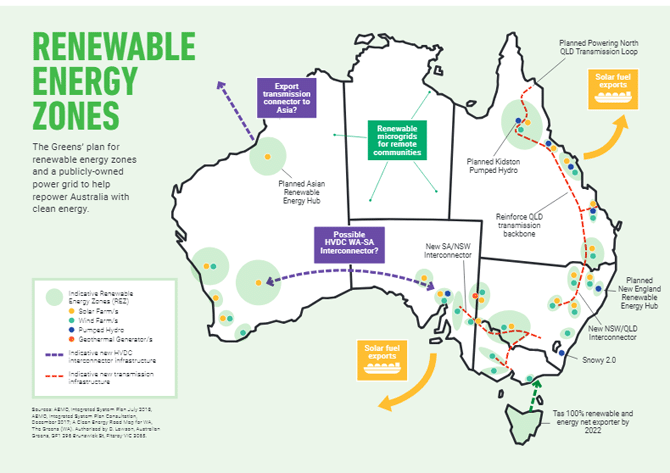
REneweconomy Giles Parkinson3 October 2018 The Australian Greens are proposing to create up to 30 special renewable energy zones across Australia, backed by a $2.8 billon grid transformation fund to help drive the transition towards 100 per cent renewables.
The plan, outlined by energy and climate spokesperson Adam Bandt as the All Energy conference in Melbourne on Wednesday, would see renewable energy zones located across the country – from the Pilbara in the north west of Western Australia to the best wind and solar resource areas on the east coast.
“Australia’s grid is still largely a set of wires out to coal mines. Government now needs to build the grid out to where the sun shines and the wind blows,” Bandt said in his prepared speech.Renewable energy is the cheapest form of electricity. With the right policy, Australia can become a renewable energy superpower,” also noting the potential for significant exports of renewables, either through carrying technologies such as hydrogen or direct links to Asia.
The Greens policy builds on the draft Integrated System Plan presented by the Australian Energy Market Operator, where most of the REZs are identified. However, the Greens fear that that current institutional arrangements may be inadequate to drive the energy transition at the scale and speed required. They aim for 100 per cent renewables, whereas the ISP envisages a share of 46 per cent (business as usual) by 2030 or more than 60 per cent if Labor’s policies are put into action.
“The Greens’ approach is focused on the public interest, so the network operator advises on how to build a grid to get us to 100% renewables,” Bandt said.
“The government assesses the proposal with a view to supporting coal-fired power station areas through the transition, and we then build the grid for the lowest possible cost as a public good, enabling new public and private renewables generation to come online.”
“I am worried that the potential of REZs and AEMO’s ‘Integrated System Plan’ will be squandered unless federal government grabs the issue by the scruff of the neck and starts building the network in the public interest.”
The proposal is the latest in a series of public interventions proposed by The Greens, including the creation of a public not-for-profit owned by the government and regulation of prices………
“The Greens are the only Federal party with a policy to construct and deliver renewable energy zones across the country, which will deliver a surge in new renewable energy construction.” https://reneweconomy.com.au/greens-propose-30-renewable-energy-zones-backed-by-grid-fund-30594/
October 3, 2018
Posted by Christina Macpherson |
AUSTRALIA - NATIONAL, energy, politics |
1 Comment
 Green Energy Markets predicts more than 6,000 annual jobs will be created but urges federal policy intervention, Guardian, Calla Wahlquist @callapilla 2 Oct 2018 The renewable energy construction boom in Victoria is on track to create more than 6,000 annual jobs, according to a new analysis.
As of August 2018, large-scale wind and solar projects under construction in Victoria had created 5,169 job years of employment – meaning one person working full time for one year – overtaking Queensland with 5,156, according to an analysis by Green Energy Markets released by GetUp on Tuesday.
When the remainder of the projects greenlit under Victoria’s renewable energy auction come online, job years of employment will increase to 6,072.
Victoria has 26 operational large-scale wind and solar projects, 12 under construction and 28 with planning approval.
But the Green Energy Markets director of analysis, Tristan Edis, said that without federal policy intervention the construction boom would being tapering off in 2020, because the large-scale generation certificates scheme would be over-supplied.
Renewable energy made up 25.5% of the electricity fed into the major east and west coast power grids in August, enough to power 12.1m homes, the report said.
As of August there were another 6,184MW of new large-scale renewable energy projects under construction, creating 15,511 jobs, the bulk of which were in Queensland and Victoria. Wind generation accounted for 54% of the new projects and the remainder were large-scale solar……..
Victoria and Queensland also on track to meet their state-based renewable energy generations targets of 40% and 50% respectively by 2030.
Victorian environment minister Lily D’Ambrosio said the construction jobs were the product of a record investment in renewable energy and that investment would be under threat if the Coalition won the state election next month.
NSW currently leads the number of jobs in the rooftop solar installation industry, followed by Queensland, Victoria and WA, although jobs in rooftop solar in Victoria are forecast to increase due to its $2250 solar panel rebate.https://www.theguardian.com/australia-news/2018/oct/01/victorias-renewable-energy-boom-set-to-create-thousands-of-jobs
October 3, 2018
Posted by Christina Macpherson |
AUSTRALIA - NATIONAL, employment, energy |
Leave a comment
 Kidston renewable energy hub one step closer, REneweconomy, Queensland Government, 28 September 2018 Genex Power’s Kidston Renewable Energy Hub in Far North Queensland has been fast tracked with the $330 million Kidston Pumped Hydro Storage project (K2H) today declared a coordinated project.
Minister for State Development, Manufacturing, Infrastructure and Planning Cameron Dick said the project, located at the decommissioned Kidston Gold Mine within Etheridge Shire, proposes an innovative use of two existing adjacent water-filled mine pits to generate hydroelectricity.
“If approved, the project could employ 370 people during the two-year construction and have a minimum lifespan of 50 years,” he said.
“When complete, Stages 1 and 2 of the Kidston Renewable Energy Hub will provide enough energy to power around 160,000 Australian homes – enough power for a city bigger than Cairns.
“Stage 1 alone will produce enough power to supply more than 26,000 Australian homes, offsetting 120,000 tonnes of CO2 per year and remove 33,000 cars off Australian roads.
“Genex has set a strong mandate to provide local residents with job opportunities, whether that be direct on-site employment, consultancy or indirect contract work.
“This renewable energy project has the ability to revitalise the local economy and I commend Genex on making sure locals benefit from the project……..
The Kidston Renewable Energy Hub comprises:
Stage 1 solar power project (50 MW) which has been constructed
Stage 2 proposed new solar project (270 MW) to integrate with the K2H project (250 MW) currently undergoing assessment
Stage 3 wind farm project (150 MW) which is in the feasibility stage.
Energy generated by Stage 2 (combined solar and hydro) will be via a new transmission line connecting the Kidston site to Mount Fox, near Ingham…….
Mr Dick said the introduction of large-scale, low-cost flexible energy storage also provides another solution to Queensland’s growing power requirements.
If approved construction is due to commence in 2019 and expected to be completed by 2021.
For more information visit: www.dsdmip.qld.gov.au/kidstonhydro https://reneweconomy.com.au/kidston-renewable-energy-hub-one-step-closer-34630/
October 3, 2018
Posted by Christina Macpherson |
energy, Queensland |
Leave a comment
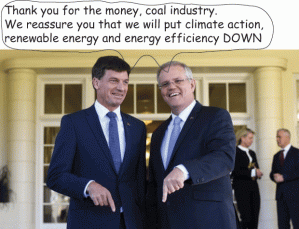 PM claims Australia will meet Paris target ‘in a canter’ despite emissions climbing
Morrison says rate of increase not as high as previous years and renewables investment will ensure Australia meets commitment, Guardian, Amy Remeikis, 30 Sept 18, Australia’s greenhouse gas emissions have continued to rise, but Scott Morrison seized on the silver lining, maintaining Australia would meet its Paris commitment, despite the government having no legislated instrument to help it get there.
Figures released on Friday showed Australia’s emissions increased 1.3% in the year to March 2018, up all sectors – except land use and electricity, where renewable technologies were having an impact on the latter.
The prime minister jumped on the rate of the increase not being as high as in previous years……..
Morrison said Australia would meet its Paris targets “in a canter”, largely based on investment in renewable energy technologies, despite concerns a lack of legislated instrument may impact investor confidence in the sector. …..
“We still have large-scale and small-scale policies there. We still have the Clean Energy Finance Corporation, and we still have the Emissions Reduction Fund for the period that it’s currently for, and we’re on track to hit it.”…..
Critics of the government’s stance have repeatedly called for legislation to ensure Australia meets the targets it agreed to when Tony Abbott signed the nation up to the Paris agreement.
But with the national energy guarantee a casualty of the leadership spillwithin the Liberal party, the government has no legislated instrument to ensure emission reductions, and no plans to create one…..
He said lowering electricity prices remained the government’s priority and criticised Labor for its policy. ….Labor has said it will look to legislate a version of the national energy guarantee the government abandoned as policy to ensure Australia does meet its targets. The Greens announced its parliamentary team will take a “hard line” on making sure any future Labor government does not back down.
Research released earlier this month found that emission reductions targets were not responsible for driving up power prices. https://www.theguardian.com/australia-news/2018/sep/30/pm-claims-australia-will-meet-paris-target-in-a-canter-despite-emissions-climbing
October 1, 2018
Posted by Christina Macpherson |
AUSTRALIA - NATIONAL, climate change - global warming, energy, politics |
Leave a comment
Sun shines on CSIRO’s cheap hydrogen industry, Brisbane Times, By Cole Latimer, 30 September 2018, Curtin University researchers have developed a cheaper and safer way to bottle and store Australian sunshine as hydrogen fuel.
Researchers from Curtin University’s School of Molecular and Life Sciences have created a lower-cost and less toxic method of developing hydrogen fuel from solar energy, paving the way for the growth of a hydrogen industry in Australia.
Hydrogen is currently being touted by the CSIRO and the government as Australia’s next major energy export industry, valued at up to $1.6 billion by 2025, and as a potential replacement for natural gas and petrol.
Current methods for creating hydrogen from solar power involve running an electric current generated by solar panels through water and requires either highly toxic cadmium or very expensive platinum as a catalyst to kick off the process.
Curtin University’s Dr Guohua Jia said the new process uses an extremely common, and much safer material, zinc selenium, which is sold in many pharmacies around Australia as a vitamin supplement…….
The new development comes as Australia’s chief scientist, Alan Finkel, tours Japan and promotes a hydrogen energy partnership between the two countries.
The Office of the Chief Scientist said Dr Finkel “led a delegation of Australian industry and government leaders interested in pursuing Australia’s potential as hydrogen supplier on an official visit to Japan”…..
the department said. “The Hydrogen Strategy Group, chaired by Dr Finkel, reported to the Coalition of Australian Government energy ministers that Australia has the necessary resources to supply hydrogen produced by near zero-emissions methods, at scale, to Japan and like-minded nations.”……https://www.brisbanetimes.com.au/business/the-economy/sun-shines-on-csiro-s-cheap-hydrogen-industry-20180928-p506px.html
October 1, 2018
Posted by Christina Macpherson |
AUSTRALIA - NATIONAL, energy |
Leave a comment
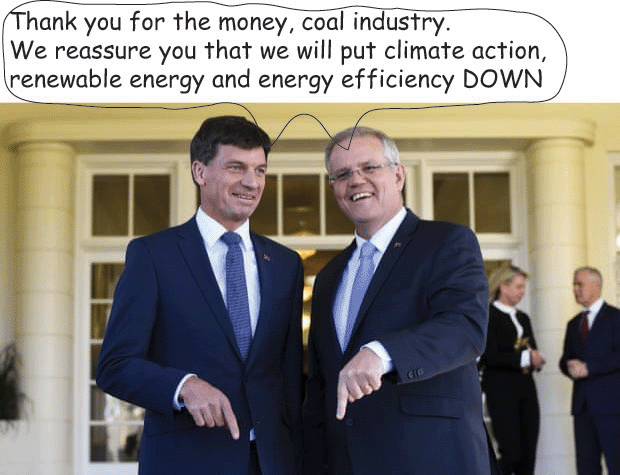
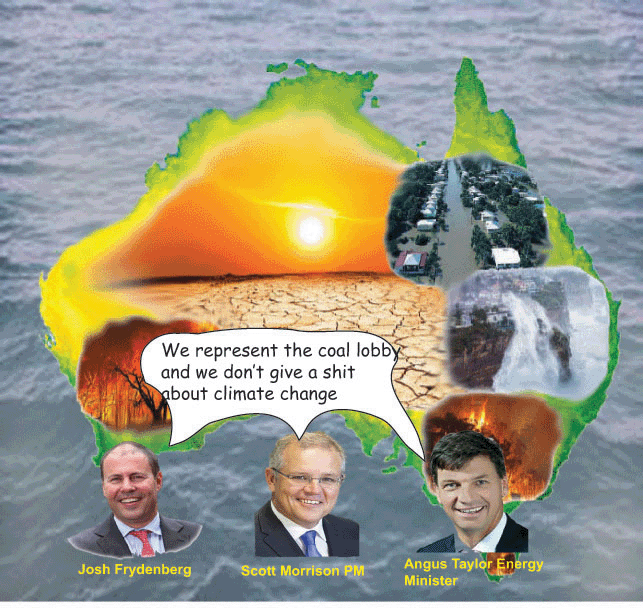
 Angus Taylor confirms government ‘won’t be replacing’ renewable energy target Canberra Times, 18 Sept 18, Energy Minister Angus Taylor has confirmed the Morrison government will not replace the renewable energy target after it peaks in 2020, officially creating a policy vacuum that opponents say will stifle clean energy investment and lead to higher prices.
In question time on Tuesday, Greens MP Adam Bandt challenged Mr Taylor to extend the target until 2022 to avoid a disastrous plunge in renewables investment when the current target ends.
“The renewable energy target is going to wind down from 2020, it reaches its peak in 2020, and we won’t be replacing that with anything,” Mr Taylor said……..
“We will drive prices down, that’s our policy, those opposite will drive them up,” he said.
An annual index released on Tuesday put Australia in the bottom three ranking for environmental policy among wealthy nations.
The Center for Global Development’s commitment to development index said the environment was “one of Australia’s weaker policy fields … largely due to its poor performance curbing climate change”….
https://www.canberratimes.com.au/politics/federal/angus-taylor-confirms-government-won-t-be-replacing-renewable-energy-target-20180918-p504j1.html
September 19, 2018
Posted by Christina Macpherson |
AUSTRALIA - NATIONAL, energy, politics |
Leave a comment


 Antinuclear