Australian government opens series of energy efficiency programs
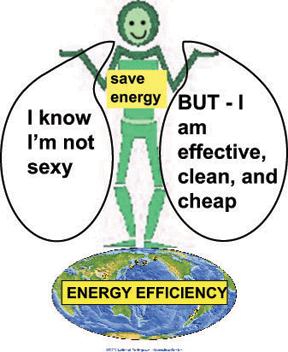 New Australian government energy efficiency programs opened Eco Business, February 9th, 2012 By : Energy Matters The Gillard Government has just announced the opening of series of energy efficiency initiatives and assistance targeted towards business, local government, households and communities.
A joint statement from Minister for Climate Change and Energy Efficiency Greg Combet, Minister for Regional Australia, Regional Development and Local Government Simon Crean; and Parliamentary Secretary for Climate Change and Energy Efficiency Mark Dreyfus states these programs will make it easier for regional communities and smaller councils to access assistance and support in the transition to a low carbon future.
The programs include:
Community Energy Efficiency Program – $200 million
To assist local government, not-for-profit and community organisations to undertake energy efficiency upgrades to community infrastructure, including council buildings, stadiums, education facilities, town halls and nursing homes.
While funding for wind and solar power systems are not considered eligible for this program, solar hot water systems are eligible as they are not classified as renewable energy generation systems.
Low Income Energy Efficiency Program – $100 million
To support groups of service providers to demonstrate smarter energy use in low income households across Australia.
Purchase and installation of renewable energy generation systems, such as solar photovoltaic, micro-hydro, wind turbine and biomass generation systems are not eligible, but solar hot water is as it is not classed as a generation system.
Energy Efficiency Information Grants program – $40 million
To support small and medium sized businesses and community groups by providing information and advice to make smarter energy choices.
“The programs will enable all Australians regardless of where they live or how much they earn to harness the opportunities of a low carbon future. They will be delivered in partnership with business, councils and community groups,” reads part of the statement.
Applications open on February 13 and the guidelines for each of these programs are now available via the links above. http://www.eco-business.com/news/new-australian-government-energy-efficiency-programs-opened/
Poo Power: why not? – it’s cleaner than nuclear
Poo Power: from poultry waste to renewable energy,PhysOrg.com, February 7th, 2012 Using curbside, commercial and biowaste from its poultry industry, the City of Greater Bendigo is building a business case that could see the introduction of Australia’s first multiple stream waste to energy facility.
The economic and environmental initiative is being undertaken with the help of Masters students from the University of Melbourne Graduate School of Business & Economics.
The students will conduct a feasibility analysis on the project over the next fortnight….. The student project is part of the University of Melbourne’s Faculty of Business & Economics Volunteer Business Practicum, a program that allows students to provide a genuine contribution to a business or community while gaining valuable work experience….. The students will work with the City of Greater Bendigo Council until mid-February, when they will present their findings to the council and their peers.
More information:
See http://www.gsbe.un … acticum.html for more information.
Provided by University of Melbourne http://www.physorg.com/wire-news/90052149/poo-power-from-poultry-waste-to-renewable-energy.html
Grattan Institute”s misleading attack on Solar Feed-in Tariffs
 The new Grattan, FOOT OFF THE GAS:GRATTAN WRONG ON SOLAR WRONG ON FEED-IN TARIFFS, Beyond Zero Emissions, 6 Feb 2012 Institute report “No quick fix for Australia’s future energy challenge” contains misleading comparisons, flawed analysis and glaring omissions on vital energy issues confronting Australia.
#1. The report makes a misleading comparison between the cost of wholesale fossil fuel electricity and the cost of solar photovoltaic electricity which currently competes in the retail electricity market and not the wholesale market.
“We do not expect a suburban Woolworths to compete with food prices at the Footscray Wholesale Fruit and Veg market. Yet this is what the Grattan Institute has done by ignoring the differences between the wholesale and retail electricity markets” says Matthew Wright,
Executive Director of Beyond Zero Emissions. “Rooftop Solar photovoltaic has halved in price in the last 24 months. This is a staggering cost reduction, and is in stark comparison to rapidly increasing rising gas prices”.
#2 The report claims that there are no viable energy storage options for renewable energy.
Matthew Wright explained that the Grattan Institute report’s conclusions “ignores Solar Thermal Power (Molten Salt Power Towers with integrated thermal storage tanks). It ignores this game-changing technology, already commercially deployed in baseload, intermediate and peaking configurations in Spain and under construction at a number of sites in the US. This technology is commercially available, off the shelf and ready for deployment in Australia. Rapid cost reductions have been projected by the International Energy Agency, the US Continue reading
How Australia’s Energy Minister sabotages renewable energy
ARENA Needed To Address Solar Flagships ‘Mess’ : Milne, by Energy Matters, 6 Feb 2012, Australia’s Solar Flagships program has faced continual delays and problems, sparking a call from the Greens to expedite the setting up of the Australian Renewable Energy Agency (ARENA) to take over the administration of the scheme.
Australian Greens Deputy Leader, Senator Christine Milne has blasted Energy Minister Martin Ferguson for his handling of Solar Flagships to date, an initiative designed to see construction of large-scale, grid connected solar farms.
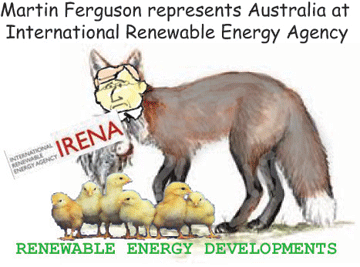
“Martin Ferguson has mismanaged this process from start to finish, helping to keep renewable energy from challenging coal’s dominance,” said Senator Milne.
“It is vital to see ARENA get off the ground as soon as possible to take political interference out of renewable energy scheme design and decisions and put them in the hands of a statutory independent authority.”…. Continue reading
Australian farmers missing opportunity to profit by farming energy
 Farmers squeezed out of energy boon, MATTHEW CAWOOD, Stock and Land 04 Feb, 2012 LANDHOLDERS should be capitalising on seismic changes in how we generate energy, says Matthew Wright, but instead they are being
pushed aside.
Mr Wright, executive director of Beyond Zero Emissions, thinks the thrust of current government policy will be to deny many landholders the ability to profit from wind generation, while compromising the enterprises of other landholders who host coal seam gas (CSG) operations without sharing in CSG profits.
Beyond Zero Emissions, a non-profit organisation, has the goal of moving Australia “from a 19th century fossil fuel based economy to a 21st century renewable powered clean tech economy”.
Wind turbines are “about as benign as it gets” for power generation, Mr Wright said, adding CSG is a “fairly destructive option for resource exploitation”.
Continue reading
Central Australia ideal for becoming a renewable energy exporter
 http://www.abc.net.au/rural/news/content/201202/s3421358.htm Central Australia bursting
  with renewable gold, ABC Rural, By Caddie Brain, 02/02/2012 A new study shows central Australia could become a major renewable energy exporter to Asia and major Australian cities. The former chair of the Climate Impact Group at the CSIRO, Dr Barrie Pittock, says the region holds an abundance of solar and geothermal resources.
He says the cost to harness the energy would be similar to the National Broadband Network, but would create local employment. “Eventually if we were generating so much electricity, we could start exporting it by undersea cable to Indonesia. There would be a huge market up there. “But I think in the near future we’re just talking about getting it to the west Australian grid or the east Australian grid.”
Renewable Energy Project for Wagga
Energy plant back on the agenda Daily Advertiser, 02 Feb, 2012 THE development of a proposed $13 million renewable energy plant in Wagga looks to be back on the agenda after the company behind the project received $800,000 to put towards new business ventures.
Representatives from the Adelaide-based company, Syngas, arrived in Wagga on Tuesday to continue the negotiations which began in April last year. Plans were first announced then for a power plant that would use green waste from Wagga’s kerbside collections to generate electricity.
Last September Syngas managing director Merrill Gray said the plant would be established on a 16,000 square metre block at the Bomen Industrial Park, with an underground cable connecting the power plant to neighbouring abattoir Tey’s Australia. The renewable energy generated by the plant would then be sent through
the cable, circumventing the grid….. http://www.dailyadvertiser.com.au/news/local/news/general/energy-plant-back-on-the-agenda/2441039.aspx
Solar power and energy efficiency save money for Queensland hospital
 Hervey Bay solar projects keep powering on, My Sunshine Coast, 2 Feb 12, Energy Minister Stephen Robertson has welcomed another key milestone in the Bligh Government’s $4 million plan to help power Hervey Bay with clean energy.
Mr Robertson said Queensland Health had now completed contractual arrangements with ABB Australia to install a $1.3 million 266 kilowatt solar panel system at the Hervey Bay Hospital.
“Depending on the weather, installation will begin within a few weeks on a solar panel system that will generate approximately 385 megawatt hours of energy each year, saving the hospital around $20,000 per year on electricity costs,” Mr Robertson said. “It will also help to reduce the hospital’s carbon emissions by 400
tonnes a year.
“An interactive web-kiosk and large screen television showing the energy being produced by the system daily, monthly and annually will also be installed in the hospital’s foyer as an education tool for visitors.
“This project and the $2.7 million Fraser Coast Community Solar Farm are part of the Bligh Government’s commitment to renewable energy
projects…. “ABB will draw from our global expertise in the solar industry to deliver a solar power system which operates at high efficiency, providing a lower cost per kilowatt production. “Our innovative technology and expertise is gained by our involvement in many of the world’s largest turnkey solar projects.
“The hospital has already reduced its energy consumption significantly by implementing a number of energy efficiency initiatives, and with the addition of the renewable energy from this system, they will become more self sufficient.”
http://www.mysunshinecoast.com.au/articles/article-display/hervey-bay-solar-projects-keep-powering-on,246
Australia’s Professor Martin Green spells it out on solar cell technology
 Solar guru receives Australia Day honour , 26 January 2012, Anna Salleh ABC Science, http://www.abc.net.au/science/articles/2012/01/26/3415244.htm Australia needs to look to Germany if it is to realise the potential of solar cell technology, says an expert who is being honoured today. Professor Martin Green of the University of New South Wales has been made a Member of the Order of Australia(AM) for his work on photovoltaics.
“Germany has been the only country that’s had a sensible long-term program in place to promote the use of renewables,” says Green.
Some argue solar cells are not a competitive option for reducing carbon emissions, and are limited by the fact that they don’t generate energy unless the Sun is shining.
But according to Green, the “stars are aligning for conventional roof mounted solar” and it is ripe for a new kick start from governments. Continue reading
Victoria’s Baillieu Liberal government was able to limit, but not stop, this last new wind farm
 Wind farm to be built near Colac, The Age, Adam Morton, January 25, 2012 A $400 million wind farm will be built in Victoria’s Western District six years after receiving planning approval from the state government. Spanish company Acciona Energy said the 63-turbine plant at Mount Gellibrand, 25 kilometres east of Colac, would generate enough power
to run about 88,000 homes. Construction of the 189-megawatt clean energy plant, scaled down from an initial proposal of 116 turbines, will start in March.
The wind farm needed final government approval before construction could begin, but was not subject to new planning laws announced by the Baillieu government in August giving households a right of veto over turbines within two kilometres of their home. The revised laws apply to new applications only…..
Mr Wickham said Acciona was yet to decide whether it would go ahead with three other wind farm proposals — at Newfield, Berrimal and Mortlake South — granted planning permits under the previous Labor government. He said the changes to planning laws, which include a ban on wind farms at tourist sites such as the Macedon Ranges and the Great Ocean
Road, meant it was “probably more beneficial for us to be looking in other states” for future projects…
Health and welfare groups have rejected claims turbines cause illness. The Climate and Health Alliance, a coalition of 20 groups including the Royal Australasian College of Physicians and the Australian Psychological Society, this week released a statement that there was no credible evidence in peer-reviewed scientific journals linking turbines to illness.
Documents obtained by environment group Friends of the Earth show NSW health officials dismissed claims by the Waubra Foundation and told the state’s ministers there was no evidence of “wind turbine syndrome”. The National Health and Medical Research Council is due to release a full review of scientific literature on wind farms and health bymid-year. http://www.theage.com.au/victoria/wind-farm-to-be-built-near-colac-20120124-1qfwx.html#ixzz1kVcrktpg
Government should promote electric cars for Australia’s automobile industry
 Innovation ‘key for car makers’, The Age, David Wroe Canberra January 25, 2012 DESPITE facing the ”toughest time of our life” amid slumping exports and job layoffs, Australia’s car industry can survive by modernising and making greener, more high-tech cars with government help, unions said yesterday…
.. Mr Jones said by way of example that the government’s previous Green Car Innovation Fund – which was axed to pay for Queensland flood assistance – had helped the industry transform itself with new models such as hybrid and fuel-efficient
cars.
”In three years, we completely transformed automotive manufacturing in Australia,” he said. ”We were being crucified because we had large cars that were petrol guzzling vehicles and were not good for the environment and people were shifting away from that product in droves.
”Within a space of almost no time at all as a consequence of the Green Car Innovation Fund, General Motors introduced a four-cylinder at its Elizabeth plant.”….
Greens industry spokesman Adam Bandt said the government should replace the Green Car Innovation Fund with an ”electric vehicle fund” of at least $75 million…..
http://theage.drive.com.au/innovation-key-for-car-makers-20120124-1qfos.html
Australia’s National Solar Schools Program takes off in Tasmania
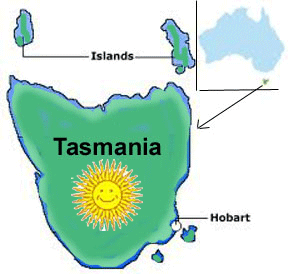 Solar funds for schools, THE MERCURY | January 25, 2012 FIFTEEN Tasmanian schools have won funding to install solar and other renewable-power systems to improve energy efficiency. The National Solar School Programs announced that more than $25 million would be distributed to 784 Australian schools for measures to tackle climate change.
Southern schools to receive grants are Bruny Island District ($50,000), Cygnet Primary ($45,333), Fahan ($47,687), Moonah Primary ($49,689), Peregrine, Nichols Rivulet ($42,197), Risdon Vale Primary ($49,975), St Paul’s Catholic School, Bridgewater ($39,440), Tasman District ($50,000) and Warrane Primary ($50,000).
The final round of applications for the grants will open on February 13. http://www.themercury.com.au/article/2012/01/25/295171_tasmania-news.html
Dubious claims that wind farms make people sick
Science on wind turbine illness dubious, say experts. SMH, Ben Cubby, January 24, 2012 FEARS that wind turbines make people sick are ”not scientifically valid”, and the arguments mounted by anti-wind farm campaigners are unconvincing, according to confidential briefings given to the state government by NSW Health.
Documents obtained under freedom-of-information laws show that health officials repeatedly warned ministers last year that there was no evidence for ”wind turbine syndrome”, a collection of ailments including sleeplessness, headaches and high blood pressure that some people believe are caused by the noise of spinning blades.
But the department’s advice contrasts with the view of the Planning Minister, Brad Hazzard, who was responsible for draft guidelines, released in December, that significantly tighten the approvals process……
One study by Nina Pierpont, which is central to the claims that wind turbines make people ill, was dismissed as ”not of sufficient scientific rigour” by NSW Health. ”This ‘study’ is not a rigorous epidemiological study; it is a case series of 10 families drawn from a wide range of locations,” according to the ministerial briefing on July 5 last year. ”This work has not been properly peer reviewed. Nor has it been published in the peer-reviewed literature. The findings are not scientifically valid, with major methodological flaws stemming from the poor design of the study.”
The documents, obtained under FOI laws by the environment group Friends of the Earth, say existing studies had been examined and no known causal link could be established. The assessment undermines the claims of an anti-wind farm group, the Waubra Foundation, which had been lobbying the government for a moratorium on new wind farms.
“The documents from NSW Health confirm our belief that the foundation has been ‘cherry picking’ data that supports its allegations about ‘wind turbine syndrome’ by talking with people who believe they have … symptoms,” said a Friends of the Earth spokesman, Cam Walker. ”This becomes a self-fulfilling prophesy and is not the basis of good science … Yet, as has been noted by a growing number of medical authorities, there is no credible evidence of a causal link between turbines and ill health.”……
A landowner near Lake George, Marcia Osborne, said her family had had no medical problems or trouble sleeping from the seven or eight turbines close by. ”Quite the opposite really, they’ve done nothing but help us,” she said.
”We are farmers … things were pretty tough [during the drought] … When they asked us if they could put a wind farm on the place it was like a gift from God. We used to curse the wind, now we get paid for the wind.”

The guidelines are on exhibition until March 14. http://www.smh.com.au/environment/energy-smart/science-on-wind-turbine-illness-dubious-say-experts-20120123-1qe98.html#ixzz1kPuwgvpd
The success of rooftop solar energy, in Germany, but in Australia, too
Last year, roof-mounted solar panels in Australia were able to compete favourably against peak-priced electricity from coal-fired power stations for the first time – without factoring in market-distorting subsidies. Solar PV panel wholesale prices are now about $1 per watt, compared to $3.50 per watt only a couple of years ago.
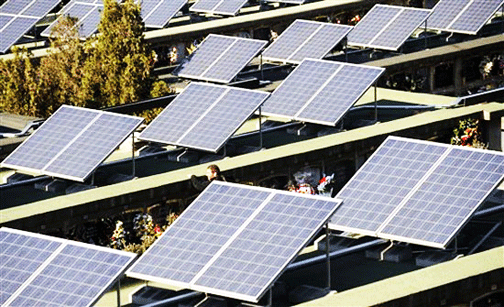
The proof is in the heating – solar’s shining success story, SMH, Martin Green January 21, 2012 Something extraordinary happened to the German national power grid during the pleasantly mild early weeks of last summer. Not only did the country’s almost 1 million, mainly rooftop (photovoltaic) solar panels pump 13.2 gigawatts into the grid – the equivalent output of up to a dozen nuclear power plants, or about 40 per cent of the highest-ever demand in Australia’s national electricity market – but they did so at exactly the right time.
That is, when demand was peaking. Whatever variability there might have been in the output of individual solar panels, due to shadowing, passing clouds or local rain, was smoothed out by the geographic range and sheer number of panels nationwide.
What the German experience demonstrates is that the stars are aligning for conventional roof-mounted solar, or photovoltaic (PV) panels, as a reliable and increasingly competitively-priced power source to make a significant contribution to electricity generation.
For many reasons – including the phenomenal uptake of PV panels in Germany, the economies of scale driven by mass production of panels in China, and increasingly efficient solar arrays – prices really are down. Continue reading
Rural communities favour wind farms, CSIRO study finds
CSIRO finds stronger wind farm support than media reflects, ABC Rural News, 17/01/2012 A CSIRO study has found there’s stronger community support for wind farms than reported in newspapers.
The case study looked at nine communities with wind farms and interviewed everyone from wind companies, to local government, turbine hosts and people both opposed to and supporting wind farms.
One of the authors of the report “Acceptance of rural wind farms in Australia” Dr Jim Smitham says residents don’t seek media attention to express their views.
“In presenting a balance picture, if there are groups of people who have a single point of view and are very strident in expressing that, they might appear to drown out some of the wider group who have lots of other reasons for support,” he says. http://www.abc.net.au/rural/news/content/201201/s3409653.htm
1 This month
7 April – WEBINAR – Australia and the Doomsday Clock – Preventing nuclear war through NoFirstUse and other policies
Online | Tuesday April 7, 4:00-5:30pm, Australian Eastern Time / 8:00-9:30am Central Europe Time
– Access the registration link
15 April – Zoom –Nuclear Power is Not the Solution
Apr 15, 2026 01:00 AM in Canberra, Melbourne, Sydney

Join the International Physicians for the Prevention of Nuclear War (IPPNW) on Tuesday, April 14th for a timely webinar exploring the risks associated with nuclear power and challenging the myth that it offers a simple, safe, carbon-free solution to the climate crisis

21 April Webinar: No Nuclear Weapons in Australia
Start: 2026-04-21 18:00:00 UTC Canberra, Melbourne, Sydney (GMT+10:00)
End: 2026-04-21 19:30:00 UTC Canberra, Melbourne, Sydney (GMT+10:00)
Event Type: Virtual
A virtual link will be communicated before the event.
Host Contact Info: australia@icanw.org

of the week – Australians for War Powers Reform (AWPR)
To see nuclear-related stories in greater depth and intensity
 Antinuclear