Australian Capital Territory legislates for solar feed in tariff
ACT passes large solar scheme, ABC News, By Kathleen Dyett December 09, 2011 The ACT Government has passed legislation to set-up Australia first large-scale solar feed-in tariff scheme. It will support renewable energy projects with a total capacity of up to 210 megawatts, with the first 40 megawatts to be allocated via an auction.
Large solar facilities that generate 2 megawatts or more will be the first to take part in the auction. The Liberals have slammed the scheme as costly and ineffective. But the Greens negotiated some changes before backing the bill.
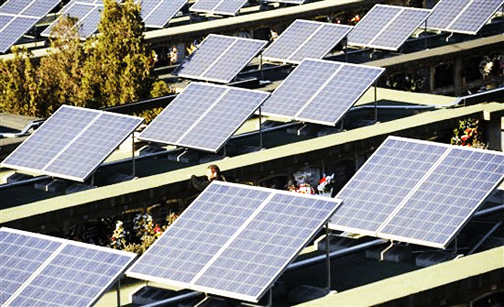
Greens MLA Shane Rattenbury says he is happy with the outcome. “The two amendments we’ve agreed with the Government are to first of all ensure that the developments take place within the Australian capital region,” he said.
“The second is to open it up to systems above 200 kilowatts which will predominantly go on rooftops. “We want to make the most of the many rooftops around Canberra that could be used to generate clean, green energy.” http://www.abc.net.au/news/2011-12-09/act-large-solar-tariff-scheme/3721884?section=act
Promoting renewable energy is the way to save the climate change debate
 The heavy polluting industres know they cannot easily shift basic values, so they have undermined solar and wind at the next level of understanding, around jobs, prices and the electricity industry. In reaction to the statement, ‘Investing in renewable energy is good for the economy by creating jobs,’ 80 per cent were in agreement, and only 10 per cent in disagreement.
After two years of campaigning for coal and against renewables, energy-intensive and heavy-polluting industry, along with certain media outlets and Opposition leader Tony Abbott, have done barely any damage to the perceived value of renewables as an industry.
 Cleaning up the climate debate, Climate Spectator , 8 Dec 2011, Dan Cass A recent poll confirms what I have come to believe after watching the global warming issue for 20 years; renewable energy is the only way to save the debate about saving the planet. If the UN wants to make progress in the climate negotiations and closer to home, if Julia Gillard wants to win the next election, then the debate should be couched in terms of the tangible benefits of today’s solar and wind technologies.
A poll by Essential Research, conducted during Australia’s recent carbon price negotiations, shows overwhelming public support for investment in solar and wind, and that this support might just win the politics of a carbon price.
detractors. Solar and wind have been politicised and companies need to step in and vigorously defend their interests. Continue reading
Solar photovoltaics booming on Australian homes
 with high levels of irradiation nationwide, some argue that residential grid parity has arrived, on average, throughout Australia.
Australia’s 500,000 solar homes PV Magazine, 07. DECEMBER 2011 BY: JONATHAN GIFFORD In a report released yesterday at the UN climate negotiations in Durban, the Clean Energy Council of Australia has revealed that more than 500,000 homes in Australia feature photovoltaic systems. The report looked at renewable electricity generation across the board and revealed that power for around four million homes was produced in 2011. This means that the country is well on the way to meet its goal of producing 20 percent of its power through renewable sources by 2020.
The progress of photovoltaics was outstanding, Continue reading
Australia’s renewable energy to double by 2020
 Report finds Australian renewable energy to double, Australia Network News, 6 Dec 11, A new report has found that renewable energy sources now provide Australia with nearly 10 per cent of its power, and that figure is on track to double by 2020.
The report produced by the industry’s Clean Energy Council said more than a million Australians now live in homes powered by solar panels and heavy rains have boosted output from hydro-electric plants. It found uncertainty over the carbon tax had stalled investment in major projects like large wind farms. But the council’s Director Kane Thornton predicts that will change now the tax has passed.”Certainly we believe that we’re on track to achieving the 20 per cent
renewable energy target by 2020,” he said.
“We’ve seen a strong year for solar power, there’s a lot of pent up investment in large scale wind projects that now that we have a carbon price in Australia we’re optimistic that there’ll be a strong growth in large scale wind farms over the coming years to ensure we really track towards that 20 per cent
target”.http://australianetworknews.com/stories/201112/3384606.htm?desktop
Bendigo calls on Victorian government to reverse its anti wind energy legislation

 Bendigo joins wind farm planning fight, ABC News, December 02, 2011 The State Government is coming under further pressure from central Victoria to overturn its controversial changes to wind farm planning rules. The Victorian Government moved in August to establish no-go zones for turbines in selected areas across the state, including land around Bendigo.
The decision upset several local environment groups and the Mt Alexander Shire at Castlemaine was among the first councils to voice opposition to the move. Bendigo Mayor Rod Fyffe says his council has also voted to ask the Government to reverse the decision…..”On balance, we feel that it was a decision that we would like to see reversed so that communities can look at what they want, work out what they want and plan for what they want.” http://www.abc.net.au/news/2011-12-02/bendigo-joins-wind-farm-planning-changes-fight/3708280
A pioneer wave energy project for Port Fairy, Victoria
 Wave energy to power homes, The Age, December 2, 2011 – A world-first wave energy project which mimics the movement of seaweed and kelp through the water will power hundreds of homes in Victoria’s south-west. The $14 million BioWAVE project is a single wave energy unit that will be anchored to the sea floor 30 metres underwater and about 800 metres from the shore at a site four kilometres west of Port Fairy.
The 450kW unit will be connected to the energy grid and power 300 homes by early 2013. The project is an example of biomimicry, in which biological traits are used in engineered systems. The Victorian government has put $5 million towards the project and other partners include AGL Energy Bluescope Steel, Lend Lease, Swinburne University, the University of Melbourne and the University of Sydney. Energy and Resources Minister Michael O’Brien said the project would also support the local economy and jobs. http://www.theage.com.au/environment/energy-smart/wave-energy-to-power–homes-20111202-1ob24.html#ixzz1fW5uImjT
As renewable energy costs go down, Australia should be partnering China in solar development
 wind is already cheaper than new-built coal in the US, and solar thermal with storage, and used as a peaking plant, will be competitive with peaking gas.
Australia should be pursuing a more strategic partnerships with China – like that between UNSW and Suntech, the world’s biggest solar PV maker
Why we don’t need coal, Climate Spectator, Giles Parkinson, 1 Dec 11 Last month, the International Energy Agency released a stunning report that suggested that the future of thermal coal exports could be threatened if the world ever decides to implement the policies to limit global warming to an average 2°C, rather than just merely talking about it, as they are doing in Durban this fortnight.
The coal industry laughed, suggesting such a scenario was highly unlikely. But what if technology took the decision out of the hands of politicians, as seems increasingly likely with the plunging costs of renewables, particularly solar PV, across the globe? And what does that mean also for Australia’s energy infrastructure, and the tens of billions of dollars that will be invested in the coming decade on the basis that business will continue as usual?
New forecasts from China suggest the cost of solar PV in that country will fall below that of coal-fired generation within 10 years. From that point, or even before, says Wu Dacheng, the vice chairman and secretary general of the China Photovoltaic Society, the country’s energy build out will be dominated by cheaper renewables. Continue reading
Geothermal power for Australia should not be ignored
 A Clean Resource Too Large to be Ignored – Geothermal Power Gains Steam Triple Pundit By Andrew Burger | November 28th, “……..recent studies showing that the US, Canada, New Zealand and Australia – Western Australia in particular – have geothermal resources that dwarf their energy needs, and despite the fact that it’s a proven, time-tested, economic source of clean, reliable baseload power….
Danish visitors puzzled by Victoria’s laws against wind farms
 Wind turbine rules mystify Danes, The Age, Adam MortoNovember 26, 2011 The head of the world’s largest wind energy company has questioned the Baillieu government’s rationale for giving households veto rights over turbines within two kilometres of their homes.
Ditlev Engel, chief executive of Danish company Vestas, said he had ”no idea” where the policy had come from. Mr Engel, who is visiting Victoria with Crown Prince Frederik and Tasmanian-born Crown Princess Mary, said no one had explained the motivation for Victoria’s most restrictive regulations on turbines.
Mr Engel backed opening wind farms to the public to dispel myths about wind power. Denmark generates a quarter of its energy from wind power. Vestas had turbine blade manufacturing plants in Victoria and Tasmania, but they closed in 2007 over policy uncertainty… http://www.theage.com.au/victoria/wind-turbine-rules-mystify-danes-20111125-1nzb0.html#ixzz1eqqTjYpA
Australian Renewable Energy Agency (ARENA) – a new approach to management
ARENA: A new approach to renewables, Climate Spectator, Scott Bouvier, 25 Nov 11 The Bills that set up the Australian Renewable Energy Agency (known as ARENA) quietly passed through Parliament this month. ARENA has been broadly welcomed as consolidating the management of multiple funding programs with greater independence. To date, ARENA has been promoted as business as usual, but with a new approach to management Continue reading
Energy farming an additional industry for rural Australia
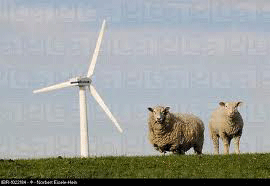 In Australia for many of us, isolation and lack of population limits such pursuits. Not so with renewable energy. It holds distinct advantages over traditional farming. It can be locally generated and locally used. We won’t face the market share and price squeezes that overseas competitors foist on us in other commodities.
I encourage state and federal politicians and bodies such as the National Farmers’ Federation and affiliated state representatives to lobby for renewable energy at ministerial level. After all it is a primary industry, no different to beef, sheep and viticulture.
Future in renewable energy, Weekly Times, 24 Nov 11 RENEWABLE energy is everybody’s concern, writes ROB NICHOLS Whether you believe the science on climate change or not, few would deny that a cleaner environment fuelled by renewable energy sources is a desirable goal. Far from threatening farming, this switch offers farmers and rural communities incredible opportunities.
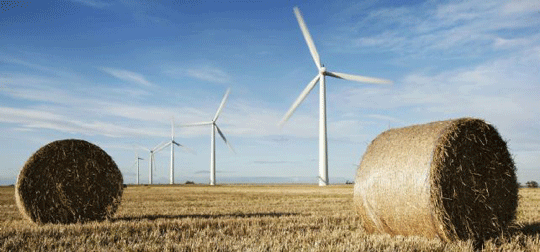
And these are big opportunities, as big as the opportunities afforded by fossil-fuel discoveries which have delivered spectacular fortunes to the world’s energy giants. After all, society’s insatiable desire for easier living and energy continues. Farmers have the resources – sun, wind, crops for biomass etc – plus the space to provide that energy.
Those resources can help us spread our financial risk, but we need to be quick. If we sit back and undervalue them, city and overseas investors will tap and rob our resources and export the financial gains away from our localities into the pockets of others. Failure to take control now will mean our businesses and communities will wither away and become irrelevant. Continue reading
Germany showing the way towards a distributed, decentralised energy future
 And will the rest of Europe follow? The poll-leading Socialists in France, after all, are talking of halving the country’s nuclear capacity. “Most of the world will follow this way, but it will be slow,” Dudenhauser says. “Everyone expected blackouts after the nuclear shutdown, but it didn’t happen. But it would not be manageable if everyone goes Germany’s way in the next two years.”
 Size not a factor in German power play , Climate Spectator, Giles
  Parkinson, 24 Nov 11 It seems strange that the world’s most cautious and best performing economy should be acting as some sort of crash test dummy for the world’s clean energy future. But this is exactly the position that Germany finds itself in following its commitment earlier this year to abandon nuclear energy and to push towards its vision of a fully renewable power supply by 2050.
And if this is the future, then companies that have based their models around the principal of centralised power stations may find little cause for comfort. But it is presenting enormous opportunities for those focused on the concept of distributed generation, particularly fuel cells – at least that’s the take of Roman Dudenhausen, the CEO and co-founder of German energy consultants ConEnergy, and a recently appointed director to the board of Australia’s Ceramic Fuels Cells. Continue reading
Big energy purchase deal for New South Wales wind farm
 Origin Energy Buying Electricity From Gunning Wind Farm by Energy Matters, 24 Nov 11 Origin Energy has expanded its renewable energy portfolio, entering into a long-term power purchase agreement to buy electricity from Acciona’s Gunning Wind Farm.
Under the deal, Origin will initially purchase federal government issued Large-Scale Renewable Energy Certificates (LSREC) from Acciona for a period of two years, beginning January 2012. From January 1st 2014, the agreement allows Origin to buy both the LSRECs and the power generated by the wind farm for a further eight years; with an option to extend. Continue reading
In China, wind power racing ahead, while nuclear power declines
Nuclear power, on the other hand, is a tale of decline. China’s wind sector overshadows the 11GW worth of nuclear in their electricity supply. In only six years, wind has blossomed to deliver 55 per cent more electricity to the grid each year than nuclear – an energy source the Chinese have been building for the last 26 years.
The growth of nuclear in China, although slow, has slowed further
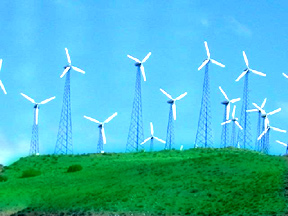
China’s massive deployments will be driving renewables down the cost curve, so Australia can invest in wind today with certainty that the technology is a wise long-term investment.
China’s path to renewable superpower Climate Spectator, Matthew Wright, 23 Nov 11 Comparing China’s wind and nuclear power sectors reveal much about the fortunes of new and old energy technologies. Wind power in China is growing at a blinding pace. China commenced construction of its first wind turbines in 2005 and in just six years has installed 58GW worth of wind power, which now contributes 128TWh to its grid. This is enough renewable electricity to power Australia’s most populous states – NSW and Victoria combined. Continue reading
Australia’s electric transport future – powered by sun and wind
Australia needs to begin a deliberate and widespread push into electrifying its transport  network, which means a big push for electric vehicles, but also a much higher ambition for renewable energy deployment. Siemens, Europe’s biggest supplier of energy equipment, which recently dumped nuclear from its portfolio after Germany’s withdrawal, suggests 40 per cent of Australia’s power generation should come from renewables – particularly solar and wind – by 2030.
An electric dream for transport, Climate Spectator Giles Parkinson, 23 Nov 11 Imagine an Australia with fast trains linking the major capital cities, diesel/electric trucks equipped with pantographs following overhead wires like trams in the inner city, electric vehicles dominating the passenger vehicle market, and 40 per cent of our electricity coming from renewable energy. Imagine, also, a smart phone-style “mobility manager” that allows you to make transport choices that can generate carbon credits, that can be accumulated and redeemed for restaurant vouchers, movie tickets and free travel. And all this by 2030. Continue reading
1 This month
7 April – WEBINAR – Australia and the Doomsday Clock – Preventing nuclear war through NoFirstUse and other policies
Online | Tuesday April 7, 4:00-5:30pm, Australian Eastern Time / 8:00-9:30am Central Europe Time
– Access the registration link
15 April – Zoom –Nuclear Power is Not the Solution
Apr 15, 2026 01:00 AM in Canberra, Melbourne, Sydney

Join the International Physicians for the Prevention of Nuclear War (IPPNW) on Tuesday, April 14th for a timely webinar exploring the risks associated with nuclear power and challenging the myth that it offers a simple, safe, carbon-free solution to the climate crisis

21 April Webinar: No Nuclear Weapons in Australia
Start: 2026-04-21 18:00:00 UTC Canberra, Melbourne, Sydney (GMT+10:00)
End: 2026-04-21 19:30:00 UTC Canberra, Melbourne, Sydney (GMT+10:00)
Event Type: Virtual
A virtual link will be communicated before the event.
Host Contact Info: australia@icanw.org

of the week – Australians for War Powers Reform (AWPR)
To see nuclear-related stories in greater depth and intensity
 Antinuclear