South Australia’s heatwave will not affect power supply
 SA heatwave will not affect power supply, Treasurer says, as TDU amateur cyclists ignore warnings, ABC News 19 Jan 18, By political reporter Nick Harmsen and staff The South Australian Government is not expecting to use the state’s new backup diesel power generators despite temperatures well into the mid-40s forcing a tight power supply balance.
The Australian Energy Market Operator (AEMO) has issued a level two lack of reserve notice for the state late this afternoon, meaning there is a small buffer of surplus generation available.A level three notice means unexpected load shedding blackouts are likely.
The power supply situation is even tighter in Victoria — with AEMO flagging the possibility of curtailing power to some industrial customers who have volunteered to be part of a demand management scheme.
SA’s hottest temperature so far recorded today was a scorching 47.4 degrees Celsius at Wudinna on Eyre Peninsula.Port Augusta hit 46.5C, Whyalla reached 46.4C and Lameroo and Tarcoola both had tops of 46C.SA Treasurer Tom Koutsantonis said while the state’s temporary generators were ready, they were unlikely to be used this afternoon.
“In terms of supply we should be okay,” he said.
“Victoria I understand is about to load shed industry. So they’re not coping with the power supply.
“They are a coal-dependent state and they are having to take industry offline to support their households. In South Australia we’re not having to do that today.”
In Adelaide today, the mercury climbed to 42.2C just after 12.30pm, after reaching a top of 41C yesterday and 38C on Wednesday……… State Emergency Service volunteers have handed out water at Adelaide Airport today and provided advice to international visitors to help them cope with extreme temperatures. http://www.abc.net.au/news/2018-01-19/sa-heatwave-will-not-affect-power-supply/9342306
Tesla’s South Australian battery project – a rapid success
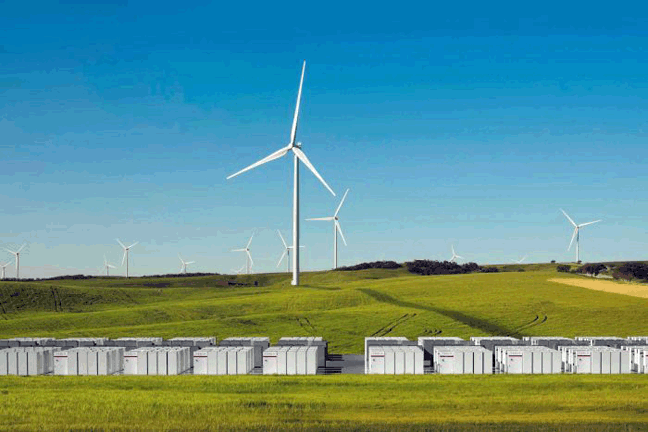 Inverse Innovation 11th Jan 2018. The results are in: Tesla’s South Australian project, touted as the
world’s largest lithium-ion battery with enough energy to power 30,000
homes, had an astonishing first month of operation. The 100-megawatt
behemoth, originally conceived by Elon Musk through a bet over Twitter, has
inspired the states of Queensland and Victoria to follow suit with their
own projects.
https://www.inverse.com/article/40117-elon-musk-tesla-south-australia-batter
Australian banking giant Macquarie invests in energy storage system
Business Green 12th Jan 2018, Connected Energy has secured a £3m investment from Australian banking giant Macquarie and French utility ENGIE to support the rollout of its
stationary storage system, it announced yesterday. The E-STOR system
offered by Connected Energy uses second-hand batteries from electric
vehicles (EVs), repurposing them into an energy storage system to help
homes and businesses cut energy costs and manage their power use more
effectively.
https://www.businessgreen.com/bg/news/3024303/connected-energy-banks-gbp3m-investment-from-engie-and-macquarie
South Australia’s renewable energy powerhouses to come – Whyalla and Port Augusta
Whyalla and Port Augusta could be a renewables powerhouse, says local mayor, ABC North and West By Tom Rohde , 4 Jan 18
SA’s clean-energy projects
- A hybrid power station is being built at Coober Pedy. The hope is that the outback community can be powered solely by solar, wind and diesel energy
- Investors have funded a $300m solar battery-power plant at Roxby Downs
- A wind, solar and battery farm is planned at Crystal Brook in the state’s mid north
- A 100 megawatt solar powered facility is being built at Tailem Bend
- US-based company Solar Reserve is seeking federal support for a $650 million solar-thermal project in Port Augusta
- Zen Energy wants to build a solar power plant in the Upper Spencer Gulf
Whyalla Mayor Lyn Breuer said she hoped her city could team up with Port Augusta 80 kilometres away to make the plan a reality.
Regional South Australian cities have seen several energy projects announced over the past year, with construction on a new solar thermal power station in Port Augusta to start early this year.
In October last year, Whyalla steelworks owner Sanjeev Gupta announced that he had approved a plan worth up to $700 million for solar, battery storage and pumped hydro, with 200 megawatts of solar photovoltaics at Whyalla……..
Port Augusta’s mayor Sam Johnson said he believed the region was already becoming a hub for renewable energy.
“Port Augusta will, and I believe actually is becoming the renewable capital of Australia and there’s no doubt that Whyalla is a direct link into that.
“There’s some really great synergies between Port Augusta and Whyalla in what’s becoming a new and exciting industry.”…. http://www.abc.net.au/news/2018-01-05/sa-cities-could-become-australian-renewable-energy-centre/9306318
Micro grids taking off in a big way In Australia
Microgrids are in their early stages in Australia, but the country is swiftly taking a world-leading position, making the nation a renewable innovation hub.

Australian towns going off the grid http://www.theage.com.au/business/the-economy/australian-towns-going-off-the-grid-20171219-p4yxvv.html, Cole Latimer, 3 Jan 17, Australia is facing an energy crisis. As prices rose to new highs last year and the ever-constant threat of blackouts hung over the east coast, many Australians looked for energy alternatives. Some turned to solar panels and battery storage technology to solve their bill woes, gain greater control of their own power and make a real change in terms of their impact on the climate.
While they are taking steps at the individual level, others are looking to take full advantage of the push for more renewable energy and shift away from centralised power systems on a larger scale.
This is seeing the rise of microgrids, a unique solution to a very Australian problem.
The vast distance covered by Australian energy distribution networks presents a serious problem: How do you get energy generated from point A to a user at point B, and how much will it cost?
Microgrids circumvent this issue by creating power and keeping it local, and at the same time lowering costs by cutting much of the associated distribution costs. Microgrids are autonomous energy distribution systems that can generate power from its users and operate off the main grid, or connect to existing grids, and support different generation assets and load demand.
This market is forecast to increase to more than $20 billion annually, with around half of all Australian homes expected to have rooftop solar panels installed, by 2024. Continue reading
22 December More REneweconomy News
 RenewEconomy
-
2020 RET in hand, with enough projects remaining to deliver 50% renewables2017 has been an impressive year for renewables, but ends with a major cloud hanging over it: what happens once the RET is sorted?
-
First thoughts: Snowy 2.0 will lift emissions without more renewableSnowy 2.0 only makes sense if Australia has a much higher share of renewables than contemplated under the NEG.
22 December REneweconomy News
RenewEconomy-
Coalition, Labor, Greens and the future of energy in 2018We asked Josh Frydenberg, Mark Butler and Adam Bandt to share their predictions for 2018 and what’s important. This is what they said.
-
After 8.3 million page views in 2017, we’re taking a short breakIt’s been a stellar year for news, readership, podcasts and feedback. We’d like to thank our readers and supporters. We’ll be back soon.
-
Stockyard Hill wind farm locks in finance after setting record low priceThree local banks agree to finance 530MW Stockyard Hill wind project in western Victoria, validating its record low price for wind project in Australia.
-
Telstra signs up for 429MW wind farm, at stunning low costTelstra, ANZ lead consortium to buy output from new 429MW wind farm, and lock in similar low price achieved by Origin earlier this year.
-
Tesla big battery leaves rule-makers struggling to catch upTesla big battery’s dramatic intervention after Loy Yang trip, and a separate 0-100MW injection in just 140 milliseconds, illustrates yawning gap between technologies and market rules. The future is here, but market rule makers are not ready for it.
-
Costs double for Turnbull’s Snowy 2.0 plan to push coal uphillSnowy 2.0 or Snow Job? Costs for Turnbull’s pet scheme more than double, the economics are kept secret, and project may do little more than use coal power to push water up hill unless Coalition seeks more wind and solar.
-
Tesla, Trump, Turnbull and the troglodytes: The best stories of 2017The death spiral for cars; Tesla’s Big Battery – and electric truck; the two faces of Malcolm Turnbull; and all the other stories that caught our readers’ attention this year.
18 December REneweconomy News
- Ramping and duck curves Grid reliability and flexibility in the NEM would be much of an issue for the next few years except for the fact that the coal generation fleet is getting very old.
-
New appointments to the clean energy finance corporation boardThe new appointments bring experience and skills in finance and investment, energy markets and corporate governance skills and add to the geographical diversity to the Board.
-
CWP Asset Management to provide asset management services to two new Wirsol Energy solar farms in Australia CWP Asset Management has been awarded contracts by Wirsol Energy to provide asset management services to two new solar PV projects in Australia. The 110MW Wemen Solar Farm in Victoria and the 89MW Clermont Solar Farm in Queensland reached financial close yesterday, and will commence construction in January 2018. CWP’s Managing Director Alex Hewitt said “We’d like to congratulate Wirsol on the successful financing of these two large solar projects. We are really looking forward to working with the Wirsol team.“ CWP Asset Management will deliver services to these projects through its asset management team in Canberra, which manages 690 MW of wind and solar farms on behalf of project owners. “Our team in Canberra is growing very quickly, as we offer our experience and our capabilities to other renewable energy project owners, to maximise their project value and to provide a safe pair of hands for their investments” said Mr Hewitt. “Canberra is a great central location for providing asset management services nationally, and it is seeing the benefits of the ACT Government’s strong support for the renewable energy sector. We look forward to employing more Canberrans and to working with other renewable energy project owners nationally” said CWPs Head of Asset Management, Bill Filby.The 110MW Wemen Solar Farm in Victoria and the 89MW Clermont Solar Farm in Queensland reached financial close yesterday, and will commence construction in January 2018.
World’s first fully solar-powered train on the New South Wales North Coast
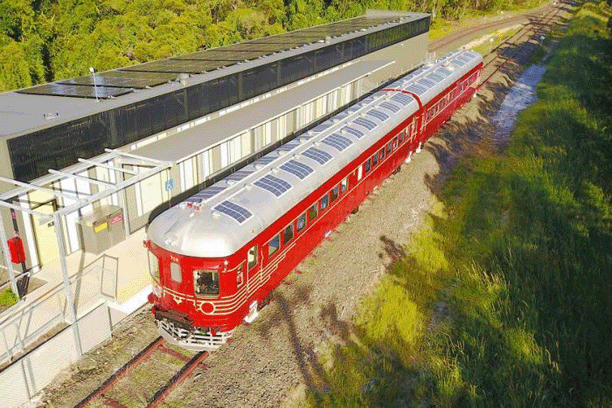
World-first solar train now leaving the platform in Byron Bay with zero emissions, ABC North Coast , By Bruce Mackenzie, 17 Dec 17, What is claimed to be the world’s first fully solar-powered train is operating on the New South Wales North Coast.
A refurbished 70-year-old ‘red rattler’ is running on a three-kilometre stretch of disused rail line at the popular tourist destination of Byron Bay.
It made its maiden trip yesterday with almost 100 passengers on board.
Electric bus solar system
The $4-million project is the brainchild of multi-millionaire businessman Brian Flannery, who owns a resort in the area.
“Hopefully it attracts people to Byron Bay,” Mr Flannery said.
“I think international tourists will come here to have a look at this world’s first solar train.
“So let’s see, in five years’ time they’ll probably still say I’m mad, but it’s a bit of fun.”
Tim Elderton, from the Lithgow Railway Workshop, was tasked with building curved solar panels and a battery system to power the train.
“Of course the major difference is it’s got solar panels on the roof so it can recharge itself.
“For those cloudy days we’ve also got 30 kilowatts of solar panels in this [station’s] roof here so we can also plug it in.
“On a sunny day like today we can do about four or five trips before we have to plug it in.”……..
Tram infrastructure a possibility
Longer trips than this one — 10 minutes to cover three kilometres or so — would require regular recharging stations along the route, but Mr Flannery said the technology might be suited to inner-city trams.
A lot of the tram networks of course have overhead wires and they’re electric but they’re powered off the grid from overhead,” he said.
“But in a case where you want to build a tramline without that infrastructure, I think you could.
“At various stations you could top the train [or tram] up.” http://www.abc.net.au/news/2017-12-16/world-first-solar-train-the-brainchild-of-byron-bay-millionaire/9265522
How Sydney could become a zero-carbon city
Sydney’s closer to being a zero-carboncity than you think, The Conversation, You live in one of the sunniest countries in the world. You might want to use that solar advantage and harvest all this free energy. Knowing that solar panels are rapidly becoming cheaper and have become feasible even in less sunny places like the UK, this should be a no-brainer.
Despite this, the Australian government has taken a step backwards at a time when we should be thinking 30 years ahead.
Can we do it differently? Yes, we can! My ongoing research on sustainable urbanism makes it clear that if we use the available renewable resources in the Sydney region we do not need any fossil resource any more. We can become zero-carbon. (With Louisa King and Andy Van den Dobbelsteen, I have prepared a forthcoming paper, Towards Zero-Carbon Metropolitan Regions: The Example of Sydney, in the journal SASBE.)
Enough solar power for every household
Abundant solar energy is available in the Sydney metropolitan area. If 25% of the houses each installed 35 square metres of solar panels, this could deliver all the energy for the city’s households.
We conservatively estimate a total yield of 195kWh/m2 of PV panel placed on roofs or other horizontal surfaces. The potential area of all Sydney council precincts suited for PV is estimated at around 385km2 – a quarter of the entire roof surface.
We calculate the potential total solar yield at 75.1TWh, which is more than current domestic household energy use (65.3TWh, according to the Jemena energy company).
Wind turbines to drive a whole city
If we install small wind turbines on land and larger turbines offshore we can harvest enough energy to fuel our electric vehicle fleet. Onshore wind turbines of 1-5MW generating capacity can be positioned to capture the prevailing southwest and northeast winds.
The turbines are placed on top of ridges, making use of the funnel effect to increase their output. We estimate around 840km of ridge lines in the Sydney metropolitan area can be used for wind turbines, enabling a total of 1,400 turbines. The total potential generation from onshore wind turbines is 6.13TWh.
Offshore turbines could in principle be placed everywhere, as the wind strength is enough to create an efficient yield. The turbines are larger than the ones on shore, capturing 5-7.5MW each, and can be placed up to 30km offshore. With these boundary conditions, an offshore wind park 45km long and 6km wide is possible. The total offshore potential then is 5.18TWh.
Altogether, then, we estimate the Sydney wind energy potential at 11.3TWh.
Turning waste into biofuels
We can turn our household waste and green waste from forests, parks and public green spaces into biogas. We can then use the existing gas network to provide heating and cooling for the majority of offices………
Extracting heat from beneath the city
Shallow geothermal heat can be tapped through heat pumps and establishing closed loops in the soil. This can occur in large expanses of urban developments within the metropolitan area, which rests predominantly on deposits of Wianamatta shale in the west underlying Parramatta, Liverpool and Penrith.
Where large water surfaces are available, such as in Botany Bay or the Prospect Reservoir, heat can also be harvested from the water body…….
Hydropower from multiple sources
The potential sources of energy from hydro generation are diverse. Tidal energy can be harvested at the entrances of Sydney Harbour Bay and Botany Bay, where tidal differences are expected to be highest………
Master plan for a zero-carbon city
All these potential energy sources are integrated into our Master Plan for a Zero-Carbon Sydney. Each has led to design propositions that together can create a zero-carbon city.
The research shows there is enough, more than enough, potential reliable renewable energy to supply every household and industry in the region. What is needed is an awareness that Australia could be a global frontrunner in innovative energy policy, instead of a laggard. https://theconversation.com/sydneys-closer-to-being-a-zero-carbon-city-than-you-think-85976
Any integrity Turnbull ever had is now blown as he kowtows to the Right on energy
 Turnbull blows trumpet for right wing idiocy on energy http://reneweconomy.com.au/turnbull-blows-trumpet-for-right-wing-idiocy-on-energy-35004/
After more than two years at the helm, Turnbull has done nothing to change the policies laid out by his predecessor Tony Abbott, and has only added to uncertainty by canning the major recommendation of the Finkel Review and trying to force the likes of AGL to invest yet more money in their ageing coal fired generators.
In an appearance on ABC TV’s Q&A program on Monday night, on the same day as a series of end-0f-year interviews with mainstream media, Turnbull appeared triumphant, cock-sure and combative, and unwavering from the hard right line on climate and energy.
Asked about his warnings – made in 2010 – that failing to address climate change would endanger future generations, Turnbull predicted a long future for fossil fuels, and repeated the usual fear-mongering about wind and solar.
“Energy policy has to be driven by engineering and economics, not by ideology, and as we’ve seen, for example, in South Australia, sheer idiocy.
“You know, where you had an enormous investment in wind power – nothing wrong with that, except they didn’t have anything to keep the lights on when the windmills stopped turning. A catastrophe. So you’ve got to plan it right. There will be a role for fossil fuels for a long time.”
But whether Turnbull likes it or not, the idiocy does not lie with Labor in South Australia; it lies with the mind numbing ignorance and obstinacy of the right wing in Australia’s politics and media, forever holding on to their attachment to coal.
The blackout in South Australia proved one thing, that the country’s ageing dumb grid was no longer fit for purpose, and the solution would not come from last century technologies like coal and gas, but a new system built around wind, solar, smart thinking and new management practices.
The Coalition’s response to wind and solar, and new technologies such as battery storage and smart things like demand response, betray their own ideology and their lack of respect to both engineering and economics.
Turnbull will be buoyed by the fact that the mainstream media has declared the energy policy issue to be “sorted” – the AFR on Tuesday said the energy policy conundrum was “fixed” and even the Guardian has suggested any opposition to the proposed National Energy Guarantee is just “playing politics”.
But energy and climate policy is anything but: stitched up maybe, fixed no.
Turnbull claims, and did so again on Q&A, that the NEG – currently little more than a thought bubble – has widespread support, but that is only among the incumbents and big business players that stand to profit from it, and their lobbyists and boosters.
The support of others is highly conditional, and is on the basis that the NEG must not look like what the modelling suggests it might look like – useless on emissions, inviting no new investment, doing little on prices, and simply reinforcing the market power of the incumbents.
The lack of scrutiny from mainstream media, and its willingness to pursue Coalition and fossil fuel industry talking points about “clean coal” and “base-load”, will make Turnbull’s task easier and take much of the political risk out of his informal treaty with the technology troglodytes on his right.
But his pursuit of these lines is all the more disappointing because he has plenty of evidence say otherwise.
+ The government’s own modelling suggested that more rnewsbles, not less, would lead to the greatest price reductions;
+ The Finkel report on storage reinforced what the CSIRO and the networks had already made clear, that the level of storage required is remarkably small and almost non-existent for the levels contemplated by this government;
+ And numerous reports put emissions at their ever highest level, point out the uselessness of the current Direct Action policy and the growing risks from global warming.
That’s why the AGL decision on Liddell is significant. A combination of renewables, storage, and some gas peaking plant would slash emissions and offer technology 20 per cent cheaper than the Coalition’s preferred option of spend money keeping ageing and unreliable coal generators on line.
But as the Institute of Sustainable Futures points out, emissions could be cut even further, and costs halved (rather than cut by 20 per cent), if an even smarter approach was adopted – a mixture of renewables and energy efficiency and demand management.
However, as ISF’s Chris Dunstan points out, this does require the government to actually do something, and reframe policy so that utilities and consumers benefit.
The sole incentive for the utilities under current market settings is to invest in more generation and continue to extract the monopoly rents from their market dominance that are screwing consumers. This report from the regulator last week underlines exactly how they are doing that.
This makes Turnbull’s latest utterings completely indefensible.
It is no longer good enough to lock himself into the Abbott era policies designed and framed by climate deniers and technology skeptics who sought to do the minimum possible.
(It may be partially explained by the fact that one of his principal climate and energy policy advisors, Sid Marris, used to work for the Minerals Council of Australia. And Patrick Gibbons, the former advisor to environment minister Greg Hunt, is now head of climate and energy at the MCA).
If he wants it, Turnbull has all the evidence he needs to argue that the energy trilemma – emissions, reliability and affordability – is best addressed by wholesale market and policy reform and ambitious renewable and climate targets.
It would lead to a smarter, cleaner, cheaper, and more reliable grid. And in quick time. What’s not to like about that?
The issue over marriage equality showed how reasoned argument, and just a little political and a lot of community leadership, can overcome the fear and loathing of the small but powerful conservative base.
But Turnbull has shown that he has not the courage, nor the political need, to push these through.
Instead, he is likely to push ahead with Snowy 2.0 pumped hydro scheme. Its feasibility study, due to be released soon, will make fascinating reading.
But if climate policies stay as they are, then Snowy 2.0 will not be, as Turnbull claimed on Q&A, “the largest single renewable project in our history since the Snowy Mountains Scheme was built”.
In fact, it won’t be renewable at all, it will simply be using excess coal power at night to push water up hill and then wait for high prices before allowing it to cascade back down again.
And if Snowy 2.0 is built in these circumstances, it will lock in the power of the incumbents, the arrival of zero marginal cost generation from wind and solar will be kept to a minimum, and it won’t just be customers getting screwed, it will be the planet as well.
But that’s the Turnbull we’ve come to know.
13 Dec REneweconomy News
RenewEconomy-
Turnbull blows trumpet for right wing idiocy on energyMalcolm Turnbull now appears perfectly comfortable parroting right wing nonsense about energy policy, branding high renewable policies as “idiocy” and defending the future of coal. That may be because mainstream media won’t challenge him.
-
Queensland names new energy minister – meet Dr Anthony LynhamA post-election cabinet reshuffle has delivered a new energy minister for Queensland. Here’s what we know about Dr Anthony Lynham.
-
CEFC continues to expand clean energy investments in South AustraliaThe CEFC is helping demonstrate the diverse potential of energy efficiency programs by helping finance clean energy improvements to two Adelaide buildings.
-
ARENA gives perovskite solar tech a push, with $6m Greatcell grantCommercial development of cheap, printable, Australian made perovskite solar cells boosted with $6m ARENA grant to Greatcell Solar.
-
AEMO relaxes constraints on wind power in South AustraliaAEMO relaxes limits on wind generation in South Australia as it continues to review system strength needs of the grid with the highest penetration of wind and solar in the world.
-
80MW solar farm proposed for Tamworth, NSWNew Australian solar developer, Oriens Energy, announces plans for 80MW solar farm in Tamworth, with more projects in the pipeline.
-
New study smashes myths about “embodied” energy in wind and solarCritics have argued renewable energies could come with high hidden greenhouse gas emissions that would negate their benefits to the climate. A new study shows the opposite is true.
11 December More REneweconomy news
RenewEconomy-
Zibelman: Resisting energy transition like trying to resist internetAEMO boss Audrey Zibelman says energy transition as unstoppable as the internet, because economics and technology have changed. Some baseload may be needed in the future, but it doesn’t need to be coal.
-
CRC awards Solar Analytics $1.9M for Smart Home Energy Management SystemSolar Analytics evolves from a solar monitoring platform to a holistic Smart Home Energy Management System with the announcement of a $1.9 million grant from the Australian Federal Government.
-
Flinders’ renewable frontierThe Flinders Island community can look forward to a secure and cleaner energy future thanks to its new Hybrid Energy Hub.
-
Construction begins at Kennedy wind, solar and battery storage hubConstruction begins on first 60MW of proposed 1200MW Kennedy Energy Park, the world-leading wind, solar, and battery storage project in north Queensland.
-
ERF review fails to douse doubts over Coalition key climate policyCCA review of Coalition’s Emissions Reduction Fund fuels concerns the scheme is an expensive, inefficient and risky way to cut carbon.
-
Know your NEM: Liddell plans could drown in Snowy 2AGL’s plans for Liddell are vague and lacking, most likely because the company is waiting to see what the Coalition aims to do with Snowy Hydro.
11 December REneweconomy News
RenewEconomy
-
Maoneng lands Australia’s biggest solar PPA with AGLChina-Australia renewable energy firm lands PPA with AGL for construction of 300MW of large scale solar – the biggest contract so far in Australia.
-
AGL proposes 1.6GW wind and solar, plus storage, to replace LiddellAGL confirms plans to invest in 1.6GW of wind and solar, plus storage and other technologies, to replace the ageing coal clunker, Liddell, which it will close in 2022, much to the annoyance of the federal Coalition.
8 December More REneweconomy news
RenewEconomy-
-
Rooftop solar: Australia’s greatest opportunity – and its greatest risk
Why rooftop solar could be one of the grid’s greatest assets but also one of its greatest threats if not properly managed. Here’s what AEMO thinks needs to be done. -
Coal versus cricket in IndiaWill the interruption of match in New Delhi between India and Sri Lanka by toxic smog finally spur the Indian Government to take coal plant pollution seriously?
-
Campoona mining project approved to produce ultra-pure graphite for batteriesArcher Exploration has been granted approval for its Campoona graphite project, north of Cleve on the Eyre Peninsula.
-
NSW signs LGC off-take deal with Neoen’s Dubbo solar farmNSW signs deal to buy LGC’s from Neoen’s Dubbo solar farm, and says “this lays the foundation for more renewable energy procurement.”
-
Zen Energy gets retail licence to launch “base-load” renewable productZen Energy gets electricity retailer licence to offer “baseload renewable energy” product and proceed with 1GW solar and storage facility at the Whyalla Steelworks.
-
Newcrest snubs solar for coal power, but was it a good deal?Gold miner Newcrest decides against solar farm to help power its Cadia mine in NSW, highlighting the challenges for renewable developers.
1 This month
Chernobyl: The Lost Tapes – A good documentary on Chernobyl on SBS available On Demand for the next 3 weeks– https://www.sbs.com.au/ondemand/tv-program/chernobyl-the-lost-tapes/2352741955560
15 April – Zoom –Nuclear Power is Not the Solution
Apr 15, 2026 01:00 AM in Canberra, Melbourne, Sydney

Join the International Physicians for the Prevention of Nuclear War (IPPNW) on Tuesday, April 14th for a timely webinar exploring the risks associated with nuclear power and challenging the myth that it offers a simple, safe, carbon-free solution to the climate crisis

21 April Webinar: No Nuclear Weapons in Australia
Start: 2026-04-21 18:00:00 UTC Canberra, Melbourne, Sydney (GMT+10:00)
End: 2026-04-21 19:30:00 UTC Canberra, Melbourne, Sydney (GMT+10:00)
Event Type: Virtual
A virtual link will be communicated before the event.
Host Contact Info: australia@icanw.org

of the week – Australians for War Powers Reform (AWPR)
To see nuclear-related stories in greater depth and intensity
 Antinuclear