4 November REneweconomy news
-
 ABB microgrid technology to power Robben Island
-
Microgrid and wireless technologies will integrate renewable solar energy and reduce the use of fossil fuels to power World Heritage Site in South Africa.
-
Ausgrid turns to rooftop solar to save on network costsAusgrid offers big incentives for rooftop solar in Sydney, so it can save on network costs. It’s a welcome change from the usual narrative about how rooftop solar is a burden to networks and consumers. Are battery storage and micro-grids next?
-
Australia among the world’s worst on biodiversity conservationAustralia is among the top seven countries worldwide responsible for 60% of the world’s biodiversity loss between 1996 and 2008, according to a study published last week in the journal Nature.
-
Rooftop solar installer caught out for fraudulent STC creationClean energy regulator takes action against solar company found to have installed rooftop PV systems without compliant Certificates of Electrical Safety.
-
Oil Search’s Alaskan oil play ignores climate realityJust days out from the start of the latest climate talks, PNG-based Oil Search has delivered a slap in the face to its Pacific neighbours.
-
Is your company disclosing its climate risk?Investors and activists have new ammunition to encourage public company disclosures on climate change risks and opportunities. They should use them.
-
Swan Hill solar farm secures debt funding to go “merchant”Impact Investment Group secures $16.5m from specialist outfit Infradebt for 19MW merchant solar farm in northern Victoria.
Clean Energy Finance Corporation triples investment in renewable projects to $2 billion
 CEFC triples investment in renewable projects to $2bn, http://www.theage.com.au/business/energy/cefc-triples-investment-in-renewable-projects-to-2bn-20171102-gzd8uf.htmlThe Age, Cole Latimer,
 The CEFC, in its annual report, said it had invested more than $2 billion in new capital to support renewable energy projects valued at more than $6.5 billion. Over the previous two years, the CEFC had only committed $1.32 billion in total.
Its total portfolio of investments now sits at $3.4 billion.
The CEFC said for every dollar it had invested in a project it helped to leverage an additional $2.10 from the private sector.
As well as investing in renewable energy projects, the group announced funding for a lithium mine, tapping into the growing demand for the metal that supplies rechargeable batteries.
CEFC’s projects are forecast to produce an annual abatement of nearly 7.3 million tonnes of carbon dioxide equivalent, or more than 121 million tonnes of CO2-e over its projects’ lifetimes.
The investments have had a positive yield for the nation beyond decarbonisation, CEFC chief executive Ian Learmonth said.
“Our $3.4 billion portfolio of investment commitments had a forecast lifetime investment yield of more than 5 per cent,” he said.
In the future, the Clean Energy Finance Corporation said it would invest in distributed energy, energy storage, improved grid transmission, network security and demand-response management.
The CEFC’s pipelines of investment has more than doubled since it began in 2014.
“This growth reflects increased interest in clean energy investment, coupled with a broader understanding of the role of the CEFC in working with investors and project developers,” the company said in its annual report.
3 November: More REneweconomy news
 RenewEconomy
-
ESB to use inflated costs for wind and solar to justify NEGEnergy Security Board to use vastly inflated costs of wind and solar to justify its National Energy Guarantee. By using prices around 30-40 per cent above actual costs, will support its argument for little new wind and solar to be built in the coming decade.
-
Lets be honest: Australia is well behind on renewablesAustralia’s fossil fuel share of electricity generation is higher than that of our peers. This chart is ugly for Australians who care about doing our bit in the 21st century.
-
RES drops 758MW wind farm proposal, amid Victoria boomAnti-wind resistance appears to win the day as RES Australia confirms Penshurst Wind Farm no longer an ongoing development opportunity.
-
NE: A rushed job that takes us backwards, not forwardsNational Energy Guarantee appears to be a plan to get through the Coalition Party Room, and then a plan to have a plan. Unfortunately, that means many more months of uncertainty.
-
Musk says Tesla big battery now more than 80% completeElon Musk says Tesla big battery in South Australia now more than 80% complete, but even bigger storage installations likely to follow.
-
Tesla falls behind on Model 3 production, burns cash at record rateProduction line “bottlenecks” at Tesla’s Nevada Gigafactory push Model 3 delivery target out 3 months. Musk says, “we’ve got it covered.”
-
China contractors and finance may help Adani’s mega coal mineThe potential involvement of China state-owned contractors and financiers may help Adani in its push for the mega coal mine in Queensland.
-
Rejected teenagers: the trend of closing young coal plantsIt’s not just old coal power plants that are being closed down. In Italy, the US, and the Netherlands, coal plants that are barely teenagers are being targeted for closure.
3 November REneweconomy news
-
Energy technologies and business model innovator Justine Jarvinen takes up role as Wattwatchers ChairEnergy technology pacesetter Wattwatchers is delighted to announce the appointment of Justine Jarvinen as non-executive Chair. Ms Jarvinen is currently Chief Operating Officer of the Energy Institute at the University of New South Wales (UNSW) and her prior corporate roles include Head of Emerging Technologies at AGL Energy. Ms Jarvinen will lead the Wattwatchers Board […]
-
Rooftop solar pushes WA grid demand to 8-year lowRooftop solar has helped push grid demand in Western Australia to its lowest levels in more than eight years.
South Australia’s Whyalla to become a booming renewable energy hub
Whyalla steel city goes green with 1GW of solar and storage, http://reneweconomy.com.au/whyalla-steel-city-goes-green-with-1gw-of-solar-and-storage-92904/ UK billionaire Sanjeev Gupta has made good on his commitment to transform his newly acquired Australian steel business into a renewable energy powerhouses, announcing massive investments in solar and storage that will knock 40 per cent off his electricity costs.
Gupta said on Monday that he would build 1 gigawatt (1,000MW) of dispatchable renewables in and around Whyalla, where his major steel plant is located. This would comprise huge investments in solar, battery storage, pumped hydro and demand management.
He won’t stop there. Gupta is looking to repeat the dose – although with varying mixes and scale of renewables and storage – to power the company’s steel operations in Melbourne, Sydney and Newcastle. He said on Tuesday he wanted these bigger plants to be powered 100 per cent by renewable energy.
The initial development will see a proposed 80MW solar farm at Whyalla expanded to 200MW and completed by the first quarter of 2019.
1 November More REneweconomy news
-
Gupta plans to take Sydney, Melbourne steel plants 100% renewableGupta says bigger steel plants in Sydney and Melbourne will go 100% renewable, and there is no reason why an aluminium smelter could not follow.
-
Five reasons not to build new coal plant in QueenslandClimate Council report on Queensland renewables offers timely reminder that building a new coal plant in the state’s north is a terrible idea.
-
Explainer: The big 3 projects making South Australia capital of battery storageThe 100MW/100MWh battery storage project proposed for Whyalla is one of three big projects that will make South Australia the leader in battery storage, as well as wind and solar.
-
NEG must grow new renewable energy capacity, not shrink itIt remains unclear how the NEG will ensure the investor confidence required to deliver a strong pipeline of new clean energy projects.
-
Battery of the Nation worthy of national significanceBattery of the Nation would double Tasmania’s renewable energy capacity from 2,500MW to about 5,000MW, through a combination of pumped hydro storage development, private wind power development, and boosting the efficiency of existing hydropower assets.
-
Vector wins new Australian smart metering contractVector has announced it has executed a contract to provide metering services to EnergyAustralia with an initial three-year deployment period that will commence before the end of 2017.
-
LONGi selected into “New China Nifty 50” by Goldman SachsRecently, the world’s largest investment bank Goldman Sachs selected 50 stocks reflecting the Chinese economy at the new stage, known as the “New China Nifty 50”.
Australia’s clean energy transition is underway – and fast!
 Time for Australia to wake up to scale and pace of clean energy transition, REneweconomy By Giles Parkinson on 1 November 2017 UK billionaire Sanjeev Gupta is a very rich man, with a very big business that consumes a lot of energy.
In the last few months he has come to the same conclusion as tens of thousands of Australian homeowners and thousands of businesses, big and small: the best way to cut your bill for energy is to generate your own.
Gupta this week unveiled the details of his plans to build 1 gigawatt of large-scale solar, battery storage, pumped hydro and demand management for the Whyalla steel works and other big energy users in South Australia.
Gupta reckons it will slash his company’s energy bills by around 40 per cent, and he intends to repeat the dose in his even bigger steel plants in Melbourne and Sydney, which he says will be powered 100 per cent by renewable energy within a few years.
Most businesses reckon they can achieve similar savings, which is why the likes of Nectar Farms are turning to wind and battery storage for a $750 million investment in a new glass house and energy park near Stawell in Victoria, and why zinc refiner Zinc Metals is turning to solar to slash the costs of electricity in north Queensland and, like Gupta, help to expand the business.
It’s why Telstra has contracted to take the output of a 72MW solar farm in Queensland, and will do the same with many more such facilities; it’s why Foster’s Brewing is going 100 per cent renewables;why Woolworths is also turning to solar, along with countless other large retailers, and mining groups.
Households can do even better. The pay-back for a rooftop solar system is probably less than five years – for an asset that will last 25 years. The savings on an electricity bill, even without the generous “premium” tariffs that too many still enjoy, are well over 50 per cent.
As Gupta says, and nearly two million household and businesses understand, it’s not a difficult equation. The cost of solar has plunged 90 per cent in the last five years, and the cost of storage is following suit.
The cost of grid power, on the other hand, has more than doubled…… http://reneweconomy.com.au/time-for-australia-to-wake-up-to-scale-and-pace-of-clean-energy-transition-
Well deserved award for RenewEconomy founder Giles Parkinson
 RenewEconomy founder Giles Parkinson wins award, as RE page views hit 25 million, http://reneweconomy.com.au/reneweconomy-founder-giles-parkinson-wins-award-as-re-page-views-hit-25-million-61271/ RenewEconomy founder and editor Giles Parkinson on Monday was announced as the winner of a major environmental prize, the Deni Greene award, as the cumulative total of page views on the website passed 25 million.In a ceremony in Hobart on Monday, the prize for environmental leadership in a professional capacity was presented to Giles by Bob Brown, the head of the Bob Brown Foundation and the former Senator and Australian Greens leader.
Also receiving awards were Stop Adani activists Adrian Burragubba, (Environmentalist of the Year), Murrawah Maroochy Johnson (Young Environmentalist of the Year), and Ken Peters-Dodd, on behalf of Reef Defenders (Community Environment Prize).
Brown said it was appropriate that the prizes went to activists working to stop the Adani mega coal mine, given that it was a landmark issue that ranked in importance with the Franklin Dam campaigns in Tasmania in the 1980s.
Brown quoted polls that showed the overwhelming majority of Australians were opposed to the mine. Yet, he noted, in the last federal election, 90 per cent of votes were made for parties that do not oppose the project. (The Greens are the only party that do).
Parkinson said he was delighted to receive the reward, and the recognition of RenewEconomy’s growing stature as a source of news, information and analysis that is all but impossible to find in mainstream media.
Deni Greene was a US energy expert, who first came to Australia to advise on energy efficiency and co-generation projects to provide an alternative to damming the Franklin River and building other dams.
She became a leading expert and helped design some of Australia’s formative climate change and clean energy policy documents.
Alan Pears, a previous winner of the award, told RenewEconomy that in 1990 Greene led a project that produced a report showing how Australia could cut its emissions by 20 per cent by 2005 – and benefit from this effort by $6 billion.
“She was mercilessly attacked by the energy establishment, and paid a high price in lost work. But that study was very solid – it just challenged the group-think about the cost and practicality of addressing climate change. In another decade or so, many people will realise she was right,” Pears said.
And as a sign of that growing interest in climate and clean energy solutions, RenewEconomy’s total page views since its launch in 2012 has soared through 25 million in October.
Page views have grown 50 per cent over the last 12 months and now average around 800,000 per month. Monthly unique visitors average nearly 300,000 – an extraordinary number for a niche publication.
Parkinson said that readers were attracted to the website’s two major themes: the falling costs and exciting developments in renewable and storage and grid technologies, and the growing frustration with policy design, politicians and regulators.
1 November REneweconomy news
-
-
Is there a future for ‘pro-nuclear environmentalism’?Nuclear lobbyists – especially the self-styled ‘pro-nuclear environmentalists’ – are few in number. So how much longer can they keep flogging a dead horse?
-
Could Tesla have bigger plans for Australia than the Big Battery?A comment posted, and then deleted, by Tesla marketing has piqued interest in the EV maker’s plans for Australia.
-
Graph of the Day: Victoria nears 50% renewables over weekendHot and windy Spring weather saw Victorian solar and wind power generate enough to meet to 44.6 per cent of local demand on Sunday.
-
Labor needs to head left, and drop Adani, to win Queensland pollQueensland Premier Annastacia Palaszczuk today called the state election for 25 November, about two months before the three-year anniversary of Labor’s shock win in January 2015.
-
Know your NEM: Climbing a wall of worry over wind and solarWind and solar PV account for 54 per cent of demand in South Australia since the closure of Hazelwood, and the grid is still functioning.
-
“Shame on you:” Frydenberg admits he doesn’t have rooftop solar60 Minutes interview reveals Australia’s energy and environment minister has not installed rooftop solar at his family home – and why.
-
-
Concerns over 5-minute rule as ESB warns of perils of wind and solarESB briefing raises concerns about future of 5-minute rule, its description of wind and solar as a threat to the system, and the hiring of Frontier Economics to do its modeling.
What High Court ruling means for climate, renewables
 Joyce out, Canavan in, Roberts out – What High Court ruling means for climate, renewables, http://reneweconomy.com.au/updated-joyce-out-canavan-in-roberts-out-what-high-court-ruling-means-for-climate-renewables-20175/ By Sophie Vorrath on 27 October 2017 Australia’s deputy prime minister and leader of the National Party, Barnaby Joyce, is headed for a by-election, after the High Court ruled him ineligible to hold his seat due to his dual Australia-New Zealand citizenship.
The ruling – which has also disqualified fellow “citizenship 7” members, Nationals Deputy Fiona Nash, Greens Senator Scottt Ludlam, Greens Deputy Larissa Waters, and Pauline Hanson’s One Nation party senator, Malcolm Roberts – leaves the Turnbull government without its one seat majority in the House of Representatives. At least until the result of the December by-election.
But what does it mean for the clean energy and climate policy debate in Australia?
For starters, the Court’s decision removes Parliament’s chief flat-earther, in Malcolm Roberts – although he is not the only federal parliamentarian to deny climate change (see Fiona Nash, below).
On energy, Roberts – like Hanson’s One Nation – is broadly anti-renewables and pro-fossil fuels. He notably anointed the Turnbull government’s National Energy Guarantee as both “atrocious”, but also in line with the his party’s desire for the RET to be scrapped and its support of “clean coal.”
In a speech to the Minerals Week Seminar, the deputy PM painted a picture of a nation under attack from a sort of economy destroying “green peril” that would shut down coal power plants, kill coal exports and – of course – turn the lights out.
“Around about January, ladies and gentlemen, families are going to come back from holiday, mum and dad are going to go back to work, mum’s going to turn on the air conditioner, get the kids ready for school, school’s going to turn on the power, and if we don’t watch out, the lights are going to go out,” Joyce said.
“And this will be a salutary lesson on how economics really work. A salutary lesson against the fatuous economics that’s being peddled.
(“In the) Galilee Basin, we are in the fight of our lives trying to open up a mechanism that will create wealth for this nation. Total insanity!” he said. “What’s one of our biggest exports, or our biggest export? Coal. And what are we making the argument against? That we should use coal. It’s absurd. …I just don’t get it.”
Joyce also doesn’t get climate science, and like his compatriot, Fiona Nash, is skeptical about the research credentials of global warming. Look….I just – I’m always skeptical of the idea that the way that anybody’s going to change the climate – and I’m driving in this morning and we’re driving through a frost – is with bureaucrats and taxes,” he told conservative commentator and noted climate denier Andrew Bolt in an interview in 2015.
“All that does is….it’s a self-fulfilling prophecy. I make you feel guilty so I can get your money and put it in my pocket and send reports backwards and forth to one another,” he said.
But Joyce may not be gone for long. The by-election is expected to be held very soon, probably December 2, and Joyce is expected to win,
And Joyce’s brief absence should be countered by the safe return of Matt Canavan, the Queensland Nationals Senator who, along with SA independent Nick Xenophon, was cleared by the High Court, despite having dual Italian citizenship. The Court ruled that Canavan did not know about his Italian citizenship, and so could not have taken all reasonable measures to renounce it.
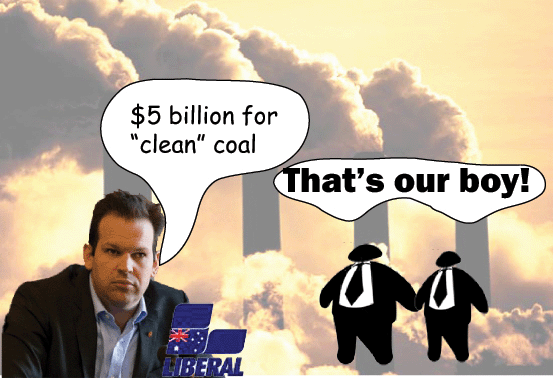 Canavan, who has already been reinstated as the federal minister for resources and northern Australia, was recently dubbed the “minister for the mining sector”, after his heartfelt farewell to the sector when the citizenship scandal first reared its ugly head in July and he stepped aside.
“It has been such an honour to represent the Australian mining sector over the past year,” he wrote on Facebook. “From the small, gambling explorers and prospectors to the large, world-beating multi-nationals, the industry provides rich and diverse experiences that can take you to the smallest towns of outback Australia to the biggest cities in the world.”
The note sparked instant outrage from readers, who noted Canavan was “supposed to represent the people of Queensland, and not private mining companies.” We will see whether his priorities have changed any when he returns to work.
The disqualification of Nationals Senator number three – and deputy leader of that party – NSW Fiona Nash (minister for regional development) could be chalked up as a small win for climate policy. Nash, like Joyce, is skeptical about the science, telling Sky News last year “I don’t think it is certainly necessarily settled.”
To Malcolm Roberts, it is farewell, after just one year in Parliament. During this short period of time, Roberts has distinguished himself by repeatedly denying the human influence on climate change; by introducing a hoax “conceptual penis” research paper to Parliament in an effort to undermine the validity of peer reviewed science; and asked Chief Scientist Alan Finkel if it was important for scientists to have an open mind, to which Finkel responded: “yes, but not so much that your brain leaks out.”
In a statement on Friday afternoon, Roberts said he was sad to leave federal parliament, but accepted the High Court decision entirely. Probably because it’s not based on science. Roberts will now run for the seat of Ipswich – the “heart of One Nation” – in Queensland state politics.
One Nation, meanwhile, still holds four seats in federal parliament. Next in line for Roberts’ seat is Fraser Anning – a publican from the Queensland coal region of Gladstone, who attracted just 19 first preference votes last year. His stance on renewables and climate is not immediately clear – neither his Facebook page nor his One Nation profile were accessible at the time of publication – but he is a fan of a good conspiracy theory.
For the Turnbull government, it is a blow, and an embarrassment, whether the PM likes to admit it or not.
n an upbeat address to reporters on Friday afternoon, Turnbull said the Coalition had remained focused on the business of government pending the Court’s decision, and pointed to his National Energy Guarantee as evidence of that. Never mind that the NEG has been widely derided as non-policy; at best an outline of one possible framework among many.
Turnbull even took the opportunity to do some energy politicking, telling reporters “we all know that Labor’s (energy policy) would see prices rising as far as the eye can see.”
Tony Windsor, who has confirmed he will not be contesting the by-election, said one of the main things that kept him interested in federal politics was the “discgraceful” short-term politics Coalition members like Abbott and Joyce, who supported climate and energy policies that “do nothing” to solve the problems of the future.
And he also noted that, despite Joyce’s position as the front runner for New England, the by-election would open up a key seat to other candidates, who could campaign on some of the key, long0-term political issues that he felt the Turnbull government had fudged.
“The government has a majority of one,” he told the ABC on Friday afternoon. “Now that ‘one’ is going to be out of town for a while. … so if people want to get up there and talk about the significant issues that affect New England, I’ll be right up there supporting them,” Windsor said.
28 October REneweconomy news
-
Graph of the Day: Negative prices in windy South AustraliaSouth Australia electricity prices plunge into negative territory.
-
A coal-based grid in 2030 will make Australia un-competitiveBuilder of world’s first wind, solar and battery storage project in Queensland says renewables will beat even existing coal within a few years, and relying on a coal and gas fired grid in 2030 will make the Australian economy uncompetitive.
-
Climate peace in our time?Pressure could mount to set a significantly tighter emissions target for the electricity sector – which does not bode well for a climate truce.
-
Solar-powered Sion completes successful test-drive tourSono Motors is approaching the end of a successful test drive tour of its new Sion all-electric vehicle.
-
Victoria big solar pipeline adds two new projectsA 120MW solar project is being proposed for Glenrowan by ESCO Pacific, and planning approval secured for 30MW project in the Gannawarra Shire.
-
World-first “solar train” about to be launched in Byron BayA world-first “solar train”, including Kokam batteries and flexible panels supplied by solar pioneer Zhengrong Shi, is about to make its debut in Byron Bay.
-
The NEG: No guarantee of successFar from being a “solution” to Australia’s power sector ills, the NEG, in its current state, raises as many questions as it purports to answer.
27 october More REneweconomy news
-
China does not need any new coal fired generationBNEF report says China needs no new coal generation, has $300bn of potential stranded assets, and needs reform to address curtailment issues for wind and solar.
-
Why NEG may kill new renewable projects, even those with finance in placeAfter initially seeing the NEG as a possible win for consumers and the environment, I now see it as an almost certain disaster for prices, reliability and emissions.
27 October REneweconomy news
-
SunPower, AES team up for major solar + storage project on HawaiiSunPower and AES join forces to build 28MW solar with a 20MW, 5-hour battery storage system on the Hawaiian island of Kaua’i.
-
Redflow battery plant under construction in ThailandRedflow says Thai factory will be rolling out zinc-bromine flow batteries by end 2017, after work on the plant started this week.
-
ACT eyes electric vehicle target, after ‘nation-leading’ renewables successReport recommends ACT electric vehicle target to “clearly guide” market, and incentives for EV uptake, in next-round climate policy.
-
Game 1 of US baseball world series breaks heat recordThis is what climate change looks like: first game of baseball world series played in 103°F heat. The average for this time of year is 75°F.
-
Amid devastation, Tesla begins restoring power in Puerto RicoCurrent estimates suggest 80% of Puerto Rico is still without power, but thanks to Elon Musk’s efforts at least one children’s hospital has been able to turn the lights on.
-
Private car ownership is ridiculously wastefulHere’s a question: how big is the entire power plant fleet in your country compared to the fleet of vehicles?
25 October More REneweconomy news
RenewEconomy-
Global investors buy Equis projects and Australia/Asia renewable storyThree major global investors buy renewable energy portfolio of Equis Energy as big money continues to flood into Asia and Australia renewable market. Meanwhile, in Canberra…
-
Nissan to join Formula E Electric Racing from 2018-19 seasonNissan will become the first Japanese automotive brand to compete in the all-electric FIA Formula E racing championship starting in 2018.
-
Know your NEM week: A closer look at Vales PointA closer look at Vales Point, and the money made by its new owner Sunset Power; and how to quantify the costs of climate change.
-
Sonnen to unveil first Australian micro-grid, contemplates local manufactureSonnen to announce first Australian micro-grid, or “SonnenCity”, where new housing developments come equipped with solar and storage. It says distributed energy key to slashing electricity prices.
-
Battery swapping will drive India’s electric car revolutionThe global electric vehicle revolution will be bottom up, and developing countries like India will lead it.
-
Herbert Smith Freehills advises lenders on the financing of central Queensland solar farmEmerald Solar Park is underpinned by a long term power purchase agreement with Telstra as offtaker. Reaching financial close marks the first banked transaction in Australia with a corporate PPA from Telstra.
-
Turnbull’s NEG claims first major renewable energy victimNEG causes market value of one of major renewable energy players to be slashed by analysts, and puts the future of some $50 billion of renewable energy projects in doubt. But it is good for incumbents, because less renewables means higher prices.
-
Powering a social licence failure: The National Energy GuaranteeThe Coalition’s NEG – based on …….
25 October REneweconomy news
-
Electric vehicle uptake will drain fuel tax revenue, report warnsProductivity Commission warns Australia’s inevitable shift from petrol fuelled cars to EVs will take a huge chunk out of the federal government budget.
-
Graphs of the Day: Wind fast, solar faster, batteries fastestFour charts show that in the global race to build new energy capacity, wind is fast, solar is faster, and batteries will be faster again. Meanwhile, coal power…
-
Construction begins on Emerald Solar Farm after financial close reachedEmerald solar farm, Australia’s first large-scale offsite renewables corporate PPA, reaches financial close and begins construction.
-
Access to RenewEconomy may be slow due to denial of service attacksReaders of RenewEconomy may find access to the website unexpectedly slow or difficult today, because of measures it introduced to deal with repeated denial of service attacks.
-
Energy consumers are paying for useless, profit-boosting infrastructureIt is difficult not to lapse into despair about Australia’s energy policy morass, which is dominated by a deeply entrenched culture of half-truths, vested interests, ideology and wishful thinking.
-
‘Buy clean’ wants to change the way we build stuffOnce again, California is leading the way, this time on state contracts for infrastructure, where suppliers work to keep their carbon pollution low.
1 This month



Help Aunty Sue Protect Her Land and Sacred Sites From Destructive Rocket Testing.
.

Australians deserve the truth
about
AUKUS – https://aukuspublicinquiry.com/

PETITION – To: Prime Minister Anthony Albanese and the Australian Labor Government

of the week – Australians for War Powers Reform (AWPR)
To see nuclear-related stories in greater depth and intensity

