 Five ways to improve Finkel’s energy blueprint http://reneweconomy.com.au/five-ways-to-improve-finkels-energy-blueprint-60985/ By Giles Parkinson on 13 June 2017 [good graphs]
First thing first, this scheme won’t amount to a hill of beans unless the Paris climate targets are adopted, and that does not mean the modest down-payment from the Coalition on which this blueprint is modelled, but a serious attempt to deliver on the pledge to limit average global warming to well below 2°C.
Quite why the chief scientist didn’t choose to make much of the chief science questions is a bit of a mystery, but he did underline the importance of bipartisan and federal and state agreement on this. The reaction, to date, shows this is as difficult now as it was when the climate-denying, fossil fuel-backing Coalition hard right thrust Tony Abbott to the head of the party in 2009.
Can we see some modelling please? The actual energy blueprint is vague on details. Some results of the modelling are shown, such as the modest fall in consumer bills (above), and the lingering presence of coal-fired generation in 2050 (25 per cent).
But the inputs are not revealed, neither are comparisons with other options, or how they are stress-tested with a 2°C target. Most consumer watchdogs would warn against buying something with so little information, and no warranties, but that is – in effect – what we are being asked to do. Or, at least, may be what the Coalition back bench is being asked to do.
Don’t leave the clean energy target mechanism in the hands of the gentailers. We saw what happened with the renewable energy target, as the big gentailers fought to have the target cut, then went on a capital strike, and then cashed in as the prices for renewable energy certificates were pushed to their penalty level.
The gentailers have too many vested interests to protect, so a better and more efficient mechanism would be for a new authority to auction capacity at various points along the target. This has been used very effectively across the world, and at state level too. It gets a good price and avoids the market being held to ransom.
Be smarter about energy storage. There is no doubt that many solar plants, and wind farms, will be happy to add battery storage to their installations, and Finkel’s report acknowledges that these combinations will beat either gas or coal on both costs and emissions. But Finkel’s proposed obligation for ALL new wind and solar plants to have storage seems like regulatory overkill, adding unnecessarily to prices.
Only in South Australia has the penetration of wind and solar reached a level where storage is now required, according to the CSIRO, which suggests that anything under 40 per cent wind and solar is “trivial” to the management of the grid (presuming the grid managers are on top of their brief). So making a no-argue requirement now seems overkill, and the approach of the Victoria and Queensland state governments – calling for bids for cheapest storage – as they roll out more wind and solar seems more sensible.
Make this transition quicker, smarter, cleaner. As we noted last week, this is not Grid 2.0, it’s actually not a whole lot different from business as usual. This review was an opportunity to redefine those boundaries, but comes up short, mainly because it does not focus enough on the implications and the benefits of all the solar and storage added behind the meter by households and businesses. The CSIRO estimates $200 billion will be spent by consumers over the next three decades.
They will want to know that this investment is worth it, and they are not locked in to a utility business model that has failed to evolve, and continues to impose costs on consumers. Indeed, half of their bills comes from the transport of electricity, which means that even if the wholesale component was free, it could not match the cost of solar and storage. Which does not mean, for a moment, that everything would go off the grid, or should; but unless there is some regulatory recognition that technology changes and costs are moving fast, then they will simply not be prepared to deal with it.
And let’s not forget, all consumers will be wanting more than $90 savings a year over the next decade after seeing their bills going up $300 a year. That’s one step forward and three steps back. There is simply no reason why more savings cannot be delivered, given the falling cost of wind, solar and storage.
June 14, 2017
Posted by Christina Macpherson |
AUSTRALIA - NATIONAL, climate change - global warming, energy, politics |
Leave a comment
 Lord Howe microgrid in doubt as Frydenberg rules out wind turbines http://reneweconomy.com.au/39084-2/, By Sophie Vorrath on 13 June 2017 One Step Off The Grid
Plans to install a hybrid renewable energy plus battery storage microgrid at New South Wales’ Lord Howe Island, and slash its diesel fuel use, have hit a major political snag, after the federal energy minister intervened to rule out the wind power component of the long-awaited, ARENA-backed project.
The project – which has been in the works for some six years now, and in 2014 won a $4.5 million grant from the Australian Renewable Energy Agency and a $5.6 million loan from NSW Treasury – was to install 500kW of wind, 400kW solar PV and 400kWh of battery storage, in an effort to cut the island’s diesel usage by two-thirds.
Just one year ago the Lord Howe Island Board called for tenders for the installation of the first stage of the project’s development.
But the Board’s manager of infrastructure and engineering services, Andrew Logan, said Minister Frydenberg had ruled, late last week, that the impacts of the proposed two 250kW wind turbines on the Island’s World and National Heritage values – particularly on its ‘visual landscape’ – were unacceptable. Continue reading →
June 14, 2017
Posted by Christina Macpherson |
AUSTRALIA - NATIONAL, New South Wales, politics, wind |
Leave a comment
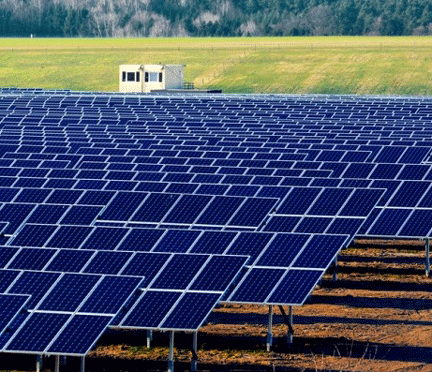
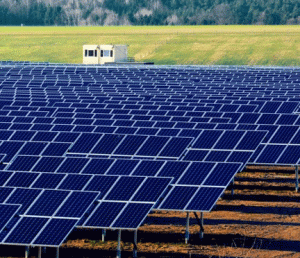 WA, UK team announce $200m big solar pipeline for Australia, REneweconomy, By Sophie Vorrath on 13 June 2017 Western Australian large-scale solar start-up Stellata Energy has joined forces with UK based renewables investment specialist, Ingenious, to build what they say is a $200 million pipeline of solar farms across Australia, starting with a flagship 120MW ground-mounted project in their home state.
The companies said in a join announcement on Tuesday that they were seeking approval to build a 120MW ground-mounted solar plant in the regional town of Merredin, roughly half way between Perth and Kalgoorlie.
The partnership signals the arrival of yet another European investor into the Australian market, in the rush to meet the remainder of the 2020 renewable energy target as technology costs continue to fall.
Stellata, which has been around for roughly one year, says it is well placed to deliver large-scale solar in Western Australia, with an executive team with extensive previous experience developing more than 600MW of ground-mounted and rooftop solar across Europe.
Ingenious, meanwhile, has raised and deployed more than £9 billion, including £500 million in renewables projects across the UK and Ireland, the companies said……http://reneweconomy.com.au/wa-uk-team-announce-200m-big-solar-pipeline-for-australia-58923/
June 14, 2017
Posted by Christina Macpherson |
solar, Western Australia |
Leave a comment
the conservatives will protest anyway, and it is difficult to see how Labor can endorse a plan that undercuts renewable energy so comprehensively, and completely ignores the Paris climate agreement
 Finkel decoded: The good, the bad, and the very disappointing http://reneweconomy.com.au/finkel-decoded-the-good-the-bad-and-the-very-disappointing-84273/By Giles Parkinson on 9 June 2017
Our coverage of the main Finkel findings can be found here, along with the reaction, and a look at his modelling. Here is our initial take on what the final Finkel Review all means.
This is not Grid 2.0
In the first draft of the Finkel Review, chief scientist Dr Alan Finkel spoke of an “unstoppable” energy transition, driven by new technologies and the role of the consumer.
But but he may just have found a way for skittish politicians and incumbent utilities to throw a spanner in the works and slow it down. This report had the opportunity to redefine the energy markets. But, to borrow an expression, it reads more like history ++ at best, rather than Grid 2.0.
That’s because Finkel has been focused on trying to find a pathway through the toxic energy politics in Australia, and accommodating the Coalition’s modest climate targets, rather than seizing the moment and outlining what can and should happen, and what Australia would need to do to meet the Paris climate targets.
That it only modeled the Coalition’s initial down-payment for the Paris climate deal. It shows it a path to reach that, but not its likely obligations in a world that vowed to cap average global warming at “well below 2°C” and so can be seen as a huge victory for the incumbents.
We need a plan
Finkel emphasises there is no plan right now, and one is needed to manage the scale of the transition. “We need a plan,” he says.
So he has recommended a whole series of actions, including the Clean Energy Target and only because of opposition to the emissions intensity target. Other options such as a high renewable energy target were not considered, even though its is clear that wind and solar are the cheapest forms of new energy, Continue reading →
June 10, 2017
Posted by Christina Macpherson |
AUSTRALIA - NATIONAL, energy, politics |
Leave a comment
 Finkel review: Households, businesses better off long-term with clean energy target, chief scientist says http://www.abc.net.au/news/2017-06-09/finkel-report-households-better-off-under-clean-energy-target/8605734 By political reporter Louise Yaxley, 9 June 17, Chief scientist Alan Finkel says households would be about $90-a-year better off under a clean energy target.
The target is a key recommendation in the report Dr Finkel handed to the Prime Minister and state and territory leaders today.
It is aimed at helping Australia reduce its greenhouse emissions while keeping power prices down.
Dr Finkel said his plan would mean households would be 10 per cent better off over 30 years, and heavy industrial power users would be 20 per cent better off.
The nation’s energy ministers will now consider the plan and report in August on the detail of the recommendations. Continue reading →
June 10, 2017
Posted by Christina Macpherson |
AUSTRALIA - NATIONAL, energy |
Leave a comment
Finkel review: Government backbenchers question clean energy target  report, ABC News, 9 June 17 By political reporters Matthew Doran and Tom Iggulden Pro-coal backbenchers within the Liberal Party have already begun undermining a report from the chief scientist Alan Finkel, as Labor foreshadows pulling support for the proposal if new coal-fired power stations are built.
Key points:
- Senator Eric Abetz accusing Finkel of using “creative assumptions” to come up with recommendations
- MP Craig Kelly calling for another report, different attempts at modelling
- Australian Energy Council says Dr Finkel’s report presents “less political” option
Dr Finkel’s report proposes a clean energy target (CET) to help reduce carbon emissions and lower electricity prices for households by about $90 per year.
Tasmanian Liberal senator Eric Abetz is accusing the chief scientist of using “creative assumptions” to come up with his recommendations for a CET.
Western Sydney Liberal backbencher Craig Kelly is calling for another report to be done into the economic effect of setting aggressive emissions reduction targets.
He said he would not support a benchmark emission target of 0.6 tonnes of carbon dioxide per megawatt hour, which is the level Dr Finkel has used in his report to model economic effects. …….http://www.abc.net.au/news/2017-06-10/pro-coal-backbenchers-undermining-finkel-report-labor-threats/8606652
June 10, 2017
Posted by Christina Macpherson |
AUSTRALIA - NATIONAL, energy, politics |
Leave a comment
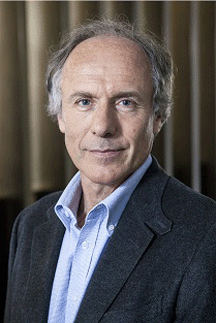 Finkel report: Major review of Australia’s energy sector explained, ABC News 9 June 17 By national science and technology reporter Jake Sturmer “”…….So you might have heard about this big government report called the Finkel review.
Basically, it is chief scientist Alan Finkel’s plan for the future of the National Electricity Market.
That market is how most states — Queensland, New South Wales (including the Australian Capital Territory), Victoria, South Australia, and Tasmania — get their power.
Right now, 87 per cent of the electricity going into that market comes from fossil fuels — a percentage that scientists say needs to fall a lot if the planet is to avoid dangerous climate change.
It is mostly high-emission brown and black coal (77 per cent) with gas making up the remainder (10 per cent). The other 13 per cent of the total comes from renewable energy…….
What does the report recommend?
It is suggesting a clean energy target.
That is basically a rule that forces companies selling electricity to us to provide a set percentage of power from low emissions technology, like renewables or efficient gas.
Coal power can be considered too — but only if it is coupled with carbon capture.
Right now that is very expensive and unlikely to be seen in the short term.
The cost is likely to be passed on to us as consumers — think of it as opting for a percentage of green energy on your power bill.
So what does the benchmark of 700kg of CO2 per megawatt hour of electricity, recommended by the report, actually mean?
Essentially, if a generator produces electricity that emits less than 700kg of carbon dioxide per unit of electricity (measured in megawatt hours: MWh) they get part of a credit, which they can then sell to retailers.
One of the dirtiest power stations in the nation — EnergyAustralia’s brown coal Yallourn plant in Victoria — emits 1,272kg per MWh and even a brand new ultra-supercritical black coal plant emits 760kg per MWh.
So coal is effectively ruled out.
That leaves credits going to the most efficient gas turbines — which produce around 400kg/MWh — and renewables, which emit no carbon.
The low emissions target (LET) essentially acts as a carrot that forces retailers to buy cleaner energy, promoting renewables into the market, eventually squeezing out older, more polluting coal plants.
That is, if the Government accepts the benchmark — and it also depends on what percentage of cleaner electricity it forces retailers to buy.
What about an ’emissions intensity scheme’?
Another alternative is an emissions intensity scheme (EIS). That is favoured by almost all industries and even government bodies like the Climate Change Authority and Australian Energy Market Commission. An EIS would hit the power stations themselves and would set limits on the volume of greenhouse gases they can emit: if they go over, they have to buy credits from lower-emitting power stations.
It is both a carrot and a stick — it is an incentive to opt for cleaner energy and a penalty for those who do not.
Generators that have high emissions like coal may have to purchase low emissions credits from renewable generators to bring them below their target.Most industries — including the electricity generators themselves — actually support an EIS….http://www.abc.net.au/news/2017-06-09/finkel-energy-report-explained/8602524
June 9, 2017
Posted by Christina Macpherson |
AUSTRALIA - NATIONAL, energy |
Leave a comment
 Dark future ahead for coal-fired power in Australia, news.com.au 9 June 17 AUSTRALIA’S Chief Scientist has predicted a dark future ahead for coal-fired power in coming years and says the country’s not prepared.
AAP AUSTRALIA’S reliance on coal to generate electricity will diminish as conventional power plants reach their use-by date, the country’s chief scientist says.
But the existing market is not equipped to deal with the transition and, if not addressed soon, could impact reliability and security.
Chief Scientist Alan Finkel briefed Prime Minister Malcolm Turnbull and state premiers in Hobart on Friday on his 212-page report into Australia’s electricity market.
He said Australia’s coal fleet is old and coming towards the end of its design life. He predicts generation will decline over the next 30 years…..
Large generators are likely to be replaced by a number of smaller plants, as the cost of wind, large-scale solar, and new gas-fired generators rapidly declines. However, the existing framework “is not well suited to co-ordinating the transition ahead”.
Dr Finkel’s report found pressure could be taken off power prices and reliability of electricity improved if governments can agree on a new national energy policy…….
“Participation is based on low emissions, not technology type,” Dr Finkel said in the report.
“There are no prohibitions, just incentives. It puts downward pressure on prices by bringing that new electricity generation into the market at lowest cost without prematurely displacing existing low-cost generators.”
Reliability could also be improved, and power bills pushed down, by rewarding consumers for playing their part in reducing demand and putting in place their own technologies such as battery storage and rooftop solar, he said.
It is estimated there are more than 1.44 million rooftop solar photovoltaic systems across Australia, with generation expected to rise by 350 per cent over the next 20 years.
Battery storage is expected to take off in popularity, with around 100,000 systems set to be installed nationwide by 2020.
Dr Finkel said the overwhelming message he had received while undertaking the review was a call for a “single, nationally agreed plan to manage the transition to a lower emissions economy”.
“Stakeholders argued that business as usual is not an option. Policy reversals and piecemeal government interventions undermine investor confidence,” he wrote.
Mr Turnbull has said state and federal governments will report back in August as to how Dr Finkel’s findings can be implemented…..
NEW ENERGY TARGET
The new clean energy target — which would provide incentives to low emission generators to enter the market — would replace the existing renewable energy target from 2020, and the federal, state and territory governments would agree to a national emissions reduction trajectory.
Dr Finkel said investors in coal with carbon capture and storage technology could receive incentives under the CET.
But he expected coal-fired generation would decline over the coming three decades and new investment in it was unlikely to be made.
KEY FINDINGS AND RECOMMENDATIONS
• All governments need to agree on an emissions reduction trajectory and implement a mechanism to drive clean energy investment
• The recommended mechanism is a Clean Energy Target, the most effective way to cut emissions and support energy security/reliability
• Low emission generation like wind and gas will be incentivised but no penalties for high emission generation
• New generators obliged to ensure adequate capacity to meet consumer demand
• Big electricity generators required to give three years’ notice of closure to allow investor/community planning
• A new integrated grid plan to inform investment and ensure energy security with significant investment decisions between states or regions to be made from a system-wide perspective
• A new Energy Security Board to deliver the plan and provide oversight, reporting on performance annually
• Financial rewards for consumers for reducing demand and sharing their resources, eg rooftop solar panels.
WHAT’S NEXT FOR FINKEL PLAN?
July 2017: Next meeting of COAG Energy Council expected to agree to new Energy Security Board.
September 2017: Australian Energy Market Operator to publish a review of its summer forecast and how it is preparing for the seasonal spike in demand. The Australian Competition and Consumer Commission to publish a preliminary report into electricity supply and prices.
Mid-2018: Energy market regulation reviews completed and new reliability guarantee adopted. Australian Energy Market Operator given a last resort power to have gas-fired generators available in emergency situations. ACCC to publish final report on prices and supply.
Mid-2019: Report on workforce needs for the energy sector.
By 2020: All governments agree to a national emissions reduction strategy, taking Australia to 2050.
Mid-2020: Complexities removed to enable consumers to share their energy data and play a more informed role in energy grid.http://www.news.com.au/technology/environment/climate-change/dark-future-ahead-for-coalfired-power-in-australia/news-story/53919a9468f454de86d0c688354b9345
June 9, 2017
Posted by Christina Macpherson |
AUSTRALIA - NATIONAL, energy |
1 Comment
 Alan Finkel’s emissions target breaks Australia’s Paris commitments Chief scientist’s report flies in the face of previous recommendations on reducing electricity emissions, Guardian, Michael Slezak, Friday 9 June 2017
Less than two weeks ago, Alan Finkel told the Senate his landmark report would help Australia meet the commitments it made in Paris to reduce its economy-wide emissions by 28% below 2005 levels by 2030.
But his recommendations on the future of the National Electricity Market, released today, appear to fly in the face of those very commitments. Before Senate estimates Finkel said: “We are very cognisant of the commitment that the nation has made through the Paris accords.
“We absolutely need to deal with the issue of ensuring that the electricity sector can do its fair share in helping the nation to meet its obligations under the Paris accord – the COP21 accord.”
Now today, his landmark review of the National Electricity Market has modelled cuts to emissions of the electricity sector that are the same as what the entire economy needs to do: 28% below 2005 levels by 2050. He said anything deeper, which had been suggested in other reports, would cause problems.
But what is the electricity sector’s fair share?
Well it’s a lot more than that recommended by Finkel’s report.
How do we know it needs to be higher? We can look at a report from the Climate Change Authority, that Finkel himself co-wrote, that examined how much the electricity sector needed to do.
After examining several scenarios for meeting Australia’s emissions reduction targets, it concluded: “The common finding is that the electricity sector can contribute deep, cost-effective emissions reductions as part of national action to meet global temperature goals.”
The electricity sector has to do much of the heavy lifting for several reasons.
- it’s the biggest source of carbon emissions – producing more than a third of the country’s total.
- many other industries can’t easily reduce emissions – it’s very hard to reduce the emissions from the agriculture sector, for example.
- decarbonising the electricity sector will help other sectors decarbonise – for example, if cars stop using petrol and shift to electricity, we will need the electricity system to be low-emissions in order to see an actual reduction in emissions.
That last point was made by the Climate Change Authority report. “Substantial decarbonisation of electricity supply can facilitate emissions reductions in other sectors, as electricity can displace their direct use of fossil fuels,” it said.
But in his report today, Finkel said any deeper cuts could be problematic. “The adoption of a more ambitious target would have larger consequences for energy security as such a target would likely see a higher level of [variable renewable energy] incentivised,” Finkel wrote.
Bill Hare, the a leading climate scientist and CEO at Climate Analytics has spent a lot of time modelling precisely this issue
“From a scientific perspective this is quite shocking because the almost universal consensus from the modelling exercises for how to achieve the Paris agreement has the power sector doing a lot more than the rest of the economy everywhere in the world,” Hare said.
“I think this conclusion appears to have been crafted to fit with the politics of the present government rather than the science and understanding of these systems,” he said.
Hare said he doesn’t know of any work globally that supports Finkel’s claim that deeper cuts to emissions will put the system’s reliability or security at risk.
Dylan McConnell from Melbourne University said an additional problem with having shallow cuts in emissions in the electricity sector, was that it was the cheapest place to make the cuts – so the overall cost to the economy of meeting our Paris commitments will be more expensive…….https://www.theguardian.com/environment/2017/jun/09/alan-finkels-emissions-target-breaks-australias-paris-commitments
June 9, 2017
Posted by Christina Macpherson |
AUSTRALIA - NATIONAL, climate change - global warming, energy |
Leave a comment
 Australians want focus on renewables not coal, Lowy poll find, The Age, Peter Hannam, 7 June 17, Australians overwhelmingly want governments to favour renewable energy over fossil fuels even if it costs more, and concerns about climate change are strengthening, a new Lowy Institute poll finds.
The survey of 1202 adults during the first three weeks of March found 81 per cent of respondents wanted policymakers to focus on clean energy sources such as wind and solar, even if it costs more to ensure grid reliability.
Just 17 per cent backed a focus on “traditional energy sources such as coal and gas even if this means the environment may suffer to some extent”.
The finding was one of Lowy’s highest results for a two-option answer and “somewhat surprising” since the poll was conducted soon after blackouts in wind-power dominated South Australia and the heatwave that stretched power supplies in coal-dependent NSW, said Alex Oliver, Lowy’s polling director. ……http://www.theage.com.au/environment/climate-change/australians-want-focus-on-renewables-not-coal-lowy-poll-finds-20170607-gwmake.html
June 9, 2017
Posted by Christina Macpherson |
AUSTRALIA - NATIONAL, energy |
Leave a comment
Low emissions target: On carbon schemes, no one says the same thing for long http://www.smh.com.au/comment/low-emissions-target-on-emissions-schemes-no-one-says-the-same-thing-for-long-20170606-gwl8b0.html 8 June 17
 Peter Martin If you don’t know the difference between a carbon tax and an emissions trading scheme, or a low emissions target and an emissions intensity scheme, it’s time to wise up.
On Friday Malcolm Turnbull gets the report of the Finkel review of the electricity market and later this year the report of the official review of his government’s climate change policies.
What he does next will affect how much we pay, how much we use, the types of electricity we use, how quickly we cut emissions and how often the system breaks down.
But if we don’t even know what the words mean, we’ll be in the dark So here’s a quick (opinionated) guide. And a warning: no one seems to say the same thing for long.
Carbon tax: It had the advantage of being simple, so simple that Tony Abbott actually backed it in his early days as opposition leader before reversing course and opposing it, and being swept to power.
“If you want to put a price on carbon, why not just do it with a simple tax?” he asked back then. “It would be burdensome, all taxes are burdensome, but it could certainly raise the price of carbon, without in any way increasing the overall tax burden.”
It’s what Julia Gillard did, and was martyred for. Exemptions from the tax and overcompensation in the form of income tax cuts and direct payments meant every cent it raised was handed back. And it cut emissions. Each year for more than a century through two world wars and the great depression Australia had used more electricity than the year before, until the lead-up to the carbon tax when both electricity use and electricity emissions began to fall and then fell sharply until mid-2014 when the tax was abolished by Abbott himself.
Turnbull gets the argument for the tax. “If you want people to do less of something, you tax it,” was how he described another measure during the 2016 election campaign.
Emissions trading scheme: It’s like a carbon tax (in fact, the carbon tax was designed to transition into one) except that it uses carrots as well as sticks. The government issues a limited number of pollution permits, but then leaves the polluters free to buy and sell them from each other. If one manages to cut emissions easily and no longer needs its permits it can sell them to another who needs them more, perhaps for a profit. It means the market sets the price of the permits, and the price is no higher than it needs to be.
US President George H. W. Bush issued tradeable sulphur dioxide pollution permits to cheaply halve the incidence of acid rain. In his last days in office John Howard promised to use tradeable permits to cheaply meet Australia’s carbon emission reduction obligations. Kevin Rudd got to work on the details with the then opposition leader Malcolm Turnbull, then Turnbull was rolled, the Greens said no, and Rudd baulked at taking the plan to an election. It would be painted as a big new tax. Voters would remember the electricity price hike but not the compensating tax cut, as Gillard later discovered.
Emissions intensity scheme: Long championed by Turnbull and independent Nick Xenophon and Greg Hunt as environment minister, an intensity trading scheme would have the advantage of raising no money whatsoever, and not pushing up prices much. Each industry would be given a “baseline” for its emissions intensity. For the electricity industry it would be a certain number of tonnes emitted per megawatt-hour produced. Plants that were above the baseline would have to buy permits from plants that were below it. As a result coal-fired plants would become more expensive to run and get less business, and gas and wind-powered plants would become cheaper and get more. All without anything that looked like a tax.
Critics say it would give gas a leg-up when what’s needed is to move straight to renewables. This year Turnbull ruled it out partly because it could be presented as the emissions trading scheme he promised not to introduce. The real downside is that it wouldn’t be an emissions trading scheme. By not moving prices much, it would do little to reduce electricity demand, working only on the sources of supply.
Low emissions target: Described by the Climate Change Authority as a second-best alternative to its preferred option of an intensity scheme, a low emissions target would operate pretty much in the same way as the current renewable energy target. Electricity suppliers would be required to source a certain proportion of their power from renewables or other very low emission sources such as highly-efficient gas or even coal plants, should they ever be built.
Its biggest drawback is that if it’s all there is, there’s no guarantee it won’t change. The government might be lobbied to weaken it (making lobbying a very cost-effective proposition) or another government might impose a grander scheme on top of it. Potential investors in new plants might be forgiven for holding back. Given the dizzying array of changes since Howard first proposed an emissions trading scheme 10 years ago, it would be hard to blame them.
Peter Martin is economics editor of The Age.
Follow Peter Martin on Twitter and Facebook
June 9, 2017
Posted by Christina Macpherson |
AUSTRALIA - NATIONAL, climate change - global warming, energy |
Leave a comment
South Australia already at 57% wind and solar in 2016/17, http://reneweconomy.com.au/south-australia-already-57-wind-solar-201617/ By Giles Parkinson on 6 June 2017
The South Australian government’s official target for renewable energy is 50 per cent of local demand by 2025. According to the Australian Energy Regulator, it didn’t just reach that target in 2016/17, eight years early, it is literally blowing past it.
Data released in the AER’s state of the energy market report released last week suggests that the combined contribution of large scale wind power and rooftop solar PV has already reached 57 per cent in the first nine months of 2016/17.
The report showed that wind power accounted for 38 per of the state’s demand in 2015/16, jumped to about 43 per cent in calendar 2016, and then jumped even further in 2016/17 as new wind farms such as Snowtown and Hornsdale came on line.
“In the nine months to 31 March 2017, the contribution of wind generation was even greater, supplying 50 per cent of South Australia’s electricity,” the AER says.
Add in the at least 7.6 per cent contribution from rooftop solar – the AER report says that the 728MW of rooftop solar contributed 7.6 per cent of South Australia’s annual energy requirements in 2015–16 – that takes the state up to at leat 57 per cent for the nine months to the end of March.
That figure is expected to jump again as households and businesses continue to add rooftop solar, and as the third 109MW stage of the Hornsdale wind project comes on line.
Over the next year, the 220MW Bungala solar project and the 212MW Lincoln Gap wind farm, both near Port Augusta, will also come on line, taking the state up towards 65 per cent renewables, and there are numerous other projects said to be near the point of financial close.
As we reported in April, The Australian Energy Market Operator predicts that the state is heading towards 80 per cent renewable energy by 2021/22, saying that capacity of large scale renewables (wind and solar) will double to around 3,100MW over the next five years.
Those additions could be affected, however, by the structure of the state’s proposed energy security target, and whether it allows wind and solar farms to be paired with battery storage, or whether its insistence on “real inertia) (i.e. from spinning turbines) results in curtailment of wind and solar.
AEMO also expects the amount of rooftop solar capacity in South Australia to double and reach over 1500 MW by 2025, by which time the state’s minimum demand could on occasions be met entirely by rooftop solar, suggesting the need for something smarter to happen with battery storage.
Interestingly, the AER notes that the wild swings in prices often attributed to high renewable energy penetration are in fact being matched by states with rely almost exclusively on coal and gas.
This is because the prices are, in the end, set by the high price of gas-fired generation, and often manipulated when states have few major generators. Both South Australia and Queensland are dominated by just two or three major generation companies, and this is seen as a major cause of the problem
The AERs analysis shows that the most number of price spikes occurred in Tasmania in recent years, thanks to the failure of its Basslink cable, the drought that depleted its hydro resources and the subsequent reliance on fossil fuel generation.
The number of price spikes in South Australia and Queensland is roughly even, although the South Australia number is higher for the latest year after the work on the upgrade to the inter-connector to Victoria saw the gas generators in the state push prices to the maximum level on multiple occasions.
June 7, 2017
Posted by Christina Macpherson |
energy, South Australia |
Leave a comment
Four shopping centres to go behind the meter in major commercial solar deal, REneweconomy, By Sophie Vorrath on 6 June 2017 One Step Off The GridOne of Australia’s biggest shopping centre owners, SCA Property Group, has joined the march to solar, after signing a deal to power four of its major commercial sites cross regional New South Wales and South Australia with a combined total of 2.9 MW of rooftop PV.
In an ASX announcement on late last week, Queensland-based solar supplier ReNu Energy said it had entered an agreement with SCA Property to own and operate solar PV and embedded network systems across four shopping centres, for a period of 10 years with an additional three, five year options……..http://reneweconomy.com.au/four-shopping-centres-to-go-behind-the-meter-in-major-commercial-solar-deal-31391/
June 7, 2017
Posted by Christina Macpherson |
New South Wales, solar, South Australia |
Leave a comment