 Regulators’ wake up call: Fossil fuel majors are gaming markets, REneweconomy, By Giles Parkinson on 1 June 2017 Australian regulators are finally waking up to the grim consequences of Australia’s archaic energy market design, and the fallout from the reckless and self-serving opposition to carbon pricing and renewable energy targets by the industry incumbents.
The Australian Energy Regulator’s latest State of the Energy Market report paints a frightening picture of how prices are controlled, manipulated and thrust into orbit by the cynical bidding practices of the major fossil fuel generators.
Consumers – both households and business – are paying the price, and they are faced with a double whammy, because as the Queensland Competition Regulator notes in its latest pricing report, it is the lack of renewable energy in the state which is allowing the coal and gas generators to set high prices.
This last bit of information is highly ironic, because the QCA, under the then leadership of Malcolm Roberts (not the Senator, but the current head of the main oil and gas lobby APPEA) was among those who used to rail against solar feed in tariffs and the like.
The then Queensland energy minister Mark McArdle argued that renewable energy would cause energy prices to surge. In fact, as anyone who was paying attention would have predicted, the opposite has turned out to be true……..
The market power of major fossil fuel generators and their bidding practices have been highlighted in the AER’s State of the Energy Market report released this week, and is yet more confirmation about the poor design of market rules which leaves the regulator powerless to act.
The report acknowledges that the problem stems largely from the decision to allow generators and retailers to form so-called “gentailers”.
This has helped those big companies protect their own revenues through hedging, but also create an oligopoly that the AER says has posed a “potential barrier to entry” to new generators and retailers.
AGL Energy, Origin Energy and EnergyAustralia, it notes, supply 70 per cent of retail electricity customers in the NEM and have expanded their market share in generation capacity from 15 per cent in 2009 to 48 per cent in 2017. In some states, control of generation lies in the hands of just two or three major players.
June 2, 2017
Posted by Christina Macpherson |
AUSTRALIA - NATIONAL, energy |
Leave a comment
 Coalition tries to push CEFC into carbon capture and storage,REneweconomy, By Giles Parkinson on 30 May 2017
In its latest attempt to prop up Australia’s fossil fuel industry, the Turnbull government says it will seek to remove restrictions that prevent the $10 billion Clean Energy Finance Corporation from supporting investment in carbon capture and storage (CCS) technologies.
The move was announced by energy minister Josh Frydenberg on Tuesday, in what he painted as a “technology-neutral, non ideological” approach to national energy policy.
In a statement, Frydenberg said that CCS was cited by both the International Energy Agency and the Intergovernmental Panel on Climate Change as critically important for the world to meet its emission reductions targets.
But both those citations carry heavy caveats – only if the technology works, and only if the costs fall significantly. So far, there has been little evidence of either, with less than a handful of CCS projects actually capturing emissions from power generators and at great expense, despite years of investment.
The Coalition has waged a war against renewable energy since its election in 2013, canning the carbon price, seeking to abolish and then cut the 2020 renewable energy target, and seeking at various points to close both the CEFC and the Australian Renewable Energy Agency, before slashing ARENA’s funding. Continue reading →
May 31, 2017
Posted by Christina Macpherson |
AUSTRALIA - NATIONAL, climate change - global warming, energy, politics |
Leave a comment
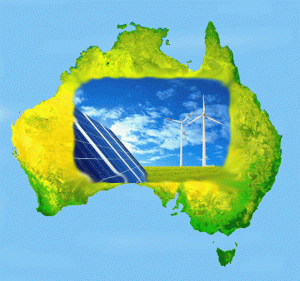 Australian renewables head for “boom-time” – led by states, REneweconomy, By Sophie Vorrath on 30 May 2017 [good graphs] Australia’s renewable energy industry is shaping up for a “boom-time” 2017, powered by a rebound in hydro-power generation, ambitious and motivated state and territory governments, the plunging cost of big solar, and a burgeoning national commercial solar sector.
In its latest annual Clean Energy Australia report, the Clean Energy Council says that an “unprecedented program” of renewable energy projects was set to go to construction across course of thise year, totalling 3150MW of new generation capacity – approximately half what is needed to meet theå remainder of RET.
“At least 30 renewable energy projects will be under construction during 2017, in what is shaping up to be the biggest year for the industry since the iconic Snowy Hydro Scheme was built more than half a century ago,” the report says.
The projects are also expected to deliver more than $6.9 billion in investment and create 3725 jobs, much of them in regional Australia.
The CEC said the “ambitious scope” of renewable energy development in 2017 was largely due to the bipartisan support returned to the RET in 2015, continued falls in the cost of RE and strong support from state and territory governments, as well as from ARENA and CEFC – the latter two are credited with pushing the price of large-scale solar down to almost half what it was just a couple of years ago.
The report was particularly keen to note the influence of state and territory policies and targets, which it said had returned stability to a market “badly shaken” by the previous Coalition Abbott government’s extended RET Review, while also acting to “fill the void of robust national energy and climate policy” beyond 2020…….http://reneweconomy.com.au/australian-renewables-head-for-boom-time-led-by-states-85762/
May 31, 2017
Posted by Christina Macpherson |
AUSTRALIA - NATIONAL, energy |
Leave a comment
 Telstra’s solar contract part of bigger power play, AFR, Angela Macdonald-Smith 30 May 17 Telstra has lifted the veil on its highly anticipated new energy strategy, revealing it will underpin the construction of a $100 million solar farm in northern Queensland as part of a wider play to protect itself from soaring power prices. Under a deal struck with renewable energy giant RES Group, Telstra will buy all the power generated by a 70 megawatt solar project to be built near Emerald over “multiple” years.
Head of Telstra’s new energy division Ben Burge also said the telco was gearing up to use its hundreds of megawatts of backup power at exchanges around the country to offer electricity into the wholesale market when ultra-high demand causes prices to surge.
“It’s a highly distributed, highly responsive source of energy which over the coming years we will look to make better use of in order to improve our resilience but also to address extreme wholesale prices in the market,” Mr Burge, the former head of Meridian Energy’s Australian business, said.
May 31, 2017
Posted by Christina Macpherson |
Queensland, solar |
Leave a comment
 German battery giant Sonnen teams with Australian solar tile maker to take on Tesla, One Step Off The Grid, By Sophie Vorrath on May 25, 2017
 German battery storage giant and major Tesla rival, Sonnen, has opened up competition on yet another front in Australia, with the announcement this week of a partnership with a local roofing company that is set to launch its own version of an integrated solar tile.
Sonnen said on Thursday that it had signed an agreement with Australian company Bristile Roofing to be the national supplier of solar powered energy storage systems for homes using its new solar tile, which is due to hit the market in September.
Under the deal, Bristile will offer the Sonnen AC Coupled modular battery storage system to the builder market, as well as its new Sonnen DC Hybrid range.
The storage system includes an inverter, battery modules, and an energy management system with built-in smart appliance control. The systems have a 10-year guarantee, but are designed for a 20-year life, according to Sonnen.
Bristile, which is a part of the building materials group Brickworks, says it expects to target the estimated 102,000 new-build homes throughout Australia in 2017-18, with a number of builders the company deals with “looking to offer integrated solar systems” as a standard feature of off-the-plan homes…..
The deal come’s just weeks after Tesla announced that its own, much-hyped solar roofing tiles were open for Australian orders, with down-payments, ahead of delivery in 2018.
Tesla, which has previously claimed the tiles would be no more expensive that a regular roof, making the solar power generation “a bonus”, has estimated that the “typical homeowner” should expect to pay $US21.85 per square foot for the tiles. Bloomberg, however, puts the price at $US42 per sqaure foot, including materials and labour.
Prices are yet to be revealed for the Bristile Solartile. https://onestepoffthegrid.com.au/german-battery-giant-teams-australian-solar-tile-maker-take-tesla/
May 26, 2017
Posted by Christina Macpherson |
AUSTRALIA - NATIONAL, solar |
Leave a comment
AEMO says major market reform essential to cut energy prices http://reneweconomy.com.au/aemo-says-major-market-reform-essential-to-cut-energy-prices-28327/ By Giles Parkinson on 26 May 2017
Two key Australian energy institutions have again pushed for more rapid and wholesale changes of market rules, saying this was essential if Australia was to manage new technologies and return to its former status of a low-cost energy nation.
Testimony from the Australian Energy Market Operator and the Australian Renewable Energy Agency underlined their plea for changes to market rules, changes which many in the industry say have been stalled under the current market rule maker. New AEMO chief executive Audrey Zibelman says Australia used to have low energy prices, but had obviously lost that status. “The question is, how do we use the resources we have to get back to that level of affordability?” she told a parliamentary inquiry in Canberra.
The answer was with new technologies like battery storage and demand management, a new set of market rules. “What we need is to think how to get these opportunities into the market. We are operating 20th Century power system trying to keep pace with 21st Century change,” Zibelman said.
Both AEMO and ARENA have been highly critical of the slow pace of reform of Australian energy market rules, the province of the Australian Energy Market Commission and the COAG energy ministers.
In its submission to the parliamentary inquiry into a modern electricity system, AEMO said that Australia’s rule making was not sufficiently forward-looking to meet the needs of the “paradigm shifts” the National Electricity Market was undergoing.
In particular, AEMO and ARENA want rule changes that can encourage battery storage and demand management, and that will address the over-investment in networks and generators that are responsible for Australia now having some of the highest electricity prices in the western world. Continue reading →
May 26, 2017
Posted by Christina Macpherson |
AUSTRALIA - NATIONAL, energy |
Leave a comment
 REneweconomy, By Sophie Vorrath on 24 May 2017 The Clean Energy Seed Fund established just under a year ago as the first investment of the Coalition government’s re-badged Clean Energy Innovation Fund, has this week completed a $26 million capital raising, easily surpassing its $20 million target.
The fund’s manager, Artesian Venture Partners, said on Wednesday that the bumper capital raising included $10 million commitments from cornerstone investor the Clean Energy Finance Corporation (CEFC) and Australian Ethical Investment, and further investments from Hostplus and Future Super.
Launched in September 2016 with a $10 million cornerstone commitment from the $1 billion CEIF, the fund was set up to focus on clean energy sub-sectors including the internet of things, battery storage, biofuels and metering and control.
It aims to provide “pull-model” venture capital support to encourage greater investment and participation in the early-stage cleantech sector and co-investment from a wide range of investors, including high net worth individuals, angel investors, venture capital firms, corporates and institutions.
In the short-term, its goal is to invest at seed, angel and later stage follow-on rounds in 30-50 startups over a four-year investment period.
The fund also draws on the finance and skills of both the CEFC and the Australian Renewable Energy Agency (ARENA), the latter of which was, at the time of the fund’s establishment, facing steep budget cuts.
CEFC investment development director, Blair Pritchard said the $26 million of funds raised would be enough to see more dedicated clean energy accelerators popping up around the country….. http://reneweconomy.com.au/clean-energy-seed-fund-raises-26m-vote-confidence-sector-96236/
May 26, 2017
Posted by Christina Macpherson |
AUSTRALIA - NATIONAL, business, energy |
Leave a comment
Guardian 19th May 2017 Using hydrogen on a large scale – either for electricity generation or transportation fuel – requires significant infrastructure investment; for example in hydrogen fuelling stations.
Zhang points out that Australia’s geography and scattered population makes that an expensive prospect, at least for the time being. Because of this, some are focusing on the perhaps more achievable prospect of Australia becoming an exporter of energy in the form of hydrogen.
Dr Michael Dolan, principal research scientist at CSIRO, says this is an attractive scenario because Australia has such an enormous capacity to generate renewable energy compared to a country like Japan, which has limited free land and sunshine…. https://www.theguardian.com/sustainable-business/2017/may/19/how-australia-can-use-hydrogen-to-export-its-solar-power-around-the-world
May 24, 2017
Posted by Christina Macpherson |
AUSTRALIA - NATIONAL, energy |
Leave a comment
National
Summer energy crisis looms without reforms, Grattan Institute warns
Panicking politicians who make kneejerk decisions to bolster Australia’s energy security run the risk of fuelling a power crisis with more blackouts and restrictions, a Grattan Institute report says.
http://www.abc.net.au/news/2017-05-21/grattan-institute-warns-of-looming-summer-energy-crisis/8545522
New coalmines will worsen poverty and escalate climate change, report finds
Oxfam attacks Australia’s ‘climate policy paralysis’ and urges it to promise no new coalmines and end public subsidies
https://www.theguardian.com/environment/2017/may/22/new-coalmines-will-worsen-poverty-and-escalate-climate-change-report-finds
Cheap way to cut emissions
Graham Lloyd
Land clearing – Australia could meet a 2C warming target under the Paris agreement at no cost to business.
http://www.theaustralian.com.au/national-affairs/climate/land-management-changes-the-lowcost-way-to-cut-emissions/news-story/eaa311fadd2d5963774b94c3bcf9bb95
May 22, 2017
Posted by Christina Macpherson |
AUSTRALIA - NATIONAL, climate change - global warming, energy |
Leave a comment
 The demand response proposal signals greater co-operation between AEMO and ARENA, particularly on the integration of renewables. A trial using wind energy to provide frequency control is to be held in South Australia next month.
AEMO looks at smarter ways to deal with extreme peaks and  heatwaves http://reneweconomy.com.au/aemo-looks-at-smarter-ways-to-deal-with-extreme-peaks-and-heatwaves-40094/ By Giles Parkinson on 19 May 2017 The new direction of a rejuvenated Australian Energy Market Operator is starting to take shape, with the organisation announcing plans to have 100MW of demand response capacity in the Victorian and South Australian markets in time for the summer peaks and heatwaves.
The program, being run jointly with the Australian Renewable Energy Agency, signals a tangible change in focus for AEMO, and the market in general, in finding smarter ways to manage supply and demand rather than simply building more fossil fuel plants and poles and wires.
AEMO’s new CEO Audrey Zibelman is already a champion of demand response and it was one of the major levers that she pulled when running New York’s Reforming the Energy Vision program that aims for more decentralised power, and 50 per cent renewable energy by 2030.
In the PJM market, one of the biggest in the US, demand response accounts for 10 per cent of total capacity, and Zibelman sees no reason why it cannot grow to be at least 30 per cent of the Australian market.
That’s because Australia has a ready-made investment in the technologies that are needed. More than 1.6 million homes and businesses have installed rooftop solar, and many of these will install battery storage as well.
“If you have solar on your roof and you are putting in storage, it is saying that during certain hours of the day you use solar to charge up the battery, and then, rather than relying on grid, you reduce demand on the grid. For us (the grid operator) that’s the same as increasing generation.”
Zibelman says it is an obvious solution to provide a price signal to use these resources, as well as rewarding others – such as manufacturers and large businesses – for cutting back on their power usage at critical moments, rather than spending more money on new plant.
“If we can reduce the amount of demand, that has the same benefit as the grid, and is a lot less expensive than building a new power plant that is only used for a few hours a year,” she says. Continue reading →
May 20, 2017
Posted by Christina Macpherson |
AUSTRALIA - NATIONAL, efficiency |
Leave a comment
 Comments on “ELECTRICITY NETWORK TRANSFORMATION ROADMAP: FINAL
  REPORT Energy Networks Australia and CSIRO Dennis Matthews, April 2017”
INTRODUCTION This 100-page document is a composite of two distinctly different contributions. The smaller part, which appears to be the work of CSIRO, is technical, relatively free of jargon, to the point, objective and mostly about computer modelling studies.
The majority of the report is loaded with jargon, feel-good words and phrases, and gives the general impression of a sales document. For example, “network platforms”, “service platform”, “incentivise”, “new information platforms will be required to animate new distributed energy resources”, “intelligent networks and markets”, “empowered”, . This latter part is presumably the work of Energy Networks Australia.
CSIRO is a well known and generally respected government organisation. Energy Networks Australia comprises electricity low voltage distribution and high voltage transmission network companies.
The report is best understood from the point of view of electricity distribution and transmission monopolies that are seeing a rapid erosion of their businesses because of the rapid uptake of rooftop solar electricity generators and associated battery storage. These (rooftop solar + battery) systems are an emerging competitive threat to monopolistic electricity network companies, which are seeking to short-circuit the threat by co-opting these small, distributed electricity suppliers with a variety of financial “rewards”.
The report emphasises the “customer” and is almost entirely about how the electricity consumer-cum-generator (gensumer) will benefit from working with the distributor. There is no mention of how the electricity distributor will benefit from this arrangement.
The following comments use the same headings as the report.
EXECUTIVE SUMMARY After acknowledging the customer-driven nature of changes in the electricity system (“transformation on an unprecedented scale”), the report concludes:
“By connecting millions of customer owned generators and energy storage systems to each other, networks can act as platforms which help match supply and demand and reduce the need for inefficient duplication of energy investments.”
- INTRODUCTION
Under the heading “customer oriented electricity” we are promised that “transformed electricity networks actively connect customers with a growing range of market actors and customized electricity solutions”.
Under “Incentives and network regulation” there will be “A fairer system through active implementation of network tariff and retail pricing reform and modernised regulation and competition frameworks.” In the past, privatised electricity distribution networks have opposed regulation and have resisted attempts to constrain network tariffs, the latter causing expense to the electricity consumer through court costs, which are recovered from the consumer.
Achieving “full development of a customer oriented network” will require “a network optimisation market (NOM) where distributed energy resources services can be procured”. This new electricity market would be in addition to the present, strongly criticized, national electricity market (NEM).
The Roadmap is divided into two phases, the Foundation Phase (2017-22) and the Implementation Phase (2023-27). The former may be considered a realistic timeframe but the latter is highly speculative. It is the latter phase that is claimed to “deliver enhanced customer choice and value”.
“Optimisation” means greater use of the electricity network, which will undoubtedly be financially beneficial to the owners of the electricity network, but no data is given on how much of this financial benefit is passed on to the consumer; presumably this is “commercial in confidence”.
At no stage in the Roadmap is the effect of privatisation (vs public ownership) of the electricity distribution system evaluated.
The Roadmap supports “advanced metering” but only gives a broad description of what an “advanced meter” will do. For decades, the electricity industry has resisted the simple idea of having a meter placed where customers can get instantaneous feedback on usage and cost in a way that will help customers manage their demand. This has clear benefits to customers but would probably lower revenue to the electricity industry. Continue reading →
May 20, 2017
Posted by Christina Macpherson |
AUSTRALIA - NATIONAL, energy |
Leave a comment
Australia’s first large-scale solar farm to quadruple in size http://reneweconomy.com.au/australias-first-large-scale-solar-farm-to-quadruple-in-size-20618 By Giles Parkinson on 19 May 2017
The Greenough River solar farm in Western Australia, the first large-scale solar farm in the country, plans to quadruple in size from 10MW to 40MW.
The plans by co-owners Synergy, the government-owned generator and retailer, and US energy giant General Electric, were unveiled in a submission to WA’s Economic Regulation Authority, and reveal that two new 15MW arrays will be built either side of the existing facility, around 50km south-east of Geraldton.
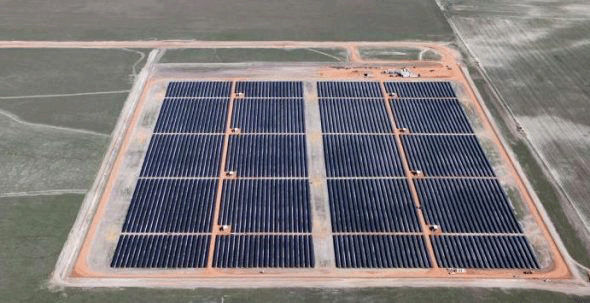
The new arrays, will use First Solar modules, as did the first, but unlike the first installation these will deploy single axis tracking technology to improve the yield. More than 90 per cent of solar farms in Australia are now using tracking technology. SMA is providing the inverters.
Synergy and GE say that the solar farm will seek a power purchase agreement, but presumably that will come from Synergy itself, as it is it the biggest utility in the state and has yet to meet all its renewable energy target commitments.
Greenough River was built in 2012 and remains the only solar farm connected to the main grid in Western Australia, although several other projects have begun, or are about to begin, construction. These include the 30MW Byford solar farm south-east of Perth and a 10MWW solar farm planned near Northam by Carnegie Clean Energy.
Across Australia, however, the large-scale solar boom is accelerating. Eight grid-connected large-scale solar farms have now been completed and another 30 are under construction, or have reached financial closure and are about to begin.
The joint owners of Greenough River says the solar plant, located on a wheat farm, “has been extremely warmly welcomed by what is a very small remote community. No public complaints or opposition have been received.”
May 20, 2017
Posted by Christina Macpherson |
solar, Western Australia |
Leave a comment
12 from 12: ARENA’s big solar plans take off across the country http://reneweconomy.com.au/12-from-12-arenas-big-solar-plans-take-off-across-the-country-81918/ By Giles Parkinson on 16 May 2017 The Australian Renewable Energy Agency has announced that all 12  of the projects that won funding under its large-scale solar program have now reached financial close and will begin construction shortly, if they haven’t already.
The last of the 12 projects to get to financial close – the 20MW White Rock solar farm in northern NSW – did so late last week. Funding was never really in doubt considering that the project is owned by Chinese giant Goldwind, which is building a 175MW wind farm by the same name at the same place.
ARENA, however, used the milestone to hail its $90 million initiative as a huge success, helping to bring down the cost of large-scale solar to the level of wind energy – and five years ahead of what had been expected.
The 12 projects have also benefited from $320 million in low-cost finance from the Clean Energy Finance Corporation, as the country’s major banks tried to wrap their mind around this new technology.
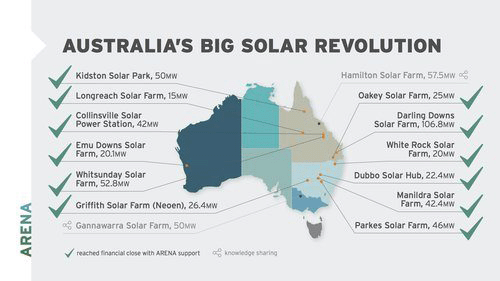
But there is every sign that they have, and have lowered the risk quotient on their financing, at least for those with long-term power purchase agreements. While the ARENA program will deliver 490MW of large-scale solar, another 1,500MW is thought to be also under construction, or about to begin, around the country.
“This competitive round is the perfect demonstration of how ARENA is accelerating Australia’s shift to a low emission, renewable energy future,” Frischknecht said in a statement. “From zero to more than 20 plants in five years, Australia’s large-scale solar industry has grown at a tremendous pace thanks to concerted efforts by ARENA and the CEFC.
“We know of at least six new plants that are being developed without any ARENA grant funding support.”
He said the ARENA program had unlocked $1 billion in investment from other sources and regional economies would benefit, with an estimated 2,300 direct jobs and thousands more indirect jobs expected to be created by these plants.
Frischknecht said planning, developing and financing large-scale solar projects remained a complex task involving multiple different parties. That’s why the knowledge gained from the project is so valuable. “ARENA believes in the power of shared knowledge. That’s why we require project developers to share the learning from each stage of development, construction and connection with the renewable energy sector,” Mr Frischknecht said.
“Our support for Whitsunday Solar Farm assisted project developer Edify Energy to secure debt finance for two additional plants, Hamilton Solar Farm in Queensland and Gannawarra Solar Farm in Victoria. ARENA is benefitting from knowledge sharing activities across the three projects.”
The projects are expected to be completed between late-2017 and mid-2018, and will help reduce wholesale prices in all three states where these projects will be built when they come on stream.
May 17, 2017
Posted by Christina Macpherson |
AUSTRALIA - NATIONAL, solar |
1 Comment









 Antinuclear