Turnbull’s dishonest spin about his Snowy Hydro energy plan
Turnbull fibbed about Snowy Hydro 2.0 https://independentaustralia.net/environment/environment-display/turnbull-fibbed-about-snowy-hydro-20,10235 Mark Hipgrave 26 April 2017, Far from being the solution to Australia’s energy crisis, bureaucrats have confirmed the upgrade to Snowy Hydro may never even go ahead, reports Mark Hipgrave.
RECENT TURNBULL GOVERNMENT announcements about renaming the 457 Visa system, toughening the citizenship test, and the one from Fiona Nash about decentralising Govt Departments, made me think about last month’s big announcement – the Snowy Hydro Scheme Expansion.
You will recall that, on March 16, the PM announced plans for a $2 billion expansion of the Snowy Hydro scheme that could add up to 50% to its capacity.
In his media statement, Turnbull outlined the basics of the project — a plan to ‘supercharge the Snowy Hydro precinct’, with the Australian Renewable Energy Agency (ARENA), charged to
‘… examine several sites, which could support large scale pumped hydroelectric energy storage in the precinct. These sites would involve new tunnels and power stations, connecting existing storages.’
In a speech in front of the penstocks feeding the Tumut 3 Power Station, he sounded positively Churchillian puffing out his chest, malsplaining to us all that the new Snowy Hydro scheme was the
‘… result of the vision and the courage of the generation that won the Second World War … they defended our freedoms …. and they came home and built this …. these are big dreams in these mountains, real courage…’
(He ignored the reality that around two thirds of the workforce employed in the construction of the scheme were immigrant workers, originating from over 30 countries. Not the winners of WWII, they were mostly the losers — displaced persons from Germany, Italy, Yugoslavia and other parts of Eastern Europe. They came with little English and no knowledge at all of Australian values. The work was largely managed by U.S. engineering contractors and, while an engineering triumph, it was achieved with what we would now regard as a shocking safety record). Continue reading
Mini hydro electric scheme could revive historic hydro power in Warburton, Victoria
 Push for a mini hydro-electric scheme in Yarra Valley town of Warburton, The Age Darren Gray, 25 Apr 17, Up to 120 homes could be powered by a mini hydro-electric scheme that’s been proposed by locals for Warburton, in the upper reaches of the Yarra Valley.
The hydro project, which would involve using water from the fast-flowing Ythan Creek as it flows through the local golf course, would produce year-round power to be fed into the electricity grid.
The proposed scheme would also restore some of the picturesque town’s early 20th century heritage, by reviving hydro power at the site of an old hydro scheme that operated at the property from 1919 onwards.
The historic hydro plant powered the old Parbury Timber Mill during the daytime, while at night it powered local street lights and part of the town for years, before Warburton was connected to the electricity grid.
The modern hydro project, expected to cost close to $1 million, is the brainchild of Warburton residents Luke Whiteside and Nick Killey…….http://www.theage.com.au/victoria/push-for-a-mini-hydroelectric-scheme-in-yarra-valley-town-of-warburton-20170424-gvrf2d.html
Renewable energy leader South Australia could lead some more, with pumped hydro storage
Could South Australia be the nation’s hydrogen state, too? REneweconomy, By Valdis Dunis on 24 April 2017 South Australia is already tops for solar and wind use in Australia, crossing over its 50 per cent generation goal from these clean renewable sources last year – eight years ahead of schedule.
Soon the state is will be Australia’s (and a world) leader in battery storage, led by its government’s new tender for a 100MW/100MWh battery system for the state’s grid, plus the other private initiatives from the Lyon Group, AGL’s 1,000 battery virtual power plant in Adelaide, and other companies building large storage systems in the state.
It also is likely to become a leader in new large scale pumped hydro storage thanks to Energy Australia’s detailed work now being done on the feasibility of building a 100MW version near Whyalla in the state’s North, thanks to support funding from ARENA.
Finally, the most high-profile and long-fought-for renewable project in the state – the 24/7 despatchable solar thermal plant near Port Augusta – will now hopefully get over the line, thanks to a new $110M low-cost loan that SA Senator Nick Xenophon was able to wrench out of the federal government last month.
However, South Australia might soon have a new clean feather to add to its cap:
Last Friday, the state’s Energy Minister Tom Koutsantonis surprised most at a CEDA lunch to announce the state will also now go heavily in to implementing a hydrogen industry, leveraging the state’s increasing supply of clean and low cost- renewable energy to power the creation of this fuel from water.
Hydrogen is well known as a clean way to power transport – from cars to trucks to trains and eventually planes potentially, and for driving power turbines and other equipment needing large amounts of power quickly on demand. Best of all is that it does it all without the pollution (assuming water vapour from the tailpipe noone considers pollution!).
The Minister presented a set of slides on this new goal, with the “aim to capitalise on our abundance of renewable resources to become the green hydrogen capital of Australia”.
The hydrogen fuel would not just be for local state use, but as a new export industry both to other states and internationally. The Minister conceded Victoria was currently ahead of South Australia, but said the state will be able to leverage its existing strong engineering expertise in gas processing, pipelines and storage. He also said Asia, in particular Korea and Japan, are large potential markets for hydrogen. …….http://reneweconomy.com.au/could-south-australia-be-the-nations-hydrogen-state-too-11243/
Communities of battery users could create a virtual power plant.
 New power generation: Home battery sharing could build virtual public utilities, The Age, Brian Robins, 23 Apr 17 It was one of the disasters of recent energy policy: the boom in sales of air conditioners without taking into account the impact their mass sale would have in forcing up power prices for all.
Those without air conditioners have had thousands of dollars added to their electricity bill to pay for the network upgrades to cope with air conditioners, since much of the extra “poles and wires” are used only a few hours a year, when the weather is very hot or very cold.
Now, mass adoption of battery storage systems poses the same risk for those who don’t install them. Their adoption will allow households to slash their use of the grid which will leave fewer users faced with higher bills to maintain the network.
Communities of battery users But for German battery challenger Sonnen, batteries are only part of the energy equation. More fundamental is creating “communities” of connected battery users to create virtual power plant. Continue reading
19 big South Australian industrial users join to buy electricity in bulk: a path to more wind and solar projects?
 Industrial bulk-buy could open path for more wind and solar projects, REneweconomy
The South Australian Chamber of Mines and Energy (SACOME) this week won approval from the Australian Competition and Consumer Commission for 19 big industrial users to band together to negotiate long-term electricity contracts, having grown tired of the soaring prices and short-term contracts being offered by the state’s retail oligopoly.
The companies – which include Nyrstar, Arrium, Oz Minerals, and a collection of high profile auto groups, food companies, retailers, wineries and universities (see full list below) – account for 15 per cent of the state’s electricity demand.
Most have been hit with electricity price rises of between 30 and 80 per cent in the last year, and are now paying between 8c/kWh and 15c/kWh for their electricity, and are unable to get any long-term contracts.
SACOME’s Rebecca Knol says the tender is not designed to favour one technology or another, and they would welcome either renewables or gas. “We are not predicting the outcome,” she told RenewEconomy. “We don’t have a preference.”
The move, she says, is more about challenging the pricing power of the retail oligopoly. “By aggregating their load, they will improve their individual bargaining position and be able to establish more cost-competitive supply contracts,” Knol said.
But a quick glance at prices for new wind and solar farms, and for gas generation, puts renewables in the driving seat.
Wind and solar farms are being delivered for around 7c/kWh, but even the short-run marginal cost of gas generators (i.e.. the fuel and maintenance cost) ranges from 7c/kWh to more than 12c/kWh………
The total load of 19 industrial users (19 companies, 24 installations) is 246MW at peak, and represents annual demand of 1,957GWh. Most interestingly for the wind and solar plants, the businesses are offering an 11 year contract – a length of contract that has been all but impossible to secure from large retailers.
“We are looking for opportunities to improve the electricity price so our businesses can stay competitive,” Knol says. “What we are hoping is that they do see this as opportunity to change the wholesale market. It could bring on a new generator, or it could be with an existing generator.”
Australian corporates have been slow to engage with renewable energy developers – possibly given the fact that the fall in wind and solar costs below the prevailing wholesale price of electricity is only very recent.
Queensland zinc refiner Sun Metals, that state’s largest single energy user, is one exception, having decided to build its own 116MW solar farm, rather than commission a third party. The Sunshine Coast Council is also building its own 15MW solar farm in south-east Queensland…..
The original application included: Nyrstar, Arrium, OZ Minerals, Hillgrove Resources, Rex Minerals, Seeley International, SMR Automotive, Thomas Foods and Intercast & Forge.
Since the application was made in January 2017, Peregrine Corporation, Foodland, Independent Grocers of Australia (IGA), Pernod Ricard Winemakers, Orora Glass, Brickworks, Flinders University and the University of South Australia have also come on board. http://reneweconomy.com.au/industrial-bulk-buy-could-open-path-for-more-wind-and-solar-projects-22023/
Tasmania’s $3 billion hydro plans – some doubts, with Victoria’s renewable energy and batteries rising
Plunging battery costs raise doubts over Tasmania’s $3 billion hydro plans http://reneweconomy.com.au/plunging-battery-costs-raise-doubts-over-tasmanias-3-billion-hydro-plans-39326/ By Giles Parkinson on 21 April 2017
The idea of adding 2,500MW of pumped hydro into Tasmania’s existing hydro system – and using this and its considerable wind resources as a “renewable energy battery” for the mainland – was unveiled with much fanfare by prime minister Malcolm Turnbull, premier Will Hodgman and Hydro Tasmania on Thursday.
But the crucial ingredient in the plan is the construction of a new $1 billion inter-connector to carry all that renewable power to the mainland. And a study by John Tamblyn released on the same day raises considerable doubts about the economic viability of such an investment.
In one “neutral” scenario, drawn up by the Australian Energy Market Operator, the benefits might outweigh costs over a 20 year period by just $20 million. And these benefits might be eroded if battery storage costs continue to fall and utility-scale batteries become widespread, as many predict.
Further complicating the matter is Victoria’s own renewable energy target, which will likely deliver 5,000MW of new capacity by 2025.
“That means that building new renewable generation in Tasmania (1,200MW of wind), timed to coincide with commissioning of the second Bass Strait inter-connector, would not increase projected market benefits,” the report says. Instead, it is likely to “lead to oversupply in the southern regions (Victoria, Tasmania, and South Australia).” Continue reading
Switch from coal to gas – still polluting. Turnbull also touts hydro-power
More hydro power on federal agenda, Herald Sun, Katina Curtis, Australian Associated Press, April 20, 2017 Malcolm Turnbull is boosting his renewable energy credentials by providing federal funding for another study into expanding Australia’s hydro storage, this time in Tasmania.
It comes as Labor accuses the prime minister of giving gas companies a wet lettuce leaf flogging in his bid to persuade them to increase domestic supply.
Mr Turnbull also confirmed on Thursday his government is looking at building a multi-billion dollar pipeline to bring gas from Western Australia to the east coast – an idea climate experts dismiss as ridiculous and expensive…….
However, energy expert Andrew Stock, from the Climate Council, dismissed it as an idea that would lock in high power prices.
“LNG export pricing out of the west coast plus transportation through a multi-billion dollar pipeline doesn’t make for cheap gas,” he told reporters in Canberra.
Mr Stock was launching a new Climate Council report warning switching from coal to gas power will do nothing to lower electricity bills and will be nearly as polluting. http://www.heraldsun.com.au/news/breaking-news/more-hydro-power-on-federal-agenda/news-story/4b0b27dfd550e150108b8662f68f550e
Queensland govt calls for large scale renewables hub near near major coal port
 Queensland wants “huge renewables hub” built near major coal port, REneweconomy, By Sophie Vorrath on 20 April 2017 The Queensland government has earmarked one of the state’s major coal centres as a future renewable energy hub, calling for expressions of interest to develop up to 450MW of large-scale solar, wind or biofuels on a 1,248 hectare patch near Gladstone.
In a document published on Thursday, Economic Development Queensland (EDQ) said it was seeking to enter into an agreement with an organisation or consortia that “will act quickly” to develop a large scale solar farm or other renewable energy facility on government-owned land at Aldoga, within the Gladstone State Development area.
Gladstone – which is home to a 1,680MW coal-fired power station, the state’s largest electricity generator – is also known for its shipping port, which is largely used to export Australian coal and, more recently, LNG.
The government’s proposal to build up to 450MW of renewable energy capacity at Aldoga – more than half of the total 719MW currently installed in the state – offers a neat illustration of the shifting momentum in global energy markets, while also supporting the Palaszczuk government’s target of 50 per cent renewables by 2030……..The Aldoga site will be EDQ’s flagship renewable energy project and is part of the government’s Advancing Our Cities and Regions Strategy, which aims to renew and repurpose underutilised state land to generate jobs, and drive economic growth. http://reneweconomy.com.au/queensland-wants-huge-renewables-hub-built-near-major-coal-port-98363/
Victoria’s 132MW Mt Gellibrand wind farm set to be developed

Construction underway on Victoria’s 132MW Mt Gellibrand wind farm http://reneweconomy.com.au/construction-underway-on-victorias-132mw-mt-gellibrand-wind-farm-88672/ By Sophie Vorrath on 19 April 2017 Acciona Energy has broken ground on its 132MW Mt Gellibrand wind farm, a $258 million project in Victoria’s western plains that was fast-tracked after winning a state government tender designed to reboot renewables investment in the state, and side-step a capital strike by major utilities.
At a turning of the sod ceremony at the wind farm’s site, 25km east of Colac, Acciona managing director Andrew Thomson said the company expected to see Mt Gellibrand “pouring” clean energy into the grid within about 15 months – at a time when the nation would be seeking to increase its capacity for renewable power generation.
Thomson said the new wind farm would be a “massive economic driver” for the region over the next 25 years, creating 100 local jobs in the construction phase, and up to 10 operations and maintenance roles continuing for decades ahead.
Of course, generating local jobs and investment was a key aim of the Andrews government tender, alongside meeting its legislated target of 25 per cent renewables by 2020, and 40 per cent by 2025. Continue reading
Tasmania, with wind and hydro can be “energy battery” for Australia – says Turnbull
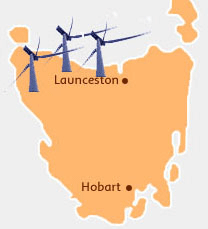 Turnbull says Tasmania wind, hydro can become “energy battery” for Australia, Reneweconomy, By Giles Parkinson on 20 April 2017 Prime minister Malcolm Turnbull has extended his vision of large-scale pumped hydro and storage to Tasmania, outlining plans to expand the island’s existing hydropower system, and possibly add 2,500MW in pumped hydro, and describing the possibility that the state could become the “renewable energy battery” for Australia. Continue reading
Enormous solar farm planned for Gympie area, Queensland
Queensland company lodges plan to build Australia’s biggest solar farm near Gympie, ABC News, By Bruce Atkinson, 19 Apr 17, A company proposing to build Australia’s largest solar farm near Gympie says the $2 billion facility will eventually supply about 15 per cent of south-east Queensland’s power needs.
Queensland company Solar Q has lodged a development application with the Gympie Council to build a solar farm and battery storage facility 30 kilometres north-west of the city.
The project will be built in stages, with initial approval being sought for a 350-megawatt facility, but within four years it is proposed to increase this to 800 megawatts or enough electricity to power about 315,000 homes.
Managing director Scott Armstrong said the finished facility would be the biggest in Australia but “the way the market is going is that there will be bigger projects that will come on”……..
When completed, around 3 million solar panels will provide power to the network on the 17-square-kilometre site. During peak consumption at night, the battery storage facility, which is powered by the grid, will ease the load on power stations……..
The proponents are not expecting any hurdles to approval from the Gympie Council or State Government agencies, Mr Armstrong said.
“Solar and battery storages are a static generation facility so it will produce minimal noise, it doesn’t emit, it doesn’t have particulates from chimney stacks, it doesn’t have ash dams, so we are not expecting any impediments with regards to getting approvals,” he said.
Once the approvals are in place Mr Armstrong expects the connection agreement with the transmission company will be finalised.
He said the project would be funded by private investors, including superannuation management funds.Work is expected to start by the end of the year…….http://www.abc.net.au/news/2017-04-19/mega-solar-farm-planned-for-gympie-qld/8451774
Victoria’s Ararat Wind Farm now supplying power to Victoria and ACT
 Ararat Wind Farm fully commissioned, supplying power to Victoria and ACT http://reneweconomy.com.au/ararat-wind-farm-fully-commissioned-supplying-power-to-victoria-and-act-51770/ By Sophie Vorrath on 19 April 2017 The recently completed 240MW Ararat Wind Farm in south-western Victoria is now operating at full capacity, feeding enough renewable energy into the grid to power 120,000 homes, 37,000 of them in Canberra.
The wind farm, which is operated and managed by Canberra-based company Windlab, was fully commissioned on Wednesday this week, after several years in the works. It first began sending power to the grid in Victoria in August 2016. This graph below, from the Energy and Climate College, shows how it has expanded production.
The project gained significance as the first wind farm to be contracted after the reinstatement of a bipartisan federal renewable energy target – that is, after the Coalition and Labor agreed to cut the RET to 33,000GWh from 41,000GWh).
In Ararat’s case, the go-ahead was buoyed by the signing of a power purchase agreement with the ACT government, which guaranteed the purchase of approximately 40 per cent of its annual output – a contract it is now delivering on.
“The ACT’s agreement with the Ararat Wind Farm provided certainty for investors and enabled construction to commence in late 2015,” ACT climate minister Shane Rattenbury said on Wednesday.
“This is good news for consumers as well as climate change mitigation, as the ACT government has locked-in a set price for the renewable electricity produced by 10 wind and solar projects, including Ararat, for the next 20 years.”
Rattenbury – whose predecessor, Simon Corbell, is widely regarded as the mastermind of the nation-leading renewables policy – said that the Capital was showing the federal government how to deliver on clean energy.
“If the generators make more money than the set price for the electricity they sell into the national electricity market, they pay the difference back to the ACT,” Rattenbury said.
Ararat Mayor, Paul Hooper, described the wind farm as a “really significant” project for the city, bringing $450 million of investment, 350 jobs at its construction peak, and more than $40 million into the local economy during construction, which lasted about 18 months.
“It was completed on time and to a very high standard,” Hooper said, adding that project developer RES Australia had been “…very, very good corporate citizens” throughout the development.
The great gas con: There are cheaper, cleaner alternatives
REnewec onomy, By Giles Parkinson on 20 April 2017 [excellent graphs etc]
In Canberra on Thursday, as yet another “gas summit” hosted by prime minister Malcolm Turnbull ended without a “fix” to soaring gas prices, the Energy Users Group was complaining that one industrial customer in Queensland was being hit with a new gas supply contract at the usurious price of $23/gigajoule.
Frankly, it beggars belief that Australian industry is even bothering to ask for cheaper gas prices, when there are obviously cheaper alternatives available – for both electricity and for industrial gas users.
An Australian Renewable Energy Agency report last year identified how biogas, geothermal and solar thermal alternatives could provide industrial heat at the equivalent of $5/gigajoule – less than one-quarter of the price being asked for gas now. Why aren’t they embracing these patently cheaper and cleaner alternatives?
Part of the answer is the ingrained fossil fuel mentality in Australia. For so long, the true cost of fossil fuels has been hidden by massive cross-subsidies – to electricity users in remote and regional areas, and to big industrial customers……..
Andrew Richards, from the Energy Users Association, says it is because of the complexity, and the fact that renewable options require up-front investments, rather than paying-as-you-go commodity fuels. But he thinks that business is slowly getting their mind around the alternatives and looking carefully at the technology options.
Some, like the South Australian greenhouse tomato grower Sundrop, are using solar thermal technologies, and the Clean Energy Finance Corporation has backed other businesses looking to exploit biogas as an alternative to natural gas.
And more technology options will be on their way: Those outlined by the ARENA report include:
- High temperature solar concentrator driven processes to convert biomass, water, gas or other fossil fuels into chemical feedstocks or new solar fuels.
- Electrolysis of water to produce hydrogen as a feedstock or fuel.
- High temperature solar thermal approaches to direct driving minerals processing and other thermal processes.
- New advanced biomass gasification systems.
- Innovative systems for purifying gas streams from gasifiers or digesters for use in sensitive direct combustion processes (ovens etc) or for injection to existing gas pipeline infrastructure.
- New advanced biomass production or collection systems.
- Targeted innovations to improve existing renewable energy technologies. http://reneweconomy.com.au/the-great-gas-con-there-are-cheaper-cleaner-alternatives-13767/
Carnegie raises $18m for Northam solar farm and micro-grids
By Giles Parkinson on 20 April 2017 Carnegie Clean Energy plans to accelerate its project pipeline of large scale solar farms and renewable-based micro-grids after securing $18 million in a new capital raising – three times more than its original target.
The listed Perth-based company says the money will be used to fund its equity share of the soon-to-be-built 10MW solar farm in Northam, in West Australia, as well as accelerating its other solar projects and renewable-focused micro-grids.
The company, which has recently transformed from a single-focused wave energy developer to encompass solar, storage and micro-grid technologies, had planned a $6 million capital raising, but expanded the process in response to “overwhelming” demand from shareholders……http://reneweconomy.com.au/carnegie-raises-18m-for-northam-solar-farm-and-micro-grids-19682/
New South Wales becoming a quiet achiever in renewable energy
For a start, the NSW Coalition government now has one thing that the federal government no longer has – a long-term target (2050) to achieve zero net emissions for the state, including its electricity grid.
More than that, while it does not have its own state-based renewable energy target, it has high ambitions of its own that put it on a par with what has been achieved in South Australia, and what is being sought in Victoria, Queensland, and in the territories.
The Climate Change Fund Strategic Plan – unveiled as part of the NSW 2050 zero emissions target last October – openly canvasses a scenario where the state doubles its level of renewable energy to more than 10,000MW.
NSW could be dark horse of Australia’s renewable energy boom, REneweconomy, By Giles Parkinson on 18 April 2017 Federal energy minister Josh Frydenberg must feel a little friendless when he gets together with his state counterparts at the regular COAG energy meetings and looks around the room.
For a start, there are four Labor and Greens energy ministers – ACT (100 per cent by 2020), Victoria (40 per cent by 2025), and Queensland and Northern Territory (each 50 per cent by 2030) – with specific renewable energy targets far beyond the federal government
Then there is the new Labor energy minister in Western Australia, Ken Wyatt, who is yet to declare his hand, but who is likely to scupper the state subsidy for electricity which disguises the high cost of its fossil fuels. Renewables, and particularly rooftop solar, are likely to be the solution.
The Coalition states are not likely to be much help either. Tasmania wants a new Basslink so it can build more wind farms and export “baseload” renewables into the Victorian grid.
That leaves, NSW, the only mainland state or territory with a Coalition government and energy minister. It should be a strong ally – especially given that a year ago it was branded the worst place in Australia to invest in renewable energy. But appearances can be deceiving. Continue reading
1 This month
Chernobyl: The Lost Tapes – A good documentary on Chernobyl on SBS available On Demand for the next 3 weeks– https://www.sbs.com.au/ondemand/tv-program/chernobyl-the-lost-tapes/2352741955560
15 April – Zoom –Nuclear Power is Not the Solution
Apr 15, 2026 01:00 AM in Canberra, Melbourne, Sydney

Join the International Physicians for the Prevention of Nuclear War (IPPNW) on Tuesday, April 14th for a timely webinar exploring the risks associated with nuclear power and challenging the myth that it offers a simple, safe, carbon-free solution to the climate crisis

21 April Webinar: No Nuclear Weapons in Australia
Start: 2026-04-21 18:00:00 UTC Canberra, Melbourne, Sydney (GMT+10:00)
End: 2026-04-21 19:30:00 UTC Canberra, Melbourne, Sydney (GMT+10:00)
Event Type: Virtual
A virtual link will be communicated before the event.
Host Contact Info: australia@icanw.org

of the week – Australians for War Powers Reform (AWPR)
To see nuclear-related stories in greater depth and intensity
 Antinuclear