The great gas con: There are cheaper, cleaner alternatives
 REnewec onomy, By Giles Parkinson on 20 April 2017 [excellent graphs etc]
In Canberra on Thursday, as yet another “gas summit” hosted by prime minister Malcolm Turnbull ended without a “fix” to soaring gas prices, the Energy Users Group was complaining that one industrial customer in Queensland was being hit with a new gas supply contract at the usurious price of $23/gigajoule.
Frankly, it beggars belief that Australian industry is even bothering to ask for cheaper gas prices, when there are obviously cheaper alternatives available – for both electricity and for industrial gas users.
An Australian Renewable Energy Agency report last year identified how biogas, geothermal and solar thermal alternatives could provide industrial heat at the equivalent of $5/gigajoule – less than one-quarter of the price being asked for gas now. Why aren’t they embracing these patently cheaper and cleaner alternatives?
Part of the answer is the ingrained fossil fuel mentality in Australia. For so long, the true cost of fossil fuels has been hidden by massive cross-subsidies – to electricity users in remote and regional areas, and to big industrial customers……..
Andrew Richards, from the Energy Users Association, says it is because of the complexity, and the fact that renewable options require up-front investments, rather than paying-as-you-go commodity fuels. But he thinks that business is slowly getting their mind around the alternatives and looking carefully at the technology options.
Some, like the South Australian greenhouse tomato grower Sundrop, are using solar thermal technologies, and the Clean Energy Finance Corporation has backed other businesses looking to exploit biogas as an alternative to natural gas.
And more technology options will be on their way: Those outlined by the ARENA report include:
- High temperature solar concentrator driven processes to convert biomass, water, gas or other fossil fuels into chemical feedstocks or new solar fuels.
- Electrolysis of water to produce hydrogen as a feedstock or fuel.
- High temperature solar thermal approaches to direct driving minerals processing and other thermal processes.
- New advanced biomass gasification systems.
- Innovative systems for purifying gas streams from gasifiers or digesters for use in sensitive direct combustion processes (ovens etc) or for injection to existing gas pipeline infrastructure.
- New advanced biomass production or collection systems.
- Targeted innovations to improve existing renewable energy technologies. http://reneweconomy.com.au/the-great-gas-con-there-are-cheaper-cleaner-alternatives-13767/
Carnegie raises $18m for Northam solar farm and micro-grids
By Giles Parkinson on 20 April 2017 Carnegie Clean Energy plans to accelerate its project pipeline of large scale solar farms and renewable-based micro-grids after securing $18 million in a new capital raising – three times more than its original target.
The listed Perth-based company says the money will be used to fund its equity share of the soon-to-be-built 10MW solar farm in Northam, in West Australia, as well as accelerating its other solar projects and renewable-focused micro-grids.
The company, which has recently transformed from a single-focused wave energy developer to encompass solar, storage and micro-grid technologies, had planned a $6 million capital raising, but expanded the process in response to “overwhelming” demand from shareholders……http://reneweconomy.com.au/carnegie-raises-18m-for-northam-solar-farm-and-micro-grids-19682/
New South Wales becoming a quiet achiever in renewable energy
For a start, the NSW Coalition government now has one thing that the federal government no longer has – a long-term target (2050) to achieve zero net emissions for the state, including its electricity grid.
More than that, while it does not have its own state-based renewable energy target, it has high ambitions of its own that put it on a par with what has been achieved in South Australia, and what is being sought in Victoria, Queensland, and in the territories.
The Climate Change Fund Strategic Plan – unveiled as part of the NSW 2050 zero emissions target last October – openly canvasses a scenario where the state doubles its level of renewable energy to more than 10,000MW.
NSW could be dark horse of Australia’s renewable energy boom, REneweconomy, By Giles Parkinson on 18 April 2017 Federal energy minister Josh Frydenberg must feel a little friendless when he gets together with his state counterparts at the regular COAG energy meetings and looks around the room.
For a start, there are four Labor and Greens energy ministers – ACT (100 per cent by 2020), Victoria (40 per cent by 2025), and Queensland and Northern Territory (each 50 per cent by 2030) – with specific renewable energy targets far beyond the federal government
Then there is the new Labor energy minister in Western Australia, Ken Wyatt, who is yet to declare his hand, but who is likely to scupper the state subsidy for electricity which disguises the high cost of its fossil fuels. Renewables, and particularly rooftop solar, are likely to be the solution.
The Coalition states are not likely to be much help either. Tasmania wants a new Basslink so it can build more wind farms and export “baseload” renewables into the Victorian grid.
That leaves, NSW, the only mainland state or territory with a Coalition government and energy minister. It should be a strong ally – especially given that a year ago it was branded the worst place in Australia to invest in renewable energy. But appearances can be deceiving. Continue reading
Opposition in South Australia to $500 million solar and wind farm
 Beetaloo Valley residents to fight against planned $500 million solar and wind farm by Neoen Erin Jones, Regional Reporter, The Advertiser April 17, 2017 SOUTHERN Flinders Ranges residents are vowing to stop a 50-turbine wind farm from ruining the landscape, fearing the project will be fast-tracked because of the state’s energy crisis.
Western Australia’s State-owned regional power provider Horizon encourages off-peak electricity use
 Peak power users to pay more, The West.com.au ,
Households that guzzle power during periods of peak demand would be charged more for the right to be connected to the grid under a mobile phone-style payment trial aimed at slashing costs for consumers.
In a move that could pave the way for electricity pricing reform across WA, State-owned regional power provider Horizon has tested charging customers according to how much pressure they put on the grid during peak demand times.
During the four months to March 31, more than 400 residential and small business customers were put on to payments plans and given a monthly “allowance” of energy they could use between 1pm and 8pm.
Those homes that used the most power during the peak were charged a higher monthly fixed sum than customers that drew relatively little from the grid…….
Horizon Power managing director Frank Tudor said the trial was aimed at cutting pressure on the grid during peak times — and thereby avoiding the need for costly upgrades to its capacity — by giving customers more choice and control over their bills.
Mr Tudor noted that under the trial households that were able to shift their use to off-peak periods could become eligible for a cheaper fixed plan, while they would avoid “bill shocks” from one month to the next.
He said the pilot also highlighted the benefits of advanced meters, which showed how much each customer typically uses during the peak and enabled Horizon to target individual allowances.
“A mobile phone style of electricity plan would give customers more choice and control over their electricity bills,” he said.
“This pricing structure is also sophisticated enough to adapt to new technologies like solar PV and battery storage solutions and to apportion charges to customers fairly but, at the same time, is simple enough to be easily understood by users.”
According to Mr Tudor, 97 per cent of customers were willing to change their behaviour to take advantage of the incentives.
He also said mobile phone-style payment plans would help rather than hinder the uptake of technologies such as solar panels and batteries. https://thewest.com.au/news/wa/peak-power-users-to-pay-more-ng-b88448262z
Energy watchdog warns Victorians against misleading gas and electricity deals
Households being lured into misleading electricity and gas deals: energy watchdog, The Age, 15 Apr 17 Adam Morton The head of Victoria’s energy watchdog has warned that households are being lured into deals with the promise of large discounts unaware that companies can ratchet up prices at any time.
Ron Ben-David, the chairman of the Essential Services Commission, says discounts of up to 40 per cent offered by electricity and gas retailers are rarely locked in, and called for a dramatic rethink to make power bills fairer for consumers…….
With Victoria holding a bipartisan review of the retail electricity and gas markets headed by former Labor deputy premier John Thwaites and ex-Liberal cabinet minister Terry Mulder, Dr Ben-David is urging reforms to force more effective competition between companies.
Should those steps fail, he says Parliament should consider the “nuclear option” – starting to re-regulate electricity pricing – just eight years after the state became the first in the country to fully de-regulate.
Power bills have increased dramatically in recent years, with retail margins playing a significant part in the rise in Victoria in particular. Several submissions to the review suggest retailers are making large profits and vulnerable households are paying the highest prices.
Last month, think tank the Grattan Institute found up to 43 per cent of household power bills goes into the pockets of electricity retailers as profits.
Prime Minister Malcolm Turnbull ordered an Australian Competition and Consumer Commission inquiry, and Victorian Premier Daniel Andrews appointed himself chair of a new cabinet taskforce on energy and promised to keep the state’s electricity supply “as affordable, resilient and secure” as possible……..
The energy review is due to report to the government by May 31. http://www.theage.com.au/victoria/households-being-lured-into-misleading-electricity-and-gas-deals-energy-watchdog-20170415-gvlgyw.html
Port Augusta highlights the energy transformation now happening in Australia
Leading the transformation, though, is the city of Port Augusta in South Australia……Nothing highlights the clean energy transformation more dramatically than what is happening in that city.
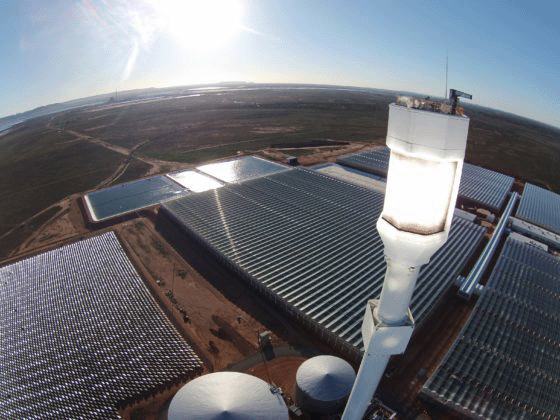
Tide turns as solar, storage costs trump ideologues and incumbents, REneweconomy, By Giles Parkinson on 13 April 2017
But there is no doubt that the transition is happening. Over the last few months, small but significant gains have been made as key politicians, regulators, market operators and many incumbents realise just how quickly the cost of new competition technologies are falling, and how quick the transition to a smarter, cleaner, more reliable and cheaper grid might be.
Awareness about the plunging costs of wind energy, solar energy and battery storage, along with the enabling software that could lead to a complete redesign of the way we generator, share, transport and use energy, is growing each day.
Politicians – both to the left and the right – are starting to embrace this change. The public is supportive, while the fossil fuel incumbents are slowly and surely losing their social licence, both due to the pollution levels of their plant and their manipulation of prices. Even the regulatory barriers that currently protect their business models are starting to unwind.
This is not to say that victory is at hand, or that this transformation will suddenly be complete within a few years. It won’t. But change is starting to happen quickly, old plant is being replace by new, rules are being changed, industry leaders are starting to talk of a new energy vision. Consumers are picking up new technology with increasing speed.
And here are a bunch of key developments in Australia over the last few months that indicate that the plunging cost of key technologies costs will trump the resistance of conservative ideologues and fossil fuel incumbents: Continue reading
South Australian businesses set to jointly purchase electricity
South Australian energy users club together for energy purchasing, AFR, by Angela Macdonald-Smith Simon Evans, 13 Apr 17, Cement maker Adelaide Brighton, steelmaker Arrium and 22 other major energy users in South Australia have won draft clearance from the competition regulator to jointly purchase electricity in a significant move that looks set to change the balance of power in the state’s fragile energy market. Continue reading
Huge surge in household solar panel installations
Solar panel installations ‘skyrocket’ in Australia, ABC News, By consumer affairs reporter Amy Bainbridge , 14 Apr 17 There has been a big surge in the number of households installing solar panels, with March installations reaching their highest level in almost five years.

Key points:
- Solar panels were installed on about 15,000 homes and businesses in March 2017
- Installations have hit their highest level in almost five years
- Experts say rising electricity bills and recent blackouts in SA are turning people to solar
Warwick Johnston from energy consultancy firm Sunwiz crunched the numbers and said 91 megawatts of solar photovoltaic (PV) systems were installed during the month.
“March has been a very impressive month for 2017,” he said.
“We already saw a surge starting to build up in 2016, and we were wondering if that was going to continue into 2017 and it really has just continued to skyrocket.”
Queensland led the way, installing 25 megawatts of capacity, which is enough to power about 5,500 homes and businesses.
Installations were also up in South Australia, New South Wales and Victoria.
Mr Johnston said the recent blackouts in South Australia were a factor in the rising demand.
“People are certainly aware of the benefits of solar power and storage to offset or protect against grid blackouts, and that has been a driving factor in the uptake of solar,” he said.
“We’re seeing the uptake occur in states which weren’t affected by those blackouts as well, so it really is people being aware that solar panels are a great way to beat rising electricity bills.”
Installation figures in Tasmania, the Northern Territory and the ACT were flat……http://www.abc.net.au/news/2017-04-14/solar-panel-installations-skyrocket-in-australia/8443550
EnergyLab: Program to accelerate creation of renewable energy start-ups launches in Sydney
ABC Radio Sydney By Amanda Hoh 14 Apr 17 A start-up accelerator program, dedicated to supporting entrepreneurs designing renewable energy products and technologies, has kickstarted in Sydney.
EnergyLab, based in Chippendale, has granted four companies $50,000 each to spend 12 to 24 months bringing their clean-tech products to market.
Most start-up incubators give entrepreneurs 90 days to develop their products, according to co-founder Piers Grove.
The companies include:
- Eveeh: An electric vehicle car-sharing network.
- Iron Matrix: A Perth company designing a construction system that replaces bricks and mortar with easy-to-manoeuvre steel posts and solar panels.
- BlueVolt: Solar products that can be installed anywhere by anybody.
- Energy Assist: Loans company for those wanting to buy energy-efficient appliances.
The first cohort of start-ups moved into the EnergyLab hub this week at the University of Technology Sydney, where they will receive dedicated mentors, office space and partnership opportunities as they bring their ideas to fruition……..http://www.abc.net.au/news/2017-04-13/renewable-energy-startup-accelerator-launches-in-sydney/8442594
Broken Hill’s giant leap – from mining hub to solar centre
 Renewables roadshow: how Broken Hill went from mining to drag queens and solar farms The home of BHP and Mad Max can now take credit for kickstarting the large-scale solar industry in Australia, Guardian, Michael Slezak, 13 Apr 17, “…….Broken Hill gave birth to one of the least renewable industries on Earth, but it can now claim to be the Australian birthplace of one of the most renewable.
Officially opened in January 2016, the plants were built with subsidies from the federal government through the Australian Renewable Energy Agency (Arena), as well as support from the NSW government.
With that funding, AGL was able to jump into the large-scale solar industry, and in doing so, create a supply chain that is bringing down the cost of solar farms around the country.
For example, Mackett says a manufacturing plant in the struggling car industry retooled to provide the frames for the solar panels, and is now able to do that for the whole industry. Continue reading
New rules flag big switch in energy markets to cheaper, smarter grid
By Giles Parkinson on 12 April 2017 New rules flag big switch in energy markets to cheaper, smarter grid
AEMC indicates its support for switch to 5-minute settlement period, albeit with a 3-year transition period, and to a new rule that could allow alternatives to investment in more poles and wires. Both offer incentives to storage, demand response, and local renewables, and herald a more …
http://reneweconomy.com.au/new-rules-flag-big-switch-in-energy-markets-to-cheaper-smarter-grid-19663/
The Parkinson Report: Rooftop solar now Queensland’s biggest power station
 Rooftop solar now Queensland’s biggest power station http://reneweconomy.com.au/rooftop-solar-now-queenslands-biggest-power-station-14848/By Giles Parkinson on 12 April 2017 One Step Off The Grid
The 1,805MW of solar PV capacity on the rooftops of Queensland homes and business now amount to be the biggest power station by capacity in the state, overtaking the 1,780MW of the Gladstone coal fired power station.
The milestone was reached after homeowners and business owners in Queensland added 25MW of rooftop solar capacity in the month of March, the highest since the premium feed-in tariffs of 2012, when households were offered 46c/kWh for their solar power.
Now, they get around 6c/kWh (some smaller retailers offer 10c/kWh) for their exports back to the grid, but the falling costs of rooftop solar, the prospect of competitive battery storage, and the soaring costs of grid power appear to be driving another solar boom.
The likely passing of the milestone was flagged last month by energy minister Mark Bailey, who told a battery storage conference in Brisbane that:
“The combined solar rooftops are now the second largest power generator, just behind the 1680 MW Gladstone Power Station – which emits approximately 11.8 million tonnes of greenhouse gas each year, versus zero from the sun and our second biggest generator.
“So Queensland, as a significant renewables market, is on the transition path. We see our role as a state government as being a facilitator in that transition.”
Queensland is not actually the only state or territory where rooftop solar is the biggest power station. In the ACT, there is 59MW of rooftop solar, but the only competition within the boundaries of the ACT is the 20MW Royalla large-scale solar farm.
There are no gas or coal-fired generators within the boundaries of the national capital, and the ACT is now well on its way to sourcing the equivalent of 100 per cent of its electricity needs from renewable energy by 2020, after contracting a series of new solar and wind farms across South Australia, Victoria and NSW.
In Western Australia, there is 696MW of rooftop solar, but it falls short of the 854MW of the ageing Muja power station, while in South Australia there is 722MW of rooftop solar, still well short of the Torrens Island gas fired generator of 1280MW, although half of that capacity comes from the Torrens Island A, which is 50 years old and tipped for retirement some time soon.
This article was originally published on RenewEconomy’s sister site, One Step Off The Grid, which focuses on customer experience and ambitions with distributed generation. To sign up to One Step’s free weekly newsletter, please click here.
Strong support for renewable energy, by Victorian government
 Victorian Government To Invest $1 Million Into Regional Renewable Energy Development https://cleantechnica.com/2017/04/12/victorian-government-investment-1-million-regional-renewable-energy-development/
by Joshua S Hill The Victorian Labor Government has announced it will commit $1 million in funding to establish a series of community hubs to drive renewable energy projects in regional Victoria, while also exploring the renewable energy potential of empty mine shafts in the state’s center.
An announcement made on Wednesday by the state’s Minister for Energy, Environment and Climate Change, Lily D’Ambrosio, by the Andrews Labor Government, will see a total of $900,000 committed for three, two-year pilot Community Power Hubs in the towns of Bendigo, Ballarat, and the Latrobe Valley region. The community-owned and operated hubs would aim to drive investment into regional Victoria renewable energy projects, create jobs, and help reduce electricity bills. The hubs would also provide legal and technical expertize, as well as start-up funding.
An additional $100,000 has been committed to a feasibility study into the renewable energy potential of empty mine shafts in Bendigo. A further $50,000 will be provided to the City of Greater Bendigo to support the study, which will specifically investigate the potential of using solar powered pumped hydro to generate and store electricity in mine shafts which have long been empty. Early calculations already suggest that such a project could generate up to 784 kilowatt-hours, while simultaneously boosting the reliability of the local electricity grid, creating much-needed local jobs, and supporting the growth of local businesses.
“Interest in community energy projects has increased significantly over the years, with communities wanting greater control over their energy and associated costs,” said Lily D’Ambrosio. “Solar pumped hydro has the potential to store and generate significant amounts of energy. This feasibility study is the first key step towards realising the benefits of solar pumped hydro for the Bendigo region.”
Huge 300MW solar farm begins construction near Port Augusta,
 Isn’t this a brilliant outcome? For the last few years, the nuclear lobby has been touting Port Augista as the place for a nuclear power station. Following the absolute defeat of the shonky South Australian Nuclear Fuel Cycle Royal Commission, and thanks to all those who fought against it, so brilliantly – South Australia now could become a world leader in modern clean energy.
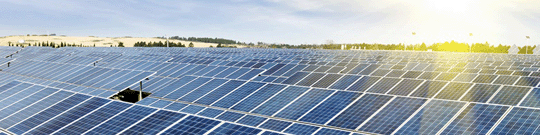
REneweconomy, By Giles Parkinson on 11 April 2017 The first two stage of a 300MW solar farm – Australia’s biggest – has begun construction near Port Augusta in South Australia after its developers last Friday reached financial close on the project, and agreed to sell it to two of Europe’s biggest investors in renewables, Italy’s Enel Green Energy and the Dutch Infrastructure Fund.
The first two stages, totalling 220MW, of the Bungala project is being built around 12kms from Port Augusta, where the state’s last coal fired generator closed last May. Ironically, project developer Reach Energy is headed by Tony Concannon, the former head of the owners of the Hazelwood brown coal generator in Victoria which closed late last month.
The two first stages of Bungala will be completed late in 2018, and will be built by Spanish company Elecnor, which recently completed the 57MW Moree project in NSW and the smaller 21MW Barcaldine project in Queensland.
Bungala will be built “battery storage ready”, and will also likely be the first major solar farm to participate in Australia’s FCAS market (frequency control and ancillary services), using SMA inverter technology to provide voltage control for the grid.
Concannon says the remaining 80MW of capacity could be built – along with battery storage – should the company win a South Australian government tender for 25 per cent of its electricity needs with “dispatchable” renewables.
Reach has submitted proposals for both 20MWh of battery storage and 100MWh, although it did not participate in the other tender for a separate 100MWh battery unit. If the tender is not successful, there are also discussions with other potential off-takers in train…….
The new plant, he says, will be designed to provide FCAS – even at night, after the sun has gone down. “What a number of people don’t realise is that you can design ancillary services for solar plants to operate at night time.
“We can draw in power from the grid at night, and use the inverter technologies to regulate voltage, and that helps stabilise the system, even when the sun is not shining.”
Unlike battery storage in households, which he describes as mostly “passive” and focused on converting the output of solar panels from DC power to AC power so it can be put into the grid, utility-scale inverter technologies are able to shape voltage and current very quickly and in a very flexible manner. Modern wind farms are also using the same technologies.
“The inverter changes phase between the voltage and current … inverters can pull the current in, and change the phase to what grid wants.”
Concannon, a power engineer, says it is a tricky subject to try and explain, but says a lot of the articles he has read in the media – about wind and solar not being able to provide grid services – are wrong……..http://reneweconomy.com.au/huge-300mw-solar-farm-begins-construction-near-port-augusta-63411/
1 This month



Help Aunty Sue Protect Her Land and Sacred Sites From Destructive Rocket Testing.
.

Australians deserve the truth
about
AUKUS – https://aukuspublicinquiry.com/

PETITION – To: Prime Minister Anthony Albanese and the Australian Labor Government

of the week – Australians for War Powers Reform (AWPR)
To see nuclear-related stories in greater depth and intensity

