South Australia’s renewable triumph is stunning proof that Dutton’s nuclear plans are a folly
Giles Parkinson, Jul 12, 2024 https://reneweconomy.com.au/south-australias-renewable-triumph-is-stunning-proof-that-duttons-nuclear-plans-are-a-folly/
When the federal and state governments were deciding on a location to announce a funding deal that will underwrite South Australia’s final leap to its remarkable goal of 100 per cent net renewables within the next three years, Port Augusta was the obvious choice.
The city at the top of the Spencer Gulf, like the neighbouring Whyalla, is everything that the climate deniers, the renewable naysayers, the conservative media and the federal Coalition say is not possible.
Port Augusta once played host to the state’s ageing and incredibly dirty coal generators. Whyalla was the subject of taunts from former prime minister Tony Abbott that it would be rendered a ghost town by a carbon price.
Now the two cities are host to thriving renewable energy hubs, new green industries and technologies that will help propel the state into a clean energy future.
And it is remarkable how little is actually known about the achievements of South Australia beyond its borders. Already it is at an annual average of 70 per cent renewables, and by 2027 it intends to be the first in the world to reach 100 per cent net renewables primarily through wind, solar and storage.
Just to be clear, that does not mean that it will consume only renewables. “Net” means that the amount of power it produces from wind and solar during the year will be equivalent to the amount it consumes. But it will still export and import as needs must.
It’s a stunning achievement, and still one that the naysayers insist is not possible. The state has become a globally significant testing ground in technologies – it hosted the first Tesla big battery that helped change the thinking on future grids around the world – and it is addressing and solving complex engineering issues that many experts thought were too difficult and some still say are insurmountable.
More importantly, it is doing this as a result of bipartisan policy. Labor kicked it off more than a decade ago by making itself the most welcoming state for wind and solar.
The Liberal state government set the target of reaching 100 per cent renewables by 2030. Labor is now back in power and has accelerated that target to 2027. It is marvellous what can be achieved when the coal lobby is removed and not pulling the strings of the politicians and public mood.
Despite all this, the achievements in South Australia remain largely ignored by the rest of the country.
The announcement by federal energy minister Chris Bowen and state energy minister Tom Koutsanstonis about the funding deal for a gigawatt of new wind and solar and 600 MW (2,400 MWh) of battery storage – to ensure the 100 per cent net renewable target is met – barely rated a mention in mainstream media outside the state.
Yet it is here, in Port Augusta, that federal Opposition leader Peter Dutton has decided should be one of seven sites – along with Collie, Liddell, Mt Piper, Loy Yang, Callide and Tarong – that should play host to their nuclear power plant proposals.
They were chosen, the Coalition tells us, because they are locations that still have or once supported coal fired power generators, and – they claim – would have available transmission capacity. But as Koutsantonis pointed out during his visit this week, that is simply not the case. That capacity has already been taken up by other projects.
“This site here where the Port Augusta power station once sat is now at capacity in terms of our renewable transmission lines to Adelaide,” he told journalists. “So the idea you can just plug in a nuclear power station here is just folly.
“I haven’t seen Peter Dutton here. I haven’t seen the Commonwealth Opposition here at all talking to the state government about their pretend plans for nuclear power in South Australia.”
Indeed, it is not surprising that Dutton has not shown up: South Australia is not just shining a path to the future, it is a real life repudiation of the folly of the federal Coalition’s nuclear plans, and the sheer nonsense of its claims.
Let’s remember that the Coalition and the conservative media’s nuclear arguments are based almost entirely around the assumption that wind and solar cannot power a modern economy.
South Australia proves them wrong, emphatically so. The grid is reliable, wholesale power prices are falling, and will continue to do so as it free itself from the yolk of fossil gas. Legacy industries are being revived by the growth of wind and solar, new industries are being established, and big business with big loads are being attracted to the state.
The once broke Whyalla steelworks, for example, has based its revival around plans for “green steel” underpinned by wind and solar, and BHP will power its giant Olympic Dam mine with a unique “firmed renewables” contract sourced from the state’s biggest wind project and a big battery.
The state’s transmission operator ElectraNet reports inquiries amounting to several gigawatts of new load from industries attracted to cheaper and greener power, and apparently not the least bit concerned about the scare campaigns that the lights will surely go out.
South Australia is already at the stage where enough rooftop solar is generated in the middle of the day to meet all local demand. That will soon occur in other states too, including Western Australia, effectively eliminating grid demand and requiring storage or new load or exports to soak up the excess.
As every major utility in Australia makes clear, the era of always-on base-load power is well and truly passed in such grids. South Australia has not just shut down its last coal generators, and is closing down its remaining combined cycle gas plants, which perform a similar role. The gaps will be filled by facilities that are fast and flexible. There is simply no room in the grid for an always-on nuclear plant.
“This site is taken. So I’m not quite sure where he’s planning to build this or how he’s planning to build this,” Koutsantonis said.
“If Peter Dutton was serious about what he was talking about, he would have come to us earlier and spoken to us about it, consulted with us. For whatever reason, he hasn’t even stepped a foot on this site to actually have a look at it.”
Bowen has been taking that message across the country. “This whole precinct’s being transformed … into a renewable energy hub, a green cement hub and a critical minerals hub,” he said at Port Augusta.
The next day, Bowen popped up in Lithgow, at the site of another mooted nuclear site, the Mount Piper coal generator, where the asset owner Energy Australia also outlined plans to build pumped hydro, a giant battery and to convert its coal plant into a “flexible” asset rather than an “always on” baseload asset in the interim.
“Traditionally Mount Piper has been a full-load, continuous load power station, and today it’s becoming much more flexible,” EnergyAustralia’s head of operations and projects Sue Elliott said. “It now operates during the day and seasonally depending on renewable availability in the market.
“We are progressing planning for a Lake Lyell Pumped Hydro Project … and we’re also planning a 500 megawatt, four hour Mount Piper Battery Energy Storage System right here on site to take advantage of transmission assets.”
As Bowen pointed out, this is real investment happening now, not some time in the distant future.
“I’m not sure if Mr Dutton and (Opposition energy spokesman Ted) O’Brien have been here yet, but they have a plan for nuclear power, which is at least 30 years away,” he said.
“They admit 2035 at its earliest; even that is wildly ambitious and optimistic and unrealistic. But that doesn’t fix the problems today.
“It doesn’t create jobs today. It doesn’t create investment today and, indeed, it will chill investment. It will stop people investing in the alternative plans because of the investor uncertainty created by having a nuclear plan, which is never going to happen – it’s a fantasy.”
South Australia, and its charge towards 100 per cent renewables, is very real. And worth talking about.
Power-hungry data centres are booming in Australia. Can the grid cope?
By Nick Toscano, July 12, 2024, https://www.theage.com.au/business/companies/power-hungry-data-centres-are-booming-in-australia-can-the-grid-cope-20240711-p5jssa.html
An explosion in the number of data centres in Australia is looming as a new test for the energy grid amid warnings they might soon require as much as electricity as two giant coal-fired power stations are capable of generating.
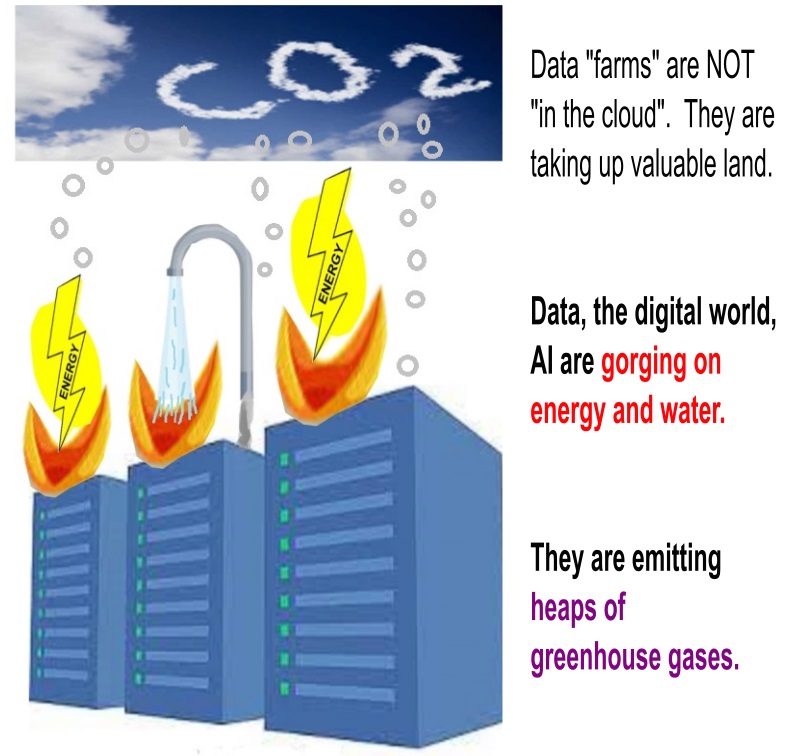
As cloud-based computing [nb there is no “cloud”] and artificial intelligence (AI) accelerate demand for data storage, Melbourne and Sydney have emerged as key locations for tech companies building vast industrial facilities to house their servers that send and receive data 24/7, known as data centres.
These data centres, which need huge amounts of electricity to run high-intensity computing and cooling systems, are already major power users in Australia – consuming about 5 per cent of available generation.
They are expected to drive further electricity demand growth alongside homes switching from gas to electric appliances and the growing adoption of electric cars.
However, new modelling from UBS suggests official forecasts may be underestimating the scale of the added demand that data centres could drive in the coming years.
The investment bank calculates between 3.3 gigawatts and 5 gigawatts of demand – equivalent to the combined generating potential of approximately two of Australia’s biggest coal-fired power plants – could be added to the east coast grid by 2030 on the back of growth in data centres and artificial intelligence.
At the top end of the range that could equate to up to 15 per cent of overall grid demand, which could add significant strain to supplies and push up prices unless properly managed.
The data centre boom is coming at a time of upheaval for Australia’s main grid as it transitions to cleaner energy, while the coal plants that have supplied the bulk of its power for decades increasingly bring forward their closures.
Although renewables’ share of the mix is growing, there are worries it’s not happening fast enough, with authorities fearing a shortfall of generation, storage and transmission lines to protect against the threat of price rises or blackouts once coal exits the grid.
Analysts at Morgan Stanley believe the grid will be able to accommodate extra demand from data centres’ growth, which it forecasts to rise from 5 per cent to about 8 per cent by 2030.
However, the system will face more strain next decade when the majority of the nation’s remaining coal-fired power plants are expected to have closed, they said.
“We see the power requirement for new Australian data centres as manageable for the Australian power system to 2030, but power could become a constraint in the 2030s given planned coal plant closures,” they said.
UBS said data centres may provide benefits for grid planners trying to maintain system stability, given they offer consistent minimum demand 24/7 – similar to the role of aluminium smelters. But they would add “incremental pressure” during evening peak demand periods once the sun sets and solar output recedes, Allen said.
The spread between daytime and evening wholesale prices could widen to up to 70 per cent by 2030 due to coal closures and delays to the renewable rollout, he added.
Squadron Energy says innovation needed to overcome jump in wind costs, but nuclear not the answer

ReNewEconomy, Sophie Vorrath, Jul 10, 2024
The CEO of the Andrew Forrest owned renewables developer Squadron Energy says the cost of developing onshore wind energy projects has jumped by up to 50 per cent over the past four years, presenting industry with a “very big challenge” as it works to deliver tens of gigawatts of new capacity in Australia.
Speaking at Australia Wind Energy 2024 in Melbourne on Wednesday, Squadron chief Rob Wheals said industry would need to act swiftly to overcome the jump in wind costs that, alongside other roadblocks, are getting in the way of scaling up development.
Wheals says about two-thirds of the cost of delivering an onshore wind project are made up of construction and installation costs and that, since 2020, developers have seen those costs increase by as much as 50 per cent
……………………………………………………………………………………………………… Esposito, Wheals and various other global wind energy executives including from RES, Goldwind and RWE, also noted that the grid connection situation, at least, is improving, with network companies, market bodies and governments joining forces to boost visibility and speed up critical project connection processes.
Cost problems – and the impacts of Australia’s predictably unpredictable energy politics – still need some nutting out.
“My message to us as an industry is that we … need to do the heavy lifting. We need to do that heavy lifting now,” Wheals told the conference.
“We’re looking at a four- to five-fold increase from today through to 2050. …We can’t afford to be distracted by the nuclear debate and, in fact, nuclear won’t be there in time for us anyway…………. https://reneweconomy.com.au/squadron-says-innovation-needed-to-overcome-jump-in-wind-costs-but-nuclear-not-the-answer/—
South Australia locks in federal funds to become first grid in world to reach 100 per cent net wind and solar
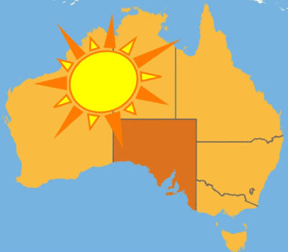
And to underline the difference in federal politics, the announcement was made at Port Augusta, the site of a former coal fired power station that the federal Coalition wants to turn nuclear, but which has already become a hub for green energy and green industry.
And to underline the difference in federal politics, the announcement was made at Port Augusta, the site of a former coal fired power station that the federal Coalition wants to turn nuclear, but which has already become a hub for green energy and green industry.
Giles Parkinson, Jul 10, 2024, https://reneweconomy.com.au/south-australia-locks-in-federal-funds-to-become-first-grid-in-world-to-reach-100-per-cent-net-wind-and-solar/
South Australia has locked in federal funding to ensure that it becomes the first non-hydro grid in the world to reach 100 per cent net renewables.
The funding deal – through what’s known as a Renewable Energy Transformation Agreement – means that the federal government will underwrite a minimum one gigawatt of new wind and solar generation capacity and another 400 MW (1,600 MWh) of storage – to ensure it meets its target of 100 per cent net renewables by 2027.
South Australia already leads Australia – and the world – with a wind and solar share of around 70 per cent over the last 12 months. The addition of the new capacity, along with the new Project Energy Connect transmission link from NSW, will enable it to become the first in the world to reach 1`00 per cent net renewables based around wind and solar.
That does not mean it will be powered at all times by wind and solar. But the amount of wind and solar generated and stored each year will be equivalent to what it consume each year. The state will export power at times and import at other times, and can fall pack on existing peaking gas plants to fill in the gaps.
Reaching that milestone will be a landmark for the state, and for advocates of the renewable energy transition, particularly as conservative and legacy fossil fuel interests continue to push back on the idea that a modern economy can be powered by renewables and storage.
The irony about South Australia is that the target of 100 per cent net renewables was originally committed by the state Liberal government. The state Labor government merely accelerated it from 2030 to 2027.
And to underline the difference in federal politics, the announcement was made at Port Augusta, the site of a former coal fired power station that the federal Coalition wants to turn nuclear, but which has already become a hub for green energy and green industry.
“South Australia has been a renewable energy pioneer – so much so that we recently brought forward our renewable energy target by three years, committing to ensure electricity generation can be sourced from net 100 per cent renewables by 2027,” state energy minister Tom Koutsantonis said in a statement.
“So we warmly welcome this agreement to accelerate the roll out of renewables while ensuring the reliability of the energy system.
“Our government is committed to working with the Commonwealth to establish a secured grid, supporting the power needs of South Australian households and businesses.”
South Australia has not added a new wind or solar project to the grid for around two years, although the biggest wind project in the state – the 412 MW Goyder South wind farm – is about to connect and send its first power to the grid.
Several new battery projects are also under construction – at Blyth, Hallett, Clements Gap and Templers and another, Tailem Bend, still waiting to be commissioned.
These projects will help propel the state towards 80 per cent renewables over the coming year, while the additional capacity of 1,000 MW of wind and solar, 400 MW of battery capacity (plus the minimum 200 MW included in the current CIS auction) will take it towards 100 per cent net renewables by 2027.
South Australia is also building the world’s first green hydrogen power plant at Whyalla, which will be accompanied by a 250 MW green hydrogen electrolyser and storage facilities, which will also be the world’s biggest when complete.
The state is also fielding huge number of inquiries from industry keen to source zero emissions and low cost green energy – with the local transmission company ElectraNet reporting that more than 2 gigawatts of load inquiries have been made.
Federal energy and climate minister Chris Bowen says the signing of the Renewable Energy Transformation Agreement means that South Australia is the first state to lock in the funding required to meet its targets under the federal government’s Capacity Investment Scheme.
The CIS aims to contract an additional 32GW of renewable generation and storage across the country to help it deliver most of the capacity needed to meet its 82 per cent renewable energy target by 2032.
The first tender of 6 gigawatts of new wind and solar capacity has been flooded with interest, with more than 40 GW of projects showing interest, while the first storage tender – for 600 MW, 2,400 MWh in Victoria and South Australia – was also heavily oversubscribed with some 19 GW of proposals.
Bowen says the bilateral agreements have been designed specifically to address the barriers developers, communities, and governments face in delivering renewable projects, and to replace ageing infrastructure that was built half a century ago.
“The Albanese Government is delivering the certainty and confidence the market spent a decade asking for,” Bowen said in a statement.
“The more renewable energy we have in our grid, the more downward pressure it puts on energy bills because it is the cheapest form of energy to power households and industry.
“Giving the market the confidence to build new projects is good; signing an agreement to collaborate with South Australia on practical steps to get the best out of this energy transformation for South Australian workers, communities and industry, is great.
“The Albanese Government’s Reliable Renewables Plan is the only plan supported by experts to deliver the clean, cheap, reliable and resilient energy system that Australians deserve. This is in sharp contrast to Peter Dutton’s anti-renewables nuclear plan – which remains uncosted and unexplained.”
As part of the deal, South Australia, will establish its own specific grid reliability mechanism and benchmark to be used in place of the national framework, and to be responsible for identifying and delivering new projects and technologies that will maintain reliability to that standard.
Renew Economy is seeking more information to understand what that means in practice.
“The Sun has won”: exponentially growing solar destroys nuclear, fossil fuels on price

Given Dutton’s claims about solar power costing more than nuclear are made ridiculous by the fact that solar’s break-even price has fallen by a factor of more than 1000 and the trend is continuing.
Meanwhile cost overruns in nuclear are endemic and SMR’s only exist in Dutton’s imagination.
By Noel Turnbull, Jul 11, 2024, https://johnmenadue.com/the-sun-has-won-exponentially-growing-solar-destroys-nuclear-fossil-fuels-on-price/—
It’s not known if Peter Dutton reads The Economist but if he does, he must probably think from time to time that it is sometimes dangerously left wing.
In the 22 June issue, it had a special essay on solar power – headlined ‘The Sun Machine’. The sub-head was “An energy source which gets cheaper the more you use it marks a turning-point in industrial history’.
The essay is a total contradiction of almost everything Dutton is claiming about nuclear and renewable energy.
“What makes solar energy revolutionary is the rate of growth which brought it to this just-beyond the marginal state”, the essay says.
They cite a veteran energy analyst, Michael Liebreich, who shows that in 2004 it took a year to install a gigawatt of solar power capacity; in 2010 it took a month; in 2016 a week; and in single days in 2023 there were a gigawatt of installation worldwide.
Current projections are that solar will generate more electricity than all the world’s nuclear plants in 2026; than wind turbines in 2027; dams in 2028; gas-fired plants in 2026; and coal-fired ones in 2032.
All that well before Dutton’s nuclear plants – if at all – start generating power. Moreover, unlike nuclear power which notoriously always takes longer to build than predicted, predictions about the rate of solar power roll-out are consistently under-estimates.
The Economist points out that in in 2009 The International Energy Agency (IEA) predicted solar would increase from 23GW to 244GW by 2030. It hit that milestone in 2016 – less than a third of the predicted time. The world capacity was 1419GW by 2023.
Ironically, one of the few organisations which got their predictions roughly right was Greenpeace – yet even their prediction was an under-estimate.
Given Dutton’s claims about solar power costing more than nuclear are made ridiculous by the fact that solar’s break-even price has fallen by a factor of more than 1000 and the trend is continuing. Meanwhile cost overruns in nuclear are endemic and SMR’s only exist in Dutton’s imagination.
Dutton is stronger on ideology and outrageous claims than economics, but the manufacture of photovoltaics is a classic example of the benefits of mass production – benefits which have always eluded the nuclear power industry.
As The Economist points out solar cells are standardised products all made in basically the same way and “they have no moving parts at all, let alone the fiendish complexity of a modern turbine.”
“Manufacturers compete on cost, by either making cells that make fractionally more electricity, by either making cells that make fractionally out of a given amount of sunshine or which cost less.”
Economics 101 teaches us that a commoditised product does not lead to more and more aggressive competition on the supply side – simply in this case by getting more electricity out of any given amount of sunshine or by costing less.
Rob Carlson, a technology investor, told The Economist: “There is no other energy-generation tech where you can install one million or one of the same thing depending on your application.”
“The Sun has won” he says.
The Economist said: “From the mid-1970 to the early 2020s cumulative shipments of photovoltaics increased by a factor of a million which is 20 doublings. At the same time prices dropped by a factor of 500. That is a 27% decrease in cost of doubling of installed capacity, which means a halving of costs every time installed capacity increases by 360%.
Adair Turner, an eminent economist and financial services executive, was Chair of Britian’s Climate Change Committee which was set up to help transition to zero emissions.
He told The Economist: “We totally failed to see that solar would come down so much.”
BloombergNEF estimated, in 2015, that the cost for solar on a global basis was $122 per MWH – higher than on shore wind and coal. Today both solar and onshore wind are almost half the cost of coal.
Meanwhile, Dutton has welcomed Keir Starmer’s election win by pointing to his support for nuclear power. Which, given that the UK has already installed nuclear power, the cautious Starmer is unlikely to announce that he is closing it down.
Moreover, Starmer’s major problem with nuclear is managing the spiralling delays in, and cost of, nuclear plants being constructed following typical Tory blunders.
The question which Dutton needs to answer is why he knows more about nuclear and solar power than The Economist reporters, Bloomberg, Adair Turner, Rob Carlson, many major investment funds and the overwhelming majority of Australian scientists?
He might ponder all that while the Murdoch media is becoming a tad critical of him – criticising his policy on supermarket divestment and speculating on who might be the Liberal Party leader if Dutton loses the next election.
Meanwhile, notwithstanding their doubts about Dutton’s chances and policies (other than nuclear) The Australian never totally loses its manic opposition to anything progressive. The inimitable Greg Sheridan opined on The Australian front page (6/7) that Labour had not won but the Tories had lost. Partly true obviously, but his piece was enough to prompt the subs to headline the piece with “Self-described socialist is set to drag Britain far to the left”.
Sheridan also rehearsed his regular hates and speculated how it would all come undone.
Jeremy Corbyn would love that to be the case but Starmer not so.
Perhaps the funniest lines in Sheridan’s’ piece were: “Starmer is brainy and works hard. Too deep immersion in the law has rendered it impossible for Starmer to write felicitous prose or create memorable images.”
From a journalist who year after year simply reproduces the same old opinions on the same old subjects that is, to say the least, a bit much.
No room for nuclear: AGL says flexibility is key as it plans to dump coal for renewables in a decade

ReNewEconomy Giles Parkinson, Jul 9, 2024
Australia’s biggest supplier of coal generation and baseload power, AGL Energy, has again underlined the fact there is no room for nuclear in Australia’s transition to renewables – neither on a grid dominated by wind and solar nor at its coal sites that it intends to transform into clean industrial hubs.
“I’d like to clarify – as I did in March – that nuclear energy is not part of our strategy and our position on this remains unchanged, AGL CEO Damien Nicks said in a presentation to a CEDA event in Sydney on Tuesday.
Nicks’ position is important because two of AGL’s coal generation sites have been identified by the federal Opposition for its nuclear power plans, which it says could see seven reactors, or more, start construction sometime in the 2030s or 2040s – should they be elected, be able to remove the bans, find the technology and finance, and the sites to host it.
AGL – and the owners of other mooted nuclear sites – have no intention of giving up their assets for nuclear power plants, despite the threats of compulsory acquisition, largely because they have their own plans.
Nicks says the site of the recently shuttered Liddell coal generator in the Hunter Valley is already accounted for, with plans for a giant battery, solar module manufacturing, panel recycling, a link to a planned 400 MW pumped hydro facility and multiple green industries including hydrogen, metals and other activities.
“The Hunter Hub is actively progressing opportunities across a variety of industries, including; solar thermal generation, solar PV manufacturing, battery and solar recycling, waste-ash-to-materials and hydrogen,” Nicks says.
“Our recent announcements with SunDrive and Elecsome are examples of the businesses we’re looking to work with.
“We’re committed to creating opportunities for our people and local communities, as well as partnering with like-minded industries to support economic diversification and jobs in the Upper Hunter.”
The point that Nicks made around the Hunter hub is that – because of its multi-billion dollar investment plans in new industries – there is no spare capacity for the sort of big nuclear projects that the Coalition wants to build. Or even small ones.
It points to the hot air behind the Opposition position on nuclear, and it’s complete of planning and consultation, something it plans to ignore by riding roughshod over opposition from state governments, asset owners, and local communities.
But the nuclear plan also makes little sense for Australia’s solar dominated grid, as so many energy experts have pointed out. Nicks once again highlighted this, saying the nature of a grid dominated by wind and solar needs flexibility rather than the “always-on” base-load design relied on by nuclear.
AGL intends to shutter the last of its coal generators by 2035, and is working to make them more flexible in the meantime so they can to respond to the generation patterns and “solar duck curves” created by rooftop PV, which will account for most of demand in daytime hours, and large scale wind and solar.
It’s critical we have the flexibility within our portfolio to firm capacity and help us manage some of the changing peaks and troughs in the renewable energy market,” he said
These include expanding its grid scale battery assets, boosting its capacity of hydro and gas peakers, and growing its portfolio of distributed energy assets to 1.6 GW by 2027, to support load shifting and orchestration of rooftop solar.
The slide provided above [on original] indicates a number of new wind, solar and battery projects, including the already announced Pottinger Energy Park in the Riverina, the proposed 500 MW, 2000 MWh Tomago battery, the newly approved Bowmans Creek wind project, and several other projects that have not yet been publicly named.
“We’ve undertaken significant upgrade works at our Bayswater plant in NSW and Loy Yang in Victoria that means these plants can now be flexed down approximately 60-70 per cent of their full operating capacity.
“This means we’re able to further ramp down during those daytime periods of peak solar generation which is commercially beneficial as it minimises production at negative pricing, using less coal and producing less emissions,” he said. …………………….. more https://reneweconomy.com.au/no-room-for-nuclear-agl-says-flexibility-is-key-as-it-switches-from-coal-to-renewables-in-a-decade/
Without a massive grid upgrade, the Coalition’s nuclear plan faces a high-voltage hurdle
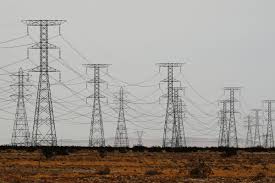
The Conversation, Asma Aziz, Senior Lecturer in Power Engineering, Edith Cowan University, 8 July 24
Keeping the lights on in Australia is a complex task. Enough capacity must be ensured everywhere in the country, at every moment. Surplus in one location won’t solve shortages in another, unless we have the transmission infrastructure to transmit electricity between them.
The transmission network largely consists of high-voltage lines and towers, as well as transformers which transfer electrical energy from one circuit to another.
Australia’s transmission network is one of the oldest and longest in the world. As coal stations close and more renewable energy is built, the task of upgrading the system becomes even more pressing. So formidable is the challenge, it’s one of the biggest roadblocks Australia faces in reaching its crucial goal of net-zero emissions by 2050.
The Coalition’s plan for seven nuclear energy plants in Australia further complicates the task. A clear policy direction for Australia’s electricity system is urgently needed………………………………………………………………………………………………………
So far this decade, 490 kilometres of new transmission lines have reportedly been added to the National Electricity Market, which serves the east coast and South Australia. A further 2,090 km of transmission lines are progressing from the planning phase to the construction phase.
There’s still a lot of work to do: around 10,000 km of new transmission lines is needed by 2050. Western Australia’s main electricity network also needs more than 4,000 km of new high-capacity transmission lines.
Transmission congestion in Australia is a looming problem. For example, South Australian transmission company ElectraNet forecasts rising congestion on that state’s network due to planned expansions of electricity generators, peaking in the late 2020s and 2030s.
What’s more, planning studies have identified ageing assets in Queensland’s transmission network, requiring new routes to manage constraints and ensure reliable supply.
Where does nuclear fit in?
All this has implications for the Coalition’s nuclear plan, if it comes to fruition.
The CSIRO and others say a nuclear power plant of any size would not be operational in Australia until after 2040.
If transmission lines are congested at that future point, nuclear power plants may not be able to send all their electricity to the grid.
Nuclear plants are expensive to build and run. But they typically generate electricity continuously, helping to offset these costs. If the plants can’t feed into the grid, or can’t sell their electricity at competitive prices, they may lose revenue and struggle to cover their costs, affecting their long-term viability.
The continuous high output of nuclear plants also helps them run efficiently. Frequently adjusting energy output leads to more wear, lower efficiency and reduced energy production over time.
Constraining nuclear output can have broader repercussions, too. In France, for instance, nuclear output is at a 30-year low, forcing the country to import electricity and prepare for potential blackouts. The reactors are offline for maintenance, not due to transmission issues. But the example highlights the consequences when nuclear energy is taken out of the mix for any reason. https://theconversation.com/without-a-massive-grid-upgrade-the-coalitions-nuclear-plan-faces-a-high-voltage-hurdle-233458?utm_source=twitter&utm_medium=bylinetwitterbutton
The nuclear and renewable myths that mainstream media can’t be bothered challenging

Mark Diesendorf, Jul 4, 2024, https://reneweconomy.com.au/the-nuclear-and-renewable-myths-that-mainstream-media-cant-be-bothered-challenging/
Nuclear energy proponents are attempting to discredit renewable energy and promote nuclear energy and fossil gas in its place. This article refutes several myths they are disseminating that are receiving little or no challenge in the mainstream media.
Myth: Renewables cannot supply 100% electricity
Denmark, South Australia and Scotland already obtain 88, 74 and 62 per cent of their respective annual electricity generations from renewables, mostly wind. Scotland actually supplies 113 per cent of its electricity consumption from renewables; the difference between its generation and consumption is exported by transmission line.
All three jurisdictions have achieved this with relatively small amounts of hydroelectricity, zero in South Australia. Given the political will, all three could reach 100% net renewables generation by 2030, as indeed two northern states of Germany have already done. The ‘net’ means that they trade some electricity with neighbours but on average will be at 100% renewables.
Computer simulations by several research groups – using real hourly wind, solar and demand data spanning several years – show that the Australian electricity system could be run entirely on renewable energy, with the main contributions coming from solar and wind. System reliability for 100% renewables will be maintained by a combination of storage, building excess generating capacity for wind and solar (which is cheap), key transmission links, and demand management encouraged by transparent pricing.
Storage to fill infrequent troughs in generation from the variable renewable sources will comprise existing hydro, pumped hydro (mostly small-scale and off-river), and batteries. Geographic dispersion of renewables will also assist managing the variability of wind and solar. For the possibility of rare, extended periods of Dunkelflaute (literally ‘dark doldrums’), gas turbines with stores of biofuels or green hydrogen could be kept in reserve as insurance.
Myth: Gas can fill the gap until nuclear is constructed
As a fuel for electricity generation, fossil gas in eastern Australia is many times more expensive per kilowatt-hour than coal. It is only used for fuelling gas turbines for meeting the peaks in demand and helping to fill troughs. For this purpose, it contributes about 5% of Australia’s annual electricity generation. But, as storage expands, fossil gas will become redundant in the electricity system.
The fact that baseload gas-fired electricity continues temporarily in Western Australia and South Australia is the result of peculiar histories that will not be repeated. Unlike the eastern states, WA has a Domestic Gas Reservation Policy that insulates customers from the high export prices of gas.
However, most new gas supplies would have to come from high-cost unconventional sources. South Australia’s ancient, struggling, baseload, gas-fired power station, Torrens Island, produces expensive electricity. It will be closed in 2026 and replaced with renewables and batteries.
Myth: Nuclear energy can co-exist with large contributions from renewables
This myth has two refutations:
- Nuclear is too inflexible in operation to be a good partner for variable wind and solar. Its very high capital cost necessitates running it constantly, not just during periods of low sun or wind. Its output can only be ramped up and down slowly, and it’s expensive to do that.
- On current growth trends of renewables, there will be no room for nuclear energy in South Australia, Victoria or NSW. The 2022 shares of renewables in total electricity generation in each of these states were 74%, 37% and 33% respectively.
Rapid growth from these levels is likely. It’s already too late for nuclear in SA. Provided the growth of renewables is not deliberately suppressed in NSW and Victoria, these states too could reach 100% renewables before the first nuclear power station comes online.
As transportation and combustion heating will be electrified, demand for electricity could double by 2050. This might offer generating space for nuclear in the 2040s in Queensland (23% renewables in 2022) and Western Australia (20% renewables in 2022). However, the cost barrier would remain.
Myth: There is insufficient land for wind and solar
The claim by nuclear proponents that wind and solar have “vast land footprints” is misleading. Although a wind farm can span a large area, its turbines, access road and substation occupy a tiny fraction of that area, typically about 2%.
Most wind farms are built on land that was previously cleared for agriculture and are compatible with all forms of agriculture. Off-shore wind occupies no land.
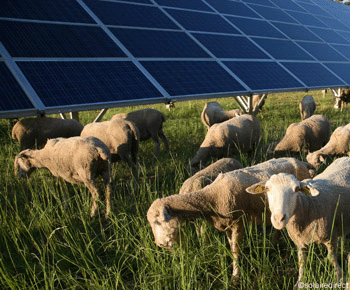
Solar farms are increasingly being built sufficiently high off the ground to allow sheep to graze beneath them, providing welcome shade. This practice, known as agrivoltaics, provides additional farm revenue, which is especially valuable during droughts. Rooftop solar occupies no land.
Myth: The longer lifetime of nuclear reactors hasn’t been taken into account
The levelised cost of energy method – used by CSIRO, AEMO, Lazard and others – is the standard way of comparing electricity generation technologies that perform similar functions.
It permits the comparison of coal, nuclear and firmed renewables. It takes account automatically of the different lifetimes of different technologies.
Myth: We need baseload power stations
The recent claim that nuclear energy is not very expensive “when we consider value” is just a variant of the old, discredited claim that we need baseload power stations, i.e. those that operate 24/7 at maximum power output for most of the time.
The renewable system, including storage, delivers the same reliability, and hence the same value, as the traditional system based on a mix of baseload and peak-load power stations.
When a nuclear power reactor breaks down, it can be useless for weeks or months. For a conventional large reactor rated at 1000 to 1600 megawatts, the impact of breakdown on electricity supply can be disastrous.
Big nuclear needs big back-up, which is expensive. Small modular reactors do not exist––not one is commercially available or likely to be in the foreseeable future.
Concluding remarks
We do not need expensive, dangerous nuclear power, or expensive, polluting fossil gas. A nuclear scenario would inevitably involve the irrational suppression of renewables.
The ban on nuclear power should be maintained because nuclear never competes in a so-called ‘free market’. Renewables – solar, wind and existing hydro – together with energy efficiency, can supply all Australia’s electricity.
Mark Diesendorf is Honorary Associate Professor at the Environment & Society Group in the School of Humanities & Languages and Faculty of Arts, Design & Architecture at UNSW. First published in Pearls and Irritations. Republished with permission of the author.
When it comes to power, solar is about to leave nuclear and everything else in the shade
In Australia, solar is pushing down prices
Australia’s energy market operator says record generation from grid-scale renewables and rooftop solar is pushing down wholesale electricity prices.
Peter Martin, Visiting Fellow, Crawford School of Public Policy, Australian National University July 2, 2024 https://theconversation.com/when-it-comes-to-power-solar-is-about-to-leave-nuclear-and-everything-else-in-the-shade-233644
Opposition leader Peter Dutton might have been hoping for an endorsement from economists for his plan to take Australian nuclear.
He shouldn’t expect one from The Economist.
The Economist is a British weekly news magazine that has reported on economic thinking and served as a place for economists to exchange views since 1843.
By chance, just three days after Dutton announced plans for seven nuclear reactors he said would usher in a new era of economic prosperity for Australia, The Economist produced a special issue, titled Dawn of the Solar Age.
Whereas nuclear power is barely growing, and is shrinking as a proportion of global power output, The Economist reported solar power is growing so quickly it is set to become the biggest source of electricity on the planet by the mid-2030s.
By the 2040s – within this next generation – it could be the world’s largest source of energy of any kind, overtaking fossil fuels like coal and oil.
Solar’s off-the-charts global growth
Installed solar capacity is doubling every three years, meaning it has grown tenfold in the past ten years. The Economist says the next tenfold increase will be the equivalent of multiplying the world’s entire fleet of nuclear reactors by eight, in less time than it usually takes to build one of them.
To give an idea of the standing start the industry has grown from, The Economist reports that in 2004 it took the world an entire year to install one gigawatt of solar capacity (about enough to power a small city). This year, that’s expected to happen every day.
Energy experts didn’t see it coming. The Economist includes a chart showing that every single forecast the International Energy Agency has made for the growth of the growth of solar since 2009 has been wrong. What the agency said would take 20 years happened in only six.
The forecasts closest to the mark were made by Greenpeace – “environmentalists poo-pooed for zealotry and economic illiteracy” – but even those forecasts turned out to be woefully short of what actually happened.
And the cost of solar cells has been plunging in the way that costs usually do when emerging technologies become mainstream.
The Economist describes the process this way:
As the cumulative production of a manufactured good increases, costs go down. As costs go down, demand goes up. As demand goes up, production increases – and costs go down further.
Normally, this can’t continue. In earlier energy transitions – from wood to coal, coal to oil, and oil to gas – it became increasingly expensive to find fuel.
But the main ingredient in solar cells (apart from energy) is sand, for the silicon and the glass. This is not only the case in China, which makes the bulk of the world’s solar cells, but also in India, which is short of power, blessed by sun and sand, and which is manufacturing and installing solar cells at a prodigious rate.
Solar easy, batteries more difficult
Batteries are more difficult. They are needed to make solar useful after dark and they require so-called critical minerals such as lithium, nickel and cobalt (which Australia has in abundance).
But the efficiency of batteries is soaring and the price is plummeting, meaning that on one estimate the cost of a kilowatt-hour of battery storage has fallen by 99% over the past 30 years.
In the United States, plans are being drawn up to use batteries to transport solar energy as well as store it. Why build high-voltage transmission cables when you can use train carriages full of batteries to move power from the remote sunny places that collect it to the cities that need it?
Solar’s step change
The International Energy Agency is suddenly optimistic. Its latest assessment released in January says last year saw a “step change” in renewable power, driven by China’s adoption of solar. In 2023, China installed as much solar capacity as the entire world did in 2022.
The world is on track to install more renewable capacity over the next five years than has ever been installed over the past 100 years, something the agency says still won’t be enough to get to net-zero emissions by 2050.
That would need renewables capacity to triple over the next five years, instead of more than doubling.
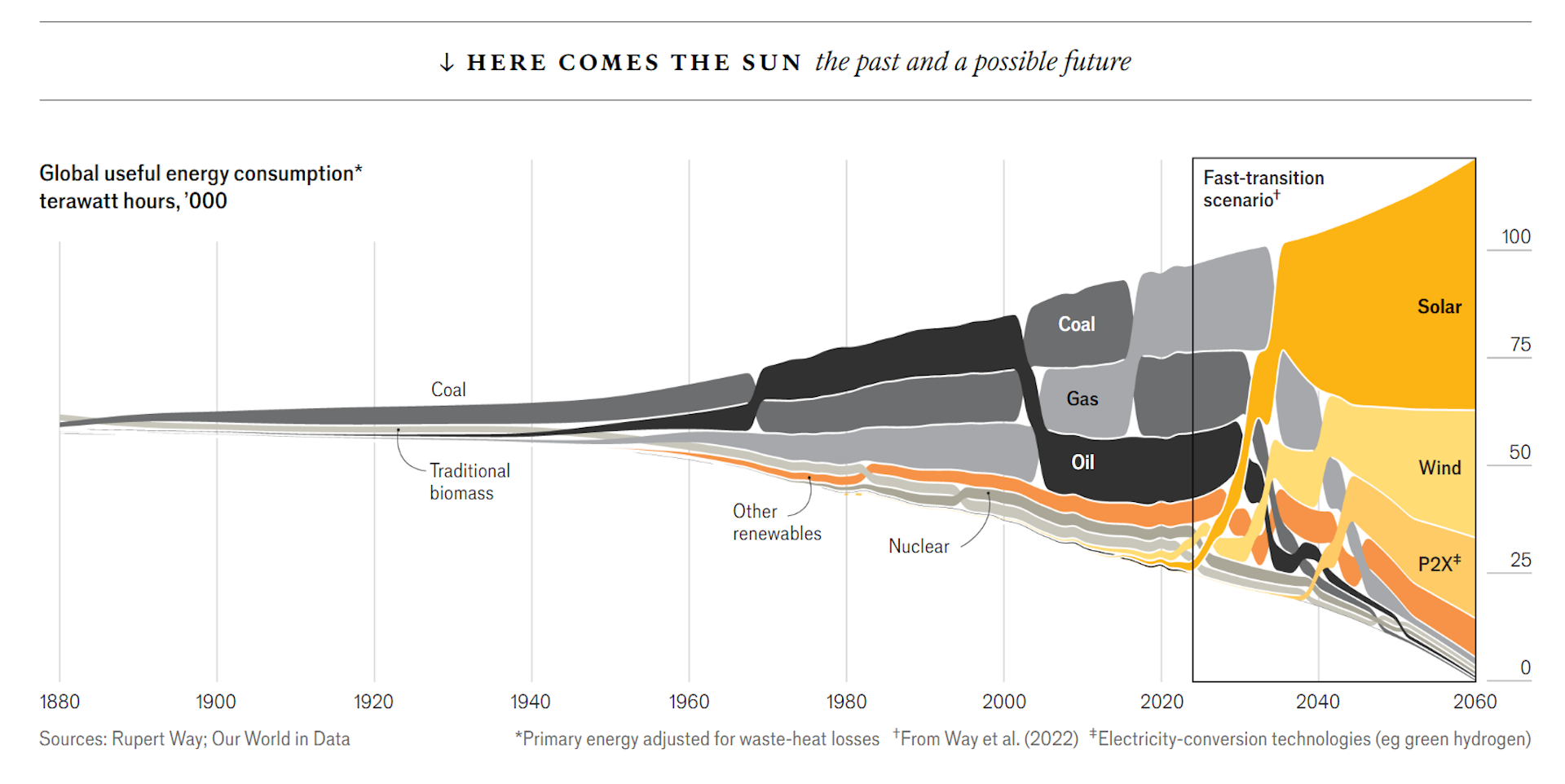
Oxford University energy specialist Rupert Way has modelled a “fast transition” scenario, in which the costs of solar and other new technologies keep falling as they have been rather than as the International Energy Agency expects.
He finds that by 2060, solar will be by far the world’s biggest source of energy, exceeding wind and green hydrogen and leaving nuclear with an infinitesimally tiny role.
In Australia, solar is pushing down prices
Australia’s energy market operator says record generation from grid-scale renewables and rooftop solar is pushing down wholesale electricity prices.
South Australia and Tasmania are the states that rely on renewables the most. They are the two states with the lowest wholesale electricity prices outside Victoria, whose prices are very low because of its reliance on brown coal.
It is price – rather than the environment – that most interests The Economist. It says when the price of something gets low people use much, much more of it.
As energy gets really copious and all but free, it will be used for things we can’t even imagine today. The Economist said to bet against that is to bet against capitalism.
“They just fit in with what we do:” Farmers reap rewards as they play host to wind and solar
ReNewEconomy Liv Casben, Jun 29, 2024
Renewables in agriculture are gaining momentum across the nation as Australia pushes to reach its net-zero emissions target by 2050.
Australia’s energy market operator has declared renewables as the most cost-effective way of reaching net-zero targets in the grid, but just how much of the load will be carried by the farming sector remains unclear.
Across pockets of the nation, farmers are already doing their bit to reduce their carbon footprint.
“Anecdotally, we have seen a huge increase in farmers seeking renewables projects as farmers seek to increase the productivity of their farms,” Farmers for Climate Action’s Natalie Collard told AAP.
“Renewables offer drought-proof income, and drought-proof income keeps farms going through the toughest of times.”
The Lee family has farmed at Glenrowan West for 150 years, but for the past three years they’ve also added solar to the mix.
A German-based company leases the land from the Lees and maintains the solar panels, which run alongside the sheep farming operation.
“The lessee basically runs it just as another paddock, the sheep go in just as they would under any other farming operation,” Gayle Lee said. “We haven’t found there to be any noticeable loss of production.”
……………………………………………………. Karin Stark, who will host the annual Renewables in Agriculture conference in Toowoomba next week, says consultation is key to farmers playing a “critical role” in the renewables transition and keeping everyone happy…………… more https://reneweconomy.com.au/they-just-fit-in-with-what-we-do-farmers-reap-rewards-as-they-play-host-to-wind-and-solar/?fbclid=IwZXh0bgNhZW0CMTEAAR0qML5s3XgsQ3EZd5pJl15CdGXQ60-BC3TLkIVpcaWkgLsBSarHkHoPUYI_aem_OC5kzgz0cTiwWtnLVva56A
Does the nuclear ‘plan’ add up? Australia’s carbon emissions under the Coalition’s proposal

Professor Clive Hamilton, 2 July 24, https://news.csu.edu.au/latest-news/does-the-nuclear-plan-add-up-australias-carbon-emissions-under-the-coalitions-proposal
The recent proposed nuclear power plan announcement by the federal Opposition prompted a Charles Sturt University climate change analyst and a colleague to model the necessary energy sources implied by the plan. They found that it doesn’t add up.
- A Charles Sturt University analysis of the Opposition’s nuclear power proposal finds that relying on nuclear power to attain net zero by 2050 would require four times as many nuclear power plants to be built in the 2040s as the Coalition currently plans
- The analysis indicates that the increasing reliance on gas generation implied under the Coalition’s plan would result in Australia having much higher carbon emissions through to 2050 than under the current renewables roll-out trajectory
- The analysis indicates that slowing the pace of the renewables roll-out implied or stated by the Coalition would have a severe negative impact on the renewables industries but would be a major boost to the gas industry
The recent proposed nuclear power plan announcement by the federal Opposition prompted a Charles Sturt University climate change analyst and a colleague to model the necessary energy sources implied by the plan. They found that it doesn’t add up.
Charles Sturt University Vice-Chancellor’s Chair of Public Ethics Professor Clive Hamilton and colleague the highly respected energy expert Dr George Wilkenfeld have analysed the implications for Australia’s emissions path of the Coalition’s nuclear plan and how it might help to meet the commitment to net zero by 2050.
The Coalition announced that it plans to commission seven nuclear power stations by 2050 and said it would abandon the government’s 2030 target of reducing the nation’s emissions by 43 per cent (compared with 2005 levels).
Professor Hamilton said their analysis shows that the Coalition’s nuclear strategy, if it met its stated aims, would see nuclear plants account for approximately 12 per cent of total electricity generation by 2050.
“The slowed pace of the renewables roll-out implied or stated by the Coalition would result in renewables supplying 49 per cent of total supply, compared with 98 per cent under Labor’s plan, and gas generation supplying approximately 39 per cent, compared with two per cent under Labor’s plan,” he said.
“It would likely have a severe negative impact on the renewables industries but would be a boon to the gas industry.
“With high continued supply of electricity from gas under the Coalition’s plan, attaining net zero emissions by 2050 would be out of the question.”
Professor Hamilton said the modelling indicates that attaining net zero by 2050 would require four times as many nuclear power plants to be built in the 2040s as the Coalition currently plans.
“Under Labor’s renewables plan, Australia’s electricity emissions are expected to decline year on year until they reach almost zero on 2050,” he said.
“Under the Coalition’s plan for nuclear power, a declining emphasis on renewables and an unavoidably greater role for fossil fuels means emissions from the electricity sector in 2050 would be nearly 19 times higher than under Labor’s plan.”
The full analysis was published in Renew Economy on Thursday 27 June.
Nuclear option ‘not enough’ to avoid rush for more wind and solar

SMH, By Nick Toscano, June 29, 2024
A massive expansion of renewable energy will still be key to driving Australia’s transition away from coal and reaching net-zero emissions by 2050, new modelling shows, even if the Coalition wins the next election and implements a plan to deploy nuclear reactors across the country.
Opposition Leader Peter Dutton rekindled Australia’s climate wars this month, vowing to abandon the government’s target for renewable energy to account for 82 per cent of the grid by 2030, and instead pushing to build seven nuclear generators to achieve the longer-term ambition of reaching net-zero emissions by 2050.
However, modelling from research group Bloomberg New Energy Finance raises questions about how beneficial it would be for Australia to adopt nuclear energy at a time when it faces an imminent wave of more coal-fired power station closures and significant power demand growth driven by electrification and decarbonisation.
Assuming the Coalition’s seven proposed nuclear reactors add 7 gigawatts of nuclear power capacity by 2050, the rollout would reduce the necessary build-out of solar farms by only up to 7 per cent and wind farms by 12 per cent, the analysis found.
Even doubling that to 14 gigawatts, nuclear was found to have a limited role in avoiding the need to hasten the shift to large-scale renewables and to build far more power lines to connect them to the grid and major cities, it said…………………………………………………………………….
n its 25-year road map released this week, AEMO says Australia’s best and lowest-cost pathway through the transition is to build a grid dominated by renewable energy, firmed by grid-scale batteries and backed up by gas-powered generators.
AEMO did not assess the costs of nuclear energy because nuclear energy is banned under federal law. But it said nuclear “is one of the most expensive ways to generate electricity” and it said building the plants “would be too slow to replace retiring coal-fired generation”.
Energy Minister Chris Bowen said the BloombergNEF report was “another example of experts confirming nuclear was too slow, too expensive and too risky for Australia”. https://www.smh.com.au/business/the-economy/nuclear-option-not-enough-to-avoid-rush-for-more-wind-and-solar-20240628-p5jpjk.html
Nuclear lobby concedes rooftop solar will have to make way for reactors

Giles Parkinson, Jun 24, 2024, https://reneweconomy.com.au/nuclear-lobby-concedes-rooftop-solar-will-have-to-make-way-for-reactors/
The nuclear lobby in Australia has conceded one aspect of the nuclear power plan that the federal Coalition does not like talking about – that the rooftop solar embraced by households and businesses will have to make way for the Opposition’s planned reactors.
This is not actually a surprise to anyone associated with the energy industry, because it is quite clear that there is no room for an “always on” generator of any type – be it coal, gas or nuclear – in a grid dominated by variable wind and solar.
In Australia, this is particularly the case because of the continent’s magnificent solar resources, and the huge uptake of rooftop PV by consumers, which already stands at more than 20 gigawatts (GW) and is forecast to quadruple to more than 80 GW in coming decades.
In South Australia, rooftop solar has already met all local demand on occasions. The market operator predicts that this will occur in Western Australia within a few years, and in other bigger states on the eastern seaboard within a decade.
How do you jam nuclear reactors into this energy mix? Renew Economy has asked this question on several occasions – here and here in particular – and it now seems the nuclear lobby has finally fessed up to the solution: Switch off rooftop solar.
“I think what will happen is that nuclear will just tend to push out solar,” Robert Barr, a member of the lobby group Nuclear for Climate told the ABC in a story that addresses the issue.
Barr admitted that nuclear power plants have some flexibility, but not a lot. They could ramp down to around 60 per cent of their capacity, he says. But the reality is that the their economics – already hugely expensive – blow out even further if not running all the time. Solar panels would have to make way, he said.
“There’ll be an incentive for customers to back off,” he said. “And I think it wouldn’t be that difficult to build control systems to stop export of power at the domestic level. It’d be difficult for all the existing ones but for new ones, it just might require a little bit of smarts in them to achieve that particular end — it can be managed.”
Almost everyone involved in the Australian grid – be they developers, generators, network operators, investors, advisors or regulators – recognises that the system design is moving on from “base-load” and always on power to variable renewables and dispatchable power (mostly storage).
But this new reality this does not support the fossil fuel industry’s view of the world, not their economic and business models, and while the Coalition has made its position against large scale wind and solar clear, it hasn’t talked about the impact on rooftop solar, apart from saying it supports it in principle.
But how?
Some insight into what is shaping the Coalition’s thinking comes from testimony to parliamentary committee in 2021 by James Fleay, a former oil and gas executive and founder of the advocacy group Down Under Nuclear Energy (Dune), who serves as an advisor to Coalition energy spokesman Ted O’Brien.
Fleay told the parliamentary committee looking into future energy choices that “baseload” architecture had served Australia well for a century and should not be changed. “We have to make a decision about grid architecture,” he said.
“We cannot adapt our energy usage to accommodate the rising and setting of the sun or seasonal weather uncertainties without enormous human and economic costs,” Fleay said, before adding later: “I think that is possible and true only at the margins, but not in bulk.”
Basically Fleay admitted that it is a choice between models – baseload or renewable, and in various interviews has said Australia’s isolated grid as a reason not to go the wind and solar route because of the inability to export.
But that same isolation has an equal, or arguably greater impact on nuclear because of its dependence on high production rates, known as capacity factors. The French nuclear generators wouldn’t survive without the connection to other European grids and the ability to export to other countries.
To be sure, the Australian market operator is pushing hard to be able to “orchestrate” rooftop solar and other consumer energy resources as a way of managing the grid. But the extent it would need to do so with multiple gigawatts of “always on” nuclear would dramatically increase.
The energy industry knows this. The two – nuclear and rooftop solar – simply can’t go out on the same date. The Coalition, or at least its advisors, also appear to know this. But when will it be honest about this situation with the general public and the households and businesses with solar on their rooftops?
Giles Parkinson is founder and editor of Renew Economy, and is also the founder of One Step Off The Grid and founder/editor of the EV-focused The Driven. He is the co-host of the weekly Energy Insiders Podcast. Giles has been a journalist for more than 40 years and is a former business and deputy editor of the Australian Financial Review. You can find him on LinkedIn and on Twitter.
Is rooftop solar a fatal flaw in the Coalition’s grand nuclear plans?

Unlike nuclear, solar is also extraordinarily cheap, at least up-front, and large-scale projects can be delivered for comparative peanuts — and with blinding speed.
There are now almost 4 million homes spread across the country with solar installations, and the electricity they generate accounted for about 12 per cent of Australia’s needs last year.
It’s a constituency that politicians would tackle at their peril.
By energy reporter Daniel Mercer, https://www.abc.net.au/news/2024-06-24/rooftop-solar-potentially-lethal-flaw-in-coalition-nuclear-plans/104008864—
Earlier this year, the Coalition made a curious, significant move.
David Littleproud, the leader of the National Party, broke cover and wholeheartedly threw his support behind rooftop solar and household batteries.
The Nationals, he said, were not against renewable energy, only large-scale projects such as wind farms and transmission lines that were “tearing up the environment”.
Quite the opposite — the National Party wanted as many Australian households to get solar and batteries as would have them.
The pitch, which was quickly backed by opposition leader Peter Dutton, evidently had a few purposes.
For starters, it clearly distinguished the opposition from the Labor government, whose plan to decarbonise the power system rests largely on big-ticket renewable energy and transmission items.
In one fell swoop, the Coalition was able to say it was pro-renewable energy while being able to attack the government’s own green plans as environmentally and economically dangerous.
What’s more, the shift was a clear nod — or a sop, depending on who you ask — to the enormous and growing political clout of Australia’s solar-owning class.
Lastly, as both Mr Littleproud and Mr Dutton have repeatedly since pointed out, rooftop solar was an ideal complement for the central plank of the Coalition’s energy plans — nuclear.
Dangers in the detail?
The thinking behind that pivot has been on full display in recent days after the Coalition finally unveiled the major details of its energy policy for the upcoming federal election.
Under the plans, Australia would get seven nuclear power plants by the middle of the century — five large-scale ones across New South Wales, Queensland and Victoria and two small ones across South Australia and Western Australia.
No longer would the renewable emphasis be on scores of new wind and solar farms in regional areas and the high-voltage power lines needed to plug them into the grid.
It would instead be directed towards people’s rooftops, “an environment that you can’t destroy”, according to Mr Littleproud.
But hiding behind this veil of logic from the Coalition, energy experts reckon, is a potentially fatal flaw.
Solar power and nuclear power don’t play nicely together.
“That’s another untested and questionable part of this whole strategy,” said Dylan McConnell, a senior researcher and energy analyst at the University of NSW.
“What happens if we look into a system that is largely dominated by … a significant proportion of … behind-the-meter solar?
“People are going to continue to install rooftop solar and, in fact, the Coalition is supportive of that.
At the heart of this tension are the differing — and some argue incompatible — characteristics of nuclear and solar power.
On the one hand, nuclear reactors are the quintessential base-load generators that can — and want to — run at or near full capacity all the time.
Not only are they well-suited to the task technically, nuclear plants also have an economic imperative to operate flat-out given their monumental development costs.
These development costs are typically exacerbated by very long lead times — lead times subject to significant blowouts — in which debts are incurred and eye-watering amounts of interest can accrue.
The hare and the tortoise
Paying off those debts is paramount for the owner of a nuclear plant.
Failure to do so can be financially ruinous.
And the way to do that is to produce and sell as much electricity as is technically possible.
By contrast, solar power — specifically from photovoltaic cells typical of suburban rooftops — are the archetypal source of variable renewable energy.
They produce the most power when the sun is shining during the day, none when it’s not, and their output can be highly variable depending on the conditions.
Unlike nuclear, solar is also extraordinarily cheap, at least up-front, and large-scale projects can be delivered for comparative peanuts — and with blinding speed.
For a household, the cost of a 10-kilowatt system — an installation capable of meeting much of an average customer’s needs — can be done for a few thousand dollars.
In other words, if nuclear power is the proverbial tortoise, solar is the hare.
None of which is to dismiss the technical and economic challenges that solar presents, namely, how to back it up when it’s not producing — a very big task indeed.
But there is another crucial way in which solar and nuclear — or any base-load power such as coal, for that matter — clash.
Solar generation, by its very nature, peaks in the middle of the day.
As ever-more Australians install seemingly ever-more solar panels on their roofs, that peak in solar output is becoming truly epic in its proportions.
Rooftop solar is a beast
or example, there are times in South Australia when rooftop solar alone can account for more than the entire demand for electricity in the state.
To ensure South Australia’s electricity system doesn’t blow up, virtually all other generators have to pare back their output to a bare minimum or switch off entirely.
And even then, South Australia’s surplus rooftop solar generation has to be exported to other states or wasted.
Rooftop solar can do this because it’s largely uncontrolled and flows simply by dint of the sun shining.
It was partly for this reason that South Australia’s only base-load coal plant retired in 2016.
Of course, there are many more times when rooftop solar provides precisely 0 per cent of South Australia’s power needs.
But it all goes to illustrate the very real challenges that base-load nuclear would face, and the very real trends that are unlikely to grind to a halt between now and 2035, by when the Coalition hopes to have the first of its nuclear reactors up and running.
A quick glance at the numbers will tell you all you need to know about the popularity — and power — of rooftop solar in Australia.
There are now almost 4 million homes spread across the country with solar installations, and the electricity they generate accounted for about 12 per cent of Australia’s needs last year.
Bruce Mountain, the director of the Victoria Energy Policy Centre, summed it up this way: “Rooftop solar has few opponents.”
“It’s the one thing that keeps on growing despite the impasse at a national level,” Professor Mountain said.
“And I think there’s much more to go to realise the potential for that, most notably on factory roofs.”
Something has to give
Professor Mountain said “I’m kind of open to the idea of nuclear”, noting that it was being taken seriously by many other developed countries seeking to decarbonise their electricity supply.
He also pointed out that Australia’s development of large-scale renewable energy projects and, particularly, the transmission lines needed to support them, had hardly been a glowing success to date.
In any case, Professor Mountain suggested the fact the Coalition was proposing to own and operate any nuclear power stations was an acknowledgement that there was no commercial case for the technology in Australia.
On that point, Dr McConnell from the University of NSW agreed.
Dr McConnell said the economic obstacles in front of nuclear in Australia were enormous, and a big one was rooftop solar.
He said that in the almost inevitable event that nuclear and solar power clashed, something would have to give.
“The way you might achieve that in a system with lots of rooftop solar is by curtailing [switching off] rooftop solar,” Dr McConnell said.
“And that may not be politically popular either.”
Robert Barr, a power industry veteran and a member of the lobby group Nuclear for Climate, did not shy away from the potential for future tensions, noting that coal was already getting squeezed out of the system by solar.
But Dr Barr said any clash could be easily managed through a combination of price signals that encouraged householders to use more of their solar power and export less, and new reactor technology that could ramp up and down more effectively.
You could probably drop down from 100 per cent down comfortably to like 60 per cent output and on a daily basis,” Dr Barr said of new nuclear technology.
Ultimately, however, Dr Barr argued it may need to be households with solar panels that gave way to nuclear energy for the greater benefit of the electricity system.
Don’t mention the solar wars
Right now, he said, renewable energy was benefiting from taxpayer-funded subsidies that allowed wind and solar projects to make money even when the price of power was below $0.
These subsidies applied to both utility-scale projects and rooftop solar panels, through the large- and small-scale green energy targets introduced by the Rudd Labor government.
They effectively allow such projects to sell their electricity for less than zero — up to a point — and still be in the money.
In the future, Dr Barr said, those subsidies would no longer exist and renewable energy projects would start to be penalised each time the price of electricity went negative.
“I think what will happen is that nuclear will just tend to push out solar,” he said.
“There’ll be an incentive for customers to back off.
“And I think it wouldn’t be that difficult to build control systems to stop export of power at the domestic level.
“It’d be difficult for all the existing ones but for new ones, it just might require a little bit of smarts in them to achieve that particular end — it can be managed.”
Much like the Coalition’s grand policy pitch, those comments might be considered bold given the political heft wielded by millions of solar households.
Last decade, politicians of all stripes got into all manner of trouble when they tried to wind back subsidies known as feed-in-tariffs, which paid customers for their surplus solar power generation.
Solar households, egged on by the industry, mobilised, went on the attack and in many cases forced governments to bend to their will.
And that was at a time when the number of households with solar was a fraction of what it is now.
It’s a constituency that politicians would tackle at their peril.
Farmers who graze sheep under solar panels say it improves productivity. So why don’t we do it more?
Guardian, by Aston Brown, 14 June 24
Allowing livestock to graze under renewable developments gives farmers a separate income stream, but solar developers have been slow to catch on.As a flock of about 2,000 sheep graze between rows of solar panels, grazier Tony Inder wonders what all the fuss is about. “I’m not going to suggest it’s everyone’s cup of tea,” he says. “But as far as sheep grazing goes, solar is really good.”
Inder is talking about concerns over the encroachment of prime agricultural land by ever-expanding solar and windfarms, a well-trodden talking point for the loudest opponents to Australia’s energy transition.
But on Inder’s New South Wales property, a solar farm has increased wool production. It is a symbiotic relationship that the director of the National Renewables in Agriculture Conference, Karin Stark, wants to see replicated across as many solar farms as possible as Australia’s energy grid transitions away from fossil fuels.
“It’s all about farm diversification,” Stark says. “At the moment a lot of us farmers are reliant on when it’s going to rain, having solar and wind provides this secondary income.”
In exchange, the panels provide shelter for the sheep, encourage healthier pasture growth under the shade of the panels and create “drip lines” from condensation rolling off the face of the panels.
“We had strips of green grass right through the drought,” Dubbo sheep grazier Tom Warren says. Warren has seen a 15% rise in wool production due to a solar farm installed on his property more than seven years ago.
Despite these success stories, a 2023 Agrivoltaic Resource Centre report authored by Stark found that solar grazing is under utilised in Australia because developers, despite saying they intend to host livestock, make few planning adjustments to ensure that happens……………………………………………………………………………….
According to an analysis by the Clean Energy Council, less than 0.027% of land used for agriculture production would be needed to power the east coast states with solar projects – far less than the one-third of all prime agricultural land that the rightwing thinktank the Institute of Public Affairs has claimed will be “taken over” by renewables. That argument, which has been heavily refuted by experts, has been taken up by the National party, whose leader, David Littleproud, said regional Australia had reached saturation point with renewable energy developments.
Queensland grazier and the chair of the Future Farmers Network, Caitlin McConnel, has sold electricity to the grid from a dozen custom-built solar arrays on her farm’s cattle pastures for more than a decade.
“Trial and error” and years of modifications have made them structurally sound around cattle and financially viable in the long-term, she says.
“As far as I know, we are the only farm to do solar with cattle,” McConnel says. “It’s good land, so why would we just lock it up just for solar panels?” https://www.theguardian.com/australia-news/article/2024/jun/13/farmers-who-graze-sheep-under-solar-panels-say-it-improves-productivity-so-why-dont-we-do-it-more
1 This month

of the week – Australians for War Powers Reform (AWPR)
To see nuclear-related stories in greater depth and intensity
 Antinuclear