No, Mr Turnbull, coal is NOT our future: renewables with energy storage, are here
 Why Coal Is Not Our Future, Skeptical Science 15 December 2016 by Riduna
Coal Problems
Australian Prime Minister, Malcolm Turnbull, has repeatedly asserted that coal will remain in use for electricity generation for ‘many, many decades to come’. He argues that moving to renewable energy would reduce production and use of coal resulting in unacceptable loss of mining and transport jobs, particularly in rural areas. However, the threat of larger job losses did not stop his predecessor from withdrawing subsidies for the car industry, resulting in its closure nationwide – action supported by the present Prime Minister.
Recently, Energy Minister Friedenberg asked Australia’s Chief Scientist, Dr Finkel, to prepare a Discussion Paper on electricity security during the transition to renewable energy. The Paper, presented to the Prime Minister and Premiers on 9 December, 2016 recommended that an energy intensity scheme be applied to the electricity generating sector. This would see the highest emitters leave electricity generation and promote orderly replacement of coal by gas and, increasingly, renewable energy generators.
The Paper reported that existing policies lacked clarity and certainty for investors and would not achieve Australia’s commitment to reduce greenhouse gas emission by 26-28% below 2005 levels by 2030, given under the Paris Agreement. Even before recipients of the paper had time to consider it, the Prime Minister rejected its main conclusions.
In declaring coal Australia’s present and future energy source, Turnbull has chosen to ignore the dangers of coal production and use to public health or, more accurately, public death. Clear evidence shows that coal mining in Australia not only causes respiratory problems through inhalation of airborne particles but that this results in the incurable ‘black lung disease’ resulting in a slow and painful death. Its combustion in power stations results in emissions which increase the incidence and severity of health problems among populations living up to 100 km away.
As the Prime Minister knows, coal has to compete with renewable clean energy sources, particularly solar and wind. It’s a no brainer of course. Continue reading
Solar energy park is seeking co-operative venture with sheep farming!
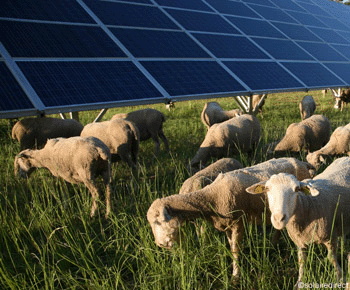
Maoneng Group, who started building the solar farm in March after winning a tender in the ACT government’s first large-scale renewables reverse auction, has this week launched its own, rather unusual, tender – for a flock of sheep. The company is seeking expressions of interest for a farmer or community group to graze 100-150 head of sheep within the Mugga Lane Solar Park – an area of around 46 hectares at the intersection of Mugga Lane and Monaro Highway in the ACT.
“Applicants must maintain the livestock inclusive of drenching, crutching, shearing, veterinarian costs and portable pens,” the tender says, adding that “weathers or non-lambing ewes are preferred.”
The owners of the solar park, which began generating power in mid-November, will provide and maintain fencing, two water troughs and a small holding paddock with all-weather accessibility.
Maoneng’s Shaun Curran said the deal, which would be a quid pro quo “cost neutral” affair, would provide a local farmer or community group with free and secure grazing, while for the Solar Farm, it would provide free lawn mowing and reduce the site’s fire risk…….
Curran also noted that sheep, while preferred, were possibly not the only livestock option.
“There was a large mob of kangaroos on site when it was first being developed,” he said. “So they could work too. They’re similar to sheep; not too destructive. They don’t want to rub up against the panels.”…… http://reneweconomy.com.au/act-solar-farm-announces-new-tender-sheep-19044/
Comments on Australian Energy Market Operator (AEMO)’ s “Black System” report
 Dennis Matthews, December 2016 BLACK SYSTEM, SOUTH AUSTRALIA, 28 SEPTEMBER 2016.
3rd Preliminary Report, December 2016 Australian Energy Market Operator (AEMO)
Introduction
The “Black System” referred to by AEMO is what is more commonly known as the South Australian state-wide blackout. AEMO also refers to it as “the event”. The AEMO report contains considerable technical jargon and use of acronyms. Constant referral to a list of terms and abbreviations at the beginning of the report is necessary.
AEMO Executive Summary
According to the executive summary, the SA blackout was “initiated by the loss of three transmission lines involving a sequence of faults in quick succession”. These electricity transmission lines are the high voltage power lines that feed into the low voltage distribution system that services homes and many small to medium businesses.
The damaged transmission lines were in the mid-north of SA.
The sequence of faults led to many wind turbine electricity generators in the mid-north initially trying to continue to generate. Within 7 seconds, these initial attempts to “ride through” the problems caused by transmission line damage were followed by wind turbines deliberately shutting down (tripping), or decreasing their output, in order to protect them from serious damage. This caused a decrease of power generation by about 460 megawatts (MW). Prior to the transmission line damage, the total generated grid power available to SA was about 1830 MW. Domestic, off-grid, solar photovoltaic power was about 50 MW.
Although it seems reasonable that wind turbines should have an ability to shut down to protect against serious damage, according to the report “AEMO was not aware of the protective feature of these generating units”. Consequently, AEMO had not taken steps to replace the lost power in such a situation.
The loss of about 460 MW of generating capacity resulted in an attempt to import extra power through the Heywood, high voltage, alternating current (AC), connector with Victoria. Such connectors between states are essential for the operating of an electricity market. Without interconnectors there would be no National Electricity Market (NEM). Continue reading
A month ahead of schedule, Queensland’s huge new solar farm is up and running
 Queensland’s largest solar farm plugs into the grid a month early The 20 megawatt plant in Barcaldine is one of first in the country to be funded by Australian Renewable Energy Agency, Guardian, Joshua Robertson, 14 Dec 16, Queensland’s largest operating solar farm has plugged into the national electricity grid and is set to generate enough power for almost 10,000 households by the end of 2016.
The Barcaldine remote community solar farm, in the state’s central west outback, connected to the national electricity market on Wednesday, more than a month ahead of schedule.
The early delivery of the 20 megawatt plant, one of the first in the country to be funded by the Australian Renewable Energy Agency, was evidence of the growing speed and proficiency of big solar developers, said Arena’s chief executive, Ivor Frischknecht.
It is to be followed by a dozen new large-scale solar farms to be built across Australia by the end of 2017, which would ramp up national solar capacity to enough power for 150,000 average homes.
Those plants – six in Queensland, five in New South Wales and one in Western Australia – would be the fruits of an Arena funding program expected to “unlock almost $1bn in commercial investment and boost regional economies”, Frischknecht said.
The Barcaldine plant developer, Elecnor – one of a number of Spanish companies invested in Australian solar – is a transnational corporation with interests from gas and rail to aerospace. Elecnor was backed by $22.8m in funding commitments by Arena and $20m in loans from the federal government’s “green bank”, the Clean Energy Finance Corporation.
Barcaldine’s mayor, Rob Chandler said the project, which features 78,000 solar panels, had “enthusiastic supporters” in a local community that saw “the great benefits it can bring to outback communities like ours”.
“If it’s one thing we have a lot of it’s sun so it’s great to see it being harnessed to power the electricity grid.”
Frischknecht said: “As well as generating clean energy, the project is demonstrating how project developers can monetise network benefits and ultimately how solar farms can improve network efficiency and reliability at the edge of the grid.”…… https://www.theguardian.com/environment/2016/dec/14/queenslands-largest-solar-farm-plugs-into-the-grid-a-month-early
Report finds 100% renewable grid “reliable, robust and stable”
100% renewable grid not just feasible, but “reliable, robust and stable” http://reneweconomy.com.au/100-renewable-grid-not-just-feasible-reliable-robust-stable-12185/?utm_source=RE+Daily+Newsletter&utm_campaign=dd172b60b8-EMAIL_CAMPAIGN_2016_12_09&utm_medium=email&utm_term=0_46a1943223-dd172b60b8-15634933 By Sophie Vorrath on 9 December 2016
The discussion paper, released on Friday by not-for-profit group the Alternative Technology Association, found that a fully renewable electricity grid would provide long-term economic and social benefits for Australia, while also playing an important part in its commitments to fight climate change.
The publication of the paper coincides with Friday’s meeting of COAG, to discuss the preliminary report of the Finkel Review into the security and stability of the national electricity market.
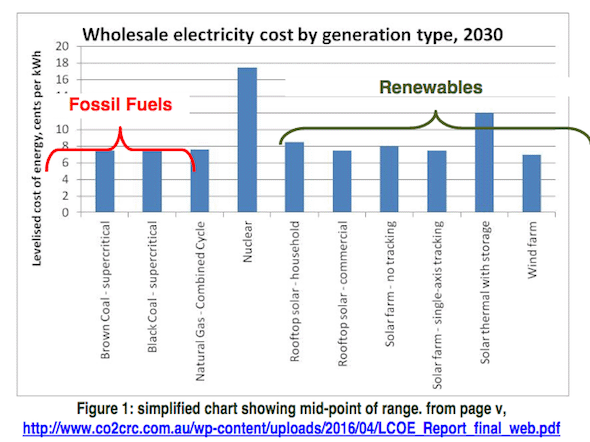
The ATA report, 100% Renewable Grid – Feasible?, reviewed evidence from recent developments in Australia and overseas, as well as previous studies including those by the Australian Energy Market Operator.
“We found all experts agree that a 100% renewable grid will be reliable and stable, as long as it uses an appropriate mix of renewable generation sources, energy storage and upgraded infrastructure,” said Andrew Reddaway, the paper’s author and ATA energy analyst.
During periods of calm, cloudy weather electricity could be sourced from sunny or windy parts of the country and supplemented with energy stores such as hydroelectric dams, molten salt heat storage, batteries, renewable gas and stockpiles of pelletised woody waste, the report found.
“This grid would be robust, with smarter renewable generators and batteries automatically injecting extra electricity when required for grid stability,” Reddaway said.
“Similarly, smart appliances would detect disturbances in the grid and independently adjust their power level to compensate.”
The ATA report also found that the cost of such a smart and diverse grid would be manageable, and compared it to a “21st century version of the Snowy Mountains Scheme.”
The Snowy hydro scheme, said Reddaway, cost the equivalent of 16 per cent of Australia’s Gross Domestic Product in its commencement year, but these costs were spread over the project’s duration, and were balanced by the creation of many local industry jobs.
“During the transition energy costs are likely to be slightly higher than ‘business as usual’, but in the longer term it would place downward pressure on electricity bills because renewable energy generation is cheap to run,” Reddaway said.
“Widespread energy efficiency measures would further offset costs.”
On the technical side of things, the report noted that there were “many possible solutions to maintain grid stability as levels of wind and solar generation increase.”
For example, to maintain inertia in the grid, the report recommends retaining the steam turbines of decommissioned fossil fuel power plants, keeping them connected to the grid, and allowing them to continue to rotate in synch with grid frequency, without burning fuel.
For wind farms, the report notes, when a slowdown in grid frequency is detected, the wind turbine’s controller could immediately increase its power output by temporarily sacrificing some blade speed – an app roach known as synthetic inertia that ATA says is already required in part of Canada.
As for rooftop solar, the report says this is already evolving to help keep the future grid stable.
“As of October 2016, all new grid-connected inverters must be capable of reducing their generation or export, in response to a signal from the grid operator,” it says.
“Known as Demand Response Mode (DRM), this feature allows solar generation to be curtailed when it exceeds overall demand – although this is not expected to be implemented for many years, the ATA notes, and requires and additional device known as a Demand Response Enabling Device (DRED) to be plugged into the inverter.
And, like other reports released recently on this subject, the ATA notes that battery storage will play a big role in future renewables-heavy grids.
“Batteries are especially well suited to support grid stability,” the report says, “as they can discharge electricity into the grid with zero start-up time.
“Large batteries have already been installed in the grid for such purposes overseas,” it says, adding that household batteries can also provide this service, while also delivering savings and other benefits to consumers.
Australian Capital Territory (ACT) – jobs growth with renewable energy
 Renewable jobs grow as ACT drives down emissions from government operations by 17 per cent in three years, Canberra Times, Katie Burgess, 13 Dec 16, Jobs growth in the ACT renewable energy sector in the past six years was 12 times faster than the national average, a report into the territory government’s action on climate change has revealed.
The Minister’s Report into Climate Change and Greenhouse Gas Reduction also showed the rate of job growth in the ACT’s renewables sector was six times higher than any other state and territory, as the government invested $12 million into a renewable energy industry development strategy.
Ahead of the COAG Energy Council meeting on Wednesday, climate change minister Shane Rattenbury said he would push other states and territories to take up their own renewable energy targets.
“We must not allow the federal government’s inaction to limit what we can achieve at a state and territory level. The ACT is a great example of what subnational governments can achieve. We are on track to meet our 100 per cent renewable electricity target by 2020 and to become Australia’s first zero emission jurisdiction by 2050,” Mr Rattenbury said.
Emissions from government operations have fallen 17 per cent since 2012-2013, the report also revealed. The ACT government is aiming to be carbon neutral in its own operations by 2020……http://www.canberratimes.com.au/environment/climate-change/renewable-jobs-grow-as-act-drives-down-emissions-from-government-operations-by-17-per-cent-in-three-years-20161213-gta1ha.html
Energy transition means Australia needs power grid upgrade
Aust needs energy grid overhaul: report , Herald Sun, Melissa Meehan and Kaitlyn Offer, Australian Associated Press December 12, 2016 Australia’s power grid needs a multi-billion dollar upgrade to safeguard future energy supply amid the shift away from coal-fired power stations, the nation’s energy operator says.
Growing food in a desert. #auspol

Sundrop Farms produces healthy, sustainable food in the middle of the Australian Desert, without using pesticides, fossil fuels or fresh water.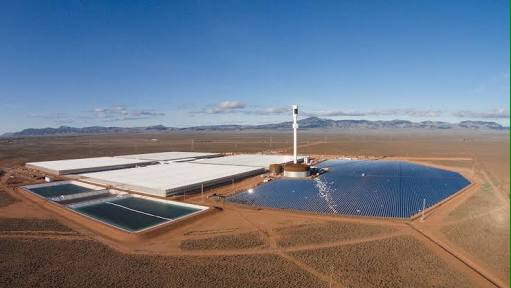
The scarcity of food resources in many parts of the world is one of the major population threats. Agricultural lands deplete continuously, as climate change and inappropriate agricultural practices cause intense soil degradation and nutrient deficiencies. Desperate farmers continue to add enormous amounts of fertilizers and pesticides, while wasting millions of gallons of fresh water for irrigation. Many even feel obliged to opt for growing genetically modified crops with questionable health benefits, but which are apparently resistant to certain factors and can result in high yields.
Sundrop Farms, a modern agricultural company, has set a task to show that healthy, organic food can be produced everywhere. Their aim is to bust the myth that genetically modified foods, toxic pesticides, and large sums of money are the only solution to…
View original post 320 more words
While Barnaby Joyce trashes South Australia’s renewables, his electorate gets multi-million dollar loan for wind farm
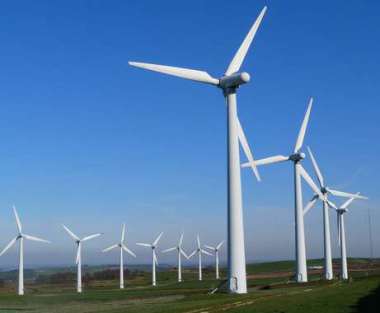 Windfarm in Barnaby Joyce’s NSW electorate gets $120m CEFC loan Clean Energy Finance Corporation loan comes three months after minister slammed SA’s over-reliance on wind power, Guardian, Gareth Hutchens, 12 Dec 16, The Clean Energy Finance Corporation has made a multi-million dollar loan for a new windfarm in Barnaby Joyce’s electorate.
General Electric in support of State-based renewable energy targets
 US energy giant GE backs states going own way on renewables, The Age, Peter Hannam 11 Dec 16 Renewable energy can add resiliency to electricity grids and there’s no reason why individual states can’t set their own goals higher than a national target, says a US industry veteran.
Nick Miller, senior technology director of General Electric’s energy consultancy, said US states such as Texas now supplied as much as half their electricity from renewable sources.
“If Australia wants to try its own state by state [approach] that is not intrinsically a bad thing,” the 36-year GE veteran engineer told Fairfax Media during a visit.
“If some states want to move forward faster, they will reap the economic benefits first, and the states that stay behind — sort of embracing the past — are probably going to get left behind.”
Mr Miller’s comments will bolster the case made by governments in states such as Queensland, Victoria and South Australia, and the federal Opposition, all of which have set renewable energy targets beyond 2020 unlike the federal government.
They will also stoke debate over the best way to meet Australia’s climate goals. Prime Minister Malcolm Turnbull last week drew widespread criticism for ruling out a price on carbon even before his government begins a year-long review from early 2017.
Mr Miller said both Republicans and Democrats had managed to find common ground on clean energy in the US.
“It’s not ideologically driven, it’s business driven,” he said. “There are huge amounts of wind going into Oklahoma and Kansas, and that’s as red [Republican] as you get.”
GE is a supplier to both the thermal and renewable energy sectors. It’s found that, contrary to may public views, wind power actually advances rather than undermines the resilience of the grid.
With modern electronic controls added, a wind plant is now “more tolerant of grid disturbances than the equivalent size synchronous [thermal] plant”, he said. “It is extremely agile, and finely and quickly controlled.”
While recent blackouts in South Australia show that state’s power sector to “very highly stressed”, the response should be to increase flexibility in the system by altering market rules and investment incentives……. http://www.theage.com.au/environment/climate-change/us-energy-giant-ge-backs-states-going-own-way-on-renewables-20161211-gt8jdl.htm
Carnegie Wave Energy to build its first commercial wave plant in ENGLAND
 Windfarm in Barnaby Joyce’s NSW electorate gets $120m CEFC loan, Guardian, Gareth Hutchens, 11 Dec 16 “…..Australia’s chief scientist, Dr Alan Kinkel, warned last week that investment in the electricity sector had stalled because of “policy instability and uncertainty”.
Over the weekend, the Australian Financial Review reported the pioneering Australian wave-power company Carnegie Wave Energy was planning to build its first commercial wave plant in Cornwall, England, because the climate policy chaos in Australia was too much.
Barwon Water and the City of Greater Geelong investigate solar array for landfill site
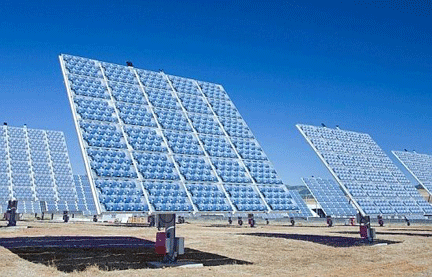 Geelong solar array capable of powering 1000 homes proposed for old Corio landfill site http://www.news.com.au/national/victoria/news/geelong-solar-array-capable-of-powering-1000-homes-proposed-for-old-corio-landfill-site/news-story/6b6154708d9fa4a7383b44246a096143 DECEMBER 8, 2016 A LARGE solar energy project with the potential to power 1000 homes is being explored at an old Corio landfill site.
Barwon Water and the City of Greater Geelong are investigating the feasibility of building a three-megawatt solar PV system at the former tip, which is next to Limeburners Lagoon. Early research into the concept has proven positive, with the agencies to embark on a detailed feasibility study. The 3000-kilowatt capacity system would generate about four million kilowatt hours of electricity annually, which is enough to power about 1000 homes.
The renewable energy would be shared by the two partners and fed through the grid to supply other locations.
Barwon Water has several power-intensive sites nearby, including the Northern Water Plant, Cowies Creek Sewer pump station and Lovely Banks water pump station. Strategy and planning general manager Carl Bicknell said Barwon Water was developing a program to achieve 100 per cent renewable energy use over the next 10 years. “Investing in locally sourced renewable energy would directly reduce Barwon Water’s use of fossil fuel-based grid electricity,” Mr Bicknell said. “A partnership approach makes good sense for the region. If feasible, the project would help both businesses make significant reductions in their emissions.”
The council’s city services acting general manager, Vicki Shelton, said the study, which is out to tender, would explore the project’s economic and environmental benefits. “Importantly it will examine how the City and Barwon Water can collaborate to secure a local renewable energy supply,” she said.
Barwon Water has recently tendered for a one-megawatt solar array at Black Rock, to feed renewable energy directly to the site’s water reclamation plant. It also hosts Victoria’s oldest wind turbine at Breamlea and jointly runs a mini-hydro generator at Lal Lal.
Australia’s gutless Minister for Environment and Energy – Josh Frydenberg
 What an extraordinary, gutless capitulation by Josh Frydenberg Forget climate policy intricacies – through this pathetic retreat the government has again revealed its true nature, Guardian, Katharine Murphy, 9 Dec 16, What an extraordinary capitulation.
Just 24 hours of controversy from entirely predictable quarters and a carefully calibrated process to try to engineer a truce in Australia’s utterly wretched climate politics has been all but abandoned by its architects.
Josh Frydenberg has gone in the space of 24 hours from saying quite clearly the government would consider an emissions intensity trading scheme for the electricity sector to trying to pretend he said no such thing.
The retreat is, frankly, unseemly.
Actually, the retreat is more than unseemly, it’s pathetic – and the consequences of it stretch far beyond yet another apparent failure to do what needs to be done to ensure our economy makes an orderly transition to the carbon-constrained world that the Turnbull government willingly accepted when it signed Australia up to the Paris international climate agreement this time 12 months ago……
On climate policy the Coalition has backed itself into a tight corner of its own making – and it shows no sign of finding the courage, the steadiness or the integrity to try to manage its way out. https://www.theguardian.com/australia-news/2016/dec/07/what-an-extraordinary-gutless-capitulation-by-josh-frydenberg
Finkel Report recommends emissions trading, warns on Australian govt’s climate policy chaos
 Finkel review criticises climate policy chaos and points to need for emissions trading Report warns investment in electricity has stalled, and existing policies won’t allow Australia to meet its Paris target, Guardian Katharine Murphy, 8 Dec 16, Australia’s chief scientist, Alan Finkel, has said investment in the electricity sector has stalled because of “policy instability and uncertainty” – and he’s warned that current federal climate policy settings will not allow Australia to meet its emissions reduction targets under the Paris agreement.
In a 58-page report that has been circulated before Friday’s Council of Australian Governments meeting between the prime minister and the premiers, Finkel has also given implicit endorsement to an emissions intensity trading scheme for the electricity industry to help manage the transition to lower-emissions energy sources.
While there is no concrete recommendation to that effect, the report, obtained by Guardian Australia, references the evidence from energy regulators that such a scheme would integrate best “with the electricity market’s pricing and risk management framework” and “had the lowest economic costs and the lowest impact on electricity prices”.
Finkel also notes advice from the Climate Change Authority which says market mechanisms have the lowest average cost of abatement, and of the options modelled, an emissions intensity scheme “had the lowest impact on average residential electricity prices”.
The positive commentary from the chief scientist cuts directly across political arguments the Turnbull government has made since dumping its nascent attempt to use the review of the Direct Action policy to explore an intensity trading scheme for electricity – equating carbon pricing with higher power prices for consumers……… Continue reading
Australia’s electricity industry strongly calls for a carbon price, and switch to clean energy
Electricity industry pushes for carbon price to aid transition to clean energy system http://www.abc.net.au/news/2016-12-08/electricity-industry-push-for-a-carbon-price/8104642 By political reporter Naomi Woodley Australia’s electricity industry has issued a strongly worded plea to federal and state governments to quickly decide on ways to transform Australia’s ageing energy grid.
In a joint statement released ahead of tomorrow’s Council of Australian Governments meeting, the groups representing generators, distributors and retailers say a national, market-based carbon price is the best option to make the transition to a cleaner energy system.
The Australian Energy Council and Energy Networks Australia said without change, customers face higher prices and an increasingly unstable electricity supply. Continue reading
1 This month



Help Aunty Sue Protect Her Land and Sacred Sites From Destructive Rocket Testing.
.

Australians deserve the truth
about
AUKUS – https://aukuspublicinquiry.com/

PETITION – To: Prime Minister Anthony Albanese and the Australian Labor Government

of the week – Australians for War Powers Reform (AWPR)
To see nuclear-related stories in greater depth and intensity

