Finkel review of the National Electricity Market – an opportunity to learn from Germany
The terms of reference for the Finkel review recognise the need to integrate energy and climate policy in Australia.
What can Australia learn from Germany’s remarkable energy transition?, https://theconversation.com/what-can-australia-learn-from-germanys-remarkable-energy-transition-69648 The Conversation, December 5, 2016 The Australian government is reviewing our electricity market to make sure it can provide secure and reliable power in a rapidly changing world. Faced with the rise of renewable energy and limits on carbon pollution, The Conversation has asked experts what kind of future awaits the grid.
The Finkel review of the National Electricity Market is an opportunity to consider how Australia can transition its electricity system to be less carbon-intensive.
Germany’s energy transition is often held up as an incredible success story. Starting from a sector relying predominantly on fossil fuels and nuclear energy in the 1990s, renewable energy now provides about 30% of Germany’s electricity.
Germany is on track to achieve its 80% renewable target by 2050. This transformation has been the result of a range of policy measures.
The depth and breadth of these legal and regulatory reforms can provide valuable lessons for Australia. Continue reading
Canberra shows off its renewable energy success
 Canberra’s renewable energy facilities host open day, Canberra Times, Stephen Jeffery , 5 Dec 16 Canberra’s renewable energy providers threw their doors open on Saturday to showcase the ways the ACT and southern NSW are helping to reduce carbon emissions.
The Renewable Energy Trail, celebrating 2016 Renewable Energy Day, took Canberrans and tourists to sites across the ACT and surrounding areas of NSW. The day kicked off, under appropriately sunny skies, at the Mount Majura Solar Farm, which began operations this year.
A bus took visitors to Canberra Institute of Technology’s Renewable Energy Skills Centre of Excellence and Renewables Battery Test Centre, before moving on to the “Big Dish” at the Australian National University, a display of electric vehicles in Tuggeranong, and Googong Dam’s mini hydroelectric facility.
A separate bus ventured into NSW, touring the Woodlawn Bioreactor and wind farm.
ACT Environment Minister Mick Gentleman and Climate Change Minister Shane Rattenbury officially opened the event…..The Renewable Energy Trail was held in the same week a report found the ACT well ahead of other Australian states and territories in emission reduction targets.
The ACT also won the Carbon Disclosure Project’s award for “Best Renewable Target” during the week. http://www.canberratimes.com.au/act-news/canberra-life/canberras-renewable-energy-facilities-host-open-day-20161203-gt39xt.html
Public submissions on renewed call for ACT Jupiter wind farm
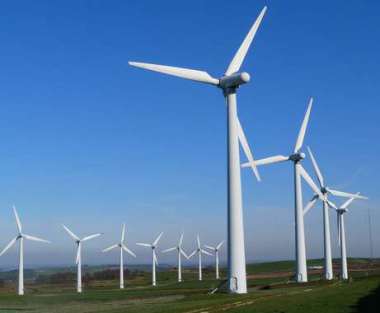 Second time lucky? Jupiter wind farm application lodged again, Canberra Times, 4 Dec 16 Katie Burgess
The company behind the controversial Jupiter wind farm has taken another swing at getting the green light to build 88 wind turbines near Canberra, a year after NSW officials sent them back to the drawing board.
The NSW Department of Planning and Environment struck out EPYC’s application to build the wind farm five kilometres out of the Tarago township last October, after it found the company had not sufficiently addressed environmental and community concerns.
But the joint Australian-Spanish venture has come back to the NSW Department of Environment and Planning with a revised proposal, which has now opened for public consultation.
While the original Jupiter wind farm proposal was to build 100 turbines across 25 rural properties, the new one outlines plans to build 88 turbines across 23 rural properties.
EPYC project manager Ibrahim Eid said the revised environmental impact statement included consultation with community members up to three kilometres away.
But residents of the surrounding regions have vowed to once again fight the proposal, which EPYC has been trying to get off the ground since 2014………
The wind farm will be within 15 kilometres of two operational wind farms, one approved wind farm and a solar farm.
The environmental impact statement acknowledged there could be wind turbines within two kilometres of properties not part of the farm.
It also stated there were 43 threatened fauna species, including the glossy black cockatoo and the spotted-tail quoll, however the turbines, substations and other ancillary buildings would be built on cleared paddocks.
The company will carry out targeted ecological surveys to determine where each wind turbine will sit.
Public submissions on the proposed wind farm close in February. http://www.canberratimes.com.au/act-news/second-time-lucky-jupiter-wind-farm-application-lodged-again-20161130-gt1f9j.html
Rooftop solar energy boom, but warnings on quality
there are companies out there using the rebate wind-down as a “scare tactic” to convince people to invest now. And a lot of these companies, Morris warns, will be pedalling poor quality and “dumb” solar.
The CEC, meanwhile, launched a new campaign “advising people buying solar panels to look for an Approved Solar Retailer to make sure they get the best possible quality and service – and avoid getting a bad deal.”
Another rooftop solar boom – this time with warnings http://reneweconomy.com.au/another-rooftop-solar-boom-time-warnings-35846/By Sophie Vorrath on 1 December 2016 Record low solar panel prices, combined with the ratcheting-down or removal of federal and state policy levers, are sparking a boom in Australia’s residential and commercial solar markets, while also prompting warnings to consumers to avoid the lure of cheap and nasty solar products – and installers. Retailers and wholesalers in the solar PV market have reported experiencing “unprecedented demand” in the month of November, which looks set to continue into December, the first month of the Australian summer. Continue reading
Need to examine Australia’s electricity system – Victorian network fault
 Vic network fault causes outages in South Australia, conservatives blame renewables, REneweconomy By Giles Parkinson on 1 December 2016 A major fault on the Victorian transmission network overnight caused power outages in South Australia for up to an hour, and forced the Portland smelter in Victoria to also go offline.
The Australian Energy Market Operator (AEMO) said that at 01:33 AEDT on December 1, the South Australian power system separated from Victoria, due to an unknown issue on the Victorian transmission network
“The root cause still under investigation,” AEMO said, but added “it is important to note that this event was not related to the Black System event in South Australia on September 28.”
It is believed that the fault lay in an Ausnet feeder line to the Heywood Interconnector in Western Victoria, when a transmission line conductor “hit the ground.”…….
questions have been raised about the decisions by the market operator, which chose to take no preventative measures, and for many underlined the fragility of a centralised grid, and the risks of storms, bushfires and other outages on an elongated network.
It has led to calls for a think about the design of electricity markets, and a push to localised grid and local renewable generation. AGL CEO Andrew Vesey, and many others, said the best security could be offered by more localised generation, and that meant renewable energy, and more storage. http://reneweconomy.com.au/vic-network-fault-causes-outages-in-south-australia-conservatives-blame-renewables-84808/
Smart planning now will enable reliable renewable electricity
Reliable renewable electricity is possible if we make smart decisions now, The Conversation, December 1, 2016 The Australian government is reviewing our electricity market to make sure it can provide secure and reliable power in a rapidly changing world. Faced with the rise of renewable energy and limits on carbon pollution, The Conversation has asked experts what kind of future awaits the grid…….
Findings from research overseas and in Australia show people are more likely to die during power outages. This is because of the increased risk of accidents, extreme cold or heat, food poisoning and communications breakdowns that can delay emergency responders.
So whatever our electricity grid looks like in the future, it will need to be reliable………
The cost of reliability
Our recent research took a highly conservative approach to testing the cost question.
We assumed that there would be no future improvements in technology from what is currently viable and no future decrease in electricity demand. We also used renewable resource supply (sunshine and wind) from 2010 because this was one of the most challenging years for renewables.
Our findings indeed showed that strategies to manage the variability of renewable resources were effective in a 100% renewable energy mix of rooftop solar, wind, large-scale solar, hydro and biofuels.
In one scenario, for instance, current demand could be matched with supply at a cost of producing electricity around 20c per kilowatt hour (the current levelised cost of coal-fired electricity is 7.8-9.1c per kWh), with overall installed capacity of 162 gigawatts (2.5 to 3 times what is installed today), relatively low transmission losses and with less than 20% wasted electricity.
The interconnected eastern Australian transmission grid would need to be 2.5 times the current size, and would need to be linked to the grids in Western Australia and the Northern Territory.
Recent developments look positive for renewables
But recent developments mean that the costs and constraints for reliable renewable energy are not likely to be as conservative as our scenario.
Battery storage has benefited from rapid improvements in technology even in the short period since our research in 2015. Significant battery storage could even mean a restructuring of our largely centralised (big power stations) network to a more decentralised one that includes rooftop solar panels and battery storage.
Decentralisation of power generation opens up the possibility of using waste heat from power generation in buildings to reduce power demand (such as tri-generation).
Our research also indicates that investing in more dispatchable technologies can reduce wasted energy, the cost of energy, the grid expansion required, and overall generation capacity.
With the price of renewables decreasing, the transition to renewables may have benefits for power producers and power consumers.
Future constraints and opportunities for renewable energy are uncertain, but we can’t wait for perfect certainty before we plan and act. In Australia we have some of the world’s leading experts in the field with a range of sophisticated modelling capabilities at hand. These assets could be the foundation of collaboration with policymakers to transition to reliable renewable energy. https://theconversation.com/reliable-renewable-electricity-is-possible-if-we-make-smart-decisions-now-68585

Australian solar power technology sold to China, by CSIRO
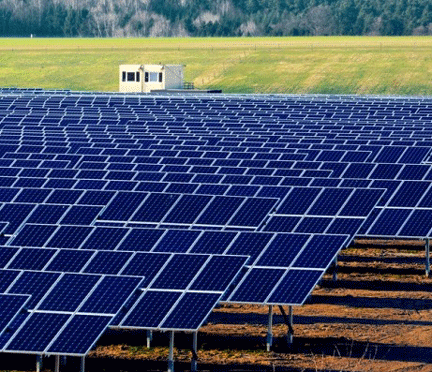 CSIRO sells concentrated solar power technology to China, The Age, Marcus Strom , 28 Nov 16 The CSIRO on Tuesday will sign a technology licensing agreement with a Chinese solar company that could reap millions of dollars in royalties for the national science and industry organisation. The deal with Beijing-based Thermal Focus will allow the company to bid for business in the burgeoning Chinese market for concentrated solar power using Australian-designed technology.
China aims to build infrastructure that produces 1.4 gigawatts of concentrated solar power by 2018, increasing this to 5GW by 2020.
“To put that into perspective, Australia has 50GW capacity in all its power stations,” said Wes Stein, CSIRO’s chief energy research scientist. John Grimes, of the Australian Solar Council, said: “This is a significant commercial opportunity, perhaps worth hundreds of millions.” CSIRO chief executive Larry Marshall said: “This partnership takes our climate mitigation focus to a global stage.”
Minister for Industry, Innovation and Science Greg Hunt said: “Australia is a leader in clean energy technology and this partnership is an important step in realising this advantage.”
The partnership will be signed at the Asia-Pacific Solar Research Conference at the Australian National University. Phil Hearne
Concentrated solar power, or solar thermal, uses mirrors to focus the sun’s energy into a collector. At collected temperatures of 560 degrees, that energy is then stored in molten nitrate salts in large thermal tanks. This can then generate superheated steam to drive turbines for electricity generation for weeks.
CSIRO’s patented technology uses smaller mirrors of about five square metres, known as heliostats, and field-control software to direct the solar energy. The technology was pioneered at the CSIRO’s energy centre in Newcastle. The solar thermal team has grown to more than 30 scientists and engineers.
Mr Stein said: “The big difference with photovoltaic cells is that our technology has storage embedded at a lower cost than batteries.”
A CSIRO spokesman said the licensing agreement covered a technology transfer payment with recurring royalties for the number of heliostats installed……
John Grimes at the Australian Solar Council said: “CSP with storage is the missing link in China’s renewable energy market.” Mr Grimes said what gave this deal credibility was that the Chinese had delivered on their plans in renewables. “Already China has installed 120GW of solar photovoltaic cells,” he said. “It really is a world leader in this field.” Its commitment was partly due to a combination of environmental concerns, cost effectiveness and air-quality pressures in cities, Mr Grimes said.
There are no commercial plants operating concentrated solar thermal technology in Australia. He said this was because government leadership in Australia had been lacking.
However, there are some companies working towards this: Vast Solar, SolarReserve and SolarStor, which is backed by former Liberal leader John Hewson.
SolarStor plans to build a concentrated thermal plant near Port Augusta, South Australia, as does US firm SolarReserve.
The solar deal comes a day after an interim report by a Senate committee recommended all Australian coal mines close by 2030.
The retirement of coal-fired power stations report committee is chaired by Greens senator Larissa Waters. Its final report will be handed down on February 1. http://www.theage.com.au/technology/sci-tech/csiro-sells-concentrated-solar-power-technology-to-china-20161128-gsz8gh.html
Western Australian town to host large renewable energy grid
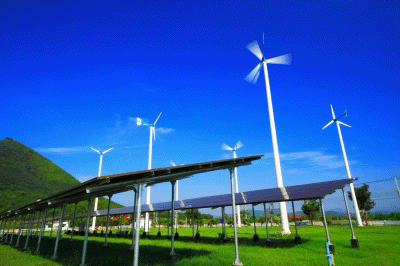 Kalbarri to host what could be Australia’s largest renewable energy grid http://www.watoday.com.au/wa-news/kalbarri-to-host-what-could-be-australias-largest-renewable-energy-grid-20161128-gsz4n5.html A $10 million renewable energy-powered microgrid which has the potential to be the largest in the country will be developed in Western Australia’s Midwest.
The coastal town of Kalbarri is currently supplied by a 140 kilometre long rural feeder line, which experiences outages due to environmental factors.
The microgrid will combine wind and solar power with a large-scale battery and Energy Minister Mike Nahan said the project will be closely looked at to see how the technology could benefit other towns in WA.
“This is a game changer for regional communities who rely on power from a long feeder line, which is subject to environmental factors that can cause outages,” Dr Nahan said.
“The project, which has the potential to be Australia’s biggest renewable microgrid, will consider all generation options and take into account the community’s desire for a renewable solution.””
Western Power will seek expressions of interest from next month with construction expected to begin in 2017.
Solar thermal plant is the best solution for Port Augusta
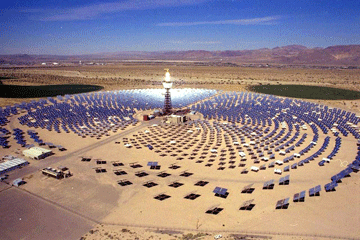 Port Augusta can show the world what just transition for workers looks like https://www.theguardian.com/commentisfree/2016/nov/21/port-augusta-can-show-the-world-what-just-transition-for-workers-looks-like Sharan Burrow
A solar thermal plant in Port Augusta is the best fit for providing both jobs and clean energy. It only needs political will to work Port Augusta, a country town of 14,000 people in South Australia, could have been a perfect example. For 68 years, coal-fired power stations and the local mines generated jobs for 400 workers and provided power for South Australia.
This is the story of a community, its power station workers and their union taking their plan for jobs and solar thermal power to state and federal government, and to global energy giants in France and the United States, demanding a just transition for the people of Port Augusta, demanding a zero carbon future for people everywhere.
The coal-fired power station was on borrowed time. Worried about air quality and environmental health, the community looked for alternative plans for energy, industry and jobs.
Five years of work – during which all options were considered – resulted in a decision that a solar thermal plant was the best fit for both a clean energy base and for skills transfer for existing energy workers.
A feasibility study and three companies interested in constructing this renewable alternative added further cause for optimism.
Even the political support appeared to line up, a promise of funding support before a national election, state government support, and a local mayor backing in his community and workers and their unions with environmental activists singing in tune.
For a moment, Port Augusta held its breath. The plan was in place. A source of energy that would allow workers to transfer from the defunct coal-fired power station. A company willing to build, the community behind it, the workers having hope for a future.
So why are they still waiting?
The missing ingredient is a shared sense of urgency to get the job done, leaving the community and governments out-manoeuvred by corporate greed.
The power station owner, Alinta, deserted its workers and the community in a shocking decision to close years ahead of public commitments. More than 250 workers are potentially stranded.
A dishonest company is nothing new; a company that takes no responsibility for the community from which they have drawn a loyal workforce that made their profits for them is sadly a global tale but where is the rescue team?
A standoff on what comes first, a contract or investment security, seems to be the villain. A standoff between layers of government with a missing procurement contract for purchasing energy from the company willing to invest in the solar thermal plant and a start-up clean tech grant.
SOUTH AUSTRALIA’s RENEWABLE ENERGY IS UNDER ATTACK!
 Victoria’s Yes2Renewables campaign is expanding to South Australia. Individuals and renewables campaign groups such as Friends of the Earth Adelaide’s Clean Futures Collective, Solar Citizens, Climate Emergency Action Network, and Australian Youth Climate Coalition are joining together to defend renewables in SA.
South Australia is a renewable energy success story. The state is fast approaching 50% renewables and has booming solar, energy storage, and wind power sectors.
This success has made South Australia public enemy #1 for the fossil fuel lobby, who will do anything to stop our transition to 100% renewables.
In July, the fossil fuel lobby and their boosters in the media blamed renewable energy for price spikes caused by big coal and gas copanies gaming the market. And in September they blamed a blackout on renewables rather than the obvious cause: a one-in-fifty-year storm.
The fossil fuel lobby is prepared to sacrifice South Australian jobs, investment in regional communities, and our climate to protect their own interests.
In Novermber, community members met up at The Joinery in Adelaide to kick off a grassroots campaign to defend South Australia’s renewable energy leadeship. For more info, visit https://yes2renewables.org/
Queensland’s solar hub in sunny Western country
 Solar energy: Sunny western Queensland to become a hub for power farms, ABC News, 6 Nov 16 By Lucy Murray Western Queensland is becoming a major hub for solar energy, with the state’s largest solar power farm soon to go online near Barcaldine and construction of another major project about to get underway in Longreach.
Six solar projects partially funded by the Australian Renewable Energy Agency (ARENA) were either recently completed or being built across Queensland.
Construction is expected to begin on another six projects next year.
With construction of the 25 megawatt (MW) Barcaldine solar farm now finished, work is underway to connect the 79,000 panels to the state’s electricity grid with about 580 kilometres of cable.
It will feed the grid with the capacity to power more than 8,000 homes once finished by mid-December, enough to light up Barcaldine 11 times over.
A short distance away, work will soon begin on the 15MW Longreach Solar Farm.
Canadian Solar was successful in the last round of ARENA funding and will begin construction on the project early next year……http://www.abc.net.au/news/2016-11-06/queensland-biggest-solar-farm-set-to-go-online/7975060
Australian Energy Market Operator blaming wind industry for it’s own mistakes
 SA blackout: Wind farm industry ‘hung out to dry’ by energy market operator AEMO RN By David Lewis for Background Briefing , 4 Nov 16, The organisation that manages the national electricity market has been accused of leaving wind farms “hung out to dry” after the recent statewide blackout in South Australia.
The Australian Energy Market Operator (AEMO) is still investigating the cause of the blackout, which plunged 1.7 million people into darkness on Wednesday, September 28.
The catastrophic power outage sparked furious disagreement about whether the state’s heavy reliance on wind farms contributed to the event.
Giles Parkinson, a veteran journalist and founder of the website RenewEconomy, believes AEMO has added fuel to the fire in a deliberate attempt to deflect attention away from its own role.
“I think people are quite confused about what the market operator seems to be doing and I think some people think it’s more interested in protecting its own reputation at this stage than getting to the bottom of it,” he said.
“It’s basically left the wind industry hung out to dry, leaving enough inference in there for people who do not favour wind to find it guilty and write and declare all sorts of things about the wind industry and the weakness of wind energy.”……..
AEMO made ‘foolhardy’ decisions
Mr Parkinson said he believed the emotionally charged wind-versus-coal debate is distracting from the mistakes AEMO made when preparing for the storm.
He pointed out that when assessing the severity of the approaching weather system, AEMO decided against declaring a “credible contingency”.
“In other words, (AEMO) saw no risk to the transmission or the generation assets despite the fact this storm was approaching and it was packing wind speeds well beyond the stated limits of many of the wind farms that were operating at the time.”
Had AEMO declared a “credible contingency”, it could have intervened in the market by reducing the amount of electricity being produced by generators, including the interconnector to Victoria.
“It was basically running the interconnector not at full throttle but pretty close to full throttle,” Mr Parkinson said……..
David Leitch, the principal at electricity consultancy firm ITK, said he agreed.
“The Heywood interconnector could have been derated an hour earlier so that when the wind generation went off, the Heywood interconnector could have picked up more electricity from Victoria and put it in and that probably would have helped a lot,” he told Background Briefing…….
AEMO unaware of safety settings
AEMO has also been criticised for not having enough information about the safety settings on wind turbines across the state.
In its second report into the blackout, the market operator admits it had no idea how many system faults individual wind farms could ride through before shutting down.
Kobad Bhavnagri, the head of Bloomberg New Energy Finance in Australia, described this gap in knowledge as one of the “big issues” with AEMO’s handling of the disaster.
“Now the question is did AEMO have a duty to know about those settings? If not, why not?” he said……..http://www.abc.net.au/news/2016-11-04/wind-farms-hung-out-to-dry-by-energy-market-operator-aemo/7992768
Western Australia missing its opportunity to become a renewable energy superpower
WA must embrace dawn of renewable energy era or risk being left behind https://www.theguardian.com/sustainable-business/2016/oct/27/wa-must-embrace-dawn-of-renewable-energy-era-or-risk-being-left-behind Michael Lord
Western Australia could become a renewable energy superpower – if the government halts LNG expansion plans and creates an innovation fund
Last year the world’s governments finally got their act together on climate change, agreeing to limit global warming to well under two degrees. To meet this commitment, we need a rapid global transition to net zero greenhouse gas emissions. The fossil fuel age is over.
The new era, powered by renewable energy, will be swept in on a massive wave of investment. According to Beyond Zero Emissions’ report, Renewable Energy Superpower, the world will invest $US28tn in renewable energy and energy efficiency in the next 20 years.
But Western Australia risks being left behind. Here investors have poured more than $100bn into liquefied natural gas (LNG) over the past decade yet the state has little to show for it. Another $60bn is slated for LNG development, but with current low gas prices, the sense of that investment is questionable. Energy consumers fork out for coal-fired power that goes unused and endure endless debate about grid privatisation. Meanwhile Western Australia’s electricity-related emissions are rising, just as almost all other states are managing to reduce them.
The irony is that Western Australia should welcome the dawn of the renewable energy era. The state’s enormous resources of sunshine, wind and wave mean it could become a renewable energy superpower of the future. Our report shows how Australia’s world-beating renewable energy resources represent a huge economic opportunity. Incredibly the report shows that in Western Australia alone, there is enough wind and solar, available at competitive prices, to provide almost 9% of the world’s energy every year. In other words Western Australia has more renewable energy than fossil energy. Continue reading
New South Wales households lose feedin tariff benefits
Households face steep hike in power charges as solar subsidies end, The Age, 28 Oct 16 Brian Robins Tens of thousands of households are facing a surge in their electricity bills from the start of the new year as the NSW government’s subsidy for rooftop solar panels expires.
This could add more than $1600 to the annual electricity bill as the so-called ‘feed-in tariff’, the price received for surplus electricity sold into the electricity grid, is slashed by as much as 90 per cent in some cases.
Under the original government program, households which installed solar systems received as much as 60¢ a kilowatt hour for surplus electricity sold into the grid. This will fall to 6¢, or possibly less, depending on the deals done with your electricity retailer. The state government’s pricing regulator IPART, the Independent Pricing and Regulatory Tribunal, has recommended electricity companies pay 5.5-7.2¢ per kilowatt hour for electricity bought from households with solar systems…….http://www.theage.com.au/business/households-face-steep-hike-in-power-charges-as-solar-subsidies-end-20161028-gscu4s.html
Jobs in a clean energy future
http://apo.org.au/resource/jobs-clean-energy-future
25 October 2016 Download file
By committing to the Paris Agreement, the world recognised the need to work together to keep global warming well below 2 degrees. Around the world, other governments are embracing the opportunities of transitioning to a clean energy future. But at home, Australia’s pollution continues to rise and Australia remains as one of the biggest per capita polluters in the world. There is still no coherent national plan to transition Australia to a net zero emissions economy.
Jobs in a clean energy future updates our 2010 collaboration Creating Jobs – Cutting Pollution and demonstrates, yet again, that creating a brighter future for the Australian community and our environment go hand in hand.
This report presents a clear choice. If Australia continues with business as usual, pollution will continue to rise and the health of the people and our natural world will continue to deteriorate. If the government acts now and implements policies under a strong action scenario we can create one million more jobs by 2040. People and nature will be better off and the places we love will thrive. If we increase public transport and clean energy Australia’s cities, towns and regions will be more liveable, smarter and healthier places to live. By embracing these opportunities Australia can be a world leader and create jobs and industries that are at the forefront of the transition.
1 This month

of the week – Australians for War Powers Reform (AWPR)
To see nuclear-related stories in greater depth and intensity
 Antinuclear