Port Augusta is attracting solar energy developers
Solar energy developers attracted to Port Augusta after power station’s closure, ABC, The World Today 25 Oct 16 By Khama Reid Solar energy developers are honing their attention on the South Australian city of Port Augusta after the community’s economy took a hit when its largest employer, Alinta Energy, closed its coal-fired power station.
For the past five years, the community has been pushing for a transition from coal to renewable energy, which is now steps closer to becoming reality.
Residents and those in the neighbouring city of Whyalla brag the region gets “300 days of sunshine” a year.
Port Augusta Mayor Sam Johnson said the tagline had become more than just a tourism slogan with solar companies getting serious about development in the region.
“Reach Solar have made an application to the State Government as recent as only a few weeks ago for a very real project here at Port Augusta using solar PV [photovoltaic],” Mr Johnson said.
“We know there’s Solastor and Solar Reserve both looking at large scale solar thermal technology, both in the vicinity of $1 billion projects.”
Mr Johnson said one of the further progressed proposals was for the DP Energy Renewable Energy Park to the south of the city.
“DP Energy actually has planning approval and will be the largest wind and solar PV farm in Australia and actually the first to have not just wind but solar PV technology as well.”
Queensland and SA ‘real hot markets’ for solar
Renew Economy editor Giles Parkinson said the spike in interest was not surprising. “There’s two real hot markets for solar at the moment, that’s Queensland and South Australia and in South Australia around the Port Augusta/Whyalla area and that comes from two things,” Mr Parkinson said.
“One is the excellent sunshine, but also the high wholesale electricity prices.
“They rely so much on gas to set the price of generation, and the price of gas has gone up, so the wholesale price has gone up as well.”
Mr Parkinson said solar was becoming a more affordable investment option.
“I guess the overwhelming driver is the reduction in costs of solar PV, it’s actually falling to a point where it can actually compete with wind energy.”
He said the Australian Renewable Energy Agency (ARENA) previously funded wind farm developments, but in its latest round awarded more than $91 million to solar photovoltaic projects across the country……http://www.abc.net.au/news/2016-10-25/solar-energy-developers-flock-to-port-augusta/7962306
Electric car charging stations for Adelaide in 2017 – says Mayor
 Adelaide City Council ‘leads the way’ with rollout of 40 electric car charging stations in 2017, ABC News, 23 Oct 16 By Candice Prosser Electric cars are the way of the future and Adelaide will lead the nation in developing infrastructure to encourage more of them, Adelaide’s Lord Mayor says.
The Adelaide City Council has announced it will roll out 40 electric charging stations throughout the city in 2017 in addition to the four charging points it currently has in two CBD car parks.
Speaking at the Electric Vehicle Expo at Elder Park, Lord Mayor Martin Haese said the infrastructure would be free to all users. “At this point in time the council needs to show leadership — we are very much in a changing environment whereby we’re forecasting the growth and sales of electric vehicles over the next few years is just going to grow exponentially,” he said. “Adelaide has a goal to become the world’s first carbon neutral city by 2025 and electric vehicles are an important part of that story.
“We want to be a smart city, we want to send a very clear signal to everyone that technology and the knowledge economy is important to our future. “We believe electric vehicles do both.”
The Lord Mayor said he expected electric vehicles to become increasingly more popular.
“Electric vehicles are very important, they are going to become incredibly commonplace much sooner than what we think,” he said.
“We’ve currently got about 700 electric vehicles registered in South Australia, we’ve got some 22,000 hybrid vehicles registered in South Australia and those numbers are going to grow exponentially.”
The council is also offering residents and businesses $5,000 to install their own charging points and will consider installing faster super chargers around the city in the future……..http://www.abc.net.au/news/2016-10-23/adelaide-city-council-rollout-40-electric-car-charging-stations/7958074
Confusing report by Australian Energy Market Operator (AEMO) Update Report on the state-wide blackout.
Dennis Matthews, 21 Oct 16 I have just read the Australian Energy Market Operator (AEMO) Update Report on the state-wide blackout.
The collapse of more than twenty transmission line towers initiated a sequence of domino-like events that ended with the loss of grid-power to the entire state. When I came to the end of the report I was mystified by the lack of attention to the first domino to fall – the transmission-line towers. The final chapter of the report, Next Steps, makes no mention of the towers, including the fact that they have been replaced by temporary structures.
I went back to the beginning of the report and was amazed to find the transmission line faults (caused by the tower collapses) classed as “pre event”.
What on earth is AEMO doing? Do we have to wait six months to find out whether the transmission-line towers are strong enough? Will there be another disruption to the electricity transmission system in the meantime? Your guess is as good as mine.
South Australia’s Sundrop Farms – desert solar powered agriculture
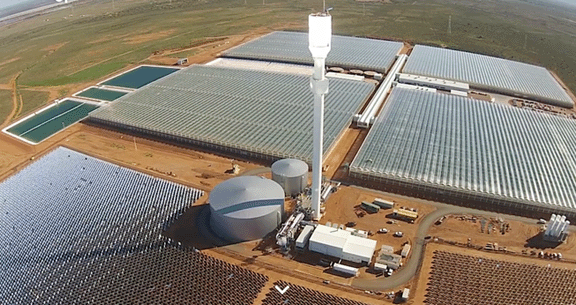
Farms that grow food in arid deserts, without groundwater or fossil fuels, could be the future of agriculture. BRYAN NELSON October 10, 2016, No soil, no pesticides, no fossil fuels, and no groundwater. And yet, a thriving farm in the heart of the arid Australian desert. How is this possible?
An international team of scientists has spent the last six years fine-tuning a system that pipes seawater in from the ocean and desalinates it using a state-of-the-art concentrated solar energy plant. The water is then used to irrigate 180,000 tomato plants grown in coconut husks instead of soil, kept in a network of greenhouses.
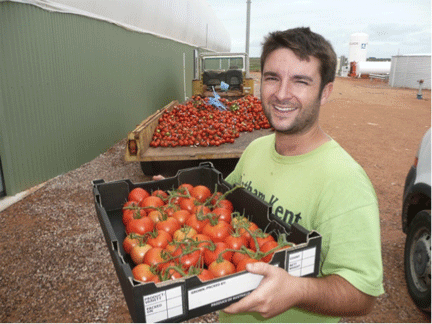 The result is Sundrop Farms, a commercial-scale facility located just off the Spencer Gulf in South Australia that began construction in 2014. Today it’s producing an estimated 17,000 tons of tomatoes per year to be sold in Australian supermarkets.
Given the increasing demand for fresh water around the world — a problem that’s particularly apparent in the sunburned landscape of South Australia — this might just represent future of large-scale farming, especially in coastal desert regions that have previously been non-arable.
The heart of the farm is the 23,000 mirrors that reflect sunlight towards a 115-meter high receiver tower. All of that concentrated sunlight produces an immense amount of power, up to 39 megawatts. That’s more than enough to cover the desalination needs of the farm and supply all the electricity needs of the greenhouses.
The seawater, too, has other purposes besides just irrigation. During scorching hot summers, seawater-soaked cardboard lines the greenhouses to help keep the plants at optimal temperature. Seawater also has the remarkable effect of sterilizing the air, meaning that chemical pesticides are unnecessary.
All in all, the facility cost around 200 million dollars to get up and running. That might sound excessive, but in the long run the facility should save money compared to the costs of conventional greenhouses that require fossil fuels for power. It’s a self-sustaining, cost-efficient design so long as the initial investment can be provided. Facilities similar to the Australian one are already being planned for Portugal and the U.S., as well as another in Australia. Desert areas like those seen in Oman, Qatar and the United Arab Emirates could be next in line.
“These closed production systems are very clever,” said Robert Park of the University of Sydney, Australia, to New Scientist. “I believe that systems using renewable energy sources will become better and better and increase in the future, contributing even more of some of our foods.”
South Australia’s home solar batteries- electricity provided throughout recent blackout
 http://www.adelaidenow.com.au/news/south-australia/market-for-solar-storage-batteries-growing-and-competitive/news-story/cae6fc767743e6b38c5165145a9bb893 Craig Cook, The Advertiser October 16, 2016
 THE hi-tech home energy storage battery revolution, allowing households to better manage solar rooftop power, has been promised for more than a decade and now it could finally arrive in South Australia.
Battery installers in Australia have reported more than 100,000 customer inquires this year, although sales of the systems – which are adaptable, stylish, and small compared to the ugly lead acid batteries of the past – number less than 5000 units.
World leaders in battery production include Elon Musk’s Tesla company that produces the popular bar fridge sized ‘Powerwall’ unit, and German firms Sonnen and BMZ.
 Leading players offering home battery solutions include ZEN Energy, based at Clovelly Park in Adelaide, with Professor Ross Garnaut as chairman, and Redflow, based in Brisbane, led by SA-based innovator Simon Hackett, as chairman, chief executive and majority shareholder.”
But the biggest indicator that this is a growing, competitive and lucrative market is that major energy providers, AGL and Origin, now offer their own storage battery solutions.
ZEN Founder and Director of Innovation, Richard Turner, said while South Australia was plunged into darkness last week, its customers were completely uninterrupted.
“They were using their electric ovens, watching television, and going about their night like nothing had happened,” Mr Turner said.
“These systems are designed to generate and store ample solar energy during the day to meet their home’s power needs at night and provide backup power during blackouts.”
Mr Turner said while luxury homeowners were among the first adopters of solar energy storage, solutions were now affordable and within everyone’s reach. Continue reading
Tidal energy – Australian Maritime College launches new turbine in Tamar River
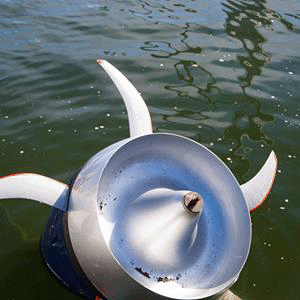 Australian Maritime College launches new tidal turbine in Tamar River http://www.examiner.com.au/story/4230602/the-future-of-energy/?cs=5312 16 Oct 2016 An emerging form of renewable energy has been met with overall positive reviews from the Tamar community.
The Australian Maritime College and Sydney-based developers MAKO have come together to install and monitor a new tidal energy turbine in the Tamar estuary near Launceston. Field experiments at a site near Reid Rock, north of the Batman Bridge, of a 2.4 metre-wide prototype have already started.
The turbine is secured beneath a floating platform and will be connected to a mooring on the east side of the estuary.
AMC project lead Irene Penesis said tidal energy was particularly exciting as it was very predictable compared with solar and wind power because of its consistent and monitorable cycles. “Through the kinetic energy of the tidal flow, we generate mechanical power and we then convert that to electricity,” Associate Professor Penesis said.
“Because tides are extremely predictable and we can predict them two years in advance, we can predict how much power we’re going to get – when you transfer that power back into the grid you know how much you’re transferring back and you can monitor that.
“It’s absolutely essential to have the community behind these types of events because if there’s an opportunity to install tidal turbines in the Tamar River, we would want those community members to have access to that power being generated.”
Owner of the nearby Tamar River Retreat Ian Stewart said after a community meeting was held to discuss the turbines last week, there was positive interest from residents and businesses in the area.
“To use tidal power to generate electricity would be absolutely fantastic,” Mr Stewart said. “I spend about $5000 a year on electricity because of my business, it’s probably my single biggest business expense, and if I can get that down even lower that would be great. “I think that a lot of people in the community want to get behind this idea and want to support it.”
Queensland govt’s push for solar power on all government buildings
 Solar should power government schools, TAFE, hospitals: report, Brisbane Times, 13 Oct 16 Tony Moore Solar panels will be installed in Queensland Government buildings including TAFE colleges, schools, hospitals and public houses, to help drive Queensland’s renewable energy from seven per cent today to 50 per cent by 2030, a far-reaching strategic report into Queensland’s renewable energy says……..
“The Palaszczuk Government is currently investigating the use of solar PV on state-owned buildings,” Mr Bailey said. Report author and investment banker Colin Mugglestone led a team of researchers who spent seven months analysing how Queensland should reach a position where 50 per cent of its energy is provided by renewable energy by 2030.
The state government now has 9 megawatts of solar panels on government buildings and hopes to generate 2000 megawatts of solar energy from government property by 2030, the report says…….
What could a renewable energy push to 50 per cent by 2030 provide? “It is projected that Queensland could reach 2200 MW of wind, 5200 MW of large-scale solar PV, and 4900 MW rooftop PV by 2030, including 5500 MW of new large scale capacity built after 2020.”
It could provide between around 6400-6700 extra full-time jobs, mainly in the construction of large scale renewable energy plants.
Last month the federal government’s renewable energy body ARENA agreed to fund $51.4 million to seed six new large-scale solar plants in Queensland. That will help potential big solar plants in Dalby, Oakey, Longreach and Kidston west of Townsville and two in Collinsville……..
What do The Greens say?“The Greens welcome this draft report, which confirms that clean energy is good for jobs,” Mr Bartlett said.”But we are dismayed at the years of delay, lack of ambition, and no transition plan for coal power workers.” http://www.brisbanetimes.com.au/queensland/solar-should-power-government-schools-tafe-hospitals-report-20161012-gs112t.html
Solar power needed, to bring energy security and jobs to Port Augusta, South Australia
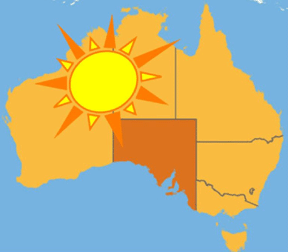 Sam Johnson: Solar power must be provided to regional centres such as Port Augusta to provide electricity security – and jobs
 http://www.adelaidenow.com.au/news/opinion/sam-johnson-solar-power-must-be-provided-to-regional-centres-such-as-port-augusta-to-provide-electricity-security/news-story/4ffcdfeb9fc35ef3f8cbfe0eea1c9bdc October 10, 2016 THE political hoo-ha over renewable energy in South Australia over recent weeks has revealed a serious lack of leadership when South Australian towns like Port Augusta need it most.
Canberra’s renewable energy leadership at risk, as Federal govt demonises renewables.
The solar industry already employs more people than coal-fired generation across the country. In 2014 the solar industry employed more than 13,000 people and even with the uncertainty and watering down of the renewable energy target this is likely to have grown. By comparison, according to the 2011 census 8,000 people worked in fossil fuel electricity generation.
A clean energy transition is already happening, but it is at risk, Guardian, Alexander White, 11 Oct 16 The transition to a low carbon economy is already happening, but is at risk when residents of Australia’s capital go to the polls in local elections.
The transition to a low carbon economy is already happening … in theAustralian Capital Territory, where the local Labor government has legislated for a 100% renewable energy target by the year 2020.
But this major achievement is at risk on Saturday when residents of Canberra go to the polls for territory elections. Continue reading
Turnbull government has misused clean energy funds
 Unlawful reallocation of clean energy investment by the Coalition, Independent Australia, 8 October 2016, John Ward discusses the Turnbull Government’s misuse of Clean Energy Finance Corporation funds.
THERE IS NOW clear evidence of misleading and deceptive conduct by members of the Coalition Government.
This crookedness needs to be exposed.
The sectional interests of our government ministers’ corporate donors are taking precedence over the national interest and the sustainability of financing for the renewable energy industry.
In 2015, then treasurer Joe Hockey and finance minister Mathias Cormann directed theClean Energy Finance Corporation (CEFC) to exclude investments in household and small-scale solar from the $10 billion fund in the future. The draft investment mandate called for ‘mature and established clean energy technologies … including wind technology and household small-scale solar’ to be excluded from the Corporation’s activities.
Interestingly, the authority to make such changes can only come from the Parliament, not the executive. The Executive Council cannot change an act of parliament. The Parliament also authorises the government to spend public money — not the other way around.
Any change, such as the revocation of a part and/or a new investment mandate to the Clean Energy Finance Corporation Act 2012, may only be modified by amendments made, requested or agreed to by the senate. Stephen Keim SC has provided advice to environmental groups about the government’s ability to direct the CEFC. He said the government had the power to put in place an investment mandate but it had to “tread a fairly thin line”.
During 1998, American Petroleum Institute (API), the USA’s largest oil trade association (member companies include BP, Chevron, Conoco Phillips, Exxon-Mobil and Shell) planned a “roadmap” for a climate of deception, including a plan to have “average citizens” believe that the realities of climate science were vague and uncertain.
Australians have been subject to fraudulent and misleading representations regarding climate change over the past ten years by the people we elected.
The direct effect of the CEFC responsible ministers acting as de facto or shadow directors of the CEFC has been to create the perception that Australian policy support for clean energy is uncertain or diminished.
These are the same negative outcomes envisaged by the American Petroleum Institute’s (API) 1998 campaign.
A third entity involved in this deception is lobby group the Institute of Public Affairs (IPA). The IPA was founded by a conglomerate of like-minded groups at the same time as the Liberal Party formed in 1943-44, after the break-up of the United Australia Party. The policy agenda of the Institute of Public Affairs (IPA) has been linked directly to Coalition policy ever since…….
Prime Minister Turnbull, Deputy Prime Minister Joyce, Former Prime Minister Abbott, Ministers Pyne, Hockey, Cormann and Hunt are attempting to falsely convince the public that the Cabinet can re-purpose and re-direct legislation without going back through the Parliament. These changes to the CEFC Act 2012 are still to be legislated. ……..
Let’s consider the limits the Clean Energy Finance Corporation Act 2012 imposes on the responsible ministers’ mandate.
Section 65 states:
The responsible Ministers must not give a direction under subsection 64(1):
(a) that has the purpose, or has or is likely to have the effect, of directly or indirectly requiring the Board to, or not to, make a particular investment; or
(b) that is inconsistent with this Act (including the object of this Act).
The object of Act is to facilitate increased flows of finance into the clean energy sector.
Joe Hockey and Mathias Cormann attempted to skirt around the law. If this gross ideological interference had not happened, the growth and jobs in the clean energy industry might have delivered some real balance to the downturns in other parts of the economy.
The Coalition Government is in contempt of Parliament. Its ministers have betrayed our trust. The Caolition and the IPA are still using the same script and still following the API’s line of climate deception.
There are strong connections between the API and the IPA’s disinformation and the Coalition’s campaign aims.
The links are there. The wrongs have been done. Let’s promote public debate on this matter. https://independentaustralia.net/politics/politics-display/unlawful-reallocation-of-clean-energy-investment-by-the-coalition,9567#.V_loHsmJvtk.twitter
National electricity review headed by a nuclear power enthusiast, Alan Finkel
 Don’t forget: Alan Finkel is a nuclear power enthusiast, and the Grattan Institute is largely funded by BHP. This all sounds good, but be wary. “ The Chief Scientist will, amongst other things, bring to the review his knowledge of current and likely future developments in energy technologies.”
Climate change must be part of Australia’s electricity system review, The Conversation Program Director, Energy, Grattan Institute,October 8, 2016 On Friday, Australia’s federal and state energy ministers met for an extraordinary meeting following the complete loss of power in South Australia on September 28. The COAG Energy Council announced a wide-ranging independent review to provide advice to governments on a coordinated, national reform blueprint. The review will be chaired by Australia’s Chief Scientist, Dr Alan Finkel.
Dr Finkel has been challenged with steering Australia’s energy system around some big potholes while keeping his eye on the horizon. And all in about six months.
The review will consider work already being done around maintaining the security, reliability and affordability of electricity as delivered by the National Electricity market (NEM) (which covers all states except Western Australia and the Northern Territory)…..
The review is expected to deliver a blueprint via a final report early in the new year. It is likely to include specific actions, both physical and financial, that respond to recent events such as South Australia’s price shock in July and blackout in September. …….
The council has highlighted the significant transition underway in the Australian electricity market. The drivers include “rapid technological change, the increasing penetration of renewable energy, a more decentralised generation system, withdrawal of traditional baseload generation and changing consumer demand”. The blueprint will address all of these issues in a comprehensive and coordinated way not previously a feature of the council’s output.
There is much uncertainty to how some of these drivers will evolve over the next two decades. To be really effective, the blueprint will need to consider a range of plausible long-term scenarios but focus on near-term options that can be adapted to evolving developments on all fronts.
The Chief Scientist will, amongst other things, bring to the review his knowledge of current and likely future developments in energy technologies. This will be important in considering policy, legislative and rule changes that favour the adoption of technologies that could address both low-emissions and reliability but are otherwise technology-neutral……..https://theconversation.com/climate-change-must-be-part-of-australias-electricity-system-review-66684
In Western Australia, retirees trading solar power
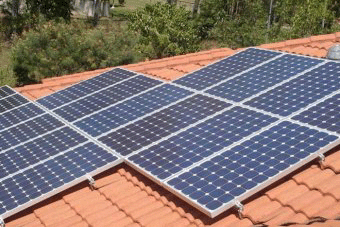 Trading solar power: Retirees test way to beat shrinking feed-in tariffs http://www.abc.net.au/news/2016-10-08/trading-solar-power:-retirees-‘plan-for-the-future’/7914736?section=environment By Kathryn Diss Retirees in the West Australian town of Busselton are trialling a new system which allows them to sell excess energy they have generated from their solar panels direct to their neighbours.
The system bypasses the state’s energy utility Synergy, saving consumers money and increasing returns for solar adopters. Continue reading
Renewable energy transition is the future, whether Turnbull likes it or not
 The electricity storage revolution now underway is charcterised by increasing storage capacity and continuously falling battery prices. Two outcomes of this storage revolution are that it will:
- have the effect of making renewable energy available 24/7 and cheaper than electricity produced by coal fired power stations. The latter will cease to operate as they are replaced at an accelerating rate by solar and wind generation, and
- enable improved grid management, permitting electricity generators to buy and sell energy at optimum prices with price determined by demand, rather than supply.
 Whether the Turnbull government likes it or not, these developments are already underway. They are bringing about change in the cost of and way in which electricity is produced, stored and used. These developments make it possible for the government to solve the budget problem it faces – by progressively withdrawing the subsidies it currently pays fossil fuel producers and applying them to budget deficit reduction.
Coal is on a one-way trip to oblivion as an energy source, whether subsidized or not.
The need for renewable electricity http://www.onlineopinion.com.au/view.asp?article=18569 By Mike Pope –, 7 October 2016 In response to the September State-wide loss of electricity in South Australia (SA), the Australian Prime Minister (Malcolm Turnbull) and Environment Minister (Josh Frydenberg) both blamed that event on a severe climate event. Both attempted to conflate the loss of power with the rate SA had adopted renewable energy (40%), particularly generated by wind, resulting in closure of all coal-fired power stations in that State.
They asserted this left SA with inadequate back-up for its overly rapid adoption of renewable energy and that the outage should be seen as a salutary wake up call for retention of fossil fuelled electricity generation. Mr. Turnbull went further, declaring that the SA power failure demonstrated the need to retain use of coal as an energy source, pointing to the importance of coal mining, employing 10,000 people and earning the country important income.
He went on to criticize the renewable energy targets of Queensland (50% by 2030) and Victoria (40% by 2025), describing both as ideologically driven and incapable of being achieved without risking the loss of energy experienced by SA. He described State targets as grossly in excess of Commonwealth emissions targets of 26-28% by 2030. He had asked his Environment Minister to negotiate with all States to ensure that their targets were consistent with achieving the Commonwealth Renewable Energy Target (RET) of 23% by 2020.
For the Turnbull Government there are 3 problems: (1) Unless Queensland and Victoria meet their targets, the Commonwealth RET is unlikely to be achieved. (2) Climate conditions in Australia, particularly the southern half, are likely to become more extreme, more often. (3) Commonwealth emissions target (26%-28% below 2005 emissions by 2030) may not be achieved or provide a fair, effective, contribution to achieving an average global temperature of no more than 1.5°C above the pre-industrial average by 2100. These things matter. Continue reading
Australia’s first sun-tracking solar farm opens at Majura, Canberra
Majura solar farm set to power more than 600 homes after four years of planning, The Age, Clare Sibthorpe, 6 Oct 16, Hundreds of Canberra homes are set to be powered by one of Australia’s first sun-tracking solar farms which opened in Majura on Thursday.The 2.3MW solar farm adjacent to the Mount Majura winery will generate 4,300 MW per hour within a year, which equals about 600 houses.
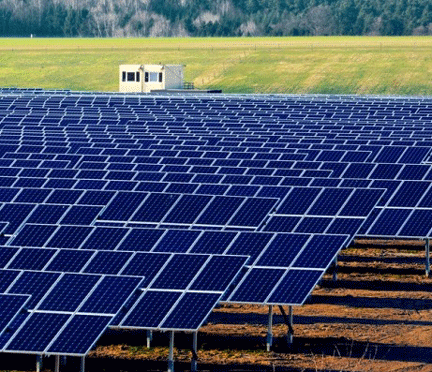
The farm has one of the first self-powered and single axis tracking technology to be used in Australia, which increases output by up to 40 per cent…..
ACT Chief Minister Andrew Barr said the completion of Canberra’s fourth solar farm – with the others in Mugga Lane, Williamsdale and Royalla – helped ensure Canberra’s future renewable power supply was guaranteed…….
He said the ACT government had contracted 640 megawatts of power which exceeded the amount needed to make the territory entirely renewable by 2020.http://www.theage.com.au/business/energy/majura-solar-farm-set-to-power-more-than-600-homes-after-four-years-of-planning-20161006-grw501.html
Look to our sun, urges Hewson
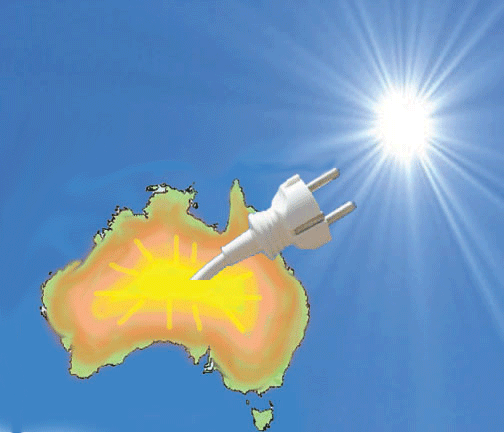 DR John Hewson is leading the charge for more renewable energy – and wants a system redesign.
 Tory Shepherd, Political Editor, The Advertiser, October 6, 2016 AUSTRALIA needs more renewables, not less, former Liberal leader John Hewson says.
1 This month

of the week – Australians for War Powers Reform (AWPR)
To see nuclear-related stories in greater depth and intensity
 Antinuclear