Turnbull govt attacks renewable energy, plans to gut Australian Renewable Energy Agency (ARENA)
 The sun will set on solar if the Australian Renewable Energy Agency is gutted, The Age, Andrew Blakers and Richard Corkish, 30 Aug 16
The federal government plans to strip the Australian Renewable Energy Agency of most of its funding, as well as its ability to give grants now that Parliament has resumed. Remarkably, the ALP, which established ARENA when in government, may allow this to happen. This is an existential threat to renewable energy research, innovation and education in Australia.
The solar photovoltaic industry is big business. It now makes up a quarter of all new electricity generation capacity installed each year across the world, and it’s growing at 20 to 30 per cent a year. Together, solar and wind energy make up half of all new generation capacity installed globally and all new generation capacity installed in Australia. A renewable energy revolution is in progress, and Australia is at the forefront. Gutting ARENA directly threatens our leadership position.
Our economy has benefited to the tune of billions of dollars in the form of dramatically reduced solar system costs, increased renewable energy business activity, fewer greenhouse gas emissions, royalties, shares and international student fees.
To provide just one example, the Australian-developed PERC solar cell now has annual sales of $9 billion and is forecast to dominate the worldwide solar industry. Further, gains in energy efficiency made possible by this technology are forecast to save our country $750 million in electricity generation costs over the next decade……..
If ARENA is cut, then hundreds of people will lose their jobs within two years. That is the cold reality. This includes researchers, PhD positions and industry leaders. Our brightest minds will be forced to either leave the field, or leave Australia in favour of other parts of the world where solar research is still valued.
In the longer term, Australia’s leadership in solar energy will vanish. As support for research and innovation dwindles, later-stage commercialisation will also start to dry up. This won’t be a temporary loss, but a long-lasting extinction as we lose the research groups that underpin the very education and training of future Australian engineers and scientists.
This would be completely at odds with the federal government’s innovation agenda, as well as its commitment at the UN climate change conference in Paris to double clean energy research and development by 2020…….http://www.theage.com.au/comment/australian-renewable-energy-agency-to-lose-most-of-its-funding-20160829-gr3qme.html
Liberal Chairman of Coalition’s environment policy committee a proud climate sceptic, suggests nuclear power
Coalition environment committee chairman takes aim at solar subsidies Craig Kelly says he wants wind and solar funding to be redirected to research into ‘technological breakthroughs’ because existing renewables had ‘little effect’, Guardian, Gabrielle Chan, 31 Aug 16, The Liberal chairman of the Coalition’s environment policy committee, Craig Kelly, has questioned solar and wind power subsidies and would like a cost-benefit analysis of future emission reductions policy, due to be reviewed next year.
Kelly was named chairman of the environment and energy committee at the party room meeting on Monday, making him responsible for coordinating backbench feedback to the government on climate and energy policy.
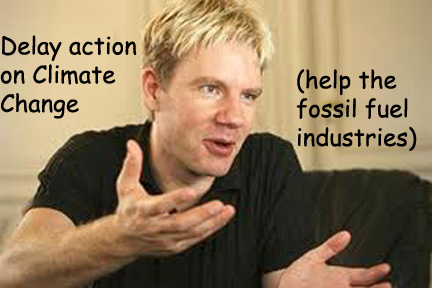 He said he was proud to be a climate sceptic rather than “wallow in groupthink, to be a sheep, or a lemming”. Kelly described himself as in the “Bjorn Lomborg” camp, suggesting wind and solar funding should be channelled into “further research” because those current renewables like wind and solar power had “diminishing returns”………
Kelly said in considering the price of power, the option of nuclear power should be considered……..https://www.theguardian.com/environment/2016/aug/31/coalition-environment-committee-chairman-takes-aim-at-solar-subsidies
Turnbull’s “innovative” crippling of ARENA
ANU and UNSW, Independent Australia, 30 August 2016 Following on from the destruction of the CSIRO, the Turnbull Government plans to cripple the Australian Renewable Energy Agency’s (ARENA) funding. We have reproduced an open letter from academics at UNSW and ANU urging public support to save this vital agency.
AN OPEN LETTER FROM ANU AND UNSW ACADEMICS
Australia’s endangered solar research THE FEDERAL GOVERNMENT plans to strip the Australian Renewable Energy Agency (ARENA) of most of its funding as well as its ability to make grants.
This is an existential threat to renewable energy research, innovation and education in Australia.
After the fiasco involving CSIRO climate scientists, we now have a potential fiasco in mitigation of climate change. Remarkably, the ALP, which established ARENA when in government, may allow this to happen.
We call upon all political parties to support retention of ARENA……..https://independentaustralia.net/politics/politics-display/turnbulls-innovative-crippling-of-arena,9411#.V8Ur0j5jSY0.twitter
Geothermal power project closes in SA as technology deemed not financially viable
ABC News, 30 Aug 16 By Tom Fedorowytsch A potential energy source in Australia is set to remain untapped, with a geothermal power project in the far north of South Australia now closed.
Energy company Geodynamics closed and remediated the sites of several test wells and generation plants in the Cooper Basin after deciding they were not financially viable.
Before the closure, the company had managed to extract super-heated water from five kilometres below the earth’s surface and use it to generate small amounts of electricity.
“The technology worked but unfortunately the cost of implementing the technology and also the cost of delivering the electricity that was produced to a market was just greater than the revenue stream that we could create,” Geodynamics chief executive Chris Murray said…….http://www.abc.net.au/news/2016-08-30/geothermal-power-plant-closes-deemed-not-financially-viable/7798962
Underground Coal Gasification (UCG) a disaster for climate
Friends of the Earth has recently released a report called ‘Fuelling the Fire: the chequered history of Underground Coal Gasification and Coal Chemicals around the world’
The report draws together evidence of UCG test projects over the last three decades and highlights how destructive UCG and Coal Chemicals are
 Fuelling the fire: New coal technologies like UCG spell disaster for climate https://independentaustralia.net/environment/environment-display/fuelling-the-fire-new-coal-technologies-like-ucg-spell-disaster-for-climate-,9393 Cam Walker 26 August 2016, Given UCG’s disastrous history including Linc Energy’s irreversible environmental damage in Queensland, Friends of the Earth is calling for a moratorium on all UCG projects in Australia. Cam Walker fromFriends of the Earth reports.
IN RECENT years Australia, like many countries around the planet, has seen a major expansion in the development of unconventional oil and gas drilling.
These are oil and gas resources which cannot be produced by conventional processes (that is, through using the natural pressure of the wells to release the resource trapped in a coal or rock seam).
Until the 1990s, production of conventionaloil and gas kept prices relatively stable, so there was limited incentive to develop technologies to explore and produce unconventional oil and gas resources.
In the 2000s, prices started to increase, and with known reserves starting to peak, it was clear that this trend would continue into the future.
As debate increasingly focused on energy independence, a number of countries who consume large volumes of fossil energy such as the USA, Canada and China started to realise they had potentially enormous volumes of unconventional oil and gas. This in turn lead to a major development effort that saw a huge expansion in the use of hydraulic fracturing (‘fracking’) to access methane in shale beds to produce gas in the USA and elsewhere.
Australia also has major reserves of oil and gas which could potentially yield through the use of unconventional drilling methods. Here the unconventional gas resource includes coal seam gas (CSG), shale gas and tight gas. Exploration for CSG in Australia began in 1976 in Queensland’s Bowen Basin. The industry took hold, initially in Queensland, where there are currently around 4,000 onshore gas rigs. More than 37% of the Australian landmass is currently under exploration permit or application for coal or gas.
The UCG industry has been strongly resisted by regional communities and environmental groups around the country and the many dangers of fracking are well documented. This has resulted in moratoriums on fracking in states such as Victoria. Continue reading
South Australia: Future Business Council calls for National smart energy grid
 Tom Quinn: South Australian business is paying high price for ‘dumb’ national electricity grid
 http://www.adelaidenow.com.au/news/opinion/tom-quinn-south-australian-business-is-paying-high-price-for-dumb-national-electricity-grid/news-story/97918e65518213082303ddd011421d3f
Last week’s meeting of energy ministers fumbled their first chance to do so, leaving business hamstrung. Nowhere is that as painfully clear than in South Australia.
The state has led the country in tapping into rich, renewable resources but when it comes to accessing the benefits business is still missing out. The problem? South Australia must operate within a larger national system that’s designed for a different age.
The wholesale electricity price spikes seen in July, claims of gas market manipulation and barriers preventing the rapid shift to 100 per cent renewable electricity have highlighted the many systematic flaws. At the heart of all this, though, sits an outdated grid that is based on last century’s centralised generation model.
This obsolete system has served us well but is now holding back the state and business community.
The sand is rapidly shifting under the traditional energy market’s feet driven by households and businesses that are no longer just consumers of energy but also producers, particularly through domestic solar panels Continue reading
Turnbull’s plan to defund Australian Renewable Energy Agency will cause loss of 100s of solar energy jobs in Queensland
Queensland solar projects that could create 2,600 jobs at risk in federal cuts
Many schemes may not go ahead if the Australian Renewable Energy Agency is defunded in the government’s omnibus bill, ACF warns, Guardian, Michael Slezak, 25 Aug 16, Thousands of jobs could be created in Queensland if 10 large-scale solar projects were to receive funding, according to analysis by the Australian Conservation Foundation.
The projects, earmarked for funding by the Australian Renewable Energy Agency (Arena), would create around 2,695 jobs according to the study.
The figure compared favourably with the 1,400 jobs which the Indian conglomerate Adani estimates its $16bn Carmichael coalmine would bring to the state if it obtains approval for the controversial project, the study claimed.
However, the findings comes as Arena faces defunding by the federal government, placing the projects in jeopardy. Continue reading
Canberra heads to 100% renewable energy, helped by wind power from South Australia
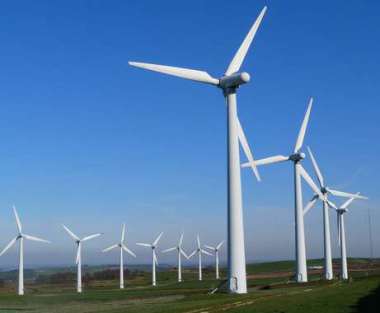 Wind farms in Crookwell, South Australia ‘final piece’ in ACT’s renewable plan http://www.canberratimes.com.au/act-news/wind-farms-in-crookwell-south-australia-final-piece-in-acts-renewable-plan-20160823-gqys5x.html Christopher Knaus, 23 Aug 16 A local wind farm has won a bid to supply 41,600 ACT homes with energy, while a third successful bid from a South Australian project means it will provide a major chunk of Canberra’s renewable power by 2020.
Environment Minister Simon Corbell on Tuesday announced what he described as the “final piece” in the government’s plan for 100 per cent renewable energy by 2020. A 91MW $200 million Crookwell wind farm, to be built by Spanish-owned company Union Fenosa Wind Australia, has won the right to be paid feed-in tariff grants under the government’s reverse auction process.
The project, due to be completed in September 2018, will build 28 turbines able to power 41,600 Canberra homes.
Mr Corbell said the Crookwell farm would be paid $86.60/MWh for the energy it feeds into the grid, which he said was a record low for a NSW wind farm. The other successful bidder was the Hornsdale Wind Farm, being built by Neoen International SAS and Megawatt Capital north of Adelaide.
The Hornsdale project has already been successful in the first and second rounds of ACT wind auctions, and is building the capacity for 309MW in total. That means the South Australian project will provide a large chunk of the ACT’s renewable energy by 2020. Continue reading
Community solar fund shares sold out in nine minutes!
 “Although this is only a particularly small project, what it is is it represents the first community solar lease product in Australia, it represents the first community solar cooperative fund and it represents the first crowdfunded equity community solar project,”
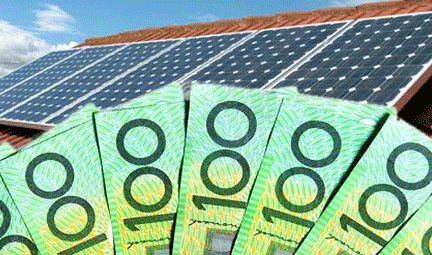
Community Solar Co-Op Shares Sells Out in Minutes https://probonoaustralia.com.au/news/2016/08/community-solar-co-op-shares-sells-minutes/ Renewable energy organisation Pingala sold out of shares in nine minutes for its first community solar fund. Pingala partnered with the environmentally-conscious Young Henrys brewery in Newtown, Sydney to build a solar farm on its roof, which will save an estimated 127 tonnes of greenhouse gas emissions a year.
The newly launched Pingala Cooperative, which sits alongside the Pingala Not for Profit, allows the organisation to raise funds from member investors to install solar panels on its partner businesses.
“We then lease the solar to the business, so they pay us a fee to be able to use the equipment as though it were their own, and through that we get a revenue stream that allows us to pay our costs and generate a small profit,” Pingala secretary Tom Nockolds told Pro Bono Australia News.
“So we’re offering our investors between 5 and 8 per cent… return on investment. But they’re investing in Pingala on an ongoing basis, so there’s no predetermined timeline for when investors get their money back, it’s totally up to the investors themselves to decide when they want to sell their shares, it’s much like buying shares in a company. Continue reading
Landmark solar powered apartment tower for Melbourne
 First solar-powered apartment skyscraper to rise in Melbourne, The Age, Simon Johanson and Marc Pallisco , 24 Aug 16
A landmark high-rise apartment tower in Southbank whose glass exterior is wrapped in solar cells will provide its residents with “off-the-grid” power stored in Tesla-like batteries, its designers say.
The 60-level building will be the first skyscraper in Australia environmentally engineered to include solar cells in the facade, creating a far greater surface area for catching the sun’s rays.
“We get an enormous area of solar panels by comparison to running them across the roof,” said Peter Brook from Peddle Thorp, the architects behind the design.
The curved exterior of the building has been orientated to deliberately capture the sun’s movement from east to west throughout the day, a feature that had created an “elegant tower”……..http://www.theage.com.au/business/property/first-solarpowered-apartment-skyscraper-to-rise-in-melbourne-20160819-gqwv76.html
Victorians, including Liberals, want urgent shift to renewable energy
 Majority of Victorians support urgent shift to renewable energy, poll finds https://www.theguardian.com/australia-news/2016/aug/18/majority-of-victorians-support-urgent-shift-to-renewable-energy-poll-finds
A ReachTEL poll commissioned by Friends of the Earth shows 68% of the state, including a majority of Liberal voters, want to see an end to reliance on coal, Guardian, Michael Slezak, 18 Aug 16, The vast majority of people in Victoria – and even a majority of Liberal voters – support the state moving towards 100% renewable energy “as a matter of urgency,” a new poll has found.
The polling comes as the state government works to rewrite the Climate Change Act, including pre-2050 emissions reduction targets.
More than 68% of Victorians said they agreed or strongly agreed that “Victoria needs to transition its energy use from coal to 100% renewables as a matter of urgency”, according to the ReachTEL poll of 1,137 people conducted on 4 August and commissioned by Friends of the Earth.
That was in line with previous national polls. But when the researchers drilled down to the views of people who supported different political parties, they found consistent support for an ambitious state-based renewable energy target. Continue reading
South Australia, Victoria – set up electricity trading scheme – says Xenophon
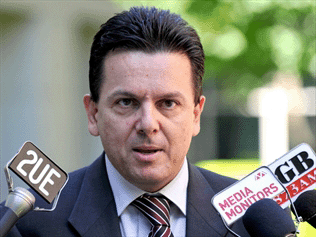 Xenophon calls for SA and Victoria to set up their own electricity emissions trading scheme, ABC News, By Nick Harmsen , 18 Aug 16, The Victorian and South Australian governments should establish their own joint electricity emissions trading scheme if the Federal Government refuses to put a price on carbon, Senator Nick Xenophon says.
The South Australian senator told an industry conference in Port Pirie that such a scheme would drive down prices.
“The sooner that COAG acts, or alternatively the Victorian and South Australian governments, the sooner consumers and businesses will have real relief in power prices with enhanced reliability,” he said.
“It could and should happen this year.”
Senator Xenophon said he had discussed the proposal with South Australian Energy Minister Tom Koutsantonis, and had written to the federal Minister Josh Frydenberg, urging the issue be discussed at a national meeting of energy ministers this Friday.
Proposal first discussed seven years ago
Rather than advocating a nationwide carbon pricing scheme, Senator Xenophon said the Federal Government should resurrect a scheme first put forward in 2009, during Prime Minister Malcolm Turnbull’s time as opposition leader.
“We, as in Malcolm and me, jointly commissioned Frontier Economics to come up with an alternative emissions trading scheme to [then prime minister Kevin Rudd’s] carbon pollution reduction scheme,” he said.
That scheme would effectively see dirty power generators pay cleaner generators to run more……..
South Australian Energy Minister Tom Koutsantonis said Senator Xenophon’s proposal had already been considered by numerous bodies, including COAG. “I am sure this idea is one of the many things we will discuss on Friday at what is an incredibly important COAG meeting,” he said.
“The main point I agree with Mr Xenophon on is that this is an urgent issue that requires the ministers to take back power in decision making, form a consensus and agree to a reform of the energy market.” http://www.abc.net.au/news/2016-08-17/electricity-emissions-trading-scheme-plan-for-sa-and-victoria/7751324
South Australia’s electricity price spike manipulated by fossil fuel generators
Energy companies withholding supply to blame for July price spike, report finds
Analysis of temporary jump in prices in South Australia showed generation capacity far exceeded demand, pointing to market manipulation, Guardian, Michael Slezak, 17 Aug 16 Fossil fuel electricity generators in South Australia withheld their supply to push up prices and reap bigger profits, according to an analysis of the causes behind the extremely high prices there in early July.
The findings suggested some solutions proposed ahead of this week’s Coag energy council meeting for the so-called “energy crisis” like increasing the supply of gas in Australia won’t help the situation at all.
The three things often pointed to as possible causes of the price spikes, especially on 7 July, have been the closure of the Northern power station, the main Victoria-SA interconnector being down and wind farms not producing much power.
But in a report commissioned by GetUp, energy analyst Bruce Mountain showed the generation capacity that was available in the market still far exceeded the demand. However, besides those owned by Origin, all other fossil fuel generators continued to operate far below their capacity, only offering electricity to the market for a very high cost.
In addition, Mountain showed the Australian Energy Market Operator (Aemo) forecasted that low wind and the interconnector maintenance would create high prices, which the generators could have responded to by ramping up supply and making solid profits.
“Yet, they did not respond to that information by making more of their production available to the market,” Mountain said in the report.
“Had this capacity been made available to the market at more reasonable prices, even prices far above production cost, those extreme prices would not have occurred.”
Mountain said Snowy Hydro, Engie, AGL and Energy Australia were exploiting their market power to push up prices. He said they weren’t doing anything illegal, but they were taking advantage of a market that wasn’t functioning properly.
“I think there’s a question of social license –and we’re seeing this in many other industries, where people are expected not just by the letter of the law but by the spirit of the law and maybe there’s scope for some of that to find its way into how we think about these things,” said Mountain.
Miriam Lyons from GetUp said the market is failing to deliver the competition needed to protect consumers’ interests.
“This shows that the answer to South Australia’s problems is not more gas, but more competition. Supporting cleaner suppliers of on-demand energy – like concentrating solar thermal in Port Augusta – would be far better for consumers, and for the planet……..https://www.theguardian.com/australia-news/2016/aug/17/energy-companies-withholding-supply-to-blame-for-july-price-spike-report-finds
AGL plans green power boost
AGL Energy plans to invest in more large-scale renewables beyond a $2 billion fund it recently set up…..(subscribers only)
http://www.theaustralian.com.au/business/mining-energy/agl-to-expand-renewables-investment/news-story/efc8152d601aa872a2a3639cd68f4d98
Community energy projects take off: Climate Council urges leadership for rural areas
 Climate Council urges bigger push towards renewables as community energy projects take off, ABC Radio AM By regional affairs reporter Lucy Barbour The Climate Council says a growing trend of rural communities setting up their own wind and solar farms could generate thousands of jobs in regional Australia.
Key points:
- Community projects will benefit local investors
- Twenty community energy projects are already operating in Australia
- Many communities are working towards 100 per cent renewable energy
The council’s latest report, on the impact of climate change on rural Australia, says rural communities will continue to be affected by worsening extreme weather events such as bushfires and drought.
But the report’s co-author, Will Steffen, said community-owned energy was one way to adapt.
“You have to have some leaders in your community that can actually get on top of the issue and say, ‘look, forget about federal politics or whatever side you’re on, this is good for our community’,” he said.
There are currently 20 community energy projects operating across the country, but Peter Fraser from Goulburn in southern New South Wales, said there was the potential for many more.
Mr Fraser is part of a group trying to build a $2.6 million community solar farm which, he said, would provide investors with a 5 per cent return on investment.
“It will be 1.2 MW. It will have about 4,000 panels of solar voltaic and it will generate enough electricity to power perhaps 300 to 400 homes in Goulburn,” he said.
Mr Fraser said investors would buy the solar equipment, pay for the connections to the grid and then sell the electricity to those who want it……….
The Climate Council’s report points out that many regional communities are working towards 100 per cent renewable energy goals, and estimates 28,000 jobs could be created if half of Australia’s energy came from renewables by 2030.
Professor Steffen said more than half of those would be in regional areas…….http://www.abc.net.au/news/2016-08-09/climate-council-says-community-renewable-energy-on-rise/7702866?section=environment
1 This month

of the week – Australians for War Powers Reform (AWPR)
To see nuclear-related stories in greater depth and intensity
 Antinuclear