Australian Renewable Energy Agency (ARENA) funds CSIRO’s solar energy initiative
 ARENA supports new, cheaper solar technology to reduce cost of renewable energy in Australia http://www.ibtimes.com.au/arena-supports-new-cheaper-solar-technology-reduce-cost-renewable-energy-australia-1490089 By Darwin Malicdem on December 07 2015 The Australian Renewable Energy Agency (ARENA) is aiming to reduce the cost of renewable energy in the country by providing a funding boost to an innovative solar cell technology. The new perovskite solar cells could significantly be cheaper than and as efficient as existing solar cells.
ARENA will be providing about $892,000 to CSIRO for the development and application of guidelines for assessing the performance of the perovskite solar photovoltaic (PV) cells. The materials of perovskite can be used in solar cells with a less cost and labour intensive process compared to silicon.
ARENA aims to accelerate the development of perovskite solar PV cells in the country. “If perovskite solar cell technology matures to commercialisation, it has the potential to provide cheaper power from the sun,” said ARENA CEO Ivor Frischknecht.
CSIRO is planning for new methods and guidelines applicable to perovskite solar cells, as international standards to measure solar PV cell performance are only applicable for silicon wafer cells. The new guidelines would be applied at the ARENA-supported PV Performance Laboratory in Newcastle, Frischknecht said. The lab would help Australian researchers test perovskite samples in the country instead of conducting tests overseas, which will boost research and reduce the risk and costs of the project.
The $2.4-million project for perovskite solar cells is expected for completion in November 2018. ARENA has already received letters of support and offers of cell samples from members of the Australian Centre for Advanced Photovoltaics and international research agencies.
The test results will be validated by internationally accredited laboratories, and CSIRO will work with overseas counterparts for the development of best practice methods suitable for different research laboratory environments, Frischknecht said.
Big solar investment on hold because of Australian govt’s policy uncertainty
 Chinese solar firm says policy instability holding back Australian investment, Guardian, Lenore Taylor in Paris, 5 Dec 15 Hareon Solar executive says firm is considering a billion dollar investment in large scale solar within a year but policy stability, not subsidies, is needed. Chinese firm Hareon Solar is “actively” considering a billion dollar investment in large scale solar projects in Australia, but the stability of government climate policy is its major concern, a senior company executive has told Guardian Australia.
Jie Zhang, Hareon’s vice president of global business development said government subsidies were not necessary for the investment decision, to be taken within a year, but policy stability was required.
“Our only wish for government is a stable policy, don’t flip back and forth, of course we are concerned what has happened in the past in Australia with the renewable energy target,” he said in an interview at the Paris climate summit……
Solar is a 25 year investment. If a government can’t keep its policy stable for five years how can we inves,” he said.
Hareon solar is a major Chinese solar cell manufacturer and global investor in large scale solar projects, founded by Australian citizen Samuel Yang.
It has invested in solar projects delivering 700 megawatts of power inChina as well as big projects in Bulgaria, Romania and the United Kingdom and smaller projects in the US and Japan.
Zhang said investment decisions were driven by government subsidies, but now required strong demand and policy stability…..
The Australian Renewable Energy Agency has announced a large-scale solar competitive round, seeking bids from major solar PV project proponents for grants of up to $30 million from a $100mn program. The Clean Energy Finance Corporation has announced a complementary $250 million large-scale solar financing program.
Renewable energy investment in Australia froze in the early years of the Abbott government when the renewable energy target was under review. In the end in was wound back, but not abolished. http://www.theguardian.com/environment/2015/dec/05/chinese-solar-firm-says-policy-instability-holding-back-australian-investment
City of Melbourne leads new renewable energy project
 New renewable energy play launches in Melbourne November 30, 2015 Tom Arup Environment editor, The Age Melbourne businesses, local councils and universities will pool resources to build new renewable energy plants under an innovative push to boost the supply of clean power to the city.
To be launched on Monday, just as the Paris climate summit gets under way, the project is a first for Australia. At least a dozen backers will pool their electricity purchasing power with the aim of encouraging new wind or solar energy.
It is being led by the City of Melbourne, which carried out a year-long test of the market to see whether there was enough interest for it to be viable.
On the way, the project has collected partners including the National Australia Bank, the University of Melbourne, RMIT and Federation Square.
The group is looking to purchase 120 gigawatt-hours of new renewable energy – enough to power 31,000 homes for a year.
Early next year the consortium will put out a tender calling for projects to come forward. If a viable project is found, those involved will look to buy power from it for 10 years…….
Other participants that have so far agreed to be named include RMIT, NEXTDC, the City of Port Phillip and Moreland City Council. http://www.theage.com.au/victoria/new-renewable-energy-play-launches-in-melbourne-20151127-gl9urr.html#ixzz3t77su419
Australian govt still will axe Australian Renewable Energy Agency despite its big new project
Australian Renewable Energy Agency announces next stage of Australia’s largest renewable mining project http://www.abc.net.au/radionational/programs/breakfast/aus-renewable-energy-agency-announces/6992978 Yesterday, Prime Minister Malcolm Turnbull used his visit to Paris to announce that Australia would sign up to a global initiative called ‘Mission Innovation’.
It would see research and development investment in green, clean technologies double to $200 million a year.
But the Government still intends to axe the Australian Renewable Energy Agency (ARENA) and the Clean Energy Finance Corporation.
For the moment, ARENA is still making announcements. Yesterday, the agency announced the next stage of a project that will result in Australia’s largest renewable mining project in central Western Australia.
Low Carbon Economy Expert Panel report – boost renewables, No to nuclear
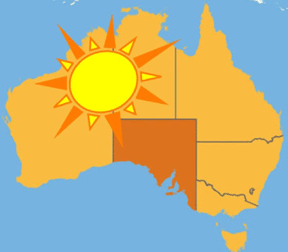 Low Carbon Economy Expert Panel report recommends South Australia move quickly to 100 per cent green energy production, Sheradyn Holderhead Political Reporter The Advertiser November 25, 2015 SOUTH Australia should produce 100 per cent green energy “relatively quickly” using a mix of solar, wind and other sources but not a nuclear power station, a report recommends.
On releasing the Low Carbon Economy Expert Panel report today, Premier Jay Weatherill said the State Government would adopt a target of zero net carbon emissions by 2050.
But Mr Weatherill is yet to map out exactly how the state will reach that target, as the Government is still to respond to more detailed recommendations in the report.
They include:
SET a goal of 100 per cent renewable electricity within, a timeframe to be decided, that could be done relatively quickly, capitalising on the abundance of solar, wind, oceanic, geothermal and bioenergy resources.
EXPAND the state’s renewable energy generation to the point where a significant amount is exported interstate.
DEVELOP and manufacture cost-effective energy storage technology, which is critical for a stable renewable electricity supply and could also become a new industry for the state.
SIGN the Under 2 memorandum of understanding, making SA a part of the growing group of sub-national governments making a commitment to contribute to limiting global warming to 2°C.
CONSIDER implementing a state-based emissions trading scheme linked to California’s ETS, which could be politically and economically attractive to California and provide significant benefits for SA.
INTEGRATE curriculum in schools, universities and TAFE colleges about carbon pollution, green energy and related technologies.
The report also noted that nuclear power stations generally need to be of a certain size to be cost effective and should not be considered for use in smaller states such as SA.
Former Federal Liberal leader John Hewson headed the panel, which also included Anna Skarbek of ClimateWorks and Australian National University’s Frank Jotzo……http://www.adelaidenow.com.au/news/south-australia/low-carbon-economy-expert-panel-report-recommends-south-australia-move-quickly-to-100-per-cent-green-energy-production/story-fni6uo1m-1227622467473
Economics stack up well for the Greens’ renewable energy plans
 The Greens’ plan for 90% renewables by 2030 sounds hard, but it stacks up, The Conversation, Andrew Blakers Director of the Centre for Sustainable Energy Systems (CSES) , Australian National University, November 24, 2015 The Australian Greens this weekend announced a target of 90% renewable electricity by 2030 – pledging to go further than Labor, which has already backed a target of 50%. How hard is it to reach these targets?
The Abbott government made plain its dislike of renewable energy by reducing the renewable electricity target (RET) for 2020 to 33 terawatt hours (TWh) of new renewable electricity.
Under this target, about 24% of electricity will come from renewable sources in 2020, comprising existing renewables (mostly hydro-electricity with some biomass) and new renewables (mostly wind energy and photovoltaic (PV) solar energy). It’s straightforward to calculate the annual additions (gigawatts, GW) of wind and PV required to hit a 50% or 90% RET in 2030……..
The corresponding figures for Labor’s target of 50% by 2030 are 1.2 GW of PV and 0.8 GW of wind per year.
An achievable prospect
Labor’s target is a straightforward prospect. In years gone by, Australia has installed this much PV and wind in a year, and can readily do so again. It is not much more than the installation rate needed to meet the 2020 RET.
The Greens’ target, meanwhile, is about 2.5 times more challenging than Labor’s, but still readily achievable. The Australian Capital Territory and South Australia have shown the way by adding new renewable electricity capacity equivalent to 90% and 40% respectively of their annual electricity consumption – mostly over a period of about 5 years. There are no practical constraints in terms of land because of Australia’s vast solar and wind resources.
Australia’s electricity system is becoming increasingly renewable. Continue reading
South Australian govt has already ruled out nuclear power
 from “Adelaide Arclight”, 25 Nov 15 , There is barely a mention of nuclear power in the 53 page Panel’s final report from the South Australia Low Carbon Economy Experts Panel. You have to hunt to find:
on page 22:
“In the high-level analysis for South Australia undertaken for the Panel, the CCS and nuclear scenarios were not considered, and all data was derived from the 100% renewable scenario.”
“Given South Australia’s abundance of wind and high solar rating (DNI), South Australia has the capacity to move to 100% renewable energy more quickly than other States and has already made significant progress in decarbonising its electricity supply utilising these advantages.”
On page 24 it states:
“The modelling for the Panel did not include consideration of whether the nuclear and carbon capture and storage scenarios modelled at the national level are a cost-effective means to move to low carbon electricity for South Australia. The Deep Decarbonisation Pathways modelling found that nuclear power stations generally need to be of a certain size to be cost effective and thus precluded their consideration for use in smaller States such as South Australia.”
Can we take it from this that the nuclear scenario is already off the table entirely? The Premier’s and Minister Hunter’s joint press release is vague talking about “zero net emissions” and “low carbon economy”, but in context their endorsement of the report would seem to undercut any push for nuclear energy, leaving the Nuclear Fuel Cycle Royal Commission with just an expansion of uranium mining and nuclear waste dumps to consider.
Given that the Nuclear Fuel Cycle Royal Commission is in progress and that one of the report’s authors gave evidence at a public hearing, it can hardly be an oversight that nuclear was not considered.
Renewable energy is the star – throughout the report:
“…….South Australia can greatly expand its renewable energy generation, to the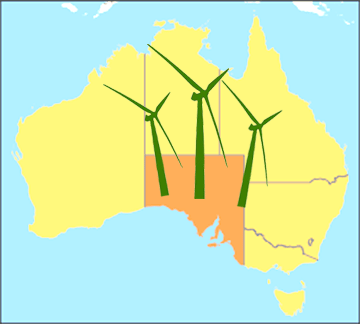 point where on balance over the year all of the State’s electricity comes from renewables and a significant amount is exported interstate. According to the Panel’s preliminary analysis, this could occur relatively quickly. South Australia can therefore set an indicative goal of 100% renewable electricity with the timeframe to be decided. The timeframe will depend on expansion of interconnectors, costs of renewables and extent of support for renewable energy federally. The share of renewables in South Australia is expected to be double that in the National Electricity Market at any point in time up to 100%. Action….”
SOUTH AUSTRALIA’S LOW CARBON ECONOMY EXPERTS PANEL Findings and recommendations
2015 http://www.environment.sa.gov.au/Science/Science_research/climate-change/climate-change-initiatives-in-south-australia/sa-low-carbon-economy-experts-panel November 2015 With an economy in transition, changes in the national and international policy environment, and key strengths in renewable energy, South Australia has the opportunity to transition to a low carbon economy.
To maximise this opportunity, the South Australian Government appointed a panel of experts to provide independent advice about climate change targets and objectives for the State to 2050. The Panel was also asked to recommend key strategies to meet these objectives and ensure that the SA economy is best placed to adjust to a carbon constrained future. The Panel members were Dr John Hewson, Anna Skarbek and Frank Jotzo.
The Panel’s final report was released on 25 November 2015. The Panel found that it is feasible for South Australia to achieve a target of net zero emissions by 2050 and that a commitment to this target will position South Australia well in a low carbon world.
South Australia to aim for zero emissions by 2050
 Premier Jay Weatherill Minister Ian Hunter Minister for Climate Change , 24 November, 2015
South Australia will adopt a target of zero net emissions by 2050, as recommended in a report by the Low Carbon Economy Expert Panel released today. The Panel consisting of John Hewson, Anna Skarbek of ClimateWorks and Frank Jotzo of the Australian National University recommends that South Australia:
SIGNALS the transition to a zero net emissions economy by 2050
SUPPORTS the community and industry to transition to a zero net emissions economy
IMPLEMENTS the transition by taking action now
PremierJay Weatherill said being the first to signal this intention to Australian and overseas investors will give South Australia a competitive advantage. “As we head towards the Paris Climate Change Conference, South Australia has an opportunity to place itself at the forefront as a leader in transitioning to a low carbon economy,” Mr Weatherill said. “The Expert Panel’s report is a roadmap for our State to reduce emissions in a way that supports job growth in new and emerging green technologies. “
One example is the potential for South Australia to be a low carbon electricity powerhouse and a net exporter of renewable energy. “The state’s abundant renewable electricity combined with its rich resource base and existing manufacturing expertise mean that the state could be a natural base for energy intensive mining and manufacturing industries in a low carbon world.”
Minister for Climate Change Ian Hunter said the Expert Panel also identified the state’s strengths in education and the potential for these to be applied to developing the skills and workforce for a carbon constrained future. “This means providing assistance for workers moving from industries in decline into new opportunities is critical as is support for communities affected by rapid change,” Mr Hunter said.
“There are also significant innovative market opportunities for energy storage solutions from the state’s high penetration of solar PV, with the potential to attract and develop technology suppliers and expertise in the state.” Minister Hunter said the Government would not seek to implement a State based emissions trading scheme – favouring a national scheme
“Consensus for global action on climate change should be a trigger for the Federal Government to revisit the important issue of a nationwide ETS,” Mr Hunter said. “We believe this is the most practical approach to this question and will not seek to implement an ETS at the State level.” Further details of South Australia’s efforts to tackle climate change, including responses to the other recommendations, will be detailed in the soon to be released new Climate Change Strategy for the State. The South Australian Low Carbon Experts Panel report is available at www.environment.sa.gov.au
Greens spell out their policy for 90% renewable energy target
Greens unveil push for 90% target for renewable energy by 2030 Daniel Hurst http://www.theguardian.com/australia-news/2015/nov/22/greens-unveil-push-for-90-target-for-renewable-energy-by-2030?CMP=share_btn_tw
Policy proposes new authority to oversee $5bn of construction in clean energy generation and a 15-year pipeline of projects through direct investment. The Greens will seek to build momentum for more ambitious action on climate change by calling for the creation of a new government authority to help Australia reach a 90% target for renewable energy by 2030.
The leader of the Greens, Richard Di Natale, said the policy to be released on Sunday showed the type of “real leadership” the country should display as world leaders prepared for climate negotiations in Paris next month.
The party has previously adopted a goal of ensuring Australia obtains 90% of its energy from renewable sources by 2030, but the new policy document spells out how this could be achieved. Continue reading
We might need a Senate inquiry into ultrasound from trees etc

If the committee is sincere in its concerns about the health effects of infrasound, will we soon learn of a new inquiry about the pernicious and unappreciated dangers of living near the sea or trees, having air conditioners, stereos, ceiling fans, or travelling in motor vehicles?
What’s next, a Senate inquiry into infrasound from trees, waves or air conditioners?, The Conversation, Simon Chapman Professor of Public Health, University of Sydney November 18, 2015 At the centre of claims about wind farms allegedly causing health problems is the infrasound that wind turbines generate as they turn in the wind.
Infrasound is sound below 20Hz, which is generally inaudible. Wind turbines are just one source of artificial man-made infrasound. Others include power stations, industry generally, motor vehicle engines, compressors, aircraft, ventilation and air conditioning units, and loudspeaker systems. Everyone living in an urban environment is bathed in infrasound for most of their lives.
As I sit at my inner Sydney desk writing this I’m copping infrasound from the planes that pass some 200-300 metres over my house sometimes many times an hour, the sound of passing road traffic on a quite busy road 100 metres from our house, and the stereo system I listen to as I write. Don’t tell anyone, but I feel fine and I’ve lived here 25 years.
But infrasound is generated by natural phenomena too. These include rare occurrences such as volcanoes and earthquakes, but also sources like ocean waves and air turbulence (wind) that countless millions, if not billions, are exposed to on most days. Anyone living close to the sea is surrounded by constant infrasound from waves.
The inclusion of wind as a source of infrasound is of particular significance to claims made that wind turbine-generated infrasound is noxious. In a Polish research paper published in 2014, the authors set out to measure infrasound from wind turbines and to compare that with naturally occurring infrasound from wind in trees near houses and from the sound of the sea in and around a house near the seaside…….
Wind is, of course, a prerequisite for wind turbines to turn and generate their mechanical infrasound. Here, the Polish authors noted that:
natural noise sources … always accompany the work of wind turbines and in such cases they constitute an acoustic background, impossible to eliminate during noise measurement of wind turbines.
This is a fundamentally important insight: wherever there are wind turbines generating infrasound, there is also wind itself generating infrasound. And it is impossible to disentangle the two. Indeed, every time I’ve been near wind turbines, easily the most dominant sound has been that of the wind buffeting my ears. Continue reading
Moree solar farm operational by end of 2015
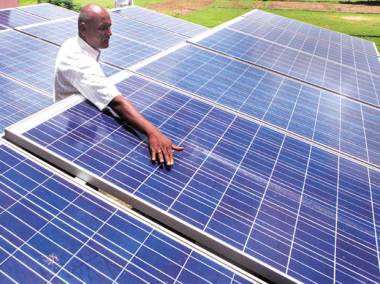 Energy generation expected at Moree Solar Farm by year’s end, ABC News, 17 Nov 15
Work is nearly complete on the Moree Solar Farm with an expectation energy will be generated at the site by the end of the year. A spokesman for the company behind the project, Fotowatio Renewable Ventures, said there’s just a few tasks left to do on site.
“The Moree Solar Farm is entering the final stages of construction,” Technical manager Tom Best said.
“We’ve finalised the installation of the PV modules and the tracking system and we’re currently undertaking commissioning of the PV plant with a view to start generating energy by the end of the year.”
The project is led by FRV and has been funded with assistance of a $102 million grant from Australian Renewable Energy Agency and $47 million in debt financing from the Clean Energy Finance Corporation…….
The solar farm is expected to supply 15,000 homes. http://www.abc.net.au/news/2015-11-17/production-expected-at-moree-solar-farm-by-year27s-end/6946716
Canberra researchers seek information from solar home-owners
Solar panels installed on homes across ACT needed by researchers for local power study 666 ABC Canberra By Hannah Walmsley with Philip Clark, 19 Nov 15 Researchers at the Australian National University (ANU) are calling for volunteers across the ACT who have solar panels on their house to take part in a new study. This project will allow us to predict what will be fed into the grid at a particular time. Dr Christfried Webers
ANU researchers are collaborating with Data61’s Machine Learning Research Group — formerly National ICT Australia (NICTA) — to develop methods of forecasting power output from rooftop solar energy systems.
Dr Christfried Webers from the ANU’s College of Engineering and Computer Science said that while total energy output could be measured over long periods, little was known about changing energy output across the day. “What we need is to be able to predict how much energy will be produced over five minutes to 60 minutes,” he said.
“That’s necessary information for the energy market operator — they need information on what’s coming from hour to hour. “It’s also important for the local utility providers because they have a spinning reserve running and if they can anticipate an energy drop, they can ramp that up when they need to.”
Close to 13 per cent of households in the ACT have solar panels generating power. “If that reaches 30 per cent, it will become vital to predict what energy will be produced to ensure the stability of the grid,” Dr Webers said. How the weather can impact
Dr Webers said he hoped the project would allow his team to develop software to forecast the solar output from each suburb using low-cost data-logging devices installed on individual homes…….Canberra residents interested in participating in the project can register their interest with NICTA. http://www.abc.net.au/news/2015-11-17/volunteers-wanted-for-canberra-solar-panel-study/6946904
King Islands’s world first renewable energy success
Renewable energy a power coup for island http://www.theadvocate.com.au/story/3489296/renewable-energy-a-power-coup-for-island/ THE use of renewable energy to power King Island’s electricity supply for 33 successive hours has been hailed as a significant milestone. The latest achievement of the Hydro Tasmania’s King Island Renewable Integration project was an unprecedented milestone, project director Simon Gamble said.
“What makes this significant is that we’ve used renewable energy to support the needs of an entire community, which includes residential and industrial loads, for a full day,” Mr Gamble said.
“Our system has successfully managed the peaks in energy consumption that occur over the course of a full day, including early evening when demand is at its highest and there’s no solar contribution.
“It’s the first time anywhere that this has been achieved at a megawatt scale for such an extended period of time.”

King Island mayor Duncan McFie said the progression of the project helped to support the image of the island, and Tasmania, as clean and green.
“That King Island is leading the way on this is a highly significant achievement,” he said. Australian Renewable Energy Agency chief executive officer Ivor Frischknecht said the project was an example of how renewable energy and enabling technologies could work together to provide stable, reliable power.
“Hydro Tasmania is using a unique combination of technologies to reduce King Island’s reliance on expensive shipped-in diesel and provide residents with a more secure and reliable energy source,” he said. “This innovative energy solution could benefit off-grid communities on islands and in regional mainland Australia. “I look forward to seeing Hydro Tasmania continue to refine and commercialise its approach in other locations
Total Environment Centre’s legal challenge to South Australia solar tariff proposal
Solar penalty tariff proposal for SA households subject of Federal Court challenge, ABC News By Candice Marcus, 16 Nov 15, An environment group wants the Federal Court to uphold the energy regulator’s decision to reject a penalty tariff on South Australian households with solar power.
The Total Environment Centre has intervened in a court case in which SA Power Networks is challenging the Australian Energy Regulator.
The regulator rejected a pricing proposal for households to face a solar tariff and a social tariff, which SA Power Networks said would have been directed toward helping low-income earners facing hardship in paying their bills.
It was estimated the solar tariff could cost the average solar-powered household about $100 annually.
The Total Environment Centre lodged submissions with the Federal Court urging it uphold the regulator’s rejection of the penalty pricing proposal.
Extra tariffs would be solar ‘disincentive’
Mark Byrne from the environment group said imposing additional tariffs would be a disincentive for people to install and use solar power.
“We’ve got half a million people living under solar roofs in South Australia already though and it’s going to negatively impact on them as well as making it less advantageous for new customers to install solar,” he said.
“Obviously in the long run we want to see more solar because it helps reduce greenhouse emissions as well as household electricity bills.”
He said SA Power Networks had a flawed argument.
“Their argument effectively is that solar customers should be paying more because they use less energy and the network is entitled to a fixed amount of revenue,” he said.
“The unfortunate thing about that is it discriminates against solar customers and will result in them paying about another $100 a year.
“What the network should be doing is introducing a tariff that affects everyone equally and recovers more of their revenue during those peaks, when they’re worried about the impact on prices because they have to build more to meet peak demand.”……..http://www.abc.net.au/news/2015-11-16/court-hears-challenge-on-sa-solar-penalty-tariff-proposal/6944870
1 This month

of the week – Australians for War Powers Reform (AWPR)
To see nuclear-related stories in greater depth and intensity
 Antinuclear