Queensland’s Newman government gutted the renewable energy industry
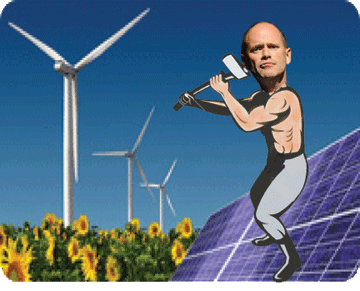 Campbell Newman’s LNP government ‘gutted’ renewable energy industry RENEWABLE energy jobs in Queensland fell by over a third under the Liberal National Party government, Energy Minister Mark Bailey says., Courier Mail, 15 Apr 15
Mr Bailey said new Australian Bureau of Statistics data showed a third of jobs in the sector vanished under the previous state government.
He said actions such as the former government’s cuts to the renewable energy target had caused the loss of 1300 jobs.
“No wonder jobs were vanishing under the LNP when they were removing any incentive for businesses to look at industries of the future like renewables,” Mr Bailey said………
Mr Bailey said the current Labor Government’s commitment to the solar sector, a renewable energy target and a renewable energy auction would grow jobs for the sector.
But the deputy opposition leader said he was yet to see any detailed government plan to create jobs.http://www.couriermail.com.au/news/queensland/campbell-newmans-lnp-government-gutted-renewable-energy-industry/story-fnihsrf2-1227303819258
The Parkinson Report: renewable investment near zero, but rooftop solar grows
 Australian renewable investment plunges to near zero, but rooftop solar grows http://reneweconomy.com.au/2015/australian-renewable-investment-plunges-to-near-zero-but-rooftop-solar-grows-93815 By Giles Parkinson on 14 April 2015 The crisis affecting investment in large-scale renewable energy projects in Australia has deepened, with new analysis by Bloomberg New Energy Finance pointing to a 90 per cent drop in the 12 months to March 31, thanks to policy uncertainty under the Abbott government.
The BNEF data shows new investment Australian large-scale renewable energy projects tumbled in the 12 months to March 31 was just $206.9 million – a fall of 90 per cent – and only one large scale renewable energy project (worth $6.6 million) was financed in the first quarter.
But the data hides an even worse story. Of that $206.9 million, $160 million came from government agencies – such as the Australian Renewable Energy Agency and the Clean Energy Finance Corporation – that the Coalition government is trying to scrap. Without that support, investment would have been virtually zero. The one project to get financed in the latest quarter was for a unique floating solar pilot project in South Australia.
BNEF says the dramatic drop is almost entirely due to the policy uncertainty brought about by the election of the Abbott Coalition government, and attempts by key members to firstly scrap, and now severely cut the previously bipartisan target of 41,000GWh by 2020.
The Clean Energy Council, supported by Labor and key industry groups, has proposed a compromise of 33,500GWh, but so far the Abbott government has refused to budge from its position of 32,000GWh. Industry minister Ian Macfarlane has indicated that even that figure is too high for many in Cabinet.
The BNEF data shows new investment Australian large-scale renewable energy projects tumbled in the 12 months to March 31 was just $206.9 million – a fall of 90 per cent – and only one large scale renewable energy project (worth $6.6 million) was financed in the first quarter.
This followed zero investment in large scale projects in the previous quarter. BNEF noted the exit of Banco Santander, the world’s third largest clean energy lender, from the Australian market, as reported by RenewEconomy here.
In contrast, the uptake of rooftop PV by households and businesses has been largely unaffected, with about 195MW of rooftop PV capacity in the sub-100kW category installed in the first quarter, a 7 per cent increase on the same quarter a year ago.
The data came as new figures from the Australian Bureau of Statistics on Monday showed the number of renewable energy jobs in Australia had fallen by 2,300 or 15 per cent up to June 30, 2014 – not including the latest downturn.
The Abbott government is hoping to strike an agreement with cross-bench Senators, many of whom are actively anti-wind and involved in a Senate-sponsored wind inquiry. However, Ricky Muir, from the Motorists Party, said he wanted a bipartisan agreement between the two parties.
He suggested Labor could even drop to the 32,000GWh limit demanded by the Coalition, with the idea of lifting the target if elected at the next election. That, Muir said, would at least provide a floor for investment.
Loves coal, hates solar, friendly to nuclear – Tony Abbott’s Energy White Paper
The energy white paper also continues its attack on solar…..
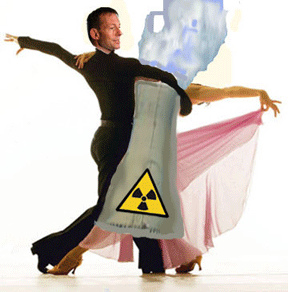 Interestingly, it says it recognises the argument that nuclear is a costly alternative to renewables, uses lots of water and has waste-disposal issues. But it also says others argue that it is “adequate” affordable and reliable, and has significant environmental benefits and public health advantages over other existing base-load technologies. It says it will consider the outcomes of the South Australian Royal Commission into the nuclear fuel cycle, including its use as an energy source.
The winners and losers of Abbott’s energy white paper (SPOILER: Tony likes coal),  Crikey, GILES PARKINSON | APR 08, 2015 In many ways, the Coalition’s energy white paper is a predictable piece of backward-looking falsehoods. But it does make some surprising concessions to a future of renewable energy. Today, the Coalition government released its energy white paper — the document that is supposed to outline the nation’s energy vision for the short and long term future. But there are no surprises for guessing that this is a document that is largely focused on the rear-view mirror.
The energy white paper begins with a false assumption: that “Australia’s large quantities of traditional energy resources provide low cost, predictable and reliable power for Australia and the world”.
They don’t. Coal might be cheap to shovel into a boiler, but it is mighty costly to transport. Grid (delivery) costs make electricity in Australia some of the most expensive in the world. Transport and shipping costs make coal and gas expensive, to the point where they are now being undermined by local, renewable alternatives — or a new focus on environmental policy — even in major markets such as India and China.
Like the Abbott government’s discussion paper on emission reduction targets released late last month, this document also works on the principle that the world will do nothing new to address climate change. The energy white paper’s assumptions are based on the International Energy Agency’s “new policies” scenario, which sets the scene for what would be a catastrophic rise in temperatures to an average 4 degrees.
No matter, the Abbott government concludes: “Ongoing access to large volumes of coal and gas will also underpin our energy generation mix for some decades.” Although it does at least acknowledge that these fuels will be “increasingly exposed to competition from renewable energy”.
Not that it intends to accelerate that transition. Quite the opposite. Continue reading
Australian Government’s Energy White Paper- mixed messages on renewables
Cost-reflective tariffs could also increase power bills for people with solar panels to make sure they’re paying their fair share of network upkeep.
Instead of being charged a flat rate for electricity, where infrastructure costs are equally shared, consumers would pay the cost of delivering the power at the time it’s used.
The proposal is outlined in the government’s energy future blueprint and would require households to install advanced metering – or smart meters – to monitor how much energy they’re using………
The paper touches on Australia’s “good potential” for a range of renewable energy sources and outlines a commitment to a sustainable clean energy sector.
But it also reaffirms a commitment to cutting the renewable energy target and plans to abolish the Clean Energy Finance Corporation and the Australian Renewable Energy Agency.
While the government doesn’t detail a promised national energy productivity plan, it does say a 40 per cent target by 2030 is achievable.
It also doesn’t rule out nuclear energy, with Canberra closely watching the outcome of South Australia’s royal commission into the possibility of a local industry.……. http://www.businessspectator.com.au/news/2015/4/8/renewable-energy/govt-releases-energy-white-paper
Bette health for Port Augusta with solar thermal power plant
Port Augusta solar thermal power promises better health SA Conservation Council says http://www.abc.net.au/news/2015-04-08/green-group-makes-fresh-calls-for-port-augusta/6377670 South Australia’s peak environment group says the need for solar thermal power in Port Augusta is an urgent health issue, as well as having climate change implications.
A study by Alinta Energy has found solar thermal technology is currently economically unviable.
Conservation Council of South Australia chief executive Craig Wilkins said a solar thermal plant at Port Augusta would not only help with jobs but improve local health.
Mr Wilkins said Port Augusta residents had suffered the health impacts of coal for decades.
He is calling for greater government support.
“We’ve got a dirty industrial plant which could be transferred to a cleaner technology which would help with jobs and the community’s health and that is a shift to the solar thermal as quickly as possible,” he said
Griffith University’s promising battery energy storage system
Battery energy storage project shows promise for electricity network, Eureka Alert 2 Apr 15 Cheaper, more efficient power among benefits from intelligent scheduling and operation system GRIFFITH UNIVERSITY WITH RISING ELECTRICITY PRICES ONE OF THE BIGGEST ISSUES FACING HOUSEHOLDS, GRIFFITH UNIVERSITY (AUSTRALIA) RESEARCH INTO ENERGY STORAGE AND SUPPLY HOLDS THE PROMISE OF CHEAPER, BETTER QUALITY POWER FOR THE LOW VOLTAGE (LV) ELECTRICITY DISTRIBUTION NETWORK.
According to the research from Griffith’s School of Engineering and published in the journal Applied Energy, a forecast-based, three-phase battery energy storage scheduling and operation system provides benefits such as reduced peak demand, more efficient load balancing and better management of supply from solar photovoltaics (PV).
Researcher Mr Chris Bennett, working under the supervision of Associate Professor Rodney Stewart and Professor Jun Wei Lu, has developed and applied an intelligent scheduling system to a South-East Queensland-based LV distribution network servicing 128 residential customers.
“The low voltage network is a typical suburb of a few hundred homes where there is a single area transformer and recently there has been a substantial increase in the number of homes with installed residential solar PV in these settings,” says Mr Bennett.
“Daily peak demand in residential networks typically occurs in the evenings in summer and both late morning and evening in winter. But because solar PV generation is dependent on incoming solar radiation, peak generation occurs during the middle of the day, typically when demand in the residential distribution network is low.”
“This means there is an incongruity between when energy is generated and when it is required, which can lead to power supply and quality issues.
“However, with a battery energy storage (BES) system comprising Lithium Ion battery banks coupled with smart power control systems, such as STATCOMS, and featuring embedded intelligent forecasting software, we can better manage the LV network.”……..
Paper: http://www.sciencedirect.com/science/article/pii/S0306261915001841
http://www.eurekalert.org/pub_releases/2015-04/gu-bes040115.php
RePower Port Augusta explain how Solar thermal power plant project could be economically viable
Solar thermal power plant project at Port Augusta ‘economically highly unviable’, http://www.abc.net.au/news/2015-04-01/solar-thermal-project-at-port-augusta-hits-a-cost-barrier/6366388Alinta Energy says A group lobbying for a solar thermal power plant to be built at Port Augusta in South Australia says Alinta Energy may have overestimated the project’s cost.
The company’s latest report into the potential for a solar thermal power plant near the Upper Spencer Gulf city has found the project to be “economically highly unviable”.
Alinta owns the coal-fired Northern Power Station and the disused Playford Station but a study report found that a funding gap and falling electricity demand meant a conversion of the station to solar thermal was unlikely to happen.
But Lisa Lumsden, from the group RePower Port Augusta, said the finding was unsurprising given the uncertainty around the federal Renewable Energy Target (RET).
The Federal Government is yet to decide on the figure set for a national target on the amount of energy coming from renewable sources by 2020.”As we continue to have no decision and no action and certainty around the RET, the prospect of solar thermal happening in Port Augusta becomes less and less,” Ms Lumsden said.
There has been a strong push from the local community in recent years to convert the coal-fired station to renewable energy.Ms Lumsden said new technologies and plant configurations meant the project could actually be much less expensive than Alinta predicted.
“If they take that all into account over the next two or so months, and bring that information to the fore, we know that some of that will bring the costs down significantly, like more than half,” she said.”We know some of those technologies have the capacity to do that.”
Alinta Energy said that even under the most optimistic scenarios, it would fall short of the $570 million capital cost by about $150 million.
Ms Lumsden said the State Government should step in and fund the $150 million shortfall.
The company is continuing to investigate the project’s potential.
Wind energy company gives up on Australia due to RET uncertainty
Renewable energy sector crisis forces Banco Santander to quit Taralga wind farm, SMH, March 31, 2015 Angela Macdonald-Smith Banco Santander, a major investor in renewable energy, will sell its only Australian wind farm and exit the local sector because of policy uncertainty that has dragged the industry into crisis.
Santander will seek a buyer for its 90 per cent stake in the 106.8 megawatt Taralga wind farm near Goulburn, which is not being included in the renewable energy fund it set up late last year with two Canadian pension giants because of the perceived poor prospects for the sector in Australia, say sources………
Santander is closing the Sydney office for its equity investment arm, which focuses on renewable energy, in mid-2015. http://www.smh.com.au/business/renewable-energy-sector-crisis-forces-banco-santander-to-quit-taralga-wind-farm-20150331-1mbjsk.html
Victoria about to get 854 wind turbines worth $5 billion
854 wind turbines worth $5 billion ready to be built in Victoria CHRIS MCLENNAN THE WEEKLY TIMES APRIL 01, 2015
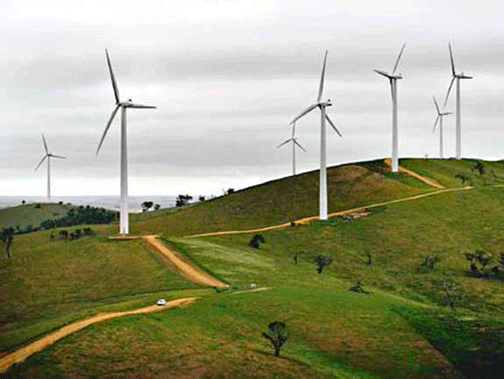 WIND farms worth almost $5 billion are poised to be built across Victoria.Thirteen projects with 854 turbines have won municipal council and State Government support and are ready to go.
Wind farms near Mortlake, Ballarat, Ararat, Warrnambool, Port Fairy, Ballan, Colac and St Arnaud can turn the soil the moment the Federal Government implements a new Renewable Energy Target scheme…….
……AGL Energy has built big wind farms at Oaklands Hill and Macarthur costing $1.18 billion. In its submission to the Senate wind farm inquiry AGL Energy estimates it has created 875 direct and indirect jobs in rural Victoria.
Northern Grampians Shire Council Mayor Murray Emerson said his council last week approved the Enerfin proposal. “It is a $460 million project, individually it would be the biggest investment in the shire’s history,” Cr Emerson said.
“Small rural shires like ours are battling all the time and the economic benefits from a project of this scale would be incredibly welcome.”Ararat Rural City Mayor Paul Hooper, who spoke at the Portland inquiry on Monday, said there were wind farm projects worth $1.68 billion ready to begin in his shire.
“This is an industry we already know very well and our residents support, we have a community which is pro-wind farm. “There are lots of jobs in construction, benefits from rates and the farms benefit which host them. “Rural shires have low populations and big areas to service, so a free kick of this magnitude is something we are very excited about.”
MAV president Cr McArthur said the dollar investment from wind farms “was astronomical”.
…….Victorian Energy and Resources Minister Lily D’Ambrosio said the Government was promoting wind farms because of job creation and regional development and impact on greenhouse gas.
Ms D’Ambrosio said the Government had recently reduced the exclusion zone from winds farms from 2km to 1km to help create even more projects. She said developments would now be approved by the state’s planning minister.
Victorian Greens leader Greg Barber said wind farms “would be a boon” to small rural councils with limited rate income.
Mr Barber said the pressure was on the State Government as well as the Federal RET negotiations “to make the wind farms happen” http://www.weeklytimesnow.com.au/news/national/wind-turbines-worth-5-billion-ready-to-be-built-in-victoria/story-fnkfnspy-1227286154627
Low-cost high-efficiency concentrated solar photovoltaic power station launched in Victoria
 The central Victorian sun powers world’s first concentrated solar power station, ABC Central Victoria By Larissa Romensky and Jonathan Ridnell, 31 March, 2015
This is the world’s first concentrated solar photovoltaic (CSPV) power station just launched by research and development company, RayGen Resources.”The end result is very low cost solar electricity and we think it’s going to really revolutionise solar energy,” said Robert Cart, CEO and co-founder of the company.
The tower acts as a receiver that collects sunlight from the mirrors that are computer controlled to move as they track the sun.”The collector field focuses the light on the receiver. The receiver directly converts that light to electricity,” said co-founder and technical director of RayGen, John Lasich.
The very small receiver is the unique part of this technology. “This is the only commercial version of this technology in the world,” said Mr Lasich.”It combines heliostats and denser photovoltaic cells, which when combined give very low cost and high efficiency.”
At this stage the $3.6 million project is a pilot testing facility. But the company are happy with the results.”It looks and feels pretty much like the real thing does,” said Mr Lasich.
High efficiency meets low costThe small plant generates enough power to run about 75 to 100 homes and the company says the technology is cheaper and more efficient than placing solar panels on roofs……….
The company recently signed a Memorandum of Understanding with their Chinese commercial partners. Juye Solar have invested $6 million which will allow RayGen to expand its manufacturing. They are currently in the process of building a larger facility at the same location.
A further $15 million will be invested by Juye Solar to develop the business in China to meet the large demand……
The ultimate aim for RayGen is to have distribution around the world. “We build the high tech components and software and sell that to the companies and they build the balance of system and put the whole plant together,” said Mr Lasich. http://www.abc.net.au/local/photos/2015/03/31/4207919.htm
GetUp and Powershop join forces to switch Australia to renewable energy
 Powershop was ranked by Greenpeace as the greenest power company in Australia. As a generator, the company only produces renewable energy through its wind farms in Victoria and South Australia. It buys carbon offsets from UN-certified projects for all the electricity it creates and sells at no additional cost to the end user. It also lets consumers buy certified Green Power from projects such as the Hepburn Wind Farm (a community project in Victoria), LMS Energy (which creates gas from landfill), and CSR’s renewable energy project.
Powershop is a disruptive player because it offers customers greater visibility and control over their electricity use with no lock-in contracts.
Why GetUp activists are the new sales agents for electricity retailer Powershop Business Review Weekly Caitlin Fitzsimmons Online editor 26 March 2015 Online electricity retailer Powershop has a novel way of winning new customers – getting online activist group GetUp to do the sales and marketing for them.
Powershop Australia chief executive Ben Burge says more than 6,000 of Powershop’s 38,000 Australian customers – about 16 per cent – have come directly via GetUp to date.
“Of course it’s helpful to have someone other than the power company talking to customers about what’s a good choice of power company,” Burge says. “The great thing about working with GetUp is they are incredibly enthusiastic and that passion comes through – we don’t ever want it to be a scripted thing.”
GetUp chief executive Sam McLean says the goal is to get 50,000 people to switch before the annual general meetings of the big three power companies, Origin, Energy Australia and AGL, later this year. As of 11.30am on Thursday, GetUp’s internal figures showed it had switched 6,902 customers in total and was adding about 150 a day via both online and telesales.
The switching campaign is part of GetUp’s Better Power push to champion climate change action and renewable energy. The big three energy companies, which control 75 per cent of the energy retail market between them, are campaigning heavily to abolish or reduce the Renewable Energy Target. By contrast, Powershop strongly supported retaining the target in its submission to the recent government review. Continue reading
John Hewson calls on Australians to switch from Origin, AGL and Energy Australia electricity companies
The more of us that switch to companies that genuinely support the RET and oppose CSG, the better we will make things for all Australian consumers, our communities and our environment
 Extensive ‘advice’ from AGL, Energy Australia and Origin on the Renewable Energy Target has been a disaster – except for the companies’ profits “……Let’s hope Bill Shorten and the opposition have the courage to stand firm. The Greens and most of the Senate crossbenchers would back them to block the government’s attempts to make the necessary legislative amendments to the RET.
The real villains here, however, are Australia’s three biggest energy companies: AGL, Energy Australia and Origin.
Abbott has been extensively “advised” by these companies. Surely it is in no small part their influence that led to the coalition setting up an inquiry into the RET, headed by climate change sceptic Dick Warburton.
Interestingly, the inquiry found that the RET will drive down the price of power for consumers. Continue reading
New South Wales govt funds Byron Bay’s renewable energy trading plan.
 NSW Govt tips $15,000 into Byron renewable energy trading , Courier Mail, JOHN CONROY MARCH 25, 2015 The Baird Government in NSW has announced $15,000 in funding to back Byron Bay’s renewable energy trading plan.
The Byron Bay council trial in collaboration with the Australian Renewable Energy Agency, the Institute of Sustainable Futures at the University of Technology Sydney and the NSW Renewable Energy Advocate, will allow the allow the local sports centre to sell renewable energy generated by their solar panel array to the council’s sewage treatment plant.
“This trial will mean we have two facilities using renewable energy from one site, allowing the sewage plant to run off clean, sustainable power and achieving greater use of energy generated by the sports centre’s solar panels,” Environment Minister Rob Stokes said……
Abbott government intransigent on its plan to weaken Renewable Energy Target
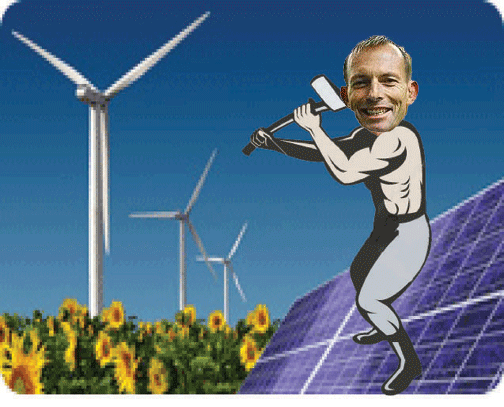 ‘Take it or leave it’, government tells renewable energy industry in latest RET talks, SMH March 24, 2015 Lisa Cox National political reporter Industry Minister Ian Macfarlane has told the clean energy industry that the government’s latest offer on the renewable energy target is a “take it or leave it” position.
In a fresh round of talks with unions and representatives for the clean energy and aluminium industries on Monday, Mr Macfarlane said the government would not budge from a figure of 32,000 gigawatt hours of renewable energy production by 2020.
The number represents a substantial reduction from the existing large scale target of 41,000 gigawatt hours and both Labor and the clean energy industry have said it is unacceptable…….
Australian Solar Council chief executive John Grimes said “we are now at the end point”.
Mr Grimes said his organisation was shut out of Monday’s talks.
“This is not a process and the end point is perpetual uncertainty,” he said. http://www.smh.com.au/federal-politics/political-news/take-it-or-leave-it-government-tells-renewable-energy-industry-in-latest-ret-talks-20150324-1m5ql8.html
Mildura’s solar farm – successful without a cent of government money
what makes the Mildura plant so special is that it was built without a cent of government grants being tipped in.
helps illustrate how solar’s smaller, highly modular scale and fast construction time could allow it to play a far greater role in ensuring the target for the large-scale RET is met
Belectric have a developed a standardised 3MW solar power installation system they call the 3.0 MegaWattBlock (pictured below) which they roll-out across the globe.
Australia’s biggest solar farm powers-up but solar’s potential shines elsewhere, Business Spectator, TRISTAN EDIS 23 MAR
Australia’s largest ever solar power plant, AGL’s 102 megawatt Nyngan – has begun feeding power into the grid. But there’s a far more interesting solar power plant no one is talking about in Mildura.
The Nyngan plant in Western NSW now has its first 25MW of capacity, involving 350,000 solar modules made by First Solar, generating power that is exporting power to the grid. Further generation will progressively be brought online over the next three months as the remaining three sections of the plant are individually commissioned.
It’s unambiguously good news, yet I’m far more excited about the solar power plant in Mildura even though it’s substantially smaller – 3MW of capacity versus Nyngan’s 102MW. In fact it’s quite astounding that the completion of the Mildura plant has received no press whatsoever, because when it started feeding power to the grid in April last year it was the second largest operational solar power plant in the country at the time, and remains comfortably the largest in Victoria. Continue reading
1 This month

of the week – Australians for War Powers Reform (AWPR)
To see nuclear-related stories in greater depth and intensity
 Antinuclear