Australia’s carbon emissions down 20% due to wide take-up of renewable energy

Telegraph UK, 29th July 2021, For Australia’s part, our experience with technology-orientated pathways
gives us confidence that with the right investments and partnerships, a prosperous net-zero world is well within our reach.
On the ground, our real-world rollout of renewables has made clear to Australian firms and families the immense benefits of investing in clean technology. Because of their embrace of our new energy future, Australia’s emissions are down over 20 per cent on 2005 levels and green technology continues to be taken
up at record levels right across our nation.
https://www.telegraph.co.uk/news/2021/07/29/technology-key-free-prosperous-net-zero-world/
Lowy Institute polling shows that 91% of Australians want the federal government to support renewable energy development
https://poll.lowyinstitute.org/charts/potential-federal-government-policies-on-climate/ Looking at a range of possible federal government policies, almost all Australians (91%) say they would support the federal government ‘providing subsidies for the development of renewable energy technology’. This aligns with Lowy Institute polling in 2018 in which 84% of Australians said the government should focus on renewables rather than traditional energy sources
.ight in ten Australians (78%) support ‘setting a net-zero emissions target for 2050’, suggesting they seek a firmer commitment from Prime Minister Scott Morrison, who has said that Australia’s “goal is to reach net zero emissions as soon as possible, and preferably by 2050”.
Seven in ten Australians (77%) support providing subsidies for the purchase of electric vehicles. A sizeable majority of Australians (64%) support introducing an emissions trading scheme or a carbon tax. These views have shifted significantly in the past five years. In 2016, in response to a differently-worded question in the Lowy Institute Poll, only 40% said they would prefer the government to introduce an emissions trading scheme or price on carbon.
ustralian views of coal exports and coal mines also appear to have shifted significantly in recent years. Six in ten Australians (63%) support a ban on new coal mines opening in Australia. The same proportion of the population (63%) say they support reducing Australian coal exports to other countries, in an apparent shift from five years ago when a majority (66%) said Australia should continue to export coal. In 2021, only three in ten Australians (30%) say they support the federal government providing subsidies for building new coal-fired power plants.
On a number of these policies, there is a significant gap between support from younger and older Australians. For example, 72% of Australians aged 18–44 years old support banning new coal mines, compared to 55% of Australians aged over 45. Similarly, 71% of respondents aged 18–44 support imposing a carbon tax or emissions trading scheme, compared to 57% of Australians over 4
The federal government’s promotion of a ‘gas-fired recovery’ for Australia’s economy appears to have general support, with 58% in favour of Australia increasing the use of gas for energy generation.
Australians are split over the question of nuclear power, which has been prohibited in Australia since 1998. Almost half the population (47%) would support removing the existing ban on nuclear power, but the same number (51%) are opposed to that measure.
New South Wales Productivity Commission slammed for recommending nuclear power while ignoring offshore wind,

NSW Productivity Commission slammed for recommending nuclear power while ignoring offshore wind, https://www.miragenews.com/nsw-productivity-commission-slammed-for-571554/
Maritime Union of Australia
The NSW Productivity Commission is under fire for recommending the NSW Government lift the state’s ban on nuclear power while ignoring proven, lower-cost renewable energy sources such as offshore wind.
Among 60 recommendations aimed at driving productivity and economic growth, the NSW Productivity Commission White Paper released this week proposed the ban on nuclear generation be lifted for small modular reactors.The same report made no mention of offshore wind generation, despite the proven technology producing a growing share of electricity around the world and several major proposals awaiting approval off the NSW coast.
This is despite the CSIRO’s most recent report on electricity generation costs showing that SMR nuclear reactors cost approximately $16,000 per kilowatt, nearly three times offshore wind. Recent UK analysis has found the cost of developing offshore wind is even lower.
The Maritime Union of Australia said it was staggering that the NSW Productivity Commission would recommend resources be thrown into small modular nuclear reactors — a technology that doesn’t yet exist — instead of cheaper, cleaner, proven technologies like offshore wind.“It is unbelievable that the NSW Productivity Commission would propose a major regulatory overhaul for a theoretical technology that doesn’t operate anywhere on earth, yet not even mention one of the fastest growing forms of energy generation,” MUA Deputy National Secretary Warren Smith said.
Rather than waste years debating a theoretical technology, which will come with huge costs and substantial safety concerns, the NSW Government should be getting on with supporting the development of reliable, cheap, and plentiful offshore wind resources.“The NSW Productivity Commission’s focus on an industry that doesn’t even exist, while ignoring a proven technology that can deliver power and jobs for NSW right now, shows an ideological pro-nuclear agenda has been put ahead of the state’s economic interests.“Small nuclear reactors have been promised for half a century, but as yet not one exists. Most countries with nuclear power are moving away from the technology, with new reactors running hugely over budget, requiring massive taxpayer subsidies, and locking in higher power prices for consumers.“In contrast, offshore wind technology continues to mature, delivering massive growth at ever-lower prices.
“Australia has the advantage of long coastlines close to population centres, along with highly skilled seafarers and offshore oil and gas workers who could be utilised to construct local wind projects.“The development of an offshore wind industry would also provide an opportunity to transition highly-skilled workers from fossil fuel industries into a clean, green alternative.“With the urgent need to reduce carbon emissions to address global heating, it’s absurd that the NSW Productivity Commission would suggest sitting on our hands for a decade in the hope a theoretical technology will magically fix the problem when we already have solutions available.“NSW has an opportunity to become a major exporter of clean, renewable energy, securing our economy for the future, but only if the Berejiklian Government takes immediate steps to support proven technologies.”
National Farmers Federation want govt to support renewable energy (not coal or nuclear)
released on Tuesday, the NFF makes the call for renewable energy to be part
of new investment to address the $3.8bn annual shortfall in infrastructure
in regional Australia. The paper, which makes no mention of coal or nuclear
energy supporting jobs in the regions, comes as the Nationals push for the
Clean Energy Finance Corporation to invest in those technologies.
Queensland neeeds job-supplying, clean, renewable energy, NOT antiquated nuclear power

“What regional Queensland needs is an Australian government that is united on growing manufacturing and delivering cleaner, cheaper, energy.
“Not a Government that is tearing itself apart and proposing antiquated solutions.”
LNP comes clean on plans for Queensland nuclear power, https://statements.qld.gov.au/statements/91502 18 February, 2021
The LNP’s latest thought bubble on energy policy has again exposed the rifts in the coalition party room, Energy, Renewables and Hydrogen Minister Mick de Brenni said today.
Mr de Brenni said the LNP’s latest announcement to bring nuclear energy to Queensland would not be welcome by the public.
“Queenslanders have emphatically rejected nuclear power time and time again and today’s revelation flies in the face of every State and Territory’s nuclear ban,” the Minister said.
“Inner city Liberals are pushing renewables, Nationals are nuclear and the result is the lack of a coherent national energy policy.
“Manufacturing and resources companies are investing in cheaper, cleaner energy to grow jobs in Queensland by investing in renewables, not old fashioned, dangerous options.
“Queensland’s renewable energy zones have been flooded with enough interest to create 60,000 megawatts of extra clean energy, which could create up to 57,000 jobs in construction alone, let alone the influx of load intensive manufacturing jobs…
“This ongoing investment in large-scale renewable energy is only happening because of Queensland’s very clear energy policy.
“What regional Queensland needs is an Australian government that is united on growing manufacturing and delivering cleaner, cheaper, energy.
“Not a Government that is tearing itself apart and proposing antiquated solutions.”
Mr de Brenni said the Queensland Opposition Leader should immediately reject the calls and ask his party for a coherent energy policy.
“He should call his Queensland federal colleagues today to put an end to calls to bring nuclear energy to Queensland,” Mr de Brenni said.
“Any decision to overturn the Australian ban on nuclear by the LNP has the potential to kill off Queensland’s chance to onshore manufacturing and the Palaszczuk Government’s plans to develop a clean, renewable hydrogen sector and thousands of renewable jobs.”
“Queensland’s renewable energy zones have been flooded with enough interest to create 60,000 megawatts of extra clean energy, which could create up to 57,000 jobs in construction alone, let alone the influx of load intensive manufacturing jobs.
“And we have the youngest fleet of coal-fired power stations.
“This ongoing investment in large-scale renewable energy is only happening because of Queensland’s very clear energy policy.
“What regional Queensland needs is an Australian government that is united on growing manufacturing and delivering cleaner, cheaper, energy.
“Not a Government that is tearing itself apart and proposing antiquated solutions.”
Mr de Brenni said the Queensland Opposition Leader should immediately reject the calls and ask his party for a coherent energy policy.
“He should call his Queensland federal colleagues today to put an end to calls to bring nuclear energy to Queensland,” Mr de Brenni said.
“Any decision to overturn the Australian ban on nuclear by the LNP has the potential to kill off Queensland’s chance to onshore manufacturing and the Palaszczuk Government’s plans to develop a clean, renewable hydrogen sector and thousands of renewable jobs.” Media contact: Rosie Gilbert 0466 834 330
Solar, storage to take over from Ranger uranium mine
|
Solar, storage to take over from Australian uranium mine https://www.pv-magazine.com/2021/02/17/solar-storage-to-take-over-from-australian-uranium-mine/https://www.pv-magazine.com/2021/02/17/solar-storage-to-take-over-from-australian-uranium-mine/https://www.pv-magazine.com/2021/02/17/solar-storage-to-take-over-from-australian-uranium-mine/
The Ranger Uranium Mine ceased production in Australia’s Kakadu National Park in January, following years of financial losses. Now, as part of a multimillion dollar rejuvenation of the park, there are plans to develop a solar and battery storage hybrid project near the town of Jabiru. FEBRUARY 17, 2021 BLAKE MATICH From pv magazine Australia Distributed energy producer EDL will build, own and operate a hybrid microgrid in the remote mining town of Jabiru, in Australia’s Northern Territory. Working with the Northern Territory government, EDL’s Jabiru Hybrid Renewable Project will help the community transition from its recent history as a uranium mining town to a new future as a tourist destination in the heart of the World Heritage-listed Kakadu National Park. Jabiru is held in native title by the Mirarr people. The town, as it is recognized today, has only existed since 1982, when it was established as a living community for the nearby Ranger Uranium Mine. The project, which integrates 3.9 MW of solar generation and a 3 MW/5 MWh battery with 4.5 MW of diesel generation, is in line with broader efforts to rejuvenate Kakadu. It will also be EDL’s 100th site since it began 30 years ago with the development of the Pine Creek Power Station on the other side of the national park. “Once completed, our hybrid renewable power station will provide Jabiru with at least 50% renewable energy over the long term, without compromising power quality or reliability,” said EDL CEO James Harman. The Ranger Uranium Mine is owned by Energy Resources Australia, a subsidiary of Rio Tinto. It was once one of the most productive uranium mines in the world. However, the mine ceased production on Jan. 8, after years of losses primarily attributed to the market slump following the 2011 Fukushima nuclear disaster. According to the Katherine Times, Kakadu is set to undergo a $276 million upgrade as part of a plan to rejuvenate tourism to the home of the world’s oldest living culture. Federal Environment Minister Sussan Ley told the newspaper that “the park’s traditional owners want to see culturally appropriate tourism grow and we will work with them to achieve that outcome.” EDL will begin construction on the project in the months ahead. It expects the hybrid system to be generating energy by early 2022. |
|
Businesses and State governments lead the transition to renewable energy
 Guardian 26th Oct 2020, Future historians will no doubt remember 2020 as the year of Covid-19. But according to veteran climate campaigner Bill McKibben, they may also view it as a turning point, the year the world moved decisively towards “the transition everyone knew we needed to make”. McKibben told the recent Global Smart Energy Summit 2020 has been a year of “extraordinary convergence”, from the images of Australia’s bushfires, seen around the world on New Year’s Day – “like something out of Hieronymus Bosch” – to unprecedented developments such as China’s commitment to achieve net zero emissions by 2060, the EU’s pledge to make its Green Deal and Є100bn Just Transition Fund the centrepiece of post-Covid recovery, and the US $15tn divested from fossil fuels.
Closer to home, there’s extraordinary convergence between business and state governments on the need to speed up Australia’s energy transition.
Tim Reed, president of the Business Council of Australia, wants a “national, bipartisan commitment to net zero emissions by 2050”. Most states have already made this commitment, and South Australia is leading the pack. The state’s energy and mining minister, Dan van Holst Pellekaan, says SA will aim for 100% net renewable generation by 2030. Rapidly expanding wind, solar and battery storage capacity in SA’s Upper Spencer Gulf region will play a key role in achieving that aim.
But energy transitions are not just about panels, turbines and targets. They’re processes of social as well as technological change. Unless local people see jobs and other benefits for their communities, there’s a danger support will falter, and the legitimacy of Australia’s energy transition will be undermined.
South Australia’s global milestone -100 per cent of energy demand met by solar panels alone
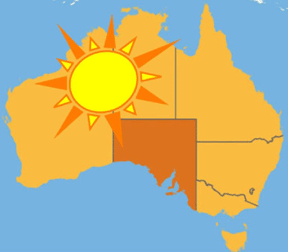 ABC 25th Oct 2020, South Australia’s renewable energy boom has achieved a global milestone. The state once known for not having enough power has become the first major ABC 25th Oct 2020, South Australia’s renewable energy boom has achieved a global milestone. The state once known for not having enough power has become the first majorjurisdiction in the world to be powered entirely by solar energy. For just over an hour on Sunday, October 11, 100 per cent of energy demand was met by solar panels alone. “This is truly a phenomenon in the global energy landscape,” Australian Energy Market Operator (AEMO) chief executive Audrey Zibelman said. https://www.abc.net.au/news/2020-10-25/all-sa-power-from-solar-for-first-time/12810366 |
|
|
The pandemic and the prospect of zero interest present a massive opportunity for clean energy development.
 The tantalising promise of ultra-cheap power South Wind, 27 October 2020 by admin The tantalising promise of ultra-cheap power South Wind, 27 October 2020 by admin
The pandemic and the prospect of zero interest present a massive opportunity for clean energy development. The story of 2020 has really been two stories, deeply interwoven, in which what happens in one keeps playing on the other and causing general mayhem. One is about the virus; the other the economy…….. Solar panels are getting steadily more efficient and cheaper to make, but Quiggin sees their greatest potential in the fact that they last three or more decades and cost virtually nothing to operate. The cost of a solar project today arises almost entirely from the need of investors to get a return on the capital they put into the project’s construction and grid connection. Solar’s low capital cost is stretching the “payback period” of projects – the time available for investors to be repaid in full – so far into the future that the power generated is virtually free. Quiggin calculates that over a module’s lifetime the cost could drop as low as 2c per kilowatt-hour. Yields from current Australian government bonds are lower than likely inflation. European countries are offering bonds maturing after 50 or 100 years, and the US government is selling similar bonds at negative interest rates. Given all this, Quiggin believes that governments should issue perpetual bonds yielding inflation-adjusted returns of zero. “In the world of zero real interest rates that now appears to be upon us… governments can, and should, invest in projects whenever the total benefits exceed the costs, regardless of how those benefits are spread over time.” If there is a powerful case for public investment in renewable energy, the case for doing the same for transmission, says Quiggin, is even stronger. “Electricity transmission lines have the same cost structure as renewables (low operational cost and long lives), if anything more so, meaning that the cost of transmission depends primarily on the need to secure a return to the capital invested.” This is where Quiggin’s interesting idea really starts to sing. A modern, smart, efficient electricity grid over a wide area like eastern Australia can make intermittent solar and wind power work well for us, rapidly switching demand to where the sun shines and the wind blows and minimising calls on alternative generators or energy stored in batteries or hydro schemes. Opposition leader Anthony Albanese proposes to spend $20 billion on transmission infrastructure to allow the national grid to fully integrate new renewable sources. The government could go one further by investing in both transmission and renewable generation. But it is still in pre-pandemic mode, offering just low cost finance for private transmission investment. The pandemic has disrupted everything we knew, killing the old economy and its ideological stereotypes. In these times of upheaval and flux, as John Quiggin says, there are huge opportunities for large-scale public investment in a new, cleaner economy. Our recovering economy will need a lot of public investment. All we ask of the Morrison government is the vision to see what’s possible and the courage to act. http://southwind.com.au/2020/10/27/the-tantalising-promise-of-ultra-cheap-power/ |
|
Energy giant Engie supercharges green city development with support for EVs, hydrogen transport

Renew Economy 21st Oct 2020, French energy giant Engie backs Greater Springfield development, aiming to be ‘world’s greenest city’, with zero emissions transport plan. The post Energy giant Engie supercharges green city development with support for EVs, hydrogen transport appeared first on RenewEconomy.
A new city being developed in south-east Queensland aiming to become one of
the world’s greenest is set to get a boost, with a new roadmap launched with the backing of one of the world’s largest energy companies.Greater Springfield, which is located around 30km south-west of Brisbane and has
grown to a population of 45,000 has released a new master plan that will see electric vehicle charging infrastructure and a hydrogen fuelled bus network rolled out, in an effort to create the ‘world’s greenest city’ by 2038.The city is one of Australia’s largest privately funded city developments, including a mix of residential and business districts, and has attracted a campus of the University of Southern Queensland.
Energy giant Engie supercharges green city development with support for EVs, hydrogen transport — RenewEconomy
Kevin Rudd’s vision for a green recovery out of the pandemic
 New jobs, new industries, new wealth’: Kevin Rudd’s vision for a green recovery out of the pandemic
Former PM says Australia risks becoming ‘the complacent country’ and could suffer another recession if it remains tied to fossil fuels, Guardian, Adam Morton Environment editor @adamlmorton, Tue 20 Oct 2020 Kevin Rudd has called for solar panels to be made compulsory on all new buildings and increased incentives to be offered to households that do not yet have them as part of a “genuinely green recovery” from recession.
Speaking at an Australian National University event on Monday, the former prime minister repeated his 2007 declaration that climate change was the “great moral challenge of our time” and accused the Morrison government of putting jobs and long-term living standards at risk by failing to deal with the issue as promised under the Paris agreement.
Rudd said the government could have used the coronavirus pandemic as a spur to accelerate the shift to becoming a zero emissions economy, but had instead used it as an excuse to delay action further. It was evidence Australia had become “the complacent country” on the issue despite the experience of last summer’s catastrophic bushfires, he said.
“Besides the United States under [Donald] Trump and Brazil under [Jair] Bolsonaro, we in Australia are the only major economy that does not take the need for action on climate change seriously. Nor do we recognise the economic opportunities that will come with that action. I would argue this is bad company to keep,” Rudd said as part of his keynote address at the Wilson Dialogue.
“I fear that seeking to untangle our carbon-intensive economy much later than the rest of the world could in fact be what causes the next recession in Australia as the global economy increasingly walks away from fossil fuel dependency.”
Rudd said his vision for a green recovery from the pandemic included large-scale investment in renewable energy to position as a clean energy superpower, saying there was evidence it could create “new jobs, new industries, new wealth” while providing clean energy at home and creating clean energy technology that could be exported……….
In his speech, Rudd urged people to “launch, collectively, a national fusillade against the Murdoch media”, which he said had been the “echo-chamber of climate change denialism for the best part of a decade”. https://www.theguardian.com/australia-news/2020/oct/20/new-jobs-new-industries-new-wealth-kevin-rudds-vision-for-a-green-recovery-out-of-the-pandemic
Net zero emissions target for Australia could launch $63bn investment boom
|
Net zero emissions target for Australia could launch $63bn investment boom, Guardian, Lisa Cox, 12 Oct 20,
Modelling shows moving towards a net zero emissions economy would unlock financial prospects in sectors including renewables and manufacturing Australia could unlock an investment boom of $63bn over the next five years if it aligns its climate policies with a target of net zero emissions by 2050, according to new economic modelling. The analysis, by the Investor Group on Climate Change (IGCC), finds the investment opportunity created by an orderly transition to a net zero emissions economy would reach hundreds of billions of dollars by 2050 across sectors including renewable energy, manufacturing, carbon sequestration and transport. However, if the country keeps to its current targets and climate policies, investment worth $43bn would be lost over the next five years, growing to $250bn by 2050. The Investor Group on Climate Change represents investors in Australia and New Zealand who are focused on the effect of the climate crisis on the financial value of investments. Among its membership are institutional investors with funds under management worth more than $2 trillion. The organisation commissioned the consultancy Energetics to examine the domestic investment opportunities that would arise from an orderly transition to net zero emissions by 2050. The report finds a net zero scenario would unlock $63bn in investment over the next five years, including $15bn in manufacturing, $6bn in transport infrastructure such as charging stations, and $3bn in domestic green hydrogen production, as companies and governments moved towards the stronger emissions goal. ………. “What it shows is that the investment opportunities extend well beyond just the renewables industry,” said Erwin Jackson, the IGCC’s director of policy. “Renewables are the backbone of the transition but there are massive opportunities in other sectors such as manufacturing, restoring the land, and electrification of transport.” The report, which targets governments, companies, investors and financial regulators, says its estimates are conservative because they do not factor in the export potential of industries such as clean hydrogen. It argues that if governments set stable policy, and companies and investors collaborate to align their decisions with the goals of the Paris agreement, then billions of dollars over the short and long term could support the jobs and wealth of millions of Australians, particularly in regional areas. The Morrison government has refused to commit Australia to a net zero emissions target and has focused its climate policy on a new technology roadmap covering hydrogen, energy storage, “low carbon” steel and aluminium, carbon capture and storage, and soil carbon……… John Connor, the chief executive of the Carbon Market Institute, said the reality Australia faced was its economy was running “below capacity and it needs a new direction”. He said clean technologies like renewable energy and transport represented significant opportunities for Australia in a post-carbon world and the country’s vast land mass, with landscapes in need of regeneration, gave it a competitive advantage in carbon sequestration. “We can either coast off the cliff into the hothouse of economic and climate disaster, or we can turn a corner towards an orderly transition and the opportunities that are there,” Connor said. https://www.theguardian.com/australia-news/2020/oct/12/net-zero-emissions-target-for-australia-could-launch-63bn-investment-boom |
|
Coalition to divert renewable energy funding away from wind and solar
|
Coalition to divert renewable energy funding away from wind and solar
Scott Morrison says solar and wind are commercially viable and do not need subsidies from the $1.43bn funding, Guardian, Katharine Murphy and Adam Morton, Thu 17 Sep 2020 The Morrison government will continue to fund Australia’s renewable energy agency to the tune of $1.43bn over a decade but overhaul its mandate so there will be less investment in solar and wind, and more focus on investment in hydrogen, carbon capture and storage, microgrids and energy efficiency.The baseline funding for the Australian Renewable Energy Agency (Arena) will be supplemented by a transfer of funds from the government’s emissions reduction fund and a new grants program worth $193.4m – but that represents a funding cut to the agency which was established by the Gillard government in 2011. The significant overhaul will be unveiled by Scott Morrison on Thursday ahead of the government outlining its next steps in the technology roadmap, which is the government’s emissions reduction strategy. The energy minister, Angus Taylor, is expected to unveil the government’s inaugural low emissions technology statement during a speech at the National Press Club early next week…….. The Morrison government will continue to fund Australia’s renewable energy agency to the tune of $1.43bn over a decade but overhaul its mandate so there will be less investment in solar and wind, and more focus on investment in hydrogen, carbon capture and storage, microgrids and energy efficiency……… The government will also continue to plough more taxpayer funds into carbon capture and storage through a $50m fund, while $70.2m will be allocated for an export hydrogen hub. ……. The overhaul of Arena follows the government outlining first steps in its much vaunted “gas-led recovery” from the economic shock caused by the coronavirus. Morrison on Tuesday pointed to new commitments in the October budget, including funding of $52.9m to unlock more gas supply and boost transport infrastructure. As well as flagging that the government would back the construction of a new gas-fired power station in the Hunter Valley if the energy company AGL failed to replace Liddell, Morrison held open the option of taxpayer underwriting for priority gas projects, streamlining approvals or creating special purpose vehicles for new investment. While Morrison and Taylor have been muscling up about the importance of new generation to replace Liddell, the government’s proposition has not been backed by a taskforce report commissioned to assess the impact of its closure. Morrison said this week the government had estimated 1,000 megawatts of new dispatchable electricity generation capacity would be needed to replace Liddell, which owner AGL has announced will close in early 2023. But the taskforce does not find that 1,000MW of additional dispatchable electricity would be needed. It listed a range of energy committed and probable projects that it found would be “more than sufficient” to maintain a high level of power grid reliability as Liddell shut.https://www.theguardian.com/australia-news/2020/sep/17/coalition-to-divert-renewable-energy-funding-away-from-wind-and-solar |
|
Labor leader Anthony Albanese says: Australia can be a ‘renewable energy superpower’
Labor leader sidesteps tension in his party around resources to call for embrace of clean energy, Guardian, Katharine Murphy, political editor, 8 Sep 20, The federal Labor leader, Anthony Albanese, says the resources sector has been the backbone of the Australian economy for decades, but the nation’s “long-term future lies in renewable energy sources”.Stepping around tensions within his own ranks, Albanese will use a speech on Wednesday about regional development to note that resources exports will “continue to meet the demands of the rapidly growing nations of our region” even as the world transitions to a lower-carbon future.But the opposition leader says in the speech the task of the coming decades is to “position our nation to be a major player in the clean energy industries that continue to grow in importance over time”.
The Labor leader says if the policy settings are right “we can transform our nation into a renewable energy superpower”.
n a speech to be delivered in the New South Wales coastal town of Coffs Harbour, Albanese will cite a report this week from the state’s chief scientist and engineer that envisages 17,000 jobs and $26bn would be added to annual growth from a domestic hydrogen industry.
The Labor leader will note that report was endorsed by the state’s environment minister, Matt Kean, but “the Morrison government appears to be blind to such opportunities”……..
Albanese’s speech on Wednesday lays out his thoughts on development opportunities for regional Australia. He insists the transition to renewable energy will create jobs in the regions.
He will argue the National party’s resistance to the energy transition is leaving them out of step with the communities they represent.
“The Nationals, who say they represent farmers, are now at odds with the National Farmers’ Federation, which recently embraced the target of net zero carbon emissions by 2050,” the Labor leader says.
He says regional Australia and the investment sector are “moving beyond this do-nothing government”.
Albanese says only Labor can tackle energy policy “in a way that recognises the value of the current resources market while seeking out the massive opportunities in renewables”.
“The right plans will create hundreds of thousands of jobs in new industries, including in regional Australia whilst also reducing power prices”. https://www.theguardian.com/australia-news/2020/sep/09/australia-can-be-a-renewable-energy-superpower-anthony-albanese-declares
Renewable energy can save the natural world – but if we’re not careful, it will also hurt it
Renewable energy can save the natural world – but if we’re not careful, it will also hurt it https://theconversation.com/renewable-energy-can-save-the-natural-world-but-if-were-not-careful-it-will-also-hurt-it-145166
September 2, 2020 Laura Sonter, Lecturer in Environmental Management, The University of Queensland, James Watson, Professor, The University of Queensland, Richard K Valenta, Director – WH Bryan Mining and Geology Research Centre – The Sustainable Minerals Institute, The University of Queensland
A vast transition from fossil fuels to renewable energy is crucial to slowing climate change. But building solar panels, wind turbines and other renewable energy infrastructure requires mining for materials. If not done responsibly, this may damage species and ecosystems.
In our research, published today, we mapped the world’s potential mining areas and assessed how they overlap with biodiversity conservation sites.
We found renewable energy production will exacerbate the threat mining poses to biodiversity – the world’s variety of animals and plants. It’s fair to assume that in some places, the extraction of renewables minerals may cause more damage to nature than the climate change it averts.
Australia is well placed to become a leader in mining of renewable energy materials and drive the push to a low-carbon world. But we must act now to protect our biodiversity from being harmed in the process.
Mining to prevent climate change
Currently, about 17% of current global energy consumption is achieved through renewable energy. To further reduce greenhouse gas emissions, this proportion must rapidly increase.
Building new renewable energy infrastructure will involve mining minerals and metals. Some of these include:
- lithium, graphite and cobalt (mostly used in battery storage)
- zinc and titanium (used mostly for wind and geothermal energy)
- copper, nickle and aluminium (used in a range of renewable energy technologies).
The World Bank estimates the production of such materials could increase by 500% by 2050. It says more than 3 billion tonnes of minerals and metals will be needed to build the wind, solar and geothermal power, and energy storage, needed to keep global warming below 2℃ this century.
However, mining can seriously damage species and places. It destroys natural habitat, and surrounding environments can be harmed by the construction of transport infrastructure such as roads and railways.
What we found
We mapped areas around the world potentially affected by mining. Our analysis involved 62,381 pre-operational, operational, and closed mines targeting 40 different materials.
We found mining may influence about 50 million km² of Earth’s land surface (or 37%, excluding Antarctica). Some 82% of these areas contain materials needed for renewable energy production. Of this, 12% overlaps with protected areas, 7% with “key biodiversity areas”, and 14% with remaining wilderness.
Our results suggest mining of renewable energy materials may increase in currently untouched and “biodiverse” places. These areas are considered critical to helping species overcome the challenges of climate change.
Threats here and abroad
Australia is well positioned to become a leading supplier of materials for renewable energy. We are also one of only 17 nations considered ecologically “megadiverse”.
Yet, many of the minerals needed for renewable energy exist in important conservation areas.
For example, Australia is rich in lithium and already accounts for half of world production. Hard-rock lithium mines operate in the Pilbara region of Western Australia.
This area has also been identified as a national biodiversity hotspot and is home to many native species. These include small marsupials such as the little red antechinus and the pebble-mound mouse, and reptiles including gecko and goanna species.
Australia is also ranked sixth in the world for deposits of rare earth elements, many of which are needed to produce magnets for wind turbines. We also have large resources of other renewables materials such as cobalt, manganese, tantalum, tungsten and zirconium.
It’s critical that mining doesn’t damage Australia’s already vulnerable biodiversity, and harm the natural places valued by Indigenous people and other communities.
In many cases, renewables minerals are found in countries where the resource sector is not strongly regulated, posing an even greater environmental threat. For example, the world’s second-largest untouched lithium reserve exists in Bolivia’s Salar de Uyuni salt pan. This naturally diverse area is mostly untouched by mining.
The renewables expansion will also require iron and steel. To date, mining for iron in Brazil has almost wiped out an entire plant community, and recent dam failures devastated the environment and communities.
We need proactive planning
Strong planning and conservation action is needed to avoid, manage and prevent the harm mining causes to the environment. However global conservation efforts are often naive to the threats posed by significant growth in renewable energies.
Some protected areas around the world prevent mining, but more than 14% contain metal mines in or near their boundaries. Consequences for biodiversity may extend many kilometres from mining sites.
Meanwhile, other areas increasingly important for conservation are focused on the needs of biodiversity, and don’t consider the distribution of mineral resources and pressures to extract them. Conservation plans for these sites must involve strategies to manage the mining threat.
There is some good news. Our analyses suggest many required materials occur outside protected areas and other conservation priorities. The challenge now is to identify which species are most at risk from current and future mining development, and develop strong policies to avoid their loss.
1 This month



Help Aunty Sue Protect Her Land and Sacred Sites From Destructive Rocket Testing.
.

Australians deserve the truth
about
AUKUS – https://aukuspublicinquiry.com/

PETITION – To: Prime Minister Anthony Albanese and the Australian Labor Government

of the week – Australians for War Powers Reform (AWPR)
To see nuclear-related stories in greater depth and intensity

