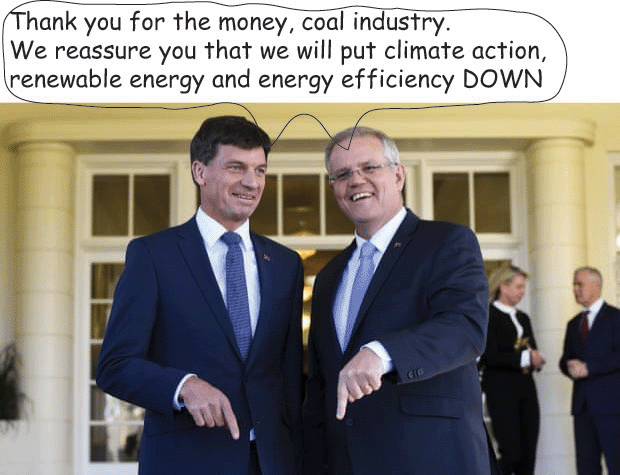
In contradiction to Angus Taylor, Australia’s Minister On Behalf of Polluting Industries, the States are leading on clean energy
 How Australia’s state energy ministers are turning the tables on Angus Taylor, Guardian Simon Holmes à Court The state energy ministers still need to deliver on their promises, but imagine if any of them held the federal portfolio @simonahac, Sat 11 Jul 202 Sometimes it just takes a bit of leadership.
Former prime minister Malcolm Turnbull likes to say that we must choose “engineering and economics” over “idiocy and ideology”. The New South Wales energy minister, Matt Kean, has been making the right choices.
In December 2018 I singled out NSW for its reckless lack of energy policy. The state, reliant on an ageing coal fleet for 80% of its power, had been shunned by energy investors……..
NSW is blessed with high-quality wind and solar resources, but lacks transmission lines between the best wind and solar areas and the state’s major population and industrial centres. In 2018, only one-in-20 proposed renewable energy projects could be accommodated into the weak grids in the west of the state, and developers were forced to turn their attention to the other states.
In a landmark speech late last year, Kean, the newly minted energy minister, made it clear his government would respond to the climate science and embrace the opportunities presented by decarbonising the economy.
“To those vested interests and ideologues who want to stand in the way of this transition, I say enjoy your Kodak moment,” he said.
Undeterred by attacks from the Murdoch media and even the prime minister, Scott Morrison, over the following months, Kean set about turning the tables in NSW……….
What’s stunning is how much ambition has shifted, and how it’s being driven by the states. Just two years ago the modelling for Josh Frydenberg’s failed national energy guarantee predicted that NSW wouldn’t build a single wind or solar farm from 2021 to 2030. Now Kean has a plan to build as much large-scale renewable energy this decade in NSW as all of Australia built over the past 20 years. …….
The Australian Energy Market Operator and CSIRO have determined that the cheapest way to “firm” the huge amounts of renewable energy is a relatively modest mix of better interconnections with neighbouring states, batteries and pumped hydroelectricity – Snowy 2.0 project and multiple smaller projects. On economic grounds alone, fossil gas is unlikely to play an increased role.
The Rezs will also open up opportunities for energy intensive industry. Flexible demand, such as hydrogen production, can help balance the grid. Instead of fracking the Pilliga forest to produce fertiliser with a huge carbon footprint, business could build a zero-carbon factory in the New England region, making fertiliser from renewable energy.
Angus Taylor, the federal minister for energy and emissions reductions, is famously no fan of renewable energy or of setting meaningful emissions reduction targets. On electricity, the state energy ministers – right across the political spectrum – are charging ahead without him, which is perhaps as it should be, given that electricity is the states’ responsibility…….
Every state and territory has now formally signed on to a net-zero emissions target by no later than 2050, a target backed by business, unions and the opposition – yet the federal government and its donors stand in the way.
Australia has three Liberal state energy ministers. South Australia’s Dan van Holst Pellekaan wants to see his state hit 100% renewables by 2030. His Tasmanian counterpart, Guy Barnett, is gunning for 200% renewables and Kean has outlined a plan for NSW to be an energy superpower.
Sure, these energy ministers still need to deliver on their promises, but imagine if any one of them held the federal portfolio. https://www.theguardian.com/environment/2020/jul/11/how-australias-state-energy-ministers-are-turning-the-tables-on-angus-taylor?utm_term=Autofeed&CMP=soc_568&utm_medium=Social&utm_source=Twitter#Echobox=1594424036
Australia could create hundreds of thousands of jobs by accelerating shift to zero emissions – report
 could create hundreds of thousands of jobs by accelerating shift to zero emissions – report
Decarbonising the economy by investing in renewable energy, clean buildings, clean transport and manufacturing could help fight the recession, Guardian, Adam Morton Environment editor @adamlmorton, Mon 29 Jun 2020 Hundreds of thousands of jobs could be created in Australia by hurrying the shift to zero greenhouse gas emissions, a study backed by business and investment leaders has found.
The Australian Bureau of Statistics estimates 835,000 jobs have been lost since the coronavirus pandemic shutdown began in March. A report by Beyond Zero Emissions, an energy and climate change thinktank, says practical projects to decarbonise the economy could create 1.78m “job years” over the next five years – on average, 355,000 people in work each year – while modernising Australian industry.
Called the “million jobs plan”, it says further stimulus measures needed to fight the Covid-19 recession are “a unique opportunity to lay the foundations for a globally competitive Australian economy fit for 21st century challenges”.
The report focuses on proposals it says are already being planned and could create jobs by accelerating private and public investment in renewable energy, clean buildings, clean transport, manufacturing and land use that will happen in the years ahead anyway. Benefits would include improved air quality and new employment in regional areas.
Eytan Lenko, Beyond Zero Emissions’ interim chief executive, said the group had brought together investment, business and industry leaders to scope the best clean solutions that would drive productivity and growth.
“No one thought 2020 would turn out the way it has. We now have a unique opportunity to seize this moment, to retool, reskill, and rebuild our battered economy to set us up for future generations,” he said.
The plan would require hundreds of billions of dollars in investment. It says clean energy investors have indicated their willingness to spend on this scale, pointing to the more than $100bn of existing renewable energy projects proposed but yet to be built.
The report says Australia risks missing out on some of these opportunities, and others in electric transport, zero-carbon manufacturing and green steel, unless governments deliver policy certainty and help create an environment that encourages large clean investment deals. Reserve Bank research found the number of large-scale renewable energy projects reaching commencement fell about 50% last year after a record-setting 2018.
Beyond Zero Emissions says governments also have a role to play in direct investment in, for example, urgent transmission line projects to new renewable energy zones, the construction of energy-efficient social housing, and the introduction and expansion of electric buses and trains………. https://www.theguardian.com/australia-news/2020/jun/29/australia-could-create-hundreds-of-thousands-of-jobs-by-accelerating-shift-to-zero-emissions-report
With Liberal Coalition business as usual on energy, thousands of renewable energy jobs will vanish
Up to 11,000 renewable energy jobs at risk if the government ignores calls for new policies, https://www.sbs.com.au/news/up-to-11-000-renewable-energy-jobs-at-risk-if-the-government-ignores-calls-for-new-policies Renewable energy groups are calling for greater public investment as companies risk losing thousands of jobs if the government ignores calls for a policy refresh. BY OMAR DEHEN, 26 June 20, Up to 11,000 jobs in Australia’s renewable energy sector could be lost over the next two years if no additional policies are introduced by the Morrison government, a new report has found.
Modelling from the University of Technology Sydney looked at several scenarios that predicted a reduction of jobs in the industry.
The modelling also examined scenarios that increased employment and reduced electricity costs across Australia.
Australian govt current energy policies will mean 11,000 renewable energy jobs lost
 Up to 11,000 renewable energy jobs could be lost under Morrison government policies Up to 11,000 renewable energy jobs could be lost under Morrison government policiesThe job losses will be equivalent to the entire local coal industry if the renewable energy target is not replaced, Guardian Adam Morton Environment editor @adamlmorton, Thu 25 Jun 2020 Up to 11,000 renewable energy workers are expected to lose their jobs over the next two years under current government policies, according to a university analysis. If correct, the loss of jobs would be equivalent to the abolition of the domestic-focused coal industry, which employs a little more than 10,000 people in mining thermal coal for local use and running Australia’s coal-fired power plants. Described as the first large-scale survey of renewable energy jobs in Australia, the research from the University of Technology Sydney found the industry would be a major source of jobs in the medium term, but its short-term future would depend on how Covid-19 stimulus packages were deployed. About 26,000 people are employed in renewable energy, but the study found this would fall to about 15,000 by 2022 under existing policies, including the Morrison government not replacing the national renewable energy target. The target, which requires energy companies to source about 23% of electricity from clean sources, was reached last year, triggering a 50% drop in large-scale renewable energy investment compared with 2018. Conversely, renewable energy jobs would be expected to reach about 45,000 by 2025 under a “step change” scenario, set out by the Australian Energy Market Operator, consistent with the goals of the 2015 Paris agreement. The study says on this path employment in renewables would be likely to fall to about 30,000 as construction eased later this decade before rising again after 2030. Chris Briggs, a research principal at the UTS Institute for Sustainable Futures, said up to two-thirds of renewable energy jobs would be expected to be created in regional areas. “It’s a difference of 30,000 jobs in the next few years depending on government policy,” he said. Many of the jobs would be expected to be in identified renewable energy zones. The zones overlap with existing coal regions but are more widespread. Briggs said it suggested renewable energy could play a meaningful role alongside other industries in creating replacement jobs in coal regions as the world reduced reliance on fossil fuels, but only if the transition was well planned and funded……… https://www.theguardian.com/environment/2020/jun/25/up-to-11000-renewable-energy-jobs-could-be-lost-under-morrison-government-policies |
|
Up to 40 Energy jobs to be cut from CSIRO
 CSIRO to pull plug on energy jobs, https://www.miragenews.com/csiro-to-pull-plug-on-energy-jobs/ CSIRO management have announced this week that up to 40 jobs will be cut from its energy team, including key scientists, engineers, and researchers.The union representing the public sector including CSIRO workers, the CPSU, are calling on the government to halt cuts to the CSIRO.
These are the latest in a series of staff cuts to hit the CSIRO, bringing the total number of job losses to 619 this financial year alone, due to the impact of the governments’ Average Staffing Level Cap and continued budget cuts.
Projects that could affected as a result of these Energy job cuts are upstream oil and gas, the Low Emissions Technologies program, and post combustion CO2 capture research.
Four energy sites will be affected including Kensington (Western Australia), Clayton (Victoria), Newcastle and North Ryde (New South Wales).
Quotes Attributable to CPSU National Secretary Melissa Donnelly:
“There is no doubt that these cuts will have an enduring impact on the national capability to develop and implement energy and climate policy. At a time when the government should be focussed on the future of our energy needs, they are more concerned with cutting jobs.”
The CSIRO is on track to lose more than 500 jobs by 1 July and that does not include these latest cuts in Energy. We need to be investing in the CSIRO not cutting hundreds upon hundreds of jobs.”
“It’s time for the government to scrap the ASL Cap and invest in Australia’s scientific resources. If the past 6 months have shown us anything, its that the CSIRO is more important than ever.”
Quotes Attributable to CPSU CSIRO Section Secretary Sam Popovski:
“Job losses of any sort in CSIRO are bad news. CSIRO Chief Executive Larry Marshall needs to do a lot more to protect CSIRO jobs and start to make a case for increased public funding.”
“The recent King Review indicates that Australia’s energy policy remains far from settled and diminishing CSIRO’s specialist capabilities in this area harms government decision-making and future innovation.”
“There are growing concerns that the October federal budget may feature spending cuts and Dr Marshall and the Board must ensure that the case for CSIRO public funding is heard loud and clear over coming months,” Mr Popovski said.
Retain integrity of renewable energy agencies: ACF
Retain integrity of renewable energy agencies: ACF, https://www.miragenews.com/retain-integrity-of-renewable-energy-agencies-acf/ 24 June 20, The Australian Conservation Foundation has welcomed Labor leader Anthony Albanese’s commitment to the integrity of the nation’s key renewable energy agencies, the Clean Energy Finance Corporation (CEFC) and the Australian Renewable Energy Agency (ARENA).
“Any moves to dilute the mandates of ARENA and the CEFC to allow them to invest in fossil fuel projects would be a perversion of their important and very successful clean energy investment functions,” said ACF’s climate program manager Gavan McFadzean.
“Australia is positioned to be a renewable energy superpower – any move to change the direction of ARENA and the CEFC is a step in the wrong direction.
The Australian Conservation Foundation has welcomed Labor leader Anthony Albanese’s commitment to the integrity of the nation’s key renewable energy agencies, the Clean Energy Finance Corporation (CEFC) and the Australian Renewable Energy Agency (ARENA).
“Any moves to dilute the mandates of ARENA and the CEFC to allow them to invest in fossil fuel projects would be a perversion of their important and very successful clean energy investment functions,” said ACF’s climate program manager Gavan McFadzean.
“Australia is positioned to be a renewable energy superpower – any move to change the direction of ARENA and the CEFC is a step in the wrong direction.
“It is important that Anthony Albanese has today closed the door on costly, high-risk, unpopular nuclear energy.
“The CEFC was created with a specific purpose: to help mobilise finance into clean energy.
“The CEFC has made profits and provided great public value by driving down the cost of new clean energy technologies, speeding the transition to clean electricity supply through projects that support reliability of electricity and helping Australia access the enormous benefits available through improved energy productivity.
“The coal and gas lobbies have tried for years to convince the Federal Government to manipulate the CEFC’s mandate to suit the interests of the fossil fuel industry.
“We urge the Federal Government to commit to maintain the remits of ARENA and the CEFC as renewable bodies.
“ACF welcomes moves towards a bipartisan approach to energy and the desire to agree to an emissions reduction mechanism that can be strengthened by future governments.”
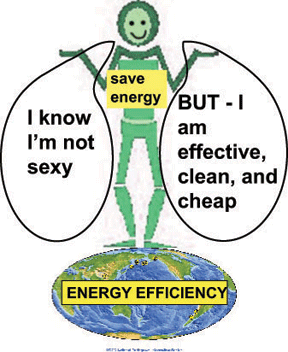
Australia’s best energy measure – to lift energy efficiency – Chief Scientist says
|
Chief scientist joins calls for Australia to dramatically boost energy efficiency
Alan Finkel calls saving electricity the ‘best form of generation’ as groups push for efficiency measures to lead economic recovery, Guardian, Adam Morton Environment editor @adamlmorton, Sun 21 Jun 2020 Australia’s chief scientist, Alan Finkel, has warned the country is not doing enough to lift energy efficiency, and described measures to save electricity as the “best form of energy generation you could possibly ever hope to have”.
Speaking in his role as chair of a panel advising the Morrison government on a low emissions technology statement, Finkel told an industry seminar that Australia had ongoing issues with energy efficiency and productivity, and noted a national energy productivity plan, agreed by federal and state energy ministers in 2015, did not appear on a list of national climate and energy policies. “I don’t think we’re anywhere close to having that nailed,” he said on energy efficiency. “There is no lack of appreciation from myself or my colleagues on the taskforce … that a gigawatt of power not needed because you’ve done an efficiency measure is the best form of energy generation that you could possibly ever hope to have.” Finkel’s view is in line with a raft of groups from across Australian society that are calling for federal and state governments to back an energy-efficiency drive for homes and other buildings to help address both the coronavirus-triggered recession and the climate crisis. Many have called for policies that focus on social and low-income housing. Buildings are responsible for nearly a quarter of national greenhouse gas emissions. The organisations calling for better energy efficiency say it could cut emissions, create tens of thousands of jobs and, unlike some other proposed stimulus measures, be delivered immediately. Household-level energy efficiency measures can include boosting thermal performance by sealing leaks and improving insulation, replacing gas appliances with those run on clean electricity, encouraging better lighting and installing solar panels and a battery to generate electricity onsite. Four separate reports on the issue were released last week. In one, more than 50 social, property, business, environment and other groups called for an energy efficiency and solar package focused on low-income houses. The 50, led by the Australian Council of Social Service (Acoss), said the government’s HomeBuilder stimulus program had helped high-income earners planning expensive renovations, but failed to do anything for those most in need, or to cut emissions. They recommended the federal government match state funding for energy efficiency upgrades and solar panel installations in social housing, work with local government to improve low-income homes, offer grants to landlords to fix inefficient rental properties and subsidise the replacement of inefficient appliances. Kellie Caught, an Acoss climate and energy senior advisor, said a low-income energy productivity program could quickly create more than 60,000 jobs in training, auditing, installation, manufacturing and local retail……… The groups calling for energy efficiency improvements are part of a push including global organisations, banks, major institutional investors and some governments, for a green recovery from the Covid-19 shutdown. A report by the International Energy Agency released last week found governments were planning to spend US$9tn globally on rescuing their economies from the coronavirus crisis, and the stimulus packages created this year would determine the shape of the global economy for the next three years. It warned emissions must start to fall sharply and permanently within that time or climate targets will be out of reach. The Morrison government and its National Covid-19 Coordinating Commission have emphasised gas, a fossil fuel, as being central to pandemic recovery……. https://www.theguardian.com/australia-news/2020/jun/21/chief-scientist-joins-calls-for-australia-to-dramatically-boost-energy-efficiency |
|
COVID-19 Commission stacked with fossil-fuel bigwigs. Surprise surprise -they find gas is the answer
 Transparency called for in fossil fuel-stacked COVID-19 Commission, Independent Australia, Martin Hirst | 2 June 2020 Who’s running the country and where are they taking us? Dr Martin Hirst thinks the Canberra bubble is filling with gas.
IN THE LAST WEEK of March, right at the start of Australia’s response to the coronavirus pandemic, Prime Minister Scott Morrison announced the formation of the National COVID-19 Coordination Commission (NC-19CC). He said it would “solve problems” so “we all get through to the other side”.
Now, at the start of June, we have some idea of what the “other side” looks like according to the leading figures on the Coordination Commission. From what we can glean from the cheap seats in the bleachers, the future is going to be a gas — literally gas……
For a start, the NC-19CC is an energy sector lovefest.
The Commission chair is Neville (Nev) Power and he’s well connected to the Australian energy and mining industries. He is Deputy Chairman of Strike Energy Ltd and for nearly a decade was managing director and CEO of Fortescue Metals Group.
Catherine Tanna is the managing director of Energy Australia, ‘one of Australia’s leading electricity and gas retailers’ according to the helpful but rather anodyne biographies provided on the commission’s website.
The commission’s “special advisor” is the American chemical industry leader, Andrew Liveris, a former CEO and chairman of the Dow Chemical Company and on the board of a major Saudi oil company.
There are two other important members of NC-19CC: the head of the Department of Prime Minister and Cabinet, Phil Gaetjens and the head of Home Affairs, Mike Pezzulo. These are also political appointments — Gaetjens is a loyal fixer for Morrison and Pezzulo is Home Affairs Minister Peter Dutton’s lieutenant.
Who does the Commission report to?
Australians first heard of the Coordinating Commission when Morrison announced it at a media event on 25 March, but he didn’t tell us how the members were selected, or why, or by whom.
Presumably, it was a “captain’s pick” by Morrison……
In mid-May, the Senate select committee that is holding an ongoing inquiry into the Government’s response to the pandemic requested Mr Power come and chat with it, but he didn’t show up. Instead, the PM’s protector, Phil Gaetjens and Peter Harris, the CEO of the Commission, came to block any real scrutiny of the Commission.
All that the senators were able to learn was that there are no rules in place for managing conflicts of interest and that the Commission’s members and advisors were being handsomely paid for their time and service. According to the transcript, almost every other question was stonewalled.
Apparently, the commissioners are also recruiting other people “through their own networks” according to Phil Gaetjens, but who remain largely unknown to the public — to help across various things to do with the economy re-opening.
Greens Senator Peter Whish-Wilson grilled Phil Gaetjens about the advice the commissioners might provide, but the PM’s advisor would only say that most advice would be confidential.
This has not satisfied a coalition of public interest watchdog groups who collectively issued a statement calling for greater transparency round the discussions and decisions of the NC-19CC………
I should mention that many environmental groups are concerned that the COVID-19 Commission is stacked with fossil fuel advocates, and with good reason. …… https://independentaustralia.net/politics/politics-display/transparency-called-for-in-fossil-fuel-stacked-covid-19-commission,13954
The Morrison government manipulates, to paint the coal industry as “clean” and “renewable”

The Clean Energy Finance Corporation has this awkward word “Clean”
The Australian Renewable Energy Agency has this awkward word “Renewable”
How can the those agencies put coal into those categories? With some difficulty.
My heart goes out to them, -like those poor gardeners in “Alice in Wonderland” – forced to paint red all the white roses , lest the Queen should cut off their heads.
Government looks to carbon capture for climate action, The Age By Mike Foley, May 19, 2020 The Morrison government is considering legislative changes to allow its clean energy agencies to fund carbon capture and storage from fossil fuel projects in a bid to unlock $2 billion of private investment to reduce greenhouse gases.
Energy and Emissions Reduction Minister Angus Taylor has accepted 21 of the 26 recommendations from an independent panel reviewing the $2 billion Emissions Reduction Fund, including all those relating to carbon capture and storage.
The panel, chaired by former Business Council of Australia president Grant King, said the government would attract more private investment in the Emissions Reduction Fund if legislation were amended to “enable a method to be developed for carbon capture and storage”.
The King report also recommended an “expanded, technology-neutral remit” for the Clean Energy Finance Corp (CEFC) and the Australian Renewable Energy Agency so they too could attract more private investment in a wider range of technologies outside renewables, such as coal or gas-fired power incorporating carbon capture and storage. This would be a significant change to the remit of the agencies, which were set up to promote the development of renewable wind and solar supplied to the electricity grid.
Carbon capture and storage, which has not yet been successfully implemented on a commercial basis, involves capturing carbon dioxide from industrial processes and transporting it to a suitable storage site for safe, long-term storage deep underground.
Mr Taylor said emissions reduction policy driven by “technology not taxes” would attract significant private investment.
“The government will target dollar-for-dollar co-investment from the private sector and other levels of government to drive at least $4 billion of investment that will reduce emissions across Australia,” he said in a statement accompanying the report’s release.
The Climate Solutions Fund was set up in 2015 with $2.5 billion funding under the Abbott government as an alternative to a carbon tax. It pays polluters to employ cleaner technologies and funds carbon capture through tree planting, soil carbon sequestration on farms and energy efficient systems in commercial properties, as well as methane capture from landfill and waste management.
Last year, the Morrison government topped up the fund with another $2 billion and rebadged it the Climate Solutions Fund. To date, it has issued 450 contracts to abate a cumulative 190 million tonnes of carbon at a total cost of $2.3 billion, or an average of $12 a tonne of carbon…….
Current legislation prohibits CEFC from investing in carbon capture and storage. But changing the legislation would enable the $1 billion Grid Reliability Fund to invest in new gas, hydrogen and coal projects relying on carbon capture.
….
Australia is uniquely placed to be able to reinvigorate manufacturing through renewable energy
 Powering onwards: Australia’s opportunity to reinvigorate manufacturing through renewable energy https://apo.org.au/node/303735 8 MAY 2020 Dan Nahum Centre for Future Work
Not only are we able to power an expanded manufacturing sector using renewables, but it is cheaper to do so than to continue down the path of an energy grid that favours and subsidises coal and gas. These economic advantages in turn can expedite a broader economic rebalancing, away from extraction towards production, in which value-added manufactures increasingly supplant the export of raw materials in our economic mix. This will be good for Australia’s economy—and for the world’s emissions.
This paper compiles evidence to demonstrate that Australia can achieve the continuation and resurgence of a vibrant, competitive manufacturing sector based on the even faster development of renewable power. To do this, the paper:
- reviews the strategic importance of, and opportunities presented by, manufacturing
-
- discusses Australia’s competitive advantage in renewable energy
- shows that, based on the government’s own figures, renewables are already cheaper than coal—and quickly getting cheaper
- debunks claims about the unreliability of renewables relative to more traditional energy sources
- identifies examples where renewable power is already in use, or could be put to use, in manufacturing and industrial processes, and instances where we can use our natural and manufactured inputs to add further value to these renewables
- examines international evidence showing that there is no connection between reliance on fossil fuels and success in global manufacturing trade
- presents a range of recommendations for government action to capitalise on the opportunity of renewable energy for revitalising Australian manufacturing.
Australian Renewable Energy Agency funds end in 2022 – a major blow for solar research
 ‘Major blow’ looms for top Sydney solar research unit as funds wither, SMH. By Peter Hannam, May 8, 2020 The future of a leading research centre whose designs power $50 billion in solar systems globally is at risk because of the uncertain future of the federal government agency that funds it.Richard Corkish, a senior lecturer at the University of NSW’s School of Photovoltaic and Renewable Energy Engineering, said as much as 80 per cent of his section’s money is provided by the Australian Renewable Energy Agency (ARENA) which is due to run out of funds in 2022. ‘Major blow’ looms for top Sydney solar research unit as funds wither, SMH. By Peter Hannam, May 8, 2020 The future of a leading research centre whose designs power $50 billion in solar systems globally is at risk because of the uncertain future of the federal government agency that funds it.Richard Corkish, a senior lecturer at the University of NSW’s School of Photovoltaic and Renewable Energy Engineering, said as much as 80 per cent of his section’s money is provided by the Australian Renewable Energy Agency (ARENA) which is due to run out of funds in 2022.
We’ll get significantly smaller unless something positive comes along,” said Dr Corkish, who is also chief operating officer of the UNSW-based Australian Centre for Advanced Photovoltaics. “It’s a major blow for us.” His school has already begun turning away prospective PhD students who would otherwise have contributed to multiple lines of scientific inquiry aimed at improving the efficiency and performance of solar cells, their integration into power networks and other renewable energy developments. …… Mark Butler, Labor’s climate spokesman, said “letting ARENA’s resourcing lapse is a devastating self-inflicted wound for Australia’s clean energy future that exposes the Liberals anti-renewable and anti-climate action ideology”. “Scott Morrison should be looking for a COVID-19 recovery plan which brings forward investment in new renewable projects which would create tens of thousands of new jobs, stimulate regional economies, and deliver cheaper power prices,” Mr Butler said. Mark Butler, Labor’s climate spokesman, said “letting ARENA’s resourcing lapse is a devastating self-inflicted wound for Australia’s clean energy future that exposes the Liberals anti-renewable and anti-climate action ideology”. “Scott Morrison should be looking for a COVID-19 recovery plan which brings forward investment in new renewable projects which would create tens of thousands of new jobs, stimulate regional economies, and deliver cheaper power prices,” Mr Butler said……. https://www.smh.com.au/environment/climate-change/major-blow-looms-for-top-sydney-solar-research-unit-as-funds-wither-20200507-p54r3j.html |
|
Investors urge governments to go green for coronavirus recovery
 Investors urge governments to go green for coronavirus recovery, The Age ,By Mike Foley, May 4, 2020 Major investors, Australian superannuation funds and the International Energy Agency are urging governments to seize the green opportunity to drive economic growth after the coronavirus pandemic and avoid the risks they see in high carbon emitting projects.“Recovery plans that exacerbate climate change would expose investors and national economies to escalating financial, health and social risks in the coming years,” said a statement from the Investor Agenda group – an international coalition of institutional investors and asset managers whose members hold more than US$80 trillion under management. Investors urge governments to go green for coronavirus recovery, The Age ,By Mike Foley, May 4, 2020 Major investors, Australian superannuation funds and the International Energy Agency are urging governments to seize the green opportunity to drive economic growth after the coronavirus pandemic and avoid the risks they see in high carbon emitting projects.“Recovery plans that exacerbate climate change would expose investors and national economies to escalating financial, health and social risks in the coming years,” said a statement from the Investor Agenda group – an international coalition of institutional investors and asset managers whose members hold more than US$80 trillion under management.
Large-scale energy generators such as coal and gas fired power plants and their heavy duty transmission networks, as well as gas powered manufacturing facilities, are built to deliver a return on investment over decades. Investors argue international commitments to tackle climate change and reduce emissions such as the Paris Agreement create an unacceptable risk for long-term investment in emissions intensive projects…… The Clean Energy Council, which represents renewable energy companies that employ more than 28,000 workers said governments had “an opportunity to transform Australia forever”. In its Clean Recovery report released on Tuesday the Council said wind and solar projects totalling 30 gigawatts energy capacity, which already have development approval, would generate $50 billion in investment across the supply chain 50,000 construction jobs and 4000 permanent positions. The Council also said support for large and small-scale renewables, such as rooftop panels, and an accelerated roll-out of batteries would create a “smart energy system” that could deliver flexibility and lower costs for consumers with low-emissions. This week, the International Energy Agency, an intergovernmental energy forecast adviser, highlighted opportunities in the energy sector in the wake of COVID-19. Global energy demand is forecast to fall a whopping 6 per cent this year, seven times more than during the global financial crisis….. The Council also said support for large and small-scale renewables, such as rooftop panels, and an accelerated roll-out of batteries would create a “smart energy system” that could deliver flexibility and lower costs for consumers with low-emissions. This week, the International Energy Agency, an intergovernmental energy forecast adviser, highlighted opportunities in the energy sector in the wake of COVID-19. Global energy demand is forecast to fall a whopping 6 per cent this year, seven times more than during the global financial crisis…. Emma Herd, chief executive of the Australian Investor Group on Climate Change, said “government policy that spurs fresh private investment in clean energy … will lead to much needed jobs and economic growth”. “The Australian government should be looking to integrate recovery plans with its technology investment roadmap, long-term emissions reduction strategy, grid modernisation planning and bushfire recovery to build greater resilience and reduce climate risk,” Ms Herd said. https://www.theage.com.au/politics/federal/investors-urge-governments-to-go-green-for-coronavirus-recovery-20200504-p54pmu.html |
|
|
Australia’s govt betting on a fossil-fuel led recovery – despite expert advice on renewable energy
 Trouble with gas: the Coalition is betting on the fossil fuel for recovery – but the sums don’t add up
The Australian government says gas is ‘essential’, but the global view is it’s the second-least desirable source of electricity Guardian, Adam Morton Environment editor @adamlmorton, Sun 3 May 2020 The agency that runs Australia’s electricity last week gave its verdict on how to deliver what would have seemed fanciful not that long ago – a power grid that within five years should at times be able to run on 75% wind and solar energy.
The Australian Energy Market Operator delivered a report on integrating renewable energy into the system with an optimistic message.
As described by its chief, New Yorker Audrey Zibelman, the technical capacity was already there, but markets and regulations would have to be adjusted. There were no “insurmountable reasons” why the grid could not take even higher levels of renewables, as it will need to for Australia to meet the Paris agreement goal of zero greenhouse gas emissions.
The minister in charge of both energy and cutting emissions, Angus Taylor, chose a different emphasis.
In a statement issued as the study was released, Taylor said it had highlighted the challenges of increased amounts of solar and wind given the system needed continuous inertia – support from constantly running “synchronous generation” – to ensure grid stability. He suggested that inertia could come from gas-fired power.
The market operator’s report does not mention gas generation, but the fossil fuel – often described as having half the emissions of coal, though recent studies have suggested it could be much more – is clearly on Taylor’s mind. A few days earlier he had given interviews to Nine newspapers to support the idea of a “gas-fired recovery” from the Covid-19 pandemic, suggesting it may be a focus of future economic stimulus measures……..
Andrew Grant, head of oil, gas and mining with London-based financial thinktank Carbon Tracker, says the global view of gas has flipped from it being seen as a cleaner fuel than coal, to it being the second-least desirable source of electricity. He points to analysis by the International Energy Agency that found global gas-fired power generation must begin to decline later this decade under a sustainable development scenario. “Better than coal is not exactly a ringing endorsement,” Grant says. …….
t there is little evidence that the Australian electricity grid will need more gas power. Last year, it provided about 9% of generation. The market operator assessment suggested this could fall to near zero in the second half of this decade before returning in a much smaller amount – less than a third of what it is now – in the 2030s if the grid was to run at lowest cost……
Simon Holmes à Court, senior advisor to the Climate and Energy College at the University of Melbourne, says the services needed for a secure power grid are increasingly available from sources other than gas, including government-backed large batteries and potentially through adjustments at wind or additions at solar farms……… https://www.theguardian.com/australia-news/2020/may/03/trouble-with-gas-the-coalition-is-betting-on-the-fossil-fuel-for-recovery-but-the-sums-dont-add-up
Forget toilet paper, consumers are panic buying solar
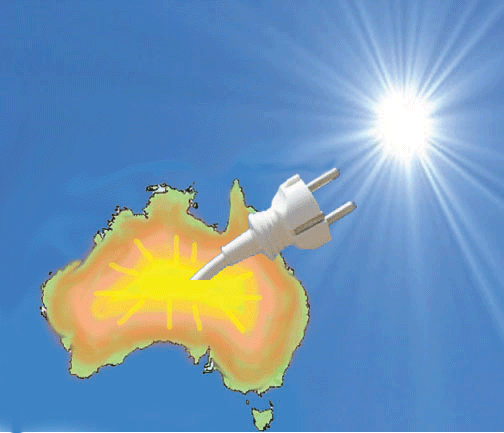 Byron Bay’s Smart Energy is seeing an unprecedented surge in sales and enquiries of solar and home storage as consumers look to shore themselves up in uncertain times. pv magazine,
Byron Bay’s Smart Energy is seeing a record sales quarter after an unprecedented 41% increase in sales and a 400% increase in battery enquiries over the last two weeks as panicking consumers look to protect themselves in times of uncertainty.
In uncertain times people rush to certainties. It is said that the only certainties are death and taxes, but what about pasta, toilet paper and solar PV? We certainly need to eat, to use the toilet, and just as certainly as the tax bill comes, so too does the electricity bill, so why not do whatever we can to lessen the impact?
When other industries and businesses are shrinking and self-isolating, Smart Energy is taking on additional resources and looking for ways to support local communities and installers as the solar and battery retailer enjoys an unprecedented surge for its products.
In a statement, Elliot Hayes, co-founder and managing director of Smart Energy said that there are many contributing factors to the growth, the main two being consumers seeking out greener purchases following the recent natural disasters in Australia and economic downturn, and consumers looking to future-proof their homes.
And why wouldn’t consumers look to future-proof their homes with solar PV and an energy storage system?……..
The solar industry in Australia expected to take quite a hit from the Coronavirus outbreak considering most panels in the market come from China, where the virus originated. Of course, many in the industry are doing it tough, but BloombergNEF reports that the production of PV components in China is already resuming, and whilst shortages may exist in the short-term, China is expected to meet its export demand before its domestic market. https://www.pv-magazine-australia.com/2020/03/19/forget-toilet-paper-consumers-are-panic-buying-solar-pv/?fbclid=IwAR3wceEHrP9MVgguwPW4092RhgYZ4GVNt7iM4abDe4XpTXOJfPf33ThqrkU
Morrison to cancel Australia’s participation in the Energy Transition Hub
 Morrison government to stop funding international collaboration on shift to zero emissions. The five-year Australian-German initiative to transition to new energy and low emissions was due to end in 2022, Guardian , Adam Morton Environment editor @adamlmorton Fri 6 Mar 2020 The Morrison government has told researchers at two of Australia’s leading universities it will break a commitment to fund an international collaboration into what is required to shift to a zero emissions future. Morrison government to stop funding international collaboration on shift to zero emissions. The five-year Australian-German initiative to transition to new energy and low emissions was due to end in 2022, Guardian , Adam Morton Environment editor @adamlmorton Fri 6 Mar 2020 The Morrison government has told researchers at two of Australia’s leading universities it will break a commitment to fund an international collaboration into what is required to shift to a zero emissions future.
The Australian-German Energy Transition Hub was announced in 2017 by then prime minister Malcolm Turnbull and German chancellor Angela Merkel as a collaboration that would “help the technical, economic and social transition to new energy systems and a low emissions economy”. Based at the University of Melbourne, the Australian National University and three German institutions, it was to receive $4m over five years from the Department of Foreign Affairs and Trade as part of an eventual full cross-country funding of $20m. But in an email to staff on Friday afternoon, hub managers said the department had told them the government had decided it would “not follow through on its original commitment to fund the hub until 2022”. Government funding for the hub will end in June. Guardian Australia has been told there is $1.75m unpaid from the original agreement. Some researchers said the decision made little sense given the hub’s work included areas of government interest, particularly the development of a clean hydrogen industry. Other hub projects focus on energy storage, energy system modelling, plans for a just transition to clean energy and integrating solar energy into the grid……..https://www.theguardian.com/environment/2020/mar/06/morrison-government-to-stop-funding-20m-international-collaboration-on-shift-to-zero-emissions |
|
|
1 This month
Chernobyl: The Lost Tapes – A good documentary on Chernobyl on SBS available On Demand for the next 3 weeks– https://www.sbs.com.au/ondemand/tv-program/chernobyl-the-lost-tapes/2352741955560
15 April – Zoom –Nuclear Power is Not the Solution
Apr 15, 2026 01:00 AM in Canberra, Melbourne, Sydney

Join the International Physicians for the Prevention of Nuclear War (IPPNW) on Tuesday, April 14th for a timely webinar exploring the risks associated with nuclear power and challenging the myth that it offers a simple, safe, carbon-free solution to the climate crisis

21 April Webinar: No Nuclear Weapons in Australia
Start: 2026-04-21 18:00:00 UTC Canberra, Melbourne, Sydney (GMT+10:00)
End: 2026-04-21 19:30:00 UTC Canberra, Melbourne, Sydney (GMT+10:00)
Event Type: Virtual
A virtual link will be communicated before the event.
Host Contact Info: australia@icanw.org

of the week – Australians for War Powers Reform (AWPR)
To see nuclear-related stories in greater depth and intensity
 Antinuclear