Annual investments in large-scale renewable energy in Australia
Annual investments in large-scale renewable energy in Australia http://www.smh.com.au/business/carbon-economy/annual-investments-in-largescale-renewable-energy-in-australia-20140716-ztkwl.html July 16, 2014Tally of Australia’s investment in large-scale renewable energy, according to Bloomberg New Energy Finance.
2000: $54.5 million
2001: $85.8 million
2002: $255 million
2003: $543.7 million
2004: $721.6 million
2005: 1.472 billion
2006: 1.797 billion
2007: $1.222 billion
2008: $1.198 billion
2009: $1.756 billion
2010: $3.091 billion
2011: $1.649 billion
2012: $1.924 billion
2013: $2.691 billion
Renewable energy and diesel hybrid power for remote Coober Pedy
 PROPOSED $18M RENEWABLE ENERGY DIESEL HYBRID PROJECT AT COOBER PEDY Coober Pedy Regional Times July 14, 2014 Coober Pedy in the Far North of South Australia, hosting a population of around 3,000 people, derives it’s electricity from a 3.9 MW diesel power station, and a 0.15MW wind turbine.
Power capacity in the small desert town is set to increase to a massive 8.9 MW pending outcomes of today’s announcement that the Australian Renewable Energy Agency has approved $18.5 million of support for a renewable energy, diesel hybrid project at Coober Pedy in South Australia.
The project is subject to a final investment decision by power provider Energy Developments Limited (EDL), along with approvals and agreements. If approved, completion is anticipated in mid-2017.
ARENA CEO Ivor Frischknecht said Energy Developments Limited (EDL) is proposing to combine wind, solar and diesel to provide the town with 70 per cent renewable energy over the life of the project. (picture below adapted from .http://cooberpedyregionaltimes.wordpress.com/2014/07/14/proposed-18m-renewable-energy-diesel-hybrid-project-at-coober-pedy/#more-8751)
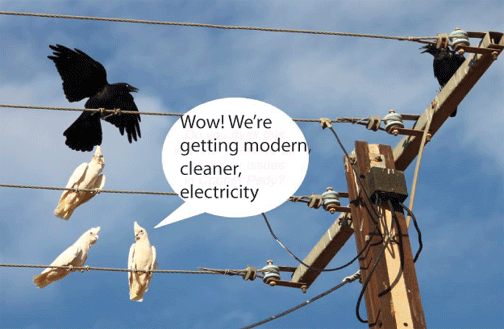
“With ARENA’s support, EDL is seeking to integrate up to 2 MW of solar PV, 3 MW of wind generation and enabling technologies into its existing 3.9 MW diesel power station at Coober Pedy,” Mr Frischknecht said.
This ambitious project may demonstrate a combined approach for powering off-grid Australian communities that currently rely solely on expensive trucked-in diesel.
Yanni Athanasiadis, the Vice Chairman of Coober Pedy’s Retail Business and Tourism Association said today, “This is very good news for Coober Pedy that ARENA have allocated $18.5M towards a potential renewable energy diesel hybrid plant.”……….
Vice President of Coober Pedy Opal Miners Association John Dunstan said that the Miners Associaton has offered to allow the Solar and Wind infrastructure to be situated on a site opposite the existing power station, that the Association uses for it’s own industry purposes.
“If it’s going to help bring cheaper power to the Coober Pedy residents and businesses, the Miners Association are very willing to allow the installations of the 2 MW of solar PV, 3 MW of wind generation on it’s land.”
“Currently EDL have erected a wind monitor at the location to monitor wind speeds at Coober Pedy for the next 12 months to help determine what size turbines will be used”, said Dunstan. “Coober Pedy’s current wind turbine is 0.15MW but these new turbines will be over twice the size.” he said.
.Mr Frischknecht said the project will include short-term energy storage, fast start diesel engines and an advanced control system to enable smooth operation.
“These enabling technologies have been successfully tried and tested by Hydro Tasmania at the ARENA-supported King Island Renewable Energy Integration Project and this represents an opportunity to see them evolve for use on the mainland and in an outback community that has few alternative energy options,” Mr Frischknecht said.
“Further demonstration of these technologies is expected to reduce costs over time and improve opportunities for future deployment without subsidies…….http://cooberpedyregionaltimes.wordpress.com/2014/07/14/proposed-18m-renewable-energy-diesel-hybrid-project-at-coober-pedy/#more-8751
Australian banks face risks if Renewable Energy Target is gutted or abolished
 Banks Also At Risk From RET Threat http://www.energymatters.com.au/index.php?main_page=news_article&article_id=4392 15 July 14, There’s a lot more riding on Australia’s Renewable Energy Target than just clean power, Australians taking control of their energy bills and thousands of jobs. Last week we mentioned a risk to the retirement savings of millions of Australians should the RET be gutted or abolished.
Now its been revealed Australian banks are holding nearly $900 million worth of large scale energy certificates (LGCs) connected to the Renewable Energy Target. The Australian states the banks include ANZ, Macquarie Group, Westpac and Commonwealth Bank; which hold 20 per cent of LGCs.
The value of these certificates has been fluctuating wildly as the argy-bargy over the RET continues. The Australian cites an example of LGCs plummeting from $30.50 per megawatt hour to $26.05 shortly after the appointment of climate-change sceptic Dick Warburton as head of the RET review. LGCs then hit a low of $22.43 in June due to uncertainty of the outcome of the review.
However, when Senator Ricky Muir weighed in on the subject of supporting renewables last week, their value reached $30.80. Uncertainty over the future of the RET isn’t just affecting LGC value. The situation is driving investment away from Australia and the longer the situation goes on, the more difficult it will be to attract local and foreign investment back as these investors will increasingly see Australia as wishy-washy on renewables and subsequently, high risk.
Pacific Hydro recently announced plans to cut 10 per cent of its Australian workforce due to uncertainty over the carbon tax and Renewable Energy Target.
It’s quite a ridiculous situation given the amount of investment and number of jobs at risk; along with other benefits. It’s become even more incredulous in light of the the Government’s own modelling showing the RET will reduce power bills for end consumers. Even with the facts firmly established, the Government is instead choosing to perpetuate myths about the RET.
Home renewable energy storage now available in Australia
 PowerLegato Energy Storage System Available In Australia http://www.energymatters.com.au/index.php?main_page=news_article&article_id=4390 14 July 14 AU Optronics Corp. (AUO) has announced its PowerLegato commercial and home energy storage system is now available to Australian customers.
Available in 7.2, 4.8 and 2.4 kWh models, PowerLegato can be used in both on-grid and off-grid applications and boasts among the world’s highest energy density in such a unit. AUO says the PowerLegato can store an average 25% more energy per kilogram of weight than competing products.
Very competitively priced, the PowerLegato is the recipient of iF and Reddot design awards and the software that runs the system, EnergyOptimizer, also won this year’s iF Communication Award.
The PowerLegato’s hybrid inverter and charger architecture, EnergyOptimizer software and battery management system (BMS) helps ensure maximized power independence, safe operation and longer battery life. The system has been made to be as user-friendly as possible and incorporates a password protected touch panel.
The PowerLegato’s 48v lithium-ion batteries are made in Japan and feature over current, over temperature, over voltage and undervoltage protection.
The unit is IP31 rated, meaning it is protected from condensation.When PowerLegato is installed in conjunction with a solar panel system, the main power supply will come from the PV system during favourable conditions and once the PowerLegato is fully charged; surplus exported to the mains grid. During the night or on days with heavy cloud, the energy stored in PowerLegato can be used first and the mains grid acts as a backup. The system can also operate fully stand-alone from the grid.
The PowerLegato 7200, 4800 and 2400 is available in Australia from Energy Matters. For further enquiries and pricing details, call 133 SUN or contact Energy Matters via www.energymatters.com.au.
In April 2010, AU Optronics Corp was listed among the top 100 green companies in China. One of its subsidiary companies is BenQ Solar, the manufacturers ofBenQ solar panels.
The home energy storage revolution is at a point reminiscent of the rooftop solar revolution just a few years ago – the products are rapidly decreasing in price and the range available is growing at a fairly rapid clip. Just last week we announced the Samsung SDI All In One home energy storage system is now also available in Australia from Energy Matters
Related:
PowerLegato datasheet (PDF)
New Senator Ricky Muir out to save Australian Renewable Energy Agency (Arena) from theAbbott axe
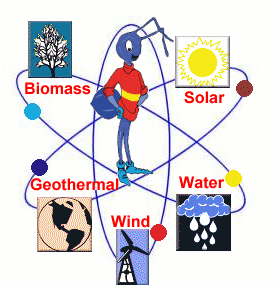 Ricky Muir seeking to save the Australian Renewable Energy Agency Lenore Taylor, political editor theguardian.com, Tuesday 8 July 2014 Senator is seeking to amend the carbon tax repeal bills to stop $435m in funding being stripped from the clean energy body Motoring Enthusiast senator Ricky Muir has emerged as a surprise would-be saviour of the $2bn Australian Renewable Energy Agency (Arena), seeking to amend the carbon tax repeal bills to stop $435m in funding being stripped from the clean energy body and promising to try to stop its abolition.
Muir’s amendment is very similar to one already circulated by the Australian Greens, and seeks to stop immediate funding reductions for Arena, which the government is seeking to abolish with separate legislation to be voted on in September.
The move raises the possibility that the crossbench could frustrate the government’s intention to abolish Arena. Palmer United party senators have already promised to stop the government’s plan to abolish the Clean Energy Finance Corporation and the existing renewable energy target.
But the government is already seeking to effectively close Arena ahead of legislation passing, refusing to reappoint board members as their terms expire. The government wants to return $1.3bn in Arena funding to the budget, and then have the industry department oversee around $900m in funding deals that have already been struck.
Muir’s amendment would stop the immediate $435m funding cut announced by the Coalition last September, but a spokesman for the Victorian senator said it was the first step in an attempt to retain the body.
“Ricky wants to preserve Arena. He is in favour of renewable energy and he thinks it is doing great work,” the spokesman said. Muir’s intervention comes as the Senate prepares to pass the package of bills repealing the carbon tax on Wednesday or Thursday, with the backing of the three Palmer United party senators and others on the new crossbench.
PUP’s Senate leader, Glenn Lazarus, introduced PUP’s only amendment to the main carbon tax repeal bills on Tuesday, reversing the onus of proof so that power retailers must show they have passed on cost savings to households.
As previously reported by Guardian Australia, PUP is also finalising amendments to legislate its dormant ETS, which it has announced will be part of the bill to repeal the climate change authority.
PUP has said its amendments will retain the CCA to advise governments on when a set of conditions are met to activate the Australian ETS. The negotiations are about exactly what actions will be required by trading partners the United States, the European Union, South Korea, Japan and China for the Australian ETS to be enacted.
At times PUP leader Clive Palmer has referred to the other countries having to have an ETS, but another proposal is that they would need to have an “effective” carbon price at a certain level, meaning they might be achieving significant greenhouse gas reductions through different policies.
The uncertainty about the amendment means the Climate Change Authority Repeal Bill will be considered separately to the rest of the carbon tax repeal legislation. It is unclear whether the government is considering the amendment.
Introducing the PUP’s power pricing amendments, Lazarus said the Australian ETS would occur “if the day comes when our American trading partners, the US, China, the EU, Japan and Korea set up an emissions trading scheme.”
Lazarus said the carbon tax repeal was “historic”.
It is understood the PUP senators and independent senator Nick Xenophon and DLP senator John Madigan are still considering how they will vote on the legislation to repeal Arena, but may back the Greens and Muir and refuse to allow its abolition.http://www.theguardian.com/world/2014/jul/08/ricky-muir-seeking-to-save-the-australian-renewable-energy-agency?cmp=wp-plugin
Sydney gets world’s first solar integrated house
 World’s first building-integrated solar system built in Australia http://ecomento.com/2014/07/08/worlds-first-building-integrated-solar-system-built-in-australia/ July 8, 2014 – NextPremium.co Many people looking to go (at least partially) off the grid install rooftop solar panels, but a house purpose-built for solar power is another matter entirely.
The first building-integrated solar energy system was recently installed in a house in suburban Sydney, Australia, CleanTechnica reports.
The house’s rooftop array thin-film photovoltaic panels with a solar-thermal duct system that warms and cools the air. While the top layer produces electricity like any other solar panel, heat trapped between the layers is also used by the house.
Australian steel manufacturer Bluescope produced the $5 million system with government assistance in the form of a $3.2 million loan grant from the Australian Renewable Energy Agency (ARENA). Government money is often an important factor in getting projects like this off the ground (no pun intended).
Whether integrated solar catches on remains to be seen, but at least the public will now get a chance to see what this technology can do. This post appeared first on NextPremium.com
Cheap effective storage for renewable energy – ” pumped hydro”
 How pushing water uphill can solve our renewable energy issues The Conversation, Andrew Blakers Director of the Centre for Sustainable Energy Systems (CSES) at Australian National University 9 July 2014
More and more renewable energy sources are being plugged into Australia’s electricity grids. South Australia, for example, will get 40% of its electricity from wind and solar once the Snowtown wind farm is completed later this year.
But if renewable energy is ultimately to dominate the market, we will need ways to store the energy so we can use it round the clock. The good news is that it is easy to store energy. All you need is two small reservoirs – one high, one low – and a way to pump water between them.
This technique, called “off-river pumped hydro energy storage”, can potentially provide the energy storage that Australia needs to embrace renewables fully. It’s cheap, too.
How pumped hydro works
When there is excess electricity, water is pumped through a pipe or tunnel, to the upper reservoir. The energy is later recovered by letting the water flow back down again, through a turbine that converts it back into electricity. Efficiencies of 90% in each direction are possible.
Pumped hydro is by far the most widely used form of energy storage, representing 99% of the total. Worldwide, pumped hydro storage can deliver about 150 gigawatts, mostly integrated with hydroelectric power stations on rivers………..
There is little opportunity for Australia to develop on-river hydroelectric power, because of environmental and other constraints. But, there are vast opportunities for short-term off-river energy storage. A typical site would comprise a pair of small reservoirs connected by a pipe through which water would be cycled daily, together with a pump and turbine, powerhouse and power lines.
Australia has thousands of excellent potential sites in hilly areas outside conservation reserves, with typical elevation differences of 750 m. They don’t need to be near a wind or solar farm.
Off-river electricity storage has several advantages over typical on-river facilities:
- There are vastly more potential sites
- Sites can be selected that do not clash with environmental and other values
- The upper reservoir can be placed on top of a hill rather than in a valley, allowing the elevation difference to be maximised
- No provision needs to be made for floods (typically a major cost).
A system comprising twin 10-hectare reservoirs, each 30 m deep, with a 750 m elevation difference, can deliver about 1,000 megawatts for five hours.
Between 20 and 40 of these systems would be enough to stabilise a 100% renewable Australian electricity system……..http://theconversation.com/how-pushing-water-uphill-can-solve-our-renewable-energy-issues-28196
Australia’s solar energy revolution is underway
Australia’s solar boom has only just begun Echo Net Daily Giles Parkinson, RenewEconomy 6 July 14 Australia is expected to spend some $55 billion on new electricity generation over the next decade and a half, but two thirds of this will be in the form of solar technology, and nearly half in rooftop solar PV.
These forecasts are included in Bloomberg New Energy Finance’s Market 2030 outlook, which includes detailed forecasts for Australia and Asia, both of which have major implications for the coal industry – exporters and local generators.
The most striking prediction is that for solar PV, which BNEF says will dominate capacity and investment over the next decade and a half. It expects 15.8GW of rooftop solar to be built in Australia out to 2030 – mostly on the basis of fundamental economics.
It suggests the payback for rooftop solar will halve to just three years by 2030. That is based on no subsidies and no carbon price, but it argues that it is still a compelling proposition to households.
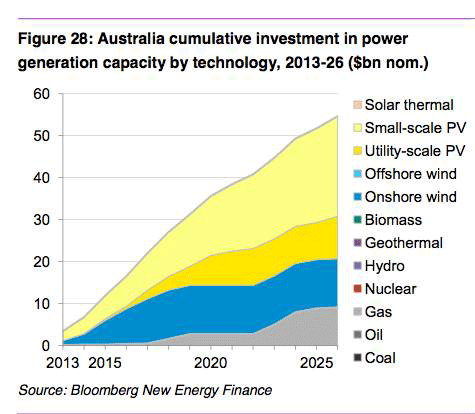
“Australia, like Japan, has high retail electricity prices which, combined with continuously reducing technology costs, are the main reasons for the small-scale PV adoption rate,” it writes.
“The favourable economics of the small-scale PV technology – ie, the reduction in payback period – will drive the sixfold increase in small-scale PV capacity and the technology’s contribution to total capacity additions between 2013 and 2030.”
BNEF expects households and businesses will invest another $24 billion on rooftop solar.
While the speed and breadth of the rooftop solar deployment will be influenced slightly by policy changes, the deployment of large-scale renewables is almost entirely dependent on the state of policies such as the renewable energy target…….http://www.echo.net.au/2014/07/australias-solar-boom-just-begun/
Renewable energy certificate prices to rise, regardless of what Tony Abbott says
 Ignore Abbott, renewable energy certificate prices should rise, Business Spectator TRISTAN EDIS 2 JUL The key barometer of the health of the renewable energy sector, particularly wind power, is the price of large-scale renewable energy certificates or LGCs. These certificates are the currency through which the electricity retailers comply with the large-scale Renewable Energy Target and make up more than half the revenue a wind farm earns (the other component is the underlying price for wholesale electricity).
On the day prior to Clive Palmer’s press conference with Al Gore, LGCs plumbed a low of $21 on the spot market. The market had only ever gone this low once before, in early 2007 when the final RET target was just 9500 gigawatt-hours.
The day after the Palmer-Gore press conference they surged to as high of $32, but then subsided and just yesterday changed hands at $28.70.
This is way too low and does not reflect the economics of renewable energy projects nor the political situation surrounding the Renewable Energy Target. Instead it reflects how the market is punch drunk from one bad piece of news after another enveloping the scheme in a cloud of uncertainty. ………
Complete repeal of the scheme with existing holders and producers of LGCs left stranded appears highly unlikely. Even as Joe Hockey was decrying wind farms as “utterly offensive”, he also told Alan Jones that they couldn’t leave those holding contracts high and dry. After all, the people on the hook are power retailers and banks – hardly the enemies of the Coalition. Also, in response to questioning from Climate Spectator, Environment Minister Greg Hunt told an audience of several hundred in May that no matter what comes out of the RET review, the scheme will continue…………https://www.businessspectator.com.au/article/2014/7/2/renewable-energy/ignore-abbott-renewable-energy-certificate-prices-should-rise
Australia’s wind energy brought down wholesale wind prices, (but not passed on to consumers)
 Big savings from renewable energy target but consumers miss out, SMH July 2, 2014 Peter Hannam Environment Editor, The Sydney Morning Herald While Prime Minister Tony Abbott says renewable energy significantly increase electricity bills, a new study finds wind energy actually forced down wholesale power prices by more than $3.2 billion over six years – but that little of the savings flowed through to consumers. Mr Abbott on Tuesday said the renewable energy target, which has largely driven investment in wind farms, was ”very significantly driving up power prices”.
”It’s precisely the opposite,” John Foster, one of the authors of the study that has been submitted to a review of the target, said. “The [target] – and the stimulation of wind – has increased supply and flattened out the expensive peaks.”
For instance, modelling of 30 minutes of heavy demand for electricity in Victoria on January 31, 2011 showed the wholesale price of $1.4 million would have ballooned to $45.6 million had only coal and gas-fired power plants had been able to respond.
Mr Abbott’s statement has been interpreted as signalling his government may weaken or scrap the target requiring at least 20 per cent of power from renewable sources once a review into the scheme is complete………
Once other costs including the purchase of renewable energy certificates were taken out, the target delivered a net benefit of $870 million from 2007 to 2012, the study found.
Little of that benefit reached consumers, though, with a lack of transparency masking just how much retailers snagged of the gains, Ms Molyneaux said. “We don’t see evidence of consumer prices going down.”
Debate over the target is expected to intensify with coal baron Clive Palmer saying last week his party will use its balance of power in the new Senate to preserve the existing target – now set at 41,000 gigawatt-hours of renewable energy by 2020 – until at least 2016, whatever the recommendations of the government’s hand-picked review panel………
Among the states, Victoria was the biggest beneficiary, snaring $2.37 billion of the $3.2 billion in wholesale savings. It hosts the second-largest wind turbine capacity of the states and can tap the largest – in South Australia – because of good transmission connections, the researchers said.
NSW lagged with only $136 million in wholesale savings because of its modest wind farm presence, while wind farm-free Queensland had barely any savings at all.
By 2012, wind farms were also responsible for reducing carbon emissions at the rate of 4 million tonnes a year, the study said.
Separately, the latest Cedex report by energy consultants Pitt & Sherry found carbon emissions from the National Electricity Market fell 10.4 per cent, or 18 million tonnes, in the two years of the carbon tax.
A fall in electricity demand contributed part of the drop, as did a switch to more wind and hydro electricity. Coal supplied 73 per cent of the power to the National Electricity Market – which serves eastern Australia – a year to the end of June, almost certainly a record low, according to Hugh Saddler, principal consultant with Pitt & Sherry. Gas supplied 12.7 per cent, hydro 9.6 per cent and wind 4.7 per cent.
Windy conditions over the past week saw wind farms supply 14.5 per cent of the generation in NSW, South Australia, Tasmania and Victoria from Monday to Saturday.
At 4.25am on Friday, South Australia’s wind generation exceeded demand in the state for the first time, according to Infigen Energy, a wind farm operator.
”The greatest significance of these figures is probably the demonstration that the [market] is sufficiently robust to be able to accommodate such large shares of wind generation, with no effect on the supply of electricity to consumers,” the report said. http://www.smh.com.au/federal-politics/political-news/big-savings-from-renewable-energy-target-but-consumers-miss-out-20140702-zstn1.html#ixzz36XYUb9LS
Solar storage project to be funded by Australian Renewable Energy Agency
 Australian Renewable Energy Agency to fund solar storage solution http://www.abc.net.au/news/2014-07-01/arena-funds-solar-storage-technology/5552394 1 Jul 2014,
AUDIO: ARENA funds breakthrough solar storage technology (ABC Rural)
“Sunverge Energy plans to work with energy retailers to offer solar packages that include its innovative storage solutions. “This approach has the potential for fast, widespread adoption of the technology, increasing the supply of renewable energy in Australia.”
The investment comes at an interesting time for ARENA which was put in place by the previous Labor Government to promote and implement renewable energy solutions but faces a cut in funds under the Coalition.
Politics aside, ARENA is still endeavouring to meet its charter with $1 billion worth of committed funding for projects to be rolled out over the coming years.
“Now the other the other thing I should emphasis is we have over a billion dollars of existing commitments and the Federal Government is very much behind keeping those.
“Out of that billion odd dollar less than a third of it has actually been spent. “So there is an awful lot to do and an awful lot of benefits to yet come out of the ARENA project.”
Victorian town Yackandandah going for Totally Renewable energy
Energy builds for Yackandandah renewables target http://www.abc.net.au/local/photos/2014/06/27/4034789.htm By Nick Fogarty
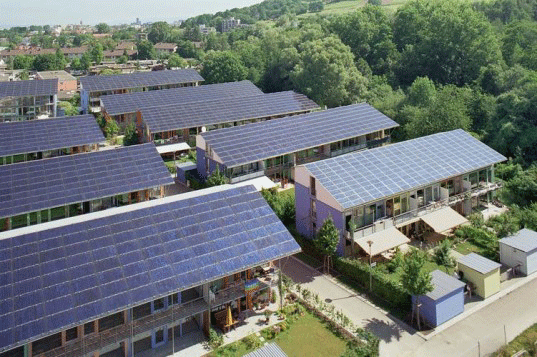
Members of TRY heard about Wildspoldsried – which produces three-times its total energy needs from renewables – at a community energy congress in Canberra last week. TRY spokesperson, Matthew Grogan, said their hope is that Yackandandah will be producing 100 percent of its own energy needs from renewables by the year 2022.
“We’ve got incredible fossil fuel resources … it’s tried and true technology and there’s a lot of it there,” Mr Grogan said. “But we know the damage that it causes and it’s at crisis point, the damage that that’s causing. “In addition to that brown coal we’ve also got one of the world’s best profiles of solar energy.”
TRY is encouraged by the fact that north-east Victoria receives more solar radiation than Germany, the world’s largest producer of solar energy. The switch to renewables has also brought financial benefits for Wildspoldsried, Mr Grogan said, from “energy tourism” and the sale of excess power back into the grid.
Wildspoldsried made the switch with stunning speed, having aimed for a target of 100 percent renewables within 10 years, but achieved the goal in five years. It’s early days for the Yackandandah group, but a community-owned petrol station and an already-high uptake of solar among residents shows a willingness to look for alternatives.
Yackandandah is not alone in its vision, with around 50 other Australian communities attending last week’s congress.
Mr Grogan said TRY had already approached local supermarkets (the area’s largest energy users) and funding bodies to sell their vision. “We know the technology is out there, we know solar panels are coming down and batteries are coming down as well in price,” Mr Grogan said. “It’s a really exciting phase to be honest, we’re just approaching it with a lot of creativity and taking any opportunities as they arise.”
Clive Palmer’s position will prevent Abbott from destroying renewable energy industries
 Ross Garnaut praises Clive Palmer’s decision to block abolition of Renewable Energy Target, ABC News By political correspondent Emma Griffiths and Kerry Brewster 27 Jun 2014, The man who helped design Australia’s current carbon pricing scheme has praised Clive Palmer over his decision to block the abolition of the Renewable Energy Target.
Economist and carbon pricing expert Professor Ross Garnaut says the Palmer United Party’s position to vote to retain the RET and other key climate change bodies will have “important” and positive effects. “We’re in a better position than we were before this news,” he told the ABC’s 7.30 program on Thursday. “We’re in a better position than when we were facing abolition of carbon pricing, major tampering with the Renewable Energy Target, abolition of the Climate Change Authority, abolition of the Clean Energy Finance Corporation. “It may not be the ideal way of doing things, but Mr Palmer’s support for keeping existing arrangements will have important effects.”
On Wednesday, Mr Palmer revealed his party would vote with the Coalition in the Senate to repeal the carbon pricing scheme if lower power prices were locked in, a condition the Government says it is “happy” to enshrine in law.
However PUP will vote to block the Government’s bid to abolish the Clean Energy Finance Corporation, the Renewable Energy Target and the Climate Change Authority. Continue reading
Coalition’s own modelling shows that their renewable energy policy is wrong
Renewable energy cheaper: reviewFINANCIAL REVIEW : 25 JUN 2014 Electricity prices fall – not rise – as more renewable energy is deployed, according to modelling done for the federal government’s review of the renewable energy target, in a finding which undermines the central argument in the Coalition’s bid to repeal the scheme.-…. (Subscribers only) http://www.afr.com/p/national/renewable_energy_cheaper_review_8dDTjd57IgYLxk4jV6IVsO
Australia’s rapid growth in renewable energy
The result is up from 13.14 per cent in 2012.
Clean Energy Council chief executive David Green said both energy efficiency and renewable energy had an important role to play in building a stronger, cleaner economy, and 2013 represented another exciting year for the uptake of these technologies.
“Last year saw another year of steady growth for solar power and wind energy in Australia, despite sustained uncertainty about the key policy settings for the sector. Australia’s renewable energy potential is massive, but we have so much more to do to fully unlock it,” Mr Green said………
Key results from the Clean Energy Australia 2013 report include:
· $5.2 billion was invested in clean energy during the calendar year, the third successive year that domestic investment has been more than $5 billion.
· Almost 1.25 million solar power systems were installed at the end of 2013, meaning more than 3.1 million Australians now live or work beneath a set of solar panels.
· Renewable energy produced 14.76 per cent of Australia’s electricity in 2013 – enough to power the equivalent of almost 5 million homes. While hydro had an extremely strong year, wind and solar power use also grew to record levels.
· Approximately 21,000 people were employed by the renewable energy industry at the end of 2013. This is several thousand fewer than the year before, mainly due to a contraction in the market for household solar power.
· The largest wind farm in the Southern Hemisphere, the Macarthur Wind Farm, opened in 2013. In total, Australia’s 1639 wind turbines across the country provided enough electricity to power the equivalent of 1.3 million homes. http://www.theaustralian.com.au/business/latest/renewables-generation-grew-to-nearly-15-in-2013/story-e6frg90f-1226965788613
1 This month

of the week – Australians for War Powers Reform (AWPR)
To see nuclear-related stories in greater depth and intensity
 Antinuclear