Solar power proving a good investment for Western Australians
 Solar Helps Delay New Power Station In Western Australia http://www.energymatters.com.au/index.php?main_page=news_article&article_id=4319 26 May 14, WA’s solar households and businesses are collectively generating as much power as a major traditional power station. According to The West Australian’s Daniel Mercer, given forecasts from Synergy of a continuing increase in solar uptake, the State Government now says a new power station would not need to be constructed in the state until 2029.
Synergy predicts there could be as much as 1500MW of solar capacity feeding into Western Australia’s electricity grid by 2020.
The rate that Western Australians have embraced solar is quite stunning. The numbers of solar power systems connected to the grid has grown from just three in June 2007 to 135,419 (Synergy customers) as of March 2014.
According to solar provider Energy Matters, a 5kW solar panel system installed in Perth can return a financial benefit of between $1,577 and $2,196 annually. In some cases, a system of this size can basically blow away an average household’s power bills.
Energy Matters’ Australian Solar Index estimates the internal rate of return of a system installed in Perth to be 17.8%; making it one of the best investments around.
However, as is the case in the rest of Australia, clouds are gathering on the horizon for WA’s solar industry and potential new solar households. The Renewable Energy Target review is currently under way and concerns have been expressed regarding possible outcomes; including a gutting of subsidies.
Current support for acquiring systems can translate to thousands of dollars off the cost of going solar. The uncertainty surrounding the review means the best time to go solar in Western Australia could be right now.
Going solar in WA doesn’t necessarily mean a significant up-front financial outlay. Energy Matters offers a zero-deposit “Save As You Go” arrangement to eligible customers where monthly repayments can be less than what would otherwise be spent on mains-grid supplied electricity.
Rio Tinto finds that solar is the best way to power Queensland off-grid mine
 Rio Tinto to deploy 6.7MW solar PV + storage at off-grid mine
REneweconomy By Giles Parkinson on 22 May 2014 A ground-breaking, $23.4 million project to cut out daytime diesel consumption at Rio Tinto bauxite mine at Weipa could unlock billions of dollars of similar investments in the mining industry – which is weighed down by soaring energy costs.
Mining giant Rio Tinto is to host a $23.4 million solar PV plus storage facility at its Weipa bauxite mine, that is the first of its type and scale in the world and could unleash billions of dollars of similar investment. Rio Tinto Alcan – with the help of the Australian Renewable Energy Agency – is to install a 1.7MW solar PV array at its Weipa bauxite mine later this year, and then add a further 5MW of solar PV and battery storage.
The Weipa mine is located on the Cape York Peninsula at the very northern tip of eastern Australia, and relies on expensive diesel that has to be shipped in.
The first phase of the solar project – to be built with First Solar thin-film modules and constructed by Australian solar firm Ingenero – is expected to reduce daytime diesel demand from the mine’s 26MW diesel generator by up to 20 per cent.
However, the addition of more solar and storage to balance out intermittency could reduce daytime diesel consumption altogether at certain times.
The Weipa project was the first of around 70 submissions – worth several billion dollars of investment – from mining operators in Australia for funding for such ground breaking projects under ARENA’s $400 million remote energy program.
The ending of the commodities boom has made miners more focused on energy costs. Continue reading
Victoria’s Ararat wind farm project in jeopardy, due to uncertainty over Renewable Energy Target
 Wind future up in the air with renewable energy target uncertainty http://www.thecourier.com.au/story/2301438/wind-future-up-in-the-air-with-renewable-energy-target-uncertainty/?cs=12 By KARA IRVING May 22, 2014, THE developer of the Ararat Wind Farm project believes the federal government’s renewable energy target (RET) review has caused uncertainty among green energy developers, investors and retailers. RES Australia is behind the $450 million Ararat Wind Farm to be built on the Pyrenees Highway about 17 kilometres from Ararat. Head of development Annette Deveson said the ongoing RET review had stirred uncertainty in the green energy sector.
“We are working very hard to get the Ararat Wind Farm ready for construction,” Ms Deveson said. “But the government is causing uncertainty in the industry and for us.” The federal government is currently reviewing the RET to examine the operation, costs and benefits of the scheme.
The RET was developed to ensure 20 per cent of Australia’s electricity comes from renewable sources by 2020.
Although a decision had yet to be made about the renewable energy targets, Ms Deveson said the review had caused difficulties for prospective green energy developers. “They are not out there in the market looking for new projects,” she said. “As a business you are uncertain of your future market.”
Ms Deveson said the potential change impacted on investor confidence. Ararat Rural City Council last Friday made a submission to the RET review to pledge the importance of the project.
Mayor Paul Hooper said it was likely the wind farm would not be built because of the review. “The project will create 13 full time jobs after the construction has finished,” he said. “About $75,000 will be put back into community grants.”Mr Harper said the Ararat community would miss out if the project were to cease.“We will not see those benefits come to town, nor the long term employment opportunities,” he said.
“The community misses out.” kara.irving@fairfaxmedia.com.au
Renewable Energy Target must stay – call by Australia’s sugar industry
Sugar industry calls for Renewable Energy Target to stay http://www.abc.net.au/news/2014-05-22/sugar-industry-calls-for-renewable-energy-target-to-stay/5471258 22 May 14, Sugar millers say any move to scrap the Federal Government’s Renewable Energy Target would be a ‘retrograde’ step.
Set up under the Howard government with the goal of having 20 per cent of Australia’s electricity generated through renewable sources by 2020, the RET scheme is currently under review.
The Australian Sugar Milling Council, in a meeting with the review panel today in Brisbane, described the program as being ‘absolutely critical’ for the industry.
ASMC chief executive Dominic Nolan, says the sugar industry has invested heavily in renewable energy and the current uncertainty surrounding the scheme’s future, places further development in jeopardy. “The sugar milling sector has invested over $300 million over the past 5 years [and] we’ve got more than $1 billion identified for further investment in energy efficiency and co-generation.”
The review is considering what role the RET scheme has had on reducing emissions and its impact on electricity prices as well as the costs and benefits to industry.
Mr Nolan insists any change to the current scheme could force sugar millers to ‘undo’ their more recent advances in burning the fibrous by-product ‘bagasse’, to produce electricity for the national grid.
He says the industry would take a $35 million hit in lost revenue and there would be no cost incentive for millers to be more energy efficient.
“We export 80 per cent of what we make, we price our sugar on the global market, we live and die on the basis of our cost of production.
“Our major competitors, Brazil, Thailand and even India, are heavily down the path around co-generation and biofuels and we need to keep pace in order to maintain our international competitiveness.”
Weipa solar project brings cheap energy to remote Queensland community
 AUDIO: Cheaper electricity from Weipa solar project final act of axed renewable energy agencyhttp://www.abc.net.au/news/2014-05-22/cheaper-electricity-from-weipa-solar-project-final/5469770?section=qld Many remote communities around Australia are totally reliant on costly diesel fuel to provide the electricity that most take for granted. But the far north Queensland mining town of Weipa is adding solar energy to the mix in what’s being called an Australian first. It could be the final act for an agency that’s facing the axe after last week’s savage federal budget.
Australia’s energy utilities fight to stop rooftop solar
 Solar Industry Battle — Australian Energy Utilities Pushing For End To Rooftop Solar Subsidies, Clean Technica 21 May 14 Australia’s major energy utilities are now united in pushing for an end to rooftop solar subsidies – pitching the incumbent utilities into a major battle with the solar industry and consumer groups over the treatment of household solar.
AGL Energy became the last of the major utilities to throw its hat into the anti-solar ring, declaring on Friday in its submission to the renewable energy target review that rooftop solar subsidies were no longer needed.
AGL Energy also said the large scale renewable energy target would be impossible to meet – earning an extraordinary rebuke from PowerShop, the Australian offshoot of New Zealand energy giant Meridian Energy, its joint venture partner in Australia’s largest renewable energy project, the 420MW Macarthur wind farm – of joining other utilities on the “dark side”.
The issue around support for solar, however, is now the major flash point for the industry. Given the stoppage in large scale developments because of uncertainty around the LRET, rooftop solar is currently accounting for the bulk of renewable energy investment in the country. It supports an industry that provides more than 11,000 jobs, and nearly $3 billion in investment in 2013, as well as supporting ongoing world-leading research.
Those jobs and investment are now under threat. Continue reading
Tasmania’s successful renewable energy industry faces loss of investment if Renewable Energy Target is scrapped
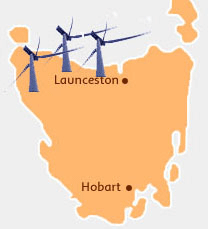 Hydro Tasmania warns scrapping Renewable Energy Target will kill off investment http://www.abc.net.au/news/2014-05-19/hydro-tasmania-warns-scrapping-renewable-energy-target-will-kil/5463404 By Lucy Shannon Australia’s largest renewable energy generator Hydro Tasmania has warned major projects will not go ahead if the Federal Government scraps the Renewable Energy Target Scheme.
The scheme, established by the Howard Government in 2001, aims to have 20 per cent of Australia’s electricity coming from renewable sources by 2020.
The Federal Government is reviewing the RET scheme, as required under legislation. Prime Minister Tony Abbott has faced strong internal pressure to scrap the target from both the Nationals and many Liberals who believe it has pushed up power prices.
Hydro Tasmania, a state-owned business, has made its submission to the review panel. Hydro Chief Stephen Davy says the RET has stimulated $18 billion worth of investment across the country. Mr Davy says if the scheme is scrapped the proposed $2 billion dollar wind farm for Tasmania’s King Island will not go ahead.
“It would almost certainly terminate any further investment in large scale renewable energy projects, and put at risk the long term viability of existing renewable energy assets,” he said.
A second electricity interconnector with Victoria would also be unlikely.
Hydro ‘vital to economy’
The submission points to the “vital and ongoing economic contribution” Hydro makes to Tasmania’s economy. It says more than $60 million was spent with Tasmanian businesses to support the construction of the Musselroe wind farm and more than 200 workers will be employed over the life of the project.
Mr Davy says with the expected abolition of the carbon price the RET is the “only long-term, large scale policy that can drive the uptake of zero-emissions energy sources.”
Last year, Hydro Tasmania announced a record pre-tax profit of $238 million dollars largely on the back of the carbon price which added $70 million to its coffers.
The Greens Senator, Christine Milne says Tasmania should be very fearful of the Government’s review.
“It’s been clear from the start that this is a sham, virtually all the people they’ve got on the review are climate sceptics, they support the old fossil fuel sector and they see renewable energy as competition to the old order,” she said. A spokesman for Greg Hunt says the review’s terms of reference specifically mention sovereign risk as an issue that will be considered by the panel.
There is no fixed date yet for when the report will be delivered.
Victoria’s Premier Napthine pledges support fo wind energy: I wish I could believe him,
 Napthine pledges continued push for renewable energy investment http://www.abc.net.au/news/2014-05-19/napthine-pledges-continued-push-for-renewable/5461022 19 May 2014, Premier Denis Napthine says he will work with renewable energy companies in south-west Victoria, amid concerns about their future.
The Federal Government axed the Australian Renewable Energy Agency and Clean Energy Finance Corporation in last week’s budget.
It is also reviewing the Renewable Energy Target.
Portland-based company Keppel Prince makes towers for wind turbines and says 150 jobs are at risk.
Dr Napthine says he hopes planned projects go ahead.
“We’ll continue to work with the Federal Government, work with the alternative energy industry, whether it’s wind energy, geothermal energy and wave energy, to see what prospects there are to continue investment in alternative energy under the new frameworks,” he said.
reactions to Australia’s Anti Renewable Energy Budget
 The Anti-Renewable Energy Budget – Reactions http://www.energymatters.com.au/index.php?main_page=news_article&article_id=4303 As feared, the first Budget delivered by the new Government has seen the axe swung upon the Australian Reneweable Energy Agency (ARENA).
According to the Budget papers:
“The Government will achieve savings of $1.3 billion over five years from 2017-18 (including $223.3 million in 2018-19, $455.9 million in 2019-20, $125.4 million in 2020-21 and $131.1 million in 2021-22) by abolishing the Australian Renewable Energy Agency and repealing the Australian Renewable Energy Agency Act 2011. Funding of $1.0 billion over eight years will remain available to support existing priority projects.” The Government says the savings will be redirected to repairing the Budget and to fund policy priorities.
The Clean Energy Council expressed its disappointment in the announcement.
“A global race for renewable energy is on, and the removal of ARENA will see potential Australian and international investors now look to countries with much stronger support for renewable energy innovation, meaning we may well miss out on billions of dollars of investment and highly-skilled jobs,” said Deputy Chief Executive Kane Thornton.
“Abolishing ARENA is a backwards step for the ‘clever country’ at a time when job losses in traditional industries like the automotive and manufacturing sectors mean we need new, innovative industries to take their place and fill this void.”
 The Australian Solar Council also reacted strongly, calling the budget a “boulevard of broken dreams” for the solar industry.
“The Budget has delivered a trifecta of broken promises to the solar industry,” said John Grimes, Chief Executive of the Australian Solar Council. “The Government promised the Australian people an additional million solar roofs by 2020. The Budget contains no funding to make this happen. A Million Solar Roofs is a mirage.”
“The Government promised to maintain the Australian Renewable Energy Agency (ARENA) but, instead, the Budget has delivered a death warrant for ARENA. Unless the Senate stands up to the Government, ARENA will be abolished.”
“The Government promised to maintain the Renewable Energy Target but every indication is this key policy will also be thrown on the scrapheap.”
The Sustainable Energy Association of Australia called the axing of ARENA a regressive step.
“ARENA was designed to increase the supply of renewable energy in Australia and to make it more affordable. It has been welcomed by both the industry and by investors, who were looking at Australia as a growing market for clean technologies,” said SEA Chief Executive Kirsten Rose.
“Unfortunately, the proposed scrapping of ARENA means it’s likely that investment in a cleaner energy sector won’t happen in Australia, but will go to other countries with stronger, more stable policy environments for renewable energy,” said Ms Rose.
Greens leader Senator Christine Milne said the Budget was “just a tunnel vision for motorways and stranded fossil fuel assets that will be worthless to our economy within decades.”
Abbott government promised energy efficiency project – now dumped

 Government dumps promise for energy efficiency agency http://www.theaustralian.com.au/business/latest/government-dumps-promise-for-energy-efficiency-agency/story-e6frg90f-1226917229830 TRISTAN EDIS MAY 14, 2014 The budget papers have stated that the Government will drop an election promise to re-establish Low Carbon Australia – a body that sought to provide specialist financing for energy efficiency projects. Low Carbon Australia was originally established by the Rudd Labor Government but was subsequently merged into the Clean Energy Finance Corporation around a year ago.
Complicating matters for the government was that they wished to abolish the CEFC while at the same time reviving Low Carbon Australia. Yet its staff and functions had been integrated into the CEFC.
To date the government has been unable to pass the necessary legislation to repeal the act which enables the CEFC to continue to operate and finance projects.
Solar power – floating panels a benefit for water short South Australia
Floating solar power plant would reduce evaporation, proponent says ABC News By Matthew Doran 12 May 2014 A solar power plant which is planned for South Australia would float on a wastewater treatment basin.
Geits ANZ is proposing the venture and director Felicia Whiting thinks it would prove at least 50 per cent more efficient than a land-based solar power system.”It’s very much like a traditional solar array with the exception that it’s designed to float on the water,” she said. (Below, Solar floating panels in France)
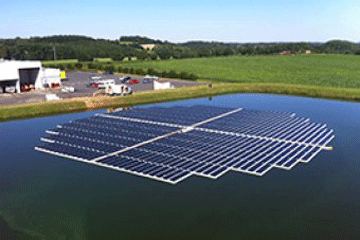
“The mass of water has a cooling effect on the panels and we also include a cooling system utilising the water body itself to be able to keep the water panels … at a constant temperature. “When that happens, you get a longer life of the photovoltaic panels and you get a greater efficiency.” In actual design, Ms Whiting says the floating solar plant would not differ greatly from a traditional one.”The system is designed from a HDP (high-density polyethylene) pipe, which is the buoyancy, and it has a structural steel pontoon sitting abreast that and then the PV (photovoltaic) panels slot into the structural system,” she said. “It’s like a racking system with buoyancy.”
She says having the wastewater largely covered by a floating plant brings other benefits. “We’re at about 90 per cent water evaporation prevention for the surface area that we cover,” she said. “In a dry climate like South Australia that’s about 2.5 metres of water evaporation depth annually that you’re saving.
“It’s a world-first for putting a system of this nature on a treated wastewater plant basin.”
Other evaporation savers in the planning
Geits has floating plants operating in France, Italy and Korea………
Geits has applied to the Essential Services Commission for an electricity generation licence.
Ms Whiting hopes construction on the ponds of the Northern Areas Council waste treatment plant can start in the second half of this year.
“Because it’s a prefabricated system we’re looking at a commissioning date of around September, October,” she said. http://www.abc.net.au/news/2014-05-12/floating-solar-power-plant-would-reduce-evaporation/5445912
Lady Elliot Island to add wind and solar to its existing hybrid energy
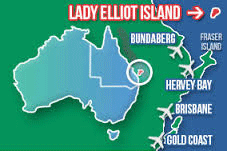 More renewable energy in the wind for Lady Elliot Island http://www.abc.net.au/news/2014-05-12/more-renewable-energy-in-the-wind-for-lady-elliot/5445804 By Frances Adcock Operators on Lady Elliot Island, north-east of Bundaberg, will consider installing wind generators to further improve the island’s energy efficiency.
One-hundred new solar panels will be installed at the island’s hybrid solar power station, which has provided more than half of the island’s power since 2008.
The island’s resort manager, Peter Gash, wants the island to become even more reliant on renewable energy.
“By Christmas we’d hope to do it by, we’d like to install a 10 kilowatt wind generator which will continue to feed power into the battery and into the grid, night and day, and if we can get the success we are hoping for with our 10 to 12 kilowatt wind generator and our 73 kilowatt of solar we will be hopeful we will be somewhere up around 90 per cent renewable,” he said.
He says after the installation of the new panels, more than 70 per cent of the island will be reliant on renewable energy. “We have a barge coming out on Wednesday and there is 125 panels on that and they are 260 watts per panel and they will go up on two separate roofs, and that’s a 16 and 17 kilowatt system,” he said.
“So another 33 kilowatts, so another 125 panels, so that puts us up at 73 kilowatts of power which is a substantial amount of power.”
Evidence mounts on benefits of Renewable Energy target: South Australia’s wind energy success
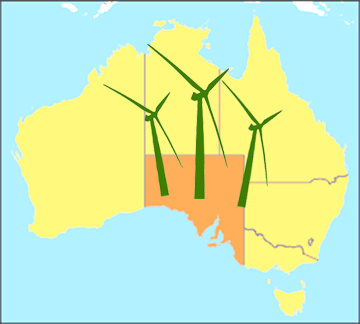 South Australian Wind Power – Economical And Effective http://www.energymatters.com.au/index.php?main_page=news_article&article_id=4299 A new report shows wind power in South Australia has not increased wholesale electricity prices, nor created a need for additional back-up power generation capacity.
Around a quarter of South Australia’s electricity is now sourced from wind power; growing substantially from just 6% in 2005/6.
The eight year study of South Australia’s electricity sector by Windlab Systems shows during the period between 2005 and 2013, wholesale electricity prices have not risen, even if the full cost of the renewable energy certificates (REC) is included. Publicly available data from the Australian Energy Market Operator (AEMO) was utilised for the study.
Reliance on expensive and emission-intensive peaking power plants has reduced as have electricity imports from Victoria states the report. Windlab says electricity related carbon emissions have plummeted 34% even though power consumption has remained stable.
“The findings should provide clear guidance to the Federal Government’s Renewable Energy Target (RET) review panel that wind energy and by association the RET should not be a scapegoat for explaining increases in domestic and business energy costs,” says Roger Price, the CEO of Windlab. “The study further underpins the conclusions of the Clean Energy Council’s commissioned report into the positive cost implications of the RET.”
The Clean Energy Council report indicates abolishing Australia’s Renewable Energy Target (RET) would see Australian households paying billions more for electricity.
A copy of Windlab’s study report can be viewed here (PDF).
The evidence is mounting that the benefits of Australia’s Renewable Energy Target far outweigh the costs. Even so, there are fears the RET review is heading towards a “predetermined and biased outcome” that will result in the loss of thousands of jobs, billions of dollars of investment and also create additional financial burden on Australian households and businesses.
Matthias Corman, Australia’s Finance Minister – Abbott’s mouthpiece for killing renewable energy
 Axing of renewable energy agency would add to broken promises, clean energy industry says, http://www.smh.com.au/federal-politics/political-news/axing-of-renewable-energy-agency-would-add-to-broken-promises-clean-energy-industry-says-20140512-zr9v1.html#ixzz31XjkyEzz May 12, 2014 – The Abbott government is planning to abolish the primary agency supporting clean energy in Australia. The planned axing of the primary agency supporting clean energy in Australia by the Abbott government would break pre-election commitments and send investment in emerging technologies off-shore, an industry group says.
Fairfax Media is among outlets reporting on Monday that the federal government will axe the Australian Renewable Energy Agency (ARENA) in Tuesday’s budget as part of efforts to curb spending.
ARENA, whose budget had been previously cut to $2.5 billion to 2022, would reportedly be left with about $1 billion to complete projects already backed. The agency, established through the combination of other bodies in July 2012, aims to increase the supply and competitiveness of renewable energy such as large-scale solar photovoltaic plants and other emerging technologies.
What’s disappointing here is that the Coalition really went out of its way prior to the election to restate their commitment to ARENA,” said Kane Thornton, deputy chief executive of the Clean Energy Council.
The Abbott government also backed the Renewable Energy Target (RET) before the September election, saying it would support the existing goal of supplying 41,000 gigawatt-hours of clean energy, such as from wind farms and hydropower, by 2020. It has since set up a review of the target led by businessman and climate change sceptic, Dick Warburton, which the renewable energy industry fears will dilute or delay the RET goal.
Axing the agency “would send concerning signals to the renewable energy sector broadly but also to investors around the world who are making investments under ARENA, and are watching closely the outcome of the RET review”, Mr Thornton said.
On ABC’s Radio National on Monday, Finance Minister Mathias Cormann said “too many agencies” were responsible for similar functions and needed to be cut back.
“This is about making government as efficient and effective as possible,” Senator Cormann said.
Support for emerging renewable energy technologies, which include geo-thermal and marine power, should be seen in the context that all other major forms of energy had got their start with backing from governments, Mr Thornton said.
“The very first coal-fired power stations, the first gas and the first nuclear power stations were all supported by the government, and wouldn’t have happened without government help,” he said.
Among the projects getting ARENA support was AGL’s 155 megawatt-capacity solar photovoltaic power plants at Nyngan and near Broken Hill in NSW. ARENA and the NSW government supplied $166.7 million and $64.9 million, respectively, with AGL supplying the remainder of about $208 million, according to the agency.
“That wouldn’t have happened without the support of ARENA,” Mr Thornton said.
“A lot of large-scale solar companies will really question why they are still operating in Australia, and will really focus their efforts on other parts of the world,” he said.
Economically depressed North Tasmania stands to lose wind farm project if Renewable Energy Target is cut.
Renewable energy fears for wind farm http://www.examiner.com.au/story/2274842/renewable-energy-fears-for-wind-farm/?cs=95 By EMILY BAKER 12 May 14, CUTS to the renewable energy target could affect a wind farm planned for the state’s economically depressed North, the project’s developer says. Low Head Wind Farm founder and director Shane Bartel yesterday said any significant cuts to the target would affect the $60 million wind farm proposed for an area east of Low Head.
Mr Bartel said the project would hire between 30 and 50 contractors in the building phase and employ five to 10 people post- construction.The project was partly driven by the federal target of 20 per cent renewable electricity production by 2020, which is under review.Low Head Wind Farm’s development application has been submitted to the government.”It’s up to the Commonwealth to approve that – we’re still working with them on that,” Mr Bartel said.
“I certainly think (a decision will be made) this month … to date, there have been no serious issues with it.”
The Australian reported on Saturday that Hydro Tasmania – which has power-purchasing agreements for its major Tasmanian wind farms Musselroe and Woolnorth – would suffer financially if there were significant cuts to the renewable energy target.
The state-owned company would not comment on the report leaked to the national newspaper but said ongoing reviews of the target had created uncertainty around wind farm revenues. “Hydro Tasmania did not confirm to The Australian the losses claimed in the story,” a statement from Hydro Tasmania said.
“It is our expectation that a positive outcome from the RET review will in fact make these figures meaningless, and our wind farm investments will be delivering the expected returns.”
Clean Energy Council deputy chief executive Kane Thornton said more than $10 billion of investment in renewable energy would be damaged if the scheme was changed. “Leaving the policy alone would create approximately 18,400 jobs by the end of the decade, additional investment of $15 billion in large-scale renewable energy and lower power bills over the medium term,” he said.
1 This month

of the week – Australians for War Powers Reform (AWPR)
To see nuclear-related stories in greater depth and intensity
 Antinuclear