Sundrop Farms in the news again for all the right reasons
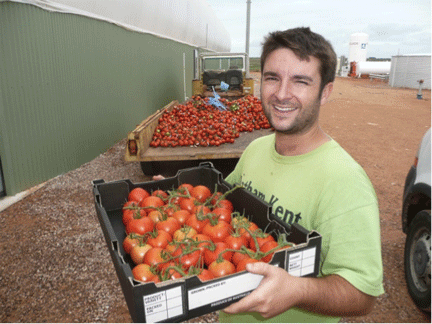 Sundrop Farms’ greenhouse expansion project approved by council | PHOTOS, The Transconntinental By Steph Say and Ryan Smith Aug. 13, 2014,
Sundrop Farms gets the green light Sundrop Farms’ innovative greenhouse expansion project has been given the green light with the support of Port Augusta City Council.
Provisional development approval was granted at Tuesday night’s Development Assessment Panel meeting.
Sundrop Farms will now start making detailed designs for the 20 hectare expansion before getting a final construction price from a selected contractor. This process is expected to take two months when the final decision on whether the development will go ahead will be made.
If the expansion does go ahead it is expected to create 200 ongoing jobs for the city and a major economic boost.
Sundrop Farms chief technology officer Reinier Wolterbeek said the provisional approval was one of the major boxes that needed to be ticked to get the expansion underway. “It’s a major milestone, we’ve worked a long time to get to this stage,” he said. We’ve worked with the .2 hectares here [inPort Augusta] for about four years…with ups and downs but we’ve achieved the yields we are after.”
Sundrop Farms uses cutting-edge solar thermal technology to desalinateseawater for irrigation and to heat and cool greenhouses.The expansion would involve the building of a 20 hectare, four greenhouse facility which will produce more than 15,000 tonnes of tomatoes a year for metropolitan markets across Australia.
Solar energy will be harnessed using a power tower which absorbs heat reflected from a field of mirrors………http://www.transcontinental.com.au/story/2484815/sundrop-farms-greenhouse-expansion-project-approved-by-council-photos/?cs=1286
Solar power used for greenhouse farming in a dry harsh area
Growing Food In The Desert With Solar Power http://www.energymatters.com.au/index.php?main_page=news_article&article_id=3488 by Energy Matters, 27 Nov 12,
Australia is home to a food production revolution – Sundrop Farms near Port Augusta is successfully growing high-value crops using seawater and sunlight in what would be considered extremely hostile conditions for horticulture.
With energy and water costs responsible for up to 70% of total farm expenses in some regions and irrigation accounting for 70 percent of the 3,240 cubic kilometres of water withdrawn for human use, Sundrop Farms’ progress is being keenly monitored.
The Sundrop Farms System uses solar power to desalinate seawater to produce freshwater for irrigation and to generate electricity to power its climate-controlled greenhouse.
The seawater based greenhouse ventilation also cleans and sterilises the air, making it possible to grow crops without chemical pesticides.
The Sundrop Farms System allows land normally not deemed suitable for agriculture or horticulture to produce large quantities of food. The company claims its hydroponics based greenhouse growing methods yield 15-30 times more produce per hectare than conventional field production. Each hectare of Sundrop Farms greenhouses also directly employs between 5-7 people
Even the salt by-product of desalination has value – it’s mostly sold to third parties and some of the minerals are at times re-used in Sundrop Farms’ greenhouse as plant nutrients.
In addition to horticultural applications, the system can also be used for floriculture and aquaculture.
With modern food systems sometimes resulting in production occurring thousands of kilometres away from the point of consumption, Sundrop Farms type systems can also play a role in substantially reducing food miles; which can significantly add to the carbon footprint of food.
A planned 8 hectare expansion of the Port Augusta facility aims to produce 2.8 million kg of tomatoes and 1.2 million kg of peppers annually while saving the equivalent of approximately 4.6 million barrels of oil equivalent and 280 million litres of fresh water per year compared to a standard greenhouse in a similar location.
In coal hub Gladstone, solar energy powers 26% of housholds
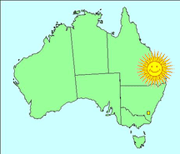 Quarter of houses rely on renewable energy http://www.gladstoneobserver.com.au/news/Why-we-rule-solar-race/2350835/ Ebony Battersby | 14th Aug 2014 DESPITE living in a coal-centric town, Gladstone residents are leading the nation in the switch to solar.
New figures reveal Gladstone homes are installing solar powered energy at rates faster than the rest of the country, coming in second on the list behind Bundaberg. About 26 per cent of Gladstone households are now relying on renewable energies.
Bundaberg tops the list with 38 per cent of households now solar users, with Mackay falling shortly behind at 23 per cent.
The Climate Council CEO Amanda McKenzie praised the efforts of Gladstone residents. “It’s great to see Gladstone residents are taking matters into their own hands, taking control of their power bills and reducing their carbon emissions at the same time,” she said. “Gladstone households already know that renewables make sense economically and environmentally, now it’s time for the rest of the country to catch up.”
Renewable energies are the one-way road to the future, according to local solar consultant Murray Kay. “We power the shop here entirely on solar,” he said.”Business has been great here in Gladstone. Solar is the way of the future.”
However, the solar versus coal argument presents a conundrum for local who invested in both the renewable and finite industries. On July 2, Queensland breached the negative energy price barrier for several hours, driven by the prevalence of rooftop solar.
This is not uncommon during the evening when power use is minimal. But on July 2, the milestone was reached in the middle of the day.
Regularly priced at around $40-$50 per megawatt hour, the plunge to zero confirmed solar was not only powering the state.
Predictions declare that 75 per cent of Australia’s residential buildings and 90 per cent of commercial buildings will be powered by rooftop solar in as little as ten years, according to UBS data. It is estimated that the demand for electricity has plummeted by 13 per cent over the past four years.
Good news: Single-Axis Tracking Solar PV Project for Moree, New South Wales
Construction Set To Begin At Australia’s First Single-Axis Tracking Solar PV Project Clean Technica 12 Auh 14 While Australia’s carbon policy seems to have hit a dead-end, good news from the renewable energy sector continues to pour in. The country will soon see construction begin on its first solar photovoltaic power project with single-axis tracking feature.

The solar pv project owned by Fotowatio Renewable Ventures (FRV) will have a generation capacity of 70 MW (DC) and located at near Moree, New South Wales. The project will be supported by the Australian Renewable Energy Agency (ARENA), which has provided more than A$101 million……
A single-axis tracking panel equipped with horizontal axis trackers would partially rotate about the horizontal axis, and track the sun’s movement through the day in the north-south direction. Panels with vertical axis tracking will track sun’s movements through the day in the east-west direction. Horizontal single-axis tracking arrangement is simpler, easy to maintain, and cheaper than vertical axis tracking arrangement.
ARENA, established as part of the Clean Energy Future policy of the Labour government, has lost favor from the current Liberal government that has spared no effort to ban it. The fact that the agency has survived the axe till now is quite miraculous. But its future continues to hang in the balance. The ARENA repeal bill was tabled in the Australian lower House of Parliament in June, and was then referred to a Senate committee which is seeking stakeholders’ views. http://cleantechnica.com/2014/08/11/construction-set-begin-australias-first-single-axis-tracking-solar-pv-project/
120 objections to Canberra solar farm -(a co-ordinated fossil fuel lobby attack?)
Government swamped by 120 objections to the Uriarra solar farm Canberra Times, August 12, 2014 Kirsten Lawson Chief Assembly reporter for The Canberra Times. The government has been swamped by objections to the Uriarra solar farm, including from federal Labor MP Gai Brodtmann, who said it would damage the character and appeal of the village, block views, affect the rural feel and probably depress house prices.
Ms Brodtmann’s intervention will put pressure on the government, as will the weight of opposition from residents of Uriarra Village across the road from the planned solar farm. More than 80 are among about 122 people to submit submissions.
Just six submissions are in favour, and only one of them if from a resident. John White wrote briefly in support. “Quite frankly, as the village is advertised as being a sustainable eco village, I do not understand the other resident views for not supporting such a wonderful opportunity the village could have gained by this solar farm.”….. http://www.canberratimes.com.au/act-news/government-swamped-by-120-objections-to-the-uriarra-solar-farm-20140811-102rbe.html#ixzz3AEwFXw3x
Australia’s largest solar photovoltaic systems research facility underway at Queensland University
Work starts at UQ Gatton on Australia’s largest solar photovoltaic systems research facility University  of Queensland News, 6 August 2014 The University of Queensland and First Solar have begun construction on a 3.275 megawatt solar photovoltaic research facility at UQ’s Gatton campus.
It will be the largest solar photovoltaic (PV) research facility in the southern hemisphere and support innovation in Australia’s renewable energy industry by providing world-leading research on large-scale solar power systems.
“The researchers using this facility will provide new insights on integrating large-scale renewable power plants with conventional electricity grids,” said UQ Vice-Chancellor and President Professor Peter Høj.
“These researchers are some of the best in the business, and their teamwork with an innovative global company such as First Solar will ensure optimal returns on a substantial Australian government investment in renewable energy research and development, with excellent implications for society and the environment.”
Covering 10ha, the plant will be Queensland’s largest solar PV project and produce enough electricity annually to power more than 450 average Australian homes, equivalent to displacing more than 5600 metric tonnes of carbon dioxide or removing 1590 cars from the road.
It is a pilot plant for new and existing large-scale Australian solar projects, including the Nyngan (102MW) and Broken Hill (53MW) plants being built by First Solar for AGL PV Solar Developments Pty Ltd, a subsidiary of AGL Energy Limited in New South Wales.
In addition to supplying and installing about 40,000 advanced thin-film photovoltaic panels in ground-mounted arrays, First Solar will also provide engineering, procurement and construction for the Gatton PV Pilot Plant………http://www.uq.edu.au/news/article/2014/08/work-starts-uq-gatton-australia%E2%80%99s-largest-solar-photovoltaic-systems-research
Australian Renewable Energy Agency (ARENA) funding large solar farm at Moree
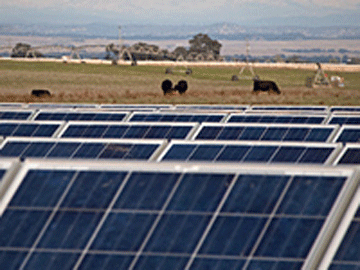 Moree Solar Farm puts big solar in big sky country 4 Aug 14 The Australian Renewable Energy Agency (ARENA) today announced $101.7 million of support for Moree Solar Farm, which upon completion will be one of the largest solar plants in Australia.
ARENA CEO Ivor Frischknecht congratulated renewable energy company Fotowatio Renewable Ventures (FRV) who are set to begin construction on the project shortly. “Moree Solar Farm will be the first large-scale solar plant in Australia to use a single-axis horizontal tracking system, where panels follow the sun across the sky to capturesunlight and maximise power output,” Mr Frischknecht said.
“The 56MWac (70MWp) farm will produce enough electricity to power the equivalent of 15,000 average New South Wales homes.”
Mr Frischknecht said the Moree community would benefit from the project and had been keen supporters, along with the Moree Plains Shire Council, for several years. “The $164 million Moree Solar Farm will benefit the local economy and will also deliver an estimated 130 local jobs during the construction phase over 2014–2016.
“More than 50 locations around Australia were investigated before the developers selected the site 10 kilometres out of Moree in NSW’s northern wheat belt, an area known as ‘big sky country’. “The location benefits from high levels of solar radiation and also allows the solar farm to connect to the national electricity grid.”
Mr Frischknecht said the project, which is also being supported by the Clean Energy Finance Corporation, would aim to demonstrate that large-scale solar power plants can be constructed and operated within Australia’s major electricity grids.
“ARENA will work with FRV to share the valuable knowledge gained in delivering the Moree Solar Farm with the rest of the industry,” Mr Frischknecht said. “We recognise reducing early mover disadvantage and supporting the transfer ofinformation will help advance development of more utility scale solar plants in Australia.”
Moree Solar Farm is a solar flagship project ARENA inherited when it was established in July 2012. Last week, another former flagship project supported by ARENA, reached a major milestone when the first of approximately 1.35 million panels were installed at AGL’s large-scale solar plant in Nyngan, NSW.
Despite Tony Abbott, Solar Power is shining in Alice Springs
Red Centre keeps shining as solar technology hub http://www.abc.net.au/news/2014-07-22/alice-springs-solar-hub-technology/5613534 ABC Rural By Lauren Fitzgerald Central Australia is continuing to attract international investment from the solar industry, despite the Alice Solar City initiative wrapping up more than a year ago. In its five-year history, the program helped hundreds of homes and businesses install solar panels and solar hot water systems.
The general manager of the Centre for Appropriate Technology (CAT), Lyndon Frearson, says Alice Springs now also has a reputation as a hub for developing technology.
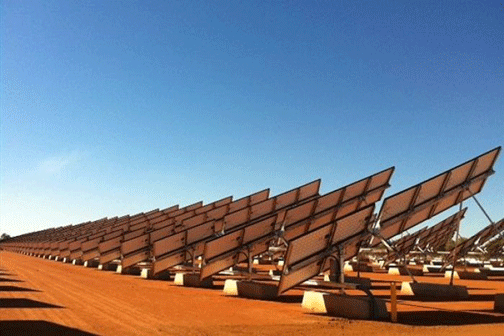
He says companies from China, Japan, Taiwan, Germany, Switzerland and America are all installing different solar PV modules at the CAT site. “The range of their investment varies depending on the size of the facility that they want to put in,” he said.
“Some of them are putting in little five-kilowatt systems as a test site, where they might be putting a number of small test sites around the world, through to a Swiss-based company which only has three R & D [research and development] facilities in the world, and they chose to build one of them here.
“And certainly those investments are in the order of hundreds of thousands of dollars.”
Mr Frearson says local businesses like the Alice Springs Airport are also demonstrating an ongoing commitment to solar. “They received a subsidy to do their original project, but they’ve just [installed] 320 kilowatts off their own bat, completely their own investment. “And that’s both a maturing of the economics, that the solar panels are cheaper and the energy prices have changed.
“But it also shows a degree of confidence that they as an organisation and their board have in the technology to better run their business. “And there are a number of examples within Alice and broader afield throughout central Australia where different entities are making those decisions.
“So I think the legacy of Alice Solar City in central Australia is strong. “Certainly it’s something we see people talking about with pride, and we still see people outside of Alice focus very heavily on and see Alice Springs as a leader in this space.”
In Australia rooftop solar is starving profits from coal power
 Game-changing rooftop solar boom is squeezing the profits out of coal power in Australia http://www.treehugger.com/renewable-energy/rooftop-solar-boom-squeezing-profits-coal-power-autralia.html Michael Graham Richard (@Michael_GR) 14 July 14
Solar power briefly turned electricity prices negative in Queensland Australia is known for its coal, which provides over 80% of its electricity and is a big export, but someday soon it might be known for its solar power. Thanks to rapidly falling solar PV prices, there’s been a rooftop solar boom in Australia. It’s now reaching a point where few coal generators made money last year, and even fewer will make profits this year… Wholesale energy pricing even briefly went negative in the middle of the day (see graph below) recently in the middle of the day in Queensland where there is 1.1 gigawatt of solar spread over more than 350,000 buildings.
Australia as a whole has about 3.4GW on 1.2 million buildings! Eventually, coal won’t be able to compete with solar at any price:
let’s imagine that the wholesale price of electricity fell to zero and stayed there, and that the benefits were passed on to consumers. In effect, that coal-fired energy suddenly became free. Could it then compete with rooftop solar?
The answer is no. Just the network charges and the retailer charges alone add up to more than 19c/kWh, according to estimates by the Australian energy market commissioner. According to industry estimates, solar ranges from 12c/kWh to 18c/kWh, depending on solar resources of the area, Those costs are forecast to come down even further, to around 10c/kWh and lower. (source)
The next step will be for people to get some storage and go off the grid to avoid having to pay these network charges. Australian solar installers are already reporting that “between 15 and 20 per cent of solar customers are asking about storage, and that rate is increasing each month.”
With companies like Tesla having ambitious goals to cut battery prices down over the next few years with gigafactories, the combo of cheap solar PV + cheap battery storage will be hard to beat. Dirty power sources will simply stop being competitive. Australia has lots of sun and high network costs, so it’s at the forefront of this movement. But most other countries will follow at their own pace. The best things we can do to accelerate the switch over to clean energy is to stop subsidizing fossil fuels, create regulation that is more friendly to rooftop solar (net-metering, for example), and put a price on carbon emissions.
Solar battery hybrid storage system for Muswellbrook, New South Wales
 Photon to build solar plus storage unit for NSW broadcast tower REneweconmy, By Giles Parkinson on 15 July 2014 German-based solar group Photon Energy is to install a large scale solar plus battery storage hybrid power system at a telecommunications tower in New South Wales that it says could be the fore-runner of thousands of such installations across the country.
The system, to be installed at a broadcast tower operated by BAI near Muswellbrook, will provide 24/7 power through a 39kW solar array and a 215kWh battery storage installation. An 8kW diesel generator will provide standby in emergencies.
Photon Energy says once successfully tested the concept could be implemented on thousands of sites across Australia.
Michael Gartner, the head of Photon Energy‘s Australian operations, said the project was a great step forward“ for solar power to provide clean and economically viable power supply for remote sites.
“The potential for solar PV in the replacement of conventional energy sources is substantial and will bring cost benefits and emissions savings for Australia in the coming years and decades.“
“… We can show how to incorporate solar PV into any given energy system and prove that using abundant sunlight for your own power consumption is the way forward.”……..http://reneweconomy.com.au/2014/photon-build-solar-plus-storage-nsw-broadcast-tower-37262
South Australia now punishing domestic solar generators?
 Dennis Matthews 18 July 14 Electricity retailers in SA are required by law to pay domestic solar electricity generators only 7.6c a kWh (the minimum retailer payment) and this will automatically decrease to 6c/kWh now that the carbon pricing legislation has been repealed by the Abbott government. Yes, no ifs or buts, automatically!
Given the grossly unequal lobbying and market power of electricity retailers versus domestic solar generators then this can only be described as a travesty. And things are only going to get worse for the household consumer with price increases already flagged by retailers and the monopoly network provider.
Whilst we wait with bated breath to see what happens to what retailers are going to charge us, thanks to Essential Services Commission (ESCOSA), retailers already know that they will pay 20% less to domestic solar generators.
Sydney gets world’s first solar integrated house
 World’s first building-integrated solar system built in Australia http://ecomento.com/2014/07/08/worlds-first-building-integrated-solar-system-built-in-australia/ July 8, 2014 – NextPremium.co Many people looking to go (at least partially) off the grid install rooftop solar panels, but a house purpose-built for solar power is another matter entirely.
The first building-integrated solar energy system was recently installed in a house in suburban Sydney, Australia, CleanTechnica reports.
The house’s rooftop array thin-film photovoltaic panels with a solar-thermal duct system that warms and cools the air. While the top layer produces electricity like any other solar panel, heat trapped between the layers is also used by the house.
Australian steel manufacturer Bluescope produced the $5 million system with government assistance in the form of a $3.2 million loan grant from the Australian Renewable Energy Agency (ARENA). Government money is often an important factor in getting projects like this off the ground (no pun intended).
Whether integrated solar catches on remains to be seen, but at least the public will now get a chance to see what this technology can do. This post appeared first on NextPremium.com
Australia’s solar energy revolution is underway
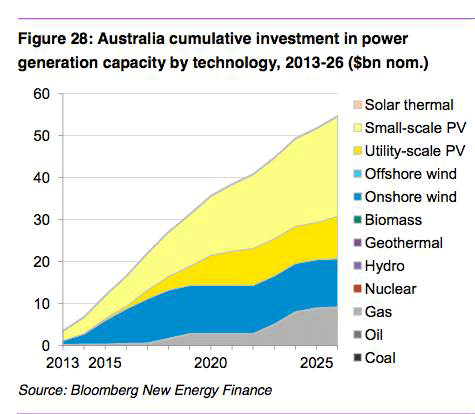
Australia’s solar boom has only just begun Echo Net Daily Giles Parkinson, RenewEconomy 6 July 14 Australia is expected to spend some $55 billion on new electricity generation over the next decade and a half, but two thirds of this will be in the form of solar technology, and nearly half in rooftop solar PV.
These forecasts are included in Bloomberg New Energy Finance’s Market 2030 outlook, which includes detailed forecasts for Australia and Asia, both of which have major implications for the coal industry – exporters and local generators.
The most striking prediction is that for solar PV, which BNEF says will dominate capacity and investment over the next decade and a half. It expects 15.8GW of rooftop solar to be built in Australia out to 2030 – mostly on the basis of fundamental economics.
It suggests the payback for rooftop solar will halve to just three years by 2030. That is based on no subsidies and no carbon price, but it argues that it is still a compelling proposition to households.
“Australia, like Japan, has high retail electricity prices which, combined with continuously reducing technology costs, are the main reasons for the small-scale PV adoption rate,” it writes.
“The favourable economics of the small-scale PV technology – ie, the reduction in payback period – will drive the sixfold increase in small-scale PV capacity and the technology’s contribution to total capacity additions between 2013 and 2030.”
BNEF expects households and businesses will invest another $24 billion on rooftop solar.
While the speed and breadth of the rooftop solar deployment will be influenced slightly by policy changes, the deployment of large-scale renewables is almost entirely dependent on the state of policies such as the renewable energy target…….http://www.echo.net.au/2014/07/australias-solar-boom-just-begun/
Solar energy a winner for homes in Caloundra and Iswich, Queensland
 Caloundra and Ipswich tops for solar: Energex Tony Moore BRISBANETIMES.COM.AU SENIOR REPORTER, 13 June 14 The retirees, holiday makers and young families of Caloundra and the working class city of Ipswich have Southeast Queensland’s highest proportion of solar systems according to a breakdown of Energex data.
The breakdown from Energex figures shows some remarkable variations from conventional thinking.
There are fewer solar systems in West End (295), Highgate Hill (210) and South Brisbane (70), than in Inala (982) or Durack (645).
There are more in Carindale (1523) and Rochedale South (1465) than in Premier Campbell Newman’s home suburb of Ashgrove (691).
Queensland Treasurer Tim Nicholls sparked a massive outcry last week when he described some solar energy users as part of the “champagne sippers and the latte set.”
Jeremy Rich, from one of Australia’s longest-running solar energy companies, Energy Matters, said Mr Nicholls’ comments were simply wrong. “It is obvious those statements are emotional statements, without looking at the data,” Mr Rich said. “Because when you look at the data it shows that it is totally the opposite,” he said. “It is the low to middle income areas of Australia that are hurting the most.”
Their company data is similar to the Energex breakdown, showing a major interest in solar energy in Ipswich, Capalaba, Browns Plains and Cleveland in four of the top five spots.
Central Ipswich – home to Swanbank power station – has 50 per cent solar energy penetration, Mr Rich said.
Ipswich homes under the postcode of 4305 – including the suburbs from Raceview through to Brassall – have 5197 solar installations.
Caloundra’s postcode of 4551 – including Caloundra, Caloundra West, Currimundi and Dickey Beach – has 6311 solar installations up to May 2014………
A quick top 10 of Energex’s solar hot spots and their postcodes are:
1: Caloundra 4551: 6311 solar installations
2: Ipswich central east 4305: 5197 solar installations from Raceview to Brassall
3: Advancetown/Gold Coast hinterland 4211: solar 4941 installations
4: Buderim 4556: 4379 solar installations
5: Beenleigh 4207: 4363 solar installations
6: Bray Park 4500: 3931 solar installations
7: Ipswich south-west 4300: Goodna/Camira to Springfield: 3930 solar installations
8: Amberley, Barellan Point and Blacksoil 4306: 3910 solar installations
9: Mt Cotton and Redland Bay 4165: 3810 solar installations
10: Gympie and its surrounds 4570: 3678 solar installations. http://www.brisbanetimes.com.au/queensland/caloundra-and-ipswich-tops-for-solar-energex-20140612-zs66n.html#ixzz34fZsRL6G
CSIRO’s breakthrough Solar Steam technology
Supercritical Solar Steam Could Rival Fossil Fuels http://www.energymatters.com.au/index.php?main_page=news_article&article_id=4338 10 June 14 A breakthrough by CSIRO scientists could see solar energy replace fossil fuels in the most advanced power stations in the world. A research program at the CSIRO Energy Centre in Newcastle focused on using solar power to create supercritical steam – super-hot, pressurised steam – to drive electric turbines in large-scale power plant.
The CSIRO team broke a world record for heating and pressurising steam using only solar thermal power in May. The work has been hailed as a coup for the renewable energy industry. Previously, only coal or gas-fired plants could achieve temperatures high enough generate supercritical steam.
Conventional solar thermal power plants currently generate subcritical steam – but CSIRO believes if these plants could be converted to supercritical steam power, the overall cost of solar electricity would be significantly lowered. “It’s like breaking the sound barrier; this step change proves solar has the potential to compete with the peak performance capabilities of fossil fuel sources,” said CSIRO Energy Director, Dr Alex Wonhas.
“Instead of relying on burning fossil fuels to produce supercritical steam, this breakthrough demonstrates that the power plants of the future could instead be using the free, zero emission energy of the sun to achieve the same result.”
Researchers used CSIRO’s test solar thermal plant in Newcastle to break the world record for solar steam, reaching temperatures of 570 degrees Celsius, at a pressure of 23.5 megapascals (a measure of force per unit area). It is this combination of enormous pressure and heat that makes the breakthrough such an important milestone for solar technology.
The CSIRO says the breakthrough was made possible through a $5.68 million research program supported by the Australian Renewable Energy Agency (ARENA) and collaboration with researchers from solar thermal giant, Abengoa Solar.
ARENA CEO Ivor Frischknecht said that while work remained before supercritical solar steam technology would rival fossil fuels, “This breakthrough brings solar thermal energy a step closer to cost competitiveness with fossil fuel generated power.”
Source
1 This month

of the week – Australians for War Powers Reform (AWPR)
To see nuclear-related stories in greater depth and intensity
 Antinuclear