Queensland’s anti solar energy government swings into action
Campbell Newman Government axes Queensland solar energy scheme, nation’s largest by: Darrell Giles The Courier-Mail July 02, 2012 AUSTRALIA’S biggest solar energy scheme is dead in the water, torpedoed by the withdrawal of funding by the Newman Government. The State Government is pulling $75 million out of a renewable energy power project, effectively killing off up to 400 jobs.
Regional Queensland was set to be home to one of the biggest combination solar and gas power plants in the world under a $1.2 billion scheme, a joint Federal-State Government and private partnership.
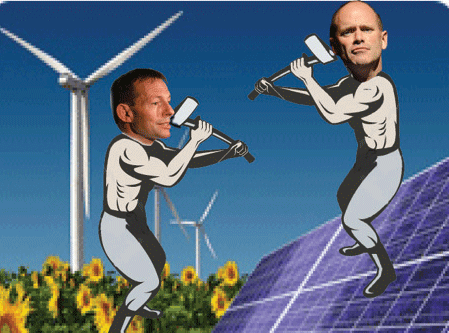
The Solar Dawn project would have used Australian-pioneered technology and transformed Chinchilla and the western Darling Downs into the nation’s mixed-energy capital. But the Liberal National Party has found a way to back out of an earlier Bligh government agreement and halt its contribution.
Premier Campbell Newman signalled soon after winning the March state election that he would look at pulling the plug on the $75 million investment if he could do it without risk to taxpayers. Minister for Energy and Water Supply Mark McArdle wrote to federal Energy Minister Martin Ferguson last week to confirm he had cut the Queensland contribution. Mr McArdle was understood to have told Mr Ferguson Solar Dawn was unable to meet the State Government’s funding agreement.
As a result, the agreement between the two governments was “terminated”…… Prime Minister Julia Gillard had committed $464 million, saying the project would support Labor’s carbon tax and keep the environment clean…… http://www.couriermail.com.au/news/queensland/campbell-newman-government-axes-queensland-solar-energy-scheme-nations-largest/story-e6freoof-1226413831562
Aboriginal and solar firms join in outback solar projects
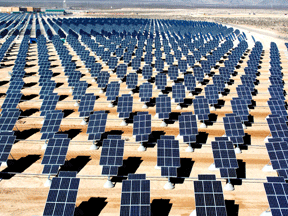
 Indigenous firm eyes solar power http://au.news.yahoo.com/thewest/business/a/-/wa/14049902/indigenous-firm-eyes-solar-power/ Peter Williams, The West Australian June 27, 2012, A new indigenous-controlled energy company has plans to build solar power systems in regional areas as big as any existing projects in Australia.
Carey Power, a joint venture between indigenous-owned mining services provider Carey Mining and Perth solar energy specialist Next Power, is targeting mine camps as well as remote communities and local governments.
Next Power chief executive and Carey Power executive director Kieron D’Arcy said Carey Power planned to install systems of up to 10 megawatts, equal to the size of the nation’s biggest solar plant being built in the Mid West. Continue reading
Queensland Premier Newman’s war on solar energy
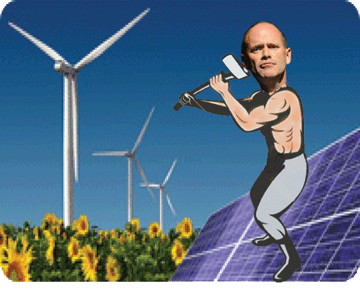 Can-do Campbell slashes Queensland solar PV tariffs, REneweconomy, By Giles Parkinson on 25 June 2012 One of the most depressingly predictable political back-flips has finally come to pass, with the Campbell Newman-led Queensland state government abandoning its commitment to the solar bonus scheme, and announcing it will slash its net feed-in tariff from a 44c/kWh to just 8c/kWh.
The dramatic move means that Queensland is the last state to remove the solar PV FiT, and replace it with a nominal amount. The 8c tariff will be reviewed in July 2013, and will end in July 2014 – leaving retailers to make only a “voluntary contribution.”
This is despite promises by Newman during the campaign that the solar bonus scheme would not be cut. But as we pointed out in this item in March, Can-do Campbell and the art of political risk, Newman intended to cut a whole range of climate and clean energy schemes. Newman has now brought an end to a variety of renewable energy schemes, including a $5 million grant for the Cloncurry solar PV project, and funding for geothermal research.
Newman also sought to exit a $75 million grant for the Solar Dawn project in the solar flagships program, but has found he could not. He may still be able to hold on to the money if Solar Dawn is unable to negotiate a power purchase agreement with the state government-owned utility. Continue reading
Community owned solar farm plan for Bacchus Marsh, Victoria
 Solar farm proposed for Bacchus Marsh, Melton Weekly, Moorabool Weekly, BY CLAIRE KNOX, 26 Jun, 2012 STATE and federal governments need to encourage smaller-scale community renewable energy (CRE) projects, according to sustainability leaders. They say promoting community-owned models could be the key to engaging the wider public in lowering carbon emissions.
Deb Porter, secretary of Moorabool Environment Group (MEG), said the group was looking at developing a community solar farm in Bacchus Marsh, with people purchasing shares. Continue reading
A New South Wales City Council sets up Australia’s largest solar powered streetlighting project
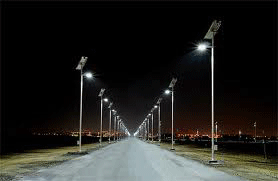 Shining light in renewable energy Goulburn Post, 22 Jun, 2012 GOULBURN Mulwaree Council is leading the way when it comes to combining renewable energy and street safety by installing more than 50 solar powered streetlights along Marys Mount Road.
The 3km stretch of road is believed to be the single largest solar powered streetlighting project for a councilowned and maintained road in Australia. The solar powered streetlights took three weeks to install, with local tradespeople contracted to assist with the project……..
Each stand-alone system comprises primarily the three major electronic
components, all working in unison.
1) Solar Panels – Absorbed radiation sent to through the controller to the batteries. The Solar Panels are monocrystalline and generally do not require maintenance.
2) Sealed Batteries – Supplying daily stored power. The batteries are sealed and require no regular maintenance.
3) Controllers – The Control Centre (operating, monitoring, regulating).
The controller automatically adjusts for the daylight savings throughout the entire year, and no manual adjustment is required.
The Cost of Life Analysis included the poles, solar panels, batteries, controller and fittings. This worked out to be $400 per pole/annum or approx five per cent of the Total Project value.
Goulburn Mulwaree Council has also installed solar panels at its Visitor Information Centre (installed by Ingenero Pty Limited), and is currently investigating options to install panels at its Aquatic Centre. Stage 1 of this process is now complete, with local company Sunup Solar and LED Lighting Systems installing the systems. Council is investigating the possibility of tendering for Stage 2 of an additional 5KW. http://www.goulburnpost.com.au/news/local/news/general/shining-light-in-renewable-energy/2598968.aspx
Harvey Norman aims to be an Australian leader in solar panel sales
 Harvey Norman invests in solar panels 19 June 12, http://news.ninemsn.com.au/article.aspx?id=8485955 Retailer Harvey Norman plans to be a market leader in the domestic solar industry after placing a substantial order for user-friendly solar panels. Continue reading
Solar panels in Australia- cutting mains electricity use and wholesale prices

 Solar Panels Cutting Australia’s Mains Electricity Consumption http://www.energymatters.com.au/index.php?main_page=news_article&article_id=3261 by Energy Matters Results of a study released earlier today show energy efficiency efforts and home solar power installations are reducing Australia’s mains grid supplied electricity consumption – and wholesale electricity prices too. Continue reading
Australia using less ‘baseload’ energy – largely thanks to solar panels
 more than half the cut in power use was due to photovoltaic solar panels, solar hot water systems and energy savings programs in Victoria and New South Wales that encourage use of more efficient lightbulbs and appliances.
the cost of solar energy and energy-efficiency schemes was modest compared with other factors pushing up electricity prices……
Solar panels linked to lower power usage, Illawarra Mercury, ADAM MORTON, 20 Jun, 2012 SCHEMES encouraging people to install solar panels and save energy have cut household power consumption and will restrict the pace at which electricity bills increase in coming years, a new analysis has found.
While solar incentive schemes have been criticised as an expensive way to reduce greenhouse gas emissions, an industry analysis has found they have led to a reduction in the amount of fossil fuel electricity drawn from the national power grid.
It suggests it is likely no new baseload power plants will be needed over the next decade.
Electricity consumption fell 3.2 per cent over the three years to 2011, ending years of dramatic increases and bucking projections that it would continue to soar due to economic and population growth. Continue reading
Distributed solar energy is transforming Australia’s electricity system
 Energy myths exposed: King Coal or King Solar? “ The Conversation, by Ray Wills, Adjunct Professor, School of Earth and Environment at University of Western Australia and Peter Newman Professor of Sustainability at Curtin University 16 June 2012, “…….. A new report was released by the Australian PV Association (APVA)… It reveals a total of 837 MW of PV was installed in Australia in 2011, capacity not considered in the BREE publication. Add 2668 MW from BREE to 837 MW from APVA and we find solar delivered an amazing 25% of new installed capacity in Australia in 2011. Revised proportions for the other generation is gas 29%, wind 33% and coal 14%. Renewables added a remarkable 58% of all electricity generation capacity in Australia in 2011.
King Coal is well and truly on the way out. What’s more, renewables now make up over half of all new power being generated in Australia.
There is a major challenge in Australia, and globally, to understand the rapidly changing scene of energy investment toward sustainable energy. The agencies responsible for reporting these metrics are not reporting the whole picture, because the conventional view of energy markets doesn’t consider you can generate a lot of electricity on homes……. Continue reading
A compelling case for Australian households to adopt solar energy
 The Australian Energy Market Operator report on solar photovoltaics,… recognises that solar PV can provide a compelling economic case for households as its costs fall and retail prices from fossil-fuel-dominated centralised grids continue to rise.
We are missing the boat on clean energy, BY: GILES PARKINSON : The Australian June 15, 2012, THE International Energy Agency was created 40 years ago, soon after the first major oil crisis, to ensure that OECD countries continued to have a secure supply of energy.
In the past few years, however, it has emerged as one of the loudest and most powerful advocates of clean energy.
The more it looks at the issues of climate change and energy security, the less it likes oil, gas and coal, and the more it is attached to what its secretary-general, Maria van der Hoeven, describes as a radical and early transformation of the world’s electricity systems.
A 685-page analysis released this week by the agency contains two important conclusions: renewable energy sources can do the job, Continue reading
CSIRO report dispels negative myths about solar power for Australia
Solar power has bright future – CSIRO, SMH, Ben Cubby, Environment Editor, June 15, 2012 THE myth that solar power is unreliable because clouds sometimes cover the sun has been dispelled by a world-first report produced by the CSIRO. While clouds or rainy weather drastically reduce the amount of electricity produced by solar panels, intelligent management of the power grid means panels and mirrors should still supply 40 per cent of
the nation’s energy in the future, the report said.
“People are worried about the reliability with little evidence, and that is limiting solar,” said Glenn Platt, a senior researcher in local energy systems at the CSIRO. “Solar intermittency is not an issue at the moment, but when it does become an issue there are solutions available to deal with it.” Continue reading
Demand for solar PV can only grow in Australia: get used to it!
An increase in electricity costs will increase demand for PV. Reading through AEMO’s report again (which we helped model), they define their “rapid uptake scenario” as being driven by “relatively large” increases in electricity price, “rapid system price reductions” and a “clear incentive” from Government. Under this scenario, they predict 18GW of rooftop PV by 2030.
We now have two out of three and arguably, the Carbon tax is the clear incentive.
get on board with PV or get out of the way. Its coming whether you like it or not.
NSW power price rises underscore case for solar REneweconomy, By Nigel Morris 13 June 2012, The Independent Regulatory and Pricing Tribunal (IPART) today released its final price determination for 2012-2013 electricity prices. Continue reading
Big Solar is NOT more beautiful than Small Solar energy
“Solar Flagships is an idea full of good intentions, but it is grandiose and cumbersome,” says Giles Parkinson, pointing out the project won’t be up and running until 2015; whereas the ACT Solar Auction will have projects up and running well before then.”
the Australian solar PV industry installed over 800 megawatts in the prior calendar year alone using a market-based policy mechanism which entirely avoided the need for government to get involved in picking a winning project
Solar Flagships – ‘Grandiose And Cumbersome’ http://www.energymatters.com.au/index.php?main_page=news_article&article_id=3247 by Energy Matters, 14 June 12, Seeing large scale solar getting a bit of a helping hand in Australia certainly isn’t a bad thing per se; but just how good a deal is it for the battling Aussie taxpayer?
AGL Energy and USA-based First Solar were recently announced the successful grantees in the Australian Government’s troubled Solar Flagships Program.
The $450 million project will see two solar panel based facilities established – one in Broken Hill and another in Nyngan. Together, the facilities will boast 159 megawatts capacity, enough to supply the electricity needs of approximately 30,000 homes. The Federal government is kicking in $129.7 million and the NSW Government has committed to provide $64.9 million to the projects; totalling $194.6 million in grants – or $1.22 per watt of capacity.
While AGL (and its shareholders), First Solar (and its shareholders) and Minister for Resources and Energy, Martin Ferguson may be rejoicing, some industry commentators haven’t shared the exuberance. Continue reading
Australia’s electricity networks can cope with plenty more Solar PV power
 Networks Should Have Nothing To Fear From Solar PV, Energy Matters, by Giles Parkinson, editor of RenewEconomy.com.au, 14 June 12, A new study led by the CSIRO has questioned the validity of fears that widespread deployment of solar PV could not be supported by the electricity grid, and says Australia could support a lot more solar PV with minimum fuss.
The integration of intermittent renewable energy sources such as wind and solar has been a major issue in discussions about the deployment of clean energy, but the CSIRO study says fears about solar have been overblown, in much the same way as they were about wind energy.
Glenn Platt, the head of CSIRO’s local energy systems division, who oversaw the team that wrote the detailed report, says it was commonly thought that the maximum amount of solar PV that could be supported by the grid without significant upgrades was 20 per cent.
“That’s a very common statement, but I’m not sure we have found much evidence to support that. The analysis shows we can have a heck of a lot more than 20 per cent,” Platt told RenewEconomy .
New solar project for Broken Hill will be operational by 2015
Silver city becomes solar city ABC Broken Hill, By Noah Schultz-Byard, June, 2012 Broken Hill will host one half of the largest solar energy project in the southern hemisphere, it was announced today. The $450 million project will have an ultimate output of 159 megawatts, enough to power 33,000 homes, and will be constructed across two sites; Broken Hill and Nyngan.
The Broken Hill site will consist of nearly a million solar photovoltaic (Solar PV) panels and will be built to the west of the
city. Construction is hoped to begin in 2014 and is expected to bring 150 jobs to Broken Hill and a further 300 to Nyngan.
The solar farm is expected to be operating by 2015 and is a joint venture between the Federal and State Governments and Australian energy company AGL…. Continue reading
1 This month

of the week – Australians for War Powers Reform (AWPR)
To see nuclear-related stories in greater depth and intensity
 Antinuclear