Solar powered air conditioning – the answer to Australia’s electricity peak load

 How solar air-con could avoid costly network upgrades http://reneweconomy.com.au/2012/how-solar-air-con-could-avoid-costly-network-upgrades-46101 REneweconomy By Giles Parkinson 13 April 2012 The biggest strain on our electricity networks right now – and the cause for at least one third of the $45 billion network upgrades, and at least half of the recently announced tariff increases – are the “super” peak demand periods triggered when everyone returns home from work and flicks on their air conditioning.
In some states this might only occur for a few hours a year, more in others, but network operators have been at a loss to address the issue, apart from building more capacity. Other solutions have been offered – demand management being one of them – but what if the network operators could turn to solar-powered air conditioners as the solution to reduce peak load? Continue reading
Rural communities like Broken Hill keenly taking up solar energy
Broken Hill embraces solar power, Margaret Paul, ABC News, April 12, 2012 The peak body representing renewable energy in Australia says regional New South Wales is leading the way in terms of the number of households installing solar panels.
The Federal Government’s Renewable Energy Regulator office has released the latest figures which show 19 per cent of properties in Broken Hill have installed solar panels….. Russel Marsh, policy director with the clean energy council, says it is no surprise to see regional areas ranked highly. “Increasingly, the people and the households who are installing solar
panels are not those who live in the urban areas, but those who live in regional areas who tend to be on lower incomes.
“We think that’s because they have the most to gain from installing solar panels on their roof, in terms of the savings they can make on their electricity bill as a result of generating their own electricity from the sun.”….
http://www.abc.net.au/news/2012-04-12/solar-postcodes/3945504
Photovoltaic solar energy boom in Australia benefits rural and low income communities
 Love of a sunburnt country a boon for solar set http://www.smh.com.au/environment/energy-smart/love-of-a-sunburnt-country-a-boon-for-solar-set-20120406-1wgtn.html#ixzz1rNtGo1ee 7 April 12, THE humble city of Dubbo has emerged as the solar power capital of Australia, with more than a quarter of the houses in one postcode generating their own electricity from rooftop panels.
Even as subsidies are slashed, data shows the boom in photovoltaic solar panel continues.
The breakdown of solar use by postcode shows a clear bias towards regional Australia and city suburbs with lower-than-average incomes, industry body the Clean Energy Council says. ”Solar panels are fast becoming the Hills Hoist of the 21st century,” the council’s acting chief executive, Kane Thornton, said. Continue reading
REneweconomy lists Australia’s top solar energy postcodes for 5 States
 The top solar postcodes, and Australia’s solar capital, REneweconomy, By Giles Parkinson 6 April 2012
The top 10 NSW solar postcodes:
1. 2830 Dubbo and surrounds 28.0%…….
The top 10 Queensland solar postcodes
1 4551 Caloundra, Pelican Waters, Golden Beach 27.3% of houses have solar power systems……
The top 10 West Australian solar postcodes:
1. 6208 Pinjarra, Oakley, Blythewood, Ravenswood 24.7% of houses have solar power systems…..
The top 10 South Australian solar postcodes:
1. 5211 Victor Harbor, McCracken, Hindmarsh Valley 25.9% of houses have solar power systems….
The top 10 Victoria solar postcodes:
1. 3564 Echuca 13.3% of houses have solar power systems…..
http://reneweconomy.com.au/2012/the-top-solar-postcodes-and-australias-solar-capital-28344
Stock analysis report shows the advantages of solar power, worldwide
In Australia, the solar industry is driven by several regulatory initiatives that support the installation of solar PV modules in both rooftop and free-field applications, including the federal government’s nationwide Renewable Energy Target, which has set a renewable energy goal for Australia of 20% by 2020. Clean Energy Finance Corporation (CEFC) and Australian Renewable Energy Agency (ARENA), both established in 2011, will begin implementation in 2012.
Alternative Energy Stock Outlook – April 2012, By: Zacks Equity Research April 03, 2012 “……A worldwide industry association for solar photovoltaic electricity market, the European Photovoltaic Industry Association (EPIA) forecasts that the power generated from solar modules in Europe could be competitive in relation to conventional forms of energy by the end of the current decade. The major solar markets under survey were Germany, Italy, France, Spain and Britain…..
A major growth area in this space is Solar Energy…… Continue reading
Queensland solar energy plan will go ahead, despite no help from government
 the nature of solar – there’s no waste, there’s no ongoing costs, there’s no emissions,
Funding cuts won’t cast shadow over Gulf solar plans ABC News, http://www.abc.net.au/news/2012-04-04/funding-cuts-wont-cast-shadow-over-gulf-solar-plans/3931956?section=qld April 04, 2012 A plan to power properties in north-west Queensland’s eastern Gulf Country with solar electricity is likely to go ahead, despite cuts to State Government clean energy funds. Continue reading
A clever solar energy tariff plan from Western Australian firm
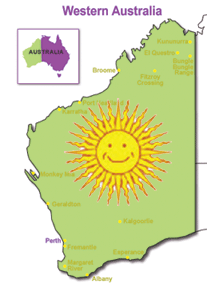 Horizon finds a smart way to price a solar tariff, REneweconomy, By Giles Parkinson 5 April 2012 Western Australia energy utility Horizon Power has achieved what appears beyond the capabilities of its larger peers in the eastern states, the Victorian and NSW governments and regulatory pricing authorities, and produced Australia’s first differentiated feed in tariff for rooftop solar PV.
Horizon, which services 100,000 residents and 9,000 businesses in towns and communities across the state, beyond the grid located in the south-western corner, is introducing area-specific solar feed-in tariffs which recognise a higher value for solar put back into the grid from remote locations, and a lower value for solar energy fed from near towns and alternative energy sources. Continue reading
Rooftop solar energy to turn out to be an election winner for Gillard?
 it could also have a big impact on established energy utilities, both generators and retailers, and has the potential of changing the political rhetoric as the next federal poll is fought on cost-of-living issues, mostly retail electricity prices.
A new surge in the deployment of rooftop solar in Australia could have an impact on generators, who are already worried about the impact it is having on their profits…. AGL highlighted the potential for this to happen in Australia, which is why it is lobbying to slow down the growth in the solar industry in Queensland, the last state to have a significant feed in tariff.
The Clean Energy Future can indeed be clean, exciting (new technology), and cost a lot less than sticking with polluting fossil fuels.
 Zero-cost solar: Will this be Gillard’s election secret weapon?, REneweconomy, By Giles Parkinson 2 April 2012 Australian solar installers are racing to become the first companies to offer long-term leasing arrangements that will allow householders to install large rooftop solar installations at zero up-front cost and hedge against rising electricity prices. Continue reading
Western Australia’s Horizon Power’ s solar feed-in tariffs will especially benefit rural communities
 Solar households in towns located further from energy generation sources, or where power generation is expensive, will be offered higher prices for the electricity they export to the grid…. For households in regional and remote areas of Western Australia, under Horizon’s new feed in tariff structure the savings could be much higher.
Horizon Power To Offer Location Based Solar Feed In Tariff, Energy Matters, 3 April 12, In what appears to be a first for Australia, Western Australia’s Horizon Power will introduce area-specific solar feed-in tariffs. While owners of systems in some towns will receive a much higher rate, others will receive less.Horizon Power’s Renewable Energy Buyback Scheme rate is currently equivalent to a customer’s current electricity tariff, minus GST. Horizon’s incentive is in addition to Western Australia’s state government mandated feed in tariff rate of 8c per kilowatt hour. Continue reading
Decentralised energy – you can start with a mixture of grid power and off-grid solar
 Hybrid solar: How to kiss the grid goodbye , REneweconomy, By Jeff Bye 30 March 2012 If ever there were a need to develop off-grid power systems it would have to be now, when transmission costs are now up to around 60 per cent of non-solar power bills.
Solar systems have historically been classified into two broad camps – “grid connected” or “off-grid” systems. This distinction has arisen due to historical segments of the market that needed solar to do different things. The vast majority of systems we see around Australia’s towns and cities are grid connected and have been driven by feed-in-tariffs and consumer desires to cut electricity costs and do something positive for the environment.
Off-grid systems have historically been the preserve of regional customers seeking to avoid expensive network augmentation costs to provide power to their remote locations. Off-grid systems are usually a lot more expensive as they require battery storage, more complicated control technology and often diesel backup generators to ensure the lights will always shine. Battery technology has also been a culprit as the memory effect of old-style lead-acid batteries has meant that battery arrays are oversized to ensure the depth of discharge is not high and hence battery life is extended.
An emerging trend though is for so-called hybrid systems which take a little from column A, and a little from column B. Such systems could either be described as an off-grid system which uses the grid as the standby generator or a grid-connected system with some added battery storage. Either way, these systems don’t require expensive diesel generators since the grid provides that service, and the size of the battery arrays can be downgraded as the cost of back-up power using off-peak grid electricity is much lower than that provided by diesel generators.
The technology that is making this possible is a new generation of products capable of directing energy flows as the consumer best desires….
Increasingly the electricity grid is moving towards Grid 2.0. Eventually, the networks will cease to become simply a delivery mechanism for electrons to your home and will morph into a shared network designed to help each energy user effectively manage their surplus or deficit of electrons to meet their needs. With this will come enormous changes to the business models of the network operators as customers gradually become more and more self-sufficient and use less and less from the grid….. http://reneweconomy.com.au/2012/hybrid-solar-how-to-kiss-the-grid-goodbye-59957
Success of solar energy electricity prices is frightening power generator industries
 Why power generators are terrified of solar http://www.crikey.com.au/2012/03/27/why-generators-are-terrified-of-solar/ Crikey.com by Giles Parkinson, of RenewEconomy, 28 March 12, ”….. the merit order effect and the impact that solar is having on electricity prices in Germany; and why utilities there and elsewhere are desperate to try to rein in the growth of solar PV in Europe.
It may also explain why Australian generators are fighting so hard against the extension of feed-in tariffs in this country….. that solar PV is not just licking the cream off the profits of the fossil fuel generators — as happens in Australia with a more modest rollout of PV — it is in fact eating their entire cake….. Continue reading
Premier Campbell Newman to stop Queensland’s solar thermal energy program
 Huge solar project in limbo as Newman pulls funding SMH, March 29, 2012 The first chance to test whether solar thermal energy can provide large-scale alternative power in Australia may be in doubt under the new LNP state government. The incoming Queensland government wants to pull out of an agreement formed by its predecessor to provide $75 million towards the $1.2 billion Solar Dawn solar research and power plant at Chinchilla, west
of Toowoomba, Premier Campbell Newman said yesterday.
The Solar Dawn project is set to be one of the largest of its kind in the world….. Solar Dawn is a 250 megawatt solar thermal project using sun-heated water in tubes to produce steam-driven energy, and is backed by the federal government and was supported by former Premier Anna Bligh. It is part of the federal government’s Solar Flagship Program. A similar project at Moree, in New South Wales, has received federal funding under the same program.
The University of Queensland has developed a $60 million research project to link to Solar Dawn.
UQ’s Professor Paul Meredith, the head of the university’s renewable energy research, said he was worried the LNP’s decision would damage what he thought was a worthwhile project and one that provided almost
400 jobs. http://www.brisbanetimes.com.au/queensland/huge-solar-project-in-limbo-as-newman-pulls-funding-20120328-1vynx.html#ixzz1qXtf3XFT
Ballarat, Victoria launches drive for big solar energy
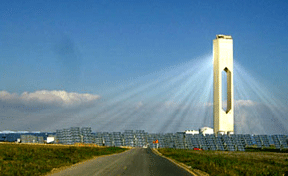 National campaign aims to shine spotlight on big solar. ABC Ballarat, By Margaret Burin, 26 March, 2012 Renewable energy advocates have begun a national campaign to promote large-scale solar power generation. About 50 groups around Australia are behind a campaign to push building large solar energy plants.
Supporters from Ballarat are the latest to launch the movement. Andrew Bray from the 100% Renewables group says large-scale solar energy is an underutilised resource in Australia. “We’re the sunniest country on Earth pretty much and we have no operating large-scale solar stations,” he says.
Mr Bray says large-scale solar power projects – which includes building solar towers and constructing panels in paddocks – are economically viable and can counter coal-fired power stations. “To give you some proportion, the normal coal-fired station is 750 to 1000 megawatts, and there’s no reason why solar power stations can’t scale up to that size.
“There’s a lot of know-how, lots and lots of know-how, in fact some of the major solar advances have come out of Australian universities and CSIRO, but industry needs to start putting out modest sized ones to learn how to do it and teach the financiers that the risks are quite modest.”
The Gillard Government has committed $10billion towards a new commercial fund, the Clean Energy Finance Corporation. Mr Bray says if parliament passes the legislation, it will help drive funding for big solar projects….
http://www.abc.net.au/local/audio/2012/03/26/3464085.htm
Huge commercial rooftop photovoltaic solar system for Port Melbourne
Australia’s Largest Rooftop Commercial Solar Power Project Announced, by Energy Matters, 19 Mar 12, NEXTDC Limited (ASX:NXT) (“the Company” or “NEXTDC”) has made another unprecedented move for the Australian data centre industry by committing to build what will be Australia’s largest privately-owned rooftop photovoltaic solar system at its Port Melbourne data centre called “M1”.
NEXTDC will spend approximately $1.2 million to install up to 400kW of solar panels to generate around 550 MWh (megawatt hours) of electricity per annum. A system of this size will offset over 670 tonnes of CO2 per annum. This equates to taking around 200 cars off the road, or powering NABERS 4 star office space for over 890 people….
NEXTDC has already incorporated energy efficient measures into its new-build data centres such as trigeneration plant and outside free air-cooling. After successful deployment of the solar panels at M1, additional investments will be made at their other data centres around Australia.
“We are proud to be the first data centre operator in Australia to invest in solar energy,” Mr Slattery said. “In fact, we are also committing to install up to 1MW of solar energy within the next 12 months at our upcoming data centre facilities”….
http://www.energymatters.com.au/index.php?main_page=news_article&article_id=3109
7,200 jobs to be lost in Australian govt’s sudden closure of solar hot water rebate
GREEN DEALS: Solar surprise, Climate Spectator, Daniel Palmer, 7 March The federal government’s decision to abandon the solar hot water rebate (Renewable Energy Bonus Scheme) on Tuesday afternoon has been a major talking point, with manufacturers critical of the lack of consultation.
An initiative of the Coalition government in 2007, the Renewable Energy Bonus Scheme offered rebates of up to $1,000 for households that installed solar hot-water systems. It was always slated to end after five years (i.e. 2012) but the exact date for its cessation was widely expected to be June 30, the end of the financial year (and basically five years from its beginning on July 17, 2007). Hence the move to end the offer for rebated as of close of business Tuesday was met with more than a hint of surprise from the industry.
The industry has said that as many as 7,200 jobs (1,200 in manufacturing and 6,000 in installation) could be at stake. It is a blow to the likes of Dux and Rheem, but Dreyfus indicated that the government would be offering no special assistance……http://www.climatespectator.com.au/commentary/green-deals-solar-surprise
1 This month

of the week – Australians for War Powers Reform (AWPR)
To see nuclear-related stories in greater depth and intensity
 Antinuclear