Solar energy a good financial deal for Australian homes
 Double quick time for solar returns, The Border Mail, 22 Feb 12, Solar power systems are offering a return on investment in half the time it took a decade ago, according to an industry leader. Eco-Kinetics general manager South Australia, Mark Hofner, said solar power investments today would pay for themselves in about five years.
“A return on investment a decade ago would have taken 10 years,” Mr Hofner said. “Today it is around half the time; even a little 1.5 kilowatt system is under three-and-a-half years for a return. Solar is a good deal.” Continue reading
Australia’s has inadequate renewable energy policy , in opposing solar feed-in tariffs
 The Australian laws – dubbed the ”clean energy future package” by the government….The package also includes a
$10 billion Clean Energy Finance Corporation to invest in and underwrite the development of fledgling technologies.
But the government opposes feed-in tariffs and is reducing a national solar incentive scheme. State solar feed-in tariffs have been wound back
German experience: clean energy requires subsidies, The Age, Adam Morton February 18, 2012 AN ARCHITECT of Germany’s rapid growth in clean energy – it has nearly half the world’s rooftop solar power – has warned that Australia’s climate policies will not alone drive a switch to greenhouse-gas-free electricity.
Germany reached its 2020 target of generating a fifth of its electricity from renewable sources nine years ahead of schedule, largely through feed-in tariffs that guarantee new power forms an inflated rate for the power they use to make them competitive.
It installed 3 gigawatts of solar photovoltaic panels in December alone – roughly enough for 1.5 million homes. Australia has less than half this in total. Continue reading
Australian research: solar heat + power, plus energy efficiency
 Australian Made Solar Roofing Panels Provide Heat And Power by Energy Matters, 14 Feb 2012, In an effort to bring Australia in line with an international zero-emissions building code, researchers from the University of New South Wales (UNSW) are working on a system to better harness the power of solar energy to generate electricity and heating for homes.
A prototype rooftop solar power system developed by UNSW’s School of Photovoltaic and Renewable Engineering (SPREE) that combines photovoltaics with thermal technology has demonstrated the ability to produce warm air throughout winter.
Unlike conventional PV systems with solar cells mounted on top of the roof of a house, the UNSW technology is designed to be integrated into roofing panels, allowing excess heat generated by the panels – which would otherwise be wasted – to warm the home.
 The research is part of a series of ‘carbon-positive’ products that will be tested and further developed by the Cooperative Research Centre (CRC) for Low-Carbon Living at UNSW later this year; aimed at bringing Australia in line with Europe and the UK, which plan to introduce a zero-carbon building code in 2016. Professor Deo Prasad, head of the CRC, says when it comes to lowering Australia’s carbon footprint, the biggest savings can be made in energy efficient buildings.
“The built environment is responsible for 40 per cent of energy use and Australia’s homes account for 16.5 per cent of our emissions in electricity use alone, without accounting for energy embodied during the production and disposal of building materials.”….. http://www.energymatters.com.au/index.php?main_page=news_article&article_id=3049
Small scale, decentralised solar energy paying off for Queensland
 Queensland has embraced small scale solar – and that is set to continue.
Queensland Aims For 9000 Gigawatt Hours Of Renewable Energy Generation, by Energy Matters, 10 Feb 12, Queensland Renewable Energy Plan (QREP) 2012 has been launched by Energy Minister Stephen Robertson – and the future of solar in the state continues to look bright.
“QREP 2012 places Queensland front and centre of Australia’s clean energy future. It positions Queensland to leverage up to $8.9 billion in renewable energy investment and deliver 9000 gigawatt hours of renewable energy generation by 2020,” said Minister Robertson.
The Minister sees the state benefiting from the Australian Government’s Clean Energy Future initiative.
“Substantial opportunities will emerge for Queensland from this national plan. With a strong ongoing program of initiatives and new focus on collaboration and capacity building, QREP 2012 aims to position Queensland as a primary beneficiary.” Continue reading
Grattan Institute”s misleading attack on Solar Feed-in Tariffs
 The new Grattan, FOOT OFF THE GAS:GRATTAN WRONG ON SOLAR WRONG ON FEED-IN TARIFFS, Beyond Zero Emissions, 6 Feb 2012 Institute report “No quick fix for Australia’s future energy challenge” contains misleading comparisons, flawed analysis and glaring omissions on vital energy issues confronting Australia.
#1. The report makes a misleading comparison between the cost of wholesale fossil fuel electricity and the cost of solar photovoltaic electricity which currently competes in the retail electricity market and not the wholesale market.
“We do not expect a suburban Woolworths to compete with food prices at the Footscray Wholesale Fruit and Veg market. Yet this is what the Grattan Institute has done by ignoring the differences between the wholesale and retail electricity markets” says Matthew Wright,
Executive Director of Beyond Zero Emissions. “Rooftop Solar photovoltaic has halved in price in the last 24 months. This is a staggering cost reduction, and is in stark comparison to rapidly increasing rising gas prices”.
#2 The report claims that there are no viable energy storage options for renewable energy.
Matthew Wright explained that the Grattan Institute report’s conclusions “ignores Solar Thermal Power (Molten Salt Power Towers with integrated thermal storage tanks). It ignores this game-changing technology, already commercially deployed in baseload, intermediate and peaking configurations in Spain and under construction at a number of sites in the US. This technology is commercially available, off the shelf and ready for deployment in Australia. Rapid cost reductions have been projected by the International Energy Agency, the US Continue reading
How Australia’s Energy Minister sabotages renewable energy
ARENA Needed To Address Solar Flagships ‘Mess’ : Milne, by Energy Matters, 6 Feb 2012, Australia’s Solar Flagships program has faced continual delays and problems, sparking a call from the Greens to expedite the setting up of the Australian Renewable Energy Agency (ARENA) to take over the administration of the scheme.
Australian Greens Deputy Leader, Senator Christine Milne has blasted Energy Minister Martin Ferguson for his handling of Solar Flagships to date, an initiative designed to see construction of large-scale, grid connected solar farms.
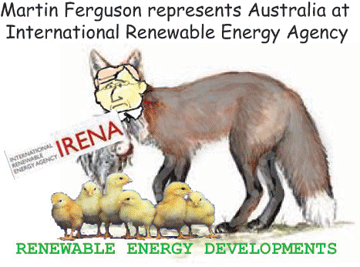
“Martin Ferguson has mismanaged this process from start to finish, helping to keep renewable energy from challenging coal’s dominance,” said Senator Milne.
“It is vital to see ARENA get off the ground as soon as possible to take political interference out of renewable energy scheme design and decisions and put them in the hands of a statutory independent authority.”…. Continue reading
Solar power and energy efficiency save money for Queensland hospital
Hervey Bay solar projects keep powering on, My Sunshine Coast, 2 Feb 12, Energy Minister Stephen Robertson has welcomed another key milestone in the Bligh Government’s $4 million plan to help power Hervey Bay with clean energy.
Mr Robertson said Queensland Health had now completed contractual arrangements with ABB Australia to install a $1.3 million 266 kilowatt solar panel system at the Hervey Bay Hospital.
“Depending on the weather, installation will begin within a few weeks on a solar panel system that will generate approximately 385 megawatt hours of energy each year, saving the hospital around $20,000 per year on electricity costs,” Mr Robertson said. “It will also help to reduce the hospital’s carbon emissions by 400
tonnes a year.
“An interactive web-kiosk and large screen television showing the energy being produced by the system daily, monthly and annually will also be installed in the hospital’s foyer as an education tool for visitors.
“This project and the $2.7 million Fraser Coast Community Solar Farm are part of the Bligh Government’s commitment to renewable energy
projects…. “ABB will draw from our global expertise in the solar industry to deliver a solar power system which operates at high efficiency, providing a lower cost per kilowatt production. “Our innovative technology and expertise is gained by our involvement in many of the world’s largest turnkey solar projects.
“The hospital has already reduced its energy consumption significantly by implementing a number of energy efficiency initiatives, and with the addition of the renewable energy from this system, they will become more self sufficient.”
http://www.mysunshinecoast.com.au/articles/article-display/hervey-bay-solar-projects-keep-powering-on,246
Australia’s Professor Martin Green spells it out on solar cell technology
 Solar guru receives Australia Day honour , 26 January 2012, Anna Salleh ABC Science, http://www.abc.net.au/science/articles/2012/01/26/3415244.htm Australia needs to look to Germany if it is to realise the potential of solar cell technology, says an expert who is being honoured today. Professor Martin Green of the University of New South Wales has been made a Member of the Order of Australia(AM) for his work on photovoltaics.
“Germany has been the only country that’s had a sensible long-term program in place to promote the use of renewables,” says Green.
Some argue solar cells are not a competitive option for reducing carbon emissions, and are limited by the fact that they don’t generate energy unless the Sun is shining.
But according to Green, the “stars are aligning for conventional roof mounted solar” and it is ripe for a new kick start from governments. Continue reading
Australia’s National Solar Schools Program takes off in Tasmania
 Solar funds for schools, THE MERCURY | January 25, 2012 FIFTEEN Tasmanian schools have won funding to install solar and other renewable-power systems to improve energy efficiency. The National Solar School Programs announced that more than $25 million would be distributed to 784 Australian schools for measures to tackle climate change.
Southern schools to receive grants are Bruny Island District ($50,000), Cygnet Primary ($45,333), Fahan ($47,687), Moonah Primary ($49,689), Peregrine, Nichols Rivulet ($42,197), Risdon Vale Primary ($49,975), St Paul’s Catholic School, Bridgewater ($39,440), Tasman District ($50,000) and Warrane Primary ($50,000).
The final round of applications for the grants will open on February 13. http://www.themercury.com.au/article/2012/01/25/295171_tasmania-news.html
The success of rooftop solar energy, in Germany, but in Australia, too
Last year, roof-mounted solar panels in Australia were able to compete favourably against peak-priced electricity from coal-fired power stations for the first time – without factoring in market-distorting subsidies. Solar PV panel wholesale prices are now about $1 per watt, compared to $3.50 per watt only a couple of years ago.
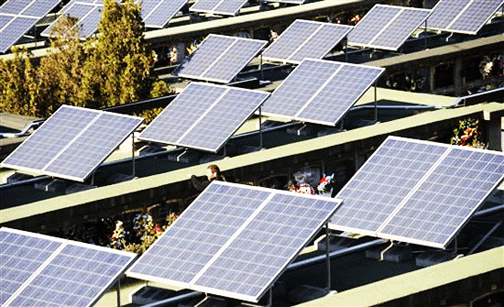
The proof is in the heating – solar’s shining success story, SMH, Martin Green January 21, 2012 Something extraordinary happened to the German national power grid during the pleasantly mild early weeks of last summer. Not only did the country’s almost 1 million, mainly rooftop (photovoltaic) solar panels pump 13.2 gigawatts into the grid – the equivalent output of up to a dozen nuclear power plants, or about 40 per cent of the highest-ever demand in Australia’s national electricity market – but they did so at exactly the right time.
That is, when demand was peaking. Whatever variability there might have been in the output of individual solar panels, due to shadowing, passing clouds or local rain, was smoothed out by the geographic range and sheer number of panels nationwide.
What the German experience demonstrates is that the stars are aligning for conventional roof-mounted solar, or photovoltaic (PV) panels, as a reliable and increasingly competitively-priced power source to make a significant contribution to electricity generation.
For many reasons – including the phenomenal uptake of PV panels in Germany, the economies of scale driven by mass production of panels in China, and increasingly efficient solar arrays – prices really are down. Continue reading
Solar energy can power your electronic book, iPad, iPhone, other mobile phones and USB devices
Solar Panel Cover For The Kindle E-reader, by Energy Matters, 9 Jan 12 Using solar energy to provide power for hand-held devices has huge potential and while solar panels embedded in mobile phones mightn’t be much chop (yet) in terms of performance; it seems a new solar cover for the Kindle e-reader delivers.
The SolarKindle, weighing just 215 grams, incorporates a flexible, lightweight triple junction amorphous solar panel and is able to provide some level of charging even in the shade. A one hour charge in direct sunlight can provide almost three days worth of reading time according to the company that created the device, SolarFocus Technology.
After fully charging the Kindle, the solar panel automatically switches to charge the SolarKindle’s 1500mA reserve battery. A fully charged reserve battery requires around eight hours of direct sunlight and provides up to 80% of backup power to the Kindle.
However, bearing in mind that Australia’s sunshine and temperatures can be extreme during summer, perhaps sticking your SolarKindle enshrouded e-reader out in the sun on a 40 degree day for extended periods may be unwise.
The SolarKindle also incorporates an 800 lux LED reading lamp. If the reserve battery is used for lighting alone, it can power the light for up to 50 hours. An LED indicator incorporated in the SolarKindle shows battery power level and status of charging and discharging.
The SolarKindle can be purchased online for around AUD $80, plus delivery.
SolarFocus was named an International CES Innovations 2012 Design and Engineering Awards Honoree for its SolarKindle Lighted Cover. The company says it holds several solar technology patents with their products used in extreme environments such as the Himalayas and the North Pole.
SolarFocus also manufactures a folding solar charger for the iPad, iPhone, other mobile phones and USB devices called the SolarMio Pro. While certainly not as compact as the embedded solar panel Nokia recently trialed, the 5 watt SolarMio Pro watt system can provide 6 hours of talk time on the iPhone 3Gs with just an hour of solar charging.. http://www.energymatters.com.au/index.php?main_page=news_article&article_id=1972
Community solar energy for Australia – Mallacoota shows the way
 While these types of schemes are still relatively uncommon in Australia, a popular method of using the power of collaboration to install solar here is the solar buyers group. Consisting of people within a local area, these groups use their collective clout to secure better pricing for installing solar panels on their own rooftops…
In an initiative led by local resident Jim Sakkas, the community banded together to form a solar buyers group and since that time, close to one hundred solar power systems have been installed in Mallacoota by national solar solutions provider Energy Matters under the model.
A Co-operative Approach To Going Solar, by Energy Matters, 6 Jan 12, A growing number of people are starting renewable energy schemes in their communities through co-operatives and other forms of collaboration. A recent report from Co-operatives UK and The Co-operative Group states 43 communities are in the process of or already producing renewable energy by investing money to install solar panels, large wind turbines or hydro-electric power in their area.
£16 million has been invested by over 7,000 people in these schemes, which include a £2 million wind farm and a 98kW solar photovoltaic installation on the roof of a brewery.
The report says green economy co-operatives are the most rapidly growing part of the UK co-op sector, jumping 24% since 2008. In addition to these co-operatives’ efforts seeing clean, renewable energy being supplied to their communities, there is also a financial return to participants through the sale of electricity produced.
The co-operative approach covered in the report basically works like this: Continue reading
Solar energy costs, especially small scale, overestimated by 2 Australian agencies
renewable energy is coming down in price and fossil fuels are going up. In a carbon-constrained world, renewable energy is an investment in a lower electricity cost future for all Australians compared to the one they would face without it. Solar power will cost far less and provide far greater benefits over the medium term.”
 Productivity Commission And EUAA Blinkered On Solar by Energy Matters, 3 Jan 2012, Two Australian bodies criticising the cost of solar power have again failed to factor in all the benefits of the technology.
A Productivity Commission report from June this year was widely criticised by the solar power industry and supporters for stating rooftop solar has “generated little abatement for substantially higher cost”.
According to a recent article in The Australian, the backlash saw the Productivity Commission check over its figures recently and the Commissions has revised the cost of the small-scale component of the federal government’s Renewable Energy Target and state-based feed-in tariffs downwards – by tens of millions of dollars.
However, the Productivity Commission continues to dig its heels in relating to small scale solar’s cost generally. Continue reading
Australia’s Energy Minister subtly sabotages photovolcaic solar energy
Ferguson labeled all clean technologies as expensive and requiring subsidies, however the figures in the white paper, concerning photovoltaics, are more than 12 months old and do not reflect the rapidly falling cost of photovoltaics.
Australian energy “white paper” neglects PV potential, PV Magazine, 14. DECEMBER  2011, BY: JONATHAN GIFFORD A strategy document released this week, on Australia’s energy future, seems to have
  overlooked the potential of photovoltaics in the country. Instead the report focused on unproven technology, like carbon capture and storage, and leaving the door open for thedevelopment of nuclear power stations.
The Australian Federal Government has released a draft energy “white paper” in an attempt to develop a clearer energy policy direction for the nation. While “accelerating cleaner energy outcomes” is identified as one of the policy priorities, it appears that a major role for photovoltaics has been eschewed in favor of alternative “cleaner” energy technologies, such as carbon capture and storage – forcoal-fired power plants, nuclear and geothermal power. Continue reading
Australian Capital Territory legislates for solar feed in tariff
ACT passes large solar scheme, ABC News, By Kathleen Dyett December 09, 2011 The ACT Government has passed legislation to set-up Australia first large-scale solar feed-in tariff scheme. It will support renewable energy projects with a total capacity of up to 210 megawatts, with the first 40 megawatts to be allocated via an auction.
Large solar facilities that generate 2 megawatts or more will be the first to take part in the auction. The Liberals have slammed the scheme as costly and ineffective. But the Greens negotiated some changes before backing the bill.
Greens MLA Shane Rattenbury says he is happy with the outcome. “The two amendments we’ve agreed with the Government are to first of all ensure that the developments take place within the Australian capital region,” he said.
“The second is to open it up to systems above 200 kilowatts which will predominantly go on rooftops. “We want to make the most of the many rooftops around Canberra that could be used to generate clean, green energy.” http://www.abc.net.au/news/2011-12-09/act-large-solar-tariff-scheme/3721884?section=act
1 This month

of the week – Australians for War Powers Reform (AWPR)
To see nuclear-related stories in greater depth and intensity
 Antinuclear