At least there is a plan in South Australia, albeit one that will place its drive for self-sufficiency in conflict with the operation of the National Electricity Market.
Provided there is decent backup power generation there shouldn’t be an issue with developing VPPs and new forms of energy storage so that they can be refined and more affordable in time.
Role of batteries provides aspirational charge to energy debate , The Australian, 16 Mar 17 CHRIS GRIFFITH Technology reporter Sydney @chris_griffithCall it battery fetishism if you must, but batteries are going to play an even bigger role in power sources being tested in Australia. Take for example the virtual power plant concept which has gone live in South Australia.
A VPP comprises hundreds, maybe thousands, of homes each with solar panels where excess energy is stored in batteries. Instead of operating as separate entities, energy stored in those batteries is made available in unison to the grid at times of peak load or an outage.
An outside body such as an energy retailer co-ordinates the flow of battery power back to the grid. For the rest of the time, consumers self-manage their stored solar power. Continue reading →
The South Australia government has pressed the fast-forward button on its 100MW battery storage tender, announcing that expressions of interest for the country’s biggest battery storage installation are now open, and will close within two weeks. Continue reading →
Battery-makers on Turnbull’s Tesla chat: ‘Give Australian companies a fair go’
Industry wants more support from federal government now prime minister has ‘taken interest in the tweets of an American billionaire’, Guardian, Melissa Davey, 13 Mar 17, Malcolm Turnbull should encourage Australia’s battery energy storage industry now he has “taken interest in the tweets of an American billionaire”, Zen Energy chairman Ross Garnaut says.
Garnaut was referring to Elon Musk, the billionaire co-founder of electric car giant Tesla, who tweeted that Tesla could solve the power shortage issue causing price spikes and blackouts in South Australia within 100 days by installing 100-300 megawatt hours of battery storage.
Turnbull subsequently tweeted that he had phoned Musk and enjoyed a “great, in-depth” conversation.
But Australian companies had been working on large battery projects for years, Garnaut said, including one by Zen Energy in the upper gulf of South Australia which it had discussed with the market. Continue reading →
Greens say Elon Musk’s plan is a game changer Australian Greens Senator for South Australia Sarah Hanson-Young says Elon Musk’s proposal to solve South Australia’s energy crisis with battery storage is the game changer our state needs to switch back on.
“We live in the perfect state for wind and solar. Battery technology allows us to make hay while the sun shines, storing the power so we can use it when we want and need. While chairing a senate inquiry into battery storage, I’ve heard evidence that if 20,000 homes with solar panels had a battery as well, the load shedding that cut off the air conditioning when we needed it most last month wouldn’t have happened.
“This is the innovation Malcolm Turnbull promised when he declared he would be the ‘Innovation Prime Minister’
Elon Musk says his Tesla battery company could solve South Australia’s energy crisis in 100 daysLuke Griffiths, Lauren Novak, The Advertiser March 11, 2017 TECH billionaire Elon Musk on Saturday confirmed he’s spoken personally with Jay Weatherill to discuss his company’s plans to build a battery farm to help SA solve its power woes – amid support from the Australian Greens, who say his plan to build a batter farm could be “game changer”.
Michio Kaku – Musk & Game Changing Tesla Powerwall Battery
Mr has weighed into South Australia’s energy crisis, boldly claiming he can fix the problem for $33 million and in under 100 days.
Elon Musk on Friday said his US-based company, Tesla, could build a 100MWh battery farm less than four months after a contract being signed.
Such a system, he said, would go a long way to preventing a repeat of recent blackouts due to load-shedding. Tesla recently launched a similar, but smaller, system in California.
Today billionaire Mr Musk revealed he had spoken by phone with Premier Jay Weatherill, describing the State Government as “clearly committed to a smart, quick solution” to the state’s power woes. Continue reading →
Elon Musk, Malcolm Turnbull in talks on renewables after billionaire’s ‘100 days or it’s free’ pledge http://www.abc.net.au/news/2017-03-12/elon-musk-malcolm-turnbull-in-talks-on-renewables/8347554Prime Minister Malcolm Turnbull says he has held a “great, in-depth discussion” with Elon Musk, after the billionaire tech entrepreneur offered to fix South Australia’s energy problems within 100 days.
On Friday, Mr Musk said energy storage could solve the state’s electricity problems with a Tesla battery farm, and work could be completed within 100 days, or it would be free.
Twitter was again the preferred medium of communication on Sunday, with Mr Musk and Mr Turnbull swapping appreciative tweets after speaking for nearly an hour.
Tesla’s offer: How SA’s power network could benefit from energy storage, ABC News, By Michael Collett 11 Mar 17 South Australia’s energy network has been struggling of late — there were forced blackouts for tens of thousands of homes during a heatwave last month because there wasn’t enough power to meet demand.
But Tesla thinks it has a solution. The company’s billionaire boss Elon Musk says he could install a battery farm capable of fixing the system within 100 days of signing a contract.
It’s a suggestion that the Grattan Institute’s energy expert Tony Wood says should be taken seriously, but it’s not the only electricity storage option that’s available.
What’s the advantage of electricity storage? The idea is that energy storage technologies can take power during off-peak hours and put it back into the grid when it’s needed.
As well, wind and solar are intermittent sources of electricity generation, so this power needs to be stored if the grid is to rely entirely on renewables. (Keep in mind that South Australia already gets about 50 per cent of its energy from renewables, mostly wind and solar.)
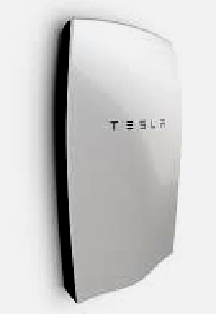
One storage technology that’s getting a lot of press is Tesla’s Powerpack.
Tesla says this battery is “infinitely scalable” — that means a business could buy a single Powerpack so that it still has power during a blackout, while a city, state or country could install hundreds, thousands or even millions of them in order to support an entire grid.
In 2015, Musk said you’d be able to transition the United States to renewable energy with 160 million of them, and the entire world with 900 million……
LG Chem, the South Korean battery storage maker that has so far claimed the biggest share of the nascent Australian market, says that solar and battery storage is already beating grid power in most states.
The assessment by LG Chem follows similar analysis by private energy consultants, and suggests that the market for battery storage could be about to take off, even with looming threats of restrictions.
According to Jamie Allen, the marketing head in Australia for LG Chem, a 5kW rooftop solar system and a 10kWh battery storage device (such as LG Chem’s own 9.8kWh offering) can be purchased and installed for around $15,000.
Based on the assumed output of around 22kWh a day from the solar array, that makes the cost per kWh of solar power at around 22c/kWh over 10 years.
Given that most flat rate per kWh tariffs start at around 23c/kWh or 24c/kWh – even in NSW where there are high fixed network charges on top of that – the solar power is still on the money, although the battery storage is essential to ensure that much of that output is used directly, or stored for later use at night.
Of course, the actual cost per kWh of the solar output would be less than half the 22c/kWh cited here, because the panels would last well beyond 20 years.
But the 10 year time frame is used because that is the warranty period for most battery storage and it is the “combo” package that is being promoted. And without storage, then much of the output would have to be exported, with tariffs in NSW as low as 6c/kWh or non-existent for some.
What does this tell us? Allen says it is that storage is crucial to maximize the value of that solar output. Every kWh that can be consumed on site will beat the cost of production.
Of course, this is not the only benefit. Allen notes that the solar system will likely last at least another decade, possibly two, and the cost of battery storage to replace the current system will also be cheaper, while grid costs are likely to rise.
CEFC plans to repeat solar success in battery storage, REneweconomy, By Sophie Vorrath on 2 March 2017 Clean Energy Finance Corporation chair, Jillian Broadbent, says Australia’s energy system can safely accommodate significantly higher levels of renewable energy, as long as this was “planned and coordinated” with the rollout of smart technologies, including demand management and battery storage.
Speaking on the subject of Australia’s Energy Future, at a conference hosted by UTS, ISF and BNEF on Thursday, Broadbent outlined the kind of technological solutions the green bank would be backing to help achieve what the PM likes to call the “energy trifecta” of security, sustainability and affordability.
Instead, Broadbent used the Sydney event to highlight the organisation’s plans to fast-track the roll-out of large-scale energy storage in Australia, in the same way its $250 million large-scale solar financing program boosted big solar development by bringing down costs.
“We’re close to finalising the transactions under our (large-scale solar) program, and we’re seeing falling technology costs,” she told the conference.
“Now we’re looking to have the same impact with large-scale storage, also working alongside ARENA to support the accelerated deployment of batteries and pumped hydro.
“Just this week we had a roomful of investors meet with 10 clean energy entrepreneurs seeking finance in our first Innovators Demo Day. One strong theme was the focus on the integration of sustainable energy production and storage at the household level, fortifying the grid’s stability and making energy more affordable.”
Further focuses for CEFC funds, Broadbent said, would include strengthened transmission infrastructure, behind-the-meter solutions, innovative business models to get more value from distributed energy resources, and frequency control services including hardware, data collection and control software……http://reneweconomy.com.au/cefc-plans-repeat-solar-success-battery-storage-78533/
REneweconomy By Giles Parkinson & Sophie Vorrath on 24 February 2017 The world’s biggest battery manufacturing brands and clean energy lobby groups have signalled they will fight proposed new guidelines and recommendations that could effectively ban battery storage units from inside homes and garages, saying the restrictions are over the top and don’t conform to international standards.
Standards Australia is believed to be preparing the release of new standards that would effectively force most battery storage units to be put in a free-standing and fireproof enclosure, possibly adding thousands of dollars to the cost of installation and making it uneconomic.
“If a project of this scale, a pumped hydro project of this scale, had been available recently in South Australia, there wouldn’t have needed to been the load shedding that occurred there,” Mr Turnbull said.
Power is generated by releasing sea water from a top dam, through a turbine, into a lower dam
During times of plentiful energy on the network, seawater is pumped up into the top dam, like charging a battery
The top dam would hold about eight hours of power which can be switch on at short notice
Backed by federal funding, the company and its partners will investigate the proposal further, with hopes it could be operational by the end of the decade.
“What’s required is to find a site, obviously being pumped hydro, that has water, but we also look for a site that has the right geography and topography … elevation, but also a site that has proximity to transmission,” Ms Tanna said.
Using $450,000 received from the Australian Renewable Energy Agency, the company will look at whether it is feasible to put a 100 to 200-megawatt power station close to Port Augusta and Whyalla. Continue reading →
EnergyAustralia managing director Catherine Tanna, along with the company’s executive for energy, Mark Collette, were in Sydney on Tuesday updating the Cabinet Energy Committee on the progress they have made, along with their research partners Melbourne Energy Institute and Arup Group, investigating the viability of a pumped hydro energy storage plant using seawater.
In a statement on Tuesday, Arup Group said that the proposed South Australia project would have the capacity to produce around 100MW of electricity with six-to-eight hours of storage – the equivalent of 60,000 home battery systems, EnergyAustralia says, but at “one-third of the cost.”
Pumped hydro, one of the oldest and most basic and low-cost forms of energy storage, converts electrical energy into potential energy by pumping water up to the top of a hill, storing it there in a reservoir, and then using it when needed to generate electricity at very high efficiency.
Most recently in Australia, it has been linked with a ground-breaking project being developed by Genex Power, which proposes to convert an old gold mine into a 330MWh pumped hydro storage project, to go alongside a 150MW solar PV array.
But its potential for Australia has come into sharper focus in recent months, as governments and electricity market operators grapple with the problem of how to support the smooth transition of electricity networks to renewable energy generation. Continue reading →
Solar power battery storage would solve SA’s electricity problems, company says, ABC News, By Claire Campbell, 21 Feb 17, The company behind a $100-million solar plant with battery storage says its project could solve South Australia’s energy woes as the Federal Government announces a $445,000 investment into a pumped hydro-station for the state.
South Australia’s power supply has been scrutinised since the state was plunged into darkness last September, and was forced to “load shed” during a recent heatwave.
Chairman Professor Ross Garnaut said the battery would “solve most” of the state’s energy problems and if increased by a further 50MW it would solve “all” energy issues.
“The blackouts of the past year would not have happened if this was in place,” he said.
Early skirmishes point to a war over renewable energy lasting well into 2017, The Age, Peter Hannam, 15 Jan 17 “……Trenches are now being dug for what looms as a political battle that will probably last through 2017. On one side lie the Turnbull government, fossil fuel suppliers and right-wing pundits, who say the priority has to be affordable and reliable power.
On the other, Labor and the Greens and clean-energy backers who argue ageing coal-fired power stations need to prepare for an orderly if not accelerated exit to meet Australia’s commitments agreed in the Paris climate treaty.
Josh Frydenberg, environment and energy minister, ended holidays early on Thursday to rail against states for curbing unconventional gas exploration, which also feeds into higher electricity prices. That’s especially true in SA where gas provides all the power that’s not from wind or the sun.
He took particular aim at Queensland, where the Labor government under Annastacia Palaszczuk is aiming for a 50 per cent share of renewable by 2030, up from 4.4 per cent in 2015………
Frydenberg’s Labor counterpart, Mark Butler, though, says the Coalition’s energy policy was “being dictated by the hard right of the party with the likes of Tony Abbott and Cory Bernardi”.
“The culture-war element starts to blind people to pretty clear policy,” he says, noting three-quarters of Australia’s fleet of power stations were operating beyond the end of their design life and needed to be replaced.
“The Turnbull government leaves a policy vacuum at the federal level, the states will fill the void,” he says.
Federal Labor remains committed to a 50 per cent renewable share by 2030, he said, noting the Turnbull government has no target beyond 2020 nor is a target among the terms of reference for its 2017 climate policy review. NSW Labor shares the party’s national goal……
Abbott, as if on cue, weighed into the renewables debate on Saturday……
What is certain is that energy bills are on the rise – although the causes are highly debated…….
Bruce Mountain, an energy economist with CME Australia, says rising energy prices will prompt more people to add solar panels and also batteries as prices continue to tumble – much faster than regulators predict.
Tesla’s new 13.5-kilowatt-hour Powerwall 2, costing about $8800 before installation, already offers a lower battery price than AEMO had predicted for 2040, he says
An average household in Adelaide, where power prices have doubled in the past eight years to be among the highest in Australia, would now be better off with panels and storage.
While panels alone typically slash demand for electricity from the grid by a third, adding a battery will reduce grid purchases by about 95 per cent, he said.
‘Existential threat’
Dylan McConnell, a research fellow at the Melbourne Energy Institute, notes AEMO is predicting 15.5 gigawatts of coal-fired power plants will be shut by 2030. That’s about half of such stations and equivalent to 10 Hazelwoods.
Importantly, AEMO is betting 12GW of new gas-fired power will come on stream “assuming no alternative technologies come to fruition”, Mr McConnell said.
However, the open-cycle gas plants that can provide peaking power to complement variable suppliers such as wind and solar farms “face an existential threat from batteries”, he said……..
Without clear signals, investors won’t have the confidence to invest the billions needed to bring new, more efficient capacity online.
RET challenges
Bloomberg New Energy Finance underscored the scale of the challenge even meeting the 2020 Renewable Energy Target of supplying 33,000 gigawatt-hours from clean energy annually from 2020.
Last year, investment in large scale renewables under the RET bounced back from a meagre $US10 million in 2014 and 2015 after the Abbott government’s review of the sector threw it into a panic. In 2016, it recovered to $US1.1 billion ($1.45 billion).
“However it is still well below the $US2.9 billion per annum now needed to satisfy the notional 20 per cent target by 2020,” Bloomberg said.
Greens energy spokesman Adam Bandt says the Coalition will be tempted to stir up fears of rising electricity prices “in the hope that they can repeat 2013”, when Tony Abbott swept to power in part because of the carbon tax issue.
It is an analysis by investment bank CLSA – partly informed by Frontier Economics, the consultancy behind the other notable analyses we reported on last week, here and here – and argues why rooftop solar and battery storage will never take off in Australia and why no one in their right mind would ever leave the grid. Or even install solar modules.
We wouldn’t normally bother with it, but it got some serious air-time in the AFR, and in other Fairfax media, and may just be cited by others.
So it’s worth looking at and pointing out that it is based on some extraordinary assumptions – not just about the cost of solar and storage, but also about the way people would use the technology.
Let’s take its assumptions on going off-grid for instance. It cites as an example an energy hungry, four-bedroom house, the sort of consumer that would likely be the last to choose to go off grid.
No matter. It assumes that such households would want to use all of their appliances at the same time (the oven, the microwave, the dishwasher, the washing machine, the iron, the kettle, the air-con, the drier, the TV, and every light in the house as well as laptops) and would therefore need 19kW of continuous power to supply all that. [good table here on original]
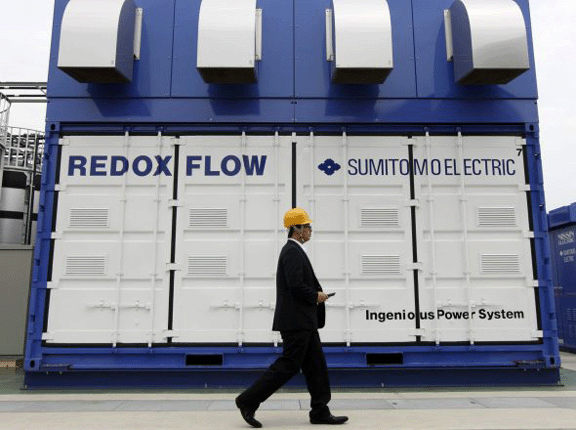
This, concludes analyst Baden Moore, would require 3 Tesla Powerwall 2 batteries or three Redflow ZCells, just to manage two hours of that demand – not to mention the 3-7 days of backup. Just the cost of meeting this peak, he says, would be prohibitive and cost more than $50,000 for the battery storage alone.
There are myriad problems with this calculation. The first is that many houses simply can’t download that amount of power anyway even from the coal-powered grid. In Victoria, for instance, new households have a “capacity” limit of around 10kW.
And then there is something called the “diversity factor,” which, as SolarQuip’s Glen Morris – a leading authority on solar and storage – explains, means it is almost impossible to reach such peak demand at the same time.
One appliance might go for a few seconds at maximum demand then ease off. “I’ve got 10kW (of maximum demand) just in my kitchen but I’ve never been able to turn them on all at the same time and trip the 5kW inverter,” says Morris, who lives off grid.
If a household was going to consider going off grid, would they choose to pay more than $50,000 for batteries that would not be needed most of the time, or would they pay $1,000 or less for smart controls to ensure that most of these appliances are used in off-peak?
The other issue is the sort of thinking that the CLSA report represents. It’s the same dumb attitude – based on visions of soaring peak demand – that was used to over-build and gold plate the country’s electricity network, such that Australian consumers are now paying through the teeth for their grid supply; the very cost that is making rooftop solar and battery storage so attractive to consumers.
But Moore doesn’t seem to see a problem here. He argues that the grid has been built and paid for, and that the energy networks should use any means possible to recover their costs.
“The Australian Energy Markets Commission (AEMC), the key regulator of Australian energy markets, highlights the networks will be allowed to vary the price of grid connection to ensure the cost of capital on the network is recovered,” Moore writes.
“On this basis, the cost of the network will be recovered from all consumers regardless of their usage of battery and solar energy.”
Even the networks know how crazy this attitude is. In the report they prepared with the CSIRO, and in their advice to the Finkel report, they say that millions of households will be driven, economically, to take up solar and storage.
And unless the industry gets its act together and offers them a decent and competitive service, then many will choose to leave the grid, leaving the economics of the industry in a complete mess.
Part of the problem is what Moore and Frontier Economics are comparing the price of solar and storage to. Instead of the full grid price, Moore and Frontier compare solar and storage to the retail and wholesale component of people’s bills. But then they come up with some extraordinary estimates of those prices……
[good charts on original] ….The CLSA report even highlight an analysis on South Australia’s recent blackout by Russell Skelton, a former head of the two biggest coal generators in NSW. Needless to say, Skelton says the high level of wind energy was at fault for the blackout and will cause similar problems elsewhere.
This is in direct contrast to the AEMO report, which said that the nature of wind energy had nothing to do with the outage, and of the Finkel review, which pointed out there are plenty of technology alternatives to coal and gas to ensure grid security and reliability as renewables grow.
It also contradicts the CSIRO and the network owners, who see no problem incorporating more than 90 per cent wind and solar over time, and more than 80 per cent in South Australia in the same time frame that other states are aiming for 50 per cent.
CLSA’s principal point out of all this is to argue that the incumbent utilities are in the box seat when it comes to (slowly) migrating the energy system from black to green.
It is true that these utilities, and the networks, wield enormous influence at political and regulatory level on policies. But simply wishing away the cost competitiveness of new technologies is no strategy to protect the incumbents, or the consumer. http://reneweconomy.com.au/analysts-kid-future-solar-storage-33799/
Stucco students install one of Australia’s first shared solar and battery systems for apartment block, 702 ABC Sydney ,By Amanda Hoh, 8 Dec 16, After 18 months of “bureaucracy” and jumping through regulatory hoops, the students of Sydney’s Stucco apartments have finally achieved their goal of spearheading a “solar revolution”.
The social housing apartment block in Newtown has become one of the first multi-dwelling buildings in Australia to install a shared solar and battery storage system.
Last week 30 kilowatts of solar panels were placed on the roofs and 36 batteries set up in the building totalling 42.3kW storage capacity. The solar system will now provide 80 per cent of the residents’ energy needs, with the remainder of electricity drawn from the grid. Each student is expected to save up to $35 a month on their electricity bill. “As poor uni students, that difference in a bill makes a huge difference,” Sarah King, Stucco committee president, resident and social work student, said.
“There’s also the great feeling of using green clean energy as opposed to dirty coal.
“As a cooperative, it’s quite empowering to have your own locally sourced power system, otherwise you’re quite vulnerable to what electricity companies are going to charge you. Stucco is a cooperative, not-for-profit housing complex for low-income students from Sydney University. There are 40 residents in the eight units who each pay about $90 in weekly rent. As a cooperative, the students self-manage the property, which is part-owned by the university and the Department of Housing.
How do students pay for solar? A software system was put in place to manage and analyse the energy output from each unit, meaning the Stucco committee now acts as its own energy retailer and issues electricity bills to the residents. For the energy consumption that is provided by solar, the students are charged a maximum of 10 cents during off-peak times and up to 40 cents during peak use.
They are currently in pricing talks with various commercial energy retailers for when the building draws from the grid.
The cost of the project totalled $130,000, with the solar technology costing $97,000……..The students received an $80,000 grant from the City of Sydney.
The remainder of the cost was made up from 25 years’ worth of sinking funds and “grassroots community efforts” of voluntary contributions and pro-bono work……The solar and battery system is expected to take about six to seven years to pay for itself, although Mr Janse Van Rensburg said the long-term gain and savings far outweighed the cost of the system…..The students have started a crowdfunding campaignto help rebuild the administration and sinking funds.
Calls for more solar as household tariffs dumped There are 1.6 million solar systems installed across the country; mainly in free-standing owner-occupied homes and in lower to medium income suburbs.
According to Claire O’Rourke from community-based organisation Solar Citizens, Stucco is “a pioneering project”, particularly as it was conceived by a housing cooperative.
“We’ve had a lot of anecdotal reports from apartment owners who have tried to get this [a multi-apartment dwelling solar and battery system] in place but have failed,” Ms O’Rourke said……..
“The real opportunity is in cities where there are more apartments and renters…….
The Solar Bonus Scheme in New South Wales ends on December 31, which means solar households will no longer receive a feed-in tariff when they redirect energy back into the electricity network. Solar Citizens is lobbying the Government for a mandated minimum tariff to pay solar owners.”Going solar now is the best way to save for the long term, because solar panels will last 20 to 25 years, batteries will last for a decade,” Ms O’Rourke said.
Apr 15, 2026 01:00 AM in Canberra, Melbourne, Sydney
Join the International Physicians for the Prevention of Nuclear War (IPPNW) on Tuesday, April 14th for a timely webinar exploring the risks associated with nuclear power and challenging the myth that it offers a simple, safe, carbon-free solution to the climate crisis
21 April Webinar: No Nuclear Weapons in Australia
Start: 2026-04-21 18:00:00 UTC Canberra, Melbourne, Sydney (GMT+10:00)
End: 2026-04-21 19:30:00 UTC Canberra, Melbourne, Sydney (GMT+10:00)
Event Type: Virtual A virtual link will be communicated before the event.






 Early skirmishes point to a war over renewable energy lasting well into 2017, The Age, Peter Hannam, 15 Jan 17 “……Trenches are now being dug for what looms as a political battle that will probably last through 2017. On one side lie the Turnbull government, fossil fuel suppliers and right-wing pundits, who say the priority has to be affordable and reliable power.







 Antinuclear