South Australia’s home solar batteries- electricity provided throughout recent blackout
 http://www.adelaidenow.com.au/news/south-australia/market-for-solar-storage-batteries-growing-and-competitive/news-story/cae6fc767743e6b38c5165145a9bb893 Craig Cook, The Advertiser October 16, 2016
 THE hi-tech home energy storage battery revolution, allowing households to better manage solar rooftop power, has been promised for more than a decade and now it could finally arrive in South Australia.
Battery installers in Australia have reported more than 100,000 customer inquires this year, although sales of the systems – which are adaptable, stylish, and small compared to the ugly lead acid batteries of the past – number less than 5000 units.
World leaders in battery production include Elon Musk’s Tesla company that produces the popular bar fridge sized ‘Powerwall’ unit, and German firms Sonnen and BMZ.
 Leading players offering home battery solutions include ZEN Energy, based at Clovelly Park in Adelaide, with Professor Ross Garnaut as chairman, and Redflow, based in Brisbane, led by SA-based innovator Simon Hackett, as chairman, chief executive and majority shareholder.”
But the biggest indicator that this is a growing, competitive and lucrative market is that major energy providers, AGL and Origin, now offer their own storage battery solutions.
ZEN Founder and Director of Innovation, Richard Turner, said while South Australia was plunged into darkness last week, its customers were completely uninterrupted.
“They were using their electric ovens, watching television, and going about their night like nothing had happened,” Mr Turner said.
“These systems are designed to generate and store ample solar energy during the day to meet their home’s power needs at night and provide backup power during blackouts.”
Mr Turner said while luxury homeowners were among the first adopters of solar energy storage, solutions were now affordable and within everyone’s reach. Continue reading
South Australia: Future Business Council calls for National smart energy grid
 Tom Quinn: South Australian business is paying high price for ‘dumb’ national electricity grid
 http://www.adelaidenow.com.au/news/opinion/tom-quinn-south-australian-business-is-paying-high-price-for-dumb-national-electricity-grid/news-story/97918e65518213082303ddd011421d3f
Last week’s meeting of energy ministers fumbled their first chance to do so, leaving business hamstrung. Nowhere is that as painfully clear than in South Australia.
The state has led the country in tapping into rich, renewable resources but when it comes to accessing the benefits business is still missing out. The problem? South Australia must operate within a larger national system that’s designed for a different age.
The wholesale electricity price spikes seen in July, claims of gas market manipulation and barriers preventing the rapid shift to 100 per cent renewable electricity have highlighted the many systematic flaws. At the heart of all this, though, sits an outdated grid that is based on last century’s centralised generation model.
This obsolete system has served us well but is now holding back the state and business community.
The sand is rapidly shifting under the traditional energy market’s feet driven by households and businesses that are no longer just consumers of energy but also producers, particularly through domestic solar panels Continue reading
Western Australian farmers see solar off-grid savings opportunity
 Solar could be game changer for rural communities going off the grid, ABC News By Kathryn Diss , 7 Aug 16 For decades, farmers in Western Australia’s south have put up with the most unreliable electricity supply in the state, now they are about to find out if they can live off-grid, surviving on solar power instead.
Key points:
- Farmers in Western Australia are investigating using stand-alone solar power systems
- Solar battery technology is making this more easily achieved, and the State Government will pay for it
- Power-supply to south west WA has been unreliable, a problem in other regional areas
Ros and Bernie Giles are part of a handful of farming families giving the technology a crack after living through years of frustration at their farm in West River, 500 kilometres south of Perth.
“Summer is our worst time, we seem to have more fluctuations then,” Ms Giles said……
Power problems span farmland across nation
WA’s south west grid spans more than 250,000 square kilometres, an area the size of the United Kingdom, yet it only services a 50th of the population, making it unreliable and expensive to maintain.
But the power problems faced by the people of West River are hardly unique.
Matthew Warren heads up the Australian Energy Council, which formed earlier this year to respond to the world’s rapidly changing energy market.
He said most edge-of-grid communities around the nation suffered the same problems……….
Renewable energy reaches tipping point
The move by WA’s Liberal-National Government to invest in the technology is seen as a step towards a greener future.
It is not just environmental goals driving the innovation but the financial realities of providing an expensive poles and wires network versus the improving economics of renewables……..http://www.abc.net.au/news/2016-08-06/solar-could-be-game-changer-for-rural-communities-on-grid-edge/7681398
World’s largest ‘virtual power plant’- 1000 battery systems for solar energy in Adelaide
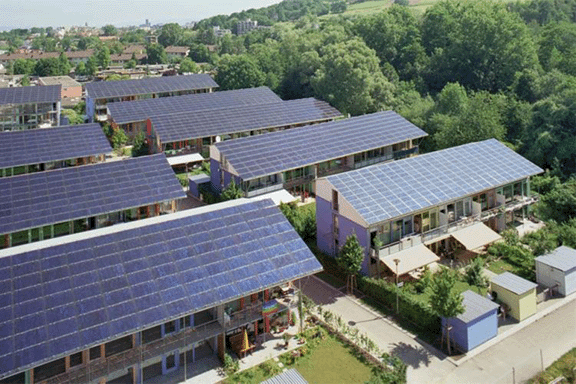 Adelaide charges ahead with world’s largest ‘virtual power plant’ AGL project to roll out 1,000 battery systems to homes and businesses will operate like a 5MW plant, and optimise energy produced from solar panels, Guardian, Michael Slezak, 5 Aug 16, Adelaide will be home to the world’s largest “virtual power plant” – AGL is rolling out 1,000 battery systems to homes and businesses, with backing from the Australian Renewable Energy Agency (Arena).
AGL and Arena say the project will improve network security and dampen a volatile wholesale electricity price in South Australia. However, an energy expert says that at the current size, the system will have a minimal impact on network security or wholesale prices, but might pose a challenge to the revenues of companies that own the poles and wires.
Offered to homes and businesses with solar systems, the $20m AGL project, backed with $5m from Arena, will operate like a 5MW peaking power plant, providing power to homes and businesses during periods at optimal times.
The chief executive of AGL, Andy Vesey, told Guardian Australia: “The beauty of the project is it’s being done over 1,000 batteries, and that’s how we deliver an aggregate benefit to the grid itself.
“But for the consumer, it will have the value of the battery. And it’s being priced at a way that a good investment decision could be made. We’re viewing that the average savings for someone who has rooftop solar right now would be $500 a year. It’s really a way of optimising the energy produced out of their solar panel.”
The system will cost $3,500, and AGL estimates it will take about seven years for solar customers to recover the costs.
Arena’s chief executive, Ivor Frischknecht, said the project would boost grid stability, reduce power price volatility and support the expansion of renewable energy……..
As a demonstration of something that could be bigger, McConnell said one of the biggest impacts of the business model could be on how the networks recover the costs of the poles and wires.
About half the cost of a home energy bill is linked to the network’s cost recovery of its poles and wires. McConnell said that meant a lot of the money being saved by consumers was actually done by avoiding paying the network costs. And that’s what AGL is relying on for its business model.
But this “virtual power plant” isn’t moving people off the grid. Instead, it’s relying on the grid, while avoiding the charges the distributors use to pay for the grid…….https://www.theguardian.com/environment/2016/aug/05/adelaide-charges-ahead-with-worlds-largest-virtual-power-plant
Solar and battery mini grid hits the suburbs

Australian Mini-Suburb ‘Tesla Town’ Project with Powerwalls gives a glimpse into future sustainable communities, Electrek, Nathaniel Kobza, 15 July 16 Near Melbourne, Australia lies an incredible suburban project underway dubbed Yarrabend. This development is currently home to 60 houses and is planned to eventually hit around 2500. What is unique about this venture is not only the art, food or shopping that will be near it, but that all of the houses will come standard with Tesla Powerwalls and solar panels. Via the Heidelberg Leader, Nick Marinakis, sales and marketing manager of the Glenvill development team for Yarrabend, states that the suburb…
will achieve the highest possible ESD rating under the UDIA (Urban Development Institute of Australia) Envirodevelopment scheme, a first for an infill development site in Melbourne.
UDIA’s chief executive, Danni Addison, said that a big reason that this will receive the highest rating is because it will “be one of the most environmentally sustainable developments in Australia.” Further, Ms. Addison goes on to explain:
Some areas that are a standout include water reduction of 43 per cent, landfill reduced by 80 per cent and the potential to reduce energy use by 34 per cent. The Powerwalls, combined with solar panels, will mean that future residents will be able to benefit in a variety of ways, including dramatically smaller power bills and knowing that the majority of their energy usage is coming from a clean and renewable source…….http://electrek.co/2016/07/15/australian-mini-suburb-tesla-town-project-with-powerwalls-gives-a-glimpse-into-future-sustainable-communities/
South Australia to get world’s biggest solar + storage project
 World’s biggest solar + storage projects planned for Australia http://reneweconomy.com.au/2016/worlds-biggest-solar-storage-projects-planned-australia-95528 By Giles Parkinson on 19 July 2016 Australian infrastructure investor Lyon Group says it plans to build the world’s biggest solar plus storage project in South Australia in the next two years, and sees a huge future for combined solar and battery storage plants..
Lyon Group’s David Green – which worked on developing a soon-to-be built 30MW solar plant and 1.4MW/5.3MWh lithium battery storage facility near Cooktown, in far north Queensland, before selling it to German-based company Conergy – plans a series of other projects and claims a pipeline of more than 300MW of solar and up to 60MW of battery storage.
The first new project is planned for South Australia, with a 100MW solar PV plant to be combined with a battery storage array of up to 40MW, Green says the plant could be in operation near Roxby Downs by early 2018, and there are plans for other similar projects around the country.

The first stage of what is known as the Kingfisher project – 20MW of solar PV plus a minimum 2MW battery storage – is expected to be running late next year.
The project is one of the finalists in the Australian Renewable Energy Agency funding round for large scale solar, which is expected to allocate monies to 10 or more projects when decisions are announced next month.
Green says the company – which has previously invested in coal, gas and wind projects, but is now specialising in solar and storage – is looking to be a global industry leader in solar plus storage.
“The genie is out of the bottle. There will be a burst of activity now in large scale solar + battery projects. This is the real battery storage story coming out of Australia – batteries used to convert large scale solar to effectively baseload, or peaking plant.”
The combination of solar and storage means the facilities can compete on two levels – providing clean energy and dispatchable power, either to household or large energy users, and also re-enforcing the edge the grid, in some cases avoiding the costs of grid upgrades. Continue reading
A solar world first for Perth: solar panels and battery storage on apartment buildings
Apartments set for solar world first https://au.news.yahoo.com/thewest/wa/a/31335712/apartments-set-for-solar-world-first/ Daniel Mercer – The West Australian on April 13, 2016 Dozens of apartments will be able to use, store and trade power under a world-first trial of micro-grid technology to be unveiled in Perth’s south.
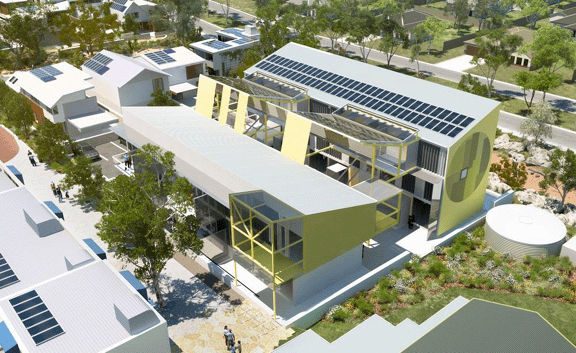
Federal Environment Minister Greg Hunt will today announce the Commonwealth’s green energy fund ARENA has tipped $1 million into a micro-grid project in White Gum Valley.
The $3 million project will have solar panels and batteries installed across four separate apartment developments. It would be up to the strata companies managing the apartment buildings to on-sell the electricity to tenants, rather than State-owned power provider Synergy. The strata companies could sell the electricity cheaper than Synergy or at the same price, currently set at 25.7¢ for every unit of electricity sold. Homes owners and tenants would also be able to trade power to other apartments within the complex during the day and night.
Headed by Curtin University and backed by Western Power, LandCorp, the City of Fremantle and Balance Services Group, the project aims to establish a viable model for the uptake of solar panels on apartment buildings.
Demand for solar panels has exploded across Perth, with more than 170,000 homes installing the systems on their roofs. Apartments, which make up a third of Perth’s housing stock, have been much slower on the uptake.
Curtin University’s Jemma Green said that with battery systems rapidly becoming commercially viable, there was an unprecedented opportunity for apartments to get in on the act.
And she said the implications could be huge, with micro-grids such as White Gum Valley popping up everywhere and transforming the way electricity was generated, transported and sold.
“These kinds of innovations are not only making solar power a viable option for everyone, but potentially reflect the future of power utilities,” Ms Green said.
Australian Capital Territory funding battery storage in homes
 battery storage in homes http://www.abc.net.au/news/2016-04-01/canberra-energy-auction-funds-battery-storage-in-homes/7290834 A new ACT Government renewable energy auction will help pay for battery storage in thousands of Canberra homes.
The auction for 109 megawatts of renewable energy feed-in tariff capacity begins today.
Minister for the Environment and Climate Change Simon Corbell said it would complete the Territory’s investment to meet its commitment of using renewable sources to supply 90 per cent of Canberra’s electricity needs by 2020.
He said successful bidders would provide the money needed to establish a photovoltaic battery storage program in the ACT.
“We expect up to $25 million to be available to support about 26MW of battery storage to be rolled out in more than 5,000 Canberra homes and businesses over the next four years,” Mr Corbell said.
“This will represent the largest deployment outside of Germany.”
Mr Corbell said photovoltaic battery storage would put renewable energy on demand when it was needed and reduce the need for network investment.
“It is exciting to see the 90 per cent renewable energy target on track to be completed on time and with minimal flow-on cost for the Canberra community,” he said.
Mr Corbell said the request for proposals would close in May.
Australia’s home solar battery company launches new product
Australian company launches home solar storage battery to take on electronics giant Tesla With the number of depleted home solar batteries being thrown away tipped to rise over the coming years, one Australian company is taking on electronic giants such as Tesla and Panasonic with the launch of an easily recyclable power source.
http://www.abc.net.au/news/2016-03-30/recyclable-solar-storage-battaries-to-take-on-giants-tesla/7284518?section=environment
Australian designed ZCell home battery storage system to be available by midyear
AN Australian-designed battery system partly built in Adelaide will allow householders to use stored solar power during the night. But it will cost you.
http://www.adelaidenow.com.au/business/simon-hackettbacked-redflow-launches-zcell-home-battery-storage-system/news-story/c5cc9be96f517103b02c363adae6a6b5
Telstra to rollout solar and battery storage technologies
 Telstra takes on energy utilities with home solar and storage plan, Independent Australia Giles Parkinson 11 February 2016 Telstra’s rollout of solar and battery storage looks to be a game-changer in the home energy market. RenewEconomy‘sGiles Parkinson reports.
AUSTRALIA TELECOMMUNICATIONS giant Telstra plans to accelerate the rollout of solar and battery storage technologies, and is looking to offer home energy services to millions of consumers in the first sign it will take on the major energy utilities.
Telstra has established a dedicated project team to be led by Ben Burge, the feisty CEO of Powershop and Meridian Energy Australia,which has made major inroads into the Australian energy oligopoly, and which has been a keen proponent of wireless technology and smart-phone apps.
The arrival of a giant corporation such as Telstra into the home energy market signals massive change in the industry, as new technologies such as solar and battery storage, and the “internet of things” offer new avenues to the consumer market.
Telstra is flagging the possibility of offering home energy services – including solar and battery storage – as part of its bundled services that includes internet and telephone.
Telstra’s head of new business, Cynthia Whelan says in her corporate blog:
We see energy as relevant to our Connected Home strategy, where more and more machines are connected in what is called the Internet of Things.
We are looking at the opportunities to help customers monitor and manage many different aspects of the home, including energy……..
Analysts have predicted for several years now that the traditional energy industry would come under attack from new players such as telcos, and IT giants such as Google.
Mark Coughlin, the head of utilities at PwC, says electricity utilities, are facing their “Kodak moment” as the emergence of rooftop solar, in combination with battery storage and smart software, shift the power from the utility to the customer.
And, he says, telcos such as Telstra are better at consumer service than energy utilities, which will struggle to maintain their right to survive. …….https://independentaustralia.net/environment/environment-display/telstra-takes-on-energy-utilities-with-home-solar-and-storage-plan,8666
In bushfire season, Solar microgrids and batteries are safer than conventional grid
 Turner says his company has been in productive talks with Victorian energy minister Lily D’Ambrosio over the prospect of subsidising Zen Energy systems capable of running as a localised backup for periods when the grid needs to be switched off
|
Solar microgrids and batteries could prevent another Black Saturday bushfire, Guardian, Max Opray 9 Feb 16, The cause of the Kilmore East fires that contributed to Victoria’s 2009 Black Saturday bushfires was found to be an ageing SP AusNet power line
Smaller sustainable energy systems are a better option than trying to maintain ageing Australian energy infrastructure, say experts On 7 February, Australia solemnly marked the anniversary of an electrical fault.It was on this date in 2009 that Melbourne endured its hottest conditions on record – a sweltering 46.4C. To make matters worse, hot winds blasted through the region at speeds in excess of 100km/h. In Kilmore East, just north of Melbourne, a critical failure in a 43-year-old power line caused bursts of 5000C plasma to arc out and ignite the tinder-dry vegetation in the gully below. Fanned by such extreme winds, the fast-growing inferno would by the end of the day be responsible for the majority of the 173 lives lost in the dozens of fires that engulfed Victoria on Black Saturday, Australia’s worst bushfire disaster. Several of the other blazes that day were started by felled power poles and other electrical issues. This was also the case for many other fires before and since, including Australia’s previous-worst bushfire tragedy, the 1983 Ash Wednesday fires, which claimed 75 lives. Richard Turner, director of South Australian renewable energy powerhouse Zen Energy, has a plan to stop such a thing happening again. Continue reading |
Queensland launches solar storage battery trial
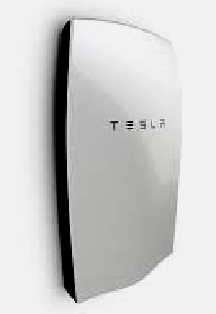 Queensland installs Australia’s first Powerwall battery for solar trial,
  Guardian, Joshua Robertson, 18 Jan 16 Energex, which is owned by the state government, launches a 12-month trial of solar batteries to investigate ways to integrate them into electricity supply
A Queensland government-owned power company has installed the country’s first solar battery storage system from Tesla as it begins a year-long trial into how it can reward consumers who cut their reliance on the electricity grid.
Energex, which has installed a Tesla Powerwall and another storage system from Californian company Sunverge at its Brisbane training facility, will collect data to work out how to integrate solar batteries into the network with financial incentives for customers.
The trial, which will extend monitoring of systems in Energex employees’ homes to those in outside consumers’ in coming months, follows lobbying by the Queensland premier, Annastacia Palaszczuk, of Tesla executives in the US six months ago.
Queensland boasts one of the highest rates of household solar panel systems in the world, although uptake in recent years has been inhibited by a dramatic cut in the rate consumers are paid for power that they return to the grid.
The commercial release of the Powerwall this year is widely expected to drive popular take-up of a system that at best would supply about seven hours of nightly power for televisions, air-conditioning and other appliances……..
Terry Effeney, the chief executive of Energex, said information about the effect of solar batteries on peak demand could allow power network operators to defer costly infrastructure investments or reduce generation where possible.
Contrary to the idea of consumers being able to quit the grid, Effeney said the 12-month trial would “demonstrate that in fact the best way to use batteries and solar is to integrate them into the grid to deliver the best possible outcome to the customers”. http://www.theguardian.com/environment/2016/jan/18/queensland-installs-australias-first-powerwall-battery-for-solar-trial
Battery storage for renewable energy: boom expected in 2016
2016 boom in uptake of electricity battery-storage systems predicted by Clean Energy Council, ABC Radio 17 Dec 15 The year ahead will see a booming take-up of battery-storage energy systems, the Clean Energy Council predicts.
Key points:
- Battery storage costs ‘becoming affordable’
- Clean Energy Council says best power deals require aggressive ‘shopping around’
- Fewer power lines in bushfire risk zones could have benefits
“The main barrier has been that batteries have been fairly high cost but that cost is really coming down,” solar policy manager Darren Gladman told 891 ABC Adelaide.
“People are expecting in the next year or two batteries will become quite affordable and it’ll become a real option for households and businesses.”
He said South Australia and Queensland led the world in uptake of solar panel rooftop systems and battery storage of that energy was the next logical step.
“We don’t have a lot of big solar farms in Australia but we do have a lot of rooftop solar,” he said……..http://www.abc.net.au/news/2015-12-17/battery-electricity-storage-systems-2016-clean-energy-council/7037416
In Australian Capital Territory panasonic home battery trial launched
First panasonic home battery trial launched in the ACT December 11, 2015 David Ellery Reporter for The Canberra Times ActewAGL has partnered with Panasonic to promote the installation of solar panel and storage battery packages across the territory. Continue reading
A network of micro-grids for Australia’s energy future?
Australia’s energy future could be network of micro-grids http://reneweconomy.com.au/2015/australias-energy-future-could-be-network-of-micro-grids-84534 By Giles Parkinson on 13 October 2015
The creation of micro-grids is seen by many leading players as an obvious solution to Australia’s soaring electricity costs, where the grid has to cover huge areas, at the cost of massive cross-subsidies that support it.
The major network operators in Queensland, NSW, South Australia and Western Australia see micro-grids as an obvious solution to the challenge and cost of stringing networks out, sometimes more than 1,000km away from the source of generation.
In Western Australia and Queensland, these subsidies amount to more than $500 a household. The cost of service to regional consumers in Queensland is far above the cost of service to those in the south-east corner. To address this, these states are proposing to take some small communities, and towns like Ravensthorpe in Western Australia off the grid. In New South Wales, some towns are taking the initiative themselves.
In northern rivers region, the township of Tyalgum revealed it is considering a micro-grid that would allow it to largely, or entirely, look after its own energy needs.
Indeed, the whole Byron shire is considering micro-grids as part of its efforts to become “zero net emissions” within the next decade, and to source 100 per cent of its electricity needs from renewables.
But micro-grids are not just about grid defection. While it will make sense for those towns and communities at the edge of the network to become self-sufficient and disconnect entirely, most micro-grids will remain connected to the network, helping to reshape a centralised grid to one focused on more efficient decentralised renewable power generation sources and storage. Continue reading
1 This month
Chernobyl: The Lost Tapes – A good documentary on Chernobyl on SBS available On Demand for the next 3 weeks– https://www.sbs.com.au/ondemand/tv-program/chernobyl-the-lost-tapes/2352741955560
15 April – Zoom –Nuclear Power is Not the Solution
Apr 15, 2026 01:00 AM in Canberra, Melbourne, Sydney

Join the International Physicians for the Prevention of Nuclear War (IPPNW) on Tuesday, April 14th for a timely webinar exploring the risks associated with nuclear power and challenging the myth that it offers a simple, safe, carbon-free solution to the climate crisis

21 April Webinar: No Nuclear Weapons in Australia
Start: 2026-04-21 18:00:00 UTC Canberra, Melbourne, Sydney (GMT+10:00)
End: 2026-04-21 19:30:00 UTC Canberra, Melbourne, Sydney (GMT+10:00)
Event Type: Virtual
A virtual link will be communicated before the event.
Host Contact Info: australia@icanw.org

of the week – Australians for War Powers Reform (AWPR)
To see nuclear-related stories in greater depth and intensity
 Antinuclear