ACF responds to Labor’s Environment Protection Agency announcement
26 October 2025 AIMN Editorial, https://theaimn.net/acf-responds-to-labors-environment-protection-agency-announcement/
The Australian Conservation Foundation acknowledges Environment Minister Murray Watt’s announcement today that the Albanese government intends to establish a national Environment Protection Authority (EPA).
The details announced fall short of creating a fully independent EPA. A better model than the one announced by Minister Watt would be one in which the Environment Minister makes nature protection rules, and the EPA assesses and approves projects and enforces the rules based on strong National Environmental Standards.
“For decades, ministers have been able to be influenced and pressured by developers. Tragically, this has resulted in millions of hectares of valuable bushland and habitat being razed by bulldozers, and Australia’s natural wealth significantly degraded,” said ACF Acting CEO Paul Sinclair.
“We remain strongly of the view that independent, expert decision making by the EPA on assessments and approvals is the best way to the deliver the consistency and certainty that is needed under our national nature protection laws. Arm’s length decision making is better for nature and better for business. We will carefully consider the details of the model proposed in the context of the entire reform package by the government once we see the legislation.
“A strong EPA is an important step in addressing the woeful lack of enforcement under the EPBC Act, especially in relation to agricultural deforestation. But an EPA alone will not be enough. We need stronger nature protection laws, we need all decisions to account for climate harm, and deforestation loopholes that allow rampant clearing of precious habitat must be closed. An independent referee is only as good as the rules they have to follow”
Plutonium Levels in Sediments Remain Elevated 70 Years After Nuclear Tests
June 24, 2025,
https://www.marinetechnologynews.com/news/plutonium-levels-sediments-remain-650328
Researchers from Edith Cowan University (ECU) in Australia have confirmed plutonium levels in sediment up to 4,500 times greater than the Western Australian coastline.
Three plutonium-based nuclear weapons tests were conducted at the Montebello Islands in the 1950’s, which introduced radioactive contamination to the surrounding environment. The first nuclear test, coded Operation Hurricane, had a weapon’s yield of some 25kT, and formed a crater in the seabed, while the second and third tests, dubbed Operation Mosaic G1 and G2, had weapons yields of around 15kT and 60kT, respectively.
The three tests released radioactive isotopes including plutonium, strontium (90Sr) and caesium (137Cs) into the surrounding marine environment.
“Plutonium is anthropogenic, which means that it doesn’t exist on its own in nature. The only way it is introduced into an environment is through the detonation of nuclear weapons and from releases from nuclear reprocessing plants and, to a lesser extent, accidents in nuclear power plants,” said ECU PhD student and lead author Madison Williams-Hoffman.
“When plutonium is released into a coastal setting in the marine environment, a significant fraction will attach to particles and accumulate in the seabed, while some may be transported long distances by oceanic currents.”
The region is not inhabited by humans and has not been developed, however it is visited by fishing boats, so collecting data on the levels of contamination in the marine environment is important.
Currently, the protected island archipelago and surrounding marine areas also reside within the Montebello Islands Marine Park (MIMP). The MIMP is ecologically significant due to the presence of numerous permanent or migratory species, and its high-value habitat is used for breeding and rearing by fish, mammals, birds and other marine wildlife.
The water and sediment quality within the MIMP are currently described as ‘generally pristine’, and it is fundamental to maintain healthy marine ecosystems in the region.
The concentrations of plutonium at Montebello Islands were between 4 to 4,500 times higher than those found in sediment from Kalumburu and Rockingham from the Western Australian coastline, with the northern area of the archipelago, close to the three detonation sites, having four-fold higher levels than the southern area.
The concentrations of plutonium found in the sediment at Montebello Islands were similar to those found in the sediment at the Republic of Marshall Islands (RMI) test sites, despite 700-fold higher detonation yields from nuclear testing undertaken at RMI.
Plutonium is an alpha emitter so, unlike other types of radiation, it cannot travel through the skin and is most dangerous when ingested or inhaled.
The research was undertaken by Williams-Hoffman, under the co-supervision of Prof. Pere Masqueand at ECU and Dr Mathew Johansen at ANTSO.
Chernobyl’s shadow highlights Australia’s potential nuclear risks
April 26, 2025, Don’t Nuke the Climate
On 26 April 1986, the Chernobyl nuclear power plant in Ukraine exploded, spewing uncontrolled radiation across Europe and beyond.
Chernobyl caused massive human, environmental and economic impacts. The ongoing clean-up is set to continue for another four decades, with parts of the exclusion zone likely to remain uninhabitable for many hundreds of years.
Against the shadow of Chernobyl, Peter Dutton’s proposal to build nuclear power plants at seven sites around the country could put up to 200,000 Australians in direct danger.
Advocacy group Don’t Nuke the Climate has produced an online resource based on real world data from the Fukushima nuclear disaster in Japan. This detail has been transposed to Australia to help people understand the extent of nuclear contamination from a potential reactor accident.
The maps at www.nuclearplume.au show how far radioactive fallout from a Fukushima-sized accident would spread under different wind conditions from the seven sites identified for nuclear reactor by the federal Coalition. They highlight how a nuclear accident at one of the proposed reactor sites would affect nearby communities, including schools and hospitals.
Don’t Nuke the Climate is sharing this research to assist with evidence-based decision making that reduces nuclear risks and prioritises environmental responsibility and a safe future ahead of the coming federal election.
Dave Sweeney – Nuclear analyst, Australian Conservation Foundation says:
‘Australia should heed the lessons of Chernobyl and Fukushima and keep the door shut on domestic nuclear power. Nuclear isn’t just dangerous, it’s an irresponsible distraction from real climate action that makes no economic or environmental sense in Australia.’
‘Instead of the threat of radiation blowing in the wind we should be using the wind to generate clean electricity. Australia’s energy future is renewable, not radioactive.’
Dr Jim Green – Nuclear campaigner, Friends of the Earth Australia says:
‘Emergency Leaders for Climate Action recently warned that nuclear reactors would introduce significant and unnecessary risk to Australian communities and emergency responders, including firefighters already stretched by escalating climate fuelled disasters.’
‘The Coalitions nuclear push is risky and reckless. It is a high cost, high risk thought bubble, not a credible national energy policy.’
Nuclear would funnel up to 200 Gigalitres away from Australian farms annually.
Liberals Against Nuclear, 9 Apr 25
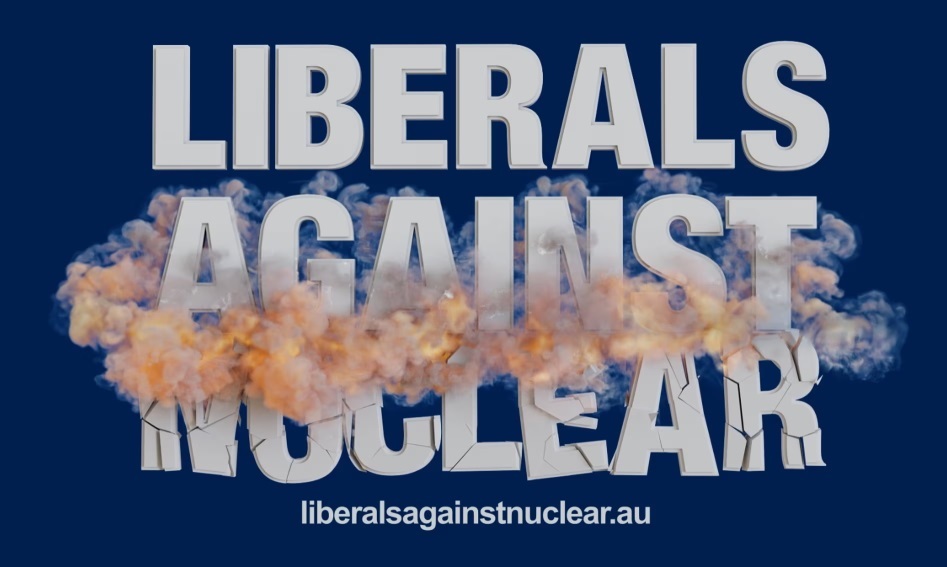
Peter Dutton’s nuclear plan would spark an Australian water crisis, potentially sucking a mammoth 200 gigalitres away from farmers in dry years through water buybacks and acquisitions, according to a new report by one of the nation’s leading subject matter experts. The Coalition bitterly opposes the current Labor Government buyback of 43 gigalitres of water allocation a year, less than a quarter of what its own nuclear plan would require. “The nuclear idea is toxic with voters,” said Liberals Against Nuclear spokesman Andrew Gregson, a former NSW Irrigators’ Council chief executive. “It will require enormous water buybacks from farmers – which the Coalition has fought bitterly against for 15 years.” |
The report, Australian nuclear energy proposals, water availability and acquisition options was commissioned by Liberals Against Nuclear and authored by former Land & Water Australia chief executive and ANU visiting fellow, Professor Andrew Campbell. It reveals the scale of water acquisitions required to run the Coalition’s proposed nuclear reactors by asking how much water would need to be acquired through buybacks or compulsory acquisitions to run them at the seven proposed sites.
Relying on the Coalition’s own modelling, the report assumes 13.8 gigawatts of nuclear capacity would replace the existing 8 gigawatts of coal-fired capacity. It estimates water consumption based on newly-commissioned nuclear reactors at Georgia USA, the same ‘off the shelf’ Westinghouse AP-1000 units proposed by The Coalition.
The report found:
- Annual high-security water allocation for a mammoth 200 gigalitres would potentially have to be acquired from farmers and other water users, such as coal mines and urban water supplies, to cool the nuclear reactors
- There is no guarantee farmers would give up this much water for sale. Compulsory acquisitions would likely be required
- Up to 39 gigalitres of annual allocation would need to be acquired each year in the Hunter, up to 25 GL around Mt Piper/Lithgow, up to 125GL in the Latrobe Valley (where the typical annual allocation to the local Macalister Irrigation District is just 32GL), 5GL in Callide and 7.5GL in Collie, WA
The report concludes that 50% of the proposed nuclear generation capacity is already infeasible due to lack of water, and a further 40% would need to be curtailed in dry seasons due to lack of water to cool the reactor, or the water becoming too warm- In short, at 5 of the 7 sites, representing 90% of the proposed generating capacity, nuclear power generation would be an unreliable source of electricity
- Most nuclear reactors overseas are near the ocean, large lakes or large rivers – in cold and wet places – due to the enormous amount of high-security water required. Six of Coalition’s seven proposed sites are inland.
“The Nationals have spent 15 years educating rural communities on how much water buybacks hurt them and fighting tooth and nail to protect our agricultural water,” Gregson said. “Now, there is a proposal to take water from the very farmers who grow our food.
“Making matters worse, this precious water will be used to create government-owned electricity companies to compete against private businesses. Forcing farmers to compete with the government when they buy water assaults every value that Liberal voters hold dear.
“We recently saw polling which showed support for nuclear in the political death zone in the proposed host sites. Support was 22% in Central West NSW, 27% in Gladstone, 24% in the rest of Central Queensland, 24% in south-west WA, just 32% in the Hunter and 31% in Gippsland. This policy is electoral poison.
“Nuclear must be dumped. It is already causing an electoral nightmare and in the long run, it is political and economic suicide. It will completely distort our economy, crowding out the private sector. It is the wrong thing to do and means destroying the livelihood of some of our most loyal supporters.
“This water grab threatens to sever the trust between the Coalition and agricultural communities permanently. We’ve spent decades building our reputation as champions of farmers’ rights – particularly water access. Why would we throw away that political capital for nuclear plants that most Australians don’t want?
“Mr Dutton must drop this toxic nuclear policy and focus on our winning strengths of small government, managing the economy and real liberal values. We can still win this election, but not with this nuclear proposal, which is diametrically at odds with our values.
Not enough water available for Coalition’s nuclear proposal to run safely, report finds
Analyst says nuclear is the ‘thirstiest’ energy source, as report commissioned by Liberal supporters throws doubt on plan’s feasibility.
Guardian, Petra Stock, 9 Apr 25
About 90% of the nuclear generation capacity the Coalition proposes to build would not have access to enough water to run safely, according to a report commissioned by Liberals Against Nuclear.
The report authored by Prof Andrew Campbell, a visiting fellow at the Australian National University, assessed nuclear energy’s water needs and the available supply across the seven sites where the Coalition has proposed new reactors.
Campbell found replacing coal generation with “off the shelf” nuclear technology as proposed by the Coalition would require 200 gigalitres of water annually.
He found half of the proposed nuclear capacity was already unfeasible given insufficient water, while a further 40% of the capacity would need to be curtailed during dry seasons.
“At Loy Yang in Victoria, Mt Piper in NSW and Muja in Western Australia, existing water availability is already so constrained that new nuclear power stations of the capacities proposed would lack sufficient cooling water to provide reliable power now, let alone for 80 years into the future, even if the majority of existing irrigation water entitlements were acquired,” the report said.
The volumes required at Callide in Queensland and Liddell in New South Wales would be so significant the demands could place pressure on other water users, including agriculture, industry, urban residents and the environment.
Dave Sweeney, a nuclear policy analyst at the Australian Conservation Foundation, described nuclear energy as the “thirstiest of the energy sources”, which required reliable access to large volumes of water for steam to drive a turbine as well as to cool the reactor core.
On a per-kilowatt hour basis, nuclear power used more water than coal, and “massively more than renewables”, he said……………………………………
Dr Mark Diesendorf, an expert in sustainable energy at the University of NSW, said nuclear power stations were typically larger than coal generators and used more water as a result. “In comparison, solar and wind don’t use any water during operation at all,” he said.
“Australia is the driest continent in the world, apart from Antarctica,” he noted. That meant water use was an important issue, alongside other concerns such as the proliferation of nuclear weapons, the difficulty and expense of managing radioactive waste and the danger of low-level radiation as well as accidents…………………………………………………………….
Andrew Gregson, the spokesperson for Liberals Against Nuclear and a former state director of the Liberal party in Tasmania, said the nuclear water grab threatened to “sever the trust between the Coalition and agricultural communities permanently”.
“We’ve spent decades building our reputation as champions of farmers’ rights – particularly water access. Why would we throw away that political capital for nuclear plants that most Australians don’t want?” https://www.theguardian.com/environment/2025/apr/09/not-enough-water-available-for-coalitions-nuclear-proposal-to-run-safely-report-finds?fbclid=IwY2xjawJj08VleHRuA2FlbQIxMQABHsr4gCWoCyIIPdf_Pd5L89YMaJnymCsNl3F3wcT-YgT7oP1C5Bl9U_fpxYsf_aem_RVvJw4Qzs8w3lNw7HHFP9g
Nuclear power plan puts thousands of farms in “radiation alert zone”
ReNewEconomy, Stephanie Gardiner, Jul 18, 2024
Nuclear energy threatens Australia’s food production with more than 11,000 farms near the opposition’s proposed reactor sites, the government says.
The farms are located within an 80km radius of the seven earmarked sites, according to a data analysis released by the federal government on Thursday morning.
Under international standards that radius is classified as an “ingestion exposure pathway” in which people may be exposed to radiation through contaminated food, milk and water after a nuclear leak.
US farmers in those zones must take on preventative measures in an emergency, such as providing livestock with separate feed and water, holding shipments and decontaminating produce.
“Based on international practice, farmers would need to take expensive steps during a nuclear leak and would need to inform their customers that they operate within the fallout zone,” Agriculture Minister Murray Watt said in a statement.
“It’s bizarre that the Nationals and Liberals are putting at risk our prime agricultural land like this, especially without the decency to explain it to farmers and consumers how they’d mitigate all the potential impacts.”
Senator Watt also told the Australian Global Food Forum on Wednesday that nuclear power needs more water than coal-fired energy and renewables.
“One issue not yet considered in the nuclear debate is the fact that nuclear energy production is a thirsty endeavour,” he told the industry crowd in Brisbane.
………………………………………..There would be more than 1000 affected farms close to each of the sites at Callide, Collie, Liddell and Mount Piper, 2400 near Tarong and 260 near Port Augusta, according to the government’s analysis.
Victoria’s La Trobe region would be the hardest hit with more than 4100 farms within the 80km radius.
Nuclear power will be on the agenda as the nation’s agriculture ministers meet in Queensland on Thursday…. https://reneweconomy.com.au/nuclear-power-plan-puts-thousands-of-farms-in-radiation-alert-zone/
DUTTON’S RISKY NUCLEAR REACTOR PLAN THREATENS 12,000 FARMS
FOOD PRODUCTION ACROSS THE COUNTRY ON HIGH ALERT FROM DUTTON’S RISKY REACTOR PLAN
Agriculture Minister Murray Watt, 18 July 24
The fallout from Peter Dutton’s expensive and risky nuclear reactor announcement continues with new revelations that nearly 12,000 farms across Australia could be impacted.
The LNP’s announcement that nuclear reactors would be built at seven sites across the country could have serious implications for the agricultural sector.
The regions selected by Mr Dutton are major contributors to Australia’s food supply with significant cattle, milk, lamb, grain and vegetable production nearby.
Various states in the United States of America, including Illinois, California, Indiana, Maryland, Missouri and Florida set out detailed guidelines to be followed by farmers, processors and distributors within an 80-kilometere radius of nuclear reactors (known as the “ingestion zone”) to protect their food supply, in the event of a nuclear accident.
Analysis of ABS and local government data by the Parliamentary Library has found approximately 11,955 farms are located within an 80-kilometre radius of the Coalition’s selected sites.
Mr Dutton must urgently explain whether Australian farmers, processors and distributors within a similar ingestion zone will be forced to replicate the expensive actions recommended by American counterparts.
On top of this, leaks have occurred in recent years at nuclear reactors in the United States, Japan, India and Europe, in some cases contaminating agricultural land, crops and water sources.
Eating contaminated foods and drinking contaminated milk and water could have a harmful, long-term effect on the health of the wider community.
Mr Dutton needs to explain his plan to prevent such leaks, how he will manage them if they occur and how he would compensate affected farmers.
Agriculture Minister Murray Watt: –
“Peter Dutton’s risky nuclear plan is not only expensive, slow and unreliable, it also poses a threat to the agricultural industry.
“Based on international practice, farmers would need to take expensive steps during a nuclear leak and would need to inform their customers that they operate within the fallout zone.
“It’s bizarre that the Nationals and Liberals are putting at risk our prime agricultural land like this, especially without the decency to explain it to farmers and consumers how they’d mitigate all the potential impacts.”
BACKGROUND:
Parliamentary library analysis of farm businesses within the 80km ingestion zone of each proposed reactor.
- Collie (WA): Approximately 1,150 agricultural establishments. Major agricultural products include beef cattle, milk, lamb, barley, and carrots.
- Callide (Qld): Approximately 1,040 agricultural establishments. Major agricultural products include beef cattle, cotton, vegetables, wheat, and herbs.
- Hunter (NSW): Approximately 1,650 agricultural establishments. Major agricultural products include beef cattle, milk, chicken (meat), eggs, and hay.
- Latrobe Valley (VIC): Approximately 4,175 agricultural establishments. Major agricultural products include milk, beef cattle, vegetables, applies, and strawberries.
- Mt Piper (NSW): Approximately 1,280 agricultural establishments. Major agricultural products include beef cattle, cultivated turf, lamb, mushrooms, and other vegetables.
- Port Augusta (SA): Approximately 260 agricultural establishments. Major agricultural products include wheat, barley, lamb, wool, hay, and eggs.
- South Burnett/Darling Downs (Qld): Approximately 2,400 agricultural establishments. Major agricultural products include beef cattle, pork, sorghum, cotton, and milk
Radiation monitoring at SA nuclear subs site starts – but community consultation is lacking.
The first steps in monitoring radioactive contamination at the state’s new nuclear-powered submarine shipyard and nearby dolphin sanctuary is starting, sparking calls for far greater consultation with residents.
Belinda Willis, In Daily 11 Oct 23
New documents released under the Freedom of Information Act reveal details of an 18-month contract to collect soil, groundwater and marine water samples at the future subs site and the nearby sanctuary to establish a baseline for checking future radiation levels.
Documents released to former federal senator and submariner Rex Patrick show samples will be delivered to the Australian Nuclear Science and Technology Organisation “for radiological analysis”.
The test findings will be used to build an Environmental Contamination Baseline Assessment so radioactive activity where the nuclear-powered submarines are built or docked can be closely monitored.
Patrick said the papers raised new concerns about South Australians not being consulted about regulations and the handling of operational nuclear waste at the $2 billion shipyard, saying there “is absolutely no community engagement, there’s no attempt to establish social licence” about having nuclear reactors on site.
“(The monitoring is) in order to be able to understand the magnitude of a leak or the nature of a problem that might develop in the future,” Patrick said, adding that people living in Port Adelaide and Osborne “probably aren’t aware that this activity is taking place”.
Sadly, the Defence Department is not interested in being open and transparent about what they are doing around nuclear stewardship and safety,” Patrick said.
“There is no community engagement and there is no social licence being developed. It’s a foolish approach noting that ANSTO has warned defence of the need for social licence.
“Perhaps they’re setting themselves up for another ‘Kimba’ style court case.”
Patrick was referring to a recent court decision that led to the dumping of a site for a low-level radioactive waste site at Kimba in South Australia despite years of consultation and the more than $100 million spent on the process………………………………………………..
Under the AUKUS deal with the United States and United Kingdom, Australia is obtaining eight nuclear-powered submarines at an estimated taxpayer cost of $268-$368 billion.
Defence Minister Richard Marles has said submarines will be built at Osborne and also that waste from spent nuclear reactors from the submarines will be stored on defence land.
Port Adelaide Enfield Mayor Claire Boan said the local council “has not been briefed on the specifics of this matter i.e. management of radioactive materials”, but said council staff has had an initial meeting with defence staff regarding the environmental impact assessment for this development required under federal and state regulations. ……..
The documents released to Patrick show the Submarine Construction Yard will span about 75 hectares and is made up of four distinct areas.
Nearby is the 12,000-hectare Adelaide Dolphin Sanctuary which is the home of up to 60 bottlenose dolphins and is visited by another 400 to feed and nurse their calves in the Port Adelaide River and Barker Inlet.
Mutton Cove Conservation Reserve is also nearby.
South Australia’s Defence Minister Susan Close, who is also Port Adelaide’s member of parliament, did not respond to questions about whether people living in her electorate have been consulted about work at the nuclear-powered submarine construction site.
The Minister and Premier Peter Malinauskas have been vocal supporters of the project, the Premier having flown to the United Kingdom to meet with the UK submarine builders. https://indaily.com.au/news/2023/10/11/secrecy-surrounds-radiation-monitoring-at-sa-nuclear-subs-site/
Friends of the Earth comments accuse the Australian Government Industry Department of blatant racism in its Kimba nuclear waste dump plan.

Comments on: Guidelines for the content of a Draft EIS National Radioactive Waste Management Facility, SA EPBC 2021/9128 April 2023
RIGHTS OF TRADITIONAL OWNERS
Recommendation #1: The Guidelines must require the proponent (the Australian Government Department of Industry, Science and Resources) to explain how the nuclear dump/store proposal complies with the United Nations Declaration on the Rights of Indigenous Peoples, in particular Article 29.2:
“States shall take effective measures to ensure that no storage or disposal of hazardous materials shall take place in the lands or territories of indigenous peoples without their free, prior and informed consent.”
Of course it is common knowledge that the proposal is a gross violation of Article 29.2 and that the nuclear dump/store is unanimously opposed by Barngarla Traditional Owners. Nevertheless, the proponent must be asked to explain its position and its crude racism.
Recommendation #2: The list of documents in section 3.5.1 of the Guidelines should also include the United Nations Declaration on the Rights of Indigenous Peoples.
Recommendation #3: The Guidelines mention a “process for ongoing consultation with FirstNations people”. The proponent should be required to declare whether or not it reservesthe right to ignore the rights, interests and recommendations of the Barngarla Traditional Owners in future just as it has ignored and overridden unanimous Barngarla opposition to the nuclear dump/store proposal.
Recommendation #4: The proponent should be required to discuss the adequacy of the
National Radioactive Waste Management Act (NRWMA) and in particular to provide
justifications for each of the following provisions of the Act:
- The nomination of a site for a radioactive waste facility is valid even if Aboriginal
Traditional Owners were not consulted and did not give consent. The NRWMA states that
consultation should be conducted with Traditional Owners and consent should be secured ‒
but that the nomination of a site for a radioactive waste facility is valid even in the absence
of consultation or consent. - The NRWMA has sections which nullify State or Territory laws that protect the
archaeological or heritage values of land or objects, including those which relate to
Indigenous traditions. - The Act curtails the application of Commonwealth laws including the Aboriginal and Torres
Strait Islander Heritage Protection Act 1984 and the Native Title Act 1993 in the important
site-selection stage. The Native Title Act 1993 is expressly overridden in relation to land
acquisition for a radioactive waste facility.
Recommendation #5. The proponent should be required to explain why it rejects the SA
Government’s policy that Traditional Owners should have a right of veto of nuclear waste
sites. SA Labor’s Deputy Leader (and now Deputy Premier) Susan Close noted in September
2020 that: “South Australian Labor is calling on the Federal Government to halt its plans to
dump nuclear waste at Kimba. … SA Labor has consistently expressed its concerns about the
site selection process and the lack of consultation with native title holders. … This was a
dreadful process from start to finish, resulting in fractures within the local community over
the dump. The SA ALP has committed to traditional owners having a right of veto over any
nuclear waste sites, yet the federal government has shown no respect to the local
Aboriginal people.”
FEASIBLE ALTERNATIVES
Recommendation #6. The Guidelines should require discussion on the ‘feasible alternative’
of targeting states/territories which do not have legislation prohibiting a nuclear
dump/store such as the one proposed. The current proposal requires the Commonwealth to
override the SA Nuclear Waste Storage (Prohibition) Act 2000.
Recommendation #7. The Guidelines state that the no-action alternative should be
discussed “if relevant”. The term “if relevant” should be removed and the proponent should
be required to discuss the no-action alternative since it is in fact a viable alternative.
Recommendation #8. The Guidelines should explicitly require the proponent to consider the
option of abandoning the plan to store intermediate-level waste (ILW) and Kimba since an
overwhelming majority of ILW is currently store at ANSTO’s Lucas Heights site with no
practical or legal obstacles to ongoing storage. The plan to move ILW to Kimba is absurd: it necessarily entails double-handling; and it entails moving waste from a site with strong
security and an abundance of nuclear experts to a site with weaker security and a dearth of
nuclear experts … for no reason whatsoever let alone a good, compelling reason.
It should be noted here that ARPANSA plans separate assessments of the proponent’s plans
for disposal of lower-level wastes and storage of ILW. Further, in its March 2022 Regulatory
Assessment Report approving ANSTO’s new ILW Storage Facility at Lucas Heights to 2037,
the ARPANSA CEO states that a “clear net benefit must be provided by the licence applicant
to support a licence application”. It is implausible that the proposal to move ILW from Lucas
Heights to Kimba would meet this net-benefit criterion. Thus DCCEEW must be alert to the
misinformation and obfuscation that the proponent may present to justify ILW storage at
Kimba instead of Lucas Heights, and DCCEEW must ensure a full evaluation of alternatives to
ILW storage at Kimba.
Recommendation #9. Further to the above recommendation, the proponent should be
required to consider the option of abandoning plans for ILW storage at ANSTO and instead
working on a consolidated plan for deep underground disposal (or deep borehole disposal)
of both ILW as well as high-level nuclear waste from nuclear submarines.
TRANSPORT OF SPENT FUEL REPROCESSING WASTES
Recommendation #10. The proponent should be required to thoroughly consider
transportation of waste products arising from reprocessing of spent research reactor fuel.
There is no logical reason or justification for this omission
ERA hopes to raise $369 million to continue rehabilitation of Ranger uranium mine in Kakad
ERA hopes to raise $369 million to continue rehabilitation of Ranger uranium mine in Kakadu The operator of a decommissioned uranium mine in Kakadu National Park is hoping to raise $369 million to continue paying for rehabilitation, with its current funds due to be exhausted by the end of September. Energy Resources Australia (ERA) has been trying to find enough money to return the Ranger uranium mine, 250 kilometres east of Darwin, to its pre-mining state, after operations shut in January 2020.
Ocean discharge is the worst plan for Fukushima waste water — IPPNW peace and health blog

Japan may soon start dumping radioactively contaminated waste water from the Fukushima Daichi nuclear plant into the Pacific Ocean, despite warnings from neighboring countries, marine scientists, and health experts. As soon as within a month or two, Japan could begin dumping into the Pacific Ocean 1.3 million tons of treated but still radioactively contaminated wastewater […]
Ocean discharge is the worst plan for Fukushima waste water — IPPNW peace and health blog
As soon as within a month or two, Japan could begin dumping into the Pacific Ocean 1.3 million tons of treated but still radioactively contaminated wastewater from the stricken Fukushima Daichi nuclear plant. Construction of the kilometer long undersea discharge tunnel and a complex of pipes feeding it commenced last August.
This cheap and dirty approach of “out of sight out of mind” and “dilution is the solution to pollution” belongs in a past century. It ignores the significant transboundary, transgenerational and human rights issues involved in this planned radioactive dumping, projected to continue over the next 40 years.
Concerns about Japan’s ocean dumping plans have been strongly voiced by China and South Korea, and by numerous Pacific island nations. Multiple UN Special Rapporteurs have severely criticised the plan, which has also been opposed by the United States National Association of Marine Laboratories and many regional and international health and environmental civil society organisations.
Australia bears a particular responsibility in relation to the aftermath of the ongoing Fukushima nuclear disaster, since fuel fabricated with uranium from Australia was in each of the Fukushima reactors which exploded. Yet my letters to the relevant Australian federal ministers on this matter have gone unanswered for seven weeks, and no evidence is publicly available that the Australian government has supported our Pacific neighbours in raising concerns about the planned discharge with its Japanese counterparts.
We are in the UN Decade of Ocean Science for Sustainable Development (2021-30). As Pacific Islands Forum (PIF) Secretary-General Henry Puna reminded us in his piece in The Guardian on 4 January, in 1985 the Forum welcomed the then Japanese prime minister’s statement that “Japan had no intention of dumping radioactive waste in the Pacific Ocean in disregard of the concern expressed by the communities of the region.” The current plan is inconsistent with this commitment.
In a public event organised by the PIF in Suva on 18 January, Puna noted Prime Minister Kishida’s reassurance during Japan’s regular meeting with the Forum in July 2022 of the need to progress this matter consistent with international law and verifiable science. The Secretary-General reiterated his request on behalf of Forum members for postponement of the planned discharge in order to allow adequate consideration of alternative options and to engage in respectful and full evidence-based consultation with Pacific nations in planning the best course of action. His calls have been ignored.
The most authoritative independent scientific assessment of the planned discharge has been conducted by a five-member independent international scientific panel appointed by the PIF. The experts were unanimous in their conclusions and recommendations. Their main conclusions:
- TEPCO’s knowledge of the specific radionuclide contents of all the tanks is seriously deficient. Only roughly one quarter of the more than 1,000 tanks at the site have been sampled at all, and in almost all cases only nine or fewer of 64 total radionuclides are measured in the data shared with PIF. TEPCO’s assumptions of consistent ratios of various radionuclides across different tanks are contradicted by the data, with show many thousand-fold variation.
Sampling and measurements have been unrepresentative, statistically deficient and biased, and have not included the debris and sludges, which Japan has acknowledged are present in at least some of the tanks. Sludges and debris are likely to be most radioactive, particularly in relation to harmful isotopes like plutonium and americium.- More than 70% of the tanks which had gone through ALPS (Advanced Liquid Processing System), designed to remove most of the radioactive contaminants, will require re-treatment. For some isotopes, the levels after treatment are up to 19,900 times higher than the regulatory limits for discharge. There is no evidence confirming that even repeated processing through ALPS can provide consistently effective purification.
- There has been no adequate consideration of the behavior of radioactive elements in the ocean, with transport by ocean currents and organisms, accumulation in biota and sea floor sediments, or the behavior of organically bound tritium in an ocean environment. The seafloor off Japan’s east coast still contains up to 10,000 times the cesium concentration as before the disaster, before any planned discharge.
- Neither TEPCO nor the IAEA acknowledged or addressed the many serious scientific questions raised by the panel. For example, TEPCO reported that tanks sampled in 2019 contained tellurium-127, an isotope with a half-life of only 9 hours. This signifies either that accidental criticality with fission reactions are occurring on an ongoing basis in the molten reactor cores, which would be very significant, or that the measurements are wrong. However no satisfactory answers were provided. Indeed the IAEA cut off contact with the panel.
- Neither TEPCO, the International Atomic Energy Agency (IAEA) nor the Japanese Nuclear Regulatory Authority have properly considered several viable alternative approaches, including storage in purpose-built seismically safe tanks, possibly after initial purification, subsequent use in concrete for structural applications with little or no potential for contact with humans and other organisms, and bioremediation for some important isotopes such as strontium-90. All the proposed alternatives would have orders of magnitude less impact and avoid transboundary impacts.
The argument that the site is running out of room to store water is spurious. Contaminated water will continue to be generated for many decades hence, and there is plenty of nearby space available that will be unfit for other uses for a very long time and is already being used to store large amounts of contaminated soil from around the prefecture. There is in fact no urgency to begin ocean discharge.
The independent expert panel recommended unanimously that the planned ocean dumping should not proceed. Their overwhelming case, based on scientific evidence and the need to minimise transboundary and transgenerational impacts, is that new approaches and alternatives to ocean dumping are needed and are the responsible way forward.
This matter requires urgent attention. Construction of the pipeline through which the ocean discharge is planned to occur is well underway, and the discharge may commence as soon as this month. Given that the discharge is planned to continue over 30-40 years, reconsideration could still be undertaken even after ocean discharge commenced. However it would be far better if the planned discharge were postponed until better alternatives were properly considered and implemented.
Now is the time for the Australian government, scientists and citizens to join with our Pacific neighbours in calling on Japan to stop its irresponsible plan to use the Pacific Ocean as a radioactive waste dump.
Radiation ‘hotspots’: legacy of British nuclear tests lingers on idyllic islands in Western Australia
Tourists warned not spend more than an hour at the Montebello Islands sites – as a new study examines the effect of radioactive sands on marine life.
Guardian, Narelle Towie, @narelletowie 8 Oct 22,
The white ocean sands of Western Australia’s Montebello Islands may appear inviting, but 70 years ago they were the site of Britain’s first nuclear tests.
Now researchers are working to uncover how much and what type of radioactive material persists in sediment on the ocean floor of the archipelago, made up of 265 low-lying islands and islets, 1,200km north of Perth. They hope to get a clearer idea of its effects on the area’s abundant marine life and any lingering dangers to people who visit the islands for tourism or fishing.
The nuclear fallout from atomic blasts in the 1950s have been well studied on land, but little is known about how radioactive sands affect the 60,000-hectare marine park’s ecosystem.
In June 2020 a team led by Madison Hoffman, an environmental radioecologist at Edith Cowan University, collected hundreds of kilograms of sediment from an area near the blast sites, 120km west of Dampier, for analysis.
Hoffman says they detected levels of radioactivity higher than background levels, as expected.
“Those levels are highest in areas around where those three detonations took place, but we also have some areas which have come up with levels a little higher than we expected for where we found them.”
Advertisement
The 12 nuclear tests carried out between 1952 and 1957 – including three in the Montebellos – were part of a secretive deal between Britain and Australia that was championed by the then prime minister, Robert Menzies. Further “minor trials” were carried out in South Australia until 1963.
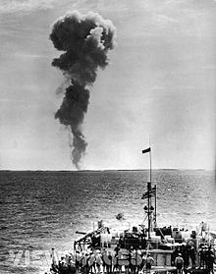
The first test, codenamed Operation Hurricane, took place on 4 October 1952 at a lagoon off Trimouille Island in the Montebellos.
A decommissioned warship, HMS Plym, was rigged up with a 7kg plutonium device, sending tonnes of seawater and mud 3,000 metres into the air and impregnating the ocean sand with radioactive isotopes.
On 16 May and 19 June 1956 two more bombs were set off from towers at Trimouille and Alpha islands as part of Operation Mosaic. The bombs were boosted with hydrogen and lithium and were the biggest ever detonated in Australia.
Hoffman says while some radionuclides, or radioactive atoms, are blasted inside sand grains, others attach to the surface of sediment and shift in rough weather, such as during cyclonic activity.
“When we know what radionuclides there are and what ratios they are in, they can act like a fingerprint, kind of like a forensics tool that is distinct to the Montebellos,” Hoffman says.
“When sediment rock gets moved from point A to point B, it is taking those radionuclides with it and potentially moving those hotspots and migrating them around.”
Hoffman wants to know where these hotspots are so she can study how the radiation exposure affects sediment-dwelling marine life. The area is home to a rich variety of marine species including dugongs, turtles, whales, hundreds of fish species and mangroves………………….
Darren Koppel, a marine contaminant expert with the Australian Institute of Marine Science, says low levels of radiation over long periods can cause chronic toxicity to plants and other organisms.
“We do not have much data on the chronic effects of radiation to marine organisms, so this type of research is critical to fill those data gaps,” Koppel says.
“The most likely effect is that sensitive organisms and plants will have stopped living or growing in the areas with higher radioactivity, leaving only the more tolerant species.”
The Montebello Islands are managed by the WA Department of Biodiversity, Conservation and Attractions.
It says there are still “slightly elevated radiation levels” at Trimouille and Alpha islands and warns tourists not to camp or spend longer than one hour at those sites.
Tourists travel from the nearby towns of Karratha, Port Hedland, Onslow and Dampier on fishing trips. Despite warning signs , the department has found evidence of campers on the islands in recent years.
In the Great Victoria Desert, in outback South Australia, authorities spent millions trying to clean up radioactive fallout from nuclear testing at Maralinga, where the British detonated seven atomic bombs.
According to researchers at Monash University, residual plutonium and uranium still contaminate the land at Maralinga as tiny radioactive grains in the soil.
Little heed was given to the Anangu Pitjantjatjara people who lived on the land, who lived with the legacy of the explosions for decades afterwards. It wasn’t until 1994 that the Australian government paid $13.5m in compensation for what had been done to the land.
British and Australian servicemen exposed to radiation by the blasts have also fought long campaigns for the effects on their health to be recognised and adequately compensated…………………
Hoffman says that key technical documents about the nuclear testing, which could help with her research, were reclassified by the UK in 2018.
“We have so little documentation or information about what really happened,” Hoffman said.
“Without that information and all the really crucial statistics [about the blasts] it is really difficult to make sense of the answers we have now in relation to what originally happened.” https://www.theguardian.com/australia-news/2022/oct/08/radiation-hotspots-legacy-of-british-nuclear-tests-lingers-on-idyllic-islands-in-western-australia
‘Radiation risk’: Nuclear threat discovered off the WA coast
perth now Eli Green, NCA NewsWire, October 3, 2022,
Tourists visiting a popular destination in Western Australia have been warned there is still a “radiation risk” 70 years after it was used as a nuclear test site, a study has found.
The Montebello Islands, located 120km off the WA coast, were used by the British in 1952 for Operation Hurricane, which saw three nuclear tests performed.
“More than half a century on, marine scientists have discovered there remains a radiation risk to marine life and tourists,” the four-year study by Edith Cowan University PhD student Madison Hoffman found.
With the islands attracting nature lovers such as fishers, divers and snorkellers to its coral reefs, the study has brought a fresh warning for tourists.
Due to the elevated radiation levels, visitors are currently encouraged to keep their trips to an hour a day.
The exact level of danger that the radiation levels pose to humans is yet to be determined, but Ms Hoffman hopes that is something she can determine soon.
“We don‘t quite have an answer for that yet, but we’re hoping over the next two years that we’ll be able to put a number to the potential risk,” she said.
Operation Hurricane was the first time an atomic bomb was tested by the British, with the site chosen due to its isolated location and Australia’s close ties with the UK.
The study saw more than 100 samples of marine sediment and marine life collected and tested.
“It is really important that we try and understand exactly what type of radionuclides and what levels of radiation remain in the marine ecosystem at the Montebello Islands,” Ms Hoffman said.
Radionuclides are substances that release radiation, with some being harmful to humans as they damage the body’s cells and cause cancer.
“We’re focusing now on mapping out areas where higher levels of radionuclides are found in marine sediment all around the Marine Park.”
The level of radiation also poses a threat to local wildlife, with more than 450 species of fish, 630 types of molluscs like octopi and cuttlefish, and 170 varieties of starfish and sea urchins found in the area…………….. https://www.perthnow.com.au/travel/radiation-risk-nuclear-threat-discovered-off-the-wa-coast-c-8431
Time to speak up: water apartheid is Australia’s dirty secret
Canberra Times By Erin O’Donnell, Kirsty Howey, July 4 2022
Imagine, in Australia, having to buy bottled water just so you can have clean water to drink. Imagine in 2022, in Australia, Aboriginal communities still have to do that, because they don’t have access to safe drinking water supplies.
While the 2022 NAIDOC week theme is get up, stand up, and show up, that’s an instruction for all of us.
All Australians need to get up, stand up, show up and speak up about this national shame.
In the Northern Territory, drinking water in remote communities regularly breaches guidelines for uranium, and heavy metals. It makes people sick. In Western Australia, the Auditor-General found 24 communities still require the government to truck in bottled water, as local supplies contain harmful contaminants, including uranium. In Queensland, remote, largely Indigenous, townships have faced ongoing water quality issues. Further south, NSW communities also struggled with water quality during the recent drought, and a 2022 study found towns and communities with higher Aboriginal populations and lower income levels were less likely to have access to free sources of filtered water within the community.
In the NT, predominantly white towns such as Darwin, Alice Springs and Katherine have a regulated and safe drinking water supply, but in Indigenous communities drinking water supply is unregulated, with many residents needing to resort to buying bottled water. And far from being an unavoidable consequence of life in remote communities, this is the result of ongoing failure by successive NT governments to plug gaps in water regulation.
………………………………………… The new Labor government’s commitment to restoring a National Water Commission must end water apartheid in Australia. The commission cannot come too soon for northern Australia, where this disaster is unfolding. https://www.canberratimes.com.au/story/7804335/time-to-speak-up-water-apartheid-is-australias-dirty-secret/
Harsher anti-protest laws targeting environmentalists are putting greed before green

Guardian, Bob Brown 27 June 22,
Penalties for peaceful action are now the same as for aggravated assault.
Last Friday dozens of armed New South Wales police officers raided a camp near Sydney and arrested two environmentalists. One was Aunty Caroline Kirk, an Aboriginal elder. She was charged with “wilfully obstructing and intimidating police”.
“I can’t run, I can’t climb,” she said. “All I can do … is teach my culture. Why are they doing this?”
The answer lies in the showdown of our age between greed and green.
At the heart of this is greenophobia, the fear of things green, including environmentalists. It involves the blighted idea that people should be stopped from taking action to defend the environment, especially if it gets in the way of making money.

It has infected the world of natural resource extractors and they have found the established political parties around the world extra helpful. So, in this year’s Queen’s speech, Boris Johnson announced a bill to jail peaceful UK protesters for up to 10 years. The proposal of those measures was one of the triggers that brought 400 alarmed scientists out to support environmental activists last year.
Brazil’s president, Jair Bolsonaro, is a greenophobe who is letting the Amazon rainforest and its Indigenous cultures be destroyed. His nation has descended into environmental lawlessness in which two rainforest defenders, British journalist Dom Phillips and Brazilian Indigenous advocate Bruno Pereira, were murdered this month. Globally, 220 environmentalists were murdered last year and thousands more were injured, terrorised or imprisoned. Most of the perpetrators have not been arrested or charged.
MMG’s lobbying helped influence the Tasmanian parliament to vote last week for harsher penalties for the defenders of the Tarkine and its giant masked owls. A clear majority of Tasmanian MPs want MMG to get its toxic waste dump in the Tarkine and Tasmania’s defenders of nature to get a cell in Risdon prison.
Tasmania’s laws match those of NSW, with penalties of up to $11,000 for peaceful environmental protest and double that, or two and a half years in jail, for a second offence. Had these laws been in place in other jurisdictions at other times, the Franklin River would be dammed, the Daintree rainforest razed and much of Kakadu national park mined.
Victoria has also introduced legislation, one aim of which is to deter scientists who have previously gone into the highlands and found forests with protected species – such as the greater glider and the state’s critically endangered faunal emblem, the Leadbeater’s possum – being logged. That’s illegal. While the loggers faced no charges, the intention of the new laws is to stop or arrest those scientists next time.
In Newcastle last year a young man was sentenced to a year in jail for delaying a coal train. The court did not hear the assessment of the former chief scientist at Nasa who told the US Congress that, in this world of dangerous global heating, transporting coal is a criminal activity.
Greenophobia is percolating down. On the Monday before Aunty Caroline’s arrest, 100 or so officers raided Blockade Australia’s camp for peaceful protest at Colo near Sydney after four undercover officers who failed to identify themselves “feared for their lives” – though the police had the guns and the people in the camp, including the children, had none……………………………..
Corporate PR machines, with the rightwing media ready to go, are developing greenophobia to divert attention to their business wellbeing and away from the graver threat of the collapse of Earth’s biosphere, including through global heating and species extinctions. As the NSW attorney general, Mark Speakman, put it: “What we are stopping, or criminalising even further, are protests that shut down major economic activity.” It’s money before the planet.22
The new federal environment minister, Tanya Plibersek, is now Australia’s most powerful environmentalist. She will decide if MMG should treat its toxic wastes inside or outside the Tarkine rainforest. In doing so she will also decide if Tasmania’s environmentalists will face the new draconian sentences there. Those penalties, for peaceful environmental action, are now the same as for aggravated assault or for threatening neighbours with a shotgun.
Such laws may be tested in the high court as earlier laws were, after I was among those arrested in Tasmania’s Lapoinya rainforest in 2017. The court found those laws unconstitutional because they took away the right to peaceful protest. Meanwhile the Lapoinya forest was flattened and burnt, along with its rare wildlife. No one was arrested for that… The court found those laws unconstitutional because they took away the right to peaceful protest. Meanwhile the Lapoinya forest was flattened and burnt, along with its rare wildlife. No one was arrested for that.
If MMG’s needless waste dump is given the go-ahead I, for one, will help defend that vital forest, its owls, kingfishers and Tasmanian devils. They can take us out of nature but they can’t take nature out of us.
As for the “terrifying” Aunty Caroline, I would like to meet her and thank her. She may not be able to run or climb but she is an inspiration. https://www.theguardian.com/commentisfree/2022/jun/27/harsher-anti-protest-laws-targeting-environmentalists-are-putting-greed-before-green-bob-brown
- Bob Brown is a former senator and leader of the Australian Greens and is patron of the Bob Brown Foundation……
1 This month

of the week – Australians for War Powers Reform (AWPR)
To see nuclear-related stories in greater depth and intensity
 Antinuclear