Pick out the anti-environment statements in Sussan Ley’s spiel!
 Sussan Ley: I’ll be an environmentalist as minister, Guardian 14 June 19,
 The new environment minister, Sussan Ley, has declared herself an “environmentalist”, saying she is prepared to fight for the environment around the cabinet table even when colleagues disagree with her.
Ley, who welcomed the Queensland government’s decision on Thursday to give the green light to the Adani coalmine, told Guardian Australia she wanted to see more action on recycling, threatened species and biodiversity protection, and a greater focus on individual action to achieve a better environment.
But in the lead-up to a 10-yearly review of the country’s Environment Protection and Biodiversity Conservation Act, Ley has also flagged that she wants approval times for major projects cut, has left the door open to lifting the country’s ban on nuclear power, and has questioned whether land clearing is responsible for species loss.
The former health minister, who was returned to cabinet by Scott Morrison after she quit over an expenses scandal in 2017, said she saw the role as an advocacy position……
Ley welcomed the review of the EPBC Act, due in the second half of this year, saying the country’s current environmental laws were “unnecessarily arduous, complex and not productive”.
….. Along with the approvals process, a clutch of Coalition MPs have indicated they will use the EPBC Act review to have Australia’s nuclear ban removed, a push that is being backed by the Minerals Council of Australia and industry groups.
Ley said the question of nuclear power in Australia was one “where you have to listen to all of the voices” but said she was open to the review considering a removal of the ban.
“To be honest, I am not strongly for or against nuclear power. I think there are good arguments for it, and there are good arguments against it.
“From the perspective of the environment it is important that it is considered, so I am not going to lead that discussion at any point of the review process. Plenty of other people will.”
Ley also made clear her views on the threat to biodiversity after a UN report warned that a million species across the world faced extinction. The minister said she was “concerned” about the problem, but questioned whether land clearing was to blame.
The Australian Conservation Foundation has estimated that there has been a loss of more than 7.4m hectares of threatened species habitat since the EPBC Act was introduced in 1999, with Australia singled out for its high rates of deforestation.
“Biodiversity and … our level of loss of species is of great concern to me,” she said.
“I really believe that the biggest threat to our threatened species is probably feral cats. Loss of habitat isn’t just land clearing, if it is land clearing at all, loss of habitat is often the wrong type of vegetation and that is often introduced weeds……
I do want my approach to the portfolio to be about what you can do, whether it be reducing plastic waste, whether it be about joining a local volunteer group, whether it be about agitating for better weeds and pest management in national parks that are near you, where you live – these are practical things that people can do and they do make a difference.”
On climate change, Ley said she was “interested” in the emissions reduction task of government which is included with the energy portfolio, under Angus Taylor, rather than environment, and said she believed the Coalition’s climate solutions fund is “where we need to be”.
“I am not going to discuss the emissions policy, that is Angus Taylor’s to discuss,”……..
Having argued during the campaign for the compliance and operational parts of the Murray-Darling Basin Authority to be split, Ley also said she would use her new role to push for changes being demanded by irrigators……..perhaps we need to work harder on that balance between environmental water and agriculture.” https://www.theguardian.com/australia-news/2019/jun/14/sussan-ley-ill-be-an-environmentalist-as-minister
Adani’s flawed protections for groundwater: its Carmichael mine may dry up ancient desert springs
 Scientists warn ancient desert springs may dry up under Adani plan, Brisbane Times, Nicole Hasham, June 9, 2019 A group of Australia’s pre-eminent water scientists say a rare desert oasis may dry up under Adani’s “flawed” protections for groundwater near its proposed Carmichael mine, in a scathing assessment days out from a crucial ruling on the plan.
Queensland’s Department of Environment and Science is this week due to decide on Adani’s groundwater management plan – one of the last remaining barriers to construction of the coal project.
Former federal environment minister Melissa Price granted approval for the highly contentious groundwater plan days out from the federal election campaign. This came despite CSIRO and Geoscience Australia raising concerns over the energy company’s modelling and proposed management……..
Mining activity such as drilling through aquifers can cause groundwater levels to fall, or “draw down”, and reduce water vital to the survival of connected ecosystems.
Seven leading experts from four Australian universities examined the latest groundwater plans and conducted on-site analysis at Doongmabulla Springs.
The team was led by Flinders University hydrogeology professor Adrian Werner, a former adviser to the Queensland government.
Their report concluded that the Carmichael project may cause the springs to stop flowing permanently, pushing the wetland to extinction.
It found Adani is likely to have underestimated future impacts on the springs – partly because the aquifer feeding the wetland had not been identified and Adani’s estimates did not consider possible water leakage between underground formations.
The void left behind at the end of the mine’s life would draw down water for many years, meaning the worst groundwater impacts would occur after the company left the site, they said.
The scientists rejected Adani’s so-called ‘adaptive management’ plan to mitigate risks to the wetland. The method – essentially a learning-by-doing approach – was unsuitable partly because of lag times between mining activity and the effect on the springs, they said.
Possible cumulative impacts to the wetland from other proposed coal projects have also not been properly considered, the report added.
Professor Werner said the research showed Adani’s water plan was “severely flawed” and risked the extinction of both the springs complex and the flora and fauna that depend on it.
The report was presented to officials at the Department of Environment and Science on Wednesday. A department spokesman said it was awaiting advice from CSIRO on Adani’s groundwater plan before considering if any changes were required. The department’s decision is due on Thursday, June 13. …… https://www.brisbanetimes.com.au/politics/federal/scientists-warn-ancient-desert-springs-may-dry-up-under-adani-plan-20190608-p51vqn.html
Melissa Price – Australia’s Minister For Coal – but don’t we need a Minister for the Environment?
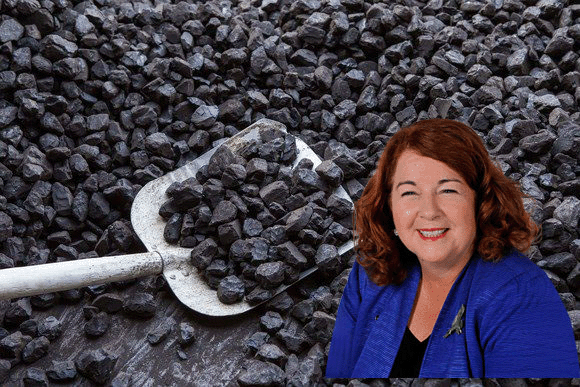 Environment Minister Price under pressure to front the public, https://www.smh.com.au/federal-election-2019/environment-minister-price-under-pressure-to-front-public-after-campaign-20190520-p51pak.html ,By Nicole Hasham, May 20, 2019 Australia has failed to deliver a major report to the United Nations on its progress in halting the extinction crisis as pressure mounts on Environment Minister Melissa Price to front the public over highly controversial election-eve decisions.Ms Price’s absence from the federal election campaign became a national curiosity. She refused scores of media interview requests, ignored challenges from her political rivals for public debates and did not appear at government announcements relating to her portfolio.
This prompted suggestions she was avoiding scrutiny of controversial approvals she granted just before the election, such as groundwater plans for the divisive Adani coal project and a contentious uranium mine in her home state of Western Australia.
Prime Minister Scott Morrison has indicated Ms Price will be re-appointed to the portfolio in his next cabinet.
The Department of the Environment and Energy, which Ms Price oversees, was due last December to present Australia’s sixth national report to the United Nations Convention on Biological Diversity.
The report would outline the government’s progress on conservation measures and in meeting the objectives of the convention, to which Australia is a party. However, it has not been delivered.
Australia has one of the world’s worst extinction records. The global crisis was highlighted in a shocking United Nations report this month that warned 1 million species on Earth were headed for extinction within decades.
The Morrison government has also failed to deliver an official plan to protect the nation’s animals and plants. A draft version of the plan, Australia‘s Strategy for Nature 2018-2030, was panned last year as a “global embarrassment” for its brevity and lack of specific targets.
Ms Price’s office did not respond to this publication’s questions or interview request.
Mr Morrison was grilled over the United Nations extinction report and appeared to stumble in his response, referring to government measures that do not exist.
Two days out from the election, Ms Price and Resources Minister Matt Canavan announced an independent audit of energy giant Equinor’s plans to drill for oil in the Great Australian Bight, in response to deep concerns in South Australian coastal electorates.
Should Ms Price continue in the environment portfolio, she faces a number of persistent questions, including how Australia will meet its Paris climate targets if the government’s plans to use carryover carbon credits from the Kyoto period are deemed outside the rules.
The separate national biodiversity strategy was being revised and required agreement from state and federal environment ministers, it said.
Greens environment spokesperson Senator Sarah Hanson-Young said Mr Morrison “must dump Melissa Price from the ministry … The climate and our environment can’t afford another term with Melissa Price as environment minister”.
Yeelirrie uranium approval, Adani coal – Australia needs new and stronger national environment laws
|
Adani, Yeelirrie and mining: Our environmental laws are broken, https://independentaustralia.net/environment/environment-display/adani-yeelirrie-and-mining-our-environmental-laws-are-broken,12664
By Dave Sweeney | 11 May 2019, The Morrison Government’s quiet approval of a controversial uranium mine in Western Australia the day before the Federal Election was called is evidence that our national environment laws are broken and too often subverted for political purposes.
Environment Minister Melissa Price approved the Yeelirrie uranium mine on April 10, the day before the Prime Minister headed to Government House to call the 2019 Federal Election. Ms Price did not announce the approval via a public release. Instead, two weeks later a notice was placed on the Environment Department’s website, late in the day ahead of the Anzac Day public holiday. Perhaps the view was that when it comes to public awareness of irresponsible sign-offs for radioactive pollution and species extinction, we best forget. Minister Price’s approval came despite a clear commitment that she would not advance any further federal approval until a continuing legal challenge to the earlier state approval for Yeelirrie had been decided. The controversial project, which is in Ms Price’s electorate of Durack, is still being legally challenged on appeal by senior Tjiwarl native title holders and conservationists. Ms Price had previously told media: “My department advised that it was prudent to wait for the result of the WA Supreme Court proceedings before finalising the federal assessment [for Yeelirrie].” The mine had been previously rejected by the WA Environmental Protection Authority (EPA) because it could drive rare subterranean fauna species to extinction and do harm to other wildlife species like the Malleefowl, Princess parrot and Greater bilby. Critics have identified that Yeelirrie could produce more than 35 million tonnes of radioactive mine waste, use up to 10 billion litres of groundwater and require 2500 hectares of vegetation to be cleared for its nine-kilometre long open pit. The lack of respect for the Australian people and due process demonstrated by this clandestine approval under the cover of a national election is a sign of both Government desperation and the fact that environmental protection currently runs a poor second to political imperatives. The WA EPA’s prudent recommendation not to approve Yeelirrie was overruled by the conservative Barnett Government just weeks before it lost the 2017 state election. Now the Morrison Government has performed the same trick, approving Yeelirrie hours before the Federal Election was called, without regard for the Tjiwarl Traditional Owners on whose land the planned mine sits or other stakeholders who might be adversely impacted. The proposal threatens the area which is part of the Seven Sisters Dreaming songline. The word Yeelirrie translates to the word Yullala – which mean to weep or mourn – and Yeelirrie is referred to as a “place of death”. The cultural stories and connections with Yeelirrie are a major factor in the strong and consistent opposition to this project by members of the Tjiwarl Traditional Owners. The community has been dudded doubly over this project with both the State and Federal governments putting politics and corporate interests ahead of science and the national interest. The approval decision followed hard on the heels of Minister Price’s rushed approval of Adani’s plans to guzzle billions of litres of groundwater for its massive coal mine on the eve of the election and was greeted with widespread scepticism and described by Opposition leader Bill Shorten as “shonky”. Environment groups have called the assessment deficient and urged that this rushed rubber stamp be reviewed by any future federal government. The Conservation Council of West Australia has started an online call to Federal Labor: It’s not worth wiping out a species for an unsafe, unwanted and uneconomic uranium mine. Radioactive risks last longer than any politician and deserve real assessment, not backroom fast-tracking. Australia’s environment laws have long been abused and short-changed by politicians cutting deals that put the interests of big companies over nature, traditional owners and local communities. For environmentalists, the lessons from the Yeelirrie and Adani eleventh hour approvals are clear. Australia needs new and stronger national environment laws that protect nature and take politics and undue influence out of approval decisions for major industrial projects. These laws should be overseen by an independent national EPA that is charged with making approval decisions free from the interfering hand of big businesses and their politician mates. Since the Minister’s rubber stamp there have been three further developments. Mining company Cameco has stated it will not immediately develop the project due to “challenging market conditions”. An expert international body has warned of one millionlooming species extinctions. And Minister Price has been missing, just like the species at Yeelirrie will be, should this flawed project ever go ahead. Approving Yeelirrie is a deeply deficient decision that makes neither dollars nor sense. |
|
|
Melissa Price – the Environment Minster you get from an anti environment government
|
‘Missing in action’: hunt goes on for Coalition’s invisible environment minister, Guardian, Lisa Cox, Sat 11 May 2019
It’s supposed to be the climate change election, and the UN says the planet’s ecosystem is under existential threat. But Melissa Price is nowhere to be seen, ours after the release of a UN report on the dire state of the planet’s ecosystems, the environment minister, Melissa Price, posted a photo of herself on Facebook at the opening of a miniature railway in her electorate.It wasn’t until more than 12 hours after the Facebook post that the West Australian MP issued a statement responding to the analysis by 450 scientists and diplomats that warned the decline of the natural world was accelerating, and a million species were at risk of extinction. There was no interview. The written statement referenced Coalitionprograms, including a $100m fund announced in the federal budget, aimed at tackling biodiversity loss. It was the most that had been heard of Price so far in the election campaign. It’s one thing to not want the environment portfolio,” Labor’s environment spokesman, Tony Burke, said. “It’s another thing to refuse to do the job.” Since she took over the environment portfolio last year, the most conspicuous thing about Price’s performance has been her low profile. In February, she defended herself against criticism from environment groups calling her the “invisible minister”. At the beginning of this month, she was not by prime minister Scott Morrison’s side for the launch of the Coalition’s environment platform for the election. The executive producer of the ABC’s 7.30 program, Justin Stevens, tweeted this week that Price had turned down 11 requests for an interview since becoming minister. In an election where climate change and the environment have been identified as dominant concerns for voters, Price’s opponents are dismayed the Coalition would hide the person with ministerial responsibility for environmental protection from view. Both Burke and Labor’s climate spokesman, Mark Butler, have written to Price requesting a debate similar to those that have been held for the health and Treasury portfolios. They said they had received no response. “In an election when it’s clear that climate change is right at the top of issues of importance for voters, it is extraordinary that the minister has been absent from the whole campaign,” Butler said. “Melissa Price has been missing in action this election campaign, and since she took the job in August,” she said in a statement this week. “When she has surfaced it has been to insult world leaders fighting for climate action, or to approve the Adani coalmine and a mega uranium mine in WA.” Immediately before the election was called, Price signed off on Adani’s groundwater management plan for its Carmichael coal mine, despite the CSIRO and Geoscience Australia raising concerns about groundwater drawdown and the monitoring approaches proposed by the company. A day before the government entered caretaker mode, Price approved a massive uranium mine in Western Australia. Both the federal and WA governments have been warned it could lead to the extinction of native species. Burke says Price’s absence from the campaign and refusal to participate in interviews has denied voters the opportunity to scrutinise those decisions. “It’s completely reasonable for the public to expect an explanation,” he said. Since the release of the UN report, Morrison has been forced to defend the minister…… https://www.theguardian.com/australia-news/2019/may/11/missing-in-action-hunt-goes-on-for-coalitions-invisible-environment-minister |
|
Adani project faces another hurdle – another groundwater review
Adani’s controversial Carmichael coal mine project is facing another hurdle, with the Queensland government seeking a further review of their groundwater plans.
Adani Mining’s chief executive Lucas Dow said the new request came from the Department of Environment and Science last Friday.
“It appears this process will again go beyond the scope of what our project is required to deliver under regulatory conditions – and, put simply, is another fishing expedition,” he said in a statement.
Federal Environment Minister Melissa Price signed off the company’s groundwater plans just before the start of the election campaign. ….
The new review means Adani can’t start construction on the mine which has been stuck in the courts and approval process for almost a decade.
The mine, to be developed in central Queensland’s Galilee Basin, has been a political football, with the country divided on the value of the $2 billion project.
It has dogged the federal election campaign and the coalition believes the Queensland Labor government is putting up road blocks to win over Green preferences in inner-city seats.
This is the second road block for the mine in less than two weeks, with the government recently rejecting Adani’s plans for managing the endangered Black-Throated Finch on the site………..https://www.sbs.com.au/news/adani-project-faces-another-hurdle
Scott Morrison on “cutting green tape” – commentators respond savagely and sceptically
 There was a great long stack of comments on the Brisbane Times article (below) – and all condemned Prime Minister Scott Morrison’s pledge to cut environmental regulations – he chose the same day as the UN’s damning report on biodiversity loss was released. Here’s just a couple of samples .
They call it “green tape”, many others call it saving the environment from destructive ultra right policies.
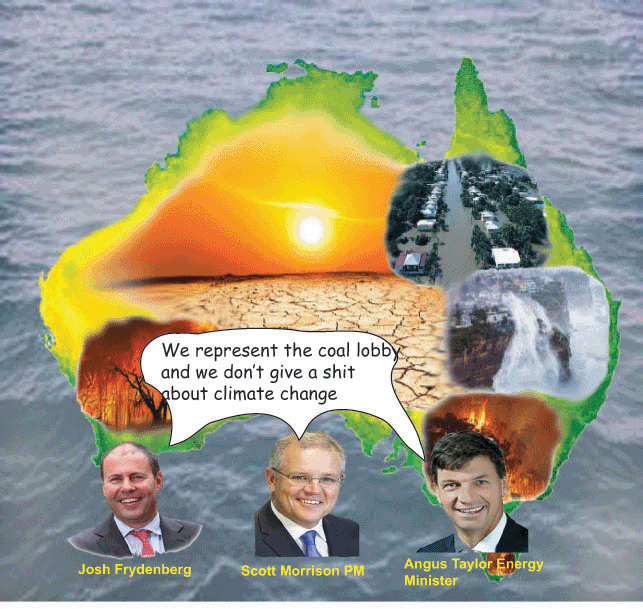 Scott Morrison perpetuating the Liberal policy of ‘cutting environmental red tape’.
No wonder 1 million species of flora and fauna around the world are on the brink of extinction within just decades..
“Federal government botched scrutiny of plan to bulldoze pristine forest”
(SMH 27 Nov 2018) “The Morrison government has conceded it botched scrutiny of a plan to bulldoze 2000 hectares of pristine Queensland forest near the Great Barrier
Reef and has been forced back to the drawing board following a legal challenge by conservationists.”
“The development comes as confidential documents show government MPs lobbied environmental officials to wave through the proposal, which would raze land almost three times the size of the combined central business districts of Sydney and Melbourne.”
“Old growth forest in the vicinity of Kingvale Station, where 2000 hectares is set to be cleared.”
“Environment Minister Melissa Price agreed to court orders that the weak assessment applied to the Kingvale proposal was unlawful.” https://www.smh.com.au/politics/federal/federal-government-botched-scrutiny-of-plan-to-bulldoze-pristine-forest-20181127-p50il2.html#comments
Melissa Price is the Liberal member for Durack in WA.
Only 10 more days until Melissa Price can be kicked out of parliament for good.
PM shifts attack on Labor to ‘green tape’ he says costs Australian jobs, Brisbane Times, By David Crowe, May 7, 2019 Prime Minister Scott Morrison has vowed to stop the spread of union power and stem the growth of environmental rules that he blames for costing Australian jobs, as he sharpens his pitch to voters in the final days of the election campaign.
Ahead of his final debate against Opposition Leader Bill Shorten in Canberra on Wednesday night, Mr Morrison warned of a threat to the economy from the expansion of union “red tape” and environmental “green tape” that tied down employers when they should have more freedom to expand and hire workers…….
Lagging Labor in the polls with only 10 days to go until ballots are cast, the Prime Minister warned that a vote for Labor would give unions control over industrial laws and the Greens control over environmental laws.
“I don’t want to see the Labor Party get to office where they tie businesses up with all sorts of union red tape and all sorts of the Greens’ green tape, which would just cost people jobs,” he said……
The Coalition has blamed “lawfare” and “green tape” for halting or delaying mining and other projects in recent years, turning this into a major dispute with Labor and the Greens.
Mr Morrison said voters should remember that Labor sought to apply native vegetation laws more widely and increase the power of the Environmental Protection Agency to slow down developments.
“They want to hypercharge an Environment Protection Authority which will basically interfere and seek to slow down and prevent projects all around the country,” he said.
Unfinished business: a new report on the Ranger uranium mine: what its clean-up means for Kakadu National Park
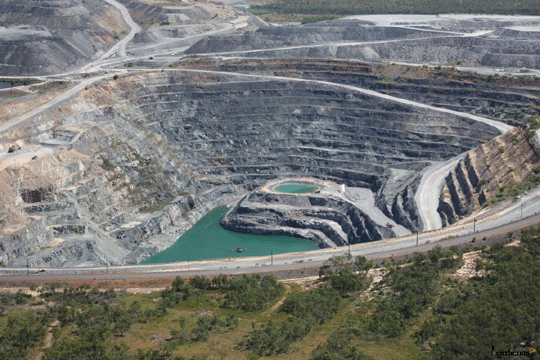
Unfinished business: Kakadu needs a new approach to cleaning up an old mine, https://www.acf.org.au/unfinished_business_kakadu_needs_a_new_approach 7 May 19, How well the Ranger uranium mine is cleaned up is key to the long-term health of Kakadu.
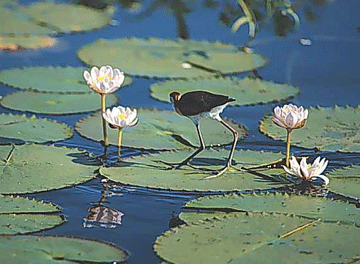 A new report has found Australia’s largest national park is at long-term risk unless the clean-up of the Ranger uranium mine in Kakadu is done comprehensively and effectively.
Unfinished business, co-authored by the Sydney Environment Institute (SEI) at the University of Sydney and the Australian Conservation Foundation (ACF), identifies significant data deficiencies, a lack of clarity around regulatory and governance frameworks and uncertainty over the adequacy of current and future financing – especially in relation to future monitoring and mitigation works for the controversial mine site.
Mine operator Energy Resources of Australia (ERA) and parent company Rio Tinto are required to clean up the site to a standard suitable for inclusion in the surrounding Kakadu National Park, dual-listed on UNESCO’s World Heritage list.
“No mine in the world has ever successfully achieved this standard of clean up,” said report co-author Dr Rebecca Lawrence from SEI.
“Rehabilitating what is essentially a toxic waste dump is no easy task. Rio Tinto faces a complex and costly rehabilitation job.
“The challenge is not to simply scrape rocks into holes and plant trees, it is to make sure mine tailings, radioactive slurry and toxic by-products of mining are isolated from the surrounding environment for 10,000 years.
“To ensure this in a monsoonal environment, such as Kakadu, which is already being impacted by climate change, raises enormous environmental and governance challenges.
“For the rehabilitation process to even have a chance at success, the existing opaque and complex regulatory regime needs an urgent overhaul,” Dr Lawrence said.
Tailings, the waste material remaining after the processing of finely ground ore, are one of the serious environmental risks outlined in the report. The report examines how ERA and Rio Tinto intend to deliver on the federal government’s requirement to protect the Kakadu environment by isolating any tailings and making sure contaminants do not result in any detrimental environmental impacts for at least 10,000 years.
“Long after the miners have gone this waste remains a direct human and environmental challenge,” said report co-author Dave Sweeney from ACF.
“This issue is key to the long-term health of Kakadu but there is insufficient evidence and detail on how this work will be managed and assured in the future. Without this detail there will be a sleeping toxic time bomb deep inside Kakadu.
“At its London AGM last month Rio again committed to make sure ERA has the financial resources to deliver its rehabilitation obligations, however the financial mechanism to do so remains undisclosed.
“The community and environment of Kakadu need certainty and a comprehensive clean up.
“This work is a key test of the commitment and capacity of Northern Territory and Commonwealth regulators as well as the mining companies.”
The report makes recommendations to improve the chances of a successful clean-up at Ranger. It calls for increased transparency, public release of key project documents, a better alignment of research and operations and open review processes for key decision points.
The full report is here.
UN Report – One million species at risk of extinction – Australia not interested?
|
|
|

The black-throated finch – a species threatened with extinction, if Adani coal project goes ahead
Key points:
- The range of the black-throated finch has contracted by 80 per cent
- Birdlife Australia says it is already extinct in NSW
- The Carmichael mine proposal would consume one of the finch’s key habitats
Last night, the proposed coal mine was dealt a massive blow when the Queensland Department of Environment and Science (DES) rejected Adani’s current management plan for the southern black-throated finch.
It told the Indian miner the management plan “does not meet the requirements of the company’s environmental authority”.
The Carmichael mine would take up one of the last remaining healthy habitats for the black-throated finch.
A DES web page on the endangered bird explains that the black-throated finch (southern subspecies) once extended from Inverell in north-east New South Wales, through eastern Queensland, to the Atherton Tablelands and west to central Queensland.
It said the finch (southern subspecies) range had “contracted by approximately 80 per cent of its former extent over the last 20 years and is now restricted to the northern part of its former range”.
“The black-throated finch (southern subspecies) inhabits grassy woodland dominated by eucalypts, paperbarks or acacias where there is accessibility to seeding grasses,” DES said.
“Recent records from Queensland suggest that riparian habitat is particularly important as it seems to provide shelter within a highly fragmented and modified environment.”
Sean Dooley from Birdlife Australia said the finch was already extinct in New South Wales and that there were now only two small populations left in the world, both in Queensland.
There are believed to be fewer than 1,000 black-throated finches still alive.
There is a small population west of Townsville, but the main population is on the footprint of the Adani mine lease in the Galilee Basin. “Carmichael coal mine is ground zero for this bird,” Mr Dooley said………
Mr Dooley congratulated the Queensland Government for rejecting the company’s environmental management plan for the finch.
“Obviously the Queensland Government would have been under a lot of political pressure and pressure from interest groups to allow this to go through,” he said…….https://www.abc.net.au/news/2019-05-03/how-is-a-tiny-bird-such-a-big-problem-for-adani/11076386
Traditional owners fight Adani coal project, – fear destruction of their sacred wetlands
|
Adani coal mine poses ‘alarming’ risk to sacred wetlands, traditional owners say, ABC News
Key points:
The ABC this week became the first media organisation to visit the remote springs complex — one of the world’s last unspoiled desert oases — which are at the centre of a controversial Morrison Government decision that thrust Adani forward as a federal election issue. The trip to the nationally important wetlands was at the invitation of a determined group of mine opponents within the Wangan and Jagalingou (W&J) people, who have vowed to take their fight all the way to The Hague. The Doongmabulla, which means “the place of many waters”, represents the key hurdles to Adani’s mining ambitions in a project already four years overdue. The miner still has to prove to the Queensland Government it can safeguard the springs, which are also the key cultural concern for traditional mine site owners who could further put the brakes on Adani by taking them to the High Court. Scientists dispute Adani’s mine impact modellingCommonwealth science agencies have raised doubts about Adani’s modelling of the mine’s impact on the springs, saying it could drain its underground water source by four times its legal limit. But Federal Environment Minister Melissa Price approved Adani’s groundwater plans after it agreed to extra monitoring and safeguards and amid pressure from Queensland colleagues to sign off before the election was called. However, concerns raised in a joint report by the CSIRO and Geosciences Australia are being assessed by the Queensland environment department, which said it could not let the mine proceed until Adani provided better evidence about the sources of the springs…….. https://www.abc.net.au/news/2019-05-01/adani-coal-mine-poses-alarming-risk-to-sacred-wetlands/11058854 |
|
Federal Environment Minister, Melissa Price, fails the environment with secretive Yeelirrie uranium approval.
It’s not worth wiping out a species for the Yeelirrie uranium mine
 SBS, BY GAVIN MUDD 26 Apr 19, Like the rest of the Western Australian outback, there’s a wonderful paradox where the land appears barren, but is, in fact, rich with biodiversity – and animals are under threat of extinction if the mine goes ahead. The Western Australian outback may look bare at first glance, but it’s teeming with wildlife, often beneath the surface.
The Tjiwarl Traditional Owners have fought any uranium mining on their land for the last 40 years, and the decision by the government wasn’t made public until the day before Anzac Day……..
This region is home to several of Australia’s deposits of uranium and not only holds cultural significance as part of the Seven Sisters Dreaming Songline, but also environmental significance. If the mine goes ahead, groundwater levels would drop by 50cm and wouldn’t fully recover for 200 years. And 2,422 hectares of native vegetation would be cleared.
I visited the site 16 years ago and, like the rest of the Western Australian outback, there’s a wonderful paradox where the land appears barren, but is, in fact, rich with biodiversity.
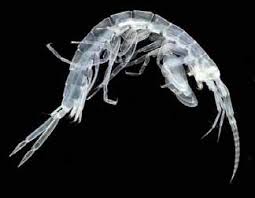
Native animals living in underground water, called stygofauna, are one such example of remarkable Australian fauna that aren’t obvious at first glance. These animals are under threat of extinction if the Yeelirrie uranium mine goes ahead.
Stygofauna are ecologically fragile
Most stygofauna are very tiny invertebrates, making up species of crustaceans, worms, snails and diving beetles. Some species are well adapted to underground life – they are typically blind, pale white and with long appendages to help them find their way in total darkness.
n 2016, the Western Australian Environmental Protection Agency (EPA) advised against building the Yeelirrie uranium mine because it would threaten the stygofauna species there, despite the proposed management strategies of Cameco Australia, the mine owner.
Stygofauna are extremely local, having evolved in the site they’re found in. This means individual species aren’t found anywhere else in the world. EPA chairman Tom Hatton said:
Despite the proponent’s well-considered management strategies, based on current scientific understanding, the EPA concluded that there was too great a chance of a loss of species that are restricted to the impact area.
And to get to the uranium deposit, the miners need to dig through the groundwater, a little like pulling the plug in the middle of the bathtub. Stygofauna have adapted to living at different levels of the water, so pulling out the plug could dry out important parts of their habitat.
Stygofauna are also susceptible to any changes in the chemistry of the groundwater. We simply do not know with confidence what mining will do to the groundwater chemistry at Yeelirrie in the long term. Various wastes will be backfilled into former pits, causing uncertainty for the welfare of surrounding stygofauna.
The approval conditions suggest that the mine should not be allowed to cause extinction – but if this does happen, nothing can be done to reverse it. And there would be no penalty to Cameco either – which has said it can’t guarantee such a condition can be met………..https://www.sbs.com.au/news/it-s-not-worth-wiping-out-a-species-for-the-yeelirrie-uranium-mine
Australia gets a very bad environmental report for 2018
 Australia’s 2018 environmental scorecard: a dreadful year that demands action The Conversation, Albert Van Dijk, Professor, Water and Landscape Dynamics, Fenner School of Environment & Society, Australian National University, April 4, 2019 Environmental news is rarely good. But even by those low standards, 2018 was especially bad. That is the main conclusion from Australia’s Environment in 2018, the latest in an annual series of environmental condition reports, released today.
Every year, we analyse vast amounts of measurements from satellites and on-ground stations using algorithms and prediction models on a supercomputer. These volumes of data are turned into regional summary accounts that can be explored on our Australian Environment Explorer website. We interpret these data, along with other information from national and international reports, to assess how our environment is tracking.
A bad year
Whereas 2017 was already quite bad, 2018 saw many indicators dip even further into the red. Temperatures went up again, rainfall declined further, and the destruction of vegetation and ecosystems by drought, fire and land clearing continued. Soil moisture, rivers and wetlands all declined, and vegetation growth was poor.
In short, our environment took a beating in 2018, and that was even before the oppressive heatwaves, bushfires and Darling River fish kills of January 2019.
The combined pressures from habitat destruction, climate change, and invasive pests and diseases are taking their toll on our unique plants and animals. Another 54 species were added to the official list of threatened species, which now stands at 1,775. That is 47% more than 18 years ago and puts Australia among the world’s worst performers in biodiversity protection. On the upside, the number of predator-proof islands or fenced-off reserves in Australia reached 188 in 2018, covering close to 2,500 square kilometres. They offer good prospects of saving at least 13 mammal species from extinction. ……..
A bad start to 2019
Although it is too early for a full picture, the first months of 2019 continued as badly as 2018 ended. The 2018-19 summer broke heat records across the country by large margins, bushfires raged through Tasmania’s forests, and a sudden turn in the hot weather killed scores of fish in the Darling River. The monsoon in northern Australia did not come until late January, the latest in decades, but then dumped a huge amount of rain on northern Queensland, flooding vast swathes of land……. https://theconversation.com/australias-2018-environmental-scorecard-a-dreadful-year-that-demands-action-114760
Western Australian Aboriginal community uses solar hydropanel to solve problem of uranium in water
 Buttah Windee in remote WA now has clean water thanks to solar hydropanel technology https://www.abc.net.au/news/2019-03-31/solar-hydropanels-fix-water-supply-in-remote-community/10941788?fbclid=IwAR2j446RfOuRIZNBC0K1xY6CWBq3Jnn48zx0b-WiuI8o96Jklb-bL1pfZHQ
Key points:
- Six solar hydropanels have been installed in the small WA community, capturing 900 litres of water a month from the air
- The community had discovered its water supply contained uranium more than twice the national health standard, and the State Government deemed it too expensive to address
- With the help of crowdfunding and technology donated by a WA company, the residents of the community no longer need to live elsewhere
The remote Aboriginal community is 760 kilometres north-east of Perth on the outskirts of Meekatharra.
Almost a decade ago, resident Andrew Binsiar discovered the community’s water was tainted with naturally occurring uranium at more than twice the national health standard.
“I was actually very surprised,” he said.
“You’d imagine people would test the water for human consumption before people are allowed to drink it.”
Unable to drink the community’s tap water, most of the 50 people who lived at Buttah Windee left.
Too expensive to fix: State Government
But for Andrew Binsiar and his wife Janine, leaving the home where they had raised their five children was not an option.
He turned to the State Government for help, but was told fixing the water supply would be too expensive.
“They come out and put up ‘do not drink the water’ signs and that was their solution to it,” Mr Binsiar said.
The State Government offered to move the remaining residents into state housing in Meekatharra, but Mr Binsiar was apprehensive about exposing his family to the town’s social issues.
“We knocked them back … for the simple reason I’d already been there and done that. My life changed when I moved here,” he said.
“I wasn’t a very good father when I lived in Meeka.”
Solar hydropanels pull water from air
Almost a decade on, Buttah Windee is the first remote Aboriginal community in Australia to use innovative technology for its water supply.
Six solar hydropanels have been installed at the outback community, donated by a WA company who heard about the community’s plight and wanted to help out.
Director of Wilco Electrical Frank Mitchell said the units captured water from the air and produced up to 900 litres of water a month.
“Those fans, you can hear them whirring away, are just drawing in air all day, all around, and the piece of material inside collects … the moisture in the air, then condenses down into the tank where it’s got a pump straight out to the tap,” he said.
Mr Binsiar said it was a simple idea, which should be introduced to all remote communities.
“Water is a basic human right that everyone deserves,” he said.
“It could mean better health for your children … I would guarantee that most communities have bad water.”
Crowdfunding rallies support
The near decade-long battle for clean drinking water has not come easily for the Buttah Windee residents, with Mr Binsiar turning to crowdfunding as a last resort.
Word spread quickly when Mr Binsiar began the fundraising campaign last year, and people from across Australia donated nearly $26,000 in three months.
“It was a huge success. The Australian public have been awesome,” he said.
Mr Binsiar used the funds to install a reverse osmosis water treatment plant.
“Reverse osmosis takes out all the contaminants in the water … on the back end of it, it puts the minerals your body needs back into the water,” he said.
“They’ve given us a chance where no-one else would and we are really proud of what we have done here.”
Barramundi fish farm to boost employment
The two separate systems now supply the community with safe drinking water and enough water to run a small barramundi fish farm.
Mr Binsiar and several residents built the fish farm hoping it would eventually provide local employment and a potential source of income. “Hopefully we can continue on and make it bigger and provide this region with fresh barramundi,” he said.
“I’d like to welcome everyone out to Buttah Windee and come and look at the work we do.”
1 This month
17 October, Free Public Talk on Nuclear Issues in South Australia
David Noonan will speak on public interest concerns over the new Roxby Downs Indenture Act 2026 on BHP copper-uranium mining and ore processing in SA, and on how AUKUS may face SA with a High-Level nuclear waste agenda.
Dr Jim Green will discuss international developments in the field of nuclear power including ‘small modular reactors’ and Generation 4 ‘advanced’ nuclear reactor concepts.


Help Aunty Sue Protect Her Land and Sacred Sites From Destructive Rocket Testing.
.

Australians deserve the truth
about
AUKUS – https://aukuspublicinquiry.com/

PETITION – To: Prime Minister Anthony Albanese and the Australian Labor Government

of the week – Australians for War Powers Reform (AWPR)
To see nuclear-related stories in greater depth and intensity

