Morrison government’s drought policy mess
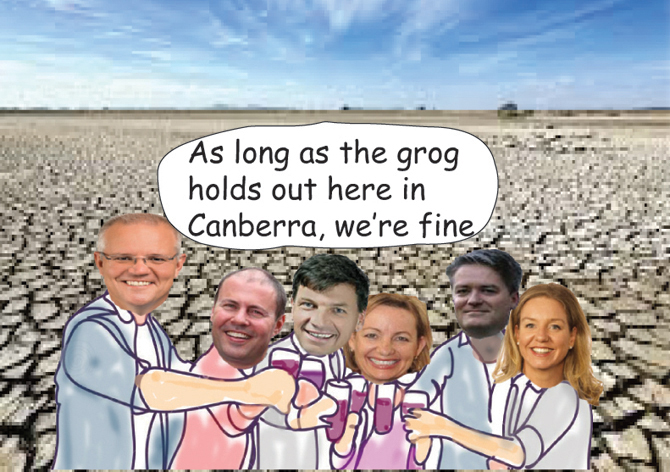 Has drought policy become a casualty of the federal-state blame game? ABC The Conversation By Michelle Grattan 18 Oct 19, Government sources insist shock jock Alan Jones didn’t drive Thursday’s announcement of a cash payment to drought-stricken farmers about to be turfed off their household support because they’d reached the four-year time limit.They say the measure — giving up to $13,000 to a couple and $7,500 to individuals at a cost of $12.8 million this financial year — had been in Cabinet’s expenditure review committee process for some time.
But the National Farmers Federation says it wasn’t given any notice, which seems odd since Drought Minister David Littleproud is constantly referencing the NFF.
Regardless of the sequencing, Mr Jones’ extraordinarily angry and emotional performance on Tuesday, haranguing Mr Morrison on radio, breaking down on TV, and warning of dire political consequences if the Government didn’t do something, certainly concentrated the Prime Minister’s mind.
As one official puts it, Mr Morrison is “attuned to the zeitgeist”.
Described more prosaically, the PM is highly sensitive to public opinion, and he judges that in metropolitan areas as well as the regions, people want more action — and then more still — to help those brought to their knees.
Can drought policy deliver better outcomes?
When he became PM, Mr Morrison was immediately anxious to own the issue of the drought. He referred to it in his news conference the day he was elected leader, saying it was “the first thing I need to turn attention to”, and was quickly off to a drought-affected area.
Now he is feeling the full cost — political as well as financial — of that ownership, as he’s confronted with pressure on all sides.
NFF president Fiona Simson continues to say she doesn’t think the Government has a drought policy…….
A sign of weakness?
Also, the Government has no credible reason for keeping under wraps the report it commissioned from Stephen Day, who was its drought coordinator, which would provide some useful overview.
Thursday’s announcement of the cash payment was messy: Mr Morrison trumpeted it on radio at the same time as the Nationals unveiled it at a press conference.
The Coalition’s handling looks ad hoc and reactive……..
Also, the Government has no credible reason for keeping under wraps the report it commissioned from Stephen Day, who was its drought coordinator, which would provide some useful overview.
Thursday’s announcement of the cash payment was messy: Mr Morrison trumpeted it on radio at the same time as the Nationals unveiled it at a press conference……. https://www.abc.net.au/news/2019-10-18/drought-gives-scott-morrison-a-harsh-political-lesson/11614698
Australia’s climate crisis: destruction of forests
An epidemic of land clearing is sabotaging efforts to address climate change. Farming communities are bitterly divided over the issue – but it also has global consequences
Roger Fitzgerald’s family has been farming near Moree since 1925. But these days he feels under siege on his own farm. His 1,700-hectare property, 50km north of the town, is now surrounded by the operations of the sprawling agribusiness Beefwood Farms, which has been steadily buying up land in New South Wales to expand its operations.
The old easement to Fitzgerald’s cottage across the sprawling Beefwood property has been planted over with crops. His letterbox has mysteriously disappeared on several occasions, making it hard for visitors to spot the entrance to his farm. But it is the extent of land clearing by his neighbour, Beefwood’s owner, Gerardus Kurstjens, that has upset him the most.
Fitzgerald says the microclimate of the nearby Welbon plains has moved a kilometre further on to his property since losing a tree line on Kurstjens’ property that once sheltered his land.
Pockets of remaining vegetation have been ripped from the grey soil to expand cultivation and square up paddocks – and the first Fitzgerald knows of it is when the bulldozers arrive.
“There is something seriously not right about the extent of land clearing in my little part of the world,” he says.
Think of land clearing like a rezoning in the city. Land cleared for cropping west of Moree sells for $2,500 a hectare whereas grazing land will sell for between $700 and $1000 a hectare. East of Moree most of the prime land has already been converted to crops and sells for $6,800 a hectare, three times the value of grazing land.
Clearing vegetation has the potential to add millions to a property’s value, as well as yielding high returns in a good year.
That alone is enough for farmers to risk up to $1m in fines for illegally clearing, according to one former NSW Office of Environment and Heritage compliance officer, who asked not to be named.
But while land clearing might benefit individual farmers in the short term, the loss of native vegetation comes with enormous costs for the rest of us.
“Land clearance and degradation is one of the greatest crises facing Australia and the world,” says Bill Hare, the chief executive and senior scientist with Berlin-based Climate Analytics. “It undermines the basis for food production, is causing species loss and ecological decline, destroys climate resilience, degrades water resources and reverses carbon storage on the land.”
Pollution from land clearing is projected by the federal government to remain at about 46m tonnes of carbon dioxide a year to 2030, roughly equivalent to emissions from three large coal-fired power plants. The rate at which we are clearing land in Australia is almost immediately wiping out gains being made under tax-payer funded schemes to address climate change.
Australia is among the 11 worst countries when it comes to deforestation, according to the World Wildlife Fund.
Queensland, with its vast swathes of untouched land on Cape York, has the highest clearing rate, but NSW is rapidly becoming a hotspot – and there is less to lose, with only 9% of the state’s vegetation in its original state.
What is becoming clear is that successive NSW governments have failed to explain the science behind preserving native vegetation – both in relation to climate change and protecting the landscape and endangered species – to farmers and the public.
Instead, land clearing laws in the state have been successively weakened, first by Labor and then more comprehensively by the Coalition, with the introduction of amendments to the Local Land Services Act in August 2017.
“NSW’s native vegetation laws were [once] based on the principle that broad-scale land clearing would not be permitted and clearing could only proceed if it could be shown to maintain or improve environmental outcomes,” says Rachel Walmsley, a solicitor at the NSW Environmental Defenders Office.
“The new act brought in a new approach with the twin stated objectives of arresting the current decline in the state’s biodiversity while also facilitating sustainable agricultural development.”
But while farmers are mostly happy with the new rules, environmentalists say they have ushered in an environmental disaster because they allow farmers to self-assess whether clearing is permissible.
The old act also protected paddock trees; the amended act has made it much easier to get rid of them.
Critics say farmers have been given the green light to clear.
“I have sat in meetings where arguments have been put that driving a tractor around a tree is a significant cost in diesel for farmers,” Walmsley says.
“There’s no valuation of the ecosystem services these trees provide: clean water, clean air, healthy soils and hosting pollinators. There’s no dollar value put on vegetation.”………
The facts are unequivocal. NSW is losing vegetation at an alarming rate………………… https://www.theguardian.com/environment/ng-interactive/2019/oct/17/stripped-bare-australias-hidden-climate-crisis
Minister Canavan and Department of Industry Innovation and science ready to spoil beautiful, sacred, and arable land – for nuclear trash
Goodes abuse mirrors SA nuclear fight, Eureka Street, Michele Madigan, 03 September 2019 On 21 August I came out of an Adelaide preview of The Australian Dream, Stan Grant’s documentary about the racialised mistreatment of the former AFL footballer Adam Goodes, for a brief interview on our local ABC’s Evening Show. The topic: the resumption of federal government visibility and determination to both deposit and dump nuclear waste in either the Flinders Ranges or Kimba regions.
There is at best exasperation, and at worst, genuine anger shown to many Australians seeking to defend country: to Aboriginal and Torres Strait Islander defenders certainly. In regard to non-Aboriginal people, the word ‘greenie’ has become largely a term of derision………
On 13 August, DIIS, in meeting with the Barndioota Consultative Committee in the Flinders, confirmed that the size of the proposed site would now be 60 per cent larger. On 21 and 22 August Minister Canavan visited both areas for brief ‘consultative’ meetings, declaring the site decision is likely before the end of this year, and acknowledging that this may take place before the Flinders ballot. While again refusing to give a named acceptable percentage on such a ballot, Senator Canavan stressed the ballot was just one component in the decision making. Other evidence will include the 1000 submissions in this still open process.
 On his 26 August Evening Show, Peter Goers interviewed an enthusiastic proponent — the Member for the vast federal seat of Grey. Rowan Ramsey was indignant that ‘outsiders’ were daring to protest the project. As well as ignoring his companion interviewee, local Greg Bannon, Ramsay revealed his misconception that other South Australians and indeed other Australians have no right to object. In claiming no knowledge of nuclear transport accidents, clearly he had not heard of the 1994 spill near Port Augusta, to name just one example; nor that transporting and simply ‘storing’ the spent fuel rods from the Lucas Heights reactor is exponentially more dangerous than Olympic Dam yellowcake transport…… https://www.eurekastreet.com.au/article/goodes-abuse-mirrors-sa-nuclear-fight?utm_medium=email&utm_campaign=Eureka%20Street%20Daily%20-%20Wednesday%204%20September%202019&utm_content=Eureka%20Street%20Daily%20-%20Wednesday%204%20September%202019+CID_df4eff5733a50d6914ba873c7e09aea7&utm_source=Jescom%20Newsletters&utm_term=Goodes%20abuse%20mirrors%20SA%20nuclear%20fight
As forests disappear in the Amazon, Australia’s rainforests are being destroyed, too
|
Calls to preserve Australia’s rainforests as fires rage in the Amazon, https://www.sbs.com.au/news/calls-to-preserve-australia-s-rainforests-as-fires-rage-in-the-amazon People must fight to save the Amazon rainforest from deforestation – but it is important efforts to preserve Australia’s rainforests are also made, local environmental groups say. BY EVAN YOUNG 25 Aug 19, Environmental groups are urging people to channel raised awareness about deforestation in the Amazon into renewed efforts to preserve Australia’s own forests.
|
|
Mirrarr people to lead the Kakadu region’s transition from uranium mining

Kirsten Blair, Community and International Liaison, 15 Aug 19, Gundjeihmi Aboriginal CorporationToday GAC chairwoman, Toby’s Gangale’s daughter: Valerie Balmoore signed an MOU with the Federal and NT Governments as well as mining company ERA committing all parties to a Mirarr-led post-mining future for Jabiru.
There is still much work to be done on Mirarr country including cleaning up the immense Ranger uranium mine. GAC and others will continue our diligent work in this area – and there are no guarantees the cleanup will be wholly successful – but restoration of country remains the absolute objective.
Mirarr continue to assert their rights as Traditional Owners and lead the way for people and country, this Jabiru story is evidence of a massive shift. The power in these images speaks for itself. Today is deeply hopeful for the Kakadu region and offers an incredible message for all communities resisting unwanted mining projects.
|
JABIRU FUTURE SECURE AS PARTIES SIGN MoU. A historic Memorandum of Understanding (MoU) to be signed today in Jabiru will secure the town’s future as the tourism heartland of the World Heritage Listed Kakadu National Park. Federal Minister for the Environment Sussan Ley will join Northern Territory Minister for Aboriginal Affairs, Selena Uibo, Energy Resources of Australia (ERA) and Traditional Owners from the Gundjeihmi Aboriginal Corporation (GAC) for the signing of the MoU, which will support the town’s transition from a mining town to a tourist town. ERA is scheduled to cease operations at the Ranger
“This is about working together to ensure that the community will prosper and the mining land is cared for,” Federal Minister for the Environment Sussan Ley said. “The Australian Government has committed $216m to Kakadu with $35m directly supporting Jabiru’s transition from mining to tourism. Importantly, the certainty that comes from this MoU will encourage further private investment.” Selena Uibo, Minister for Aboriginal Affairs, said the NT Government has committed a further $135.5m to the town. “Jabiru is, and always has been, Aboriginal land. The Territory Labor Government will work closely with GAC to support the employment opportunities tourism will present for the Mirarr people, so they can achieve their social and economic aspirations,” Minister Uibo said. “Kakadu is home to the oldest continuous culture on earth. The Mirrar traditional owners, by drawing upon more than 65,000 years of knowledge and wisdom, can improve the visitor experience for those who come to visit this very special part of the Territory.”
Valerie Balmoore, Chair of GAC and a senior Mirarr Traditional Owner, said the Corporation has formed a new partnership with the NT Government, Jabiru Kabolkmakmen Ltd, to guide the postmining move, and developed a Jabiru Master Plan to drive the town’s evolution. “The Masterplan is our vision for the new Jabiru town. We welcome the investment commitments from the Commonwealth and the Northern Territory and ERA in supporting our goals. Jabiru and Kakadu are places where we can share our cultural heritage with future generations,” Ms Balmoore said.
Paul Arnold, Chief Executive and Managing Director, Energy Resources of Australia Ltd (ERA), said ERA will continue to have a presence in Jabiru as the Company undertakes the rehabilitation of the Ranger Project Area to protect Kakadu’s World Heritage values. “I want to acknowledge the leadership of the Mirarr Traditional Owners and the contributions of the Commonwealth and Northern Territory Governments toward creating a future for Jabiru,” Mr Arnold said. “ERA is proud of its role in establishing the town and the contribution of our people to the community over the last 40 years. We look forward to continuing to be a valued member of the community and working closely with the Mirarr and the Commonwealth and NT Governments to support the transition of Jabiru.
Jabiru was established in 1982 to support uranium mining in the region. Today it is a services and tourism hub for Kakadu National Park and the West Arnhem region. ERA will cease processing activities at the Ranger Uranium Mine no later than January 2021, with remediation work to be completed by 2026. As Jabiru transitions from a mining town to a locally-led community, until 2023, the Northern Territory Government will continue to take responsibility for essential services and infrastructure, including education, health, police, fire and emergency
|
|
Australia’s one great river system – Murray-Darling Basin Plan ‘untenable’ – corrupt?
|
Murray-Darling Basin Plan ‘untenable’ says NSW, as Inspector-General says more corruption wouldn’t surprise https://www.abc.net.au/news/2019-08-05/murray-darling-basin-plan-untenable-says-nsw/11382396
Key points:
|
South Australian Labor – too pro environment ?
|
Our own base rejected us”: Labor warned on ‘pro-environment’ agenda, InDaily, Tom Richardson @tomrichardson, 2 Aug 19
The ALP’s recent caucus strategy meeting in the Barossa – colloquially known as the ‘Labor Love-In’ – was given detailed analysis of the federal election results in SA, with a breakdown of booths relevant to state seats. Results in the key Liberal-held marginal of Boothby, obtained by InDaily, show strong swings to Labor in more affluent areas, including Hills districts such as Belair and Blackwood, with swings away from the party in more traditional working class booths such as Edwardstown, Ascot Park and South Plympton. Boothby was retained by Nicolle Flint on a 1.4 margin, despite a 1.3 per cent swing against her after a federal boundary redistribution. A Labor insider says the Boothby booth result is indicative of a broader trend seen “in every seat in the country” – which they insist dispels the popular election post-mortem that Labor’s financial reform policies cost them the poll. “The principal conclusion you come to from that data is that there are mild swings in the wealthiest parts of the seat to Labor, and big swings in the working class areas against Labor – that would rather suggest it wasn’t the franking credits that lost us the election,” the source said. “It was something more fundamental – it was our own base that rejected us. “Did they reject us on the franking credits [or a] scare campaign on negative gearing policy? Maybe. “Or did they get the sense that we were more pro-environment than pro-jobs?” That conclusion is one being impressed on Peter Malinauskas’s state caucus, with insiders insisting Boothby “doesn’t augur well for a state result”…….. But ALP insiders aren’t universally convinced that the lesson from the federal result is to eschew a strong climate change agenda, which was a hallmark of Labor’s 16 years in government. …… https://indaily.com.au/news/politics/2019/08/02/our-own-base-rejected-us-labor-warned-on-pro-environment-agenda/ |
|
Rio Tinto moves to own Ranger remediation
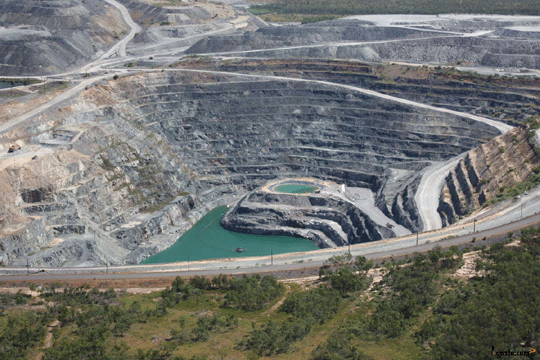 Rio Tinto moves to own Ranger remediation, Matthew Stevens, Jul 26, 2019
https://www.afr.com/companies/mining/rio-tinto-moves-to-own-ranger-remediation-20190725-p52ape
In pushing Energy Resources Australia towards a potentially controversial capital raising Rio Tinto has moved to take greater ownership of what is arguably the most important mine retirement and clean-up in Australian resources history.
The task ahead is the required $830 million remediation of the Ranger uranium mine, which sits in a necessarily excised pocket of the United Nations World Heritage-listed Kakadu National Park.
Ranger has been operated by Energy Resources Australia through its often controversial 40-year life. Through that time ERA has been majority owned by Rio Tinto or its Australian forebear, CRA. Currently Rio owns 68.4 per cent of ERA.
But a plan to fill the $400 million or so gap between what Ranger’s remediation is expected to cost and the cash that ERA has at hand to pay for the big clean-up could quite easily see Rio creep to a position that would see the mine operator fully absorbed by the mother ship.
ERA revealed extended discussion with Rio Tinto over how the funding gap would be filled has ended with its Anglo-Australia overseer insisting the only path was for Ranger’s operator to make a renounceable rights issue.
Rio Tinto has committed to take up its full entitlement and to underwrite the balance of any issuance if alternatives are not available.
The erstwhile uranium miner told its minority owners that it is “considering the size, structure and terms” of any potential rights issue “having regard to the interests of ERA as a whole”.
While that is an appropriate expression of independence, the most unlikely outcome here would be an ERA board populated by Rio Tinto appointees will end up doing anything that does not concur with the parent’s view of the company’s future.
The minority question
The most likely question ahead, then, for minority shareholders is going to be whether or not they double-down on a failed punt and back the rights issue needed to sustain the long, costly wind-up of their business?
Whatever the size, structure and terms of the raising Rio Tinto wants ERA to make, it will be material to the minority owners. ERA’s current market capitalisation is $130 million. So tapping the market for even half the shortfall could prove definitively dilutive for those unprepared to throw funds at a business destined to disappear.
In most circumstances this course might be cause to wonder at whether or not this pathway might represent a level of minority shareholder oppression. Rio Tinto’s pitch though is the exception to the rule.
ERA stopped being a miner five years ago and hopes its future might be extended were dashed a few years later when Rio Tinto found itself unable to support the Ranger 3 underground expansion, a conclusion we revealed first in April 2015.
Presently ERA’s only recourse to income is through processing uranium from stockpiled ore. That production will end in 2021 and ERA has a legal obligation to safely close the operation by 2026. The cost of remediation will endure at least half a decade beyond that and so too will the risk to reputation and social licence of any and all shortcomings of that effort.
Quite sensibly, Rio Tinto assesses it fully owns the risk of any failure or future non-compliance. It is regularly reminded of that inescapable reality by the anti-uranium activists, by the increasingly power ESG lobby and by governments state and federal.
RELATED: Rio Tinto worried about ERA’s Ranger uranium mine
The funding proposal sketched out on Thursday announces those warnings were unnecessary. Rio Tinto really does want to own Ranger’s remediation.
Acute water shortage in rural Australia, as drought persists
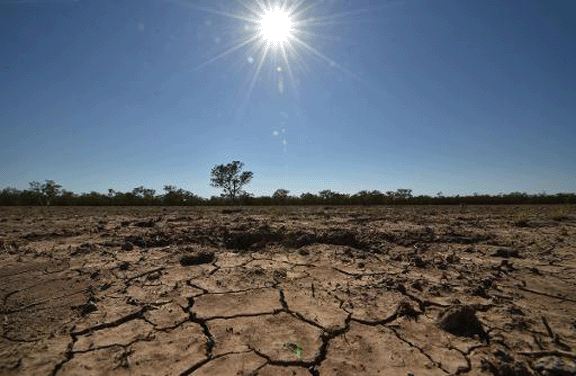
Country towns close to reaching ‘day zero’, as water supplies dry up in the drought, ABC News, By National Regional Affairs reporter Lucy Barbour 14 July 19, Across New South Wales and Queensland’s southern downs, country towns are approaching their own ‘day zero’, as water supplies dry up in the drought.
Huge volumes of water gulped by Olympic Dam uranium mine – even more with expanded mine
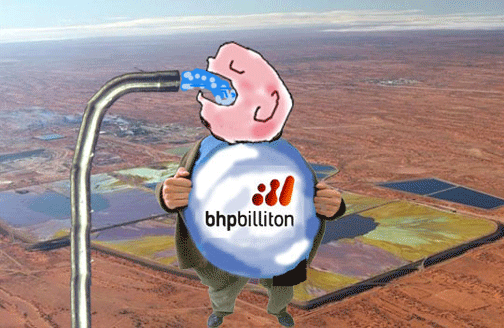
The nuclear cycle of destruction, Red Flag, James Plested, 12 July 2019 “……..The first stage of the cycle – the mining of uranium, the fuel used in nuclear power stations – is particularly relevant to Australia, home to an estimated 31 percent of the world’s known uranium reserves.
Uranium mining requires huge volumes of water – an obvious problem in arid Australia – and produces large quantities of toxic “tailings” which threaten the surrounding environment and people.
The historical record speaks for itself. According to the Gundjeihmi Aboriginal Corporation, over the 38 years of operation of the Northern Territory’s Ranger mine, there have been around 200 leaks, spills or other breaches of the mine’s operating licence. In 2013, the collapse of a leach tank resulted in a spill of about 1 million litres of radioactive waste over the mine site.
Beyond the risk of accidents, there are many other downsides to nuclear power. One particularly relevant factor for Australia is that nuclear reactors require massive amounts of water. A typical US reactor, for example, consumes 114 million litres of water an hour. To put this in perspective, total residential water consumption in Melbourne, a city of 4.8 million people, in 2018 was around 32 million litres an hour.
Australian business heads and governments have long had an eye on further uranium mines. The anti-nuclear movements of the 1970s and early 1980s, as well as the later campaign against the proposed Jabiluka uranium mine (see article in this issue), kept this aspiration in check. In recent years, however, state and federal governments have renewed the push.
The South Australian government is supporting a proposal by BHP to expand massively the operations of its existing Olympic Dam mine – which contains the largest single uranium deposit in the world. And the day before the last election was called, the federal government abruptly announced its approval of a new uranium mine in  Western Australia…….
The need for water means that reactors must be located close to rivers, lakes, dams or the ocean. In Australia, this would inevitably mean reactors would need to be built in or near densely populated areas…..” …… https://redflag.org.au/node/6835
Hasty, secretive federal approval of Yeelirriee uranium project shows contempt for the scientific environmental evidence
News of the project’s approval did not emerge until around Anzac Day later that month, with no releases announcing the minister’s decision, prompting Australian Conservation Foundation (ACF) nuclear free campaigner Dave Sweeney’s call that it was a “clandestine approval under the cover of a national election”.
Yeelirrie, which sits within the boundaries of Ms Price’s vast federal electorate of Durack, had a long history of resistance.
It was previously rejected by the WA Environmental Protection Authority which flagged, among others, concerns about the project’s impact on 12 species living underground and in the water table.
Some species were only found in the area covered by the project and there were fears they could go extinct as the miner dug through groundwater to get to the uranium below.
It was later approved at a state level by the then-Barnett government, and several options on how to proceed were presented to Ms Price by the federal Department of the Environment and Energy on April 5 this year.
But the release last week of a statement of reasons from Ms Price – secured by the ACF – has revealed she signed off on the project with a less stringent set of environmental conditions than those recommended by the department, noting that if she attached the more onerous conditions “there is a real chance that the project could not go ahead”.
“I was satisfied that if the project did not go ahead and the social and economic benefits would not be realised, this would have an adverse effect on the region and the State as a whole,” Ms Price wrote.
The Wilderness Society WA state director Kit Sainsbury said the revelation meant the minister put economic and social conditions ahead of what should be her primary consideration – the environment.
“To see both at the state and federal level such contempt for the scientific evidence suggesting that this project is environmentally unsustainable – yet receiving approval – is galling and highly contentious,” he said.
“As the Yeelirrie decision proves, too often decisions affecting the environment are made behind closed doors … a national body with teeth can stand up for the communities which need it and their country they honour.”……….
Tjiwarl native title holders and conservationists are also appealing a Supreme Court decision against their challenge to the WA government’s approval of Yeelirrie, which Ms Price had previously told media she would wait for the outcome of before signing off on the approval. …….. https://www.watoday.com.au/national/western-australia/new-light-on-wa-uranium-mine-approval-sparks-call-to-put-environment-before-economics-20190709-p525mx.html
BIRDS VS BHP: Evaporation ponds at BHP’s Olympic Dam mine are killing hundreds of birds
BIRDS VS BHP: Evaporation ponds at BHP’s Olympic Dam mine are killing hundreds of birds
Hundreds of birds are dying each year after mistaking Olympic Dam’s evaporation ponds for wetlands. Environment campaigners want the miner to stop using them. Clare Peddie, Science Reporter, The Advertiser, July 10, 2019
Conservationists want BHP to stop using evaporation ponds at Olympic Dam that kill hundreds of birds, including threatened species.
They want BHP to cancel plans for a new pond and phase out 146ha of existing ponds, which are used for the disposal of acidic waste water………
Scientist and environment campaigner David Noonan says it’s shocking that birds are drowned, choked or scalded by BHP’s highly acidic, toxic wastewater.
“They see this as a wetland in an arid region as they’re travelling through,” he said. “They’re typically poisoned by contact, they die on site or they’re poisoned and die later.”
BHP found 224 dead birds during weekly monitoring in the 2017-18 financial year and that included 39 banded stilts, a vulnerable species in SA. The number of dead birds found annually has hardly changed since 2011-12, when the banded stilt, red-necked avocet, whiskered tern, grey teal, black swan, hoary-headed grebe, …..
Plans for a huge open cut mine that were shelved in 2012 would have required a phase-out of evaporation ponds, but BHP says that condition is no longer relevant or applicable to current growth and expansion of the underground mine.
BHP is preparing to make a submission to both state and federal governments for a sixth evaporation pond.
A separate submission on a the new tailings storage facility – about the size of the Adelaide CBD and ten storeys high – has already been made, triggering an Environment Protection and Biodiversity Conservation Act referral, as in the case of the endangered bird in the path of the interconnector. https://www.adelaidenow.com.au/news/south-australia/evaporation-ponds-at-bhps-olympic-dam-mine-are-killing-hundreds-of-birds/news-story/1b886e4946f87fb7a729e201282f5cfb
Uranium contamination in groundwater in an Adelaide suburb
|
Uranium among contaminants sparking proposed bore water ban in Thebarton, ABC News By Eugene Boisvert, 5 July 19 About 1,500 Adelaide residents and businesses have been told not to use groundwater because of contamination from uranium and degreasing chemicals.
Key points:
The Environment Protection Authority (EPA) is proposing a permanent groundwater ban for the area, which includes most of Thebarton and a small part of Mile End, just west of Adelaide’s CBD. The authority has also found contamination from degreasing chemicals tetrachloroethene (PCE) and trichloroethene (TCE) that were used in the area. Similar groundwater bans are in place in Adelaide suburbs including Edwardstown, Clovelly Park, ……. https://www.abc.net.au/news/2019-07-04/uranium-among-contaminants-leading-to-thebarton-bore-water-ban/11277300 |
|
Former Environment Minister rejected department advice and approved uranium mine day before election called
The admission is contained in a statement of reasons signed by the minister before she approved the Yeelirrie uranium mine, 500km north of Kalgoorlie, the day before the federal election was called in April.
The document also shows the environment and energy department recommended conditions that would require the developer, Cameco, to ensure the project would not result in the extinction of up to 11 stygofauna, which are tiny groundwater species.
But Price instead adopted a weaker set of conditions aimed at reducing the risk to groundwater species but which the department said contained “significant uncertainties” as to whether or not they would be successful.
Price acknowledged the department had recommended tougher conditions but said in the statement that if they were imposed there was “a real chance that the project would not go ahead”.
“In making this recommendation, the department considered only the environmental outcomes, and did not weigh the environmental risks against the social and economic benefits of the project,” she said.
“Rather, as the department’s briefing noted, this balancing exercise was for me to do”.
Price wrote that she “accepted that there was a risk” that species could be lost but that the department’s advice was this was not “inevitable” if the project went ahead.
The statement of reasons also notes that the project could lead to the wipeout of the entire western population of a species of saltbush, known as the Atriplex yeelirrie.
The saltbush has just two distinct populations, the western and eastern population, both of which are found on Yeelirrie station.
The statement of reasons says the western population occurs entirely within the proposed area for the mine and there is a risk the development would clear all of it.
The Australian Conservation Foundation, which requested Price’s statement of reasons, described the document as “an extraordinary piece of decision making”.
Silly talk from Sussan Ley, Australia’s new Minister Against the Environment
 She babbles on. You have to pause and try to figure out what she really means – the underlying messages. As Minister she wants “greater focus on INDIVIDUAL action” rather than government action. “I do want my approach to the portfolio to be about what YOU can do”. Wants ” approval times for major projects cut”. She doubts that ” land clearing is responsible for species loss”. Wants to simplify the EPBC Act, (too much green tape). She is “open to the review considering a removal of the nuclear ban”
Really, we were better off with Melissa Price. She was a straight out no nonsense advocate for coal. She was well informed in her subject (coal) , and we all knew where she stood. I forgot to mention this. I heard Sussan Ley on ABC radio, saying that on the subject of species extinctions in Australia “she knew better than the UN researchers, because she had lived in rural Australia” She said that “the UN had got it wrong”
I

Environment Minister floats ‘lending’ Murray Darling environmental water to farmers, Brisbane Times, By Nicole Hasham, June 15, 2019 New Environment Minister Sussan Ley says farmers in the Murray Darling Basin should be allowed to “borrow” water reserved for maintaining the river’s health, and federal approval for major developments must be streamlined to “give proponents more assurances” and reduce delays.
In an interview with The Sydney Morning Herald and The Age, Ms Ley also identified invasive starfish as the “most imminent” threat to the Great Barrier Reef as she flagged potential changes to the way Australia’s natural assets are managed.
The Liberal MP was returned with a 7 per cent swing against her in the rural NSW seat of Farrer, where concern about water allocations to farmers featured heavily in the federal election campaign.
Ms Ley’s new portfolio captures the Commonwealth Environmental Water Office, which manages the majority of water for the environment recovered under the Murray Darling Basin Plan.
She cited the need for “flexibility” to allow water storages intended for environmental use to be “borrowed” by struggling farmers.
Sometimes the environment doesn’t need all its water but farmers desperately do need water,” she said……
The Australia Institute senior water researcher Maryanne Slattery, a former director at the Murray-Darling Basin Authority, described Ms Ley’s depiction of the problem as “not very accurate”…….
Ms Ley re-entered the Coalition government’s cabinet last month, after a 2017 expenses scandalforced her resignation from the front bench.
The environment portfolio includes protection of the Great Barrier Reef, which is under grave threat from climate change.
The federal government’s Great Barrier Reef Marine Park Authority says climate change “is the greatest threat to the Great Barrier Reef and coral reefs worldwide”. …..
Australia’s key piece of environment legislation, the Environment Protection and Biodiversity Conservation Act, is due to be reviewed this year.
Ms Ley said it provided “real opportunity to remove some of the green tape around environmental approvals”…..
Australian Conservation Foundation nature campaign manager Basha Stasak said talk about cutting green tape was “code for making it easier for the loggers to cut down our forests, the diggers to rip up endangered animal habitat and corporate irrigators to suck more water out of our rivers”. https://www.brisbanetimes.com.au/politics/federal/environment-minister-floats-lending-murray-darling-environmental-water-to-farmers-20190614-p51xsf.html
1 This month



Help Aunty Sue Protect Her Land and Sacred Sites From Destructive Rocket Testing.
.

Australians deserve the truth
about
AUKUS – https://aukuspublicinquiry.com/

PETITION – To: Prime Minister Anthony Albanese and the Australian Labor Government

of the week – Australians for War Powers Reform (AWPR)
To see nuclear-related stories in greater depth and intensity

