New website makes Aboriginal ecological knowledge available
 First Nation knowhow to help save our landscapes http://phys.org/news/2014-05-nation-knowhow-landscapes.html May 08, 2014 The deep knowledge of First Nation (Aboriginal) people is being called on as part of a nationwide effort to stem the tide of extinction and decline that is engulfing the Australian landscape and its wildlife.
At a major scientific meeting in Canberra today, a new website will be unveiled which brings together thousands of records documenting Aboriginal traditional knowledge about Australian native landscapes, plants and animals.
The knowledge is presented in the form of a world-first map, which records publically-available Australian Indigenous bio-cultural knowledge (IBK) that is place-based. The detailed content of the identified documents is only made available with the express permission of the Aboriginal communities which own it.
Aboriginal people and non-Indigenous scientists and managers are currently working together on hundreds of projects across Australia to understand and better manage country using a combination of indigenous bio-cultural knowledge and ecological science.
The map draws together, for the first time worldwide, the wealth of projects, documents, reports, research and management plans where Indigenous bio-cultural knowledge is being used and Aboriginal people are adding value to today’s understanding of Australian ecology and land management practices.
This website maps the places where projects have been or are being carried out, documents results and provides examples of current leading practice, useful information and case studies of “living knowledge” and its practical application.
These include cases of Aboriginal-led landscape restoration, fire management, knowledge about native plants and animals and knowledge about wetlands and other important ecosystems.
“This is the first time that Aboriginal knowledge about landscape and Australian ecological science have been brought together across the whole continent in a single resource,” says ACEAS director Associate Professor Alison Specht
“It also represents a major contribution to documenting and preserving traditional knowledge for future generations of Aboriginal people – and for all Australians.”
The project is part of a worldwide trend to bring the knowledge held by First Nation peoples together with science and conservation policy, and makes Australia one of the global leaders in this field, she says.
“We have shown that all of Australia’s conservation priorities could be greatly informed by Indigenous bio-cultural knowledge – although the existing opportunities far outweigh the advances made to date,” says the team behind the project, in a soon to be published discussion paper. The ACEAS IBK Working Group is led by Dr Emilie Ens and includes twenty Indigenous and non-Indigenous researchers and land managers from around Australia.
“Threats to global environments are increasing, so it is timely to rethink our ecological knowledge base and develop more holistic and inclusive research, management and funding options for the future.
“Enhanced cross-cultural and cross-disciplinary engagement has great potential to strengthen global capacity to build socio-ecological resilience for … inclusive and sustainable environmental management strategies.”
Rio Tinto dodging its responsibilities for radioactive pollution of Kakadu National Park
 Rio Tinto dismisses Ranger rehab funding concerns as “hypothetical” Mining Australia, 8 May, 2014 Rio Tinto has stated that concerns about the funding for rehabilitation of the Northern Territory Ranger mine site are hypothetical, and remain the concerns of the ERA board of directors.
CEO Sam Walsh once again shrugged off suggestions that Rio Tinto, as 68 per cent shareholder in ERA, is responsible as the parent company for any of ERAs financial shortcomings in regard to rehabilitation and clean-up at the Ranger uranium mine…….David Sweeney of the Australian Conservation Federation, in his question to Sam Walsh and the Rio Tinto board of executives, suggested that because ERA reports to RioTinto’s energy division, it will be “closely watched and long judged on its actions regarding ERA”……..
“I thought his response was very partial and legalistic,” Sweeney said.
“Clearly Energy Resources Australia is a separate legal entity to Rio Tinto, but Rio provides the mining instructions, they provide the management, the CEO of ERA is appointed by Rio and is always a Rio person, Rio’s energy division manages ERA.
“It is absolutely a Rio Tinto subsidiary, it is a Rio Tinto child, and it concerns us greatly now that, when it’s coming to the pointy end of what will be a costly and complex rehabilitation exercise, ERA is saying they don’t have the funding capacity and Rio Tinto is saying they don’t have the responsibility.
“Just this week, Rio bailed ERA out of a problem caused by the suspension of mineral processing, by saying that they will pool Australian and Namibian uranium through the Rio Tinto marketing authority.”……http://www.miningaustralia.com.au/news/breaking-rio-tinto-dismisses-ranger-rehab-funding
Unsatisfactory answers on coal seam gas radiation leak
 More questions on CSG uranium scare #agchatoz http://coalseamgasnews.org/news/world/australia/nsw/more-questions-on-csg-uranium-scare-agchatoz/ May 5, 2014 Mike Foley A RANGE of unanswered questions have emerged over Santos’ Pilliga uranium aquifer contamination , as the environmental watchdog’s investigation report comes to light.
In March 26, 2013, Santos advised the NSW Environment Protection Authority (EPA) its monitoring measures had detected aquifer contamination was caused by a leaking storage pond at the Bibblewindi site, which contained salty water which had been sucked up from underground during coal seam gas (CSG) activates.
Nearly a year after Santos was fined, in March 2014, the EPA finalised its report on the contamination.
But the EPA investigation leaves key questions unanswered concerning remediation of the Pilliga’s groundwater, the reliance of the authority on companies for information and public health risks. It confirmed a groundwater system beneath the Bibblewindi storage pond contained heavy metals and other elements, including elevating uranium levels to 20 times the safe drinking limits. Santos was fined $1500 by the EPA for causing the contamination.
The investigation report details correspondence between the EPA and other government agencies, highlighting areas requiring further information, including:
Can the contaminated groundwater be repaired? Santos advised the EPA in October its trial efforts to remove contaminated water had failed.
“The results of the trial concluded that recovering the perched water by abstraction in the surrounding shallow perched bores is impractical,” Santos said. Further remediation plans are not discussed.
Have all potential health concerns been laid to rest?
The NSW Office of Health was consulted on potential impacts on drinking water. Its advice, reproduced in the EPA’s report, noted the “nearest public drinking water supply is 27 kilometres away (Narrabri) and does not appear to be affected by the Bibblewindi site.
NSW Health said it “would be appropriate” for the NSW Office of Water to independently review the technical information Santos’ provided to the EPA to establish its accuracy. “This is considered somewhat justified given that the report has some comprehensive limitation attached,” NSW Health said.
Does the EPA have enough resources to monitor effectively?
The data on which the EPA’s report is based has been provided by Santos. The Land does not suggest impropriety on either Santos or the EPA’s behalf, but this does highlight the limitations of the government regulator and the significant role the gas proponent plays in monitoring its environmental impacts.
Wilderness Society Newcastle campaign manager Naomi Hogan said: “Santos said it would never threaten groundwater, but it has polluted an aquifer with uranium and other toxic heavy metals and the EPA report says Santos can’t fully clean up the mess”.
A Santos spokeswoman said “rehabilitation works are continuing”, noting the contamination poses no health risk. The water from the storage pond will be transferred to a treatment facility, she said. “Monitoring will continue to ensure the isolated groundwater underlying the pond is rehabilitated. There remains no risk to people or livestock.”
Uranium industry not economic for Mt Isa, and fraught with environmental problems for Queensland
 Uranium debate heats up in Mount Isa Queensland labour senator Jan McLucas says the state’s uranium deposits are too small to warrant developing the industry. ABC Rural By Virginia Tapp, 1 May 14
“These mines at Valhalla and Westmoreland are not huge deposits, they will not employ large numbers of people like Mount Isa, Cloncurry and Century have done.
“These are small mines and I don’t think they are the answer to the question of employment in the Mount Isa region.”…….Senator McLucas also claims there is not enough information about managing uranium mines in areas that experience intermittent periods of very high rain fall and flooding.
She says parts of the abandoned Mary Kathleen uranium mine, situation between Mount Isa and Cloncurry, are still radioactive.
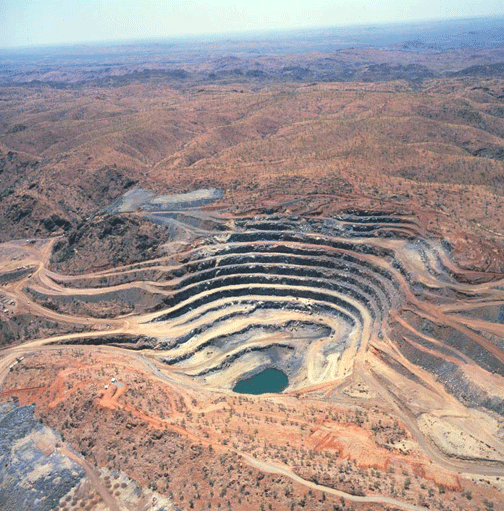
“The residents of Mount Isa are still living with the results of that mine and the inadequate capping of the spoil and the contamination of the land that even graziers today won’t go near.”…….
[Queensland Department of Natural Resources and Mines and the Department of Environment and Heritage Protection joint statement] ……”We are still assessing the condition of the Mary Kathleen site and looking at whether it could be mined again in the future.
“Contamination issues at the site may not have been properly addressed in the past.”…..http://www.abc.net.au/news/2014-05-01/uranium-debate-queensland/5423232
Aboriginal climate ambassadors assess impact of climate change
Indigenous ambassadors assess climate impact on native land SBS World News, Two young Indigenous climate ambassadors have been touring Australia to document the impact of the changing natural environment on traditional communities. By Gary Cox Source NITV News, 27 April 14 Narelle Long and Malcolm Lynch were the first young Indigenous people to set foot in Antarctica back in 2012.
Uranium mining plans by Toro Energy – expensive, polluting, and under investigation
Toro uranium expansion plan: premature and polluting http://www.ecovoice.com.au/toro-uranium-expansion-plan-premature-and-polluting/
Western Australia’s peak environmental group has condemned a move by uranium mining hopeful Toro Energy to expand their unrealised Wiluna mine plan into a much larger uranium mining precinct spanning 100km and two ecologically sensitive lake systems in the East Murchison region.
The state EPA has released details of the expansion plan while the company is under investigation by the Australian Securities Exchange for a second time over claims they have released misleading information to shareholders and the market. (See background below).
“Toro have never successfully mined anything before and have a long way to go to get their original single-mine project approved – let alone any new expansion,” said CCWA Nuclear Free campaigner, Mia Pepper.
“Contrary to their statements to shareholders, the company needs to complete additional environmental management , mine closure, tailings management and transport plans for assessment before any mining can commence at the Wiluna site.”
The company has struggled to find investors and currently needs $300 million in start-up costs and a further $300 million in upfront bonds.
“This new plan to attract investors is likely to draw further scrutiny from both regulators and the wider community who will be looking at the cumulative impacts of a regional uranium precinct covering 100km and two arid zone Lake Systems.”
“Toro plans to double its water consumption and store radioactive mine waste from several mine sites in a Lake bed. This idea lacks credibility and the company lacks capacity, experience and financial backing.”
Toro’s new plan involves four deposits over one hundred kilometres – Lake Way, Centipede, Millipede and Lake Maitland, with the company’s long term plans including mining an additional three deposits Nowthanna, Dawson Hinkler and Firestrike – covering a hundred kilometres in the other direction.
Also in the region is WA’s largest uranium deposit – Yeelirrie, which is now owned by Cameco. Traditional Owners have consistently opposed this project for forty years.
CCWA is partnering with a range of public health, union and faith groups to call for a public inquiry into the Toro mine plan.
ASX investigation
The Mineral Policy Institute and the Conservation Council of WA received formal notification that the Australian Securities Exchange is investigating Toro Energy for the second time over the release of potentially misleading information. Continue reading
Our National Parks are no place for uranium mines
By Dave Sweeney and Mia Pepper, 17 Feb 14 When we think of National Parks in Australia we generally think of places of renewal and natural beauty where we can take the whole family to recharge and reconnect with nature – places that draw international visitors to our shores looking for a taste of the wild places that have made our state famous.
Yet Western Australia’s largest National Park is current in the cross hairs of a Canadian company for a large scale uranium mining project. Right now the Canadian mining company Cameco is proposing to mine uranium in the Pilbara at Kintyre, in an area that has been excised from WA’s biggest National Park – Karlamilyi (Rudall River).
The area that contains the Kintyre uranium deposit is one of the most unique and diverse ecosystems in the country, including the fate 28 endangered, vulnerable and priority species. The proposed mine site is nestled between two branches of the Yandagoodge creek, which feeds springs and lake systems throughout Karlamilyi National Park and provides water for the communities of Punmu and Parnngurr.
On top of the question of the appropriateness of placing a uranium mine in an area well recognised for its unique and fragile environmental assets, the equation becomes even more fraught when the track record of the proponent – Cameco Resources – is given closer inspection.
Cameco’s track record overseas raises disturbing questions about the risks and potential impacts on this fragile desert ecosystem and the adequacy of the state systems that are meant to protect the people and the place. Cameco’s operating uranium mines in Canada have been dogged by leaks, floods, contamination and unsafe work environments.
Cameco has been through court over license breaches in the US, has been investigated for tax avoidance in Switzerland and has had Chinese companies turn back their leaking uranium shipments. Community division, lowering house values,community court actions and secret deals with the US military are all things that feature in reports about Cameco.
The company is also currently embroiled in a court action with the Canada Revenue Agency, which is seeking millions in unpaid tax between 2007 and 2013. Which all begs the question – is this the kind of corporate track record to which we should be willing to open up our National Parks?
Karlamilyi National Park should not be the testing ground to see if this company can operate safely or treat communities with respect without creating division.
Despite industry assurances and government promises the Australian uranium sector has a sorry track record of failed uranium mines, with leaks, spills and license breaches from exploration projects at Wiluna and Yeelirrie in WA to operating mines at Ranger in the NT and Olympic Dam in SA.
In fact there has never been single uranium mine rehabilitated successfully in Australia – Rum Jungle, Nabarlek, Mary Kathleen and more are all names associated with unresolved radioactive or acid mine drainage legacies.
Giving a blank cheque to a foreign company to operate a dirty mine in one of WA’s most special places is not smart politics or policy. It is a short term trade that would see a long term loss and an uncapped liability on the State and its tax-payers.
We all know from past experience both here and overseas that mining uranium is a risky business. Between the processing acids, heavy metals, radon gas, dust and radioactive mine waste there is a lot that can go wrong. This is sector facing strong opposition internationally with nuclear shut downs in Germany and Japan after the Fukushima disaster – a catastrophic natural and nuclear disaster fuelled by Australian uranium.
When you put this contaminated cocktail next to a National Park that is home to a network of ephemeral rivers and numerous endangered, vulnerable and priorityspecies then the stakes get even higher. WA can – and must – do better than this.
Dave Sweeney is the Nuclear Free Campaigner at the Australian Conservation Foundation. Mia Pepper is the Nuclear Free Campaigner at the Conservation Council of WA.
How Australia caved in to Britain, in not properly cleaning up Maralinga bomb sites
 Why cabinet sought only a partial clean-up of British nuclear test site Archives give new insight into Hawke government’s response to royal commission on weapons testing in Maralinga region Paul Chadwick theguardian.com, Wednesday 1 January 2014
 Gareth Evans, the energy minister at the time, said ‘a non-confrontational approach’ had been adopted in dealing with the Thatcher government.
The complete rehabilitation of areas of Australia used to test British nuclear weapons may not be possible, the Hawke cabinet was advised in 1986.
Cabinet was warned that a full clean-up may have been more expensive than the British government would be willing to contemplate, according to documents released this week by theNational Archives.
They provide new insights into the Hawke government’s response to the recommendations of the McClelland royal commission into British nuclear tests in Australia. Continue reading

Increased risk of radiation pollution from uranium mining in Kakadu
the Ranger mine is more than 30 years old and we are increasingly seeing metal fatigue and accidents, such as the one we saw so spectacularly 10 days ago.
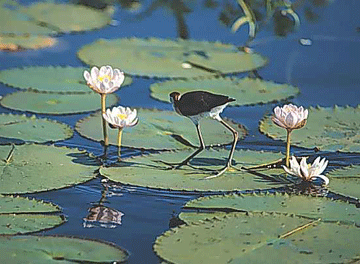 Kakadu mine: risk of uranium leakage could be greater than thought
Study shows the radioactive particles can escape into the environment, raising alarms about the national park Oliver Milman theguardian.com, Wednesday 18 December 2013 The risk of uranium leakage from filtration systems used by facilities such as the Ranger mine in Kakadu could be greater than is currently acknowledged, with new research showing that the hazardous substance is far more mobile than previously thought.
A study published in Nature Communications found that seemingly immobile uranium“piggybacked” onto iron and organic material and flowed into a stream that joined a wetland in France.
The Australian Conservation Foundation said the findings were “alarming” given the proximity of the Ranger mine to the World Heritage-listed wetlands of Kakadu national park in the Northern Territory. The ACF said the new European research called into question mine operator Energy Resources of Australia’s practice of using a wetland filtration system to ensure uranium doesn’t escape into the environment. A community of Mirarr people live about 10km from the Ranger mine. Continue reading
AUDIO: climate change causes dangerous jellyfish to move South, threatening Australia’s tourism industry
 AUDIO Researchers say Irukandji jellyfish migrating further south along Qld coast http://www.abc.net.au/news/2013-10-29/irukandji-jellyfish-migrating-further-south-along-qld-coast/5051580 AM By Nance Haxton and staff 29 Oct 2013,
Marine researchers say climate change could be altering the migration patterns of the dangerous Irukandji jellyfish along Queensland’s east coast.
The Irukandji is one of the deadliest marine animals, so venomous it inflicts excruciating pain that sometimes leads to death.
It has been on a relentless march southwards down the Queensland coast.
If the Irukandji becomes established off Queensland’s south-east coast, it would be devastating for the region’s tourism industry……
Call for inquiry into proposed uranium mining in Queensland
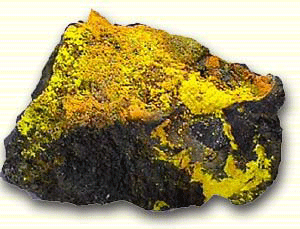 The Newman government must hold a fully independent and open inquiry into the real risks of uranium mining before Queensland starts down a risky pathway for existing industries, workers and our environment.
If it’s as safe as they claim, then they have nothing to fear from any inquiry.
Independent inquiry needed into uranium mining Brisbane Times, Mark Bailey, October 23, 2013 This week marks one year since the Newman government breaking its pre-election promise by overturning Queensland’s ban on uranium mining – without any mandate to do so.
Queenslanders across the state should be deeply worried about the dangers of mining and transporting uranium yellow cake due to the many radioactive risks involved. It was no surprise to hear Premier Campbell Newman admitting no research or modelling had been done before overturning the ban.
Given the extensive history of over 150 recorded mishaps at the Ranger uranium mine in the Northern Territory, why would our state allow a uranium mine located in our tropical climate prone to heavy summer rainfall and cyclones from the Coral Sea and the Gulf?
Given the vast amounts of radioactive sludge (or ‘tailings’) involved in uranium mining, the impact of inevitable extreme weather events slamming into mine sites with many hectares of tailings risks radioactive sludge spreading over vast distances in our state. That’s not a risk worth taking for existing industries in north and north-west Queensland let alone residents.
Uranium mines use vast amounts of water that are likely to come from the Great Artesian Basin for most of the year. While rainfall is often torrential in the wet season in north Queensland, much of the north west is dry most of the time.
The cumulative impact on the Great Artesian Basin of anywhere between one to five uranium mines may have a significant impact on water resources for other existing agricultural and cattle industries. Once one uranium mine is approved then other mines will likely be approved……
Shamefully, the Newman government has not ruled out exporting uranium across the Great Barrier Reef which should be a source of great national and international concern. Continue reading
Australian Commonwealth keeping laws over nuclear and other environmental matters
 Commonwealth will keep environmental power over state projects , The Conversation, 30 September 2013,
 The Commonwealth will not delegate to the states decisions under its national environmental laws in which the states have a “conflict of interest”. Federal Environment Minister Greg Hunt confirmed this significant commitment in an interview on ABC radio last Thursday.
The Coalition’s pre-election Policy for Resources and Energy promised to deliver a “one-stop-shop” for environmental approvals. The policy read like a complete handover of all Commonwealth decisions to the states.
But the Minister qualified the Coalition’s policy before the election when he was the Coalition’s environment spokesperson. He said in an interview reported in theWeekend Australian in May 2013 that: “some matters would be reserved where the Commonwealth would be the one-stop-shop but overwhelmingly it would be the states.”
In his recent radio interview, the Minister confirmed that the Commonwealth will retain control over decisions involving offshore Commonwealth waters, nuclear actions, and projects for which state governments are “likely to have a significant conflict of interest” as the proponent.
This alleviates the most significant concern about the one-stop-shop policy: where the state is the proponent they’ll have difficulty making an independent assessment…….
Complications of water trigger
The new water trigger created under the EPBC Act also complicates the one-stop-shop policy. Now-retired MP, Tony Windsor, who championed the trigger, managed to include alegislative prohibition on it being delegated to state governments.
Just how big a complication this creates is evident in Greg Hunt’s recent announcement that 47 coal seam gas and mining projects currently being assessed will need to consider the water trigger. All in all, the “one-stop-shop” policy looks like creating the patchwork regulatory regime that the Gillard Government ultimately decided not to pursue.
Queensland’s Newman government to open up Cape York wilderness to mining
Blueprint splits Cape Liam Parsons Thursday, September 19, 2013 The Cairns Post HUGE sections of Cape York will be opened up to mining and farming under the Newman Government’s draft Cape York Regional Plan.
Deputy Premier Jeff Seeney was in Cairns yesterday to unveil the plan which will replace the former Labor government’s Wild Rivers laws……. Wilderness Society Northern Australia campaigner Gavan McFadzean described the draft plan as the Newman Government’s blueprint to industrialise Cape York. “This Government wants to open up the most sensitive waterways and landscapes to mining, dams and land clearing,” he said.
Mr McFadzean said the plan snubbed the region’s world heritage values and “rides roughshod over the aspirations of the traditional owners of Cape York.” http://www.cairns.com.au/article/2013/09/19/248318_local-news.html

New equipment: old problems – ERA’s Kakadu uranium plans in focus
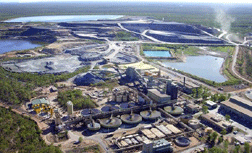 Environment Centre NT, 17 Sept 13, Uranium miner Energy Resources of Australia will unveil its new brine concentrator – a long overdue piece of infrastructure that seeks to address both chronic water management problems and contaminated process water – at its aging Ranger uranium mine in Kakadu on Thursday.
The Ranger mine has been plagued with water and waste management problems that have caused extended shutdowns and deep concerns about impact on the World Heritage Kakadu National Park. “The new infrastructure is a long overdue and welcome initiative,” said Lauren Mellor, Nuclear Free NT Campaigner with the Environment Centre NT.
“The delay in commissioning this key piece of equipment is a poor reflection on ERA’s commitment to rehabilitation, given the company’s long history of water mismanagement. That ERA has been allowed to continue mining and expanding its waste water inventory, now estimated at eleven gigalitres, without having an effective waste water management plan or the ability to treat process water shows a disturbing lack of regulatory rigour.” Continue reading
Queensland govt says no exporting of uranium over great Barrier Reef
Government rules out uranium exports over Great Barrier Reef The Satellite, APN Newsdesk 12th Sep 2013 APN NEWSDESK EXPORTING Queensland’s uranium is a priority for the state government, but the radioactive material is unlikely to leave Australian shores via the Great Barrier Reef.
In an “action plan” released on Thursday, the State Government has ruled that any uranium pulled from Queensland provinces can only be exported from Adelaide or Darwin……… The government has again ruled out allowing nuclear power plants or the disposal of radioactive waste in Queensland.
And like all major resources projects, the state is pushing to gain control over approvals – but environmental activists are concerned.
Australian Conservation Foundation Dave Sweeney said such state powers conflicted with comments by the incoming Federal Government that it would retain its hold over uranium projects. “Uranium mining is an issue of national interest and importance and is rightly a matter for the active consideration of the national government,” Mr Sweeney said.
Mines Minister Andrew Cripps said the government would begin considering projects by mid-2014. From there, demand from industry would determine when mining began.http://www.thesatellite.com.au/news/exporting-queenslands-uranium-barrier-reef/2018482/
1 This month
17 October, Free Public Talk on Nuclear Issues in South Australia
David Noonan will speak on public interest concerns over the new Roxby Downs Indenture Act 2026 on BHP copper-uranium mining and ore processing in SA, and on how AUKUS may face SA with a High-Level nuclear waste agenda.
Dr Jim Green will discuss international developments in the field of nuclear power including ‘small modular reactors’ and Generation 4 ‘advanced’ nuclear reactor concepts.


Help Aunty Sue Protect Her Land and Sacred Sites From Destructive Rocket Testing.
.

Australians deserve the truth
about
AUKUS – https://aukuspublicinquiry.com/

PETITION – To: Prime Minister Anthony Albanese and the Australian Labor Government

of the week – Australians for War Powers Reform (AWPR)
To see nuclear-related stories in greater depth and intensity

