Aboriginals and Environmentalists combine to save Arnhem Land from unchecked resource development
Aboriginal-green link to fight gas projects BY:AMOS AIKMAN , THE AUSTRALIAN, July 19, 2013 ENVIRONMENTAL groups are seeking to capitalise on the beauty of Arnhem Land and the plight of its indigenous people to build support for campaigns against resource development and a northern food bowl.Five indigenous people from the remote community of Maningrida will hold a protest in Sydney’s Martin Place today, objecting to petroleum-licence exploration applications covering about 1500km of coastline.
Their $8000 travel bill was paid by The Wilderness Society, the Australian Marine Conservation Society and Environment Centre NT, which are co-sponsoring the event.
Anti-coal-seam and shale gas group Lock the Gate Alliance and a coalition of anti-nuclear protesters are also involved.
A traditional owner from the nearby Blythe River area, Eddie Mason, said he was worried about the safety of his country and about songlines and sacred sites beneath the sea. Indigenous landowners cannot veto exploration or mining in open water. “That’s our main food source, our supermarket,” Mr Mason said.
He accused Palter Petroleum, which has applied for the Arnhem Land exploration licences, of failing to consult properly with indigenous people, who he said should have veto rights over territorial waters.
Gavan McFadzean, The Wilderness Society’s northern Australia campaign manager, said his organisation was keen to use iconic sites in the Kimberley, Arnhem Land and Cape York Peninsula to develop a national campaign around the dangers of resource extraction and northern food bowl development.
He said the prospect of a future Abbott-led Coalition government was a particular threat.
Lock The Gate Alliance spokesman Drew Hutton said his organisation was also increasing its work in the Top End.
Mr Hutton predicted that Aboriginal land would be the next battlefront after farmland in the war to control unconventional gas developments.http://www.theaustralian.com.au/national-affairs/indigenous/aboriginal-green-link-to-fight-gas-projects/story-fn9hm1pm-1226681650900
Fukushima radiation did reach Australia
 Traces of Fukushima reach Australia Asian Correspondent, By Gavin Atkins May 03, 2011 Tiny traces of radioactive particles from Fukushima have been picked up by monitoring stations in Australia, Fiji, Malaysia and Papua New Guinea.
Detected on April 13, the small amount of Xenon detected in Darwin is too small to be of concern for public health. The Government agency responsible,the Australian Radiation Protection and Nuclear Safety Agency (ARPANSA) has kept the news at a low profile by burying the information in its media releases. ARPANSA operates some of the monitoring stations and is tasked with informing the Australian public about radiation risks……..
The system of more than 270 monitoring stations around the world (eventually to number 337) is being established primarily to ensure that all nuclear tests are detected.
Eighteen of these stations operate around Australia and in Antarctica, and another two are being constructed…….
The monitoring system can detect a range of radioactive isotopes that would have been emitted from Fukushima including Caesium-137. The CTBTO says that current readings are clearly consistent with material from a damaged nuclear power plant, almost certainly Fukushima.
The monitoring stations are astonishingly sensitive, being able to pick up a few atoms of radioactive materials and can, for example, detect one tenth of a gram of Xenon if it is evenly distributed throughout the earth’s atmosphere. http://asiancorrespondent.com/53525/traces-of-fukushima-reach-australia/
ERA’s new uranium plan for Ranger mine sheds doubt on proper future cleanup
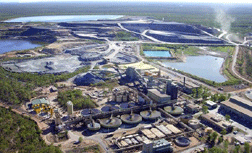 Ranger uranium mine expansion plan faces scrutinyhttp://www.abc.net.au/news/2013-07-09/environment-centre-nt-on-ranger-uranium-mine-eis-undergounding/4808406 By Kristy O’Brien Jul 9, 2013 The Northern Territory Environment Centre says it is assessing draft environmental guidelines for the expansion of the Ranger uranium mine.
The draft EIS guidelines from the Northern Territory Environment Protection Authority aim to minimise the effects on the surrounding Kakadu National Park of a move from open-cut to underground mining.
The Environment Centre’s Lauren Mellor says the group is opposed to the expansion but is happy to see increased scrutiny of the project.
“What has been proposed here is underground mining, which is something that has never been done before at the Ranger site,” she said. “This is being proposed at a time when the company should be ramping down operations in preparation for rehabilitation, not ramping them up.”
Mine operator Energy Resources of Australia (ERA) says underground mining would extend the life of the operation. Ms Mellor says her group will assess the EIS guidelines to ensure they are appropriate.
“They [ERA] have got a legal obligation to cease mining and mineral processing by 2021 on the site,” she said. “What they are proposing here is to increase contamination, increase tailings and waste at the site, which means rehabilitation is more than likely to be delayed,” she said.
Mary Kathleen uranium mine – still toxic decades after closure
Remediation efforts continue at abandoned uranium mine Australian Mining, 11 June, 2013 Vicky Validakis Queensland officials inspected the abandoned uranium mine at Mary Kathleen last week, as part of an ongoing assessment of the site’s remediation status.
Minister for Natural Resources and Mines Andrew Cripps announced last year, the government would assess opportunities for mining at the site, which contains millions of tonnes of ore tailings.……. A spokesperson for the minister said the inspection was not connected to an assessment of opportunities for future mining at the site.
The Mary Kathleen mine is under a Restricted Area 232 status, meaning exploration and production are both prohibited.
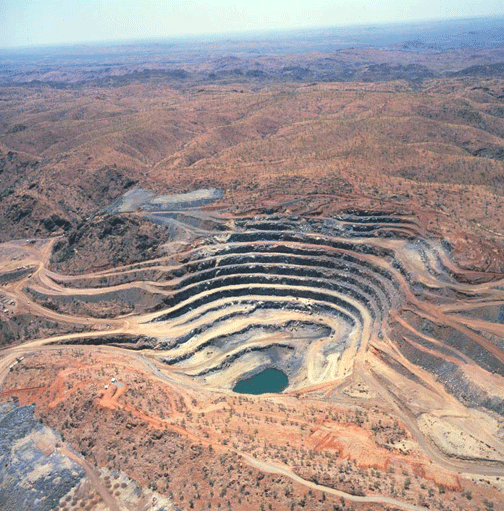
“Remediation and environmental management issues are critical factors for the Queensland Government to address prior to any future consideration about whether or not to release land from Restricted Area 232,” Cripps said.
Cripps said Abandoned Mine Lands program officers from the Department and the Geological Survey of Queensland would undertake field assessments later this month, including drilling at the tailings dam.
“This work will enable the Department to gain a better understanding of the current condition of the abandoned mine,” he said.
The Greens North Queensland spokesperson Jenny Stirling, said “toxic” tailings at the mine meant that uranium mining had made the site useless for other purposes.
“They are looking to mine rare earth and, if they had the good sense that God gave them, they would know that they would have to deal with the toxic tailings of uranium mining at Mount Kathleen,” Sterling said.
“It’s just a highly problematic situation.” http://www.miningaustralia.com.au/news/remediation-efforts-continue-at-uranium-mine
Northern Territory govt sets levy on miners to clean up old mines, such as Rum Jungle
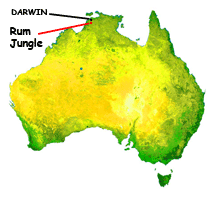 Miners to pay for mess, NT News, ALISON BEVEGE | May 8th, 2013 A MINING levy will raise funds to fix polluted legacy mine sites, the NT Government has announced.
The fee will be 1 per cent of the upfront environmental bond that all miners must pay, as set by the Department of Mines’ Security Assessment Board.
The Government has said the bond would be 100 per cent of clean-up costs but there is no way for the public to tell as the amount is secret. The new levy comes into effect in October. Mines Minister Willem Westra van Holthe said the impost would raise $6.5 million in its first year………. “We’re simply asking mining companies to chip in to a program that will be used to remediate legacy environmental problems caused by the industry.”
The move comes after the NT News exposed environmental disasters that festered for decades at defunct mines including Rum Jungle, Redbank and Mt Todd.
Camping is banned at the recreational lake near abandoned uranium mine Rum Jungle, 100km south of Darwin, as radiation levels are too high for long-term use…… Environment Centre NT co-ordinator Stuart Blanch said he supported the levy, but it would not be enough to clean up the polluted mine sites which could cost up to a billion dollars….. http://www.ntnews.com.au/article/2013/05/08/320647_ntnews.html
Mining companies the largest leasholder of Western Australian pastoral land
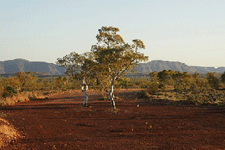 WA land owned increasingly by conservation and mining Science Network Western Australia, 29 April 2013 “The research focused on pastoral country from the edge of the Wheatbelt up to and including the Pilbara, which historically has been held under pastoral leases owned by families and used for grazing such as sheep and cattle stations”—Dr van Etten. Image: Stefan Jurgensen RESEARCHERS say an increasing amount of land in Western Australia is being managed for environmental conservation, however mining companies are the single largest lease holder of what was previously pastoral land. Continue reading
Doctors make powerful statement on protection of animals from uranium mining radiation
Medical Assocation for the Prevention of War (MAPW) SUBMISSION ON FEDERAL REGULATION OF URANIUM MINING, by Dr Margaret Beavis April 2013 “…..With regard to non-human species, the 2010 ARPANSA Technical Report No. 154 entitledWestern Australia’s asbestos town – a prelude to uranium towns?
WA GOVERNMENT TO MOVE LAST RESIDENTS FROM ASBESTOS TOWN ABC Radio National 3 April 2013 By:Catherine Van Extel The West Australian Government is looking to move a group of residents who continue to live in the deadly asbestos mining town of Wittenoom, in the Pilbara region of Western Australia. But while there are moves to finally clean up the toxic site, many continue to face the legacy of their time spent growing up in or visiting the notorious town.

The 1990 Midnight Oil song ‘Blue Sky Mine’ was inspired by Wittenoom and its deadly mining industry. It’s estimated that more than 20,000 people lived at Wittenoom before the mine closed in 1966.
Asbestos-related diseases have killed more than 2000 former workers and family members of Wittenoom, a death toll that continues to rise.
In 2007, the state government withdrew Wittenoom’s town status—disconnecting services like water and electricity—but a small group of residents stayed. Now the government wants them out in order to remediate the contaminated site. Continue reading
Uranium through Great Barrier Reef? Financial foolishness, and ecological crime!
The price tag of the uranium deposits in Queensland, if all extracted and sold is about $10 billion. A pretty big chunk of cash, but worth only a paltry two years of tourism dollars that the Great Barrier Reef brings in.
To anyone who has looked in wonderment at the fish on a reef, this is not an “Australian issue”, this is an issue that speaks to how we want to leave the world to future generations. Our kids will remember visiting a reef teeming with tropical fish, turtles and fluorescent coral, but what will they remember if it isn’t there to be seen? They sure as heck won’t remember the quick buck made by uranium mining companies a few decades previous
Radioactive scuba diving a potential new Aussie destination sport http://www.vancouverobserver.com/city/outdoors/radioactive-scuba-diving-potential-new-aussie-destination-sport Kevin Grandia Mar 19th, 2013 Okay, I am exaggerating, but only slightly, but new anti-regulation laws have recently been passed in Australia that could mean uranium will be shipped out directly over this oceanic masterpiece of nature. Continue reading
30 years after closing, Queensland’s Mary Kathleen uranium mine still leaks radioactive water
Queensland’s last uranium mine still leaking radioactive water 30 years after production stopped John McCarthy The Courier-Mail March 21, 2013 THE state’s last uranium mine at Mary Kathleen – in the Selwyn Range between Mount Isa and Cloncurry – is still leaking radioactive water from the site 30 years after production stopped. But, according to a committee report handed to the State Government this week, the return of uranium mining to Queensland is “risky but manageable”.
“The uranium mining industry has a number of inherent environmental risks,” the report said….. The report says the Mary Kathleen mine’s pit is still full of highly contaminated water to a depth of about 50m, and since the mine closed in 1982, several other studies have found “ongoing environmental legacy issues”.
Those include the seepage of acidic, metal-rich, radioactive waters from the base of the tailings dam into the former evaporation ponds and local drainage system.
Australian Conservation Foundation spokesman Dave Sweeney said there was no evidence that uranium mining was safe because not one former mine had been rehabilitated properly.
“In the Northern Territory there is a range of old mines, maybe a dozen or more, that are still being cleaned up 50 years after the event,” Mr Sweeney said…… http://www.couriermail.com.au/news/queensland/queenslands-last-uranium-mine-still-leaking-radioactive-water-30-years-after-production-stopped/story-e6freoof-1226601866129
Queensland Government apparently willing to export uranium through Great Barrier Reef
Uranium export through Reef not ruled out 9 News, March 18, 2013 The Queensland government won’t rule out exporting uranium through the Great Barrier Reef, after receiving a report advocating a return to mining the radioactive material.Natural Resources and Mines Minister Andrew Cripps made the concession on Monday after receiving 40 recommendations from a committee tasked with examining the resurrection of the uranium mining industry.
Uranium mining was banned in Queensland in 1989 and the material hasn’t actually been mined since 1982. The Uranium Mining Implementation Committee’s report has recommended uranium be exported from ports in Adelaide and Darwin, given they already have the appropriate environmental licences.
However, committee chairman Paul Bell says the option is open for a port to be opened up in Queensland if demand warrants it. Talks have already been held with the Port of Townsville, he says.
Mr Cripps has not ruled out shipping uranium through the reef…. green groups remain unimpressed and have hit out at the government for lifting the ban despite saying before the election that it had no plans to do so.
An anti-uranium mining alliance of key environmental groups produced its own report on Monday, labelling the industry “high risk, low return”. “Premier (Campbell) Newman was elected with a no-mines position and then broke this commitment without evidence, independent assessment or consultation,” alliance spokeswoman Robin Taubenfield said in a statement.
AREVA was not able to bribe Jeffrey Lee, and Koongarra is safe from uranium minng
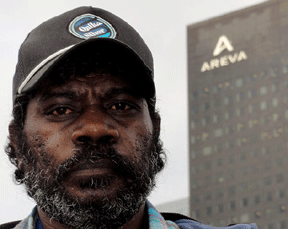 Australia: Koongarra is now permanently protected from uranium companies INTERCONTINENTAL CRY, BY JOHN AHNI SCHERTOW • MAR 18, 2013 The Australian government finally made good on its word. On 6 February, 2013, Environment Minister Tony Burke introduced the “Completion of Kakadu National Park (Koongarra Project Area Repeal) Bill” signalling an end to one of three long standing struggles against uranium mining within the Alligator Rivers Region of Australia’s Northern Territory.
Just a few short days ago, Australia’s senate passed the Bill, ensuring once and for all that Koongarra is permanently protected.
“This is a great day for me, my country and my culture. My mind is at peace now that I know that there will be no mining at Koongarra and that Djok lands will be protected forever in Kakadu National Park,” said Jeffrey Lee, Djok Senior Traditional Owner and the Custodian of Koongarra, in a written statement. Continue reading
Inclusion of Koongarra the first step towards a non uranium mining Kakadu National Park
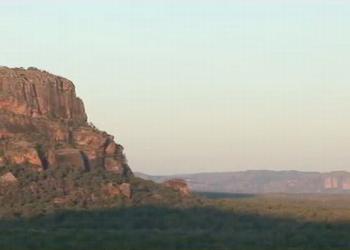 Koongarra’s inclusion welcome, but Kakadu remains incomplete. 14 March, 2013. The Greens today welcomed the inclusion of the Koongarra mineral lease in Kakadu National Park, but said Kakadu would remain incomplete until the Jabiluka and Ranger mineral leases are returned.
Greens Senator Scott Ludlam praised the efforts of Traditional Owner Jeffrey Lee, who had been in the public gallery when the Bill was introduced in early February.
“When Mr Lee came to Canberra a few weeks ago to witness this Bill being introduced, he said ‘Money comes and goes but the land is always here… If we look after it, it will look after us.’ …It’s difficult to comprehend the pressure Mr Lee withstood so we could get to this point, but I want to pay tribute to this fine and courageous man, a softly spoken and gentle man, who stood up to some of the most powerful interests on earth, and won,” Senator Ludlam told the Senate. Continue reading
A win win situation – carbon economy enables conservation, with early fire practices in Australia’s Northern Territory
There is little doubt that the new carbon economy is transforming fire and biodiversity management across northern Australia. Many areas managed for biodiversity conservation can now generate a substantial income beyond the public purse. This will surely allow the further privatisation of biodiversity conservation, at a time when non-government organisations are already playing an increasingly central, and indeed successful, role in conservation in northern Australia.
Implementing biodiversity-friendly fire regimes remains an enormous management challenge in the north. Although the carbon economy is unlikely to be a panacea, it certainly provides a much-needed income stream for sustainable land management, especially for the vast lands outside of the traditional conservation estate.
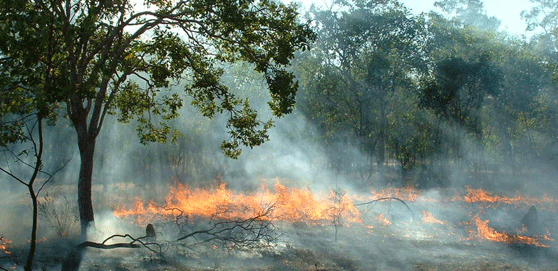
 Savanna burning: carbon pays for conservation in northern Australia http://theconversation.edu.au/savanna-burning-carbon-pays-for-conservation-in-northern-australia-12185 22 Feb 13, Fire and biodiversity have a complex relationship in northern Australia. Tim Flannery and others blame the current northern biodiversity crisis, at least in part, on changed fire regimes. Improving fire management is critical to conserving savanna landscapes – but who pays for it? A new funding model, tapping into the carbon economy, has emerged in the far north and is rapidly transforming fire management and biodiversity conservation.
A new funding model for fire management
The idea that land management could be funded by carbon credits emerged from Aboriginal-owned Arnhem Land in the Northern Territory. By the 1990s it was clear that the region’s enormous biodiversity values were being eroded by frequent, intense late dry season fires.
To address this problem, a trailblazing group of Western scientists and land managers, and Aboriginal Traditional Owners developed a program of prescribed burning early in the dry season to pre-empt large, intense wildfires late in the dry season.
The most innovative part of their work was to link improvements in fire management to reductions in greenhouse gas emissions. They also realised that this emissions reduction (or abatement) could be used to secure resources for land management. The abatement occurs because early dry season fires tend to be patchier and less intense than late season fires, and therefore burn less fuel. Because less fuel is burnt, fewer emissions are produced.
The project that resulted from this early work – the 28,000 km²West Arnhem Land Fire Abatement project – has operated since 2005 and is funded by one of the world’s largest energy companies, ConocoPhillips. They provide $1 million annually in return for an abatement of greenhouse gases equivalent to 100,000 t of CO₂. Continue reading
Something Australia can be proud of – beautiful Koongarra preserved from uranium mining
Australia Places Aboriginal Land in Park to Bar Uranium Mining http://ens-newswire.com/2013/02/07/australia-places-aboriginal-land-in-park-to-bar-uranium-mining/ CANBERRA, Australia, February 7, 2013 – After 34 years of campaigning to keep uranium mining out of his ancestral land of Koongarra, Djok Senior Traditional Owner Jeffrey Lee sat in the House of Representatives Wednesday to watch this land be protected forever.
Environment Minister Tony Burke introduced a bill to repeal the Koongarra Project Area Act – a 1979 law excluding Koongarra from the original boundaries of Kakadu National Park because of its potential to be the site for a uranium mine.
“In 2010, the Government promised Mr. Lee that we would incorporate Koongarra into Kakadu National Park, to ensure that the threat of mining was banished forever,” Burke said. Koongarra is an area of native woodland of great environmental and cultural significance, now incorporated within the boundaries of Kakadu National Park. Kakadu is located within the Alligator Rivers Region of the Northern Territory of Australia, 171 kilometers southeast of the territorial capital, Darwin.
The Koongarra uranium deposit is estimated at about 14,000 tonnes. Mining companies, most recently the French company AREVA, have been trying to mine the deposit for decades despite the opposition of traditional owners. Continue reading
1 This month
17 October, Free Public Talk on Nuclear Issues in South Australia
David Noonan will speak on public interest concerns over the new Roxby Downs Indenture Act 2026 on BHP copper-uranium mining and ore processing in SA, and on how AUKUS may face SA with a High-Level nuclear waste agenda.
Dr Jim Green will discuss international developments in the field of nuclear power including ‘small modular reactors’ and Generation 4 ‘advanced’ nuclear reactor concepts.


Help Aunty Sue Protect Her Land and Sacred Sites From Destructive Rocket Testing.
.

Australians deserve the truth
about
AUKUS – https://aukuspublicinquiry.com/

PETITION – To: Prime Minister Anthony Albanese and the Australian Labor Government

of the week – Australians for War Powers Reform (AWPR)
To see nuclear-related stories in greater depth and intensity

