Western Australia governs on behalf of mining companies. as Kimberley’s natural wonderland is threatened
 over the past weeks, the WA Premier Colin Barnett has sent hundreds of police to the once placid town to protect the interests of the mining company Woodside, ….
Is this the way we conduct business in Australia in 2012? The WA Premier has effectively sent his own army to Broome at a cost of over $1 million to Australian tax payers in order to protect the interests of one of our largest mining companies….
Kimberley under threat from mining boom, The Drum, Wade Freeman, 11 June 12 “……. one of the world’s most untouched and iconic regions was granted National Heritage protection last August. Australia’s beautiful Kimberley, which stretches all the way from Broome, north up around the Buccaneer Archipelago, and east as far as the NT border – was declared of great national significance due to its cultural and environmental values to the nation.. Continue reading
Uranium mining will leave Western Australian tax-payers with virtually permanent toxic pollution
Preventing tailings contamination even after a uranium mine has closed has proved impossible in every uranium mine in Australia to date there is no former Australian uranium mine that has been rehabilitated successfully — all are still radioactive no-go zones because of radionuclide dispersal from waste stockpiles and water seepage. We will be fooling ourselves if we think that “best practice” regulation can somehow contain tens of millions of tonnes of finely powdered carcinogenic wastes for thousands of years.
 Uranium mine tailings leave an enduring toxic legacy http://au.news.yahoo.com/thewest/opinion/post/-/blog/13904615/uranium-mine-tailings-leave-an-enduring-toxic-legacy/ Alison Xamon , June 8, 2012, The Environmental Protection Authority’s approval of a uranium mine in Wiluna should concern all West Australians. This is no longer a theoretical discussion. Research shows a serious risk that uranium mining will cause long-term harm to WA communities. Uranium mining has caused a string of accidents across Australia and has proved impossible to regulate appropriately.
Yet the highly radioactive waste produced by uranium mines — known as uranium mine tailings — remain radioactive for thousands of years. The State Government has given a commitment to seek to regulate uranium mining through “world’s best practice”, including isolating uranium tailings for at least 10,000 years. This is a worthy commitment but it is unclear how it will be achieved, especially when it is apparent that no uranium site in Australia has successfully accomplished this for even 10 years.
The best regulations will not stop chronic radioactive waste seepage. Preventing tailings contamination even after a uranium mine has closed has proved impossible in every uranium mine in Australia to date, Continue reading
Call for moratorium on industrial development at Point Lowly, to save Giant Cuttlefish from extinction
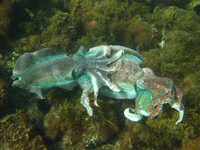 CUTTLEFISH numbers at a key breeding ground in Spencer Gulf have plummeted, the Greens say.http://www.adelaidenow.com.au/news/south-australia/cuttle-fish-numbers-plummet-at-point-lowy-say-australian-greens/story-e6frea83-1226389582466 Greens state MP Mark Parnell said local divers at the Point Lowly site
have reported a huge drop in numbers during the current breeding season.
“This annual marine breeding spectacle is of worldwide significance, not to mention how important it is for the local tourism industry,” Mr Parnell said in a statement on Friday. He said the state government must conduct an immediate investigation
to determine the cause of the slump in numbers. “First step is commissioning some urgent research by marine scientists
to find out exactly what is going on,” he said.
“Next is a moratorium on all industrial development at Point Lowly until the cause of the decline is discovered.” Mr Parnell said the annual breeding of the giant Australian cuttlefish at Point Lowly is the world’s only known mass cuttlefish spawning
event. “The permanent loss of this annual breeding event would be devastating,” he said.
Australia’s clean, non nuclear, soil giving hope to Japanese farmers
Japan farmer harvests hope in our soil, BY: SUE NEALES The Australian May 23, 2012 JAPANESE farmer Takemi Shirado still sounds grief-stricken and shell-shocked when talking about last year’s Fukushima nuclear disaster that so devastated his rural community.
Catastrophic radiation contamination of the soil means his family won’t be able to sow rice on their Iwaki rice paddies, about 60km from the crippled defunct power plant, for at least 300 years. Other local farmers are starting to grow leafy vegetables on less-contaminated fields, but are finding consumers too scared to buy their risky produce.
But Mr Shirado is clearly not a man to moan and mope. Instead he has come to Australia as head of a consortium of Fukushima farmers to see if north Queensland’s fertile Burdekin valley might hold the solution to his prefecture’s long-term fallout-affected food problems.
Mr Shirado’s dream now is to turn the sugarcane fields around Ayr into fertile flooded rice paddies growing Japanese rice varieties in traditional organic ways, to supply the people of his ruined home prefecture once again with their staple food…… “So far this looks like being a very good area for growing rice; I think we can grow four crops a year here and the water is very pure too.”……http://www.theaustralian.com.au/news/nation/japan-farmer-harvests-hope-in-our-soil/story-e6frg6nf-1226363955828
Western Australia’s inadequate laws on uranium tailings
WA’s uranium tailings laws fall short: independent review, SMH, May 14, 2012 Western Australia needs to completely revise its ageing laws governing the storage of uranium tailings and update its regulations to allow greater transparency of the uranium approvals process, an independent review into the state’s uranium regulations has found.
The review comes as Toro Energy braces for final approvals to mine uranium in the Northern Goldfields, after the WA Government removed the state’s ban on uranium mining in 2009. The Uranium Advisory Group led by University of Western Australia and CSIRO researchers, made nine recommendations to the Department of Mines and Petroleum targeted at ensuring more transparent and safer guidelines for the fledgling industry in a report…….
http://www.watoday.com.au/wa-news/was-uranium-tailings-laws-fall-short-independent-review-20120514-1ymqu.html#ixzz1v5miLFpI
Australia does a poor job, (no job?) of monitoring radiation levels
Less Than 1% Of Base Stations In Australia Have Been Radiation Tested LOGAN BOOKERGIZMODO AU MAY16, 2012 For something that has been a massive source of concern for general public for decades, it doesn’t appear the Australian Radiation Protection and Nuclear Safety Agency (ARPANSA), responsible for “protecting the health and safety of people … from the harmful effects of ionising and non-ionising radiation”, is in much of a hurry to allay anyone’s fears…..
The Australian reported the news earlier this week and managed to get a follow-up from ARPANSA yesterday , which said it’s organising a “panel of experts” to help it review the body of new information on mobile radiation published in the last 10 or so years.
The Australian’s beef seems to be with the fact that Australia’s limits, while in line with those of the European Union, are much, much more generous than those of Russia, Switzerland and Belgium. …. http://www.gizmodo.com.au/2012/05/less-than-one-percent-of-base-stations-in-australia-have-been-radiation-tested/
Mega Uranium’s Ben Lomond project, dangers to water supply, and Bob Katter
Jim Green, 14 May 12, The Ben Lomond uranium (and molybdenum) deposit is located 50 kms west of Townsville. It is owned by Mega Uranium, which purchased it in 2005
As at May 2012, Mega Uranium was undertaking prefeasibility studies with a view to determining the project economics, the preferred mining and processing options and the key steps in mine development. The recently-elected Liberal National Party state government has thus far maintained previous government policy of banning uranium mining, but Mega Uranium is betting on a change of policy.
Far-right pro-uranium federal MP Bob Katter had this to say in Parliament on 1 November 2005:
“ there is a limit to the dangers we will accept. In the case of Ben Lomond, the company said that there had been no spill. The government agency—the forebears of what we now call the Environmental Protection Agency—also said that there had been no spill. That was for the first three or four weeks. When further evidence was disclosed, they said, firstly, that there had been a spill but the level of radiation was not dangerous and, secondly, that it had not reached the water system from which 210,000 people drank.
For the next two or three weeks they held out with that story. Further evidence was produced in which they admitted that it had been a dangerous level. Yes, it was about 10,000 times higher than what the health agencies in Australia regarded as an acceptable level. After six weeks, we got rid of lie number 2. I think it was at about week 8 or week 12 when, as a state member of parliament, I insisted upon going up to the site. Just before I went up to the site, the company admitted—remember, it was not just the company but also the agency set up by the government to protect us who were telling lies—that the spill had reached the creek which ran into the Burdekin River, which provided the drinking water for 210,000 people. We had been told three sets of lies over a period of three months.
So I say to the people of the Northern Territory: make sure that ordinary people have some sort of oversighting mechanism. Do not leave it up to the government or its officials. They will dance to the tune played by whatever piper is in charge money-wise or politically. They will not answer to the tune of protecting the people. That has been my experience.”
Radioactivity over Sunshine Coast likely to have come from Lucas Heights Nuclear Facility
In a long article, Paul Langley traces the history of nuclear radiation releases and coverups. Marcus Grezechnik of Australian Radiation Protection and Nuclear Safety Agency (ARPANSA) was reassuring, and vague about the origin of this radiation But – this same Marcus Grezechnik is one of the authors of the only research study done on radioactive clouds in Austtralia. That study of radioactivity in the atmosphere above Melbourne, in 2008 and 2009 found that the source was the Lucas Heights nuclear facility, in Sydney. – Christina Macpherson
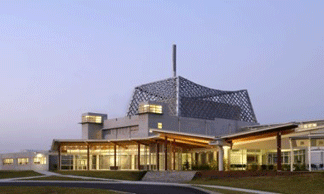 That cloud of reactor gas reported off the Sunshine Coast – Not Fukushima. It’s Lucas Heights, Paul Langley’s Nuclear History Blog, 14 Jan 2012,
Quote: “Evaluation of radioxenon releases in Australia using atmospheric dispersion modelling tools.
The origin of a series of atmospheric radioxenon events detected at the Comprehensive Test Ban Treaty Organisation (CTBTO) International Monitoring System site in Melbourne, Australia, between November 2008 and February 2009 was investigated. Backward tracking analyses indicated that the events were consistent with releases associated with hot commission testing of the Australian Nuclear Science Technology Organisation (ANSTO) radiopharmaceutical production facility in Sydney, Australia. Forward dispersion analyses were used to estimate release magnitudes and transport times. The estimated (133)Xe release magnitude of the largest event (between 0.2 and 34 TBq over a 2 d window), was in close agreement with the stack emission releases estimated by the facility for this time period (between 0.5 and 2 TBq). Modelling of irradiation conditions and theoretical radioxenon emission rates were undertaken and provided further evidence that the Melbourne detections originated from this radiopharmaceutical production facility. These findings do not have public health implications. This is the first comprehensive study of atmospheric radioxenon measurements and releases in Australia. Crown Copyright (c) 2010. Published by Elsevier Ltd. All rights reserved.
Rick Tinker, Blake Orr, Marcus Grzechnik, Emmy Hoffmann, Paul Saey, Stephen Solomon. Evaluation of radioxenon releases in Australia using atmospheric dispersion modelling tools. Journal of environmental radioactivity. 2010 May;101(5): 353-61 ” end quote.
Australian Radiation Protection and Nuclear Safety Agency, 619 Lower Plenty Road, Yallambie, Victoria, Melbourne 3085, Australia. rick.tinker@arpansa.gov.au
Journal of environmental radioactivity 2010 May http://www.nextbio.com/b/search/article.nb?id=20346548
Mysterious radioactive cloud detected by Geiger counter over Sunshine Coast
 Radiation cloud ‘not harmful’ , Sunshine Coast Daily, Kate Clifford | 14th January 2012 A RADIOACTIVE cloud lingering off the Sunshine Coast on Sunday was not dangerous, according to the Australian Radiation Protection and Nuclear Safety Agency.
Caloundra IT manager Peter Daley picked up the cloud’s radioactivity on his Geiger counter, a device that measures ionizing radiation in the atmosphere. The reading was taken at 6.30pm and measured 0.80 microsieverts, which is eight times over the average level of radiation in the atmosphere.
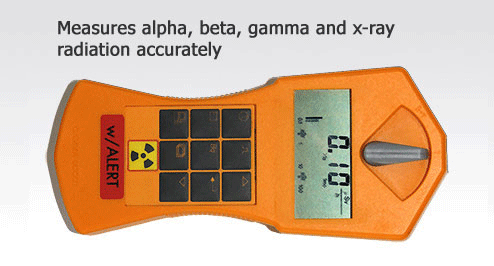
Mr Daley said he was concerned the cloud could have formed from a radioactive fall out from the Fukushima nuclear disaster in Japan. “This may be just a one off but even still, any exposure to an increase in radiation is not good,” Mr Daley said. He first noticed the hike when his Geiger counter began erratically beeping.
He then watched the rise in radiation fluctuate for three hours, peaking for 20 minutes at 0.80. “I was shocked to hear the Geiger alarm going off, I have been recording radiation in the atmosphere for four years and the highest it has ever gone was 0.20 microsieverts.”
Australian Radiation Protection and Nuclear Safety Agency senior environmental scientist Marcus Grezechnik said the reading was unusualbut not concerning for the Coast…..
http://www.sunshinecoastdaily.com.au/story/2012/01/14/radiation-cloud-not-harmful-sunshine-coast/
Australia participating in 23 States monitoring radiation in Pacific Ocean
Considerable volumes of radioactive contaminated water entered and
polluted the Pacific Ocean following the March 11 Nuclear accident. It
raised concern among countries in the Pacific region that radiation
releases may reach and damage coastal zones with possible consequences
for communities and economies.
IAEA Project To Monitor Radioactive Substances In Pacific Ocean Region (RTTNews) 13 Dec 11 – The International Atomic Energy Agency (IAEA) is implementing a Technical Cooperation (TC) Project for countries
throughout the Pacific Ocean region to monitor radioactive substances in the marine environment in the wake of the release of radioactive particles into the Pacific from the tsunami-wrecked Fukushima Daiichi Nuclear Power Plant in Japan. Continue reading
Secretive and inadequate plan for Toro Energy’s uranium mining project at Wiluna, Western Australia
 Toro Energy acknowledges that it has not fully verified the accuracy or completeness of its own application, and does not accept responsibility or liability for its application.….A mining agreement with Traditional Owners has not yet been negotiated…Uranium mining and tailings disposal in this region would occur below the water-table and be connected to aquatic ecosystems. There is a risk of contaminating the aquatic ecosystems….The mine rehabilitation plans are incomplete and Toro Energy’s preliminary costing for rehabilitation is being kept secret.
 Submission to the Environmental Protection Authority of Western Australia on behalf of the Conservation Council of WA, the Australian Conservation Foundation, the Wilderness Society and the Anti Nuclear Alliance of WA. This submission was prepared with the help and advice from Dr Jim Green, Dr Gavin Mudd and Dr Nic Dunlop.
re: Toro Energy Ltd Wiluna uranium project Environmental Review and Management Programme (ERMP) Wiluna ERMP Submission_Final.doc
Australian uranium mines have a history of leaks, safety breaches and failed rehabilitation. Accordingly a 2004 report by a Senate References and Legislation Committee found “a pattern of under-performance and non-compliance” in the uranium mining industry and identified many gaps in knowledge. To date, not a single uranium mine in Australia has been rehabilitated to the point that radiological conditions are stable and ongoing monitoring is no longer required.
The history of the wider mining sector in WA has also been problematic as detailed in a recent Auditor General’s report . Continue reading
Few Australians aware of the environmental disaster that will be Olympic Dam uranium mine
 The project was vigorously opposed from the start by both the local Arabunna and Kokatha peoples …..
The mining operations are expected to produce 8 million litres of radioactive tailings every day – which will eventually leach into local aquifers – and will create 9 billion tons of radioactive waste that will need to be monitored for the next 10,000 years,
Virtually every adult Australian citizen was aware of the “carbon tax” …Very few, however, were aware that at much the same time, a project had been set into motion that made a complete mockery of any pretensions to act in a an environmentally responsible manner.
Learning To Shine Through The Ruins, By Vincent Di Stefano, 30 October, 2011,Countercurrents.org “…….Despite the fact that the Chernobyl melt-down 25 years ago has already cost nearly a million lives , and despite the fact that hot Strontium from the damaged Fukushima nuclear plant has been detected on the rooftops of houses in Yokohama 250 kilometers away, the nuclear industry, together with its marketing arm, the International Atomic Energy Commission continues to aggressively pursue their deadly interests.
On October 10th 2011 , both the Australian Federal Government and the South Australian Government obligingly rubber-stamped a massive industrial development at the Olympic Dam mine complex at Roxby Downs in South Australia that will, over the next 10 years, see an additional 19,000 tons of uranium oxide (yellow cake) produced annually for export every year. Australia already exports over 10,000 tons of yellow cake every year.
This mammoth project will result in the creation of the world’s largest open-pit mining operation. Continue reading
BHP Billiton’s proposed desalination plant to exterminate Australia’s iconic Giant Cuttlefish?
Save the Giant Australian Cuttlefish and Upper Spencer Gulf The Point Lowly Peninsula is the only known place in the world where hundreds of thousands of Giant Australian Cuttlefish gather to breed. We need your help to urge the State Government of South Australia to protect this wildlife phenomenon from proposed industrial impacts.
Other fish species also spawn in the area including Snapper, Western King Prawns, Squid, Eagle Rays and Port Jackson Sharks. The Upper Spencer Gulf ecosystem also supports resident dolphin pods plus visiting whales, endangered sealions and turtles.
A desalination plant is currently proposed for the Point Lowly Peninsula. If approved, its operation will release salty brine into this sensitive ecosystem. Scientific studies have shown that increased salinity kills cuttlefish and squid eggs.
The Giant Australian Cuttlefish and Upper Spencer Gulf fish nurseries need your help. Sign and share our petition and urge our State Premier to insist on relocating the proposed desalination plant to a less vulnerable area. http://www.thepetitionsite.com/7/save-the-giant-australian-cuttlefish-upper-spencer-gulf/
Olympic Dam an unprecedented attack on Australia’s environment
BHP Billiton’s Olympic Dam mine expansion will leave an uprecedented environmental legacy THE AUSTRALIAN, BY:PAUL CLEARY October 11, 2011 FUTURE generations of Australians will have to contend with an unprecedented environmental legacy from the expansion of Olympic Dam’s copper-uranium mine, but our system provides no way of compensating them.
BHP Billiton’s open-cut expansion of mining to extract an estimated $800 billion in mineral wealth will leave behind an above-ground heap of radioactive tailings spread over 44sq km and as high as the Sydney Opera House.
After 40 years of production, the mine will also leave behind a toxic crater measuring 4km wide and more than 1km deep.
Both legacies pose significant risks to ground water, according to BHP’s environmental impact statement . . . although these were dismissed yesterday by Environment Minister Tony Burke.
Under Australia’s federal-state system, the South Australian government has no incentive to set up a future fund so that it can compensate future residents for having to live with much less mineral wealth, and with the environmental costs of this development. Nor has the federal government or opposition shown any interest in measures to compensate our grandkids, and their descendants, for having used our inherited mineral wealth to inflate our standard of living….. the mineral resources rent tax won’t collect any of the above-normal profits earned from developing one of the world’s biggest ore deposits, because it only taxes coal and iron ore production. http://www.theaustralian.com.au/business/opinion/counting-the-cost-of-bhps-olympic-dam/story-e6frg9if-1226163362958
Radioactive birds may arrive in Tasmania in seasonal migration
 Mutton bird radiation warning, ABC News, September 30, 2011 Tasmanians are being warned not to collect dead mutton birds for research. A recent Tasmanian Farmers and Graziers Association newsletter describes research into mutton bird exposure to radiation from Japan’s Fukushima nuclear plant. It says the birds will soon be migrating back to Australia after many spent winter in the Sea of Japan.
The article says people can help researchers by collecting freshly dead mutton birds, freezing them and handing them over to their local Parks and Wildlife office or museum. But the department says it is not seeking samples and discourages people unfamiliar with wildlife from collecting them. A spokeswoman says suggestions of radiation exposure in birds is being further investigated. http://www.abc.net.au/news/2011-09-30/20110930-muttonbird-radiation-warning/3193736?section=tas
1 This month
17 October, Free Public Talk on Nuclear Issues in South Australia
David Noonan will speak on public interest concerns over the new Roxby Downs Indenture Act 2026 on BHP copper-uranium mining and ore processing in SA, and on how AUKUS may face SA with a High-Level nuclear waste agenda.
Dr Jim Green will discuss international developments in the field of nuclear power including ‘small modular reactors’ and Generation 4 ‘advanced’ nuclear reactor concepts.


Help Aunty Sue Protect Her Land and Sacred Sites From Destructive Rocket Testing.
.

Australians deserve the truth
about
AUKUS – https://aukuspublicinquiry.com/

PETITION – To: Prime Minister Anthony Albanese and the Australian Labor Government

of the week – Australians for War Powers Reform (AWPR)
To see nuclear-related stories in greater depth and intensity

