Radioactive dust storms from uranium mine will threaten Australia’s cities
Dust storm envelopes Coober Pedy, South Australia – September 27 11, Christina Macpherson Dust storms can travel thousands of km, from South Australia – the Olympic Dam uranium mine area, to three capital cities, and even to New Zealand.

These winds travelled similarly to the 2009 Red Dust storm and went across to NSW and through Victoria. Coober Pedy is just East of Emu Field.
Weather forecast was : A vigorous front moving across South Australia 28 September 2011, with west to southwest winds averaging 60-km/h with damaging wind gusts in excess of 80 km/h
RED DUST STORM TWO YEARS AGO to the week was: Forecast September 2009 A vigorous front moving across South Australia 22-25 September [2009], with west to southwest winds averaging 60-70 km/h with damaging wind gusts in excess of 90 km/h.
This time around, Australia’s capital cities have been lucky. Not like two years ago, when dust covered dozens of towns and cities in three states, affecting Adelaide , Melbourne and blanketing Sydney. The dust from the Olympic Dam region might have carried radioactivity – the uranium mine then , and now,  an underground mine.
But what happens when Olympic Dam uranium mine becomes the world’s biggest open cut mine?
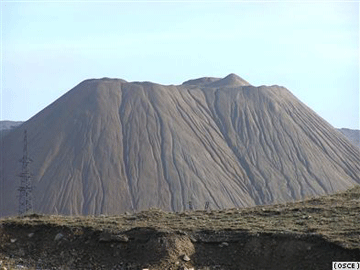
Similar wind storms will happen. But then the winds will be carrying the radioactive dust from BHP Billiton’s massive mountain of tailings. The waste rockpile (overburden) will be an enormous mountain on the landscape, 150 metres high and up to 8 kilometres wide.
BHP Billiton themselves admit – or is it boast ? – that this giant mine will alter the region’s weather patterns – to such an extent that aircraft flight paths will have to be changed.
Wake up, city-dwelling Australians – the radioactive threat of Olympic Dam means that Coober Pedy’s dust storms will concern you, too
Research to benefit the Giant Cuttlefish, or the Giant Non Australian BHP Billiton?
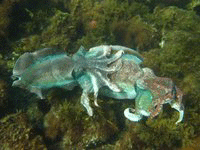 In South Australia, a Flinders University team is doing the USA’s bidding, as Professor Pam Sykes pushes U.S. funded research into making low level ionising radiation look good.
Now we have another research team in South Australia,, funded by Australian governments, investigating the giant cuttlefish. We must wonder to what extent this research is geared at truly studying this unique and beautiful animal, and its specialised habitat. This is a species that will be lost to the world, made extinct by a change in the salt/freshwater balance in the upper Spencer Gulf.
The proposed desalinationn plant – needed for BHP Billiton’s expansion of Olympic Damn uranium mine – would make that change, and make that extinction of an iconic Australian species.
Will the new research study really lead to the protection of the giant cuttlefish, or the protection of the giant Non Australia – BHP Billiton? – Christina Macpherson
Federal and state funds for cuttlefish research, ABC News, September 15, 2011 Research into giant cuttlefish in South Australia’s upper Spencer Gulf will receive $105,000 in federal and state funding.
SA Fisheries Minister Michael O’Brien says a monitoring and evaluation program will look at population biomass, water quality and habitat. There has been some recent concern that fewer cuttlefish are in the upper Gulf.
Concern also has been expressed about the possible effects of discharge if a desalination plant is built in the area. http://www.abc.net.au/news/2011-09-15/giant-cuttlefish-research-funding/2900668
Why Toro’s uranium mining plan at Wiluna should be stopped
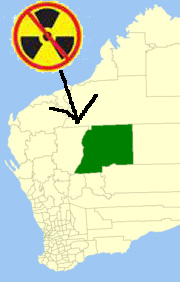 Key concerns with Toro’s plan to mine uranium at Wiluna,
by Mia Pepper and Jim Green, 9 sept 11,
* Traditional Owners are opposed to the construction of a uranium mine at
the significant sacred site of Lake Way. Toro has not completed
Archeological and Ethnographic studies and does not already have a
comprehensive Aboriginal Heritage Management Plan.
* Uranium exported from Wiluna will at best end up as high-level nuclear
waste. At worst it will end up as fissile (explosive) material in nuclear
weapons, or in a nuclear disaster such as that unfolding in Fukushima,
Japan.
* Toro does not accept responsibility for its own application, stating
that it has “not fully verified the accuracy or completeness” of its
application.
* Lake Way is home to a unique population of Stygofauna − a
newly-discovered species of subterranean crustaceans.
* Toro has not factored in recent advice from the International Commission
on Radiological Protection that radon is twice as carcinogenic as
previously thought.
* Transport plans are presented as a “preliminary draft” and the company
plans to transport its toxic, radioactive product over many thousands of
kilometres, from Wiluna to Adelaide and Darwin.
* Uranium mining and tailings disposal in this region will occur below the
water-table and will be connected to aquatic ecosystems. There is a
significant risk of contaminating the aquatic ecosystems with changes in
water chemistry, including the mobilisation of radioactive compounds.
* The legal requirement for tailings management at the Ranger uranium mine
in the NT is effective isolation for at least 10,000 years. The minimum
standard should be the same for Wiluna.
* There has not been a calcrete uranium deposit mined in Australia and
there is only one calcrete deposit presently being mined worldwide. There
is a lack of expertise and experience in engineering and mine design for
these deposits.
* Wiluna has a number of operating mines close to town and in the region.
Despite current mining activity, Wiluna still suffers from extreme
poverty, homelessness, unemployment, violence and other social problems.
Lynas Rare Earths plant to be highlighted in documentary on ionising radiation
 Japanese filmmaker to highlight Lynas controversy, Free Malaysia Today, G Vinod, September 6, 2011“….A foreign documentary on the nuclear meltdown in Japan will also highlight the controversy over the Lynas rare earth refinery in Malaysia.
PETALING JAYA: A Japanese filmmaker plans to include the Lynas rare earth controversy in his upcoming documentary on nuclear radiation which is scheduled to be released in October 2011.The filmmaker, Shunji Iwai, decided to highlight the plight of the people in Gebeng, Pahang after hearing about the matter from his Malaysian counterpart, Tan Chui Mui.
Lynas Corporation Ltd plans to build a RM700 million rare earth refinery in Gebeng, to facilitate transportation of its mining products from Western Australia’s Mount Weld to the plant in Gebeng. The plant is expected to be operational by end of this year.
However, the community in Gebeng are up in arms against the project fearing radioactive contamination in the area surrounding the plant. Although the International Atomic Energy Agency (IAEA) had said the mine would be safe, Kuantan MP Fuziah Salleh dismissed its report, saying that most of the findings were made based on data given by Lynas itself…….
Tan herself would be directing a few parody educational video called “Survival Guide in Radioactive Village” to create awareness among the public on the Lynas scare. The documentary is scheduled for release in October for the Japanese market. It will subsequently be released to the global audience via the Internet…http://www.freemalaysiatoday.com/2011/09/06/japanese-filmmaker-to-highlight-lynas-controversy/.
Call to stop transport of radioactive rare earths through Fremantle
 Carles moves to ban rare earth ores in Freo – The West Australian, 5 Sept 11,Fremantle MP Adele Carles has called for the transportation of rare earth ores through Fremantle to be halted immediately because she is concerned about potential radioactivity.In a position that puts her at odds with her partner, Transport Minister Troy Buswell, and the State Government, the independent MP has claimed the rare earths, which are mined by Lynas Corporation at Mt Weld near Laverton, could be a hazard to public health and safety…..
The term “rare earths” refers to a range of metallic elements that are used in a range of modern products including high-powered magnets for wind turbines, electric hybrid vehicles, computer hard discs, smartphones and flat panel displays.
The ore contains thorium and uranium oxides, albeit at levels regulators say do not pose a radiation risk…..
Ms Carles said she was concerned Lynas’ proposal “looks like the Magellan experiment all over again”, referring to the problems Magellan Metals has had in complying with its environmental management plan to export lead carbonate through Fremantle……
Ms Carles yesterday hosted protestors from Malaysia, who are opposed to Lynas building a processing plant in Kuantan, the capital of Malaysia’s Pahang state. The protestors are concerned that the strategically important plant – the only rare earths processing facility outside China – could leave the area a toxic site…..Carles moves to ban rare earth ores in Freo – The West Australian
Australian federal government abdicating its role in environmental protection?
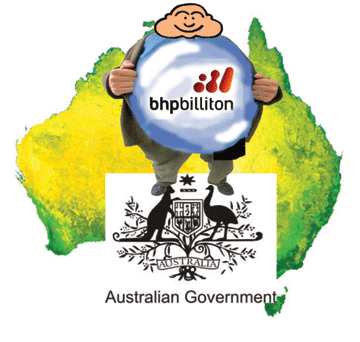 States get a bigger say on the environment, The Age, Tom Arup, August 25, 2011, THE Gillard government has rolled out a business-friendly overhaul of national environment laws, boosting the states’ role in approving or rejecting controversial new projects like pulp mills and mines…….
Under the reforms the Commonwealth will seek deals with the states that would mean most projects would need either state or federal environmental approval, not both….
Australian National University environmental legal expert Andrew Macintosh said yesterday the proposal had to ensure adequate protection of national environmental assets and ”leave an opening for the Commonwealth to intervene where the national interest is threatened by parochial state interests”.
The Australian Conservation Foundation’s Dr Paul Sinclair said delegating power to the states to approve projects would be a backwards step, adding “if business wants a one-stop shop, it must be a federal shop”..….
opposition environment spokesman Greg Hunt. Mr Hunt yesterday welcomed the proposed reforms and said the Coalition was broadly supportive.
Greens environment spokeswoman Larissa Waters said she was disappointed the reforms did not include measures to consider a project’s carbon emissions and impact of water resources…http://www.theage.com.au/national/states-get-a-bigger-say-on-the-environment-20110824-1ja8n.html
South Australia to ban uranium mining in Arkaroola Wilderness Sanctuary
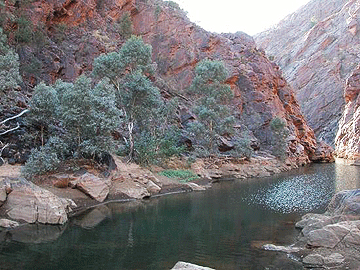 Premier Mike Rann announces permanent protection for Arkaroola Wilderness Sanctuary, Herald Sun, By Greg Kelton and Sarah Martin , July 22, 2011 ARKAROOLA will be protected for all time from mining, South Australia Premier Mike Rann has announced during a visit to the wilderness sanctuary. Continue reading
Time that Australian govts stepped in to protect Kakadu from ERA’s dangerous uranium mining plans
little wonder that Ranger has been hammered by the market and described as Rio Tinto’s ”major shame in this country”…. the cold hard fact remains that no modern uranium mine has ever undertaken large-scale acid heap leaching let alone in the monsoonal tropics surrounded by a renowned World-Heritage site…
The time has come for the Northern Territory regulator the Department of Resources and the Commonwealth adviser, the Office of the Supervising Scientist, to ensure that ERA and the Ranger site addresses the systemic failures in tailings and water management and ends the habit of unnecessary risk taking. .
 Need for greater mining rules to protect Kakadu, Canberra Times, BY GAVIN MUDD, 15 Jul, 2011 Plans to expand the Ranger uranium operations pose big dangers. Inside Australia’s largest national park lies one of the country’s most controversial mines. Earlier this year it came close to a serious failure that would have contaminated Kakadu, effectively forever. Now, instead of heeding the warning signs, it wants to expand. Continue reading
Koongarra now a World Heritage National Park – and not an Areva uranium mine
 Koongarra makes world heritage listing ABC News Jun 28, 2011 After more than 30 years, a uranium-rich piece of Aboriginal land near Kakadu National Park has been added to the World Heritage List. The 1,228-hectare site, known as Koongarra, was added to the register during a meeting of the UNESCO World Heritage Committee in Paris. The French nuclear energy company Areva, which owns mining licences in the area, had unsuccessfully asked the committee to remove Koongarra from its agenda.
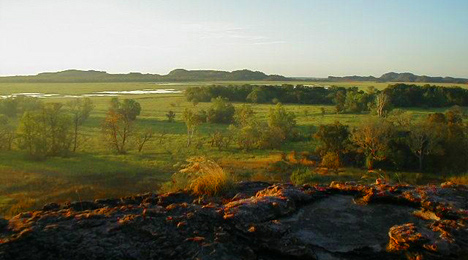
Koongarra is important Aboriginal land but was originally excluded from the park in 1979 because of its potential uranium resources.
Australian Conservation Foundation chief executive Don Henry says it is the end of a long fight to protect it from uranium mining. “Kakadu is beloved by many Australians,” he said. “This is right beside the famous Nourlangie Rock area and it’s a great tribute to Jeffrey Lee, the traditional owner who’s called for its protection to look after his own country, but it’s a great gift for all Australians.” Environment Minister Tony Burke welcomed the decision, saying it will help protect Koongarra for generations to come. There are some legal steps the Government will need to finalise before Koongarra is officially included as part of Kakadu National Park. It means the area will be fully protected under law and mining prohibited……http://www.abc.net.au/news/stories/2011/06/28/3255045.htm?site=news
Uranium mine expansion to damage marine life, leave huge radioactive wastes
 plans for the desalination plant would pose a major risk to local marine life……..”Under no circumstances should the governments
  involved in the assessment of the supplementary EIS approve of this desalination plant,”
it will dump more than two cubic kilometres of radioactive tailings over an area measuring up to 44 square kilometres,” Senator Ludlum said.
“The new open pit proposed will leak over eight million litres of radioactive liquids every day.”
OLympic Dam Mine Expansion ‘Staggering’ ninemsn news, 31 May 11 BHP Billiton’s proposed expansion at its Olympic Dam mine in South Australia would make it the biggest mine in the world. The figures involved are simply staggering……….the whole site, with its production and support facilities, will cover an area of about 30 square kilometres, a fair chunk of Adelaide’s metropolitan area…… Continue reading
BHP’s desalination plant a threat to Upper Spencer Gulf ecology
at left – the unique and beautiful Giant Cuttlefish faces extinction by the desalination plant
Green fears aired over Olympic Dam mine plans ABC News (Australian Broadcasting Corporation) May 20, 2011 Concerns have been raised about BHP Billiton’s plan to expand the Olympic Dam mine.A fishing group in Upper Spencer Gulf says BHP Billiton’s revised plans do not go far enough to protect the environment.In its revised environmental impact statement, BHP confirmed it will go ahead with a desalination plant at Point Lowly. BHP also plan to build an unloading facility to barge machinery further up the gulf.
Robin Sharp from the Coastal Homes Association says he is worried the region’s ecosystem will be in danger.”We’ve already got an invasive oyster up here that we believe has been introduced by shipping over the last 20 or 30 years, pretty much overrun the whole razorfish intertidal zone, so it will pretty much wipe out all the razorfish in this area,” Mr Sharp said.Green fears aired over Olympic Dam mine plans – ABC News (Australian Broadcasting Corporation)
Olympic Dam uranium mine waste pile – 6720 hectares,150 metres high
 BHP’s Olympic Dam uranium mining expansion “……In all it will remove a 350-metre thick layer of overburden and the rock taken out will be transported to a rock storage facility that covers 6720 hectares and will eventually be 150 metres high. By 2050, when the mine has not even completed half its life, the pit will be 4.1 kilometres long, 3.5 kilometres wide and one kilometre deep……” – Robert Gottliebson, Climate Spectator
BHP’s uranium mine project will create a mountain of radioactive wastes
“This EIS shows the company has designed Olympic Dam to leak up to eight million litres of liquid radioactive waste per day. BHP Billiton plans to dump radioactive tailings on the surface and leave them there forever, rather than pay to isolate the toxic waste from the environment
BHP Final EIS & ACF Call to account for Olympic Dam’s international impact -BHP Billiton has released a multi-phonebook-sized environmental impact statement to support its proposal to make Olympic Dam the world’s largest uranium project, but the EIS does not address the risks that go along with Australian uranium when it is used in nuclear reactors overseas.
The Australian Conservation Foundation has challenged the company to re-do its environmental assessment to take account of disasters like Fukushima. Continue reading
Australian government’s strange delay on environmental laws
”It is curious the government will take longer to respond to the review than it took a team of experts to investigate and write it.”..
Environment laws on hold, The Age Tom Arup, 1April 26, 2011, THE government will wait at least two years until it responds to a comprehensive review recommending a shake-up of national environment laws. Continue reading
End self-regulation of uranium mines: ERA can’t be trusted
The situation at Ranger added weight to his calls for an end to self-regulation of the Northern Territory’s resources sector.
“Mining companies have consistently shown they can’t be trusted to monitor themselves and the government needs to step in and end this ridiculous situation immediately.”
Uranium mine shutdown sparks environmental fears, Sydney Morning Herald, Lindsay Murdoch DarwinApril 19, 2011 THE largest Aboriginal organisation in northern Australia has warned the Rio Tinto-controlled company Energy Resources of Australia against cutting corners on environmental protection during an emergency shutdown of its Ranger uranium mine in Kakadu National Park. Continue reading
1 This month
17 October, Free Public Talk on Nuclear Issues in South Australia
David Noonan will speak on public interest concerns over the new Roxby Downs Indenture Act 2026 on BHP copper-uranium mining and ore processing in SA, and on how AUKUS may face SA with a High-Level nuclear waste agenda.
Dr Jim Green will discuss international developments in the field of nuclear power including ‘small modular reactors’ and Generation 4 ‘advanced’ nuclear reactor concepts.


Help Aunty Sue Protect Her Land and Sacred Sites From Destructive Rocket Testing.
.

Australians deserve the truth
about
AUKUS – https://aukuspublicinquiry.com/

PETITION – To: Prime Minister Anthony Albanese and the Australian Labor Government

of the week – Australians for War Powers Reform (AWPR)
To see nuclear-related stories in greater depth and intensity

