Australian government to blame for failure of environment laws
 Let there be no doubt: blame for our failing environment laws lies squarely at the feet of government, The Conversation June 29, 2020 Peter BurnettHonorary Associate Professor, ANU College of Law, Australian National University A long-awaited draft review of federal environment laws is due this week. There’s a lot riding on it – particularly in light of recent events that suggest the laws are in crisis.
Late last week, the federal Auditor-General Grant Hehir tabled a damning report on federal authorities’ handling of the Environment Protection and Biodiversity Conservation (EPBC) Act. Incredibly, he found Australia’s premier environmental law is administered neither efficiently or effectively.
It followed news last month that mining company Rio Tinto detonated the 46,000 year old Juukan rock shelters in the Pilbara. The decision was authorised by a 50 year old Western Australian law –and the federal government failed to invoke emergency powers to stop it.
Also last month we learned state-owned Victorian logging company VicForests unlawfully logged 26 forest coupes, home to the critically endangered Leadbeater’s possum. The acts were contrary both to its own code of practice, and the agreement exempting VicForests from federal laws.
As relentless as Hehir’s criticisms of the department are, let there be no doubt that blame lies squarely at the feet of government. As a society, we must decide what values we want to protect, count the financial cost, then make sure governments deliver on that protection.
Shocking report card
I’ve been involved with this Act since before it began 20 years ago. As an ACT environment official reading a draft in 1998 I was fascinated by its complexity and sweeping potential. As a federal official responsible for administering, then reforming, the Act from 2007-2012, I encountered some of the issues identified by the audit, in milder form.
But I was still shocked by Hehir’s report. It’s so comprehensively scathing that the department barely took a trick.
Overall, the audit found that despite the EPBC Act being subject to multiple reviews, audits and parliamentary inquiries since it began, the Department of Agriculture, Water and the Environment’s administration of the laws is neither efficient nor effective………
How did this happen?
The EPBC Act itself remains a powerful instrument. Certainly changes are needed, but the more significant problems lie in the processes that should support it: plans and policies, information systems and resourcing.
As I wrote last month, between 2013 and 2019 the federal environment department’s budget was cut by an estimated 39.7%.
And while effective administration of the Act requires good information, this can be hard to come by. For example the much-needed National Plan for Environmental Information, established in 2010, was never properly resourced and later abolished……..
A national conversation
There is a small saving grace here. Hehir says the department asked that his report be timed to inform Professor Graeme Samuel’s 10-year review of the EPBC Act. Hehir timed it perfectly – Samuel’s draft report is due by tomorrow. Let’s hope it recommends comprehensive action, and that the final report in October follows through.
Beyond Samuel’s review, we need a national conversation on how to fix laws protecting our environment and heritage. The destruction of the Juukan rock shelters, unlawful logging of Victorian forests and the Auditor-General’s report are incontrovertible evidence the laws are failing……https://theconversation.com/let-there-be-no-doubt-blame-for-our-failing-environment-laws-lies-squarely-at-the-feet-of-government-141482
Auditor general finds that Morrison government has failed in its duty to protect environment
|
Morrison government has failed in its duty to protect environment, auditor general finds
Conservation groups call for independent environment regulator after scathing review of national laws, Guardian, Lisa Cox, 25 Jun 2020 The government has failed in its duty to protect the environment in its delivery of Australia’s national conservation laws, a scathing review by the national auditor general has found.
The Australian National Audit Office found the federal environment department has been ineffective in managing risks to the environment, that its management of assessments and approvals is not effective, and that it is not managing conflicts of interest in the work it undertakes. The report also finds a correlation between funding and staffing cuts to the department and a blow-out in the time it is taking to make decisions, as highlighted by Guardian Australia. The review, which comes in advance of the interim report on Australia’s Environment Protection and Biodiversity Conservation Act, has prompted renewed calls for the establishment of an independent national environmental regulator……. Among its findings, the auditor found the department could not demonstrate that the environmental conditions it set for developments were enough to prevent unacceptable risk to Australia’s natural environment. Of the approvals examined, 79% contained conditions that were noncompliant with procedures or contained clerical or administrative errors, reducing the department’s ability to monitor the condition or achieve the intended environmental outcome. The report also found that a document the department is required to produce to show how the proposed environmental conditions would produce the desired environmental protections was in most cases not being written……. “This report is a scathing indictment of the federal government’s administration of our national environment law and highlights why we need a stronger law and a new independent regulator,” said James Trezise, a policy analyst at the Australian Conservation Foundation. Trezise said the audit showed the government and department had failed in their duty to protect Australia’s unique wildlife and environment. “Worryingly for an area of public policy in which commercial interests are constantly trying to influence, the auditor general found ‘conflicts of interest are not managed’,” he said.
He said the organisation had raised concerns with the auditor about the capacity for political interference in what should be independent decisions………. Australia’s conservation laws are currently subject to a statutory review by the former competition watchdog chair Graeme Samuel. In advance of the interim report, due next week, the government has expressed a desire to streamline approvals and cut so-called “green tape”. But environment groups said the audit confirmed Australia’s laws were “fundamentally broken”. The Wilderness Society’s Suzanne Milthorpe said the findings showed a “catastrophic failure” to administer the law and protect the environment. “This report shows that the natural and cultural heritage that is core to Australia’s identity is being put at severe risk by the government’s unwillingness to fix problems they’ve been warned about for years,” she said. “It shows that even when the department is aware of high risks of environmental wrongdoing, like with deforestation from agricultural expansion, they are unwilling to act…….. https://www.theguardian.com/environment/2020/jun/25/morrison-government-has-failed-in-its-duty-to-protect-environment-auditor-general-findshu |
|
Scott Morrison gives a boost to uranium mining at Olympic Dam
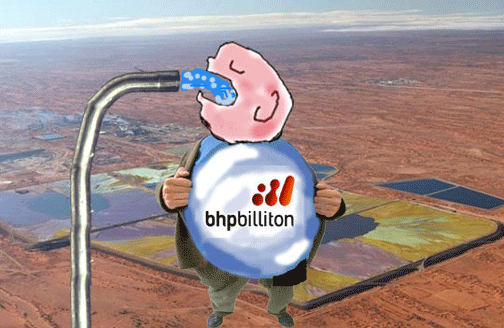
Poor old BHP. My heart bleeds! The so-called “Big Australian” (about 70% owned by overseas interests), is so poor that it’s had to get exemptions from just about every regulation that matters. The SA Roxby Downs Indenture Act legislation allows the mine to operate with  wide-ranging exemptions from the Aboriginal Heritage Protection Act, the Environment Protection Act, the Natural Resources Act, and the Freedom of Information Act. There are constant problems with tailings such as ongoing seepage and large numbers of bird deaths.
Probably worst of all, BHP plans to increase extraction of precious Great Artesian Basin water to an average 50 million litres per day for the next 25 years, with likely serious adverse impacts on the unique and fragile Mound Springs ‒ which are listed as an Endangered Ecological Community and are of significant cultural importance to Aboriginal people.
Olympic Dam expansion on fast track,e InDaily, 15 June 20
The Olympic Dam expansion is being fast-tracked as part of a Federal Government plan to boost employment and reduce the length and severity of the coronavirus-induced recession.
Prime Minister Scott Morrison is expected to today announce $1.5 billion to immediately start work on priority projects identified by the states and territories…….
BHP is proposing for a staged increase in copper production at Olympic Dam from 200,000 to up to 350,000 tonnes per annum.
The expansion has been granted Major Development status by the state government …. https://indaily.com.au/news/2020/06/15/olympic-dam-expansion-on-fast-track/
Coalition’s push to deregulate environmental approvals will lead to extinction crisis
Scientists fear Coalition’s push to deregulate environmental approvals will lead to extinction crisisScott Morrison’s announcement in wake of bushfires is ‘distressing’ and puts threatened species at risk, ecologists say, Guardian, Lisa Cox, Tue 16 Jun 2020 Scientists have expressed dismay and frustration at Scott Morrison’s latest push to deregulate the environmental approval process for major developments, noting it comes just months after an unprecedented bushfire crisis and during a review of national conservation laws.In a speech on Monday, the prime minister said he wanted to slash approval times for major projects by moving to a streamlined “single touch” system for state and federal environmental assessments.
Morrison said the change would be informed by the review of Australia’s environment laws, the Environment Protection and Biodiversity Conservation (EPBC) Act, which is under way. But his speech did not mention the environment or the act’s objectives to protect threatened species and ecosystems. ……
Scientists and environmentalists argue the act is failing to prevent an extinction crisis. Just 22 of 6,500 projects referred for approval have been knocked back in the act’s 20-year history.
Australia has the world’s highest rate of mammalian extinction. Reporting by Guardian Australia has found the government has failed to implement or track measures for species known to be at risk, stopped listing major threats to species, and not registered a single piece of critical habitat for 15 years.
The listing of species and ecosystems as threatened has been delayed by successive ministers, funding has been directed to projects that did not benefit threatened species and hundreds of plants and animals have been identified as requiring urgent attention after the summer bushfire disaster.
The government has framed its commentary about the review around a desire to speed up approval times for projects as the country moves out of the economic shutdown caused by the Covid-19 pandemic. …..
Megan Evans, an environmental policy researcher at the University of New South Wales in Canberra, said one of the reasons approvals could be slow was because the capacity of the public service had been cut. …… we have highly ambiguous wording [in the act] which provides maximum discretion to the minister that reduces certainty and puts all power in the hands of the minister of the day. You can’t on one hand complain about the lack of certainty but then on the other shy away from measures that would actually provide greater certainty.”
The climate scientist, Bill Hare, said Australia’s approach to its natural environment was damaging not only for the country’s ecosystems, but its democracy…….. https://www.theguardian.com/environment/2020/jun/16/scientists-fear-push-to-deregulate-environmental-approvals-will-lead-to-extinction-crisis
Australia’s Environment Laws have no teeth, are in much need of strengthening
‘No checks, no balances’: push for change to environment laws, The Age, By Mike Foley, June 14, 2020 Australia’s 20-year-old flagship environmental protection laws are failing badly and in urgent need of an overhaul, the crossbench senator who helped the Howard government install the landmark legislation says.
“Clearly it’s not working well,” former Democrats senator Andrew Bartlett said ahead of an imminent review of the Environmental Protection and Biodiversity Conservation Act. “The most obvious failure is despite the fact conditions can be attached to project approvals, there are just so many cases where conditions aren’t adhered to. There are no efforts to check and no penalties.”
Mr Bartlett stared down bitter opposition from some powerful players in the conservation movement and sided with the Howard government against Labor and the Greens to vote for legislation in 1999.
The act was an attempt by the Howard government to modernise environmental protection laws and was controversial because it significantly increased the environment minister’s powers, such as allowing them to intervene in project approvals to protect threatened species.
Since the act’s introduction, Australia’s list of nationally threatened species and ecosystems has grown by more than one-third – from 1483 to 1974.
The act is being reviewed by the former chair of the Australian Competition and Consumer Commission, Graeme Samuel, who is due to complete his report for Environment Minister Sussan Ley later this month.
Both conservationists and industry are unhappy with the application of the act. Conservation groups say successive governments have not used the powers in the act to protect threatened species, while industry argues the act has delayed development because of so-called “green law-fare”.
Australian Conservation Foundation policy co-ordinator James Trezise said “the idea that vexatious litigation is rife under national environment law is not borne out by the evidence”.
Professor Hugh Possingham, one of the scientists who advised the Howard government on the legislation, said the act had failed to protect the environment.
“There’s no ambiguity in the science, the EPBC Act isn’t delivering,” Professor Possingham told The Sydney Morning Herald and The Age. ……
The Wentworth Group of Concerned Scientists’ submission to Mr Samuel’s review said the “objectives of the [EPBC] act are not being met”….. https://www.theage.com.au/politics/federal/no-checks-no-balances-push-for-change-to-environment-laws-20200610-p55180.html
Australia’s very bad record on environment: it’s no time to weaken our laws
|
Now is not the time to weaken our environmental protections, Canberra Times, Katherine Barraclough, Fiona Armstrong , 10 June 20
As Australia’s primary environmental legislation undergoes a once-in-a-decade review, businesses and the government have spoken of the need to cut environmental bureaucracy (so-called “green tape”) and speed up approvals. However, health experts insist that environmental protections must be strengthened. Why? Because the stark reality is that our health is fundamentally dependent on the health of the natural world – for clean air, water and soils, food security, protection against infectious diseases and a stable climate. Nature is also the source of over half of all medicines we rely on. Last month, more than 180 health professionals and 19 health groups published an open letter to federal Environment Minister Sussan Ley, warning a failure to significantly reform Australia’s environmental law, the Environmental Protection and Biodiversity Conservation Act (EPBC Act), will risk fuelling further public health crises. Signatories included Nobel laureate Professor Peter Doherty, former Australian of the Year Professor Fiona Stanley and nutritionist and dietician Dr Rosemary Stanton. Despite being a wealthy, developed nation, Australia’s environmental track record is among the worst of all countries. We lead the world in mammal extinctions, have the highest rate of biodiversity loss bar Indonesia, and have been recognised as a land-clearing and deforestation “hotspot”. It is estimated that in Queensland and NSW alone, land clearing kills some 50 million mammals, birds and reptiles annually. Our scarce water resources are in decline, and some of our most precious marine environments, including the Great Barrier Reef, face collapse. Climate change constitutes one of the most serious threats to our natural environment and our nation’s public health, and yet Australia is one of the highest per-capita emitters of greenhouse gases. This degradation of our natural environment is, in essence, a dismantling of our life support systems. That it has occurred despite the existence of the EPBC Act is a clear indication that major environmental law reform is required. Unfortunately, examples of failed environmental protections in Australia are plentiful…….. https://www.canberratimes.com.au/story/6777567/now-is-not-the-time-to-weaken-our-environmental-protections/?cs=14230#gsc.tab=0 |
|
Order of Australia recipients for environment and conservation
from Maelor Himbury (Apologies to any I may have missed), 8 June 20
Rita BENTLEY VIC
Craig Kingston BUSH bMeerlieu VIC
Erik DAHLbKersbrook SA
Vera Frances DEACON Stockton NSW
Atticus Richard FLEMING NSW
Manfred Ernst HEIDE Teringie SA
Noel HOFFMAN Gooseberry Hill WA
Ross Edward LEDGER City Beach WA
Colin James LIMPUS Capalaba QLD
James Grant MUMME Rockingham WA
Gretel Lees PACKER NSW
William Robert PATERSON Meningie SA
Barry McGown SCOTT Sunnybank QLD
Richard John THOMSON Templestowe Lower VIC
Arron Richard WOOD Kensington VIC
Mike WOOD North Beach WA
New Zealand puts Australia to shame – with its environment – pandemic recovery programme
Australia’s destructive COVID-19 recovery
An opportunity for Australia
Economic stimulus through conservation and land management is not yet recognised as a way for Australia to respond to both the COVID-19 crisis and long-standing conservation needs.
Australian governments, if they invested similarly to New Zealand, could create jobs in the short term in any desired target region, based on economic and environmental need….
|
Let’s fix Australia’s environment with any pandemic recovery aid – the Kiwis are doing it https://theconversation.com/lets-fix-australias-environment-with-any-pandemic-recovery-aid-the-kiwis-are-doing-it-139305 5 June 20, Lachlan G. Howell, John Clulow,John Rodger, Ryan R. Witt The COVID-19 pandemic is causing significant economic challenges for Australia. With April figures showing more than 800,000 people unemployed and last month 1.6 million on JobSeeker payments, a key focus will be job creation.
Lessons should be learned from what’s happening in New Zealand, where the government is funding projects that revive the environment. Unfortunately, Australia seems to be going the other way. New Zealand gets itAs part of New Zealand’s innovative Wellbeing Budget the government will invest NZ$50 billion in a direct COVID-19 recovery response. Of that, NZ$1.1 billion will be spent on creating 11,000 “nature jobs” to combat unemployment and supplement pandemic-affected sectors. This unique investment will be delivered in a number of targeted environmental programs. Continue reading
|
Australia’s national environment laws ‘actually allow extinction to happen’
Australia’s national environment laws ‘actually allow extinction to happen’
Carnaby’s black-cockatoo, the grey range thick-billed grasswren and the swift parrot just three species in deep trouble after laws fail them, Guardian, Lisa Cox, Sun 31 May 2020 Scientists and conservationists are calling for changes to Australia’s national environment law to urgently address failures in how it is protecting native wildlife, including bird species that have declined significantly over the past decade.
Samantha Vine, the head of conservation at BirdLife Australia, says: “Our laws are actually allowing extinction to happen.”
With the Environment Protection and Biodiversity (EPBC) Act under review by the businessman Prof Graeme Samuel, environmentalists have pointed to several bird species as examples of the inadequate protection provided by the legislation…….https://www.theguardian.com/environment/2020/may/31/australias-national-environment-laws-actually-allow-extinction-to-happen
Leading doctors in Australia (over 180 of them) want Australia’s Australia’s Environmental Protection and Biodiversity Conservation Act 1999 (EPBC Act) made stronger, not weaker
More than 180 doctors sign open letter calling for overhaul of ‘failing’ environmental laws, https://www.sbs.com.au/news/more-than-180-doctors-sign-open-letter-calling-for-overhaul-of-failing-environmental-laws 25 May 20, More than 180 health professionals have signed a letter warning the Commonwealth must strengthen Australia’s environmental laws to protect people’s health.
Doctors for the Environment Australia and the Climate and Health Alliance have sent an open letter to federal Environment Minister Sussan Ley as she undertakes a once-in-a-decade review of environmental protection laws.
Australia’s Environmental Protection and Biodiversity Conservation Act 1999 (EPBC Act) was established more than 20 years ago at a time when the doctors say the effects of climate change and its links to human health were not widely considered to be related.
The review comes amid the COVID-19 pandemic and follows Australia’s catastrophic summer bushfires with the health professionals warning that failing to conserve the environment will expose Australians to further devastation and health risks.
“We must protect the natural environment in order to prevent further and potentially even more deadly pandemics,” the letter says.
“The degradation of Australia’s natural environment and loss of our unique biodiversity is in effect a dismantling of our life support systems.”
The doctors argue the laws have failed as Australia has the second-highest rate of biodiversity in the world and is recognised as a land clearing and deforestation hotspot.
“The EPBC Act has failed to achieve its objectives of protecting Australia’s environment and promoting ecologically sustainable development and biodiversity conservation,” the letter says.
The letter, also signed by former Australian of the Year Professor Fiona Stanley, calls for an “entirely new generation” of environmental laws that focus on the impacts on human health and which have greater protections in place for biodiversity.
Associate Professor Katherine Barraclough from Doctors for the Environment Australia argues clearing forests and wildlife habitat increases the risk of infectious diseases being transferred from wildlife to people.
“The COVID-19 pandemic and the summer’s fires serve as a wake-up call. We must recognise the interconnections between humans, animals and natural places,” she said in a statement.
Climate and Health Alliance founder Fiona Armstrong said the government listened to the science in its response to COVID-19 and should do the same in regards to the environment and climate change.
An interim report into the Environment Protection and Biodiversity Conservation Act review is expected mid-year with the final report expected in October.
Minerals Council of Australia keen to keep Australia’s environmental law the same, (or make it even worse)
May 19, 2020 The fossil fuel lobby, led by the Minerals Council of Australia, seem pretty happy with the current system of environment laws. In a submission to a review of the Environment Protection and Biodiversity Conservation (EPBC) Act, it “broadly” supports the existing laws and does not want them replaced.True, the group says the laws impose unnecessary burdens on industry that hinder post-pandemic economic recovery. It wants delays and duplication in environmental regulation reduced to provide consistency and certainty.
But for the fossil fuel industry to broadly back the current regime of environmental protection is remarkable. It suggests deep problems with the current laws, which have allowed decision-making driven by politics, rather than independent science.
So let’s look at the resources industry’s stance on environment laws, and what it tells us.
Cut duplication
The Minerals Council’s submission calls for “eliminating or reducing duplication” of federal and state laws.
The fossil fuel lobby has long railed against environmental law – the EPBC Act in particular – disparaging it as “green tape” that it claims slows projects unnecessarily and costs the industry money.
On this, the federal government and the mining industry are singing from the same songbook. Announcing the review of the laws last year, the government flagged changes that it claimed would speed up approvals and reduce costs to industry.
Previous governments have tried to reduce duplication of environmental laws. In 2013 the Abbott government proposed a “one-stop shop” in which it claimed projects would be considered under a single environmental assessment and approval process, rather than scrutinised separately by state and federal authorities.
That proposal hit many political and other hurdles and was never enacted. But it appears to remain on the federal government’s policy agenda.
It’s true the federal EPBC Act often duplicates state approvals for mining and other activities. But it still provides a safety net that in theory allows the federal government to stop damaging projects approved by state governments.
The Commonwealth rarely uses this power, but has done so in the past. In the most famous example, the Labor party led by Bob Hawke won the federal election in 1983 and stopped the Tasmanian Liberal government led by Robin Gray building a major hydroelectric dam on the Gordon River below its junction with the Franklin River.
The High Court’s decision in that dispute laid the foundation for the EPBC Act, which was enacted in 1999.
In 2009 Peter Garrett, Labor’s then-federal environment minister, refused the Queensland Labor government’s proposed Traveston Crossing Dam on the Mary River under the EPBC Act due to an unacceptable impact on threatened species.
The Conversation put these arguments to the Minerals Council of Australia, and CEO Tania Constable said:
The MCA’s submission states that Australia’s world-leading minerals sector is committed to the protection of our unique environment, including upholding leading practice environmental protection based on sound science and robust risk-based approaches.
Reforms to the operation of the EPBC Act are needed to address unnecessary duplication and complexity, providing greater certainty for businesses and the community while achieving sound environmental outcomes.
But don’t change the current system much
Generally, the Minerals Council and other resources groups aren’t lobbying for the current system to be changed too much.
The groups support the federal environment minister retaining the role of decision maker under the law. This isn’t surprising, given a succession of ministers has, for the past 20 years, given almost unwavering approval to resource projects.
For example, in 2019 the then-minister Melissa Price approved the Adani coal mine’s groundwater management plan, despite major shortcomings and gaps in knowledge and data about its impacts.
Independent scientific advice against the mine over the last ten years was sidelined in the minister’s final decision.
Countless more examples demonstrate how the current system works in the favour of mining interests – even when the industry itself claims otherwise.
The Minerals Council submission refers to an unnamed “Queensland open-cut coal expansion project” to argue against excessive duplication of federal and state processes around water use.
I believe this is a reference to the New Acland Coal Mine Stage 3 expansion project. I have acted since 2016 as a barrister for a local landholder group in litigation against that project.
When approached by The Conversation, the Minerals Council did not confirm it was referring to the New Acland project. Tania Constable said:
The case studies were submitted from a range of companies, and are representative of the regulatory inefficiency and uncertainty which deters investment and increases costs while greatly limiting job opportunities and economic benefits for regional communities from mining.
The New Acland mine expansion is on prime agricultural land on the Darling Downs, Queensland’s southern food bowl. Nearby farmers strongly opposed the project over fears of damage to groundwater, the creation of noise and dust, and climate change impacts.
But the Minerals Council fails to mention that since 2016, the mine has been building a massive new pit covering 150 hectares.
When mining of this pit began, the mine’s expansion was still being assessed under state and federal laws. Half of the pit was subsequently approved under the EPBC Act in 2017.
But the Queensland environment department never stopped the work, despite the Land Court of Queensland in 2018 alerting it to the powers it had to act.
Based on my own research using satellite imagery and comparing the publicly available application documents, mining of West Pit started while Stage 3 of the mine was still being assessed under the EPBC Act. And after approval was given, mining was conducted outside the approved footprint.
Despite these apparent breaches, the federal environment department has taken no enforcement action.
The Conversation contacted New Hope Group, the company that owns New Acland mine, for comment, and they refuted this assertion. Chief Operating Officer Andrew Boyd said:
New Hope Group strongly deny any allegations that New Hope Coal has in any way acted unlawfully.
New Acland Coal had and still has all necessary approvals relating to the development of the pit Dr McGrath refers to. It is also not correct to say that the Land Court alerted the Department of its powers to act with regards to this pit.
The Department is obviously aware of its enforcement powers and was aware of the development of the pit well before 2018. Further, the Land Court in 2018 rejected Dr McGrath’s arguments and accepted New Acland Coal’s position that any issues relating to the lawfulness of the pit were not within the jurisdiction of the Land Court on the rehearing in 2018.
Accordingly, the lawfulness of the pit was irrelevant to the 2018 Land Court hearing.
Dr McGrath also fails to mention that his client had originally accepted in the original Land Court hearing (2015-2017) that the development of the pit was lawful only to completely change its position in the 2018.
State and federal environmental laws work in favour of the fossil fuel industry in other ways. “Regulatory capture” occurs when government regulators essentially stop enforcing the law against industries they are supposed to regulate.
This can occur for many reasons, including agency survival and to avoid confrontation with powerful political groups such as farmers or the mining sector.
In one apparent example of this, the federal environment department decided in 2019 not to recommend two critically endangered Murray-Darling wetlands for protection under the EPBC Act because the minister was unlikely to support the listings following a campaign against them by the National Irrigators Council.
Holes in our green safety net
Recent ecological disasters are proof our laws are failing us catastrophically. And they make the mining industry’s calls to speed-up project approvals particularly audacious.
We need look only to repeated, mass coral bleaching as the Great Barrier Reef collapses in front of us, or a catastrophic summer of bushfires.
Read more: Environment laws have failed to tackle the extinction emergency. Here’s the proof
Both tragedies are driven by climate change, caused by burning fossil fuels. It’s clear Australia should be looking to fix the glaring holes in our green safety net, not widen them.
The push to weaken Australia’s law regulating the uranium industry, in the review of Environmental Protection and Biodiversity Conservation (EPBC) Act
Uranium, extinction, expedited approvals and extreme risks: the need for stronger environmental laws, https://www.onlineopinion.com.au/view.asp?article=20887
| By Mia Pepper – 14 May 2020 |
This year a Review Committee is examining the cornerstone of Australia’s environmental laws – the Environmental Protection and Biodiversity Conservation (EPBC) Act 1999. This review comes hot on the heels of three inquiries into nuclear power driven by conservative politicians and pressure from the nuclear lobby. This cohort are pushing for the removal of laws banning nuclear power, a push the current federal government has already ruled out.
They are also pushing to weaken regulatory requirements for uranium mine assessments through the EPBC Act. There is currently no national prohibition on uranium mining, but prohibitions exist in Victoria, NSW, Queensland, WA, Tasmania and Victoria. SA and the NT have a long and contested history of supplying uranium to fuel nuclear power plants overseas. Uranium from SA and the NT fuelled the Fukushima reactor during the 2011 meltdowns, fires and explosions ‒ a discomforting legacy given that there was ample evidence long before the Fukushima disaster of corruption and inadequate safety standards in Japan’s nuclear industry.
Following the Fukushima disaster the UN Secretary General advised that Australia have “an in-depth assessment of the net cost impact of the impacts of mining fissionable material on local communities and ecosystems.” No such assessment has been carried out. Worse still, the appointment of a former uranium mining company executive to the EPBC Review Committee suggests that there may be some support within the government for a weakening of uranium mining regulations rather than the necessary strengthening.
The reality of uranium mining in Australia has been one of leaks, spills, accidents, license breaches and a failure to rehabilitate. Of the 15 uranium mines that have operated, just two are still mining (Olympic Dam and Beverley Four Mile), one is preparing for closure (Ranger), another is preparing for a second round of rehabilitation failing previous attempts (Rum Jungle), three are on life support in extended care and maintenance; and the remaining sites are all contaminated and require ongoing monitoring and maintenance at the expense of taxpayers.
That track-record strongly suggests the need for greater scrutiny and a strengthening not a weakening of regulations. Proposed changes by the nuclear industry include changing the definition of ‘nuclear actions’ in the EPBC Act to remove the “mining and milling” of uranium. The impact of this would reduce requirements for whole-of-environment assessments for uranium projects and reduce federal oversight. Existing processes desperately need improvement given recent failures around transparency, upholding principles and objects of environmental laws, political influence in decision making, expedited process and unfounded exemptions.
The Ranger uranium mine in the tropical NT, owned by Rio Tinto and operated by ERA, will begin rehabilitation in 2021, a project set to cost in excess of $1 billion. There are ongoing concerns about the funding and adequacy of the proposed rehabilitation. Meeting the regulatory requirement to secure radioactive wastes and other toxins from the environment for 10,000 years is inherently difficult, not least because there is a long history of routine, daily leakage of large volumes of contaminated liquid.
Not far from Ranger, the government-owned Rum Jungle mine has been leaking radioactive and acidic materials into the East Branch of the Finniss River since it was closed in 1971. The NT government has released new plans to remediate the site which is likely to cost in excess of $300 million, but there is still no commitment from the NT or Federal governments to fund this important work.
The legacy threats from uranium mines are unlike the threats from other mines and a repeated failure to contain this waste suggests that mining uranium should be banned, or at the very least have the strictest possible regulations.
There are many other examples of industry and regulatory failure. At the former uranium mine at Radium Hill in SA, the tailings dam was shoddily constructed and was not capped when the mine closed. The Port Pirie uranium treatment plant in SA is still contaminated over 50 years after its closure. SA regulators failed to detect a mining exploration company’s dumping of low-level radioactive waste in the Arkaroola Wilderness Sanctuary. At the Beverley Four Mile in-situ leach uranium mine in SA, contaminated wastewater is routinely dumped in groundwater ‒ a process permitted by regulators who should know better.
In yet another regulatory failure, BHP’s proposal for a new tailing’s facility at its Olympic Dam copper/uranium mine in SA has been fast-tracked without requirements for federal approval. The decision not to assess the new tailings dam came after the Australian National Committee on Large Dams gave three existing tailings dams at Olympic Dam a risk ranking of ‘extreme’ – this ranking is given to tailings facilities that if failed would cause the death of over 100 people. The independent review of tailings followed the Samarco tailings disaster in Brazil, a joint venture project between BHP and Vale, which killed 19 people. The new proposed tailings should be assessed to determine the risk and likelihood of failure; instead, the facility has been fast-tracked avoiding scrutiny under the EPBC Act.
Cameco’s proposed Yeelirrie mine in WA provides another example of unseemly haste and unseemly exemptions. The WA EPA recommended that Yeelirrie not be approved because of the likelihood the mine would cause multiple species extinctions. Despite this recommendation the former State Environment Minister approved the mine weeks before losing his seat and the Liberal party lost Government in the 2017 WA election. In a similar scenario, the mine was given federal approval on the eve of announcing the 2019 federal election. That federal approval followed direct lobbying of Ministers and the Department and resulted in a set of conditions that no longer require the company to prove the mine won’t cause species extinction.
A 2003 report by the federal Senate References and Legislation Committee found “a pattern of underperformance and non-compliance” in the uranium mining industry and it concluded that changes were necessary “in order to protect the environment and its inhabitants from serious or irreversible damage”. The same could be said now. Subsequent reviews of uranium mining regulations in Queensland, WA and Canada identify unique risks with uranium mining and calls for improved and increased regulations that meet those specific challenges and risks.
The push from the industry to weaken regulations should be wholeheartedly rejected and instead the EPBC Committee could consider advice from former UN Secretary General to hold an “in-depth” assessment of the uranium sector and its impacts.
Environment Minister Sussan Ley not to support protection of Murray-Darling river systems
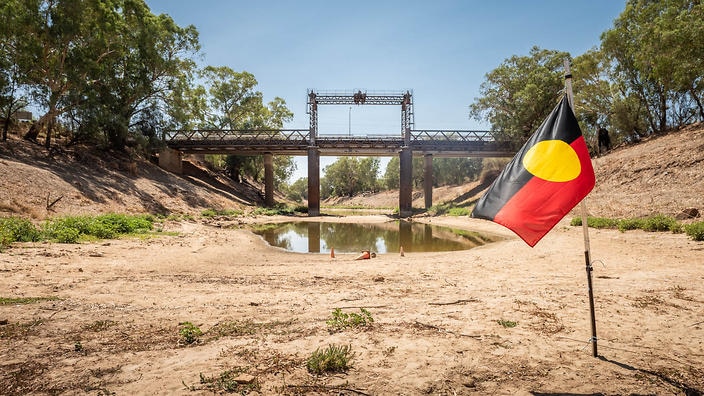
Murray-Darling systems not assessed for endangered listing after officials warned Coalition would not  support it
FoI documents reveal struggling systems were ‘clear candidates’ for protection but Sussan Ley ‘unlikely to support’ it, Guardian, Lisa Cox, Wed 13 May 2020 Struggling river and wetland systems in the Murray-Darling Basin were not assessed for listing as critically endangered after officials warned the Morrison government would not support protecting them.
Environment department staff said the two ecological communities were “clear candidates” for assessment for a critically endangered listing, documents released under freedom of information show. But the environment minister, Sussan Ley, was “unlikely to support” their inclusion on the 2019 list of species and habitats under consideration for protection, they told the threatened species scientific committee.
The department also told the committee the work required to do the assessment would have “significant resource implications”.
The two communities are known as the “wetland and inner floodplain of the Macquarie Marshes”, and the “Lower Murray River and associated wetlands, floodplains and groundwater systems from the junction of the Darling River to the sea”.
Both were listed as critically endangered by then environment minister Mark Butler in the final days of the Labor government in 2013.
After the Coalition won government, both listings were disallowed under the new environment minister, Greg Hunt. It followed a campaign against the critically endangered listings by the National Irrigators Council.
Humane Society International, the organisation behind the nomination that led to the 2013 listings, renominated the river and wetlands systems for assessment for a critically endangered listing last year.
In a briefing to the threatened species scientific committee, officials said a tool the department used for conservation assessments had ranked the two communities as the highest priorities from a conservation perspective among a group of five ecological communities nominated for listing in 2019.
But neither made it on to the proposed priority assessment list, which is given to the environment minister to consider before they determine the nominations that will make it on to the final list.
The briefing to the committee is the same document that led to Guardian Australia last week revealing the government had stopped listing major threats to species under national environmental laws…….
Labor’s environment spokeswoman, Terri Butler, said it was “outrageous” the Morrison government had not followed scientific advice. She said the government was attempting “to influence the outcomes of scientific processes designed to protect our environment”.
Richard Kingsford, the director of the Centre for Ecosystem Science at the University of New South Wales, said the scientific research on the two communities showed both had high levels of biodiversity and were degrading significantly as a result of reduced flooding.
“The question would be: why were they ruled out at that first step?” he said…… https://www.theguardian.com/environment/2020/may/13/murray-darling-systems-not-assessed-for-endangered-listing-after-officials-warned-coalition-would-not-support-it
Minerals Council of Australia wants radiation risks to be discounted in Environmental Protection and Biodiversity Conservation Act
 Coronavirus: cut green tape delay on projects, miners say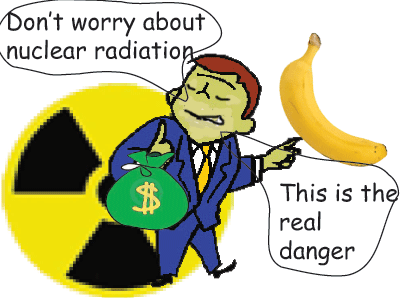
Australia’s six peak mining and resources groups are pushing for a major overhaul of environmental laws, calling for the removal of “unnecessary duplication and complexity” to provide greater certainty for businesses.
In a joint submission to the independent review of the Environment Protection and Biodiversity Conservation Act, led by former Australian Competition & Consumer Commission chair Graeme Samuel, the mining sector warns companies are facing delay costs of up to $1m a day.
Minerals Council of Australia chief executive Tania Constable said Australia was facing an unprecedented economic and social threat from the COVID-19 pandemic, arguing reforms of the EPBC Act would help reduce delays in project approvals and fast-track projects.
Environment Minister Sussan Ley last month flagged reforms to the EPBC and the government’s commitment to cut green tape to “get rid of unnecessary delays”.
Professor Samuel will deliver an interim report by June and a final report by October. “We are getting congestion out of the system and we will continue to do so as the economy comes through the COVID-19 crisis,” Ms Ley said.
The MCA submission, co-signed by the NSW Minerals Council, Queensland Resources Council, the Chamber of Minerals and Energy of Western Australia, South Australian Chamber of Mines and Energy and the Tasmanian Minerals, Manufacturing and Energy Council, suggest four key points to improve the EPBC.
These include eliminating or reducing duplication and ensuring consistency between federal and state-territory processes, reducing delays in assessment and approval processes, improving certainty for businesses and ensuring better “fit-for-purpose regulation”.
Assessing regulatory duplication and uncertainty, the ’ submission ranks NSW and Victoria lower than less mature mining jurisdictions, including PNG and the Democratic Republic of Congo.
Ms Constable said “pragmatic and considered policy reform can build a stronger minerals industry for a faster and more durable post-COVID-19 recovery”.
“When mining projects can take more than a decade to deliver, it’s clear better regulation can help deliver Australia’s economic recovery without compromising our precious environment,” she said.
“Reform to the act is long overdue to address unnecessary duplication and complexity.”
Ms Constable said a one-year delay to a project can reduce its net present value by 10 to 13 per cent per year. “For large mining projects (with a value from $3bn to $4bn), delay costs can be up to $1m per day,” she said. “Significant growth in regulation across all levels of government including the EPBC Act has not led to better environmental outcomes.”
The groups want uranium mining, milling decommissioning and rehabilitation removed from the definition of nuclear actions under the act, to help unlock the mineral sands industry. The EPBC trigger has captured non-uranium projects, including mineral sands, rare earths and base metals, where naturally occurring radioactive material may be present.
Ms Constable said Australia had the world’s largest mineral sands deposits, offering significant “opportunities for growth and jobs”. “Heavy mineral sands such as rutile, ilmenite (titanium) and zircon are essential inputs to everyday life including paint, medical implants and ceramics.”
“Many of Australia’s mineral sands deposits also contain monazite and xenotime, which are sources of the rare earth elements used in smart phones and computers, as well as medical devices.’’
‘under cover of coronavirus’ New South Wales govt approves US company to mine coal beneath a Sydney drinking water dam
|
Woronora reservoir, an hour’s drive south of the CBD, is part of a system which supplies water to more than 3.4 million people in Greater Sydney. The approval will allow Peabody Energy to send long wall mining machines 450 metres below the earth’s surface to crawl along coal seams directly below the dam. Dr Kerryn Phelps says the fact the decision was made “under the cover of coronavirus” is “unfathomable”. NSW has spent 12 of the last 20 years in drought, with record low rainfall plunging much of the state into severe water shortage last year. “We know about the potential for catastrophe,” Dr Phelps told 9News.com.au. “We just cannot let this [decision] go unchallenged.” The former president of the Australian Medical Association may seem an odd figure to lead opposition to a mining project, but Dr Phelps takes what she calls a broad view on health. She grew up on Sydney’s North Shore when koalas still lived in family backyards and has witnessed firsthand the affects human populations have on the natural world. She has also seen, as a doctor, how the degradation of the nature impacts human health. In her role as City of Sydney councillor, Dr Phelps introduced a motion to the council calling on the NSW Minister for Planning and Public Spaces, Rob Stokes, to reverse the approval. “We can’t simply risk the water supply in one part of Sydney, without considering the repercussions for the rest of the state and country,” Dr Phelps said. “We have to make a stand now. If not now, then when?” Chain reactionOn the evening of April 6 this year, the City of Sydney council almost unanimously passed Dr Phelp’s motion calling for the approval to be reversed, prompting mayor Clover Moore to send Mr Stokes a strongly worded internal letter. In it, she described the minister’s decision as “scandalous”. Sutherland Labour Party councillor Ray Plibersek says the move also led Sutherland Shire Council to pass a similar motion urging the decision be reconsidered. “We’re very concerned,” Cr Plibersek told 9News.com.au. “There’s been evidence of damage to the water table… and despite assurances from mining companies, there is a threat to a crucial resource – water.” Sutherland Shire and Wollongong, which both have more than 200,000 residents, share the Woronora special catchment area, the rivers and rivulets passing from one jurisdiction to the next. They share the water within it too – the reservoir supplies 100 per cent of the drinking water……….. https://www.9news.com.au/national/coal-mine-under-greater-sydneys-woronora-drinking-water-reservoir-approved-during-coronavirus-pandemic/d3e51de8-f370-4fcf-b4f8-7f62be1c24c7
|
|

1 This month

of the week – Australians for War Powers Reform (AWPR)
To see nuclear-related stories in greater depth and intensity
 Antinuclear