Why does the Morrison govt hear the experts on coronavirus, but ignore the experts on climate change?
|
Perhaps we should ditch the word entirely, and with it the forest of feel opinions about what governments “must” do to advance an author’s previously-held ideological positioning in the post-corona world. Imagine if we took just two lessons from the way Australian governments responded to the coronavirus: that good decisions are made when they consider the evidence and the best available expert advice; and that policy-making can accommodate reasonable differences of opinion, without becoming a “war”…… For six years now leading business, environmental, investor, union, farming and social welfare groups have been trying, largely in vain, to create a space for a sensible discussion about global heating, and to give Australian politicians a way to retreat from the self-defeating culture war that has scuppered all attempts at policy. They wouldn’t put it this way, but in effect the environmentalists, desperate for Australia to make some meaningful move towards reducing emissions, and the business groups, desperate for some kind of investment certainty, have been trying to save Australia’s politicians from themselves. The starting point for the Australian Climate Roundtable’s deliberations is that Australia needs to reach net zero emissions, and that delaying action just increases the cost of reaching that goal. Unremarkable propositions in any fact-based forum, but in some Coalition circles, still close to heresy. Now the roundtable, including its business members, argues that this post-corona reconstruction is a chance to speed up decarbonising the economy. The Business Council of Australia chief executive, Jennifer Westacott, argued in an opinion piece that the post-corona discussion should divest itself of “ideological constraints”. “In resuscitating our economy, we can tackle some of our most vexed problems. Every dollar we invest in energy should be a dollar towards a lower carbon economy and lower energy bills,” she wrote. And expert evidence about what might be possible has been flooding in by the day. The Australian Energy Market Operator this week released its long awaited “renewable integration study”, which found Australia could accommodate levels of up to 75% “instant” penetration of wind and solar in its main grid by 2025 – that we have the know-how, but need to update market and regulatory settings….. And then there was the advice from the International Energy Agency this week that renewable electricity will be the only energy source resilient to the biggest global energy shock in 70 years, triggered by the pandemic. …. – the latest Climateworks report released earlier this month found that net zero emissions by 2035 is possible in Australia, using technologies that are mostly already mature and available. The CSIRO’s roadmap released last year found there was no trade-off between economic growth and transitioning to zero emissions, and in fact strong action could lead to GDP growth, an increase in real wages and net zero emissions by 2050. …… https://www.theguardian.com/environment/commentisfree/2020/may/02/australia-listened-to-the-experts-on-coronavirus-its-time-we-heard-them-on-climate-change |
|


Annie McGovern: stop pretending that the Kimba nuclear waste dump is a”medical necessity”
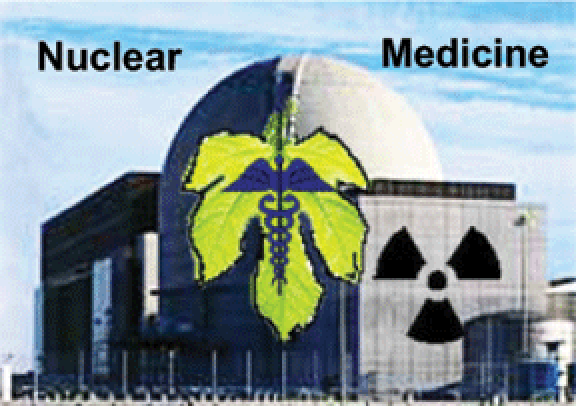
Much of what you and the Public are told is that this is mostly about providing good medicine and
saving lives. According to the Medical Association for Prevention of War ‘Factsheet’:- “Less than 1%
is medical waste (radium and some disused sources). Most states and territories each only have a
few cubic metres of low level medical waste.”
The current ploy of localising all the decision-making regarding this “National Waste Dump”, through
enticements of land procurement and localised funding, has placed this critically important process
at the level of a ‘sausage-sizzle deal’, highly inadequate for the responsibilities involved.
National Radioactive Waste Management Amendment (Site Specification, Community Fund and Other Measures) Bill 2020
[Provisions]
Annie McGovern, Submission 83 To: Senate Standing Committees on Economics.
National Radioactive Waste Management Amendment (Site Specification, Community Fund and
Other Measures) Bill 2020 (Provisions).
As stated in the support document accompanying this Bill, the Federal Government has been in the
process for the past 40 yearsof finding a site in Australia for the Dumping of Nuclear Waste. This Project has been presented bothas an independent National necessity and also as an associated proposal for an International
Industry for disposing of the world’s Nuclear Waste.
For those same 40 years the Australian people have continued to take the position that a Nuclear
Industry is a hazardous, uneconomical and unsustainable incursion into the stability of both National
and International interests, and that Australia should remain Nuclear Free.
Over time we have seen the steady erosion of the rights of the Public to express common will in
relation to industrial development in this country, and usurpation of decision-making of whether an
industry is desirable for the common good or is perceived as destructive and not in the best interests
of the Community or Environment. Clearly the Nuclear Industry falls into the latter category where
the balance of all the detrimental factors far outweigh the positive contributing factors.
The challenge of finding a disposal site is directly correlated to the resistance of allowing an easy
road for the Nuclear Industry to flourish, when it is seen to be both economically and
environmentally unsustainable. Agreement for conditions of disposal should occur when there is an
end in sight. When the Industry is shut down:- weapons, uranium and radioactive sand mining,
reactors and associated arms of the industry, then we are able to consider final disposal. With the
guarantee of no further production of this toxic and dangerous legacy there will be a genuine reason
to consider the disposal of what we have created. Until then, the current proposal is yet another
attempt to justify and legitimize a manipulative and dangerous industry, and to perpetuate its
attempts to grow in power.
The current ploy of localising all the decision-making regarding this “National Waste Dump”, through
enticements of land procurement and localised funding, has placed this critically important process
at the level of a ‘sausage-sizzle deal’, highly inadequate for the responsibilities involved.
A ‘cart-before-the –horse’ scenario occurs when acceptance of the site and facility is put before you
when there have been no Public Environmental Studies performed nor any detailed scrutiny of the
planned infrastructure. Community ratification has been achieved (minus the Indigenous Voice)
without a thorough investigation of the Impacts or ramifications of this site selection, with only an
assurance of what initial Economic gain the Community might make on this deal.
This over-simplification and commercialisation of such an important Project is reflected in the
inclusion of an extensive “Visitor’s Centre” at the site, as though it were a Tourist Attraction. This
attitude indicates a serious lack of awareness of how toxic and hazardous radioactive materials are
and a down-playing of the necessity for safe-guards that have also been eroded over the years.
Why South Australia? It is a well-known fact that the Nuclear Industry has its sites set on an
expansion of all levels of its activities, particularly in S.A. It is also a well-known fact that the people
of S.A. voted against the recent Royal Commission’s facilitation of a proposal to install an
International Radioactive Waste Dump in S.A. Its’ own State Legislation prohibits the development
of Nuclear Facilities so you as the National Senate Committee deliberating on this matter will override
the will of the people of S.A., unless you look below the surface of what you have been
proffered as justifications for this proposal.
Much of what you and the Public are told is that this is mostly about providing good medicine and
saving lives. According to the Medical Association for Prevention of War ‘Factsheet’:- “Less than 1%
is medical waste (radium and some disused sources). Most states and territories each only have a
few cubic metres of low level medical waste.”
Nuclear scans for investigating disease. These produce the vast bulk of medical nuclear waste. This is
short-lived and decays on the medical facilities’ premises until its activity is negligible. It is then
disposed of safely and appropriately in the usual manner of most waste (sewers, incinerators,,
landfill tips etc.) according to set standards.
Cancer treatment radiotherapy. Most radiotherapy uses x-rays or electromagnetic radiation which
do not produce any waste at all. A very small proportion of cancer treatment actually relies on
radioactive materials, which almost all decay rapidly. Longer lived sources must be returned to their
(overseas) sources when used up and so do not need local disposal.”
The Medical Associations for Prevention of War also supports a re-think on the production of
medical isotopes to manufacture the same product without generating radioactive waste.
“…Canada…is switching to non-reactor isotope production, which does not create radioactive wastes.
It goes on to explain: “There are broadly two areas in which radioactive material is used for medical
purposes:
Nuclear scans for investigating disease. These produce the vast bulk of medical nuclear waste. This is
short-lived and decays on the medical facilities’ premises until its activity is negligible. It is then
disposed of safely and appropriately in the usual manner of most waste (sewers, incinerators,,
landfill tips etc.) according to set standards.
Cancer treatment radiotherapy. Most radiotherapy uses x-rays or electromagnetic radiation which
do not produce any waste at all. A very small proportion of cancer treatment actually relies on
radioactive materials, which almost all decay rapidly. Longer lived sources must be returned to their
(overseas) sources when used up and so do not need local disposal.”
The Medical Associations for Prevention of War also supports a re-think on the production of
medical isotopes to manufacture the same product without generating radioactive waste.
“…Canada…is switching to non-reactor isotope production, which does not create radioactive waste.
In contrast, ANSTO is proposing to dramatically increase reactor isotope production to sell 30% of
the world market. As a result Australia will accumulate much more waste from international isotope
sales. Developing cyclotrons instead (like Canada) would eliminate waste from isotope production.”
To ply the Public with guilt-laden decision-making tools which are questionable and possibly wrong is
an underhanded way of bending peoples’ resolve. Clearly, Australia has choices of the way we
proceed into the future. It is not the right of a small group of often underinformed politicians or
vested financiers to force us into untenable industries. We, as a Nation already have enough
Radioactivity to deal with. The legacy of past mistakes and ones that today continue to add to the
problem, unseen, unchecked ‘til some day those hazards will also have to be dealt with. Roxby
Downs, Beverley, Ranger, Yeelirrie, Radium Hill, Honeymoon, Wiluna, Lucas Heights, Woomera and
Marlinga.
The Intermediate Level Waste is promoted as a temporary visitor to this site. Where is its’ long-term
repository? Is this yet another plan that has not yet been divulged? Where is the constraint, the
hazard reduction? The respect for the earth and its people that would cause decision-makers to
recognize that we gone too far?
It is a nightmare of what we already have to deal with, of decaying drums, of shipping highly toxic
huge stockpiles and dangerous goods across the country, of supervising this disposal for hundreds of
years into the future with only 100 years guaranteed by this plan.
Please see the deep and murky waters here and the lack of knowledge that lies at the bottom of
what you are being asked to authorize. There are no easy solutions or truly economically viable ones,
it will all be a cost.
Stop the Nuclear Industry now and then we will discuss what to do with the mess we have made.
Thank you for the opportunity to address this very important issue.
Annie McGovern.
Coronavirus: How deadly and contagious is this COVID-19 pandemic?
 Coronavirus: How deadly and contagious is this COVID-19 pandemic? Coronavirus: How deadly and contagious is this COVID-19 pandemic?
https://www.abc.net.au/news/2020-03-22/covid-19-how-deadly-and-contagious-is-coronavirus/12068106 Story Lab
By Annika Blau and Simon Elvery Coronavirus isn’t the first pandemic to sweep the globe in recent years. Epidemics like bird flu, Ebola, SARS and swine flu are still fresh in our memories.So how does COVID-19, the disease caused by coronavirus, compare? And what sets it apart from the flu seasons we face each winter? Here’s how Dr Norman Swan, host of the ABC’s Coronacast, explains it:
|
|
ANSTO lies about necessity of nuclear reactor: Nuclear medicines are being made in Adelaide, without dirty nuclear reactor
Brett Burnard Stokes No Nuclear Waste Dump Anywhere in South Australia 12 Mar 20 Nuclear medicines are being made here in Adelaide the modern way, with no waste problems.
To say this illegal dump is needed for nuclear medicines – that is deception. https://www.facebook.com/groups/1314655315214929/
|
The Molecular Imaging and Therapy Research Unit (MITRU) is a pharmaceutical production and research unit focused on developing tracers for molecular imaging centred on incorporating radiation. The site began the task of becoming a Therapeutic Goods Administration (TGA) manufacturing facility when the SAHMRI team moved in at the end of 2013. Eight months later they had their first federal inspection and achieved a TGA licence to provide a radiopharmaceutical FDG, a cancer diagnosis imaging tool, for patient administration across Australia. The unit began to provide the FDG for South Australia imaging facilities soon after allowing patients to no longer be reliant on this tracer being imported into the state. The demand for FDG, has begun to grow slowly in South Australia, limited currently by the lack of scanners in the state, however the SAHMRI has been able to obtain smaller scanners to utilise this and future agents through Research funding. Since the initial move to the SAHMRI iconic building on North Terrace at the end of 2013 the team has grown from two persons to a total of 10, awaiting another senior radiochemist to join within the next few months. The unit has expanded its work to include PET-generator based products to ensure expansion further into the radiopharmaceutical field and recently using the particle accelerator, GE Cyclotron, into generating further isotopes that could be provided regularly across Australia forging new research grounds. The unit is currently developing radioactive tracers that have shown promise in neurology in early diagnosis detection of Alzheimer’s, various dementia models and spinal cord injuries as and when funding is secured. It is further involved in commercial process for labelling safely radio-therapeutic drugs for several cancer to allow access across Australia using ANSTO developed materials. MITRU is a commercial facility, able to conduct research when required, that has obtained the highest manufacturing standards to allowing their current and future developments to be moved into clinical practice sooner. The timeframes for projects are often smaller as they have a unique funding model where costs are recuperated through sales once initial funding is obtained to ensure that there is a further demand. Overall this reduces the costs and adds a demand focus to the units’ endeavours. The unit is also involved with pre-arranged tours to the public, high-school and University students, where several of the team lecture on or are associated with South Australian Universities. Currently the unit has a shared supervision of several students developing agents for diagnosis and to increase disease understanding. All the team in unit do not have direct funding from grants and look for funding through either philanthropic or general research opportunities to allow them to development further into new tracer avenues with some small success which has helped the unit to become a centre of excellence for several equipment vendors. The profile in the community has grown through public and peer talks, conferences, radio, TV and newspaper articles, which is hoped to be furthered with the presence on the unit on the internet in the near future. The unit hopes to develop further tracers to ensure small animal trials to understand mechanism of disease and use this to move quickly into human work, as seen with Ga68-PSMA for prostate cancer where in less than 6months from initial donation to patient injection was possible. Work has begun to align and work together with facilities globally by developing satellite radiopharmaceutical and imaging centres using common protocols. The unit continues to expand its TGA licence and it is hoped in the near future will ensure testing of pharmaceuticals used in cold kits for SPECT imaging and implementation of new global diagnostic PET-agents for examination in Australia safely. |
|
Australia’s early nuclear history – a scandalously crooked co-operation with Britain
The British also deliberately spread plutonium dust over the outback in so called safety tests. Although a number of Australians had knowledge they desperately wanted to share with the Australian people, the Australian government threatened these people with many years jail if they spoke out.
Australian service personnel and their health status records were treated and kept at the Maralinga Hospital. John Hutton was the only involved person to ever see his Maralinga file and actually get to retain a page from it. (He nicked it).
Australia and Britain perfected a medical regime in which medical responses to radiation induced syndromes were solved without documenting the actual diagnosis. The afflicted personnel, with the exception of Mr. Hutton, never got to read their own medical records, all of which disappeared when the British Bombardiers left Australia in the 1960s. And some say they took the Maralinga medical records with them. That’s very close collaboration, isn’t it?
|
Part 1 of A Study of the “Report of the inquiry into the prerequisites for nuclear energy in Australia” Australian Parliamentary Committee 2020. Nuclear History, 29 Feb 2020 “………..Australia cooperated with the United Kingdom in that nations’ successful attempt to duplicate the Manhattan’s Project plutonium bomb. Prime Minister Menzies, without the approval of ordinary Australians, agreed to the British request to detonate atomic bombs over and on Australia. This involved excluding the Australian Sir Mark Oliphant from participating in the Atomic Weapons Safety Committee (AWTSC). Instead following British desires, Australia appointed the Englishman Professor Titterton, a radar and timing expert, to that committee. Even though the Committee was not a British Committee, but one which was paid for by Australians, and which reported to, and was subordinate to, the Australian government. Titterton rose quickly to head the committee. Justice Jim McClelland, during the Royal Commission into the British Nuclear Bombing of Australia, concluded that Titterton deliberately with held important safety information from the safety committee, the Australian government and the Australian people. Justice McClelland found that Titterton was acting under security protocols imposed by Britain and the United States. And that this was counter to Australian interests and to the safety and security of Australians. The results of this deception against Australia continue to resonant in Australia today. Continue reading
|


South Australia’s grain exports could be at risk, if Kimba nuclear waste dump goes ahead
 Paul Waldon Fight To Stop A Nuclear Waste Dump In South Australia, 17 Feb 20,
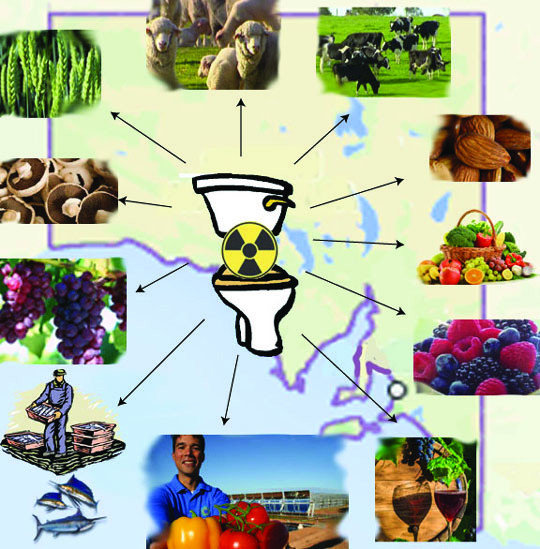
Keeping in mind the safe standard for radioactive contaminated food in Australia is 1200 becquerels, which fails to keep up with the safer standards of Japan at only 100 becquerels per kilo. Not only is Japans standards safer than ours but Australia’s grain export to Japan is about $646 million per year, and that could be in jeopardy if the program to turn Kimba into a radioactive dump proceeds.
Dr Bandazhevsky’s study came with the added problem of finding children of Belarus free of contamination, there was also a health cluster in children now recorded and known as Chernobyl heart, a condition of multiple holes in the heart, due to radioactive exposure.
Visionary Leaders Symposium: ‘Our planet is our patient.’
 Visionary Leaders Symposium: ‘Our planet is our patient.’ http://publichealthnewswire.org/?p=physicians-for-social-responsibility-visionary-leaders-symposium#.XdARGW8_6rw.twitter by Louise Dettman on 11/8/2019 Nearly 200 organizations representing medical, health care and public and environmental health professionals, including APHA, have so far endorsed the 2019 U.S. Call to Action on Climate Change, Health and Equity: A Policy Agenda.It challenges government, business, civil society and the health sector to recognize climate change as a public health emergency and to act now for climate, health and equity.
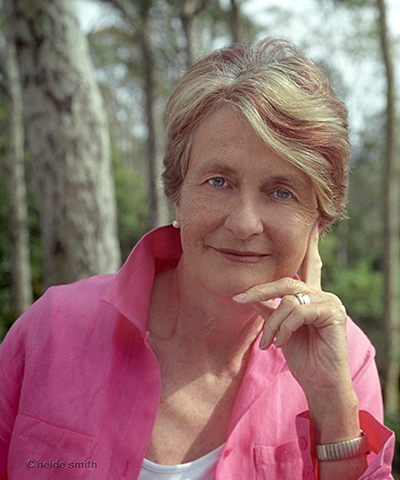
“Being health professionals, it’s important for us to realize that our planet is our patient, and it’s in the intensive care unit. We’re doctors to a dying planet and we have a job to do,” said Helen Caldicott, MD, keynote speaker at yesterday’s Physicians for Social Responsibility Visionary Leaders Symposium in Washington, D.C.
A PSR founder and former president, anti-nuclear activist, author and pediatrician from Australia, Caldicott has spent her life educating world leaders and the public about the medical hazards of the nuclear age. She urged those gathered at the Ronald Reagan Building for the symposium to “stop being polite and speak the truth loudly and clearly” about the need for action on climate change. As one of the drafters of the U.S. Call to Action, PSR is using it to mobilize and give voice to more health professionals.
It advocates for policies that promote a just transition to clean, safe renewable energy and energy efficiency; sustainable food production and diets; clean water; active transportation; and green cities. Such policies can lower climate pollution, reduce the incidence of communicable and non-communicable disease, improve mental health and realize significant cost savings in health care.
“I’m not being radical. I’m being a physician,” Caldicott said as she stressed the urgency of the situation; challenged attendees to question the role of politicians, corporations and the military in the production of greenhouse gases; and told everyone to contact members of Congress. “If you don’t use your democracy, they’ll swoop in and use it for you — for their own political and financial gain,” she said.
The U.S. Call to Action urges the health sector itself to reduce greenhouse gas emissions and — as a trusted voice — to effectively communicate the health threats of climate change and the health benefits of climate action. The symposium focused specifically on the role of women in the climate, health and equity movement and the importance of economic justice for the most vulnerable communities.
Heidi Hutner, PhD, a filmmaker, writer and professor at Stony Brook University, moderated an expert panel of women advocates discussing the health hazards of and solutions to nuclear power and climate change. Hutner opened the program with a trailer of her upcoming documentary about the women of Three Mile Island and, along with the other participants, questioned nuclear power as the answer for a just transition to clean energy.
Following the symposium, at the 2019 Visionary Leadership Awards, PSR presented Caldicott with a Lifetime Achievement Award for her work. It also recognized other individuals and organizations for their efforts in advancing nuclear weapons abolition and addressing environmental risks to human health, including the consequences of climate change.
ANSTO’s nuclear medicine problems
 Why is there no mention of the fact that all meedical radioisotopes, including technetium 99m can now be produced by a cycclotron, without need of a nuclear reactor?
ANSTO suffers nuclear medicine meltdown, THE AUSRALIAN, SEAN PARNELL, FREEDOM OF INFORMATION EDITOR, OCTOBER 18, 2019
The marketing material sent out by the Australian Nuclear Science and Technology Organisation was clear: its planned nuclear medicine facility, ANM, costing $169m and due by the end of 2016, was a big deal.
State of the art. World-class. A significant improvement on the existing facilities that already performed a lifesa NM will position Australia as a global leader in the high-end manufacturing of nuclear medicine used in over 45 million medical procedures globally each year to diagnose cancers, heart disease and skeletal conditions,” ANSTO boasted……
Atomic angst
Alongside Australia’s nuclear reactor in southwest Sydney are several buildings crucial to the production of nuclear medicine.
On the morning of August 22, 2017, around 7am, one of ANSTO’s quality control analysts dropped a vial containing a solution of the isotope Mo-99 in Building 23 at the reactor site. There, Mo-99 produced in another building is used to make Tc-99m generators for use in nuclear medicine.
Experts would later express alarm at what the worker had been required to do, likening it to “reaching around a tree truck with both hands, to perform a critical procedure” — using tongs to remove the cap from a small bottle. It was an accident waiting to happen.
Building 23 is an older facility, relying on manual labour more than automation, having originally been intended for research, not manufacturing. Even though the breakage was inside a fume cabinet it still contaminated the worker’s gloves — two pairs, worn as a precaution — and, worryingly, the skin underneath.
A specialist oncologist determined the worker had been exposed to about 20 times the statutory annual dose limit of radiation. The Australian Radiation Protection and Nuclear Safety Agency deemed it a level 3 serious incident on the International Nuclear and Radiological Event Scale (INES) and notified the International Atomic Energy Agency. It was the first time ARPANSA had reported a level 3 incident, on a scale ranging from 0, where there are no safety implications, to level 7 events such as Chernobyl and Fukushima.
“The injury has caused skin blistering, erythema and desquamation,” ARPANSA reported to parliament in February last year.
“Recent medical observations dated January 2018 showed the tissue damage to the skin of both hands is ongoing. The healing will take months and there is a risk of longer term effects.”
ARPANSA found ANSTO in breach of legislation on the basis it “had many opportunities to prevent the accident or reduce the likelihood of occurrence and/or severity of the accident consequence” and had failed to act.
ANSTO vowed to do better. However, three further safety incidents, as well as a conveyor breakdown in Building 23 that halted production of generators, led ARPANSA to issue a rare formal direction to ANSTO demanding an independent review.
Staff under pressure
The review found culture and morale at ANSTO Health, its nuclear medicine arm, had “significantly deteriorated” under internal changes and constant pressure to do more with less……..
at the end of last year the IAEA sent its own 20-member review team to inspect Australian facilities and, primarily, the regulatory system in which they operated.
Early this year they made a series of recommendations, including that the commonwealth “take actions with specific milestones to address decommissioning of facilities and radioactive waste management by assuring the strategies, programs, funding and technical expertise for safe completion are in place”……..
in June, the ANM facility had to be shut down after the hands of three workers were exposed to radiation, two of whom received a dose that exceeded the recommended annual limit.
The incident was classified level 2, and ARPANSA last month again found ANSTO in breach. Building 54 was hastily reopened before the ANM facility was cleared to resume production.
Then, last month, the unthinkable happened: the ANM facility broke down due to a mechanical fault with a gate valve at the top of a dissolution cell.
Fixing it would be no easy task, made more complicated by the presence of radiation and the effort needed to contain it.
There were no immediate safety concerns for workers but ANSTO has been forced to import Mo-99 ever since.
Currie says importing Mo-99 at least involves less wastage than the previous scenario whereby Mo-99 was traded away for generators, both of which have a limited shelf life…..
ANSTO has never revealed the full cost of the imports and other contingencies, but recently raised its prices.
Industry, Science and Technology Minister Karen Andrews hasn’t had much to say about all the problems but the government directed another $56m to ANSTO in the last budget.
Funding for new facilities has yet to be allocated.
Medical isotopes without a nuclear reactor: it’s time Australia modernised nuclear medicine.

Dr Margaret Beavis, The Age, 16 Sept 19. So the Australian Nuclear Science and Technology Organisation (ANSTO) has failed yet again in supplying nuclear medicine (Cancer drug drought after nuclear fail, (The Age14/9).
Centralised nuclear medicine production means that one failure can bring down the national supply, as has happened on multiple occasions.
Those failures will continue unless we join with Canada,the U.S. the UK and others in investing in non reactor production.
The Canadian TRIUMF consortium last year demonstrated commercial manufacture of technetium in cyclotrons (which are about the size of a four-wheel-drive car and already make many other types of nuclear medicine). medical approval trials and funding agreements are underway.
A city like Melbourne would need two or three. If one breaks down, another will fill the gap. Another plus – cyclotrons massively reduce the nuclear waste radioactive for more than 10,000 years.
Secure supply and cleaner production – it’s high time that ANSTO looked beyond its own reactor.
The politics of ANSTO’s nuclear isotopes – mainly for export, not for home use
Kazzi Jai No Nuclear Waste Dump Anywhere in South Australia, 14 Sept 19 So…..according to ABC’s radio AM and then PM reports yesterday – different reports by different reporters…. the whole situation appears as follows…..The BRAND SPANKING NEW, JUST RECENTLY LICENSED $200 million NEW FACILITY at ANSTO which was built to deal with the aim of increasing our output of 10 million doses per year up from the 500,000 doses per year of Molybdenum 99 , which is used to produce Technetium-99m which is used for IMAGING PURPOSES TO DIAGNOSE various conditions, is down. Keep in mind that this increased production is AIMED AT BEING A MAJOR EXPORT PLAYER ON THE WORLD’S EXPORT MARKET – NOTHING TO DO WITH SERVICING AUSTRALIANS.
Anyway, now there seem to be a FAULTY VALVE and the facility has to be closed down to fix it.
Sooooo……we are required now to source our Molybdenum from overseas. No big deal actually – we have done it many times in the past before – in fact that was one of the reasons why people didn’t want OPAL built as we had sourced our supplies from overseas without problems, and our domestic requirements quite small and remains so today.
But our usual – and yes it is “usual” – overseas source is from South Africa – surprise surprise (home country to Adi btw), and they are down for scheduled maintenance for the next week or so. Sooooo….we are only in possession of 31% of what we normally produce before the facility was on line.
Now here comes the interesting bit. In the Senate Estimates committee hearing 2017 Adi Paterson stated that only 28% of production goes to Australian hospitals, and the rest, 72% goes to overseas export. This figure really hasn’t changed since OPAL came on line back in 2006. Sooo…we in Australia aren’t in any hardship at all given what Adi stated then!
But wait…there’s more! Part of the PM report by the ABC was an interview with a Kalgoorlie doctor saying that he will have to ration and decide which patients need to have this now “short in supply” imaging isotope. Remember it is not a medicine – it is an imaging isotope to detect disease and for organ structure diagnosis. He said that the major cities would not be affected as they can use 3 – 4 alternative ways to diagnose these conditions using CT’s etc but he had no access to that equipment in Kalgoorlie. Given that Kalgoorlie only has a population of 29,000 wouldn’t you think that you would then send these patients TO A CITY CENTRE IN THIS CASE PERTH TO DO THE DIAGNOSIS AND THE FOLLOWUP IF REQUIRED????? I mean – yes it is 600 kms from Perth, but those conditions often need more expert care than is often funded to the smaller centres such as Kalgoorlie…….
Despite the evidence, the Australian government refuses to accept Chronic Radiation Syndrome in nuclear test veterans
 The concept of a Chronic Radiation Syndrome was first reported by Japanese doctors who observed survivors of the atomic bombs dropped upon Japan in 1945. There, the name for the syndrome is Bura Bura disease. It is not accepted by the West.
the USA was in possession of the 1971 Soviet description of Chronic Radiation Syndrome in 1973 at the latest.
In 1994 the US Armed Forces Radiobiology Research Institute Bethesda, Maryland, published “Analysis of Chronic Radiation Sickness Cases in the Population of the Southern Urals”.
From the 1950s, nuclear veterans and civilian Downwinders reported syndromes of ill health similar to Chronic Radiation Syndrome to their governments. This includes the government of the USA and the government of Australia. These reports certainly did not result in Chronic Radiation Syndrome entering the Western medical lexicon.
During the 40-year period of operations at Mayak, all studies on radiation exposure of personnel at the plant and of the off-site population, the doses of exposure, and the possible health effects from radiation exposure were classified for national security reasons”.
anyone who spoke of the reality of disease and disablement suffered by those afflicted by the nuclear weapons tests in Australia were subject to threats of imprisonment by government and to attempts of censorship by the British and Australian authorities (Marsden, cited in Cross). It took 3 decades for the Australian government to release nuclear veterans from the threat of legal action and imprisonment if they spoke.
 Chronic Radiation Syndrome, https://nuclearexhaust.wordpress.com/2014/05/01/chronic-radiation-syndrome/ Paul Langley, 9 June 19 The claim that Australian nuclear veterans suffer enhanced risk of cancer has been confirmed by the Australian Government only as recently as 2006. The official government position is that the enhanced risk suffered by the nuclear test veterans is shown in health survey results. However the Australian government refuses to acknowledge that radiation exposures due to the testing of nuclear weapons as the cause of this increased risk.
Scientists under contract to the Australian government located at Adelaide performed the analysis of the 2006 health survey results. These scientists initially suggested that exposure to petrol fumes in the Australian desert might be the cause of the increased cancer risk suffered by nuclear veterans.
This suggestion, present in the Health Survey draft report, did not make it into the final report. Instead, we are presented with a mystery. Though the scientists claim certainty in their position that the nuclear veterans’ exposure to nuclear weapons detonations was not the cause of their increased cancer risk, the scientists are unable to find any other cause.
It’s a mystery, apparently, to Australian science in the service of the State. Not that this is uniquely Australian. It is universal among the Nuclear Powers. (It is all the more perplexing given Dr. P. Couch’s compassionate and detailed submission to a Senate inquiry examining the impact of the British Nuclear Tests in Australia on the personnel involved. Dr. Couch’s submission described the suffering endured by Commonwealth Police personnel who guarded the Maralinga Nuclear Test Site after military activity had ceased. One would have logically thought that if personnel were affected by service at Maralinga in times after the cessation of weapons testing, then so were the military personnel who actually saw the bombs explode, and who saw the plutonium dust disperse during the “minor trials”. )
The report states:
“The cancer incidence study showed an overall increase in the number of cancers in test participants, similar to that found in the mortality study. The number of cancer cases found among participants was 2456, which was 23% higher than expected. A significant increase in both the number of deaths and the number of cases was found for (figures in
brackets show increase in mortality and incidence):
The health toll of Australia’s uranium nuclear industry – theme for June19
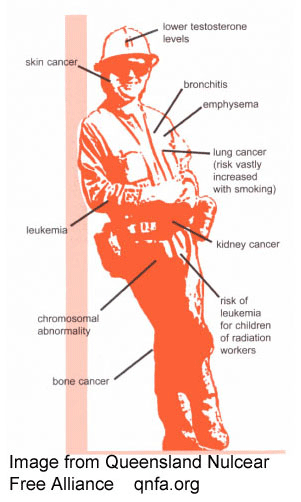 Well -they carefully haven’t kept health records, have they?
OCCUPATIONAL HEALTH AND SAFETY, Parliament of Australia
4.1 The perception that uranium mining has not led to ill health effects in workers has been created through the lack of comprehensive studies on worker health and the failure of Governments to establish a national registry for health workers. …..
Uranium mining, however, presents unique risks over other mining operations. Because of the presence of radioactive elements, uranium miners are at risk not only of immediate health problems, but of delayed fatal effects such as cancer. There is also the potential for radiation exposure to lead to illness and defects in the offspring of uranium miners
RADIATION EXPOSURE FOR URANIUM MINERS. The potentially serious effects of radiation on workers has been shown by previous mines in Australia. Evidence was given to the Committee that 40% of underground workers at the Radium Hill mine in South Australia have died of lung cancer [12]. Even with more recent mining operations it was clear that worker health and safety was not given the priority it deserves. On a trip to the closed Narbarlek mine, the Committee saw worker health records and files left scattered on the floor of an abandoned administrative building. When the Committee visited WMC’s Olympic Dam mine, it saw workers who were not wearing the Thermoluminescent Dial (TLD) badges which register their exposure to radiation. https://www.aph.gov.au/Parliamentary_Business/Committees/Senate/Former_Committees/uranium/report/d05#10
Kirsten Johnson
kirstjohn@aapt.net.au I have a father, uncle and two aunts who all worked at Rum Jungle in the 1960’s. My father and uncle passed away in their 60’s due to lung cancer. My aunt in her 60’s due to breast cancer and my other aunt who is still with us today has also had breast cancer. Surely this cannot be a coincidence and I would like to know if there is information with regards to the health impact that the Rum Jungle uranium mine has had on past workers.
Janet Dickinson nee Litchfield
dickinsonjanet@hotmail.com – I am Kirsten Johnson’s aunt, and sister to Judy, Peter and Kevin Litchfield who passed away with cancer. all having worked at Rum Jungle in the 50’s. My father in law also passed away in 1979, aged 70 from lung cancer, he worked at Rum Jungle for 20 years from 1958. I have just recently been diagnosed with inoperable lung cancer.
 Health effects on Aboriginal people near Ranger uranium mine.
….Since 1981, three years after mining began, at least 120 ‘mishaps’ and ‘occurrences’ — leakages, spillages of contaminated water, and breaches of regulations — have occurred. The Office of the Supervising Scientist has consistently claimed no harm to either the environment or human health — a claim difficult to substantiate. Since completion of the AIATSIS social impact monitoring report in 1984, there has been no monitoring of the social and physical impact on Aboriginal health and well-being, and no agency has specifically investigated the impacts on Aboriginal health.
Exploratory research undertaken in 2005 and 2006 has found a significant overall increase in the incidence of cancer among Aboriginal people in the Kakadu region — some ninety per cent greater than would be expected. We could not determine possible effects on maternal and child health because data on congenital malformations and stillbirths were not available. …. https://aiatsis.gov.au/sites/default/files/products/discussion_paper/dp20-aborigines-uranium-monitoring-health-hazards_0.pdf
Concerns about the safety of 5G mobile network technology

we just don’t know what exactly is going on, and therefore we should be cautious.
|
5G is being rolled out in Australia. Is the radiation safe? ABC 23 MAY 2019 By the end of this year, a new super-fast mobile network will be operating in all major capital cities and regional areas in Australia.
5G represents the fifth generation of mobile network technology, and it promises to be as much of a leap forward as 4G mobile broadband was back in 2011. As the rollout proceeds, however, it’s become a focal point for longstanding concerns about the health effects of electromagnetic radiation. “I’m very concerned about 5G. I already get headaches from 4G and wifi,” Oliver in Mackay wrote in to Hack. A Sydney resident told the ABC recently: “We don’t want it here. It causes us great anxiety that this thing is going to be running 24-7.”…… Australian and many other national health regulators say 5G is safe, while some recognised researchers urge caution. What is 5G?As with previous generational upgrades, the new tech is much faster than the existing network: Telstra recently achieved network speeds of around 3Gbps – about 60 times faster than 4G. It’s likely to be used for driverless cars and virtual reality, as it allows much larger amounts of data to be transferred with less time between the signal being sent and received. It achieves this speed and bandwidth partly through using higher frequencies of electromagnetic waves than 4G or any of the previous mobile networks. To understand what this means, let’s go back to high school physics: Mobile phones and mobile towers emit radiation, as do radios, microwaves, X-ray machines, and the sun. Radiation can be broadly divided into ionising and non-ionising types. Ionising radiation is powerful enough to damage DNA, which is why you have to be careful about too much sunlight or too many X-rays. Non-ionising radiation doesn’t have enough energy to break our DNA, and therefore we have traditionally thought it cannot cause cancer. 5G-type electromagnetic waves are a higher frequency than 4G (and therefore further up the spectrum towards X-rays) but still on the non-ionising side. Because they have shorter wavelengths, the waves are less able to penetrate solid objects (e.g. sunlight can’t go through a wall, but radio waves can). For this reason, 5G requires heaps of suitcase-size cell boxes to boost the signal and direct it around corners and other obstacles. These will be a lot more numerous than 4G towers. Leszczynski says these studies are evidence it also has a non-thermal effect. If that’s true, it would overturn the scientific basis of our current limits on mobile phone radiation exposure. However, these studies are limited. As Leszczynski says: “This result is from epidemiological studies that can show only whether there’s an increase or not an increased risk of developing disease. “They cannot demonstrate in particular this radiation has caused this cancer.” His point is that we just don’t know what exactly is going on, and therefore we should be cautious. What effect does it have?One reason we don’t know is because it’s very difficult to study the long-term effect of cellphone radiation on humans. Unlike, say, smoking, we’re unable to expose one group to radio frequencies, and then compare their health with the non-exposed population. Cellphone radiation is already everywhere, plus the frequency of radiation has changed rapidly over a relatively short period of time. The way we use our phones has also changed (for example, now children are more likely to use phones than before). That leaves studies on animals: In 1999, the US FDA asked the National Toxicology Program (NTP) to study the toxicity and cancer-causing capability of cellphone radio-frequency radiation. This was a US$30 million undertaking. The scientists had to have special chambers built in Switzerland so they could control exactly how much radiation the animals were getting. The draft findings came out nearly 20 years later, in 2018. It found that several rats and mice that had been blasted with with large amounts of radiofrequency electromagnetic radiation for two years exhibited tumours. “We believe that the link between radio frequency radiation and tumors in male rats is real, and the external experts agreed,” said NTP’s John Bucher in a statement. But the researchers struggled to form conclusions from the study. The rodents were exposed to much greater levels of radiation than a person would using a mobile phone or another consumer device. There was also no clear linear relationship between higher radiation exposure and more cancer. Also, humans absorb radiation differently to rats and mice. Given this uncertainty, it’s a big leap to pause the technology without any evidence of ill-effects. A huge chunk of the population has been using mobile phones for over two decades, and there hasn’t been an observed increase in cancer rates. Professor Rodney Croft from the Australian Centre for Electromagnetic Bioeffects Research at the University of Wollongong argues we can be confident in the relative safety of non-ionising radiation. “The reality is we know a lot about the mechanisms involved with the interactions with electromagnetics fields and the body,” he told Hack. The only effect we see is a small temperature rise………https://www.abc.net.au/triplej/programs/hack/what-experts-say-on-the-radiation-safety-of-5g-network/11143020 |
|
|
A Maralinga nuclear veteran’s grim story
 Maralinga nuclear bomb test survivor reveals truth of what happened in the SA desert https://www.adelaidenow.com.au/messenger/east-hills/maralinga-nuclear-bomb-test-survivor-reveals-truth-of-what-happened-in-the-sa-desert/news-story/697b17f6d3427a78aa0262b09727c169, 24 Apr 19
The nuclear bomb tests, under British Government control, at Maralinga in far west South Australia in the 1950s were conducted at the highest level of secrecy. But they had thousands of witnesses. Most were Australian servicemen, innocently used as guinea pigs and exposed to deadly radiation. Craig Cook talks to a survivor, one of the last of a group of men who built the Maralinga camp as part of 23 Construction Squadron and watched in awe as the bombs were exploded, little knowing they were risking their lives and the futures of their children.
Tony Spruzen knew the drill at the top secret Maralinga facility in the South Australian desert in the spring of 1956.
Just like hundreds of others at the nuclear site at 11-mile camp during Operation Buffalo, he was told to turn his back and cover his eyes to protect himself from the gigantic glare of the exploding atomic bomb.
What they didn’t tell the Australian Army sapper was, at the moment of the flash of detonation, he would see the bones of his hand through his tightly shut eyelids.
“It was like a massive x-ray,” Tony, 83, from Glengowrie says. ‘Unlike anything I’d ever known before.”
A week after One Tree, on October 6, 1956, Spruzen witnessed the detonation of Buffalo 2, named Marcoo.
The bomb was only a tenth the size of One Tree but this time was detonated directly above and just under the ground.
“The bomb was in an amphitheatre of hills and we were far closer to that one, maybe only 200 yards away,” he remembers.
“We were close enough to see the trenches with dummy soldiers in them holding rifles and fake aeroplanes and tanks used to test the blast effect.
“And we could see the scientists walking around in their white suits checking out the site before and afterwards but we were just in khaki shorts and short sleeved shorts. Even the dignitaries had no protection.”
Every hour, from five hours out, an elaborate PA system across the complex announced the timing of the bomb detonation.
In the final 30 seconds, and with a rising and excited inclination, the voice on the PA dramatically counted….ten, nine, eight…down to zero.
When Marcoo exploded at 7am it only took a few seconds for a heavy shower of dust to descend on the witnesses.
“We had this large piece of litmus paper attached to our shirts,” Spruzen recalls
Spruzen, originally from Victoria and a carpenter by trade, enlisted in the Army at just 16.
Four year later he was at Maralinga as part of a detachment of 23 Construction Squadron, an acclaimed unit of the Royal Australian Engineers and exclusively raised in South Australia.
Around 40 young men were selected from the unit to build a desert tent camp with cook houses and latrines for the Commonwealth military ‘high-ups’ who were having their first look at the impact of the devastating nuclear weapon.
Around 200km from the ocean, the tent city gained the facetious name of the ‘Sea View Holiday Camp’.
“It was an adventure…we were all excited,” he recalls.
“A lot of young single guys together and we had some fun.”
The lads knew it was serious too as this was a hush-hush operation. They weren’t even allowed to take a camera along for snapshots so Spruzen has no personal photos from Maralinga.
“Then we all turned around to see this mushroom cloud climbing into the sky. The next thing was the blast. The boom was deafening…and then the wind came about thirty seconds after that blowing dust and soil and debris all over us.”
But he does have a terrible reminder of his three months spent in far western South Australia.
“Of the 40 men who went up with me I only know of three of us still around,” he says. “The rest have all died – many from cancers.”
The first Maralinga bomb, Buffalo 1, with the nickname One Tree, was detonated after being dropped from a 31m high tower.
At 15 kiloton it was the same size as Little Boy, the bomb dropped by the US air force that demolished the Japanese city of Hiroshima in August 1945, killing more than 100,000 instantly and tens of thousands slowly in the aftermath from burns and radiation poisoning.
“They said, keep an eye on that and if it changes to pink come and see us. Well it turned pink for every one of us.
“Had I have known what I know now I wouldn’t have been so close.”
Transferred to Sydney on a training course, Spruzen missed the final two detonations at Maralinga that year: on October 11, 1956, Buffalo 3 (Kite) was released by a Royal Air Force Vickers Valiant bomber, the first drop of a British nuclear weapon from an aircraft; and then on October 22, and again dropped from the 31m tower, (Buffalo 4) Breakaway exploded.
There were a total of seven nuclear desert tests at Maralinga performed during Operations Buffalo and Antler.
The 1985 McClelland Royal Commission heavily criticised the detonations, declaring the weather conditions were inappropriate and led to the widespread scattering of radioactive material.
The radioactive cloud from Buffalo 1 reached more than 11,000m into the air and with a northerly wind blowing radioactivity was detected across Adelaide.
Radioactive dust clouds from other bombs were detected in Northern Territory, Queensland and across New South Wales, as far away as Sydney, 2500km from Maralinga.
Around 12,000 Australian servicemen served at British nuclear test sites in the southern hemisphere between 1952 and 1963.
In recent years, the British Government’s claim that they never used humans “for guinea pig-type experiments” in nuclear weapons trials in Australia has been revealed to be a lie.
Tony Spruzen has struggled to come to terms with being placed in danger by his own government who had full knowledge of the consequences of exposure to radiation.
“Once we all found out later what we’d been exposed to at Maralinga it makes you very angry,” he says.
“We believed them when we were told we would be safe — but we haven’t been.”
Spruzen met his wife Shirley, the daughter of an army veteran, in Adelaide where they settled after marriage in June 1960. He left the army seven months later to work in civil construction. He thought his Maralinga days were well behind him but soon after they came to haunt him.
In the first four years of marriage, the couple agonisingly suffered six miscarriages, including twins.
Alarm bells started ringing when he was sent a survey from Veterans Affairs asking about his general health and, specifically his history of cancers.
“It turned out those involved in the atomic tests had a 30 per cent higher chance than getting cancers than the general public,” he says.
“Most of those got them within the first five years and a majority of those were dead before a decade had passed.”
Spruzen, who eventually had three children with Shirley, didn’t get cancer at that time, although he has since had several melanomas removed.
But when his son was diagnosed with acute myeloid leukaemia at the age of 41, he wondered about the possibility of faulty genes, damaged by exposure to radiation, as has been documented in Japanese survivors of the atomic bombs, jumping a generation.
“My son was told by the QEH (Queen Elizabeth Hospital) there was nothing could be done for him but we went up to Queensland and after a bone marrow transfer from his sister he survived,” he adds.
“A decade on he’s working as strong as he has but I don’t think his condition was a coincidence given my history.
“There’s been nothing (compensation) for those of us who were there although they gave us a white card for our cancers and now we have a (full health) gold card.”
Ken Daly, President Royal Australian Engineers Association says it is the least the men, who literally put their bodies on the line, deserve.
“You get these young men, aged around 25-30, with a history of exposure to radiation, coming down with cancers in those numbers and you just know what has caused it,” he says.
“Many died within a few years of being exposed to the fallout and many passed on generational health problems and birth defects to their children.”
Mr Daly, who was based at Warradale Barracks for 15 years, where 23 Construction was based until being disbanded in the early 1960s, hadn’t heard of the Squadron until around five years ago.
Since then he has been central to the group gaining due recognition.
In its earliest days the Squadron, with a strength of eight officers and 160 in other ranks, built the El Alamein Army Reserve camp, part of which later became the Baxter Detention Centre, outside of Port Augusta.
It also assisted the South Australian community by providing aid during bush fires, the grasshopper plague of 1955, and significant infrastructure construction.
During the record flood of 1956, while those squad members were at Maralinga, the rest of 23 Construction were out sandbagging River Murray towns and then cleaning up after the water receded.
In 2011, the Royal Australian Engineers constructed a memorial at Warradale to all who have served in its ranks.
This year a bronzed engineer’s slouch hat, of actual size, by Western Australian sculptor and former army engineer Ron Gomboc will be incorporated into the memorial.
“The hat will be mounted on the memorial in such a way it will look like it’s suspended in mid-air,” Daly adds.
“It acknowledges the ultimate sacrifice of the more than 1250 engineers who died in World War I and the remarkable service and sacrifice of 23 Construction Squadron that has never been recognised before.”
The slouch hat, costing $6,000 and one of only six to have been cast, will be unveiled during a service at Warradale Barracks at midday on Sunday April 28.
Contact Ken Daly at dailydouble@bigpond.com for further details.
The health dangers from climate change – catching Australia unprepared
Australia’s health system unprepared for climate change, experts warn, New Daily, 15 Apr 19, Australia is unprepared for coming health emergencies caused by global warming disasters, public health experts have warned.
From floods to heatwaves, droughts, cyclones and bushfires, the “frequency, intensity, and duration” of natural disasters in Australia is increasing, and our health systems are struggling to cope, three leading public health experts said.
While Australia is geophysically stable and protected “to some extent” from “catastrophic events” such as earthquakes and tsunamis, we are vulnerable to “climate-related disasters and emergencies”, the researchers wrote in the Medical Journal of Australia on Monday.
Titled Resilient health systems: preparing for climate disasters and other emergencies, the article was co-authored by Queensland University of Technology professor of Public Health Gerard FitzGerald, University of Sydney’s Professor Anthony Capon and Queensland Health Disaster Management Unit’s Dr Peter Aitken.
Australia must prepare its health systems for climate-related disasters and emergencies by adopting a “comprehensive whole-of-system approach” integrating “all elements of population health and health care”, from preparedness to response and recovery, they said. ……
The warning follows the release of a landmark report by the United Nations Intergovernmental Panel on Climate in October, which found that some of the most dire consequences of global warming will occur earlier than predicted, with time running out to avoid the most catastrophic effects…….
Across Australia, two-thirds of the population will be vulnerable to infection for eight months of the year, while the top end of the country will be vulnerable to infection 12 months a year, the study found.
Climate change an economic and national security risk…… https://thenewdaily.com.au/news/national/2019/04/15/australia-health-system-climate-change/
1 This month

of the week – Australians for War Powers Reform (AWPR)
To see nuclear-related stories in greater depth and intensity
 Antinuclear