Court action in India against Adani – allegations of ‘coercion, fraud and undue influence’
 Adani power plant and coal plans threatened by land owner court action, ABC News, By Stephen Long, 11 July 20
The case filed with the court accuses Adani and its agents of using “coercion, fraud [and] undue influence” to illegally exclude thousands of people affected by the development from a required social impact assessment.
The claimants allege that a key meeting was full of labourers “from far away” who were paid to attend a crucial public hearing about the development and — in conjunction with local police — used brutal force to keep villagers opposed to Adani’s project out.
“Thousands of people gathered to go into the venue site but they were prevented both by the police, who were acting as agents of private company Adani Power Limited, as well as by their security guards,” the writ filed with the court alleges.
“The situation was so bad that the police lathi [baton] charged the affected families. When they tried to attend the public hearing were beaten mercilessly.”
Residents challenge land acquisition
The court case also challenges the forced takeover of land for the development by the State Government on behalf of Adani.
Under Indian law, a government can only acquire land for a private company if the project is for “public purpose”.
The claimants argue the project does not meet the definition of “public purpose” under the law.
Part of their argument is that the power plant will have few local benefits, since the electricity will all be exported and the coal used to generate the power will all be imported — largely from Australia.
“It is crystal clear from the various documents of Adani Power Limited that the power which shall be generated from this private project shall be exported to Bangladesh [while] the coal shall be imported from Australia … to Dharma Port and transported to the project covering a distance of around 700km causing immense pollution in transportation.
“Thus, there is not even a semblance of public interest.”….
The irony is that Jharkhand is a resource-rich state, accounting for more than 40 per cent of the mineral resources of India, and the Adani power project is situated amid some of the richest coal deposits in the nation.
Adani’s own Jitpur coal mine is just kilometres away from the project site; when the plant was first proposed five years ago, this was to be the source of the coal.
But those plans rapidly changed, apparently because under Indian law domestic coal cannot be used for thermal power projects that will export electricity to another country.
So, Adani now appears set to transport imported coal vast distances, at extraordinary expense, into a state that is home to the biggest coal reserves in India…….
‘Land is indispensable to a Santhal’
The patriarch of the Adani business empire, Gautam Adani, is one of the richest men in India, while many of the villagers affected by the Godda power project are from the other end of the wealth spectrum.
Some are from the lowest castes in the Hindu religion and others are from an Indigenous tribal group known as the Santhal.
Archaeologists estimate that the Santhal have been in eastern India for up to 65,000 years. Like Aboriginal Australians, they have an ancient and spiritual connection to the land that has long been recognised in legislation.
“Land is indispensable to a Santhal,” a local villager explained to the independent Indian filmmaker who shared her interviews with the ABC.
“It is an intrinsic part of culture. The Santhal tribe and their land are like two sides of one coin. If land exists, Santhal exists, but if the land is taken away it just means they will be totally wiped out.”
The Santhal have a practice of burying their dead in the fields they sow, which become sacred to them.
One of them says: “We belong here, this is our ancestral land. We are buried on our land. We have no problem dying on our land but we will not give it away.”
Santhal land rights have previously been protected under a long-standing law which prohibited industrial development on their farming lands, but the laws have recently been watered down…….
those fighting the project face a race against time; the High Court case, and a separate environmental challenge before India’s National Green Tribunal — scheduled for hearings in early August — will be of no consequence if construction reaches a point where the development becomes a fait accompli.
Curiously, geopolitics is working in favour of the project’s opponents.
Adani has contracts with a Chinese firm for equipment purchases and engineering work on the power plant.
With a border conflict taking India and China close to war, Adani is facing political pressure to terminate the deal, which could further delay or even jeopardise the project. https://www.abc.net.au/news/2020-07-10/adani-godda-power-plant-threatened-by-land-owner-court-action/12439624
Julian Assange’s father in tireless fight to free his son, calls on Scott Morrison to help Australian citizen Julian
 Assange’s father calls extradition process ‘disgrace’ https://telanganatoday.com/assanges-father-calls-extradition-process-disgrace?fbclid=IwAR1a7bQ0W_Xcgc9EIeGaAHVP7Zmm2cM6nNV65ZXtkhCwNUlarqIYTJVw6xo1 July 20, The 80-year-old is organizing public events in Australia despite the ongoing coronavirus pandemic and hopes to travel to London in August to support Assange during his extradition trial.
Sydney: WikiLeaks founder Julian Assange’s father, John Shipton, is fighting tirelessly for the release and return of his son, who is facing an extradition trial in London for publishing classified information, a process he described as abuse.
“We maintain that the extradition request is a fraud in the English court… It’s a fraud in the English legal system, it’s a case of abuse of process, it is a disgrace,” Shipton, who travelled from Melbourne to Sydney to campaign for his son’s release, told Efe news in an interview.
The 80-year-old is organizing public events in Australia despite the ongoing coronavirus pandemic and hopes to travel to London in August to support Assange during his extradition trial which, he says, is being carried out under “dire” circumstances.
In May 2019, the UN Special Rapporteur on Torture, Nils Melzer, said, after visiting Assange in the Belmarsh prison along with two medical experts, that he showed “all symptoms typical for prolonged exposure to psychological torture, including extreme stress, chronic anxiety and intense psychological trauma”.
Assange has spent almost a decade in confinement, first under house arrest in a British town and then at the Ecuadorian embassy in London between 2012 until 2019, when Ecuador withdrew his political asylum status.
Shipton has urged the Australian government to mediate with the UK administration for the release of his son, who is wanted in the US on 18 charges of espionage and computer intrusion, for which he could be sentenced to prison for up to 175 years.
“I believe the government can, if it wishes to, assist us in bringing Julian home. I believe that (it) is very simple for the Prime Minister (Scott Morrison) to pick up the phone and ring (his UK counterpart) Boris Johnson and say Julian Assange is an Australian citizen in dire circumstances.
“This will resolve this immediately and that’s easily possible,” he told Efe news during the interview.
USA adds a new indictment to its charges against Julian Assange
WikiLeaks founder Assange faces new indictment in US, By ERIC TUCKER, 29 June 20, WASHINGTON (AP) — WikiLeaks founder Julian Assange sought to recruit hackers at conferences in Europe and Asia who could provide his anti-secrecy website with classified information, and conspired with members of hacking organizations, according to a new Justice Department indictment announced Wednesday.The superseding indictment does not contain additional charges beyond the 18 counts the Justice Department unsealed last year. But prosecutors say it underscores Assange’s efforts to procure and release classified information, allegations that form the basis of criminal charges he already faces.
Beyond recruiting hackers at conferences, the indictment accuses Assange of conspiring with members of hacking groups known as LulzSec and Anonymous. He also worked with a 17-year-old hacker who gave him information stolen from a bank and directed the teenager to steal additional material, including audio recordings of high-ranking government officials, prosecutors say.
Assange’s lawyer, Barry Pollack, said in a statement that “the government’s relentless pursuit of Julian Assange poses a grave threat to journalists everywhere and to the public’s right to know.”
“While today’s superseding indictment is yet another chapter in the U.S. Government’s effort to persuade the public that its pursuit of Julian Assange is based on something other than his publication of newsworthy truthful information,” he added, “the indictment continues to charge him with violating the Espionage Act based on WikiLeaks publications exposing war crimes committed by the U.S. Government.”
Assange was arrested last year after being evicted from the Ecuadorian Embassy in London, where he had sought refuge to avoid being sent to Sweden over allegations of rape and sexual assault, and is at the center of an extradition tussle over whether he should be sent to the United States.
The Justice Department has already charged him with conspiring with former U.S. Army intelligence analyst Chelsea Manning in one of the largest compromises of classified information in U.S. history by working together to crack a password to a government computer.
Prosecutors say the WikiLeaks founder damaged national security by publishing hundreds of thousands of classified documents, including diplomatic cables and military files on the wars in Iraq and Afghanistan, that harmed the U.S. and its allies and aided its adversaries.
Assange maintains he was acting as a journalist entitled to First Amendment protection. His lawyers have argued the U.S. charges of espionage and computer misuse were politically motivated and an abuse of power.
Assange generated substantial attention during the 2016 presidential election, and in investigations that followed, after WikiLeaks published stolen Democratic emails that U.S. authorities say were hacked by Russian military intelligence officials. An investigation by special counsel Robert Mueller revealed how Trump campaign associates eagerly anticipated the email disclosures. One Trump ally, Roger Stone, was found guilty last year of lying about his efforts to gain inside information about the emails. Assange, however, was never charged in Mueller’s Russia investigation.
The allegations in the new indictment center on conferences, in locations including the Netherlands and Malaysia in 2009, at which prosecutors say he and a WikiLeaks associate sought to recruit hackers who could locate classified information, including material on a “Most Wanted Leaks” list posted on WikiLeaks’ website.
According to the new indictment, he told would-be recruits that unless they were a member of the U.S. military, they faced no legal liability for stealing classified information and giving it to WikiLeaks “because ‘TOP SECRET’ meant nothing as a matter of law.”
At one conference in Malaysia, called the “Hack in the Box Security Conference,” Assange told the audience, “I was a famous teenage hacker in Australia, and I’ve been reading generals’ emails since I was 17.”
Assange faces new indictment in US
|
WikiLeaks founder Assange faces new indictment in US, https://apnews.com/218d39782d70c434533b8faa033eb45e By ERIC TUCKER, 26 June 20 WASHINGTON (AP) — WikiLeaks founder Julian Assange sought to recruit hackers at conferences in Europe and Asia who could provide his anti-secrecy website with classified information, and conspired with members of hacking organizations, according to a new Justice Department indictment announced Wednesday. The superseding indictment does not contain additional charges beyond the 18 counts the Justice Department unsealed last year. But prosecutors say it underscores Assange’s efforts to procure and release classified information, allegations that form the basis of criminal charges he already faces. Beyond recruiting hackers at conferences, the indictment accuses Assange of conspiring with members of hacking groups known as LulzSec and Anonymous. He also worked with a 17-year-old hacker who gave him information stolen from a bank and directed the teenager to steal additional material, including audio recordings of high-ranking government officials, prosecutors say. Assange’s lawyer, Barry Pollack, said in a statement that “the government’s relentless pursuit of Julian Assange poses a grave threat to journalists everywhere and to the public’s right to know.” “While today’s superseding indictment is yet another chapter in the U.S. Government’s effort to persuade the public that its pursuit of Julian Assange is based on something other than his publication of newsworthy truthful information,” he added, “the indictment continues to charge him with violating the Espionage Act based on WikiLeaks publications exposing war crimes committed by the U.S. Government.” Assange was arrested last year after being evicted from the Ecuadorian Embassy in London, where he had sought refuge to avoid being sent to Sweden over allegations of rape and sexual assault, and is at the center of an extradition tussle over whether he should be sent to the United States. The Justice Department has already charged him with conspiring with former U.S. Army intelligence analyst Chelsea Manning in one of the largest compromises of classified information in U.S. history by working together to crack a password to a government computer. Prosecutors say the WikiLeaks founder damaged national security by publishing hundreds of thousands of classified documents, including diplomatic cables and military files on the wars in Iraq and Afghanistan, that harmed the U.S. and its allies and aided its adversaries. Assange maintains he was acting as a journalist entitled to First Amendment protection. His lawyers have argued the U.S. charges of espionage and computer misuse were politically motivated and an abuse of power. Assange generated substantial attention during the 2016 presidential election, and in investigations that followed, after WikiLeaks published stolen Democratic emails that U.S. authorities say were hacked by Russian military intelligence officials. An investigation by special counsel Robert Mueller revealed how Trump campaign associates eagerly anticipated the email disclosures. One Trump ally, Roger Stone, was found guilty last year of lying about his efforts to gain inside information about the emails. Assange, however, was never charged in Mueller’s Russia investigation. The allegations in the new indictment center on conferences, in locations including the Netherlands and Malaysia in 2009, at which prosecutors say he and a WikiLeaks associate sought to recruit hackers who could locate classified information, including material on a “Most Wanted Leaks” list posted on WikiLeaks’ website. According to the new indictment, he told would-be recruits that unless they were a member of the U.S. military, they faced no legal liability for stealing classified information and giving it to WikiLeaks “because ‘TOP SECRET’ meant nothing as a matter of law.” At one conference in Malaysia, called the “Hack in the Box Security Conference,” Assange told the audience, “I was a famous teenage hacker in Australia, and I’ve been reading generals’ emails since I was 17.” |
|
Julian Assange’s fiancé calls on the Australian government to secure his freedom
|
Julian Assange’s fiancé calls on the Australian government to secure his freedom, https://www.wsws.org/en/articles/2020/06/22/assa-j22.html, By Oscar Grenfell, 22 June 2020Stella Morris, the fiancé of Julian Assange and mother of his two young children, issued a powerful call last night for the Australian government to secure the WikiLeaks founder’s freedom and prevent his extradition to the US, where he faces life imprisonment for exposing American war crimes.
Morris was featured on Channel Nine’s “60 Minutes” program. The 24-minute segment provided an objective account of Assange’s decade-long arbitrary detention, first in Ecuador’s London embassy where he was a political refugee, and since April 2019 in the maximum-security Belmarsh Prison. The program, presented by Tara Brown, was the first substantive examination of Assange’s plight by the Australian media since the coronavirus pandemic began. Despite the fact that he is an Australian journalist being persecuted by the most powerful governments in the world for his publishing activities, corporate media outlets have maintained an effective D-notice on Assange for more than three months. This has dovetailed with the refusal of the Australian government, the Labor opposition and all of the official parties to defend the WikiLeaks founder. Morris warned that Assange’s incarceration in Belmarsh, which she noted has been dubbed the “UK’s Guantanamo Bay,” is exacerbating physical and psychological health issues stemming from his protracted persecution. “He’s very unwell and I’m very concerned for his ability to survive this,” she said. “Now he’s in the UK’s worst prison. It’s a high-security prison. One in five prisoners are murderers. He shouldn’t be there. He’s not a criminal, he’s not a dangerous person, he’s a gentle intellectual thinker and a journalist. Those people are not the people who belong in prison.” Morris stated that she was “very worried” about Assange’s circumstances. She has been unable to visit him since February, as a result of coronavirus lockdown measures. Despite widespread infections throughout the British penitentiary system, including in Belmarsh, and Assange’s vulnerability to the virus as a result of a chronic lung condition, he has been refused bail. “If you’re separated from your family and you’re alone in a tiny, dark room for 23-hours a day, with no control over your surroundings, I think people can imagine what that is like,” Morris said. Brown stated that in such circumstances, “most people would probably go mad.” Morris responded: “I think any person would get very severely depressed and he is very depressed.” “60 Minutes” showed Morris and her two young children speaking with Assange on the phone. The older of the two asked Assange when he was coming home. Morris, a 37-year-old lawyer, recounted the circumstances of her relationship with Assange. They had grown close when she was working on his legal cases after he had successfully sought political asylum in the Ecuadorian embassy. When the couple’s two children were born in 2017 and 2018, the new Ecuadorian government had initiated closer relations with the US and was increasingly hostile to Assange. UC Global, a Spanish firm contracted to manage the embassy’s security, was surveilling every aspect of Assange’s life and was passing the the material gathered to the US Central Intelligence Agency. When she fell pregnant, Morris informed Assange by writing the news on a piece of paper. They were fearful that any conversation about their personal life would be picked up by the audio recording devices placed throughout the embassy by UC Global. Morris sought to hide her pregnancies from the embassy staff and after the children were born, a friend of Assange pretended to be their father and brought them to the embassy. “The real issue was I thought that our family would be targeted by the same people that were trying to harm Julian,” Morris stated. The program featured news clips of senior US government figures denouncing Assange in hysterical terms and calling for him to be silenced. Morris noted that UC Global had considered stealing the diaper of one of her children to confirm his paternity, and had even discussed plans to kill Assange or allow American agents to kidnap him. Morris commented that it would be difficult for many people to appreciate the lawlessness that had characterised Assange’s persecution. “There’s incredible criminality that has been going on in order to gather information about Julian’s lawyers, and his family, and journalists who were visiting him,” she said. “I’ve been in a permanent state of fear for years and now it’s slowly playing out.” Significantly, the politically-motivated character of Swedish sexual misconduct allegations against Assange was made clear in the program. The allegations were concocted by that country’s police and judiciary, in the midst of a frenzied US campaign against WikiLeaks’ exposure of war crimes in Iraq and Afghanistan. Brown noted that Assange had never been charged with a crime in Sweden, and that the Swedish investigation had been dropped. Australian independent parliamentarian Andrew Wilkie pointed out that documents had shown that the British government used the allegations to enforce Assange’s arbitrary detention in the Ecuadorian embassy. The British authorities had been aware that the Swedish claims were a smokescreen for plans to dispatch Assange to his US persecutors. The program concluded with an appeal from Morris to the Australian government. She said: “I want people to understand that we’re being punished as a family. It’s not just Julian in the prison. The kids are being deprived of their father. I need Julian and he needs me.” Morris declared: “I’d like to ask [Australian Prime Minister] Scott Morrison to do everything he can to get Julian back to his family. If Australia doesn’t step in I’m very fearful this wrong won’t be righted. It’s a nightmare.” Tellingly, Brown stated that Morrison, Foreign Minister Marise Payne and Christian Porter refused to be interviewed. This was in line with the ten-year collaboration of Australian governments in the US-led vendetta against Assange. Beginning with the Greens-backed Labor government of Julia Gillard, they have rejected calls to defend the WikiLeaks’ founder, instead participating in the campaign against him. The official hostility to Assange is bound up with the Australian ruling elite’s unconditional support for the US military alliance and all of American imperialism’s illegal wars and military preparations and dovetails with a domestic assault on democratic rights, including attacks on press freedom and laws increasing punishments for whistleblowers. It is facilitated by the refusal of the Greens, the pseudo-left groups and the unions to mount any campaign for Assange’s rights. This underscores the fact that the fight for Assange’s freedom and for the defence of all civil liberties requires the mobilisation of the working class. The international protests over recent weeks against police violence have demonstrated the objective basis for building such a movement. |
|
Desmond Menz – Constitutional problems in Nuclear Waste Bill – could lead to High Court case?

why ultimately was South Australia the only state to contain the final three sites?
A tiny community poll seems to have informed the final decision, and contradicts the Minister’s stated position of “broad community support”. Just 0.037% of the voting public in SA have had a say.
why did South Australia become the only state to be chosen for the nuclear waste site, knowing that a Citizens Jury in 2016 had rejected a major nuclear waste storage industry in South Australia following the outcomes of the Nuclear Fuel Cycle Royal Commission? The Citizens Jury was substantially more representative of the views of the people of SA, in comparison with the very small poll of the eligible residents of the District Council of Kimba..
former Minister Canavan’s snap decision? The decision on site selection was announced on Saturday morning 1 February 2020, and by the afternoon Senator Canavan had resigned
Desmond Menz SUBMISSION TO ECONOMICS LEGISLATION COMMITTEE OF THE
AUSTRALIAN PARLIAMENT ON THE National Radioactive Waste Management Amendment (Site Specification, Community Fund and Other Measures) Bill 2020 Submission 13
In September 2019 ….I raised critical concerns about the validity of the National Radioactive Waste Management Act 2012 (NRWM Act) in relation to the Australian Constitution, and also the lawfulness of the process about site selection. I also raised concerns about breaches of South Australian law. It seems that my concerns were either ignored or dismissed. I again raise these critical matters for the attention of the Economics Legislation Committee. If they are not responded to, then it would not be too much a stretch of the imagination to have them resolved in a higher court of law, quite possibly the High Court of Australia. In my view, the Economics Legislation Committee should not make any decision on the Amendment Bill until all issues I have countenanced have been resolved.
Main Concerns
1.It is contended that inconsistency between the federal National Radioactive Waste Management Act 2012 (NRWM Act) and the South Australian Nuclear Waste Storage (Prohibition) Act 2000 (NWSP Act) (and other similar state/territory laws), has been manufactured by the Australian Parliament. This is a serious issue, and one that not even the Senate Standing Committee for the Scrutiny of Bills has acknowledged. It is incomprehensible why this matter was not addressed way back in 2010 during the establishment of the NRWM Act.
It is also contended that there are Constitutional matters that need to be resolved to affirm the safety of the federal law, including the Amendment Bill, because at the moment there are sufficient concerns relating to inconsistency between federal and state laws to inhibit the lawful and constitutional passage of the Amendment Bill. [here he gives an example from a previous High Court case]……… Continue reading
Injustice of UK court process regarding Julian Assange. Assange too sick to attend

2. In addition to other ongoing health concerns, Assange faces the serious risk of exposure to Covid in Belmarsh prison, and has been advised that even going to the video room to take part in hearings is unsafe. This is another reason he should be immediately released.
3. Assange’s lawyers have long complained they have had insufficient access to him in prison. Under lockdown conditions, they have had no access to him at all. They have repeatedly flagged that this lack of access seriously impacts their ability to prepare his defence.
4. One of the next steps agreed today is that psychiatric reports on Assange from the prosecution and defence will be due to the court on 31 July. Remember that UN Special Rapporteur @NilsMelzer has expressed alarm many times that Assange shows symptoms of psychological torture.
5. It is a welcome step that the continuation of the full extradition hearing was adjourned, as lockdown conditions present clear barriers to open justice – but 7 September may not be late enough to make a meaningful difference. Also the court is still struggling to find a venue.
6. It remains extremely frustrating that the court does not adequately accommodate NGO observers. I have never experienced so much difficulty accessing a trial in any country as at Woolwich Crown Court in February, and the teleconference option we now have is far from sufficient.
7. The press are also facing severe restrictions. Only 6 journalists have been allowed to attend in person the past 2 hearings, with others limited to the awful phone line. This case is of high public interest and a better solution must be found before the full hearing resumes.
8. Assange’s next callover hearing has been scheduled for 29 June at 10 am. We urge the court to find workable solutions to enable his safe attendance and ensure the press and observers are able to properly monitor proceedings. /END
The push to weaken Australia’s law regulating the uranium industry, in the review of Environmental Protection and Biodiversity Conservation (EPBC) Act

Uranium, extinction, expedited approvals and extreme risks: the need for stronger environmental laws, https://www.onlineopinion.com.au/view.asp?article=20887
| By Mia Pepper – 14 May 2020 |
This year a Review Committee is examining the cornerstone of Australia’s environmental laws – the Environmental Protection and Biodiversity Conservation (EPBC) Act 1999. This review comes hot on the heels of three inquiries into nuclear power driven by conservative politicians and pressure from the nuclear lobby. This cohort are pushing for the removal of laws banning nuclear power, a push the current federal government has already ruled out.
They are also pushing to weaken regulatory requirements for uranium mine assessments through the EPBC Act. There is currently no national prohibition on uranium mining, but prohibitions exist in Victoria, NSW, Queensland, WA, Tasmania and Victoria. SA and the NT have a long and contested history of supplying uranium to fuel nuclear power plants overseas. Uranium from SA and the NT fuelled the Fukushima reactor during the 2011 meltdowns, fires and explosions ‒ a discomforting legacy given that there was ample evidence long before the Fukushima disaster of corruption and inadequate safety standards in Japan’s nuclear industry.
Following the Fukushima disaster the UN Secretary General advised that Australia have “an in-depth assessment of the net cost impact of the impacts of mining fissionable material on local communities and ecosystems.” No such assessment has been carried out. Worse still, the appointment of a former uranium mining company executive to the EPBC Review Committee suggests that there may be some support within the government for a weakening of uranium mining regulations rather than the necessary strengthening.
The reality of uranium mining in Australia has been one of leaks, spills, accidents, license breaches and a failure to rehabilitate. Of the 15 uranium mines that have operated, just two are still mining (Olympic Dam and Beverley Four Mile), one is preparing for closure (Ranger), another is preparing for a second round of rehabilitation failing previous attempts (Rum Jungle), three are on life support in extended care and maintenance; and the remaining sites are all contaminated and require ongoing monitoring and maintenance at the expense of taxpayers.
That track-record strongly suggests the need for greater scrutiny and a strengthening not a weakening of regulations. Proposed changes by the nuclear industry include changing the definition of ‘nuclear actions’ in the EPBC Act to remove the “mining and milling” of uranium. The impact of this would reduce requirements for whole-of-environment assessments for uranium projects and reduce federal oversight. Existing processes desperately need improvement given recent failures around transparency, upholding principles and objects of environmental laws, political influence in decision making, expedited process and unfounded exemptions.
The Ranger uranium mine in the tropical NT, owned by Rio Tinto and operated by ERA, will begin rehabilitation in 2021, a project set to cost in excess of $1 billion. There are ongoing concerns about the funding and adequacy of the proposed rehabilitation. Meeting the regulatory requirement to secure radioactive wastes and other toxins from the environment for 10,000 years is inherently difficult, not least because there is a long history of routine, daily leakage of large volumes of contaminated liquid.
Not far from Ranger, the government-owned Rum Jungle mine has been leaking radioactive and acidic materials into the East Branch of the Finniss River since it was closed in 1971. The NT government has released new plans to remediate the site which is likely to cost in excess of $300 million, but there is still no commitment from the NT or Federal governments to fund this important work.
The legacy threats from uranium mines are unlike the threats from other mines and a repeated failure to contain this waste suggests that mining uranium should be banned, or at the very least have the strictest possible regulations.
There are many other examples of industry and regulatory failure. At the former uranium mine at Radium Hill in SA, the tailings dam was shoddily constructed and was not capped when the mine closed. The Port Pirie uranium treatment plant in SA is still contaminated over 50 years after its closure. SA regulators failed to detect a mining exploration company’s dumping of low-level radioactive waste in the Arkaroola Wilderness Sanctuary. At the Beverley Four Mile in-situ leach uranium mine in SA, contaminated wastewater is routinely dumped in groundwater ‒ a process permitted by regulators who should know better.
In yet another regulatory failure, BHP’s proposal for a new tailing’s facility at its Olympic Dam copper/uranium mine in SA has been fast-tracked without requirements for federal approval. The decision not to assess the new tailings dam came after the Australian National Committee on Large Dams gave three existing tailings dams at Olympic Dam a risk ranking of ‘extreme’ – this ranking is given to tailings facilities that if failed would cause the death of over 100 people. The independent review of tailings followed the Samarco tailings disaster in Brazil, a joint venture project between BHP and Vale, which killed 19 people. The new proposed tailings should be assessed to determine the risk and likelihood of failure; instead, the facility has been fast-tracked avoiding scrutiny under the EPBC Act.
Cameco’s proposed Yeelirrie mine in WA provides another example of unseemly haste and unseemly exemptions. The WA EPA recommended that Yeelirrie not be approved because of the likelihood the mine would cause multiple species extinctions. Despite this recommendation the former State Environment Minister approved the mine weeks before losing his seat and the Liberal party lost Government in the 2017 WA election. In a similar scenario, the mine was given federal approval on the eve of announcing the 2019 federal election. That federal approval followed direct lobbying of Ministers and the Department and resulted in a set of conditions that no longer require the company to prove the mine won’t cause species extinction.
A 2003 report by the federal Senate References and Legislation Committee found “a pattern of underperformance and non-compliance” in the uranium mining industry and it concluded that changes were necessary “in order to protect the environment and its inhabitants from serious or irreversible damage”. The same could be said now. Subsequent reviews of uranium mining regulations in Queensland, WA and Canada identify unique risks with uranium mining and calls for improved and increased regulations that meet those specific challenges and risks.
The push from the industry to weaken regulations should be wholeheartedly rejected and instead the EPBC Committee could consider advice from former UN Secretary General to hold an “in-depth” assessment of the uranium sector and its impacts.
The torture that awaits Julian Assange in the US.
From the frying pan into the fire. The torture that awaits Julian Assange in the US.https://www.thecanary.co/uk/analysis/2020/05/10/from-the-frying-pan-into-the-fire-the-torture-that-awaits-julian-assange-in-the-us/
Tom Coburg 10th May 2020 WikiLeaks founder Julian Assange is currently held in Belmarsh prison awaiting hearings that could see him extradited to the US to face prosecution for alleged espionage-related offences.
Award-winning US journalist Chris Hedges described the torture that would await Assange in the US prison system, adding “they will attempt to psychologically destroy him”. If extradited, Assange would likely be detained in accordance with ‘Special Administrative Measures’ (SAMs). One report equates this to a regime of sensory deprivation and social isolation that may amount to torture.
Journalists speak out
US journalist Chris Hedges spoke about the treatment Assange is likely to receive in the US. He argues that the US authorities will “psychologically destroy him” and that conditions imposed could see him turned into a ‘zombie’ to face life without parole:
Australian journalist John Pilger agrees:
If Julian is extradited to the US, a darkness awaits him. He’ll be subjected to a prison regime called special administrative measures… He will be placed in a cage in the bowels of a supermax prison, a hellhole. He will be cut off from all contact with the rest of humanity.
From the frying pan…
Assange is already in a precarious position, alongside all other UK prisoners. Belmarsh is a high-security Category A facility and, as with all other prisons in the UK, inmates there are at risk to infection from coronavirus (Covid-19).
On 28 April, the BBC reported that there were “1,783 “possible/probable” cases of coronavirus – on top of 304 confirmed infections across jails in England and Wales”. Also that there were “75 different “custodial institutions”, with 35 inmates treated in hospital and 15 deaths”.
Vaughan Smith, who stood bail for Assange, reported that the virus was “ripping through” Belmarsh:
We know of two Covid-19 deaths in Belmarsh so far, though the Department of Justice have admitted to only one death. Julian told me that there have been more and that the virus is ripping through the prison.
Assange has a known chronic lung condition, which could lead to death should he become infected with coronavirus. Assange’s lawyers requested he is released on bail to avoid succumbing to the virus, but that request was rejected.
As for the psychological effects of segregation, a European Committee for the Prevention of Torture and Inhuman or Degrading Treatment or Punishment report argued that it can “can have an extremely damaging effect on the mental, somatic and social health of those concerned”.
…and into the fire
It’s likely that Assange will be placed under SAMs if he is extradited to the US. The Darkest Corner, a report authored by the Allard K. Lowenstein International Human Rights Clinic and The Center for Constitutional Rights, describes how SAMs work.
In its summary, the report explains that:
SAMs are the darkest corner of the U.S. federal prison system, combining the brutality and isolation of maximum security units with additional restrictions that deny individuals almost any connection to the human world. Those restrictions include gag orders on prisoners, their family members, and their attorneys, effectively shielding this extreme use of government power from public view.
It continues:
SAMs deny prisoners the narrow avenues of indirect communication – through sink drains or air vents – available to prisoners in solitary confinement. They prohibit social contact with anyone except for a few immediate family members, and heavily regulate even those contacts. And they further prohibit prisoners from connecting to the social world via current media and news, limiting prisoners’ access to information to outdated, government-approved materials. Even a prisoner’s communications with his lawyer – which are supposed to be protected by attorney-client privilege – can be subject to monitoring by the FBI.
It ominously adds that: “Many prisoners remain under these conditions indefinitely, for years or in some cases even decades”. Moreover, these conditions can be used as a weapon to force a prisoner to plead guilty:
In numerous cases, the Attorney General recommends lifting SAMs after the defendant pleads guilty. This practice erodes defendants’ presumption of innocence and serves as a tool to coerce them into cooperating with the government and pleading guilty.
The report provides further details on how SAMs incorporate sensory deprivation and social isolation measures that “may amount to torture”. Also, it argues that the SAMs regime contravenes both US and international laws.
ECHR article 3
Should the UK courts agree to extradite Assange, he could face months, if not decades, of psychological torture. However, Article 3 of the European Court of Human Rights states clearly: “No one shall be subjected to torture or to inhuman or degrading treatment or punishment”. Under that article, the US extradition request should be rejected by the UK courts.
For a publisher to be subjected to such a nightmare scenario would be intolerable.
Bushfire Survivors for Climate Action taking legal action against NSW Environment Protection Authority
  ‘Kick them into action’: Fire group takes EPA to court over climate, SMH, By Peter Hannam, April 20, 2020 Lisa Roberts spent 25 years building a native plant business that was as sustainable as they come, with off-grid solar power and water harvesting, only to see it go up in flames in the recent bushfires.Her home and nursery in Wandella in southern NSW reduced to rubble, Ms Roberts fled to Canberra, powerless to act as fires threatened another venture in nearby Pialligo. Living in the smoke-choked capital also damaged her vocal cords, which have still not recovered. ‘Kick them into action’: Fire group takes EPA to court over climate, SMH, By Peter Hannam, April 20, 2020 Lisa Roberts spent 25 years building a native plant business that was as sustainable as they come, with off-grid solar power and water harvesting, only to see it go up in flames in the recent bushfires.Her home and nursery in Wandella in southern NSW reduced to rubble, Ms Roberts fled to Canberra, powerless to act as fires threatened another venture in nearby Pialligo. Living in the smoke-choked capital also damaged her vocal cords, which have still not recovered.
“A part of me totally rages at the world for its totally inadequate response to climate change,” Ms Roberts said. “Everybody’s safety is at risk.” That anger is being now channelled into a legal challenge against the NSW Environment Protection Authority. Bushfire Survivors for Climate Action, of which Ms Roberts is a member, began the suit last week with the NSW Environmental Defenders Office “to kick [the EPA] into action”, she said. EDO chief executive David Morris said the case, in the Land and Environment Court, would seek to force the EPA, which does not have a climate policy, to use its powers to keep communities safe from the increasingly severe impacts of a warming world. Mr Morris said the EPA was chosen as a test case among similar agencies nationally in part because of a section of the Protection of the Environment Operations Act 1997. That section requires the agency to “develop environmental quality objectives, guidelines and policies to ensure environment protection”. “It’s an opportunity for the EPA to recognise they have a legal obligation to take action,” he said. “They should have a policy and a plan to address the greatest threat to the environment.”…….. https://www.smh.com.au/environment/climate-change/kick-them-into-action-fire-group-takes-epa-to-court-over-climate-20200418-p54kzl.html
|
|
13 Australian peak Non Government Organisations seek stronger Environmental Law on Nuclear Issues

Joint ENGO Submission on Nuclear Issues as they Relate to the Environmental Protection & Biodiversity Conservation Act Review 2020
This submission is made on behalf of the following national and state peak environment groups:
-
- Australian Conservation Foundation,
- Australian Nuclear Free Alliance,
- Friends of the Earth Australia,
- Greenpeace Australia Pacific,
- Mineral Policy Institute,
- The Wilderness Society,
- Arid Lands Environment Centre,
- Environment Centre NT,
- Environment Victoria,
- Conservation Council SA,
- Conservation Council WA,
- Nature Conservation Council NSW and Queensland Conservation Council.
This submission outlines the importance of retaining s140A of the EPBC Act which prohibits nuclear power; the retention of uranium exploration and mining in the definition of a Nuclear Action and the inclusion of Nuclear Actions as a Matter of National Environmental Significance (MNES).
This submission is made in consideration of the broader objects and principles of the Act and is based on evidence from recent inquiries into both nuclear power and uranium mining. There is clear evidence that nuclear activities can have a significant environmental and public health risk and, in many cases, irreversible impacts, and this is consistent with the current dedicated legislative prohibitions for both nuclear power and scrutiny for uranium mining.
While the current Act does not include a prohibition on uranium mining we strongly advocate that there be a national ban on uranium mining consistent with state legal or policy prohibitions in New South Wales, Queensland, Tasmania, Victoria and West Australia Written by Mia Pepper, Jim Green, Dave Sweeney, David Noonan & Annica Schoo.
Summary of Recommendations
Uranium:
• that uranium mining and milling be included in s140A prohibitions as nuclear actions that the Minister must not approve, on the basis that the nuclear industry has failed to successfully remediate any uranium mine in Australia and has impacts inconsistent with the objects and principles of the EPBC Act.
• if the above recommendation is not adopted that uranium mining and milling remains within the definition of a ‘nuclear action’ and that nuclear actions continue to be listed as MNES and the protected matters continue to be listed as the ‘environment’ and so be subject to full environmental assessment at the state level
• DAWE to initiate an inquiry into the human and environmental impacts of uranium mining, as advised by the UN Secretary General following the Fukushima nuclear disaster, noting that Australian uranium was present in each of the Fukushima Daiichi reactors at the time of multiple reactor meltdowns
. • regulatory reform for existing operating mines • that the review committee recommend DAWE prioritise the rehabilitation of abandoned uranium mines and processing facilities, exploration sites and uranium mines that have been in care and maintenance for more than two years.
Nuclear Power:
• the retention of s140A of the EPBC Act 1999 which states “No approval for certain nuclear installations: The Minister must not approve an action consisting of or involving the construction or operation of any of the following nuclear installations: (a) a nuclear fuel fabrication plant; (b) a nuclear power plant; (c) an enrichment plant; (d) a reprocessing facility.”
Other Matters:
• a National Environmental Protection Authority be established
• the effectiveness of assessment bilateral agreements be reviewed, and approval bilateral agreements are not pursued
• legislate requirements for mine closure, address activities that are used to avoid mine closure and to work with states and territories to remediate existing legacy mine sites
• there be established internal process for DAWE to pursue the listing of newly identified species by referring to the Threatened Species Scientific Committee
• that the principles of free, prior and informed consent become a mandatory operational principle within the EPBC Act along with a governance mechanism to operationalise this principle……… . https://dont-nuke-the-climate.org.au/wp-content/uploads/2020/04/Joint_Sub_EPBC_Nukes_FINAL.pdf
Legal challenge about Adani’s planned water use for giant coal mine
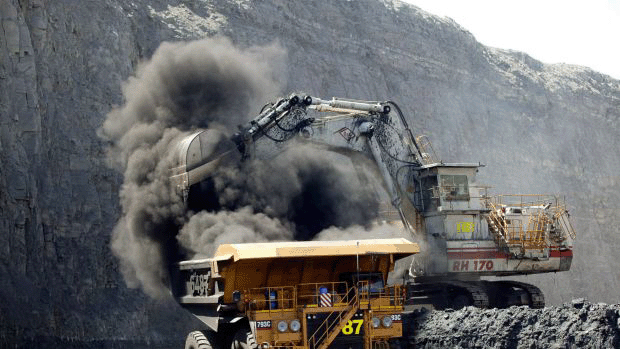 Morrison government faces legal challenge over Adani pipeline plan, Brisbane Times, Peter Hannam, March 16, 2020 The Morrison government’s failure to activate the so-called “water trigger” when assessing the proposed Adani coal mine in Queensland will be challenged in the Federal Court.
Lawyers acting for the Australian Conservation Foundation will test the government’s decision not to refer Adani’s North Galilee Water Scheme, a pipeline supplying the mine, for a thorough assessment as intended by the law.
The water trigger, introduced by the Rudd-Gillard government in mid-2013, was meant to require the government to assess the impact on water of all large coal mines and coal seam gas developments.
However, the government treated Adani’s plan to draw 12.5 billion litres a year from the Suttor River in central Queensland as a pipeline that was not a “large coal mining development”, nor did it involve one.
Similarly, it viewed the pipeline proponent, Adani Infrastructure Pty Ltd, as “a different legal entity” from the coal mine proponent, Adani Mining Pty Ltd.
The foundation plans to test both reasons for the failure not to activate the water trigger in court, arguing that the government made an error in law by ignoring infrastructure that was critical for the coal mine to proceed.
Tony Windsor, the former independent MP who was a key architect of the trigger, said reliable long-term access to clean water was “vital for regional communities and demands that we sustainably manage our rivers and aquifers”.
“Allowing companies to split up mining projects and assess them in isolation makes a nonsense of the process,” he said. “You don’t see much looking at just one piece of the jigsaw – you need to look at the whole puzzle.”……..https://www.brisbanetimes.com.au/environment/sustainability/morrison-government-faces-legal-challenge-over-adani-pipeline-plan-20200316-p54an6.html?ref=rss&utm_medium=rss&utm_source=rss_feed
Court dismisses Aboriginal group’s appeal to stop the Kimba nuclear waste dump
Court rules against bid to stop nuke dump,https://www.transcontinental.com.au/story/6677900/court-rules-against-bid-to-stop-nuke-dump/?cs=9397&fbclid=IwAR25qIOzDiqg20vLhGNb5YS9iUwZJX39yQ3yV5iM_5U86kKJaMUTasN3Slc, Tim Dornin , MARCH 13 2020 -Native title holders on South Australia’s Eyre Peninsula have lost a court bid in their continuing fight to stop the federal government establishing a nuclear waste dump near Kimba.
The government recently named a site on a farming property as the location for the dump which will take Australia’s low to medium-level nuclear waste material.
But the Barngarla Determination Aboriginal Corporation, the native title holders of the region, argued that their 200-strong community had been unfairly excluded from the ballot on their basis of the Aborginality.
They appealed to the Full Court of the Federal Court against a single judge’s decision to uphold the District Council of Kimba’s earlier move.
But the full court dismissed their appeal on Friday.
“It is not correct to say that BDAC’s members were excluded from the ballot,” the court ruled.
“Membership of BDAC was not a characteristic that disqualified any person from the franchise. Rather, the effect of the resolutions was that possession of native title rights and interests was not included among the various qualifying criteria.”
The court found the original decision by a single judge was correct in that it concluded that anyone who fulfilled one of 14 criteria could take part in the vote, irrespective of a person’s race.
“Similarly, the classes of persons who were excluded from the franchise included persons who were Aboriginal and persons who were not,” the appeal judges said.
In his argument, counsel for the Barngarla, Daniel O’Gorman SC, had told the court that their request to take part in the ballot should have been granted.
“This was a ballot of the community, the Kimba community. They are the native title holders of the land surrounding the sites in question,” he said.
“Therefore, we submit, they clearly had an interest in the ballot, they clearly had an interest in the dump and whether it goes ahead or not.
“Their mere standing as native title holders, warranted them being included as part of the community.”
The ballot ultimately returned about 62 per cent support for the dump, which then Resources Minister Matt Canavan accepted as broad community backing.
Those still opposed to the dump going ahead include some locals, environmental groups as well as indigenous communities.
Legislation to allow construction of the waste facility is before the federal parliament.
The underpinning laws allow for acquisition of land for the facility as well as a $20 million payment for the community to help establish and maintain the site, which is expected to operate for at least 100 years. AT TOP https://www.transcontinental.com.au/story/6677900/court-rules-against-bid-to-stop-nuke-dump/?cs=9397&fbclid=IwAR25qIOzDiqg20vLhGNb5YS9iUwZJX39yQ3yV5iM_5U86kKJaMUTasN3Slc
Barngarla Aboriginal people take legal action against Australian govt’s planned Kimba nuclear waste dump
 Indigenous group fights on to stop SA dump https://www.9news.com.au/national/indigenous-group-fights-on-to-stop-sa-dump/d72f3453-28e8-4182-a9bb-6c9390098bf6?fbclid=IwAR3l91JVzBoJhkIhnf49 Feb 21, 2020 Native title holders on South Australia’s Eyre Peninsula are continuing their court fight to stop the federal government establishing a nuclear waste dump near Kimba. Indigenous group fights on to stop SA dump https://www.9news.com.au/national/indigenous-group-fights-on-to-stop-sa-dump/d72f3453-28e8-4182-a9bb-6c9390098bf6?fbclid=IwAR3l91JVzBoJhkIhnf49 Feb 21, 2020 Native title holders on South Australia’s Eyre Peninsula are continuing their court fight to stop the federal government establishing a nuclear waste dump near Kimba.
The government recently named a site on a local station as the location for the dump which will take Australia’s low to medium level nuclear waste material.
The government’s decision was informed in part by a ballot of local residents which supported the proposal.
But it’s that ballot that the Barngarla people are fighting in new Federal Court action.
They’re appealing against a court judgment last year that the council had not acted wrongly in excluding about 200 native title holders from the vote.
Counsel for the Barngarla, Daniel O’Gorman SC, told the court on Friday that their request to take part in the ballot should have been granted.
“They, therefore, are part of the community,” he said.
“This was a ballot of the community, the Kimba community. They are the native title holders of the land surrounding the sites in question.
“Therefore, we submit, they clearly had an interest in the ballot, they clearly had an interest in the dump and whether it goes ahead or not.
“Their mere standing as native title holders, warranted them being included as part of the community.”
The ballot ultimately returned about 62 per cent support for the dump, which then Resources Minister Matt Canavan accepted as broad community backing.
Those still opposed to the dump going ahead include some locals, environmental groups as well as indigenous communities.
Earlier this month, legislation to allow construction of the waste facility was introduced to federal parliament.
The underpinning laws allow for acquisition of land for the facility as well as a $20 million payment for the community to help establish and maintain the site which is expected to operate for at least 100 years.
The Federal Court’s ruling on the Barngarla appeal is expected to be handed down on a date to be fixed.
|
|
|
Immoral and illegal spying on Julian Assange and his lawyers – MP Andrew Wilkie calls on Australian government to act.
|
Wilkie says Assange extradition efforts should be dropped after US spying revelations, https://www.theage.com.au/politics/federal/wilkie-says-assange-extradition-efforts-should-be-dropped-after-us-spying-revelations-20200223-p543j3.html, By Rob Harris, February 24, 2020 The revelation Julian Assange’s confidential conversations with his Australian lawyers were secretly recorded should force the British courts to throw out attempts to extradite him to the United States, independent MP Andrew Wilkie says.Mr Wilkie has again called on Prime Minister Scott Morrison to lobby the British government to reject the United States attempts to extradite Australian-born WikiLeaks founder who faces several espionage charges over the publication of hundreds of thousands of confidential government documents.
A Spanish private security company is under investigation over allegations it spied on Mr Assange while he was living at the Ecuadorian embassy, passing on hundreds of hours of recordings and other surveillance to American intelligence, according to former workers at the Spanish company. The ABC reported on Sunday that Mr Assange’s Australian lawyers, including prominent QC Geoffrey Robertson, were also among those spied on in “Operation Hotel”. Mr Wilkie, who met with Mr Assange as part of Australian parliamentary delegation in London last week, told The Sydney Morning Herald and The Age the actions were “immoral and illegal”. “It alone should be the basis for the extradition to be dropped this week,” Mr Wilkie said. “If the court doesn’t drop the proceedings in light of these allegations, a question mark hangs over the court’s neutrality. It just adds to the injustice that’s being experienced by Julian”. The ABC reported the covert surveillance was uncovered through a public investigation into the Spanish company, UC Global, contracted by the Ecuadorian government to provide security at the embassy. WikiLeaks Spanish lawyer, Aitor Martinez, told the ABC it came to light after Mr Assange was arrested, when former UC Global employees provided a large file of material.
Hundreds of supporters of Julian Assange marched through London on Saturday to pressure the British government into refusing to extradite the WikiLeaks founder to the United States to face spying charges. Famous backers, including Pink Floyd’s Roger Waters, Pretenders singer Chrissie Hynde and fashion designer Vivienne Westwood joined the crowd protesting the US espionage charges against the founder of the secret-spilling website. He will again face an extradition hearing on Monday night (Australian time) relating to US criminal charges against him for his role in the WikiLeaks releases of classified US government material. WikiLeaks adviser Jennifer Robinson, one of the Australian lawyers caught in the spying operation, said the federal government had not done enough to protect Mr Assange. “His Australian lawyers — all of us Australian citizens — have [also] had our rights as lawyers and our ability to give him a proper defence superseded by the US and potentially the UK government,” she told the ABC. “This is something that the Australian government ought to be taking very seriously and ought to be raising, both with the UK and with the United States. It is time the Australian government stands up for this Australian citizen and stops his extradition.” A spokesman for the Department of Foreign Affairs and Trade said the Australian government had discussed Julian Assange’s circumstances with partners, including as recently as during the UK Foreign Secretary Dominic Raab’s visit. “In the past 12 months, we have sought relevant assurances on multiple occasions from the UK,” the spokesman said. |
|
1 This month
17 October, Free Public Talk on Nuclear Issues in South Australia
David Noonan will speak on public interest concerns over the new Roxby Downs Indenture Act 2026 on BHP copper-uranium mining and ore processing in SA, and on how AUKUS may face SA with a High-Level nuclear waste agenda.
Dr Jim Green will discuss international developments in the field of nuclear power including ‘small modular reactors’ and Generation 4 ‘advanced’ nuclear reactor concepts.


Help Aunty Sue Protect Her Land and Sacred Sites From Destructive Rocket Testing.
.

Australians deserve the truth
about
AUKUS – https://aukuspublicinquiry.com/

PETITION – To: Prime Minister Anthony Albanese and the Australian Labor Government

of the week – Australians for War Powers Reform (AWPR)
To see nuclear-related stories in greater depth and intensity

