No charges or fines for Western Australia’s wayward radioactive capsule
Perth Now, Neve Brissenden, AAP, October 12, 2023
An investigation into the disappearance of a potentially deadly radioactive mining capsule in outback Western Australia has concluded with no charges or fines laid.
The item, measuring 8mm by 6mm, fell out of a density gauge while being trucked from a Rio Tinto mine in the Pilbara region to Perth in January.
Search crews spent six days scouring a 1400km route amid warnings the caesium-137 in the capsule could cause radiation burns or sickness if handled, and potentially dangerous levels of radiation from prolonged exposure.
The capsule was eventually found two metres from the Great Northern Highway by specialist equipment designed to pick up emitted radiation.
The truck arrived in the Perth suburb of Malaga on January 16 but it was not until nine days later that a technician realised the capsule was missing.
-ADVERTISEMENT-
The missing capsule sparked international headlines and national media coverage in addition to widespread interest in WA.
An investigation by WA’s Radiological Council found no charges or fines should be laid………………………
“Recommendations have been made about areas for improvement in gauge design and assessment and in transport of radioactive sources in WA,” the council’s chair Andrew Robertson said.
Under the Radiation Safety Act, the council said it could not release details of the investigation to “maintain security and public safety”.
“The incident was a rare event which has implications for other radiation safety bodies,” Dr Robertson said.
The Department of Health said it was sharing the findings with other jurisdictions to ensure the incident did not happen elsewhere.
Under WA laws, the maximum fine for failing to safely store or transport radioactive material is $1000.
In February, WA Health Minister Amber-Jade Sanderson said the government was looking at increasing the outdated and “unacceptably low” penalty……………………………………………. more https://www.perthnow.com.au/business/mining/no-charges-or-fines-for-was-wayward-radioactive-pill-c-12183902
David McBride facing life sentence as war criminals go unpunished
By John Jiggens | 9 October 2023
The whistleblower of Australian war crimes in Afghanistan is facing life in prison for exposing the truth, while the perpetrators remain free. Dr John Jiggens reports.
AFGHAN WAR CRIMES whistleblower David McBride is facing a secret trial on 13 November that could result in him serving a life sentence for leaking classified information that formed the basis of ‘The Afghan Files’, a 2017 ABC exposé revealing allegations of misconduct by Australian special forces in Afghanistan.
Although the allegations were substantiated by the Brereton Inquiry, which found “credible information” of war crimes committed in Afghanistan by Australian SAS personnel, in a startling similarity to the Julian Assange case, only the whistleblower is being prosecuted while those who committed war crimes go unpunished.
David McBride finds himself charged with theft of government property. Under the National Security Information Act, one of a slew of draconian laws that came in after 9/11, the Government can close the court and present secret evidence that only the judge is permitted to see, and whose contents neither the defendant nor their legal representatives are permitted to know.
During his tours to Afghanistan as a legal officer in 2011 and 2013, David McBride became increasingly concerned that the war was being dictated by politics rather than the best interests of Australia and Australian soldiers.
The rules of law and war were not being followed and were being breached with impunity because of the indifference of higher command. While some soldiers were committing war crimes, others were being wrongly prosecuted to cover up for the higher-ups. There was something terribly wrong with Defence: they weren’t defending the country anymore, they were simply defending the Government, putting out whatever good news stories the Government wanted.
In an interview with Andy Paine for 4ZZZ Paradigm Shift, McBride said:
“You can’t win wars if you just keep saying: ‘We’re beating the enemy’, even if we’re not. ‘This is good’, even if it’s not. ‘We’re going to give a medal to this guy because he’s a brave hero’, even if he’s not.”
McBride’s own “through the looking glass” experience came when he was involved in a case where it seemed the military was trying to put decent soldiers in gaol to protect bad soldiers. The only reason they did this, he reasoned, was because the really bad soldiers were famous people and if they went down, politicians could go down with them, so they needed scapegoats. It was all PR.
McBride said:
And that sickened me, to see good soldiers sacrificed in order to protect bad soldiers so as to protect the minister’s popularity.
We’ve learned from the United States, where everything is just a PR exercise. If we go on like this we’re going into another war, another unjust, unjustified, unwinnable war, where more Australian soldiers are going to die. And that is wrong. You don’t do that. You don’t sacrifice the lives of Australians; you don’t send them to places where they can’t win for political goals. So I’m not fighting about the last war, I’m also worried about the next.
……………………………………………………………….. In 2013, McBride made internal complaints about certain SAS soldiers, though he expected it would go nowhere because effectively he was complaining to the very people who had committed the cover-ups. As expected, the internal complaint failed, but it took eight months in which McBride busied himself, gathering documents marked secret that he would give to the ABC.
……………………………… Whether the documents McBride is being prosecuted for leaking are genuinely about national security or are simply hiding war crimes and cover-ups, is something that will be argued in the coming month at David McBride’s trial. What will emerge is unclear. Defence has the power to close the court down: under the National Security Information Act, the Government can clear the court and present evidence to the judge that no one – not even the accused or their lawyers – can see.
If you live in Lismore, you can hear David McBride speak about this at Star Court Theatre, Lismore, at 6:30 PM on 12 October. He will be supported by the globe-wandering John Shipton (father of Julian Assange), back from France, Switzerland and Brazil, to speak about the worldwide campaign of support Assange’s family have been building as his extradition to the U.S. draws near.
Class action launched against British Government over nuclear bomb tests in Australia
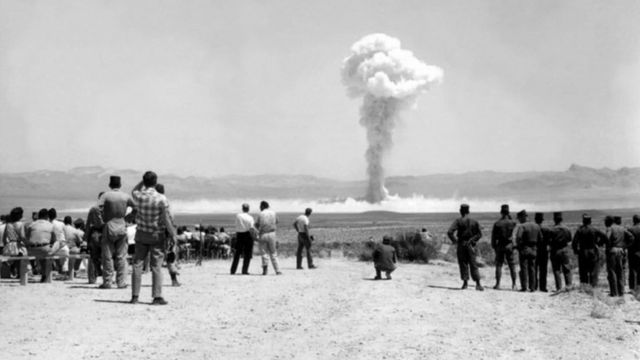
By A Current Affair Staff 7 Oct 23 https://9now.nine.com.au/a-current-affair/nuclear-bomb-testing-australia-class-action-british-government/199eafe9-c774-432e-99b2-f71a96ffb696—
It’s a scandal that has spanned decades as Australian and British servicemen sent to nuclear testing sites fight to be officially recognised for their service and suffering.
Between 1952 and 1963, Great Britain carried out nuclear bomb tests in Australia and the Pacific.
Doug Brooks was at the first one.
“The only thing we were told to do was turn our backs to the blast ground zero, cover our eyes with our hands and the blast x-rayed our hands we could see the bones,” he told A Current Affair.
Tony Spruzen was at the Maralinga test range in the remote outback of South Australia.
“The brightness was so much, it’s something like I never experienced before, I could see through my eyelids, I could see the bones of my fingers,” he said.
Doug and Tony are two of the rapidly diminishing number of veterans sent to the nuclear test sites.
In total 45 tests were conducted by Britain’s Ministry of Defence – 12 of those were in Australia at the blessing of the Menzies government.
There were 22,000 servicemen in the Pacific tests. 1500 are still alive.
Now there is a new class action against the British Government.
“Well, what’s prompted it is that we’ve discovered medical records do in fact exist for these servicemen,” lawyer Matthew Jury said.
“We have a copy of these records and what that tells us is the other medical records exist which the government has been concealing for 70 years so those surviving servicemen who want answers now know that those records exist so where and the government has been concealing them.”
Jury’s firm has launched the action class and he claims records reveal the radiation levels in the blood and urine of the servicemen.
“As they have grown older they have developed extreme and aggressive forms of cancer,” Jury said.
“There have been miscarriages and other birth defects which can’t be treated by their doctors because their doctors don’t have their full medical records.”
The British Ministry of Defence hasn’t responded to requests for an interview or statement.
Watch the full story in the video player above. [on original]
What’s Behind Talk of a Possible Plea Deal for Assange?
Were Assange to give up his legal battle and voluntarily go to the U.S. it would achieve two things for Washington:
1). remove the chance of a European Court of Human Rights injunction stopping his extradition should the High Court in London reject his last appeal; and
2). it would give the U.S. an opportunity to “change its mind” once Assange was in its clutches inside the Virginia federal courthouse.
Top U.S. officials are speaking at cross purposes when it comes to Julian Assange. What is really going on? asks Joe Lauria.
By Joe Lauria, Consortium News https://consortiumnews.com/2023/09/03/whats-behind-talk-of-a-possible-plea-deal-for-assange/
It was a little more than perplexing. U.S. Secretary of State Antony Blinken, on Australian soil, left no doubt about how his government feels about one of Australia’s most prominent citizens.
“I understand the concerns and views of Australians,” Blinken said in Brisbane on July 31 with the Australian foreign minister at his side. “I think it’s very important that our friends here understand our concerns about this matter.” He went on:
“What our Department of Justice has already said repeatedly, publicly, is this: Mr. Assange was charged with very serious criminal conduct in the United States in connection with his alleged role in one of the largest compromises of classified information in the history of our country. So I say that only because just as we understand sensitivities here, it’s important that our friends understand sensitivities in the United States.”
In other words, when it comes to Julian Assange, the U.S. elite cares little for what Australians have to say. There are more impolite ways to describe Blinken’s response. Upwards of 88 percent of Australians and both parties in the Australian government have told Washington to free the man. And Blinken essentially told them to stuff it. The U.S. won’t drop the case.
A few days before Blinken spoke, Caroline Kennedy, the U.S. ambassador to Australia and daughter of slain President John F. Kennedy, was also dismissive of Australians’ concerns, telling Australian Broadcasting Corporation Radio:
“I met with Parliamentary supporters of Julian Assange and I’ve listened to their concerns and I understand that this has been raised at the highest levels of our government, but it is an ongoing legal case, so the Department of Justice is really in charge but I’m sure that for Julian Assange it means a lot that he has this kind of support but we’re just going to have to wait to see what happens.”
Asked why she met with the parliamentarians at all, she said: “Well, it’s an important issue, it has, as I’ve said, been raised at the highest levels and I wanted to hear directly from them about their concerns to make sure that we all understood where each other was coming from and I thought it was a very useful conversation.”
Asked whether her meeting with the MPs had shifted her thinking on the Assange case, Kennedy said bluntly: “Not really.” She added that her “personal thinking isn’t really relevant here.”
Blowback
Australia has too often behaved as a doormat to the United States, to the point where Australia is threatening its own security by going along with an aggressive U.S. policy towards China, which poses no threat to Australia.
But this time, Blinken got an earful. Prime Minister Anthony Albanese reiterated that he wanted the Assange case to be dropped. Certain members of Parliament brusquely gave it back to Blinken.
Assange was “not the villain … and if the US wasn’t obsessed with revenge it would drop the extradition charge as soon as possible,” Independent MP Andrew Wilkie told The Guardian‘s Australian edition.
“Antony Blinken’s allegation that Julian Assange risked very serious harm to US national security is patent nonsense,” said Wilkie said.
“Mr Blinken would be well aware of the inquiries in both the US and Australia which found that the relevant WikiLeaks disclosures did not result in harm to anyone,” the MP said. “The only deadly behaviour was by US forces … exposed by WikiLeaks, like the Apache crew who gunned down Iraqi civilians and Reuters journalists” in the infamous Collateral Murder video.
As was shown conclusively by defense witnesses in his September 2020 extradition hearing in London, Assange worked assiduously to redact names of U.S. informants before WikiLeaks publications on Iraq and Afghanistan in 2010. U.S. Gen. Robert Carr testified at the court martial of WikiLeaks‘ source, Chelsea Manning, that no one was harmed by the material’s publication.
Instead, Assange faces 175 years in a U.S. dungeon on charges of violating the Espionage Act, not for stealing U.S. classified material, but for the First Amendment-protected publication of it.
Labor MP Julian Hill, also part of the Bring Julian Assange Home Parliamentary Group, told The Guardian he had “a fundamentally different view of the substance of the matter than secretary Blinken expressed. But I appreciate that at least his remarks are candid and direct.”
“In the same vein, I would say back to the United States: at the very least, take Julian Assange’s health issues seriously and go into court in the United Kingdom and get him the hell out of a maximum security prison where he’s at risk of dying without medical care if he has another stroke,” Hill said.
Damage Control
The fierce Australian reaction to both Blinken and Kennedy’s remarks appears to have taken Washington by surprise, given how accustomed to Canberra’s supine behavior the U.S. has become. Just two weeks after Blinken’s remarks, Kennedy tried to soften the blow by muddying Blinken’s clear waters.
She told The Sydney Morning Herald in a front-page interview published on Aug. 14 that the United States was now, despite Blinken’s unequivocal words, suddenly open to a plea agreement that could free Assange, allowing him to serve a shortened sentence for a lesser crime in his home country.
The newspaper said there could be a “David Hicks-style plea bargain,” a so-called Alford Plea, in which Assange would continue to state his innocence while accepting a lesser charge that would allow him to serve additional time in Australia. The four years Assange has already served on remand at London’s maximum security Belmarsh Prison could perhaps be taken into account.
Kennedy said a decision on such a plea deal was up to the U.S. Justice Department. “So it’s not really a diplomatic issue, but I think that there absolutely could be a resolution,” she told the newspaper.
Kennedy acknowledged Blinken’s harsh comments. “But there is a way to resolve it,” she said. “You can read the [newspapers] just like I can.” It is not quite clear what in the newspapers she was reading.
Blinken is Kennedy’s boss. There is little chance she had spoken out of turn. Blinken allowed her to put out the story that the U.S. is interested in a plea bargain with Assange. But why?
First, the harsh reaction in Australia to Blinken’s words probably had something to do with it. If it was up to the U.S. Justice Department alone to handle the prosecution of Assange, as Kennedy says, why was the Secretary of State saying anything about it at all? Blinken appears to have spoken out of turn himself and sent Kennedy out to reel it back in.
Given the growing opposition to the AUKUS alliance in Australia, including within the ruling Labor Party, perhaps Blinken and the rest of the U.S. security establishment is not taking Australia’s support for granted anymore. Blinken stepped in it and had Kennedy try to clean up the mess.
Second, as suspected by many Assange supporters on social media, Kennedy’s words may have been intended as a kind of ploy, perhaps to lure Assange to the United States to give up his fight against extradition in exchange for leniency.
In its article based on Kennedy’s interview, The Sydney Morning Herald spoke to only one international law expert, a Don Rothwell, of Australian National University in Canberra, who said Assange would have to go to the United States to negotiate a plea. In a second interview on Australian television, Rothwell said Assange would also have to drop his extradition fight.
Of course, neither is true. “Usually American courts don’t act unless a defendant is inside that district and shows up to the court,” U.S. constitutional lawyer Bruce Afran told Consortium News. “However, there’s nothing strictly prohibiting it either. And in a given instance, a plea could be taken internationally. I don’t think there’s anything wrong with that. It’s not barred by any laws. If all parties consent to it, then the court has jurisdiction.” But would the U.S. consent to it?
Were Assange to give up his legal battle and voluntarily go to the U.S. it would achieve two things for Washington: 1). remove the chance of a European Court of Human Rights injunction stopping his extradition should the High Court in London reject his last appeal; and 2). it would give the U.S. an opportunity to “change its mind” once Assange was in its clutches inside the Virginia federal courthouse.
“The U.S. sometimes finds ways to get around these agreements,” Afran said. “The better approach would be that he pleads while in the U.K., we resolve the sentence by either an additional sentence of seven months, such as David Hicks had or a year to be served in the U.K. or in Australia or time served.”
Assange’s brother, Gabriel Shipton, told the Herald his brother going to the U.S. was a “non-starter.” He said: “Julian cannot go to the US under any circumstances.” Assange’s father, John Shipton, told the same to Glenn Greenwald last week.
So the U.S. won’t be getting Assange on its soil voluntarily, and perhaps not very soon either. And maybe it wants it that way. Gabriel Shipton added: “Caroline Kennedy wouldn’t be saying these things if they didn’t want a way out. The Americans want this off their plate.”
Third, the U.S. may be trying to prolong Assange’s ordeal for at least another 14 months past the November 2024 U.S. presidential election. As Greenwald told John Shipton, the last thing President Joe Biden would want in the thick of his reelection campaign next year would be a high-profile criminal trial in which he was seen trying to put a publisher away for life for printing embarrassing U.S. state secrets.
But rather than a way out, as Gabriel Shipton called it, the U.S. may have in mind something more like a Great Postponement.
The postponement could come with the High Court of England and Wales continuing to take its time to give Assange his last hearing — for all of 30 minutes — before it rendered its final judgement, months after that, on his extradition. This could be stretched over 14 months. As Assange is a U.S. campaign issue, the High Court could justify its inaction by saying it wanted to avoid interference in the election.
According to Craig Murray, a former British diplomat and close Assange associate, the United States has not, despite Kennedy’s words last month, so far offered any sort of plea deal to Assange’s legal team. Murray told WBAI radio in New York:
“There have been noises made by the U.S. ambassador to Australia saying that a plea deal is possible. And that’s what the Australian Government have been pushing for as a way to solve it. What I can tell you is that there have been no official approaches from the American government indicating any willingness to soften or ameliorate their posihttps://www.youtube.com/watch?v=fnNjwQNV4Gction. The position of the Biden administration still seems to be that they wish to persecute and destroy Julian and lock him up for life for publishing the truth about war crimes …
So there’s no evidence of any sincerity on behalf of the U.S. government in these noises we’ve been hearing. It seems to be to placate public opinion in Australia, which is over 80% in favor of dropping the charges and allowing Julian to go home to his native country…
The American ambassador has made comments about, oh well, a plea deal might be possible, but this is just rubbish. This is just talk in the air. There’s been no kind of approach or indication from the Justice Department or anything like that at all. It’s just not true. It’s a false statement, in order to placate public opinion in Australia.”
Afran said a plea deal can be initiated by the Assange side as well. Assange lawyer Jennifer Robinson said in May for the first time on behalf of his legal team that they were open to discussion of a plea deal, though she said she knew of no crime Assange had committed to plead guilty to.
The U.S. would have many ways to keep prolonging talks on an Assange initiative, if one came, beyond the U.S. election. After the vote, the Justice Department could then receive Assange in Virginia courtesy of the British courts, if this the strategy the U.S. is pursuing.
Assange Be Weary: The Dangers of a US Plea Deal
August 18, 2023
By Binoy Kampmark / CounterPunch, https://scheerpost.com/2023/08/18/assange-be-weary-the-dangers-of-a-us-plea-deal/
At every stage of its proceedings against Julian Assange, the US Imperium has shown little by way of tempering its vengeful impulses. The WikiLeaks publisher, in uncovering the sordid, operational details of a global military power, would always have to pay. Given the 18 charges he faces, 17 fashioned from that most repressive of instruments, the US Espionage Act of 1917, any sentence is bound to be hefty. Were he to be extradited from the United Kingdom to the US, Assange will disappear into a carceral, life-ending dystopia.
In this saga of relentless mugging and persecution, the country that has featured regularly in commentary, yet done the least, is Australia. Assange may well be an Australian national, but this has generally counted for naught. Successive governments have tended to cower before the bullying disposition of Washington’s power. With the signing of the AUKUS pact and the inexorable surrender of Canberra’s military and diplomatic functions to Washington, any exertion of independent counsel and fair advice will be treated with sneering qualification.
The Albanese government has claimed, at various stages, to be pursuing the matter with its US counterparts with firm insistence. Prime Minister Anthony Albanese has even publicly expressed his frustration at the lack of progress in finding a “diplomatic solution” to Assange’s plight. But such frustrations have been tempered by an acceptance that legal processes must first run their course.
The substance of any such diplomatic solution remains vague. But on August 14, the Sydney Morning Herald, citing US Ambassador to Australia Caroline Kennedy as its chief source, reported that a “resolution” to Assange’s plight might be in the offing. “There is a way to resolve it,” the ambassador told the paper. This could involve a reduction of any charges in favour of a guilty plea, with the details sketched out by the US Department of Justice. In making her remarks, Kennedy clarified that this was more a matter for the DOJ than the State Department or any other department. “So it’s not really a diplomatic issue, but I think there absolutely could be a resolution.”
In May, Kennedy met members of the Parliamentary Friends of Julian Assange Group to hear their concerns. The previous month, 48 Australian MPs and Senators, including 13 from the governing Labor Party, wrote an open letter to the US Attorney General, Merrick Garland, warning that the prosecution “would set a dangerous precedent for all global citizens, journalists, publishers, media organizations and the freedom of the press. It would also be needlessly damaging for the US as a world leader on freedom of expression and the rule of law.”
In a discussion with The Intercept, Gabriel Shipton, Assange’s brother, had his own analysis of the latest developments. “The [Biden] administration appears to be searching for an off-ramp ahead of [Albanese’s] first state visit to DC in October.” In the event one wasn’t found, “we could see a repeat of a very public rebuff delivered by [US Secretary of State] Tony Blinken to the Australian Foreign Minister two weeks ago in Brisbane.”
That rebuff was particularly brutal, taking place on the occasion of the AUSMIN talks between the foreign and defence ministers of both Australia and the United States. On that occasion, Foreign Minister Penny Wong remarked that Australia had made its position clear to their US counterparts “that Mr Assange’s case has dragged for too long, and our desire it be brought to a conclusion, and we’ve said that publicly and you would anticipate that that reflects also the positive we articulate in private.”
In his response, Secretary of State Blinken claimed to “understand” such views and admitted that the matter had been raised with himself and various offices of the US. With such polite formalities acknowledged, Blinken proceeded to tell “our friends” what, exactly, Washington wished to do.
Assange had been “charged with very serious criminal conduct in the United States in connection with his alleged role in one of the largest compromises of classified information in the history of our country. The actions that he has alleged to have committed risked very serious harm to our national security, to the benefit of our adversaries, and put named sources at grave risk – grave risk – of physical harm, and grave risk of detention.”
Such an assessment, lazily assumed, repeatedly rebutted, and persistently disproved, went unchallenged by all the parties present, including the Australian ministers. Nor did any members of the press deem it appropriate to challenge the account. The unstated assumption here is that Assange is already guilty for absurd charges, a man condemned.
At this stage, such deals are the stuff of manipulation and fantasy. The espionage charges have been drafted to inflate, rather than diminish any sentence. Suggestions that the DOJ will somehow go soft must be treated with abundant scepticism. The pursuit of Assange is laced by sentiments of revenge, intended to both inflict harm upon the publisher while deterring those wishing to publish US national security information. As the Australian international law academic Don Rothwell observes, the plea deal may well take into account the four years spent in UK captivity, but is unlikely to either feature a complete scrapping of the charges, or exempt Assange from travelling to the US to admit his guilt. “It’s not possible to strike a plea deal outside the relevant jurisdiction except in the most exceptional circumstances.”
Should any plea deal be successfully reached and implemented, thereby making Assange admit guilt, the terms of his return to Australia, assuming he survives any stint on US soil, will be onerous. In effect, the US would merely be changing the prison warden while adjusting the terms of observation. In place of British prison wardens will be Australian overseers unlikely to ever take kindly to the publication of national security information.
An Assange Plea Deal? For What Crime? – Good Journalism?
Caitlin’s Newsletter Notes From The Edge Of The Narrative Matrix, CAITLIN JOHNSTONE, AUG 16, 2023
Whenever I talk about the need to dismantle government secrecy I always get some know-it-all empire simp going “Without secrecy we wouldn’t be able to wage wars and coordinate against our enemies and have nukes, you idiot.”
And it’s like, uh, yeah. That’s kind of my point. They only use secrecy to do evil things and act against the interests of normal human beings.
The lie is that the government uses secrecy in order to counter its enemies and win wars, when in reality the government uses secrecy to make enemies and start wars.
Julian Assange said “The overwhelming majority of information is classified to protect political security, not national security.” It doesn’t exist for our benefit, it exists for theirs. It’s so our rulers can keep doing depraved things with no accountability. That’s why they keep expanding government secrecy and increasing the punishment of those who breach it: because they want to do more depraved things and remain unaccountable.
It really is nuts how there’s now talk of Julian Assange being offered a “plea bargain” for rightly exposing US war crimes. What’s he meant to plead guilty to? Good journalism?
The last time there was a credible military threat to the United States near the US border, the US responded so aggressively that it nearly ended the world. The reason people don’t tend to get it when you compare Ukraine or Taiwan to a hypothetical scenario in which Russia or China were amassing heavily armed proxy forces on the Mexican border is because people literally can’t wrap their minds around that happening. It’s just too remote and unthinkable a proposition in today’s world.
But that shows you just how clear it is that the US is the aggressor in those standoffs: it’s doing something so freakishly aggressive that people literally cannot imagine it happening on the US border. If you see amassing a heavily armed threat on the border of an enemy nation as normal and fine in one instance and literally unfathomable in another, that shows you your perception and expectations have been warped by propaganda…………………………………….. https://www.caitlinjohnst.one/p/an-assange-plea-deal-for-what-crime?utm_source=post-email-title&publication_id=82124&post_id=136101620&isFreemail=true&utm_medium=email
Key British Assange supporter says Wikileaks founder could cut deal to secure freedom
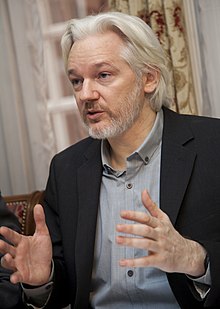
The Age, By Latika Bourke, July 26, 2023
London: One of federal parliament’s leading supporters of Julian Assange says the WikiLeaks founder could cut a deal with prosecutors and plead guilty to “whatever nonsense” necessary to secure his release from prison.
Labor MP Julian Hill, the member for Bruce, tried unsuccessfully to visit Assange in Belmarsh prison, where he has been held since 2019, during a private trip to Europe recently.
Prime Minister Anthony Albanese has directly lobbied US President Joe Biden for the Queenslander’s release but has so far failed to secure it, and has hinted that Assange may have to accept a plea deal.
“The reality is that Australia cannot force the United States to [release Assange], and if they refuse, then no Australian should judge Mr Assange if he chooses to just cut a deal and end this matter,” said Hill.
“His health is deteriorating and if the US refuses to do the right thing and drop the charges then no one would think less of him for crossing his fingers and toes, pleading guilty to whatever nonsense he has to and getting the hell out of there.”
Hill, a member of a cross-party group of MPs who support Assange’s release, also hit out at supporters who he sees as fixated on having Assange suffer as a martyr and continue to languish in prison as he faces extradition to the United States.
“It worries me greatly that there are some Assange supporters who would rather he be a martyr than a free man, but ultimately it’s important for everyone to respect what Julian himself chooses to do,” he said.
His wife Stella Assange has repeatedly warned his health has deteriorated badly due to his incarceration over the last four years…………………………………….
Stella Assange has not said if her husband will accept any plea deal, urging instead that the Biden administration force the US Department of Justice to drop the case, which began under the former Trump administration……………….
Hill said there was only one priority as the case continued to drag on and that was “bringing him home safely to be with his family”.
“I’m not privy to the negotiations that may be occurring but frankly the parliamentarians would back him to the hilt in cutting a deal if that’s what he chose,” he said.
“That’s a message that I wanted to convey personally and hear from him what he wants.”
The Australian High Commission in London tried to help Hill visit Assange on July 1, but the request was denied at the last minute by prison authorities.
“It was incredibly frustrating and disappointing that the Belmarsh Prison authorities failed to approve Mr Assange’s request for me to visit him,” Hill said. “The required paperwork was completed by Julian multiple times.
“However it mysteriously got lost and mislaid until the day before the scheduled visit when they said it was too short notice. It’s up to them to explain whether it’s a conspiracy or a stuff up, but it’s profoundly disappointing to the cross-parliamentary group.”
Jenny Louis, the governor of Belmarsh Prison, was contacted for comment. https://www.theage.com.au/world/europe/key-assange-supporter-says-wikileaks-founder-could-cut-deal-to-secure-freedom-20230725-p5dr7n.html
Court rules in favour of Barngala people, preventing nuclear waste facility in Kimba

Joseph Guenzler – July 18, 2023 https://nit.com.au/18-07-2023/6853/court-rules-in-favour-of-barngala-people-preventing-nuclear-waste-facility-in-kimba
The Barngarla people of South Australia’s Eyre Peninsula are rejoicing as the Federal Court has overturned the decision to construct a nuclear waste facility on their land in Kimba.
The proposed facility was to store radioactive waste categorised as low and intermediate level.
The Barngarla traditional owners took the matter to the Federal Court, seeking a judicial review. They argued that the facility would disrupt a site of great significance and claimed that they were not adequately consulted before the plan received approval in 2021.
“It was important to stop this dump because the Seven Sisters Dreaming goes through there,” said Barngarla Elder Aunty Dawn Taylor, who was born at Kimba.
“Having a waste dump out there would have just destroyed everything.”
The Barngarla native title area covers more than 34,000 square kilometres on Eyre Peninsula, including the town of Kimba.
On Tuesday, the court ruled in favor of the native title group.
As a result, the future of the project is now uncertain as the court has invalidated the federal government’s previous declaration made in 2021, which designated the site for the nuclear waste facility.
Justice Natalie Charlesworth ruled in favor of the Barngarla people, citing a perceived bias in the decision-making process due to “pre-judgment.”
Justice Charlesworth also found there was an error of law, but said it did not have a “material effect” on the outcome of the declaration of the site.
A separate hearing will address the matter of legal costs, which are expected to be substantial.
The decision was met with enthusiasm by opponents of the nuclear facility, who gathered at the Federal Court building and expressed their joy upon hearing the verdict.
Speaking outside the building in Adelaide’s CBD, Barngarla Determination Aboriginal Corporation (BDAC) chairman Jason Bilney said it had been a “David and Goliath” battle that had left him “very emotional”.
“It’s been proud win for Barngarla, as well as other First Nations, to continue this fight and get this message out,” he said.
“The lesson is, it’s about truth telling… and it’s about listening to the First Nations people and who we are today and we’ve prevailed and we’ve won.”
“The money that the government’s spent to take us to court could be better spent for the rest of Australia, everyday Australians and the community, instead of taking First Nations people to court, it’s very disrespectful — we’ve been here over 60,000 years.”
Justice Charlesworth has decided to withhold any definitive orders regarding the judicial review until both parties have had a chance to review her judgment.
However, she has indicated that the most suitable course of action is to invalidate the entire declaration made by former resources minister Keith Pitt concerning the proposed facility.
Barngarla people continue their fight against the proposed Kimba nuclear waste dump
Jason Bilney, Chairperson, Barngarla Determination Aboriginal Corporation. 6 July 23
COURT
We have some news regarding the court; the judgement regarding the Kimba case will be delivered on July 18, 2023 at 10.30am at the Commonwealth Law Courts Building in Adelaide.
BARNGARLA ELDER AWARDED
This year’s NAIDOC Theme is a special one ‘For Our Elders’ Barngarla people have many elders who have led the way as leaders and teachers in our community. Enders who fought long and hard for our Native Title rights and also our ongoing battle with the Federal Government against a nuclear waste dump being built in Canberra. This week one of the BDAC Directors Harry Dare was awarded with the Port Augusta NAIDOC Male Elder of the Year, Uncle Harry was recognised for the role he has played in advocating for Barngarla rights, language and land –including his efforts to elevate the voice of Barngarla People over the nuclear waste dump at Kimba. Uncle Harry expressed his thanks to supporters.
PETITION
In other news, we have been blown away by the response to our online petition started by Mahalia Bilney in February. Today we have 13,349 signatures and we hope to see that grow.
The Petition calls on Minister King and Prime Minister Albanese to listen to the Barngarla people and scrap plans to advance the nuclear waste dump at Kimba.
We thank everyone for signing and sharing. Please continue to share the petition and encourage people to support us: https://chng.it/C2zzvDT56K.
Also we have heard that a group of local and EP residents has formed in Whyalla to actively oppose the Kimba plan and the transportation of nuclear waste through the Port of Whyalla.
Aunty Dawn Taylor attended the inaugural meeting to share Barngarla’s concerns.
This continues to be a David and Goliath battle and we will not give up the fight to protect our country.
Please take a minute to watch our message to Canberra here
Draconian: South Australia just topped NSW, Tas, Victoria, Queensland with new laws penalising peaceful protesters
Michael West Media, by Wendy Bacon | Jun 3, 2023
A bill introducing harsh penalties and extending the scope of a law applying to those who obstruct public places has been passed after an all-night sitting by the South Australian Legislative Council this week. Veteran investigative journalist (herself twice imprisoned for free speech) Wendy Bacon reports.
South Australia now joins New South Wales, Tasmania, Victoria and Queensland, states which have already passed anti-protest laws imposing severe penalties on people who engage in peaceful civil disobedience. South Australia’s new law carries the harshest financial penalties in Australia.
Thirteen Upper House Labor and Liberal MPs voted for the Bill, opposed by two Greens MPs and two SABest MPs. The government faced down the cross bench moves to hold an inquiry into the bill, to review it in a year or add a defence of ‘reasonableness’.
The Summary Offences (Obstruction of Public Places) Amendment Bill 2023 was introduced into the House Assembly by Premier Peter Malinauskas the day after Extinction Rebellion protests were staged around the Australian Petroleum and Exploration Association (APPEA) annual conference on May 17. The most dramatic of these protests was staged by 69 year old Meme Thorne who abseiled off a city bridge causing delays and traffic to be diverted.
Meanwhile the gas lobby APPEA which is financed by foreign fossil fuel companies has stopped publishing its (public) financial statements. Questions put for this story were ignored but we will append a response should one be available…………………………………………………………
The new law introduces maximum penalties of $50,000 (66 times the previous maximum fine) or a prison sentence of three months. The maximum fine was previously $750, and there was no prison penalty. If emergency services (police, fire, ambulance) are called to a protest, those convicted can also be required to pay emergency service costs. The scope of the law has also been widened to include ‘indirect’ obstruction of a public place.
This means that if you stage a protest and the police use 20 emergency vehicles to divert traffic, you could be found guilty under the new section and be liable for the costs. Even people handing out pamphlets about vaping harm in front of a shop, or workers gathering on a footpath to demand better pay, could fall foul of the laws. An SABest amendment to the original bill removing the word ‘reckless’ restricts its scope to intentional acts.
Peter Malinauskus told Radio Fiveaa yesterday that the new laws aimed to deter “extremists” who protested “with impunity” by crowd sourcing funds to pay their fines.
In speaking about the laws, Malinaukas, Maher and their right wing media supporters have made constant references emergency services, and ambulances. But no evidence has emerged that ambulances were delayed. The author contacted SA Ambulances to ask if any ambulances were held up on May 17, and if they were delayed, whether Thorne was told. SA Ambulance Services acknowledged the question but have not yet answered.
The old ambulance excuse
Significantly, the SA Ambulance Employees Union has complained about the “alarming breadth” of the laws and reminded the Malinauskas government that in the lead-up to last year’s state election, Labor joined Greens, SABest and others in protests about ambulance ramping, which caused significant traffic delays.
The constant references to emergencies are reminiscent of similar references in NSW. When protesters Violet Coco and firefighter Alan Glover were arrested on the Sydney Harbour Bridge last year, police included a reference to an ambulance in a statement of facts.
The ambulance did not exist and the false statement was withdrawn but this did not stop then Labor Opposition leader, now NSW Premier Chris Minns repeating the allegation when continuing to support harsh penalties even after a judge had released Coco from prison. It later emerged that the protesters had agreed to move if it was necessary to make way for an ambulance.
…………………………………………………………. Early this year, UN Secretary-General Antonio Gutierrez declared, “2023 is a year of reckoning. It must be a year of game-changing climate action. We need disruption to end the destruction. No more baby steps. No more excuses. No more greenwashing. No more bottomless greed of the fossil fuel industry and its enablers.”
Meanwhile climate disasters mount
Since he made that statement, climate scientists have reported that Antarctic ice is melting faster than anticipated. This week, there has been record-beating heat in eastern Canada and the United States, Botswana in Africa, South East China and New Zealand. Right now, unprecedented out-of-control wildfires are ravaging Canada.
An international force of 1200 firefighters including Australians have joined the Canadian military battling to bring fires under control. Extreme rain and floods displaced millions in Pakistan and thousands in Australia in 2022. Recently, extreme rain caused rivers to break their banks in Italy, causing landslides and turning streets into rivers. Homelessness drags on for years as affected communities struggle to recover long after the media moves on.
Is it any wonder that some people don’t continue as if it is ‘business as usual’. Protesters in London invaded Shell’s annual conference last week and in Paris, climate activists were tear gassed at Total Energies AGM. In The Netherlands last weekend, 1500 protesters who blocked a motorway to call attention to the climate emergency were water-cannoned and arrested.
On Thursday 30, Rising Tide protesters pleaded guilty to entering enclosed lands and attempting to block a coal train in Newcastle earlier this year. They received fines of between $450 and $750, most of which will be covered by crowdfunding. Three of them were Knitting Nannas, a group of older women who stage frequent protests.
This week the Knitting Nannas and others formed a human chain around NAB headquarters in Sydney. They called for NAB to stop funding fossil fuel projects, including the Whitehaven coal mine.
Knitting Nannas, Rising Tide
Two Knitting Nannas have mounted a legal challenge in the NSW Supreme Court seeking a declaration that the NSW anti-protest laws are invalid because they violate the implied right to freedom of communication in the Australian constitution. A similar action is already been considered in South Australia.
In this context, fossil fuel industry get togethers may no longer be seen as a PR and networking opportunity for government and companies. Australian protesters will not be impressed by Federal and State Labor politicians reassurances that they have a right to protest, providing that they meekly follow established legal procedures that empower police and councils to give or refuse permission for assemblies at prearranged places and times and do not inconvenience anyone else.
Why is the Labor government determined to silence the Barngarla people, at the same time as Labor promotes the indigenous Voice to Parliament ?
‘While appreciating the Labor government’s strong commitment to the Voice, the question remains as to why, at the same time, federal Labor are doing so much to continue the Coalition’s determination to silence the voice of the Barngarla.’
Nuclear waste controversy continues in Federal Court Michele Madigan, 16 March 2023, https://www.eurekastreet.com.au/nuclear-waste-controversy-continues-in-federal-court
On Monday 6 March, the Barngarla Determination Aboriginal Corporation (BDAC) began action in the Federal Court in Adelaide to overturn the federal Ministerial declaration to selecting Napandee near Kimba as the proposed site for a national nuclear waste facility.
The Barngarla people, the Traditional Owners of Kimba, have consistently opposed the controversial nuclear waste plan. The federal government has spent millions of dollars fighting the Barngarla in court, despite the continued efforts of the Barngarla people who do not want their sites and stories disturbed by a nuclear waste facility.
This fourth manifestation of federal governments of either persuasion to impose a national radioactive waste dump continues to be one of the best kept environment secrets in the country on all levels. There are still unanswered questions regarding the project itself, the actual necessity for it, and the risks involved.
Capitalising on the small amount of coverage South Australian affairs have in the media in general outside our own state, three out of the four chosen sites in this serial campaign since 1998 have been in South Australia. No coincidence either that the precedent seemed to be long set by SA being the main place of choice for the British nuclear explosions and the following so called ‘minor trials’ of the 1950s and 1960s.
It may be worth again touching on the risks involved. Recently, a WA mining company lost a tiny radioactive capsule on the long southward trek down to Perth. Eureka Street readers may have heard as the story became international news. The authorities were certainly anxious that it be found, warning in the meantime how dangerous it would be to touch.
It seemed amazing that such a tiny entity could later be found in such vast territory of 1400 kms. Finding it was surely a classic triumph of the needle in the haystack success story. However, though certainly difficult, it was not impossible because of the radioactive rays it was emitting. Those of us concerned about the previous federal government‘s campaign to regularly transport, not a tiny capsule with a half life of 30 years, but long lived Intermediate Level radioactive waste — toxic for 10,000 years — have been regularly and understandably puzzled by the almost absent media coverage about this far more dangerous waste in the proposed regular 1700 km monthly transports from ANSTO Lucas Heights.
Regarding the actual necessity for the dump, the Coalition government has repeated the mantra about the ‘100 hospitals and universities throughout the nation housing radioactive waste’ as a prime reason for needing the national facility. Even normally reputable news outlets like the Guardian have been known to fall back on these easily-accessible Resource Ministers’ media statements providing inaccurate information.
The reality is in huge contrast to these claims. In October of last year, SA environmental expert David Noonan discovered, through reading the Australian Radioactive Waste Agency’s own detailed information, compelling evidence that directly contradicted the claims of multiple government officials, department personnel, and ARWA staff.
Far from the claims that the proposed facility is ‘essential’ to prevent the nationwide ‘100 hospitals and universities’ being overwhelmed by the storage of nuclear medical waste products, Noonan’s research revealed the reality. Total Hospital existing and future LLW [low -level waste] is reported at only 3 m3 [three cubic metres]. Based on ARWA’s Report, all non-ANSTO sources produce on average only approx. 1.3 m3 per year of LLW over the next 100 years and produce approx. 1.34 m3 per year of Intermediate level waste ILW over the next 50 years.’ Not enough to necessitate the creation of a waste dump in Kimbra. In the words of environmentalists, ‘it’s ANSTO’s dump.’
Ignorance, (wilful or otherwise), by Parliamentarians about the matters of nuclear medicine is not confined to the Coalition. NSW Senator the Hon Tim Ayres was the presiding member for the absent Resources Minister, Madeleine King in the recent February Senate Estimates on these matters. Ayres’ comments to SA Senator Barbara Pocock said it all: ‘But South Australians use X-rays. They use nuclear medicine. They use it for cancer treatments. They use it for all sorts of medical purposes’. When later conveyed to her, this statement drew the incredulity of Dr Margaret Beavis, GP and Co-Chair of ICAN Australia, and Vice-President Medical Association for Prevention of War. As Dr Beavis explains: ‘Nuclear medicine is used for medical imaging and to treat some cancers. Nuclear medicine should not be confused with X-rays, CT scans, MRIs, radiotherapy or chemotherapy, which are much more commonly used.’
The previous November Senate Estimates seemed to give Shaun Jenkinson CEO of Australian Nuclear Scientific and Technology Organisation (ANSTO) an almost uncritical forum for propagating ANSTO’s claims of the Kimba dump being essential for the survival of Australia’s nuclear medicine, even when challenged by the new SA Senator, economist Professor Barbara Pocock. In February’s recent Senate Estimates, Senator Barbara Pocock asked what contingency plans were in place to produce and store nuclear medicine if the facility didn’t go ahead at Kimba. Jenkinson’s response was measured, admitting that there is room at ANSTO. ‘We continually look at the storage capacity on site, and we of course look at the projected time for the national radioactive waste management facility. We work closely with ARWA, and, if there was to be a delay in that, we would be seeking approval for additional onsite storage until such time as a national radioactive waste management facility was ready.’
Cost has been, and is, no obstacle to either federal government to ensure their project goes ahead. As the recent BDAC briefing paper reveals, ‘since 1 January 2017, the Commonwealth Government has spent close to $10 million on legal work for the nuclear waste dump and the AWRA (Australian Radioactive Waste Agency).’ In the last year alone, the Commonwealth Government spent around $2 million, or approximately $40,000 every week, on a team of 14 lawyers to fight the Barngarla in court. Norman Waterhouse, the legal firm representing the Barngarla people, and the legal team working with Norman Waterhouse have endured all of the Commonwealth’s litigation for fees of $500K in 2022. The Barngarla’s legal team has withstood tremendous pressure from the Commonwealth lawyers for a quarter of the cost to take the case.
While appreciating the Labor government’s strong commitment to the Voice, the question remains as to why, at the same time, federal Labor are doing so much to continue the Coalition’s determination to silence the voice of the Barngarla.
‘David and Goliath’: Kimba nuke waste fight heads to Federal Court
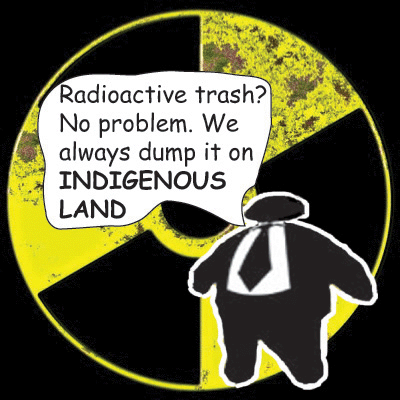
Stephanie Richards, 6 March 23, https://indaily.com.au/news/2023/03/06/david-and-goliath-kimba-nuke-waste-fight-heads-to-federal-court/?utm_medium=email&utm_campaign=InDaily%20Lunchtime%20%206%20March%202023&utm_content=InDaily%20Lunchtime%20%206%20March%202023+CID_654499187b614fa7e1f09bd8ceb7100e&utm_source=EDM&utm_term=READ%20MORE
Barngarla Traditional Owners’ fight to stop a nuclear waste facility being built near Kimba on South Australia’s Eyre Peninsula has reached the Federal Court, with the first substantive case hearing in Adelaide today.
They were supporting the Barngarla Determination Aboriginal Corporation, which has applied for judicial review in an attempt to thwart construction of the federal government’s planned radioactive waste storage facility at Napandee near Kimba.
“We’re fighting against injustices that have been happening to the Barngarla people regarding this waste dump in Kimba,” Barngarla Traditional Owner Harry Dare told InDaily outside court.
“We’re actually fighting for a seven sisters and women’s dreaming site and we’re fighting for a vote in our local governance.
“The Australian Government has given back our Native Title, but they haven’t given us a voice in those Native Title areas, so we’re fighting for equality and for all of Australia to be nuclear free.”
The Napandee site was selected by the former Morrison Government, with then Resources Minister Keith Pitt saying the government had secured “majority support” from the local community after more than “six years of consultation”.
But Barngarla Traditional Owners opposed the project and argued they were not included in the consultation.
During today’s hearing, the Federal Court was told of how the decision to locate the dump at Napandee, near Kimba, played out.
After beginning the process to select the site through its administrative powers, the then Coalition Government changed tack and decided to legislate, partly to avoid delays through legal challenges.
However, when the legislation failed in the Senate, the government restarted the administrative process.
Counsel for the Barngarla told Justice Natalie Charlesworth that raised questions over whether Pitt, who ultimately named the Napandee location and who strongly supported the legislative approach, could properly carry out his administrative role.
“That, of itself, would excite a reasonable apprehension that the minister might be unable or unwilling to approach the matter with an open mind,” he said.
“Because, effectively, the decision had already been made.”
The court was also told that the Barngarla disagreed with the former government’s view that the dump had wide community support in Kimba and would also argue the decision on the dump was unreasonable given the lack of proper consultation with the Indigenous owners.
Given Pitt’s correspondence with the Barngarla people and his other statements, the impression that might arise was that consultation would largely amount to “matters around the edges”.
“In terms of identifying culture and the like in the implementation of the site, which had already been selected and to which the minister was committed,” counsel said.
With the case listed for several days, the federal government is expected to argue that much of the material to be relied on by the applicants is subject to parliamentary privilege.
The Barngarla launched their action in 2021 after being denied the right to participate in a community ballot to gauge local support for the Napandee site because many did not live in the Kimba council area.
The community ballot returned about 61 per cent in favour of the dump.
But when the Barngala conducted their own ballot among their community members, 83 voted no and none voted yes.
They argue they were denied the right to participate in a community ballot to gauge local support for the site, because many did not live in the Kimber council area.
Traditional Owner Linda Dare told protestors ahead of this morning’s hearing that the proposed location for the nuclear waste facility was near an important women’s site for the Barngarla people.
“It just seems to be that every time the government wants to put something it’s always around a women’s site,” she said.
“We need to fight as women around Australia to protect our sites.
“We need to say ‘no’ because it’s going to affect the waterways, not just in South Australia but everywhere.”
InDaily reported in September that the federal government was spending three times more than Barngarla Traditional Owners fighting the project in the Federal Court.
Information released to SA Greens Senator Barbara Pocock showed that between December and July, the government had spent $343,457.44 on legal fees.
That compares to the approximate $124,000 spent by the Barngarla Determination Aboriginal Corporation over the same period.
The Native Title group estimates that the total cost incurred by the federal government would run into the millions.
Barngarla Determination Aboriginal Corporation chairperson Jason Bilney told InDaily the judicial review was a “David and Goliath battle”.
“But, we’re dedicated. It took us 21 years to win our Native Title, come out of Native Title six months later and we’re fighting a nuclear waste dump on our country,” he said.
“What does that tell you about truth telling, the Statement From The Heart or the Voice?
“Our Voice isn’t being heard, truth telling isn’t being told and they’re going to break the First Nations’ heart – Barngarla – and put it (the nuclear waste dump) on our country.”
Bilney said Traditional Owners expected the Federal Court would take months to reach a decision, with hearings scheduled each day this week.
“It could take a year, but we would like it to have it sooner than later,” he said.
It comes after the Barngarla Native Title group last month won a separate Supreme Court bid to overturn former Premier Steven Marshall’s decision to allow a mineral exploration company to drill at Lake Torrens in the state’s outback.
At the time, Bilney said the group was buoyed by the win as they continued their legal fight to stop the Napandee nuclear waste facility from going ahead.
South Australian Labor has long called for Barngarla people to have the right to veto the project, with Premier Peter Malinauskas previously saying that the state government had expressed its views to the federal government.
Julian Assange’s Biggest Fight in Notorious Prison Isn’t Over Extradition
NewsWeek, BY SHAUN WATERMAN ON 01/27/23 “…………………………………………….. Assange’s physical and mental health have declined severely during more than a decade in confinement — first sheltering from U.S. authorities in the Ecuadorian embassy in London from 2012-2019, where he lived in two rooms and never left the building, and for the last almost four years, since he was dragged from the embassy by British police in April 2019, in Belmarsh fighting extradition.
…………………… The proceedings in London continue to drag on. It has been more than a year since the High Court cleared the way for his extradition and his appeal was filed in August. But the court continues to weigh it, with no deadline to reach a decision. Even if he loses, there remains the possibility of an appeal to the British Supreme Court, or to the European Court of Human Rights. Assange could be in the U.S. within months, but he might remain in Britain for years.
His family says that with uncertainty about his extradition hanging over him like the sword of Damocles, he has lost weight and become depressed and anxious.
A confinement of uncertain duration
The worst part about the confinement is having no idea when or how he would be able to leave, Stella Assange said. “It is the uncertain duration that makes it so hard to bear … It’s a kind of torture.”…………..
The uncertainty has exacerbated Assange’s physical and mental deterioration, his wife said. In October 2021, during a High Court hearing about his extradition, Assange, attending via video link from Belmarsh, suffered a “transient ischaemic attack” — a mini-stroke. He has been diagnosed with nerve damage and memory problems and prescribed blood thinners.
“He might not survive this,” she said.
As a remand prisoner, not convicted or sentenced, and facing extradition, not prosecution, Assange is an anomaly in Britain’s most secure prison — designed to hold “Category A” inmates such as IRA militants, jihadis and murderers. One of a tiny handful of unconvicted prisoners, prison regulations require him to be treated differently, his wife said.
“He’s supposed to be able to get visits every day, he’s supposed to be able to work on his case,” she said, “But that’s only on paper. The way the prison system works, it is more efficient to treat everyone like a Cat A prisoner rather than to try to adapt the rules for individuals. In reality, that just doesn’t translate at all.” She said Assange is allowed one or two legal visits, and one or two social visits each week.
In between visits, time can stretch. And the isolation has been hard on him……………………………..
Phone calls, his half-brother Gabriel Shipton told Newsweek from Assange’s native Australia, are limited to 10 minutes. “You’ll just be getting into it and click, it’s over.”
Neither the governor’s office at Belmarsh, nor the press office for the British Prison Service, responded to emails requesting responses to detailed questions.
A source of inspiration and power
Assange gets thousands of letters and parcels from all over the world, Stella Assange said, but the authorities interdict banned items, such as books about national security, paintings and other forbidden objects.
His father, John Shipton, told Newsweek from Australia that Assange draws a lot of inspiration and power from the letters that people write to him. During their phone conversations, he will often read snippets or recall memorable letters, Shipton said. “He loves getting them … You can hear him light up a bit” when he talks about them………………………………………… more https://www.newsweek.com/2023/02/10/julian-assanges-biggest-fight-notorious-prison-isnt-over-extradition-1774197.html
Pursuing Assange in a US court could cause even more embarrassment than the WikiLeaks’ publications.
It’s possible that pursuing Assange in a US court could cause even more embarrassment than the WikiLeaks’ publications. As the years have passed, we have learned that a Spanish security firm recorded his every move and those of his visitors and legal counsel in the Embassy of Ecuador. This was passed to the CIA, and was used in the US case for his extradition. The trial of Daniel Ellsberg for leaking the Pentagon Papers failed because his psychiatrist’s records were stolen by investigators, and this should set a precedent for Assange.
Enough is enough for Albanese on Assange: our allies may respect us if we say this more. https://johnmenadue.com/enough-is-enough-for-albanese-on-assange-our-allies-may-respect-us-if-we-say-this-more/ By Alison Broinowski, Dec 2, 2022
The Prime Minister’s surprise revelation that he has raised the case against Julian Assange with US officials and urged that charges of espionage and conspiracy be dropped opens up many questions.
Mr Albanese thanked Dr Monique Ryan for her question on Wednesday 31 November, giving what appeared to be a carefully prepared and timed answer. The Independent MP for Kooyong sought to know what political intervention the government would make in the case, observing that public interest journalism is essential in a democracy.
The news flashed around between Assange supporters in and outside Parliament, and reached the Guardian, the Australian, SBS, and Monthly online. Neither the ABC nor the Sydney Morning Herald carried the story, even the next day. SBS reported that Brazil’s president-elect Luiz Inacio Lula da Silva expressed support for the campaign to free Assange.
But two days earlier, on Monday 29 November, the New York Times and four major European papers had printed an open letter to the US Attorney-General Merrick Garland, deploring the assault on media freedom which the pursuit of Assange represented.
The NYT, the Guardian, Le Monde, Der Spiegel and El Pais were the papers which in 2010 received and published some of the 251,000 classified US documents provided by Assange, many revealing American atrocities in Afghanistan and Iraq.
US Army intelligence analyst Chelsea Manning gave them to Assange, who redacted names of people he considered could be harmed by publication. A senior Pentagon serving officer later confirmed that no-one had died as a result. Manning was imprisoned, and then pardoned by Obama. Assange spent seven years in diplomatic asylum in the Embassy of Ecuador in London before British police removed him and he was imprisoned for breach of bail condition.
Assange has been in Belmarsh high security prison for three years, in poor physical and mental health. Court proceedings against him over extradition to face trial in the US have been farcical, biased, oppressive, and excessively prolonged.
In Opposition, Albanese said ‘Enough is enough’ for Assange, and he has at last done something about it in Government. What exactly, with whom, and why now, we don’t yet know. The PM’s hand may have been forced by the major dailies’ letter to Attorney-General Garland, which made Australian politicians and media appear to be doing nothing. Or he may have raised the Assange case in his recent meetings with Biden, at the G20 for example.
Another possibility is that he was talked into it by Assange’s barrister, Jennifer Robinson, who met with him in mid-November and spoke about the case at the National Press Club. When I asked if she could say if she and Albanese discussed Assange, she smiled and said ‘No’ – meaning she couldn’t, not that they didn’t.
Monique Ryan made the point that this is a political situation, requiring political action. By raising it with US officials, Albanese has moved away from the previous government’s position that Australia couldn’t interfere in British or American legal processes, and that ‘justice must take its course’. That wasn’t the approach Australia took to secure the freedom of Dr Kylie Moore-Gilbert, imprisoned for espionage in Iran, or of Dr Sean Turnell from jail in Myanmar. It isn’t Australia’s approach in China either, where a journalist and an academic remain in detention.
By taking up Assange’s case, Albanese is doing nothing more than the US always does when one of its citizens is detained anywhere, or than the UK and Canada quickly did when their nationals were imprisoned in Guantanamo Bay. Australia allowed Mamdouh Habib and David Hicks to spend much longer in US custody before negotiating their release. We might gain more respect from our allies if we adopted their speedy approach to these cases, than we do by subservience to British and American justice.
It’s possible that pursuing Assange in a US court could cause even more embarrassment than the WikiLeaks’ publications. As the years have passed, we have learned that a Spanish security firm recorded his every move and those of his visitors and legal counsel in the Embassy of Ecuador. This was passed to the CIA, and was used in the US case for his extradition. The trial of Daniel Ellsberg for leaking the Pentagon Papers failed because his psychiatrist’s records were stolen by investigators, and this should set a precedent for Assange.
Even though Biden once called Assange a ‘hi-tech terrorist’, as President he is now an advocate of human rights and democratic freedoms. This might be a good time for him to put them into practice. Doing so would make both Biden and Albanese look better than their predecessors.
Radioactive waste works at Napandee, South Australia, ‘pre-emptive and unjustified’.

Dave Sweeney, Australian Conservation Council, 15 Nov 22, Preliminary earthworks at a contested site proposed for a national radioactive waste facility in regional South Australia are pre-emptive and unjustified, Australia’s national environment group says.
Federal Resources Minister Madeleine King has confirmed ‘site characterisation works’ are set to commence this week at Napandee, near Kimba on the Eyre Peninsula.
While these works are not the start of facility construction, they are a clear sign of intention and are inconsistent with repeated federal government assurances that it will not pre-empt the outcome of a current Federal Court challenge by Barngarla Native Title holders to the validity of the former government’s selection of the site.
“Advancing this project at this time is effectively pre-empting the court process,” said Australian Conservation Foundation nuclear free campaigner Dave Sweeney.
“This is a political choice, not a radiological requirement. ACF calls on Resources Minister Madeleine King to revisit this decision and reconsider this project.”
The federal waste plan, initiated by the former government and driven by former ministers Canavan and Pitt, faces a growing list of critics as well as a legal challenge.
SA Premier Peter Malinauskas recently supported the Barngarla Native Title holders’ right to veto the project and last month the SA Labor state convention stated the waste plan ‘undermines efforts toward reconciliation.’
Eyre Peninsula grain producers, Barngarla people and Unions SA, along with state and national environment, Indigenous and civil society groups, have united in opposition to the plan and the highly curated process.
“Federal Labor inherited a divisive and deficient approach to radioactive waste management from the former government,” Dave Sweeney said.
“The plan is not responsible, necessary or consistent with international best practice or Labor’s stated values and platform.
“The decision to commence site works is a poor one, but not an irreversible one. It should not be advanced by a federal Labor government.”
1 This month

of the week – Australians for War Powers Reform (AWPR)
To see nuclear-related stories in greater depth and intensity
 Antinuclear