Australia’s mainstream media dutifully parrots out Government spin about gas
|
Gas Gush: the toadies of mainstream media trot out government’s fossil fuel fracking campaign https://www.michaelwest.com.au/gas-gush-the-toadies-of-mainstream-media-trot-out-governments-fossil-fuel-fracking-campaign/
 by Michael West | Sep 15, 2020 Gas fracking and a new fossil fuel power plant got a big leg-up today as News Corp, Nine Entertainment, ABC News and Guardian Australia faithfully splashed with the latest government gas plan on their front pages today. by Michael West | Sep 15, 2020 Gas fracking and a new fossil fuel power plant got a big leg-up today as News Corp, Nine Entertainment, ABC News and Guardian Australia faithfully splashed with the latest government gas plan on their front pages today.
This is not journalism. This is stenography. This is not balanced reporting. This is reporting a government press release one day early. Australia’s captive mainstream media all splashed with the same story this morning, the Morrison Government’s fossil fuel public relations campaign. The Age, the Sydney Morning Herald, The Guardian, The Australian, the Australian Financial Review. They all featured the same story on gas. Now, breakfast TV and morning radio will be left to follow it up, unquestioning, now that it’s been “in the papers”. The gas propaganda blitz did not feature the critical facts that gas is almost as polluting as coal, that fracking the Beetaloo Basin, the Galilee Basin and the North Bowen Basin will destroy water systems and endanger wildlife and farmland. Neither did this media blitz, orchestrated by expert media manipulators in the offices of government, and keenly assisted by the gas lobby, mention that the gas multinationals which stand to benefit from this campaign have been acting as a cartel, ratcheting up gas prices at a cost to all Australians and siphoning profits offshore to tax havens. Neither did the slavishly toadying coverage in the corporate media mention how much the companies Shell, BHP, Exxon, Origin and Santos and their proxies pay political parties in donations. No, the journalists and their editors simply gush the Government’s line. “Scott Morrison will announce”, “The Government will announce”. There was, and still is, no detail, nothing official from the Government but its toadies in the mainstream media have recorded the story faithfully. They are paving the way for the Government to spend billions in taxpayer money on a new gas power plant and pipelines – for a pipeline industry controlled by Chinese and Singaporean multinationals who don’t pay tax. The only difference between the big black headlines in The Age and the SMH were the words “in NSW”. “Morrison to back construction of new gas-fired power station in NSW,” touted the SMH. The team of press secretaries in the office of Prime Minister and Cabinet – a team brimming with fossil fuel advocates – could not have asked for great loyalty and dedication to the cause. “Scott Morrison is prepared to forcefully intervene in the energy market by building a new gas-fired power station in the Hunter Valley in NSW if need be, and underwriting the construction of gas pipelines to feed a new national trading hub,” wrote the AFR‘s Canberra correspondent Phil Coorey. Although there is still no press release from the Prime Minister, and nothing official from the office of Energy Minister Angus Taylor either, the AFR had four stories on the big gas plan. “The prime minister will say the government intends to pursue 13 measures,” wrote Katherine Murphy in The Guardian. How did she know that? How did they all know it? They got “the drop”. The drop is industry parlance for a leak from government which is a favour. The political operative engineers the drop to the select journalist and the select journalist is expected, in return, to deliver favourable coverage. Morning TV and radio will follow up on cue. By this afternoon, the Government’s media campaign will have dominated the 24-hour media cycle. The actual details of the plan may be released this afternoon. Late morning perhaps. By then, independent journalists and the non-spoon-fed media may become privy to the detail and report the news properly. “Power up or we build gas plant: Morrison,” is the headline in The Australian. It is accompanied by a flattering “comment piece” by Murdoch media’s top correspondent in Canberra, Simon Benson: “Morrison move to energise industry.” Already, Australia is up there with Qatar as the world’s biggest exporter of gas. Australians pay among the highest prices in the world for gas too. This is no accident. This is a failure of government and media. The corporations that dominate the gas cartel have got the better of government, completely dominated the governments state and federal in fact. They have dominated the media too. Their advertising, their slick lobbying, craven editorial management. Australia’s politicians and media have failed the people. |
|
Following the UK court hearing on the extradition of Julian Assange
 Your Man in the Public Gallery – Assange Hearing Day 8, Craig Murray September 10, 2020 The great question after yesterday’s hearing was whether prosecution counsel James Lewis QC would continue to charge at defence witnesses like a deranged berserker (spoiler – he would), and more importantly, why?
QC’s representing governments usually seek to radiate calm control, and treat defence arguments as almost beneath their notice, certainly as no conceivable threat to the majestic thinking of the state. Lewis instead resembled a starving terrier kept away from a prime sausage by a steel fence whose manufacture and appearance was far beyond his comprehension.
Perhaps he has toothache.
PROFESSOR PAUL ROGERS
The first defence witness this morning was Professor Paul Rogers, Emeritus Professor of Peace Studies at the University of Bradford. He has written 9 books on the War on Terror, and has been for 15 years responsible for MOD contracts on training of armed forces in law and ethics of conflict. Rogers appeared by videolink from Bradford.
Prof Rogers’ full witness statement is here.
Edward Fitzgerald QC asked Prof Rogers whether Julian Assange’s views are political (this goes to article 4 in the UK/US extradition treaty against political extradition). Prof Rogers replied that “Assange is very clearly a person of strong political opinions.”
Fitzgerald then asked Prof Rogers to expound on the significance of the revelations from Chelsea Manning on Afghanistan. Prof Rogers responded that in 2001 there had been a very strong commitment in the United States to going to war in Afghanistan and Iraq. Easy initial military victories led to a feeling the nation had “got back on track”. George W Bush’s first state of the union address had the atmosphere of a victory rally. But Wikileaks’ revelations in the leaked war logs reinforced the view of some analysts that this was not a true picture, that the war in Afghanistan had gone wrong from the start. It contradicted the government line that Afghanistan was a success. Similarly the Wikileaks evidence published in 2011 had confirmed very strongly that the Iraq War had gone badly wrong, when the US official narrative had been one of success.
Wikileaks had for example proven from the war logs that there were a minimum of 15,000 more civilian deaths than had been reckoned by Iraq Body Count. These Wikileaks exposures of the failures of these wars had contributed in large part to a much greater subsequent reluctance of western powers to go to war at an early stage.
Fitzgerald said that para 8 of Rogers’ report suggests that Assange was motivated by his political views and referenced his speech to the United Nations. Was his intention to influence political actions by the USA?
Rogers replied yes. Assange had stated that he was not against the USA and there were good people in the USA who held differing views. He plainly hoped to influence US policy. Rogers also referenced the statement by Mairead Maguire in nominating Julian for the Nobel Peace Prize:
Julian Assange and his colleagues in Wikileaks have shown on numerous occasions that they are one of the last outlets of true democracy and their work for our freedom and speech. Their work for true peace by making public our governments’ actions at home and abroad has enlightened us to their atrocities carried out in the name of so-called democracy around the world.
Rogers stated that Assange had a clear and coherent political philosophy. He had set it out in particular in the campaign of the Wikileaks Party for a Senate seat in Australia. It was based on human rights and a belief in transparency and accountability of organisations. It was essentially libertarian in nature. It embraced not just government transparency, but also transparency in corporations, trade unions and NGOs. It amounted to a very clear political philosophy. Assange adopted a clear political stance that did not align with conventional party politics but incorporated coherent beliefs that had attracted growing support in recent years.
Fitzgerald asked how this related to the Trump administration. Rogers said that Trump was a threat to Wikileaks because he comes from a position of quite extreme hostility to transparency and accountability in his administration. Fitzgerald suggested the incoming Trump administration had demonstrated this hostility to Assange and desire to prosecute. Rogers replied that yes, the hostility had been evidenced in a series of statements right across the senior members of the Trump administration. It was motivated by Trump’s characterisation of any adverse information as “fake news”.
Fitzgerald asked whether the motivation for the current prosecution was criminal or political? Rogers replied “the latter”. This was a part of the atypical behaviour of the Trump administration; it prosecutes on political motivation. They see openness as a particular threat to this administration. This also related to Trump’s obsessive dislike of his predecessor. His administration would prosecute Assange precisely because Obama did not prosecute Assange. Also the incoming Trump administration had been extremely annoyed by the commutation of Chelsea Manning’s sentence, a decision they had no power to revoke. For that the prosecution of Assange could be vicarious revenge.
Several senior administration members had advocated extremely long jail sentences for Assange and some had even mooted the death penalty, although Rogers realised that was technically impossible through this process.
Fitzgerald asked whether Assange’s political opinions were of a type protected by the Refugee Convention. Rogers replied yes. Persecution for political opinion is a solid reason to ask for refugee status. Assange’s actions are motivated by his political stance. Finally Fitzgerald then asked whether Rogers saw political significance in the fact that Assange was not prosecuted under Obama. Rogers replied yes, he did. This case is plainly affected by fundamental political motivation emanating from Trump himself.
James Lewis QC then rose to cross-examine for the prosecution. His first question was “what is a political opinion?” Rogers replied that a political opinion takes a particular stance on the political process and does so openly. It relates to the governance of communities, from nations down to smaller units………. https://www.craigmurray.org.uk/?fbclid=IwAR1SSVvRVbh8_y-5pargeR-U2E6JHQDcGUq_752VyejbktpjIbMY-g-MdnA
Julian Assange’s extradition hearing in London. What can we expect?
 What’s at stake at Julian Assange’s long-awaited extradition hearing?, ABC 8 Sept 20, Julian Assange is fighting an attempt by the United States to extradite him to face charges on what it says was “one of the largest compromises of classified information in the history of the United States”.
It marks the culmination of a nearly decade-long pursuit by US authorities of the Australian-born WikiLeaks founder over the publication of secret documents and files in 2010 and 2011.
Assange’s extradition hearing had initially begun in February but was delayed for several months, and the coronavirus pandemic added additional delays, meaning Assange has been kept on remand in Belmarsh prison in south-east London since last September.
As reported by Background Briefing, Assange’s defence team will attempt to persuade the court he is unfit to travel to the US to face trial, and that the attempt to send him there is essentially an abuse of process.
How did he get to this point?
WikiLeaks made international headlines in April 2010 when it published a classified US military video showing an Apache attack helicopter gunning down 11 civilians, including two Reuters journalists, on a street in Baghdad in 2007.
Later that year, WikiLeaks released hundreds of thousands of US military messages and cables, a leak that saw former US Army intelligence analyst Chelsea Manning jailed……..
Assange, 49, has always denied the allegations, saying they were part of a US plot to discredit him and eventually extradite him to the US, and the investigation was eventually dropped in 2017.
He remained holed up in the embassy for seven years until April 2019, when the Ecuadorian government withdrew his asylum and Metropolitan Police officers arrested him for failing to surrender to the court over an arrest warrant issued in 2012……..
In May 2019, Assange was sentenced to 50 weeks in jail for breaching bail conditions, and during that time the US Justice Department brought 18 charges against him.
What is Assange accused of?
Assange is facing 17 charges relating to obtaining and disclosing classified information, and one charge concerning an alleged conspiracy to crack passwords on government servers.
The US alleges he conspired with Chelsea Manning to hack into US military computers to acquire the classified information published by WikiLeaks.
What can we expect from this hearing?
The court must examine a series of factors before any extradition can be granted, such as if the alleged crimes have equivalent offences in the UK and could lead to trial.
“It’s what’s called double criminality, in other words, whether the offences for which Assange is being sought in under US law are broadly being recognised under UK law,” Professor Don Rothwell, from the Australian National University, told Background Briefing.
Prosecutors have argued there is no doubt his actions would amount to offences under the UK’s Official Secrets Act.
If the court agrees, it must then consider how extradition would affect Assange’s health.
Previous court appearances this year have been delayed due to health issues, and his lawyers say his efforts to protect himself from US extradition and being stuck inside the Ecuadorian embassy for seven years had taken its toll.
If the court accepted it would be detrimental to his health, it could open up the possibility of protecting Assange in the UK under European human rights law.
The magistrate may also take issue with how the prosecutors are seeking to impose American law on what Mr Assange is alleged to have done outside of US territory.
“In this matter, US law is seeking to extend all the way, not only from the United States, but into the United Kingdom and into parts of Europe and basically impact upon the activities that Assange has undertaken associated with WikiLeaks over 10 years ago,” Professor Rothwell said…….
Assange’s legal team contends the US is seeking to prosecute Assange for political offences and that he is thereby exempt from extradition under the terms of the UK-US extradition treaty…….
What happens next?
The hearing is expected to last between three and four weeks, with any decision made likely to be appealed and go to a higher court, meaning the legal battle would likely drag into next year and possibly beyond that.
If Assange is eventually extradited to the United States and found guilty, he faces a maximum 175 years imprisonment for the 18 offences listed in the indictment. https://www.abc.net.au/news/2020-09-09/julian-assange-what-does-extradition-hearing-mean/12642972
Journalists have been let down by ABC management
There has been a great deal of public debate recently about funding for the ABC — the cuts to its budget and the redundancies that have resulted from those. But what of the organisation’s willingness to push back not only against funding cuts, but against political interference?
The recent departure of journalist Emma Alberici from the ABC has typified the management weaknesses that have seen the organisation too beholden to government mood and not willing enough to back its journalists, writes Denis Muller. He says Australian governments have a long history of trying to influence the way the ABC does its work, particularly when the Coalition has been in power, beginning under John Howard and going right up until the unvarnished hostility of the Abbott-Turnbull-Morrison years.
In the meantime, he says journalists have been let down. Management has one task: to provide support for its journalists to do independent work, regardless of corporate, economic or political influence. But there is no sign the ABC journalists have had that protection, least of all from the board. Instead, writes Muller, “they are at the mercy of a vindictive government, urged on by its mates in News Corporation, which has a vested interest in weakening the ABC and shamelessly campaigns for exactly that”.
ABC sacking of journalist Emma Alberici – part of years of ABC management kowtowing to the Australian government
|
ABC has for too long been unwilling to push back against interference – at its journalists’ expense, The Conversation Denis Muller
Senior Research Fellow, Centre for Advancing Journalism, University of Melbourne August 27, 2020 For those who watch the affairs of the ABC through the eyes of a critical friend, the removal of Emma Alberici, made public on August 21, is deeply disturbing.It is the climax to a destructive series of events that began more than two years ago and once again draws attention to two serious weaknesses in the ABC’s management arrangements. One is structural: the editor-in-chief is fatally compromised in that role by also being managing director. The managing director has corporate responsibilities that conflict with his or her editorial responsibilities every time the government tightens the financial screws………… after six years of cumulative budget cuts by the Abbott-Turnbull-Morrison administrations, the total effective reduction in ABC funding will amount to A$105.9 million per year by 2022. And as for defenders in cabinet, the present communications minister, Paul Fletcher, is as mute as a swan. Clearly all this has sapped morale. In September 2018, a dossier compiled by Michelle Guthrie was leaked, revealing an email in which Justin Milne, as chair of the ABC, told her to get rid of Alberici, declaring the government “hate her”. Over the preceding months, the government had repeatedly criticised stories Alberici had done in her role as chief economics correspondent. Guthrie’s dossier came to light in The Age and Sydney Morning Herald at a time when the ABC had decided to sack her. In the ensuing “firestorm” – Milne’s word – he was consumed as well. Read more: ABC inquiry finds board knew of trouble between Milne and Guthrie, but did nothing Milne had been concerned also with the work of political editor Andrew Probyn. He wanted Guthrie to “shoot” Probyn because the government hated him too and his continued presence was putting at risk half-a-billion dollars in funding for the ABC. Assuming Milne and Guthrie were telling the truth, there could not be a clearer instance of how the government was using funding to undermine the ABC’s editorial independence. The effects of this sustained intimidation are felt a long way down the ABC’s editorial food chain…….. There has been no sign the ABC’s journalists have been getting that kind of protection, least of all from the board. Instead, they are at the mercy of a vindictive government, urged on by its mates in News Corporation, which has a vested interest in weakening the ABC and shamelessly campaigns for exactly that. |
Australia’s nuclear lobby targets young people, using Facebook and Instagram

Mining lobby pushes young people to embrace nuclear power , Financial Review, Aaron Patrick, 7 Aug 20,The mining industry has been wrestling for years with how to change one of the most entrenched rules in energy policy: a moratorium on nuclear power.Now, based on insights from a market researcher known for its political insights, the Minerals Council of Australia has begun a campaign to win over a group that could lead Australia to a nuclear industry: young people.
On Sunday, a week ago, 17 different ads started appearing on Facebook and Instagram promoting nuclear as safe, reliable and good for the environment.
Produced by the Mineral Council’s own staff, the ads are based on polling by JWS Research, which estimates support for nuclear power is 40 per cent, some 29 per cent of people are neutral or unsure, and women and people aged 18 to 34 are the least informed about nuclear power. Some aren’t even sure there is a connection between nuclear power and uranium, of which Australia is one of the world’s bigger producers.
After conducting focus groups and an online survey last year, JWS Research told the Minerals Council that support could rise to 55 per cent, or even higher, by providing more information to cou nter the reputational damage of the Three Mile Island, Chernobyl and Fukushima accidents.
“There is an obvious opportunity to educate Australians about nuclear power’s credentials,” JWS said in a report for the lobby group. “Low-level concerns about the cost of nuclear could be countered and its reliability and zero-emissions credentials should be promoted.”
The ad campaign isn’t a slick, big-budget production. Six ads, each about 1½ minutes long, contain statistics and information in graphical form set to music. “What are we afraid of,” says nuclear energy is the safest source of baseload electricity based on output, and no one died of radiation poisoning in the Fukushima meltdown in Japan in 2011.
Eleven other ads feature interviews about one minute long with experts and advocates discussing nuclear waste, medicine and reactor design at a nuclear conference in Sydney…….
In December, a parliamentary committee urged the government to legalise modern nuclear reactors, and in May Energy Minister Angus Taylor included nuclear among energy sources the government will study for investment. https://www.afr.com/companies/energy/mining-lobby-pushes-young-people-to-embrace-nuclear-power-20200729-p55gp
The Australian government continues its war on the national broadcaster, the ABC
OFFICIAL AUSTRALIAN state policy since 2014 on its public broadcaster, the ABC, has been to throttle it through withdrawing its budget by stages while abusing it with propaganda through Liberal-linked commercial media — News Corp newspapers, 2GB radio network and Sky News pay television. There is also a subplot that involves, while the ABC survives, pressing it to deliver positive messaging for the government of the day.
It is a changed scene since broadcasting regulations providing oversight or program guidelines were dropped from the 1980s, the same as with the former Federal Communications Commission standards in America. The present-day barrage of extravagant opinion-making on commercial media is one result — different to the ABC, which being publicly-owned has to retain standards of accountability and fairness.
ABC broadcasters know they have formidable public support. Audience research over the decades shows that high proportions of the population from all walks of life use the service, depend on it, like it and respect it. It is sometimes conditional support; they do not like everything, but it gives the ABC, despite the six years of official abuse, breathing space to fall back on prepared positions as it has done through crises past.
………. the continuing pattern of the ABC. It provides service on many fronts, often service the commercials will never give, provided by broadcasters consulting their professional values, like the journalists guided by received news values — new and interesting, important and informative with no snide agendas.
Hatred?
So why this hatred of it? The answer is that a political and financial ideology which preoccupies certain people is obstructing the rest of us just getting a good range of services from the ABC — value for money, Australian culture first.
On one hand, the government of the day believes in privatising economic life to the direct benefit of wealthier constituents so it foregoes revenue – as with the scheme to cut company taxes – and will sell off public assets where it can. Some might watch and listen to the ABC, but that clearly gets outweighed by loyalty to party, money and power, so selling off is on the books.
Secondly, government trades favours with corporate backers, in the case of media indulging the demands of commercial broadcast interests for market protection, by pushing down the ABC — “people’s choice” not coming into it.
The relationship is being demonstrated by the trend for conservative ministers to make declarations or announcements through 2GB or Sky, where they can get the easiest, most matey, often fawning form of interview. The ABC is much less favoured, as it is independent and still does critical interviews; they look for the new information, hold the speaker to account, don’t run it on-and-on.
It does itself have a small co-operative part in this game by giving away slavish credits. Where ministers will only talk with 2GB or Sky, the audio or vision has to be recorded for replay and credited to them by name; they get a free ad on ABC. That goes against the alternative, that often if you take an allowable short excerpt – and copyright laws give fair leeway on this – you say it was “on radio”, or “on commercial television”……. https://independentaustralia.net/business/business-display/the-war-on-the-abc-and-its-options-for-survival,14161
Murdoch press enthusiastic about nuclear propagandist Michael Shellenger
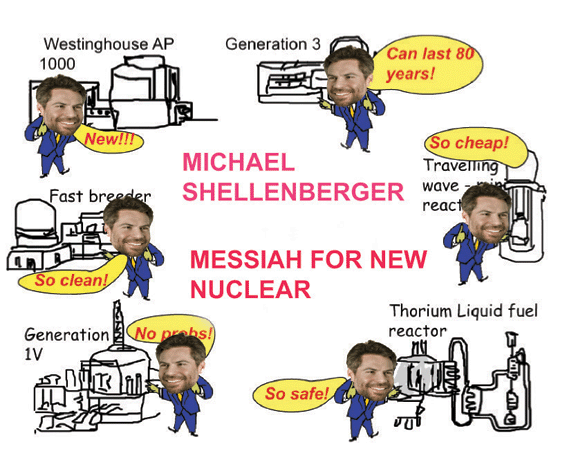
Murdoch press supports ‘reformed climate activist’ Michael Shellenberger https://independentaustralia.net/business/business-display/murdoch-press-supports-reformed-climate-activist-michael-shellenberger,14065 By Steve Bishop | 3 July 2020, The mainstream press published an attack on climate science by a supposed environmentalist who is, in fact, a nuclear lobbyist, writes Steve Bishop.
THE AUSTRALIAN misled its readers this week when it carried a major article purporting to be written by a climate activist who was, as it turned out, admitting climate science was bunkum.
Michael Shellenberger, headlined as an environmentalist in the article, is, in fact, a self-advertised nuclear power lobbyist and an advocate for nuclear weapons proliferation.
Other Murdoch newspapers and Australia’s Sky News have also carried Shellenberger’s claim that:
‘On behalf of environmentalists everywhere, I would like to formally apologise for the climate scare we created over the past 30 years.’
He may once have been an environmentalist, but the fact is he was exposed – not for the first time – for attacking climate science as long ago as 2010 by the Public Interest Research Centre which reported that along with a co-author he had restated:
‘…a plethora of half-truths, misrepresentations and outright fantasies that have lately become almost canonical in the public sphere.’
Shellenberger makes his agenda clear on various websites and elsewhere: the present approach to dealing with climate change is not working, renewable power sources won’t solve the problem and, therefore, the entire world needs to be nuclear powered.
He told the Sydney Morning Herald in 2017 that the widespread adoption of nuclear power across the world would solve the climate change problem:
“…because it basically reduces your carbon emissions to near zero in the power sector.”
The Herald described him not as an environmentalist but as a ‘nuclear power advocate’.
In 2003, he co-founded the Breakthrough Institute which says on its website:
Breakthrough’s energy work has focused heavily on the future of nuclear energy. Along with a growing cohort of scientists, journalists, philanthropists, and environmentalists, we have made the case that addressing climate change will require abundant, cheap, safe, and reliable nuclear energy.’
In 2016, he became the founder and president of an enterprise lobbying for the nuclear industry, giving it the misleading title of Environmental Progress.
He describes its aim:
‘The greatest threat to the climate today comes from the decline of clean energy as a share of electricity globally. EP is working with scientists, conservationists and citizens around the world to defend our largest source of clean energy, nuclear power.’
The website boasts:
‘He has helped save nuclear reactors around the world, from Illinois and New York to South Korea and Taiwan, thereby preventing an increase in air pollution equivalent to adding over 24 million cars to the road.’
In a major article for Forbes magazine in 2018, Shellenberger wrote:
‘Who are we to deny weak nations the nuclear weapons they need for self-defence?’
In another 2018 Forbes article under the cross-heading ‘Why nuclear energy prevents war’, Shellenberger wrote:
‘After over 60 years of national security driving nuclear power into the international system, we can now add “preventing war” to the list of nuclear energy’s superior characteristics.’
Renew Economy reported in 2017 he was:
‘…stridently pro-nuclear, hostile towards renewable energy and hostile towards the environment movement.’
At that time, Shellenberger was in Australia to speak at a major conference – not a climate change summit but the International Mining and Resources Conference – to advance the cause of nuclear power.
This is not the first time The Australian has used this nuclear lobbyist to attack renewable energy and climate science. It featured him three years ago under the headline: ‘Nuclear “must replace coal, gas”’.
He was in Australia to promote his message that wind and solar have failed, that they are doubling the cost of electricity and that:
“…all existing renewable technologies do is make the electricity system chaotic and provide greenwash for fossil fuels.”
In his article, Shellenberger gives 12 examples of scientific findings which he says are incorrect and which are climate alarmism.
Take just the first: ‘Humans are not causing a “sixth mass extinction”’.
His assertion contradicts the work of more than 1,000 scientists contributing to the Intergovernmental Science-Policy Platform on Biodiversity and Ecosystem Services (IPBES) which found ‘1,000,000 species threatened with extinction’ and warned:
“We are eroding the very foundations of our economies, livelihoods, food security, health and quality of life worldwide.”
What makes The Australian’s publishing of the article all the more risible is that in reality, it is a puff piece for Shellenberger’s new book, ‘Apocalypse Never’ and is more or less identical with what he had published on his website on 29 June.
Forbes, which has carried Shellenberger’s articles in the past, withdrew the puff piece.
National Post asked Forbes why this had happened and was told:
‘Forbes requires its contributors to adhere to strict editorial guidelines. This story did not follow those guidelines and was removed.’
Don’t expect The Australian to follow suit.
(Readers who might want to read about a real climate scientist changing his mind about global warming should read Professor Richard Muller’s story.)
Julian Assange’s father in tireless fight to free his son, calls on Scott Morrison to help Australian citizen Julian
Assange’s father calls extradition process ‘disgrace’ https://telanganatoday.com/assanges-father-calls-extradition-process-disgrace?fbclid=IwAR1a7bQ0W_Xcgc9EIeGaAHVP7Zmm2cM6nNV65ZXtkhCwNUlarqIYTJVw6xo1 July 20, The 80-year-old is organizing public events in Australia despite the ongoing coronavirus pandemic and hopes to travel to London in August to support Assange during his extradition trial.
Sydney: WikiLeaks founder Julian Assange’s father, John Shipton, is fighting tirelessly for the release and return of his son, who is facing an extradition trial in London for publishing classified information, a process he described as abuse.
“We maintain that the extradition request is a fraud in the English court… It’s a fraud in the English legal system, it’s a case of abuse of process, it is a disgrace,” Shipton, who travelled from Melbourne to Sydney to campaign for his son’s release, told Efe news in an interview.
The 80-year-old is organizing public events in Australia despite the ongoing coronavirus pandemic and hopes to travel to London in August to support Assange during his extradition trial which, he says, is being carried out under “dire” circumstances.
In May 2019, the UN Special Rapporteur on Torture, Nils Melzer, said, after visiting Assange in the Belmarsh prison along with two medical experts, that he showed “all symptoms typical for prolonged exposure to psychological torture, including extreme stress, chronic anxiety and intense psychological trauma”.
Assange has spent almost a decade in confinement, first under house arrest in a British town and then at the Ecuadorian embassy in London between 2012 until 2019, when Ecuador withdrew his political asylum status.
Shipton has urged the Australian government to mediate with the UK administration for the release of his son, who is wanted in the US on 18 charges of espionage and computer intrusion, for which he could be sentenced to prison for up to 175 years.
“I believe the government can, if it wishes to, assist us in bringing Julian home. I believe that (it) is very simple for the Prime Minister (Scott Morrison) to pick up the phone and ring (his UK counterpart) Boris Johnson and say Julian Assange is an Australian citizen in dire circumstances.
“This will resolve this immediately and that’s easily possible,” he told Efe news during the interview.
Killing Australia’s democracy – first kill the ABC
Latest $84 million cuts rip the heart out of the ABC, and our democracy, The Conversation, Alexandra Wake, Program Manager, Journalism, RMIT University, Michael Ward, PhD candidate, University of Sydney, 24 June 20
In the latest cuts, wrapped up as part of the national broadcaster’s five-year plan,
- 250 staff will lose their jobs
- the major 7:45am news bulletin on local radio has been axed
- ABC Life has lost staff but somehow expanded to become ABC Local
- independent screen production has been cut by $5 million
- ABC News Channel programming is still being reviewed………
- Clearly the coronavirus pandemic has slashed Australia’s commercial media advertising revenues. But the problems in the media are a result of years of globalisation, platform convergence and audience fragmentation. In such a situation, Australia’s public broadcasters should be part of the solution for ensuring a diverse, vibrant media sector. Instead, it continues to be subject to ongoing budget cuts.
Moreover, at a time when the public really cannot afford to be getting their news from Facebook or other social media outlets, cutting 250 people who contribute to some of Australia’s most reliable and quality journalism and storytelling – and literally saving lives during the bushfires – appear to be hopelessly shortsighted.
The latest Digital News Report 2020 clearly showed the ABC is the media outlet Australians trust the most.[table on original shows this]……
- the end of short wave radio services to the Northern Territory
- a reduction in live concerts on Classic FM
- a contraction of Australian drama
- cut costs for Australian children’s programming
- reductions in women’s and local sport
- an end to the coverage of international events such as the Olympics cancelled
- an end to non-news and current affairs television outside of Sydney and Melbourne
- the closure of ABC Open
- 100 websites shut down.
- ……… It is against this background the latest funding freeze, due to a failure to meet the impact of inflation costs, occurs. While it doesn’t sound like a lot, the three year impact is $84 million, and has resulted in the cuts announced today.But more importantly, these ongoing cuts represent an attack by the federal government on the broadcaster, its role in democracy, and in keeping Australians safe, informed and entertained. https://theconversation.com/latest-84-million-cuts-rip-the-heart-out-of-the-abc-and-our-democracy-141355
Another Australian wonderful lead – in CLIMATE DENIAL!!!!
 The number of climate deniers in Australia is more than double the global average, new survey finds, The Conversation, Caroline Fisher, Co-author of the Digital News Report: Australia 2020, Deputy Director of the News and Media Research Centre, and Assistant Professor of Journalism, University of Canberra, Sora Park, Lead Author of Digital News Report: Australia 2020, Associate Dean of Research, Faculty of Arts & Design, University of Canberra, June 16, 2020 Australian news consumers are far more likely to believe climate change is “not at all” serious compared to news users in other countries. That’s according to new research that surveyed 2,131 Australians about their news consumption in relation to climate change.
The Digital News Report: Australia 2020 was conducted by the University of Canberra at the end of the severe bushfire season during January 17 and February 8, 2020.
Read more: Media ‘impartiality’ on climate change is ethically misguided and downright dangerous
It also found the level of climate change concern varies considerably depending on age, gender, education, place of residence, political orientation and the type of news consumed.
Young people are much more concerned than older generations, women are more concerned than men, and city-dwellers think it’s more serious than news consumers in regional and rural Australia.
15% don’t pay attention to climate change news
More than half (58%) of respondents say they consider climate change to be a very or extremely serious problem, 21% consider it somewhat serious, 10% consider it to be not very and 8% not at all serious.
Out of the 40 countries in the survey, Australia’s 8% of “deniers” is more than double the global average of 3%. We’re beaten only by the US (12%) and Sweden (9%).
While most Australian news consumers think climate change is an extremely or very serious problem (58%), this is still lower than the global average of 69%. Only ten countries in the survey are less concerned than we are.
Strident critics in commercial media
There’s a strong connection between the brands people use and whether they think climate change is serious.
More than one-third (35%) of people who listen to commercial AM radio (such as 2GB, 2UE, 3AW) or watch Sky News consider climate change to be “not at all” or “not very” serious, followed by Fox News consumers (32%)……. https://theconversation.com/the-number-of-climate-deniers-in-australia-is-more-than-double-the-global-average-new-survey-finds-140450
Australian media watchdog found Andrew Bolt breached press standards by vilifying Greta Thunberg
Andrew Bolt breached media standards calling Greta Thunberg ‘deeply disturbed’, watchdog rules, SBS, The Australian media watchdog has found Andrew Bolt breached press standards by attempting to “diminish the credibility” of Greta Thunberg on the basis of her disability.
BY MAANI TRUU, 5 June 20 A column by News Corp writer Andrew Bolt mocking teenage climate change activist Greta Thunberg breached standards by attempting to “diminish the credibility” of her opinions on the basis of her disability, the Australian media watchdog has found.
The column, published online in August last year, referred to the 17-year-old as “freakishly influential”, “deeply disturbed”, and a “strange girl”.
“I have never seen a girl so young, with so many mental disorders, treated by so many adults as a guru,” Bolt wrote.
The Australian Press Council found the article breached General Principle 6 of its standards of practice, which requires media organisations to avoid causing offence, distress, prejudice, or a substantial risk to the health and safety of an individual, unless publishing the story is in the public interest. …..
“[The column] attempts to diminish the credibility of Ms Thunberg’s opinions on the basis of her disabilities and by pillorying her supporters on the basis of her disabilities,” the watchdog’s findings, published on Thursday, read. ……. https://www.sbs.com.au/news/andrew-bolt-breached-media-standards-calling-greta-thunberg-deeply-disturbed-watchdog-rules
Today’s News Corp cuts represent an enormous threat to Australian democracy
 Dark day for journalism as Murdoch’s global empire sells democracy down the river
Today’s News Corp cuts represent an enormous threat to Australian democracy — and a grim reminder of the power of a single family. ERIC BEECHER AND PETER FRAY, MAY 28, 2020
Australian news journalism has never seen a day as black as today — and not just because News Corp has closed 12 of its 17 regional daily newspapers, leaving Australia with just 20 remaining.
Today also demonstrates the grotesque power of
one company — and one family — to decimate a large slice of a country’s
news in a single media release.
A company worth $16.3 billion, run from New York, has wielded a knife through large swathes of Australian democracy….. (subscribers only) https://www.crikey.com.au/2020/05/28/rupert-murdochs-global-empire-sells-democracy-down-the-river/?utm_campaign=Weekender&utm_medium=email&utm_source=newsletter&wkndr=VWI3bngzTjl0a0V6UEhQbEJJeTFxUT09
Australian media is not doing its job to expose power and corruption
|
What lies beneath must be resurfaced — or the media is not doing its job to expose power and corruption
And yesterday, the government released a discussion paper proposing that the declining role of gas in Australia’s energy production and manufacturing sectors instead be significantly expanded, which would also directly benefit Santos. In between, the government’s COVID economic recovery panel, chaired by another energy company executive, also urged that gas be used as part of Australia’s economic recovery. Both ideas would require massive government subsidies for gas companies like Santos. As a result Santos has had a good week. Last Friday, the company saw its share price close at $4.60. Yesterday it closed at $5.29, a 15% rise compared to just 3% on the ASX 200. This represents a handy return on investment. Santos is the country’s second-biggest fossil fuel industry political donor after Clive Palmer, having given over $1 million to the Coalition in the last decade. It has a rich history of exchanging staff with Coalition governments…… [In the media coverage] The story was treated as an energy or climate policy story, rather than one about corruption and power……. When even good, experienced journalists fail to give a full account of the fossil fuel companies working to not merely stymie climate action but to turn climate policies to their financial advantage, it points to a serious problem in our media — an inability to explore how surface events reflect underlying structures of power in Australia. And it results in a normalisation of corruption. Why do we instinctively see corruption if Trump does something, but if the government here does exactly the same thing, it’s written up seriously as an energy policy story, with the government and business on one side of a serious debate and “green groups” on the other? We see through the words a figure like Trump uses to disguise their corruption; here, the same words are taken at face value, and debated as serious contributions to policy…… Turnbull at least spoke and wrote about the role of fossil fuel interests and News Corp (which he correctly described as a foreign political party, rather than what it purports to be, an Australian media company) ….. Despite the woeful level of transparency around influence-peddling, there is considerable information available about the financial and personal links between key stakeholders and policymakers across federal politics.
At the ABC, Stephen Long is one of the few mainstream media journalists who sees his “investigative” role as extending to the structures of power rather than simply the surface. Paul Karp of The Guardian is also attuned to the tendency of donors to benefit from political parties. But they are, sadly, exceptions. We’ve seen before what happens when the media ignores the underlying reasons for decisions by policymakers. For years, the extensive donations by the major banks to the Liberal Party, and the revolving door between the executive suites of banks and the ranks of both ministerial staff and ministers themselves, was ignored by the media. The donations and revolving doors operated for both political parties, but the Liberals had — and have — by far the deepest and richest links with the banks. But the role of these financial and personal links in the Liberals’ long-running protection of the banks from regulation, and their constant attacks on industry superannuation funds, received little attention……. Australia’s political system is corrupted. Corrupted not merely or even particularly in the NSW Labor way of bags of cash and dodgy deals for mates, but systemically, institutionally corrupt, a pervasive soft corruption in which the powerful use money and lobbying to influence policymakers and get favourable policies, indeed, as we’ve seen this week, often get to craft policy themselves. All it takes to understand and explain that is to look beneath the surface. Is the Australian media holding policymakers to account? Let us know your thoughts by writing to letters@crikey.com.au. Please include your full name to be considered for publication in Crikey’s Your Say column. https://www.crikey.com.au/2020/05/22/political-reporters-not-doing-their-job-power-corruption/ |
|

The Liberal coalition government killing the ABC by 1000 cuts – but a possible way exists to save it
 With luck the ABC can be saved , Crispin Hull, 8 May 20, This week’s report on ABC funding should alarm Australians.
The death by a thousand cuts of the ABC and the slow strangulation of Medicare have become woven into in Liberal Party’s DNA since John Howard turned Robert Menzies’ broad church of a liberal-conservative Liberal Party into a purely conservative one by shutting out almost everyone left of the nave.
A different liberal-conservative Liberal Party, on the other hand, would have recognised them as essential Australian institutions to be nurtured and supported. After all, the ABC has been around since 1932 and Medicare (in one form or another) since 1973.
The Liberal Party’s desired outright abolition of both has been impossible because of the two institutions’ ingrained popularity. So the onslaught has to be cunningly dressed up as measures to “improve” Medicare and to voice support for the independence of the ABC and promise “no cuts” while ever trying to bully the ABC; sway its board to the right; and to apply cuts to stifle its voice.
This week’s report by the independent think tank Per Capita says that the ABC has lost $783 million in funding since the Coalition came to power in 2013, starting with $245 million in the 2014 Budget, despite Tony Abbott’s promise before the 2013 election that he would not cut the ABC.
More cuts in staff and programming will come before the end of this financial year. They follow seven years of program and staff slashing, critically a 50 per cent cut in the hours of scripted Australian drama.
The Per Capita report concludes that real funding per year since 1985-86 is down 30 per cent or $370 million. Per head of population, the ABC’s funding has been halved in that time. The cuts have come despite the ABC having to provide extra services to keep up with the digital age.
Very likely the Government will cut more as it seeks to claw back from the Covid-19 crisis, even though the ABC – especially the excellent Dr Norman Swan – did so much to inform Australians about the pandemic, as it always does in times of crisis.
What can be done? The ABC itself is down to the bone, though perhaps it could cut out all sport which the commercials to well enough. It is doubtful a Coalition Government would ever increase real funding for the ABC. Perhaps the best we can hope for is that Labor makes some suggestions that the Coalition feels obliged to match or that they become reality with a Labor Government (whenever that might be). ……..
funding solution used in Britain, New Zealand, and only Western Australia among the Australian states to fund culture which could help fund the ABC – a lottery. The Federal Government should set up its own national lottery to boost ABC funding……..
The BBC is well-funded and broadcasters throughout the world line up to pay for its product. The result is a lot of soft-power dividend for Britain. Australia, too, would get a lot of benefit from properly funding the ABC, not least a better-informed community.
Silly me. It’s that last bit the Coalition detests more than anything. http://www.crispinhull.com.au/2020/05/08/with-luck-the-abc-can-be-saved/?utm_source=mailpoet&utm_medium=email&utm_campaign=crispin-hull-column-16-nov-2019_99
1 This month

of the week – Australians for War Powers Reform (AWPR)
To see nuclear-related stories in greater depth and intensity
 Antinuclear