New involvement of Attorney General in press freedom
The order could shield News Corp’s Annika Smethurst and the ABC’s Dan Oakes and SamClark who were named in Australia Federal Police (AFP) warrants used during raids in June and have not yet been cleared of any criminal charges. The move, however, has ignited debate about an elected politician’s direct involvement in police matters and press freedom.
Now, Smethurst, Oakes and Clark can only be charged if the Attorney-General gives written consent to the charges. A directive was signed to the Commonwealth Director of Public Prosecutions (CDPP) in September, the details of which have only come to light this week. The decision follows legal challenges from both the ABC and News Corp Australia over the legitimacy of the raids and the warrants used.
“The direction means where the CDPP independently considers that there is a public interest in a prosecution for one of the relevant offences involving a journalist, the consent of the Attorney-General will also be required as a separate and additional safeguard,” Porter said in a statement.
“This will allow the most detailed and cautious consideration of how an allegation of a serious offence should be balanced with our commitment to freedom of the press.
“I have previously said that I would be seriously disinclined to approve prosecutions of journalists except in the most exceptional circumstances and would pay particular attention to whether a journalist was simply operating according to the generally accepted principles of public interest journalism.”
Porter hasn’t yet commented on the cases regarding Smethurst, Oakes or Clark.
An ABC spokesperson called the directive a ‘welcome step’, but said the organisation continues to look forward to the results of the two press freedom inquiries which have been triggered by the raids.
“The Attorney General’s directive is a welcome step. It is one plank in a raft of legislative reform that the ABC identified in its submissions to the two concurrent media freedom parliamentary inquiries,” said the spokesperson.
“The ABC looks forward to seeing the recommendations from those inquiries as well as an expeditious conclusion to the current AFP investigation into ABC journalists.”
“The direction issued by The Attorney General is unremarkable. They make the Commonwealth Department of Public Prosecution seek the Attorney General’s consent to take legal action against journalists in a few more instances but they offer no comfort for journalists disclosing information in the public interest that they are safe from prosecution for doing their job,” said Reid.
“This so-called safeguard falls a long way short of what media organisations are seeking to recognise the role of journalists to keep the public informed.”
The Law Council of Australia has also weighed in on the move, with president Arthur Moses SC citing grave concerns over the Attorney General’s involvement with press freedom.
“I have grave concerns that this sort of direction undermines the independence of the CDPP by requiring her to obtain the consent of the Attorney General before prosecuting an offence,” Moses said.
“What will enhance press freedoms in this country is a proper review of our laws to ensure that the actions of journalists doing their job as a watchdog of government are not criminalised and put at risk of prosecution.
“I have no doubt the Attorney General would act in good faith. But it puts the Attorney General – a politician – in the position of authorising prosecutions of journalists in situations where they may have written stories critical of his government.
“It creates an apprehension on the part of journalists that they will need to curry favour with the government in order to avoid prosecution. The media must be able to lawfully report on matters of public interest without fear or favour.
“Journalists should not need to fear prosecution because of a story that embarrasses government.”
The government seeks to intimidate the media
The national security bureaucracy doesn’t want a police state. It is more ambitious than that. The hope is to return Australian culture to the conformity and political quietude of the 1950s.
Now the government seeks to intimidate the media through laws and criminal prosecutions into a deferential posture once more, with editors becoming habituated to asking permission before they publish.
Clinton Fernandes, The Witness K case and government  secrecy https://www.thesaturdaypaper.com.au/opinion/topic/2019/09/28/the-witness-k-case-and-government-secrecy/15695928008833 In recent months, I have sat in court as an observer as Canberra lawyer Bernard Collaery has faced charges over disclosing information about the Australian Secret Intelligence Service (ASIS). On Thursday, Collaery’s case was back before the Supreme Court of the Australian Capital Territory. It is a good time, then, to consider this case and the national security state’s assault on Australia’s democratic culture more generally.
In 2004, ASIS installed listening devices in the government offices of newly independent Timor-Leste to eavesdrop on its internal discussions during oil and gas negotiations with Australia. The espionage operation occurred while Alexander Downer and John Howard, who were respectively foreign minister and prime minister at the time, said they were deploying Australia’s resources against extremist Muslim terrorism in Indonesia.
But the Timor operation diverted precious ASIS resources away from the war on terror. On September 9, 2004, Jemaah Islamiyah terrorists succeeded in bombing the Australian embassy in Indonesia. To make matters worse, the Timor bugging occurred under cover of an aid project, jeopardising the safety of Australian aid workers everywhere.
A senior ASIS officer, known only as Witness K, expressed concerns about the Timor bugging operation. His career is believed to have suffered as a consequence. He approached the inspector-general of intelligence and security and obtained permission to speak with a lawyer – Bernard Collaery. Both men are now on trial: Collaery in the ACT Supreme Court, where he will exercise his constitutional right to a jury trial, and Witness K in the ACT Magistrates Court……. Continue reading
Australia: Freedom of Information and the Nuclear Industry- theme for October 19
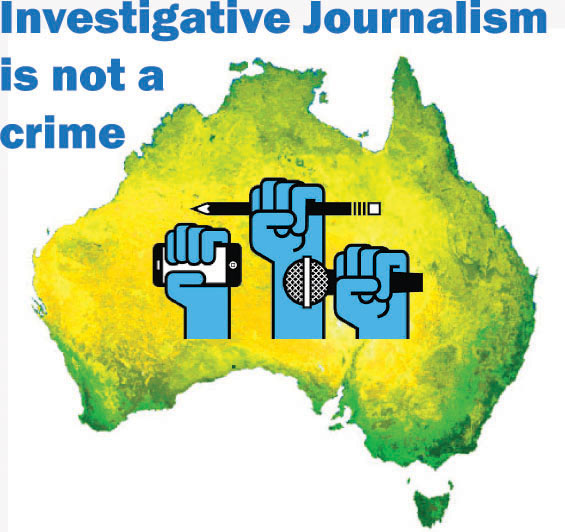
Australia’s press freedom is under threat as never before.
It’s always been pretty bad, with Murdoch media controlling at least 70% of media outlets, and with Liberal governments trying to strangle the ABC,
But now – it is at crisis point. We have an Australian citizen, Julian Assange, held in solitary confinement in London, for the crime of skipping bail. UK and complicit Australia want to have him extradited to USA, to face life imprisonment for ‘treason”. What was his “treason”? Publishing the facts, revealed by Bradley Manning, on USA military atrocities. i.e. investigative journalism. (Manning also in prison)
We also have federal police raiding ABC offices and a journalist’s home. We have draconian security laws, and prosecutions of whistleblowers Richard Boyle, David McBride and Witness K.
 Australia is fast developing a culture of press intimidation by government.
Has this anything to do with the nuclear industry? Not obviously directly. Not yet. But government and industry have always tried to see that the harms from uranium mining and nuclear bomb testing were covered up. Few Australians would have heard of the long term push by some politicians and defence industry personnel, for nuclear weapons.
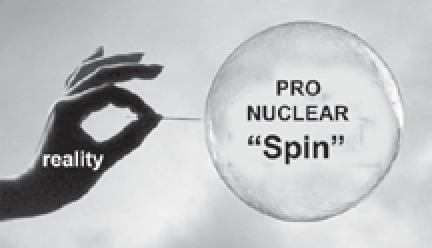
As the global nuclear industry revs up its dishonest spin for “new nuclear”, and as climate change impacts this country, Australia is a sitting duck for the lie that “nuclear solves climate change”. And for the push for even more involvement in America’s nuclear weapons system. And for involvement in  Trump’s Nuclear Weapons in Space programme.
We now have a government without any policy (unless you count “having a budget surplus” as a policy) Scott Morrison can’t forever shout “How good is that?” about everything. Journalists that criticise government actions are under scrutiny. It doesn’t bode well for any public policy area. And that certainly includes matters nuclear. more https://www.meaa.org/campaigns/press-freedom/
Found – historic film of Aboriginal resistance to uranium mining
Kakadu uranium protest documentary Dirt Cheap unearthed by Northern Territory Library, ABC News By Matt Garrick 18 Sept 19 The rediscovery of an old VHS tape, left forgotten on the shelves of the Northern Territory Library, has unearthed a tense and important piece of Australian history.
Key points:
- The 1980 documentary Dirt Cheap showcased the Mirarr people’s fight against uranium mining
- The Northern Territory Library recently hunted down the only digital copy of the documentary so it could be shown at a film festival
- Filmmaker Ned Lander says the movie created a stir at the time of its release
The rare copy of the nearly 40-year-old documentary Dirt Cheap, which details the early pushback against uranium mining in Kakadu National Park, was practically unwatchable due to its age……..
The film documented the concerns of the Mirarr people during what was a tense period of negotiation in the lead-up to the 1979 Ranger Uranium Mining Agreement.
It also showcased the pressures and broken promises the traditional owners faced. “It was very, very apparent to us that people were not ready to sign the agreement in relation to mining, and this was being done under pressure.
Mirarr resistance inspires protests around nation
Against the push of government and business interests, the Mirarr stood resolute in their bid to protect their land.
“As a child growing up I saw the struggle of my family, including my grandfather — they [had] been struggling,” traditional owner Jimmy Nabanardi-Mudjandi said.
I’m really proud of them, but it’s sad because they’re not here to see what the new future of Jabiru’s gonna be.”
The resistance from the Mirarr had a flow-on effect around the nation.
Banner-waving protesters took to the streets in Melbourne and Sydney in great numbers, scenes which Dirt Cheap captures in vivid detail.
“Mirarr people got major support from around Australia, from around the whole nation,” Mr Nabanardi-Mudjandi said.
Next stage of uranium mining looms
In the decades since the film’s release, uranium has been mined at Kakadu, but the Ranger mine is now expected to wind up in 2021.
Mr Nabanardi-Mudjandi said it was vital the land was protected during its rehabilitation.
“We are watching them, what they’re doing,” he said.
Mr Nabanardi-Mudjandi will be a special guest when Dirt Cheap screens as part of the Darwin International Film Festival at the Northern Territory Library at 5:30pm on Wednesday. Contact Matt Garrick https://www.abc.net.au/news/2019-09-18/northern-territory-film-uranium-protests-unearthed-for-festival/11519914
Media silence on Julian Assange’s imprisonment encourages governments to intimidate journalists
 All around the world, Assange’s treatment seems to have given the green light to governments to intimidate and hassle journalists. Australian police, for instance, recently conducted a raid on journalist Annika Smethurst’s home. Smethurst had not long before that revealed that the Government had been secretly requesting permission to spy on its own citizens.
He must not be extradited’ – Vivienne Westwood on Julian Assange
The media blackout on Julian Assange’s imprisonment https://independentaustralia.net/business/business-display/the-media-blackout-on-julian-assanges-imprisonment,13094 By Mint Press News | 11 September 2019, The same media that has spent years dragging Assange’s name through the mud is now engaging in a blackout on his treatment.
If you are waiting for corporate media pundits to defend freedom of the press, you’re going to be disappointed.
The role of journalism in a democracy is publishing information that holds the powerful to account — the kind of information that empowers the public to become more engaged citizens in their communities so that we can vote in representatives that work in the interest of “we the people.”
There is perhaps no better example of watchdog journalism that holds the powerful to account and exposes their corruption than that of WikiLeaks, which exposed to the world evidence of widespread war crimes the U.S. military was committing in Iraq, including the killing of two Reuters journalists; showed that the U.S. Government and large corporations were using private intelligence agencies to spy on activists and protesters; and revealed how the military hid tortured Guantanamo Bay prisoners from Red Cross inspectors.
It’s this kind of real journalism that America’s First Amendment was meant to protect but engaging in it has instead made WikiLeaks publisher Julian Assange the target of a massive smear campaign for the last several years — including false claims that Assange is working with Vladimir Putin and the Russians and hackers, as well as open calls by corporate media pundits for him to be assassinated. Continue reading
‘All of us are in danger’: John Pilger delivers warning from Julian Assange
Today, in further flagrant and conscious censorship, no British, Australian or American newspaper is carrying a report on Waters’ initiative and the rally.
Roger Waters and John Pilger make powerful defence of Julian Assange in London, WSWS 3 September 2019
Up to 1,000 people gathered last night in central London to hear internationally acclaimed musician Roger Waters deliver a musical tribute to imprisoned WikiLeaks’ publisher Julian Assange.
Performing outside the UK Home Office, just miles from Belmarsh Prison where Assange is being held as a Category A prisoner, Waters sang Pink Floyd’s iconic song “Wish You Were Here.” He was accompanied by guitarist Andrew Fairweather Low.
Supporters filled the forecourt and pavement on both sides of Marsham Street, many carrying banners and placards demanding Assange’s freedom and the release of imprisoned whistleblower Chelsea Manning. Spontaneous chants rang out, “Free, Free Julian Assange!” and “There’s only one decision: No extradition!”
John Pilger, a veteran filmmaker and investigative journalist and a personal friend of Assange, opened the event with an impassioned speech. Pointing in the direction of the Home Office, Pilger told the crowd: “The behaviour of the British government towards Julian Assange is a disgrace. A profanity on the very notion of human rights. It’s no exaggeration to say that the treatment and persecution of Julian Assange is the way that dictatorships treat a political prisoner.”
John Pilger, a veteran filmmaker and investigative journalist and a personal friend of Assange, opened the event with an impassioned speech. Pointing in the direction of the Home Office, Pilger told the crowd: “The behaviour of the British government towards Julian Assange is a disgrace. A profanity on the very notion of human rights. It’s no exaggeration to say that the treatment and persecution of Julian Assange is the way that dictatorships treat a political prisoner.”………
Pilger warned that Assange’s condition was a matter of grave concern. “I worry a great deal about him if he spends many months in Belmarsh,” he said. “The regime there is imposing a kind of isolation on him that is deeply psychologically wounding. He’s in a small cell in the hospital ward. They seem not to know what to do with him. Of course, what they should be doing is letting him out. He certainly should not be in a maximum-security prison.”…….
Underscoring the point made by Kristinn Hrafnsson about the mainstream media, no major British television station reported on the event on their evening news broadcasts. Today, in further flagrant and conscious censorship, no British, Australian or American newspaper is carrying a report on Waters’ initiative and the rally.
Via social media and publications such as the WSWS, however, reports and video of Waters’ performance, Pilgers’ speech and the statements of Gabriel Shipton are circulating widely and will be viewed by hundreds of thousands of people internationally over the coming days.
Aaron Patrick of Australian Financial Review misrepresents economist John Quiggin on nuclear power
Sep 2, 2019
Left-wing economist John Quiggin has urged the NSW Parliament to legalise nuclear power, making the University of Queensland academic the most prominent environmentalist to support the controversial energy source.
Economist John Quiggin supports nuclear power. [?]
Professor Quiggin told a NSW parliamentary inquiry into uranium mining and nuclear power that the ban should be lifted simultaneously with the introduction of a price charged for emitting Greenhouse gases.
“The Parliament should pass a motion … removing the existing ban on nuclear power,” he said in a written submission. “Nuclear power is not viable in the absence of a carbon price.”
The inquiry, one of three similar under way, is seen by some Coalition MPs as the start of a long process of convincing voters to support nuclear reactors to replace the state’s ageing coal power stations, including Liddell in the Hunter Valley, which is due to close after the summer of 2023……..
The Minerals Council of Australia, a lobby group, successfully pushed for a federal parliamentary inquiry into nuclear, which is examining the feasibility of a new generation of compact power plants that are meant to be safer and much cheaper than the huge stations that supply about 11 per cent of the world’s electricity……..
The NSW inquiry is the result of a private members bill introduced by state One Nation leader Mark Latham that would allow uranium mining. Nuclear power is banned in NSW under federal and state regulations…….
The biggest impediment to development of the industry is opposition from the Labor and Greens parties, environmental groups and left-wing think tanks such as The Australia Institute.
The conditional support of left-wing academics such as Professor Quiggin could, over time, lessen opposition to nuclear power, which supporters say could be used as a back up for wind and solar power.
In Victoria a parliamentary inquiry began two weeks ago at the request of a Liberal Democrat MP, David Limbrick.
The 12-month inquiry will explore if nuclear energy would be feasible and suitable for Victoria in the future, and consider waste management, health and safety and industrial and medical applications, AAP reported.
Aaron Patrick is The Australian Financial Review’s Senior Correspondent. He writes about politics and business. Connect with Aaron on Twitter. Email Aaron at apatrick@afr.com.au
https://www.afr.com/companies/energy/left-support-for-nsw-nuclear-power-industry-20190830-p52mjiDr Jim Green explodes the Australian Financial Review ‘s propaganda promoting Small Modular Nuclear Reactorsll
|
|
|
Shock Jock Alan Jones takes time off insulting women, to praise thorium nuclear power
Thorium ‘more environmentally friendly and safer’ than nuclear https://www.news.com.au/video/id-5348771529001-6074698767001/thorium-more-environmentally-friendly-and-safer-than-nuclear August 20th 2019
Sky News host Alan Jones explains the element thorium, which is “seen by many as more environmentally friendly” than nuclear as an energy source. Mr Jones said thorium-based reactors are safer too because the reaction can easily be stopped and produce less waste that is radioactive. “It’s three times as abundant as uranium, we’re told, and there’s enough thorium in the United States alone to power America at its current energy level for a thousand years,” he said. The broadcaster noted that rolling blackouts for smelters and manufacturers has created a “crisis” for the energy market and suggested thorium as a possible answer.
Australian investigative journalist Mark Davis explodes the myths around Julian Assange
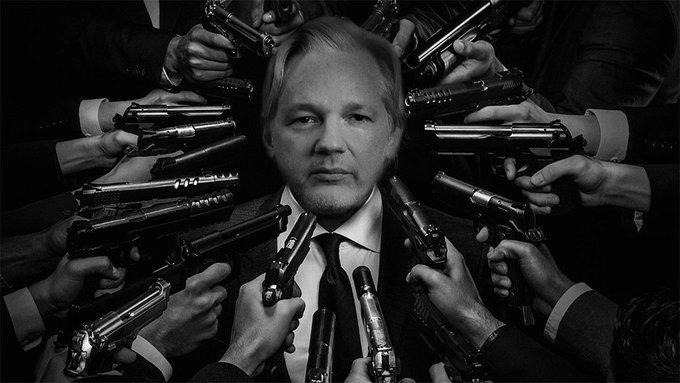
While the Internet was meant to democratise the transmission of information we see a few giant technology companies, Google, Facebook, and Twitter, have near total control of what is seen and shared.
The situation is even worse in Australia with two or three media companies and the same technology giants having control. And the Government of Australia has granted them ever wider market access to extend their monopolies.
Slowly, instance by instance, the malicious and deceitful smears of Julian Assange’s character have been exposed for what they are; an effort to destroy trust in a system of anonymous leaking that will educate everyone.
WikiLeaks’ threat to the powerful was recognised and every effort was, and is, being made to criminalise anonymous leaking, which would be akin to criminalising Gutenberg’s printing press, but there is not much chance this criminalisation will succeed.
It’s time to bring Julian Assange home. Torturing and punishing him has never been legitimate and serves absolutely no purpose.
Media dead silent as Wikileaks insider explodes the myths around Julian Assange, Michael West, by Greg Bean — 16 August 2019 – It is the journalists from The Guardian and New York Times who should be in jail, not Julian Assange, said Mark Davis last week. The veteran Australian investigative journalist, who has been intimately involved in the Wikileaks drama, has turned the Assange narrative on its head. The smears are falling away. The mainstream media, which has so ruthlessly made Julian Assange a scapegoat, is silent in response.
Nuclear lobby claims that Australia will hold Parliamentary Inquiry into nuclear power, especially small modular reactors
Australian parliament to launch nuclear energy inquiry. http://world-nuclear-news.org/Articles/Australian-parliament-to-launch-nuclear-energy-inq, 02 August 2019
Australia’s Energy Minister Angus Taylor has asked the House Standing Committee on the Environment and Energy to investigate the nuclear fuel cycle, Committee Chairman Ted O’Brien announced today
“This will be the first inquiry into the use of nuclear energy in Australia in more than a decade and I believe it’s the first time the Australian Parliament has ever undertaken such an inquiry,” O’Brien, who is Member of Parliament for Fairfax in Queensland, said. He will be tasked with leading the inquiry after the ministerial request is considered and adopted by the committee.
In a letter to O’Brien, Taylor said the inquiry will consider the economic, environmental and safety implications of nuclear power. The minister has specifically asked the committee to inquire into and report on “the circumstances and prerequisites necessary for any future government’s consideration of nuclear energy generation including small modular reactor technologies in Australia”.
The terms of reference for the inquiry include: waste management, transport and storage; health and safety; environmental impacts; energy affordability and reliability; economic feasibility; community engagement; workforce capability; security implications; national consensus; and “any other relevant matter”.
“Australia’s energy systems are changing with new technologies, changing consumer demand patterns and changes in demand load from major industries,” the context for the inquiry notes. “At the same time the National Electricity Market is seeing a significant increase in capacity in intermittent low emissions generation technologies.” The country’s bipartisan moratorium on nuclear electricity generation – which has been maintained by successive Labor and Coalition governments – will remain in place, it said.
The inquiry will have regard to previous inquiries into the nuclear fuel cycle, including South Australia’s 2016 Nuclear Fuel Cycle Royal Commission and the 2006 Review of Uranium Mining Processing and Nuclear Energy in Australia, which is also known as the Switkowski report after its lead author Ziggy Switkowski.
The minister has requested that the committee completes the inquiry and delivers its report by the end of this year.
Australian govt ignored nomination panel, appointed uranium industry’s Vanessa Guthrie to ABC Board
Documents show Coalition government passed over some of Australia’s most eminent cultural figures to appoint Vanessa Guthrie, Guardian, Margaret Simons, Sat 3 Aug 2019 The government passed over some of Australia’s most eminent cultural figures in order to appoint a mining executive to the ABC board in 2017, despite the fact that she was not recommended by an independent selection process.Documents released under freedom of information legislation show that in February 2017, the government rejected singer, writer and director Robyn Archer, former managing director of SBS Shaun Brown, and Sandra Levy, former chief executive of the Australian Film, Television and Radio School.
They were on a list of eight names recommended by an independent nomination panel after an extensive application and vetting process. The then communications minister, Mitch Fifield, instead appointed the chair of the Minerals Council of Australia, Vanessa Guthrie.
Guthrie had no media experience. At the time, the ABC was facing constant government criticism over its reporting on the coalmining industry and energy security.
Guthrie had also been through the application process but was not recommended for appointment. Fifield’s press release at the time said that while Guthrie had not been recommended, she “was identified by the government as having the requisite skills”.
However, until now, we have not known who was passed over in Guthrie’s favour.
Robyn Archer – singer, writer, director and public advocate for the arts, as well as the former artistic director of the Adelaide and Melbourne international arts festivals.
• Shaun Brown – former managing director of SBS for four years from 2006. Before that, a reporter, presenter, producer and senior executive with Television New Zealand.
• Sandra Levy – former CEO of the Australian Film, Television and Radio School, former head of drama at Zapruder’s Other Films, former director of development at Channel Nine and, before that, director of television at the ABC.
• Emile Sherman – Academy award-winning film producer, known for his work on the films The Kings Speech, Lion and Shame. Co-founder and managing director of See-Saw Films.
• John M Green – publisher, novelist, former executive director of an investment bank, business writer and commentator, member of the governing council of the National Library of Australia.
Georgie Somerset was also on the list recommended by the board, and was appointed with Guthrie. She is a Queensland cattle farmer with board experience across the not-for-profit sector.
An eighth recommended person’s name has not been released at their request. …….
Out of the current nine-member ABC board, five were appointed by the government despite not being recommended through the independent process. As well as Buttrose and Guthrie, the others are company director Dr Kirstin Ferguson (appointed 2015), businesswoman Donny Walford (2015) and businessman Joseph Gersh (2018).
The revelation of the rejected February 2017 applicants is the result of a 22-month battle. The original freedom of information request was lodged in October 2017…….. https://www.theguardian.com/media/2019/aug/03/abc-board-secret-shortlist-of-candidates-ignored-in-favour-of-mining-executive-revealed?CMP=share_btn_tw
Andrew Bolt’s media attack on Greta Thunberg – Greta’s answer
|
Teen activist Greta Thunberg hits back at ‘deeply disturbed’ jibe from Andrew Bolt, SBS News, 2 Aug 19 Sixteen-year-old Greta Thunberg has responded to an op-ed written by columnist Andrew Bolt which describes the teenager as ‘deeply disturbed’.
Teen climate activist Greta Thunberg has derided criticism levied at her by conservative commentator Andrew Bolt. Her response follows an opinion piece by the News Corp columnist, labelling the 16-year-old a ‘deeply disturbed’ messiah. In a tweet, Greta returned fire, saying “hate and conspiracy campaigns” around climate change had prompted her strident advocacy action. “I am indeed ‘deeply disturbed’ about the fact that these hate and conspiracy campaigns are allowed to go on,” she tweeted.
“Just because we children communicate and act on the science. Where are the adults?” The Swedish activist’s School Strike for Climate initiative has sparked a worldwide movement calling for greater government action on climate change. She has been nominated for a Nobel peace prize for her campaigning, which has emphasised the need for urgent human action against global warming. But in his opinion piece, Mr Bolt questioned why so many are listening to her “climate panic”. “No teenager is more freakishly influential than Greta Thunberg,” Mr Bolt wrote in his op-ed…… Mr Bolt targeted this unwillingness to “compromise” in his opinion piece. “This allows followers who are tormented with doubt and burden of freedom to relax into her totalitarian certainty,” Mr Bolt wrote. “What is so fascinating about this Thunberg cult is not just that she’s believed so fervently even though she’s wrong.”….. He said it was troubling to him that this “wrong” view was being accepted. …….https://www.sbs.com.au/news/teen-activist-greta-thunberg-hits-back-at-deeply-disturbed-jibe-from-andrew-bolt |
|
|
Senate voted on Press Freedoms – Matter of Public importance
 Press Freedoms – Matter of Public importance Senator Sarah Hanson-Young