7th June 2019 On behalf of the ABC, I have registered with the Federal Government my grave concern over this week’s raid by the federal police on the national broadcaster.
An untrammelled media is important to the public discourse and to democracy. It is the way in which Australian citizens are kept informed about the world and its impact on their daily lives.
Observance of this basic tenet of the community’s right to know has driven my involvement in public life and my career in journalism for almost five decades.
The raid is unprecedented – both to the ABC and to me.
In a frank conversation with the Minister for Communications, Cyber Safety and the Arts, Paul Fletcher, yesterday, I said the raid, in its very public form and in the sweeping nature of the information sought, was clearly designed to intimidate.
It is impossible to ignore the seismic nature of this week’s events: raids on two separate media outfits on consecutive days is a blunt signal of adverse consequences for news organisations who make life uncomfortable for policy makers and regulators by shining lights in dark corners and holding the powerful to account.
I also asked for assurances that the ABC not be subject to future raids of this sort. Mr Fletcher declined to provide such assurances, while noting the “substantial concern” registered by the Corporation.
There has been much reference in recent days to the need to observe the rule of law.
While there are legitimate matters of national security that the ABC will always respect, the ABC Act and Charter are explicit about the importance of an independent public broadcaster to Australian culture and democracy.
Public interest is best served by the ABC doing its job, asking difficult questions and dealing with genuine whistle-blowers who risk their livelihoods and reputations to bring matters of grave import to the surface. Neither the journalists nor their sources should be treated as criminals.
In my view, legitimate journalistic endeavours that expose flawed decision-making or matters that policy makers and public servants would simply prefer were secret, should not automatically and conveniently be classed as issues of national security.
The onus must always be on the public’s right to know. If that is not reflected sufficiently in current law, then it must be corrected.
As ABC Chair, I will fight any attempts to muzzle the national broadcaster or interfere with its obligations to the Australian public. Independence is not exercised by degrees. It is absolute.
Nuclear Fuel Cycle Watch South Australia, Steve Dale 20 May 19, I listened to that Alan Jones, Morrison interview (that Wong’s press release references) – Jones was rabidly pro-nuclear (as usual) and Morrison was trying to point out that nuclear is not cost effective. When Alan Jones goes, I wonder how many pollies will drop their support for nuclear power – I think many say they support it just to get on the right side of him.
“Mr Morrison told broadcaster Alan Jones that he would do whatever it takes to bring electricity prices down but when it came to nuclear power, “I don’t have any issues” but the “investment doesn’t stack up”.
He compared nuclear power unfavourably with Hydro Tasmania’s Battery of the nation – a proposal to develop thousands of megawatts of pumped hydro capacity in addition to the island state’s existing hydro capacity to back up rapidly expanding solar and wind power.” https://www.afr.com/…/scott-morrison-no-issue-with…
When it was founded in 1923, News Limited concealed its mining company connections at the same time it promised the public that its news would be “independent” and “impartial”.
Lip service or not, notions of balance and the public interest were important then. This was because News Limited’s founders knew that respect was an important precondition for influence, and that newspapers had to be responsive to the communities they served in order to attract a wide audience and prosper.
News Corp’s recent behaviour suggests it now sees such notions as quaint.
Professor, University of Melbourne, May 16, 2019, News Corp must have been startled to find itself becoming one of the major issues in this election campaign. But this is just another sign that, in recent years, the company’s ability to read the public mood has gone wildly off-kilter.
From attacking the decision of the jury in the sexual assault trial of Cardinal George Pell to last week’s Daily Telegraph attack on Bill Shorten using his deceased mother as ammunition, there are mounting signs of panic and folly at one of Australia’s largest media companies.
With the media and political landscape shifting rapidly around the company, there is a feeling akin to the last days of the Roman Empire.
Rupert Murdoch is winding back after six decades building up an Australian, and then global, media empire. The Murdoch family has retreated from buying up assets and instead become a seller, offloading, for instance, 21st Century Fox to Disney last year.
If the next generation of Murdochs starts looking to sell unprofitable assets, the Australian newspapers have reason to be concerned. Because they are no longer financially valuable to the newly slimmed down company, the Australian papers seem to be trying to prove their worth by being politically useful while they still can.
Since 2013, the News Corp papers have become more politically aggressive, with some adopting the shrill, cartoonish and openly-partisan approach of British “red top” tabloids. During the 2019 election, News Corp journalists – past and present – have spoken out against the company’s determined barracking for the return of the Coalition government.
Academic Denis Muller recently called News Corp a “propaganda operation masquerading as a news service”. Remarkably, this statement neatly encapsulates how News Corp actually began.
South Australia’s “The Advertiser” can be depended upon to regurgitate nuclear lobby propaganda. Yesterday’s offering was ” Nuclear-powered desalination for SA?
Some people were impelled to write to the paper. Here are a couple of answers:
from Renfrey Clark: Nuclear-powered desalination for SA? B.W. Foster (The Advertiser, April …) has a vision of nuclear power in South Australia providing abundant desalinated water for domestic use and irrigation. But price considerations, alone, show that nuclear is the wrong choice.
In the most advanced desalination plants, which use reverse osmosis technology, the key price factor is the cost of electrical energy. Here, renewable energy sources have a dramatic and quickly increasing advantage.
Research at the Australian National University concludes that in future decades a 100 per cent renewable energy system, “balanced” by pumped hydropower or batteries to make supplies fully dispatchable, would have a “levelised cost” of A$75-80 per megawatt-hour.[1]
Comparable studies for nuclear power in the US suggest prices well above A$100 per megawatt-hour.[2]
That’s not taking into account the massive additional problems ‒ and real dangers ‒ of the nuclear industry. In 2016 the Nuclear Fuel Cycle Royal Commission recommended firmly against developing almost all aspects of the industry in South Australia.
In coming years advances in desalination, along with further steep drops in the cost of renewable energy, will likely make desalinated water affordable for various kinds of high-value agriculture.
Nuclear power, however, will not be part of the picture. (picture below is of MIT’s small portable system)
from Robyn Wood : Yet again we hear the same tired old calls for Australia to adopt nuclear power (The Advertiser 22.4.19). We recently had a Nuclear Royal Commission that found that nuclear power is uneconomic. Quite apart from the safety risks and lack of a permanent high level reactor waste disposal system, the costs of building nuclear power plants around the world are skyrocketing, and the costs of building renewables is rapidly coming down. Building renewables with energy storage such as big batteries and pumped hydro makes far more sense than wasting our money on nuclear power.
Former Greens leader describes Murdoch media headlines as ‘a disgrace to journalism’ The conservationist and former federal Greens leader Bob Brown delivered a broadside at “disgraceful” coverage in News Corp newspapers as his Stop Adani convoy arrived in Queensland to fervour among activists and stoushes in the local press.About 5,000 people joined Brown at a rally in the Brisbane central business district on Wednesday afternoon, protesting against the proposed Carmichael coalmine.
But Brown, whose Stop Adani convoy resembles its own mini election campaign, has attracted the ire of News Corp’s Brisbane masthead, the Courier-Mail……..
Brown, who rose to prominence because of his opposition to the Franklin Dam project in the 1980s, was asked why the Carmichael mine, and not other proposals, have become the focus of environmental and climate activism.
Julian Assange: Within Washington’s grasp? | The Listening Post (Full)
Debunking All The Assange Smears, by Caitlin Johnstone , Robert Gore, STRAIGHT LINE LOGIC,21Apr19
This is the definitive and comprehensive source for anyone who wants to defend Julian Assange in an argument and win. From Caitlin Johnstone at theburningplatform.com:
Have you ever noticed how whenever someone inconveniences the dominant western power structure, the entire political/media class rapidly becomes very, very interested in letting us know how evil and disgusting that person is? It’s true of the leader of every nation which refuses to allow itself to be absorbed into the blob of the US-centralized power alliance, it’s true of anti-establishment political candidates, and it’s true of WikiLeaks founder Julian Assange.
Corrupt and unaccountable power uses its political and media influence to smear Assange because, as far as the interests of corrupt and unaccountable power are concerned, killing his reputation is as good as killing him. If everyone can be paced into viewing him with hatred and revulsion, they’ll be far less likely to take WikiLeaks publications seriously, and they’ll be far more likely to consent to Assange’s imprisonment, thereby establishing a precedent for the future prosecution of leak-publishing journalists around the world. Someone can be speaking 100 percent truth to you, but if you’re suspicious of him you won’t believe anything he’s saying. If they can manufacture that suspicion with total or near-total credence, then as far as our rulers are concerned it’s as good as putting a bullet in his head.
Those of us who value truth and light need to fight this smear campaign in order to keep our fellow man from signing off on a major leap in the direction of Orwellian dystopia, and a big part of that means being able to argue against those smears and disinformation wherever they appear. Unfortunately I haven’t been able to find any kind of centralized source of information which comprehensively debunks all the smears in a thorough and engaging way, so with the help of hundreds of tips from my readers and social media followers I’m going to attempt to make one here. What follows is my attempt at creating a tool kit people can use to fight against Assange smears wherever they encounter them, by refuting the disinformation with truth and solid argumentation.
This article is an ongoing project which will be updated regularly where it appears on Medium and caitlinjohnstone.com as new information comes in and new smears spring up in need of refutation.
Here’s a numbered list of each subject I’ll be covering in this article for ease of reference:
Whatever you think of Julian Assange, his extradition to the US must be opposed,Owen Jones, Guardian, 12 Apr 19, States that commit crimes in foreign lands depend on at least passive acquiescence. This is achieved in a number of ways. One is the “othering” of the victims: the stripping away of their humanity, because if you imagined them to be people like your own children or your neighbours, their suffering and deaths would be intolerable. Another approach is to portray opponents of foreign aggression as traitors, or in league with hostile powers. And another strategy is to cover up the consequences of foreign wars, to ensure that the populace is kept intentionally unaware of the acts committed in their name.
It is Manning who is the true hero of this story: last month, she was arrested for refusing to testify to a grand jury investigating WikiLeaks, placed in solitary confinement for four weeks, and now remains imprisoned. We must demand her freedom.
These leaks revealed some of the horrors of the post-9/11 wars. One showed a US aircrew laughing after slaughtering a dozen innocent people, including two Iraqi employees of Reuters, after dishonestly alleging to have encountered a firefight. Other files revealed how US-led forces killedhundreds of civilians in Afghanistan, their deaths otherwise airbrushed out of existence. Another cable, which exposed corruption and scandals in the court of Zine al-Abidine Ben Ali, the western-backed then-dictator of Tunisia, helped fuel protests, which toppled him……..
Assange must answer the allegations of sexual assault in Sweden without the threat of extradition to the US………. That Swedish case must be entirely disentangled from the US extradition attempt. And while opposing Assange’s rightwing libertarian politics is perfectly reasonable, it is utterly irrelevant to the basic issue here of justice. ………
Assange’s extradition to the US must be passionately opposed. It is notable that Obama’s administration itself concluded that to prosecute Assange for publishing documents would gravely imperil press freedom. Yes, this is a defence of journalism and media freedom. But it is also about the attempt to intimidate those who expose crimes committed by the world’s last remaining superpower. The US wishes to hide its crimes so it can continue to commit them with impunity: that’s why, last month, Trump signed an executive order to cover up civilian deaths from drones, the use of which has hugely escalated in Afghanistan, Somalia, Yemen and Pakistan.
Snowden points out that the WikiLeaks team has won many awards for its reporting. These include:
The Economist New Media Award (2008)
The Amnesty New Media Award (2009)
The Sam Adams Award for Integrity (2010)
The National Union of Journalists Journalist of the Year (Hrafnsson) (2011)
The Sydney Peace Foundation Gold Medal (2011)
The Walkley Award for Most Outstanding Contribution to Journalism (2011)
The Voltaire Award for Free Speech (2011)
The International Piero Passetti Journalism Prize of the National Union of Italian Journalists (2011)
The Privacy International Hero of Privacy (2012)
The Global Exchange Human Rights People’s Choice Award (2013)
The Brazilian Press Association Human Rights Award (2013)
The Kazakhstan Union of Journalists Top Prize (2014) https://www.facebook.com/dunrenard?__tn__=%2CdC-R-R&eid=ARDsY6zh-XW-n6LQ3xBNitIkpLlrj2d_EY3QVMtZpkpIpUitBAOcbg-Jneyv9V0sBuUmUzP8kTPjKdaJ&hc_ref=ART42xFstjUK2mNP1sgOwKX9KXHTBaFbBxJ3FqA5K4sDWZN1J_D46gCLZpRG74XZMjc&fref=nf
This prospect prompted the UN Working Group on Arbitrary Detention and 33 EU parliamentarians to issue strongly worded statements to both the UK and Ecuadorian governments in December last year, warning against facilitating the prosecution of a journalist, editor and publisher for “publishing the truth”. The statements demanded Assange’s “immediate release, together with his safe passage to a safe country”, and reminded the UK of its “binding” legal obligations to secure freedom for Assange.
A critical task for propagandists such as those waging a psychological war on Wilkileaks, then, is to feed audiences material that supports official narratives and exclude that which does not. Since its inception, the smear campaign against Julian Assange and Wikileaks has been remarkably concerted and consistent in that regard.
With the new year, however, news broke that the International Monetary Fund (IMF) had offered Ecuador a $10 billion bailout in return for handing Julian Assange over to the United States. This bounty came on top of earlier US pressures and inducements, reportedly including increased oil exports, military co-operation and another $1.1 billion in IMF loans, with the US representative of the IMF instructing Ecuador that it must “resolve” its relationship with Julian Assange in order to receive the IMF money.
Australian Barrister Greg Barns has called it the blackmailing of a nation. News website 21st Century Wirecalled it “one of the biggest international bribery (or extortion) cases in history.”
While there is “not a single shred of evidence that any of [Wikileaks’] disclosures caused anyone harm”, writes journalist and author Nozomi Hayase, what Wikileaks did do in 2010 was expose thousands of previously unreported civilian deaths in Iraq and Afghanistan. These deaths included the nonchalant gunning down of children, journalists and their rescuers, and other “indiscriminate violence… torture, lies [and]bribery”, writes Chris Hedges. According to Pentagon Papers whistleblower Daniel Elsberg, the leaks exposed “a massive cover-up over a number of years by the American authorities”.
Julian in ‘critical danger’, new rules ‘torture’ – Assange mother *AUDIO*
The Psychology Of Getting Julian Assange, Part 2: The Court Of Public Opinion And The Blood-Curdling Untold Story, New Matilda, By Dr Lissa JohnsonFebruary 25, 2019In her ongoing special investigation into the detention of Julian Assange, Dr Lissa Johnson turns to the art of smear, and how to corrupt a judicial system.
On Friday 14th February, the Editor in Chief of news website Consortium News, Joe Lauria, visited Sydney to host a ‘Politics in the Pub’ event: Whistleblowing, Wikileaks and the Future of Democracy. The event took place in anticipation of upcoming rallies to free Assange…….
. It is imperative that we pressure the Australian government to make sure its citizen, Julian Assange, is protected from the lawlessness of the American Empire.” Continue reading →
Great Barrier Reef: Sky News and Peter Ridd are deliberately misleading, Independent Australia, By Graham Readfearn | 6 April 2019, According to misinformation from sources such as Sky News and scientist Peter Ridd, the Great Barrier Reef is in perfect health, writes DeSmogBlog’s Graham Readfearn.
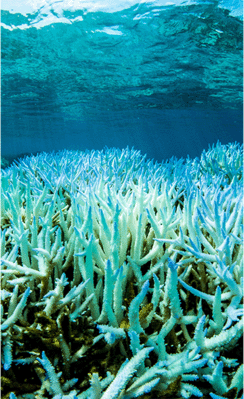
AUSTRALIA’S GREAT BARRIER REEF is in some serious trouble, with the latest research in the journal Nature showing the number of new corals has dropped by 89%.
In 2016 and 2017, the Reef was smashed by back-to-back mass bleaching events and heat stress caused by global warming that killed about half the corals.
‘Dead corals don’t make babies,’said James Cook University’s Professor Terry Hughes, the paper’s lead author.
‘We used to think that the Great Barrier Reef was too big to fail — until now,’added colleague Professor Morgan Pratchett.
The paper was just the latest in a steady and, many would agree, depressing parade of findings for the World Heritage icon. And if the scientific papers don’t do it for you, then there are always the pictures.
But the release of the study served as a remarkable contrast to the way the Rupert Murdoch-owned Sky News, furnished with material from climate science denial think tank the Institute of Public Affairs, has been “reporting” on reef science in the past week.
On at least five occasions, the channel has interviewed the IPA’s policy director, Gideon Rozner, who has been updating the channel on the case of Dr Peter Ridd, a marine scientist specialising in sediments who was fired in March 2018 from James Cook University.
According to the various interviews, the Reef is in great shape, the science is probably wrong, and Ridd is a “world renowned” Reef expert in a historic fight for freedom. None of this is true, yet the claims have been allowed to stand unchecked.
The saga of Peter Ridd
Ridd’s saga is a long one, but here’s the short version (and, while we’re here, in the interests of full disclosure, in the time since I first started writing about Ridd’s case, I’ve taken a part-time job at an Australian marine conservation charity as a media adviser).
Ridd does not think that human-caused climate change is a problem and he thinks the Reef is in fabulous health. This has been his public position for at least a decade.
But in 2017, Ridd started to publicly accuse his scientific colleagues, some of who were based at his own university in Townsville, of being untrustworthy. This went against the university’s code of conduct. The university censured him. Ridd refused to back down and made more statements. He published “private” university correspondence on his website. He was further disciplined, so he sued his employer. Then they fired him.
Last week, Ridd’s case was finally heard in court with three days of hearings. A judgment is expected in the coming months.
Jim Green shared a link. Nuclear Fuel Cycle Watch South AustraliaUnpublished letter to The Advertiser … Congratulations to The Advertiser for exposing the terrorist risks associated with Canberra’s plan to establish a national nuclear waste dump in SA. The government’s claim that the dump would pose “no security or safety risk to the community” is contradicted by the plan to station 14 security and safeguards officers at the site.
The nuclear dump would be subject to aircraft strikes and intrusions. It would also be a target for terrorists removing drums to make a radioactive “dirty bomb” ‒ risks that have previously been flagged by nuclear engineers Alan Parkinson and John Large:
”If terrorists can raid a nuclear waste repository or store and steal radioactive material,” Mr Parkinson said, “they can easily spread it by conventional explosives.”
Nuclear terrorist hazards also apply to nuclear waste transportation. In 2006, a reporter succeeded in planting a fake bomb on a train carrying nuclear waste in north-west London.
A NSW Parliamentary Inquiry found there “is no doubt that the transportation of radioactive waste increases the risk of accident or incident – including some form of terrorist intervention”.
Premier Steven Marshall did himself proud by standing up against the dangerous plan to turn SA into the world’s nuclear waste dump. Will the Premier now stand up to Canberra and oppose the plan to turn SA into the nation’s nuclear waste dump?
Jim Green, Friends of the Earth https://www.facebook.com/groups/1021186047913052/
Noel Wauchope, 19 Feb 19 Today’s Adelaide Advertiser makes it clear. Adam Creighton , Economics Editor at The Australian, is quoted approvingly, as he calls for Australia’s laws against nuclear power to be removed – “for the public good”
According to Mr Creighton – nuclear power is ” ‘the best, most reliable, emissions-free form of power’”
News Corp attacks scientists assessing Adani coalmine – and ignores science, Guardian, Sarah Bekessy Hugh Possingham, James Watson, Georgia Garrard and Alex Kusmanoff, 16 Feb 19 Damaging the credibility of scientists when we need their fearless advice more than ever is socially irresponsible and morally reprehensible.
What Mediawatch did not report is the pointed attacks on the scientists engaged to critically assess the likely impact of the mine. The following sentence in the Courier Mail on 27 January is just one example: “If you were in the bunny hugging business and were hiring you’d look at Prof Wintle’s resume and say “impeccable”.In the past month, there have been numerous News Corp articles published about the review under way regarding the impacts of the Adani coalmine on the critically endangered southern black-throated finch. Most have attacked the scientists behind the review or quoted statements undermining the scientist’s integrity. We could find none that have critically discussed the science, apart from one article that cites an anonymous ecologist who claims that the mine is the only way to conserve the species. No evidence is provided to support this claim.
The attacks have consisted of unsubstantiated efforts to smear people instead of addressing the substantive issues. Wintle’s comical tweet of school children protesting (“I’ll stop farting if you stop burning coal”) is the only evidence provided that he is indeed a “self-proclaimed anti-coal activist”, as claimed in the Queensland Times on 21 January and again on Friday mentioned in the Australian. Yet, apparently“questions still loom as to whether Professor Wintle, an open anti-coal activist, would be able to carry out the review with impartiality”.In addition to seeking to degrade political debate and balanced decision making on important topics, this kind of journalism also seeks to damage the credibility of science and scientists in the eyes of the general public. This is arguably socially irresponsible and morally reprehensible, but importantly may also discourage scientists from engaging in policy and planning processes where their expertise is essential………https://www.theguardian.com/commentisfree/2019/feb/16/news-corp-attacks-scientists-assessing-adani-coalmine-and-ignores-science
Australian independent media on the rise, Michael West , Feb 1, 2019The coming of the Internet was the media world’s first real game-changer. Profits enjoyed from the 1970s to 2000s were gone and anyone could start an online news site for little cost. Independent digital media sites not only flourished but did something novel: they engaged with their readers — especially via social media. Today, these sites attract three to four times more visitors via social media than mainstream media. Kim Wingerei reports.
MUCH HAS been said about the power that Rupert Murdoch wields in our concentrated media landscape. But it is a landscape that continues to change and although Murdoch’s News Corp Australia remains a dominant force together with the remnants of Fairfax, his influence is on the wane. Local independent media – somewhat inadvertently supported by the global social media behemoths – is where not just growth but influence is increasingly found……….
Newspapers once ruled the world of news and was the focal point for informed public debate. Radio came along and got a place at the same table, albeit never as glamorous and rewarding for its proprietors. TV had much more of an impact as a provider of entertainment — immersing itself into the living rooms of the world.
Both radio and TV heralded the end of the newspaper, predictions that never quite came through. People still liked to read the paper and the daily broadsheet carried a gravitas that radio and TV could never match — except maybe for Walter Cronkite.
The Internet changed everything. Not straight away and not in the ways originally foreseen, but it removed forever the traditional gatekeepers of information. Some would say replacing them by Google, Facebook, Instagram, Twitter and the plethora of lesser social media and search engine platforms.
The Internet was the catalyst for change and social media was the real game changer for traditional media companies.
When all we had was broadcast media (papers, magazines, radio and TV) the only alternative was people conversing and arguing — around the fireplace and the dinner table, at the pub, community halls or on a soapbox in the public square. Social media has taken those conversations beyond its physical limitations to the world square — for better or for worse.
But unlike the established trust of local communities, unregulated and borderless communication is a place of fear and distrust. Social media – despite its proliferation – has a Net Trust Score (NTS) of minus 42 per cent in the recent Roy Morgan Media Net Trust Survey (the number of respondents that trust less than those that don’t). Television (-16 per cent) and Newspapers (-13 per cent) fare much better but still significantly less than the Internet (-7 per cent), Magazines (-4 per cent) and Radio (-2 per cent).
The only major media brands in Australia with a positive NTS score are the ABC, SBS and (by a whisker) Fairfax — a brand that won’t be around for the next survey………..
as the recent Senate hearing into the ABC showed, politicians are also not shying away from trying to influence the national broadcaster in much the same way as media proprietors do — through appointments, intimidation, hiring and firing. The day the ABC is not feared by the government is the day the ABC stops doing its job.
Albeit somewhat cowed at the moment, the ABC remains a stalwart of independent media. And with its high trust rating, it would also benefit from being much more active on social media than it is.
Despite the low trust in social media, it is an important driver of traffic for the fast growing independent media sector. There is a reason some senators went out of their way to attack the #auspol Twitter community recently — and it was not to protect democracy as it pretended.
“Everyone” is on social media and according to a recent Roy Morgan poll (May 2018) and 78 per cent of Australians aged 14+ also access online news-sites.
News.com.au is the largest (5.8 million monthly readers), followed closely by The Sydney Morning Herald (5.3) and the ABC (5.0). Of the top 20 news-sites in Australia, News Corp’s sites represent 31.9 per cent and Nine/Fairfax 28.7 per cent. Counting Kerry Stokes’ modest 4.5 per cent (Yahoo!7 and The West Australian), it leaves the independents with just under 35 per cent of the top 20.
After the ABC, the Daily Mail comes in at 3.9 million readers of other outlet’s stories; and of the other independents, The Guardian (3.0) are just ahead of the BBC (2.9) – a surprising inclusion on the list – I am guessing driven by Anglo-Saxon baby-boomers and their parents. The online reading habits of Gen Z ensures that Buzzfeed (2.2) and Huffington Post (1.2) are included in the top 20.
Second bottom of the top 20 is The New Daily just shy of one million readers and, although not included in the Roy Morgan surveys (yet), there is also a plethora of online sites that provide news coverage and extensive political and current affairs commentary and analysis.
These sites are not only all independent but according to the online visitor statistics as provided by SimilarWeb (an online web measurement service) they are also growing at a rapid rate, whereas “traditional” media growth online is mostly offset by the steady decline in print readership.
And while Murdoch may lament the increasing dominance that Google, Facebook and Twitter have over the worlds’ virtual eyeballs, search and social media is an important source of web traffic and the latter, in particular, for the independent media which relies on social media for much of its visitor numbers.
Based on SimilarWeb’s data, News.com.au gets 5.5 per cent of its visitor traffic from social media, in contrast to The Guardian’s 12.2 per cent and Independent Australia’s almost 20 per cent. Overall, independent media gets three to four times more of its visitors referred by social media (mainly Facebook, Twitter and Reddit) than the mainstream news media sites do.
This is significant as social media is also the platform where the conversations are happening — as exemplified by the #auspol hashtag on Twitter. Contrary to the belief by some ill-informed politicians, these are vibrant conversations between engaged people, the bots are few and far between and easily spotted (when you know how, which Senator Fierravanti-Wells’ staff clearly did not).
In reality, if we look beyond the entertainment dominated mainstream media, the Australian media landscape is increasingly diverse. Murdoch and Nine Entertainment may well have the numbers of overall visitors for now but for debate and influencing voters, there are many more options.
As an example, Murdoch’s flagship purveyor of politicised opinion – The Australian – has close to a million fewer readers online than The Guardian and less than half of the ABC. Based on online visitor stats, the top five politically-focused independent media outlets combined (of those NOT in the top 20) has about the same readership as The Australian online.
The ABC and The Guardian are the leaders of a diverse pack of fast growing online media sites that challenge the status quo — including this publication. They play an increasingly important role in keeping our politicians honest. Politicians for their part need to stand up to the vested interest of the media proprietors or suffer the consequences.
It is all well and good to lament the power of the media. Strong politicians must withstand it through transparency and focus on policies instead of politics and not succumb to their fear of missing out.
Kim Mavromatis Fight To Stop Nuclear Waste In The Flinders 10 Dec 18Ranges SELECTED FOR DOCULAB 2018 – We are really excited to be one of 6 teams selected to participate in the South Australian Film Corporation and Screen Australia Doculab Initiative.
OUR PROJECT : “Unwilling Nation” – a film about the 40 year fight to stop Nuclear Waste getting dumped in South Australia.
PROJECT KEY CREATIVES (Participating in the Doculab) :
Kim Mavromatis and Quenten Agius (Producers).
Robyn Ravenna (Writer / Researcher).
Supporting the development of a range of documentary and factual projects in South Australia, Doculab is an intensive three day lab for factual screen-makers.
Courtney Gibson (SAFC Chief Executive ) said “Doculab is about putting weight behind SA documentary projects and teams, bringing them together as a community to provide latest market intelligence and develop their projects to optimal creative strength before they’re out to market, and we’re so pleased to be partnering with Screen Australia to make this happen”.
Sally Caplan (Head of Content at Screen Australia) said “The calibre of content emerging from SA is both locally and internationally recognised and it’s important to continue nurturing its vibrant screen community. The Doculab initiative is committed to developing the skills and knowledge of diverse documentary filmmakers. We firmly believe that incubating people and projects through mentorships, funding and fostering pitching skills to penetrate specific markets is essential. We’re excited to see new South Australian projects develop from this initiative that we hope provide longevity for the industry.”










 Antinuclear