 Some comments on Weatherill’s article .( Jay Weatherill: South Australia can learn valuable lessons from nuclear waste facility at Eurajoki, Finland)
Adelaide Advertiser’s nauseous sycophantic account of Premier Weatherill’s nuclear jaunt to Finland
 I knew that The Advertiser was the mouthpiece of the nuclear lobby, anyway, but their latest effort was really sick-making. A rave which portrays Premier Weatherill as some kind of democratic champion, and which is pushing the soft sell that the decision on nuclear waste importing will not happen soon, but be dragged on for years. (They don’t say this, but in the interim, the nuke lobby has time to get secret arrangements made – and money lent to South Australia, so that ultimately, it might all be just too committed to turn back.)
A Premier with any spine might make a decision, a soon decision, and a wise one, to say no to the whole noxious scheme, – send home the business lobbyists and the propaganda spruikers like Geraldine Thomas, put the lid on the shonky Nuclear Royal Commission’s biased report, stop the silly nuke spinning Forums, and get on with running South Australia properly. Such an opportunity that State has, as a world leader in renewable energy!
Lack of trust more toxic than nuclear dump notion: Daniel Wills, The Advertiser September 23, 2016 “South Australia is still at the stage where it needs reassurance about the science, as well as the competency and motivations of a government that would oversee its administration.
No site has been selected to house the world’s high-level international waste for profit, should the state choose to build one, nor any explanation of how one would be picked. The State Government is yet to overturn laws that ban public money being spent on investigating the establishment of a nuclear dump or even to pick up the phone to ask places like Japan what they would pay…….
 The Finnish operators say they would jump at the chance to form an alliance with SA to build a dump here…..
Mr Weatherill is likely to confirm before Christmas that the Government will begin the serious work of developing a robust business case…….
Expect the Government to seek money from overseas to undertake a major geological survey that rules out places too unsafe for disposal to occur. At a cost of up to $1 billion, this is too expensive for SA to fund itself, but could have the benefit of doubling as a discovery tool for new mining deposits.
From there, it is likely the offer will be thrown open to communities to show an interest, and estimates made of what they could receive. Even on the most extremely rapid timeline, that point is unlikely to have been reached by the time voters head to the polls in March 2018.
This project is multi-generational, with a point of no return years away. But it is a doubtful and open question as to whether our politics are up to the job…….Mr Weatherill has framed this as a great test of our democracy’s ability to consider difficult questions and come to wise solutions. … http://www.adelaidenow.com.au/news/opinion/lack-of-trust-more-toxic-than-nuclear-dump-notion-daniel-wills/news-story/e927e455e6f244f35a8b6743bc791adb
Adelaide Advertiser readers not all taken in by Premier Weatherill’s dishonest spiel about nuclear waste
Some comments on Weatherill’s article .( Jay Weatherill: South Australia can learn valuable lessons from nuclear waste facility at Eurajoki, Finland)
It is not a good legacy to leave behind, Jay. 100,000 years is a long time for something to go wrong and you’ll be remembered for it, if it does.
@Michael well, actually the Fins haven’t. Not any radioactive waste at all. But they hope too! Probably some time next decade, unless things go wrong. But they are c̶e̶r̶t̶a̶i̶n̶ c̶o̶n̶f̶i̶d̶e̶n̶t̶ hopeful that it will be fine, that is why they want to sell it to us. Not for money, because it has cost them so much more than they expected and taken so much longer. No for altruistic reasons, sortof.
Finland currently have two different types of operating reactors and the different fuel rods mean canisters are different for the two types of reactors they have. It also means that they drill different depth holes.
But Australia won’t be so lucky if SA imports high level waste from different countries because there will be all sorts of different reactors with many, many different fuel rod length and array dimensions. Lucky eh?
Well, that is if we stick to Finland’s quality KBS-3V system, and not try to sacrifice safety for price by using cheap steel and concrete vessels. When has safety ever been sacrificed for cost in SA? n̶R̶A̶H̶, R̶a̶i̶l̶ ̶u̶p̶g̶r̶a̶d̶e̶, s̶o̶u̶t̶h̶ ̶r̶o̶a̶d̶ ̶s̶u̶p̶e̶r̶w̶a̶y̶, a̶m̶b̶u̶l̶a̶n̶c̶e̶ ̶r̶a̶m̶p̶i̶n̶g̶…..
Pfffft! mere details, it only has to work without failure for 100,000 years!, http://www.adelaidenow.com.au/news/opinion/jay-weatherill-south-australia-can-learn-valuable-lessons-from-nuclear-waste-facility-at-eurajoki-finland/news-story/b8e2250210f4f2a3b0c6a60d9a8037d5
Welcome To The Nuclear State – wake-up song from Mike Roberts
The South Australian government is proposing to build a nuclear waste dump on traditional indigenous land in the stunningly beautiful Flinders Ranges. If plans come to fruition we may well be seeing high-level radioactive waste from around the world shipped into our pristine, clean green state hoping that a catastrophe from any of the inherent risks never eventuates. Mike Roberts’ song is a wake-up call about our scenario that will have impact both nationally and internationally.
Welcome to the Nuclear State – words and music Mike Roberts 2016
Players:
Mike Roberts – lead vocal, backing vocals, acoustic guitar
Quentin Eyers – slide guitar, bass guitar, drums, piano
Production – Quentin Eyers, Q the Music, Norwood, South Australia
Video Production – Jordan Roberts, FSR Media House
Photographs – Mike Roberts, Dianne Bills
http://www.mikerobertsmusic.com.au
info@mikerobertsmusic.com.au
Whyalla is a worry – residents not awake up to the nuclear waste economic and environmental dangers?
 What’s happening in Whyalla? These articles come From February. I hope that Council and the newspaper editor have done their homework on nuclear waste, since then
Acting Whyalla mayor Tom Antonio has said that he is “positive” about nuclear energy’s future in South Australia ahead of his visit to the Lucas Heights nuclear reactor in Sydney next week.
The trip on February 9 will be made by a delegation from the Upper Spencer Gulf Common Purpose Group pending the findings of the Nuclear Fuel Cycle Royal Commission in South Australia….
Huge income and many jobs hinge on a proposal for a nuclear-waste repository in Whyalla in the wake of devastating news about the future of the Arrium steelworks.
Meanwhile, in an exclusive report, The Whyalla News can reveal that Whyalla City Council is close to declaring an interest in hosting a low-level nuclear waste repository…..
Three jeers to Today Tonight Adelaide reporter, Hendrik Gout
100% Renewables for SA Three jeers to Today Tonight Adelaide reporter, Hendrik Gout, turning the people he interviewed – fans of solar power in to seeming solar dislikers. Never let the truth get in the way of good fear-mongering story?
Could Mr Gout’s former job have something to do with it?

Today Tonight’s misleading report on renewables in South Australia, REneweconomy
By Sophie Vorrath & Giles Parkinson on 29 July 2016
Over the last few weeks we’ve been giving the Murdoch press a bit of a hard time over its regular publication of erroneous claims that South Australia’s electricity price rises and spikes are being caused by the state’s high penetration of renewable energy. But we should clarify; they are not the only offenders.
On Monday, the Adelaide branch of the Seven Network’s daily current affairs program, Today Tonight, ran with a similar anti-renewables slant, as it has done before. And, like much of the Murdoch media’s reporting, its chock full of errors.
The program opened by recalling South Australia’s November 2015 black-outs – a predictable starting point for a renewables witch hunt, considering that was the reaction of the mainstream media back when the outages occurred.
According to Today Tonight Adelaide reporter, Hendrik Gout, “the November night the lights went out” happened because of the “state’s reliance on ‘unreliant’ energy”.
Never mind that this is simply not true. As we reported at the time, “there was only one technology that abandoned its post on Sunday evening, and that was the massive transmission line linking Victoria and South Australia.”
And, as the Australian Energy Market Operator later concluded in a report, the black-out caused by a switch failure lasted much longer than needed because a gas-fired generator failed to follow instructions, causing the system to trip again. The blackout had nothing to do with renewables at all.
That claim should not be a surprise coming from Gout, who was a former senior staffer for South Australia Liberal David Ridgway, the party’s leader in the upper house.
The Coalition in South Australia is notoriously anti-wind, feeding rubbish data to The Australian last week that had to be retracted. Ridgway is also the instigator of an ongoing upper house inquiry into wind energy.
Gout’s program went on to interview two different South Australian business operators: one a farmer/irrigator in the Riverland region who complained – not without reason – that the state’s high power prices had made his business less competitive; and one a micro-brewer on the Murray, who similarly seemed to suggest that power supply difficulties had restricted the growth of the business.
But something didn’t quite gel with these interviews, so we decided to talk to the people ourselves……….
When we asked Beavis why the 30kW PV system wasn’t mentioned in the Today Tonight report, he told us in an emailed statement: “Our solar project was one of the main points I was aiming to get across. But from viewing the piece, it seemed to get lost in the edit.”
Beavis also told us that the solar system offsets 100 per cent of the brewery and houseboats’ power consumption……..http://reneweconomy.com.au/2016/today-tonights-misleading-report-renewables-south-australia-85014
Independent inquiry finds that the ABC is not biased
 ABC cleared of ‘anti-business’ bias in independent review http://www.theage.com.au/business/media-and-marketing/abc-cleared-of-antibusiness-bias-in-independent-review-20160722-gqbp68.html Matthew KnottThe ABC has been cleared of systemic “anti-business” bias in a major review of its coverage, with former ANZ boss Mike Smith confessing he has rethought his negative perceptions of the broadcaster.
The independent editorial review, for which Mr Smith was a key adviser, has been one of the broadcaster’s most comprehensive yet. As well as analysing a week’s worth of ABC programming, the review included interviews with ABC business staff and submissions from business groups, think-tanks and unions.
Fairfax Media understands the review, which has not been released publicly, is overwhelmingly positive about the ABC’s coverage overall while making some criticisms.
Sources familiar with the review, led by longtime BBC adviser Kerry Blackburn, said they were relieved and surprised by its positive tone. In his submission, Mr Smith writes that when he began the review, he shared the widespread view in corporate Australia that the ABC was hostile to business and that its coverage of business issues was poor.
But after examining the broadcaster’s output in detail, he came to be impressed by the rigour and balance of most of the ABC’s business reporting.
Investments in wind have brought costs down- THE AUSTRALIAN got it SO wrong!
 How The Australian got it hopelessly wrong on wind energy The Australian got its facts wrong on wind energy in South Australia. Investments in wind have brought costs down. Giles Parkinson Crikey, 22 July 16 The Murdoch media attack on the Australia wind industry knows no bounds, and not many facts either.
This week’s front-page “exclusive” in The Australian suggests South Australia’s wind turbines were producing significant amounts of “negative power” from the grid at the height of the recent electricity “crisis”. But the numbers it quotes are ridiculously wrong.
The story, by Adelaide bureau chief Michael Owen, suggests the state’s wind turbines were “producing about 5780MW” between 6am and 7am, but by mid afternoon were producing “negative 50MW”. Asanalysis from Ron Brakels observes, the report confuses energy terminology, apparently not knowing the difference between capacity and output.
In fact, the state’s wind turbines cannot produce 5780MW — they only have a combined capacity of 1600MW. There’s not even 5780MW of wind capacity in the whole country……
As SA Energy Minister Tom Koutsantonis told the ABC, that’s precisely why the government encouraged investments in wind and solar: to bring costs down. That has largely succeeded. https://www.crikey.com.au/2016/07/22/558133/
Corporations rejoice as The Age sacks a top investigative journalist
A pity that I can’t read the full article. Being on a low income, I don’t subscribe to any paid journal or newspaper. Well, I did, until today, subscribe to Fairfax’s The Age. But not any more.
It is a sad sacking of many staff, and I feel for all of them.
However, it says something a bit more about Fairfax, when they pick out a top investigative journalist. Michael West not only has confronted the big end of town with some very inconvenient facts, but – a worse crime – he has written about them in lively language that the peasantry can understand.
Watch now as the Business Pages of the Age become more obscurely written, and even more pro business. And along with that. The Age particpates in the general dumbing down of the Australian media.
Michael West among Fairfax redundancies, Crikey.com, Myriam Robin Media Reporter, May 13, 2016 Hard-hitting business journo Michael West is among those saying goodbye to Fairfax. Senior business reporter Michael West, whose work appeared in the Business Day sections of the Sydney Morning Herald and Age, is leaving Fairfax today.West confirmed his compulsory redundancy, but declined to comment further. In a tweet after this piece was published online, west wrote “told my skillset not aligned with fairfax strategy going forward”….. subscribers only http://www.crikey.com.au/2016/05/13/michael-west-fairfax-redundancy/

Sickening pro nuclear spin from THE AUSTRALIAN today
Here’s an example:
“…..Politically, the need for a centralised facility has bipartisan support across multiple levels of government. Socially, the government has moved from suggesting sites to prioritising community consultation in all stages of the project, especially site selection. Environmentally, international experience has demonstrated that highly engineered and well-regulated low- and intermediate-level repositories can be managed safely with no impact on the community or agricultural industry….”
Minerals Council of Australia on the back foot with its pro uranium campaign
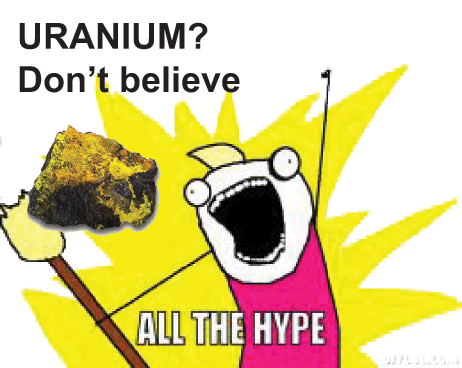 Pro-uranium social media campaign’s #epicfail Why are some still championing nuclear power when renewable energy generation has doubled worldwide over the past decade? Jim Green, SBS, 25 Apr 2016 www.sbs.com.au/news/article/2016/04/25/comment-pro-uranium-social-media-campaigns-epicfail
The Minerals Council of Australia launched a pro-uranium social media campaign on Wednesday. By that afternoon the twitter hashtag #untappedpotential was trending but ‒ as an AAP piece picked up by SBS and others noted ‒ contributors were overwhelmingly critical.
Nearly all contributors offered thoughts such as these: “A week away from the #Chernobyl 30-year anniversary and Minerals Council begins propaganda trip on the #untappedpotential of uranium. Huh?!” said Twitter user Jemila Rushton.
“We need to better harness the #untappedpotential of solar power”, tweeted Upulie Divisekera.
“#untappedpotential to put more communities at risk of nuclear waste dumps,” Ace Collective said.
“We concur that uranium has much #untappedpotential … for disaster, cost and time blowouts and proliferation,” Anglesea After Coal said.
No doubt the Minerals Council anticipated the negative publicity and is working on the basis that all publicity is good publicity. But what the MCA didn’t anticipate is that in recent days the uranium price has fallen to an 11-year low. Mining.com noted in an April 20 article that the current low price hasn’t been seen since May 2005. The current price, under US26/lb, is well under half the price just before the 2011 Fukushima disaster, and under one-fifth of the 2007 peak of a bubble.
Mining.com quotes a Haywood Securities research note which points out that the spot uranium price “saw three years of back-to-back double-digit percentage losses from 2011-13, but none worse than what we’ve seen thus far in 2016, and at no point since Fukushima, did the average weekly spot price dip below $28 a pound.”
Mining.com notes that five years after the Fukushima disaster only two of Japan’s 50 nuclear reactors are back on line, and that in other developed markets nuclear power is also in retreat. The last reactor start-up in the U.S. was 20 years ago. The French Parliament legislated last year to reduce the country’s reliance on nuclear power by one-third. Germany is phasing out nuclear power. The European Commission recently released a report predicting that the EU’s nuclear power retreat ‒ down 14% over the past decade ‒ will continue.
China is a growth market but has amassed a “staggering” stockpile of yellowcake according to Macquarie Bank. India’s nuclear power program is in a “deep freeze” according to the Hindustan Times (unfortunately the same cannot be said about its nuclear weapons program), while India’s energy minister Piyush Goyal said on April 20 that India is not in a “tearing hurry” to expand nuclear power since there are unresolved questions about pricing, safety and liability waivers sought by foreign companies.
Even if all of Japan’s 50 reactors are included in the count, the number of power reactors operating worldwide is the same now as it was a decade ago. Zero growth despite the endless rhetoric about a nuclear renaissance.
A decision on two planned reactors in the UK could be announced in the next fortnight and the price-tag for the reactors explains why nuclear power is stagnant worldwide and why the Minerals Council is talking about uranium’s ‘potential’ rather than its current contribution to export revenue and employment. The total price-tag for the two planned reactors is A$45 billion. If the project proceeds, the industry will be hoping it doesn’t go three times over budget, as reactor projects in France and Finland have.
South Australian academic Richard Leaver has neatly summed up the uranium industry’s tiresome rhetoric: “‘Potential’ is one of the most powerful chemicals available to the political alchemist. Any individual, firm or sector deemed to have potential is relieved of a massive and perpetual burden − the need to account for past and present achievements (or, more probably, the lack of them). The history of Australian involvement in the civil uranium industry offers an excellent example of this alchemy at work.”
Whatever the future potential of the uranium industry, it contributes next to nothing to the economy at the moment: <0.2 percent of national export revenue and <0.01 percent of all jobs in Australia. And those figures will fade further into irrelevance with the end of mining and the gradual winding down of processing at the Ranger uranium mine in the NT.
The stagnation and cost escalation of nuclear power contrast sharply with the trajectory of renewables. Driven by sharp cost reductions, renewable energy generation has doubled worldwide over the past decade and renewables now produce more than twice the amount of electricity as nuclear power. The gap is widening every day. Dr Jim Green is the national nuclear campaigner with Friends of the Earth, Australia.
Nuclear news excluded or downplayed in Australian media
The terrorists’ initial aim to blow up Belgium’s nuclear reactors was explained on SBS World News, last night, but did not get a mention on ABC news. It was reported on Sydney Morning Herald, but that story appears to have been withdrawn.( – Brussels bombers considered nuclear site, changed their minds: report Sydney Morning Herald–24 Mar. 2016. )
I doubt that it was reported on the Murdoch dominated commercial media
Could Australia’s media be experiencing pressure to avoid uncomfortable nuclear topics, – heading in the self censorship direction now prevalent in Japan?
Alternative media: WGAR: Working Group for Aboriginal Rights (Australia)
 About WGAR News: http://groups.google.com/group/wgar-news
Subscription to ‘WGAR News’ e-newsletters is free.
The best way of subscribing to WGAR News e-newsletters is to
go to the ‘WGAR News Public Google Group’ link, sign in, and click on ‘Join Group’:
http://groups.google.com/group/wgar-news
This best way of subscribing means you will receive e-newsletters automatically and it is reliable.
Otherwise, to subscribe, email wgar.news@gmail.com and
include the words “subscribe WGAR News” in the message header.
‘WGAR News’ monitors the media, including alternative media, focusing on:
* The Freedom Summit’s National Freedom Movement;
* the Australian Federal government intervention into Northern Territory (NT) Aboriginal communities;
* Plans to close Aboriginal homelands / remote communities in Western Australia (WA), South Australia (SA), [and Northern Territory (NT)?];
* Treaties with Aboriginal Sovereign Nations of Australia;
* the Aboriginal sovereignty movement and the Aboriginal tent embassies;
* Justice Reinvestment, Aboriginal imprisonment and Aboriginal Deaths in Custody;
* Aboriginal land rights and mining;
* Suicide and self-harm in Aboriginal & Torres Strait Islander communities;
* Removal of Aboriginal children and the continuing Stolen Generation;
* Aboriginal peoples and the impact of the Australian Federal Budget;
* Aboriginal & Torres Strait Islander health and wellbeing;
* other Aboriginal rights issues; and
* upcoming Aboriginal rights events around Australia.
‘WGAR News’ gives priority to grassroots Aboriginal voices
and grassroots voices in solidarity with Aboriginal peoples’ rights.
The role of ‘WGAR News’ is to facilitate the voices of others,
and as such, ‘WGAR News’ rarely writes its own articles.
South Australia”destined to be locked in to nuclear industry” – Adelaide Advertiser
The Adelaide Advertiser – mouthpiece of the nuclear lobby advises that we should all just give up – “see the light’ and let South Australia just roll over like a tame dog, and let the nuclear juggernaut roll over it.

we hosted the British nuclear bomb tests at Maralinga in the 1950s, and we have the world’s largest uranium mine at Olympic Dam.
So we are destined to be locked in to the nuclear fuel industry for decades to come. – Chris Kenny, The Advertiser 21 Feb 16
Questions, omissions, contradictions, in news report on #NuclearCommisisonSAust
 The Age today reported on the South Australian Nuclear Fuel Chain Royal Commission. I guess we should be thankful that this news actually got into more than just the South Australian press and the corporate mouthpiece THE AUSTRALIAN.
Of course, this is in the Business section, not the major part of the paper. . After all, it’s not as if the question of importing radioactive trash is of concern to Australian sin general. Or is it?
Anyway – some of the contradictions, omissions and problems in the Royal Commission findings, as reported.
QUESTIONS
Optimism about money?. I really doubt that anyone has a clue about the long term costs of the 
nuclear waste import plan.
“…….. waste disposal facility could deliver $5 billion in revenue annually for the first 30 years, and would be “highly profitable” because of strong demand from other countries……..
Mr Scarce said he had been conservative in his assumptions.
“I want to under-promise and over-deliver,” he said…..”
“Facility could be open in a decade“….Really?
“He [Scarce] said during the life of a nuclear storage facility, a net present value of profits of more than $51 billion had been calculated”. Why hasn’t some other country with nuclear expertise and experience grasped this opportunity?
The tax-payer will be up for huge costs?
“He [Scarce] recommended that such a facility be government owned.….. the facility would require a dedicated port facility, airport and rail freight line”. Who pays for all that?
OMISSIONS
“There are significant quantities of used fuel from nuclear reactors in temporary storage in the Asia-Pacific region and these quantities will grow ” -not a mention of the transport problems and dangers .
CONTRADICTIONS
“There’s always an opportunity if we dawdle that someone would take the competitive advantage away from us,” he [Scarce] said…
…..Mr Weatherill said.“The critical thing here is we don’t rush the process. There’s no doubt there’s some exciting possibilities for South Australia contained in the report”…… [this statement appears in the online version, but not in the print version]
Quotes are from Nuclear waste a $5 billion-a-year opportunity, TheAge 16 Feb 16 ……. http://www.theage.com.au/business/mining-and-resources/nuclear-waste-a-5-billionayear-opportunity-20160215-gmuji8.html#ixzz40HLWW3iu
Australian media ignored the indigenous achievements in opposing a nuclear South Australia
Dennis Matthews 24 Dec 15 In response to Dave Sweeney’s “good nuclear news” – on the leadership of indigenous Australians in opposing the nuclear industry and nuclear waste dumping in South Australia
 It’s correct, in December Karina and Rose Lester shared the Conservation Council of SA (Conservation SA) 2015, $1000, Jill Hudson Award for environmental protection for their opposition to the nuclear industry, but, apart from a small column in The Advertiser which didn’t mention the nuclear industry I’ve seen no mention of this important event.
I looked for a media release on the Conservation SA website but couldn’t find anything.
Perhaps someone could put the media release on this website?
PS. The first winners of the Jill Hudson award were Adnyamathanha activist Dr Jillian Marsh and ABC journalist Rose Crane. I understand that Jillian is involved in fighting attempts to put the proposed national nuclear waste dump on Adnyamathanha land.
1 This month

of the week – Australians for War Powers Reform (AWPR)
To see nuclear-related stories in greater depth and intensity
 Antinuclear